China Smart Infrastructure Sensor Market Size & Growth Rate
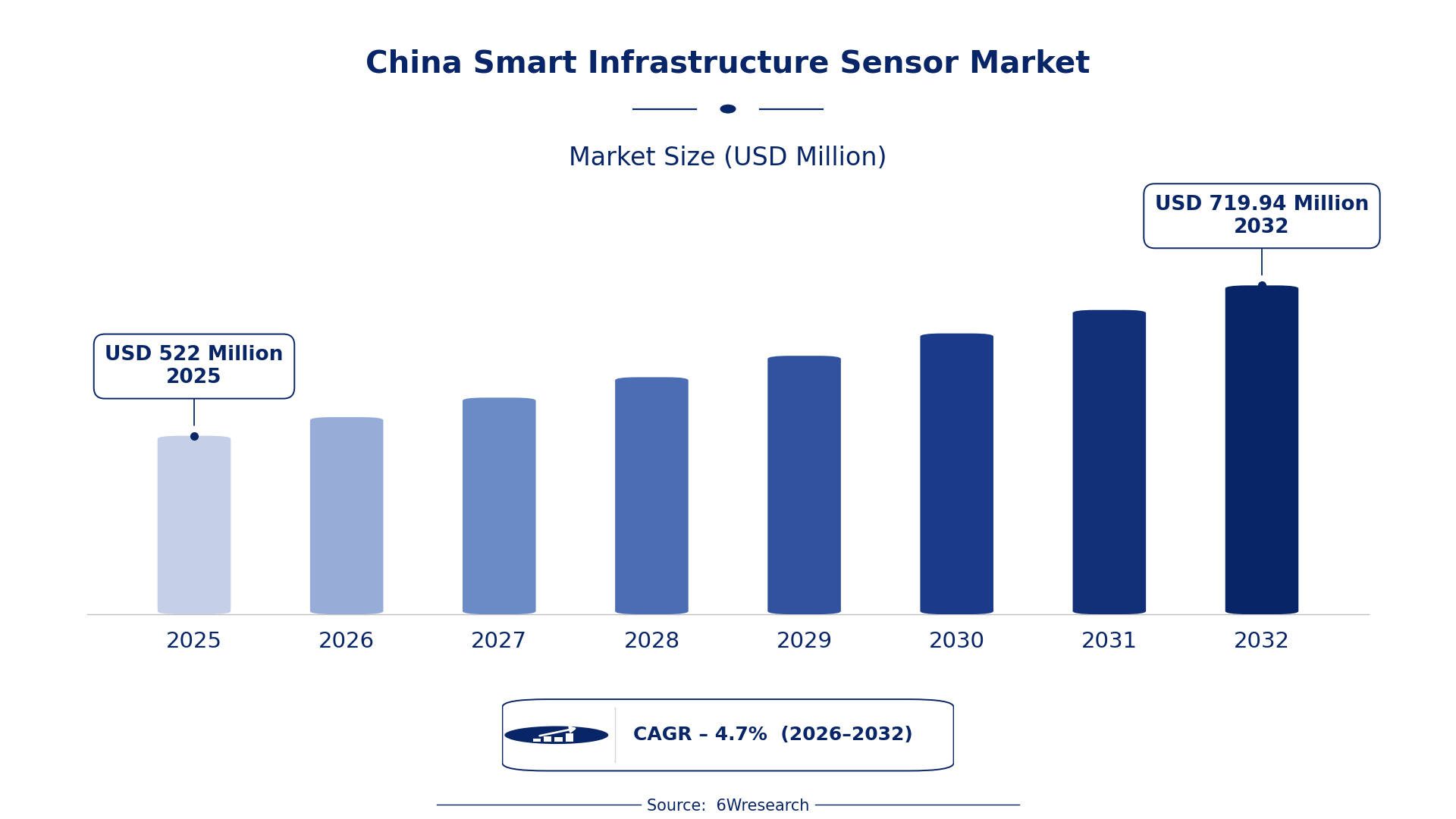
According to 6Wresearch internal database and industry insights, the China Smart Infrastructure Sensor Market was valued at USD 522.0 million in 2025 and is projected to reach USD 719.94 million by 2032, growing at a CAGR of approximately 4.7% during 2026–2032.
China Smart Infrastructure Sensor Market Highlights
| Report Metric | Details |
| Report Name | China Smart Infrastructure Sensor Market |
| Market Size 2025 | USD 522.0 million |
| Market Size 2032 | USD 719.94 million |
| Absolute Growth 2025–2032 | USD 197.94 million |
| CAGR 2026–2032 | 4.7% |
| Peak Annual Growth | 7.5% in 2032 |
| Forecast Period | 2026–2032 |
| Historical Data | 2022–2025 |
| Base Year | 2025 |
| Leading Sensor Type, 2025 | Strain Sensors (44% share) |
| Leading Monitoring Feature, 2025 | Bridge Load Monitoring (43% share) |
| Leading Infrastructure Type, 2025 | Transportation Structures (34% share) |
| Leading End User, 2025 | Civil Engineers (47% share) |
| Fastest-Growing Sensor Type | Moisture Sensors (7.4% CAGR) |
| Fastest-Growing Monitoring Feature | Water Leak Detection (6.1% CAGR) |
| Fastest-Growing Infrastructure Type | Pipelines & Tunnels (7.3% CAGR) |
| Fastest-Growing End User | Infrastructure Developers (6.9% CAGR) |
| Growing Sector | Civil Engineering |
| Key End Users | Civil Engineers, Municipal Authorities, Infrastructure Developers, Water Authorities |
China Smart Infrastructure Sensor Market Year-wise Growth Rate and Key Drivers (2022–2032)
This graph illustrates the annual growth rates of the market from 2022 to 2032, highlighting a steady upward trajectory and projected market expansion over the forecast period.
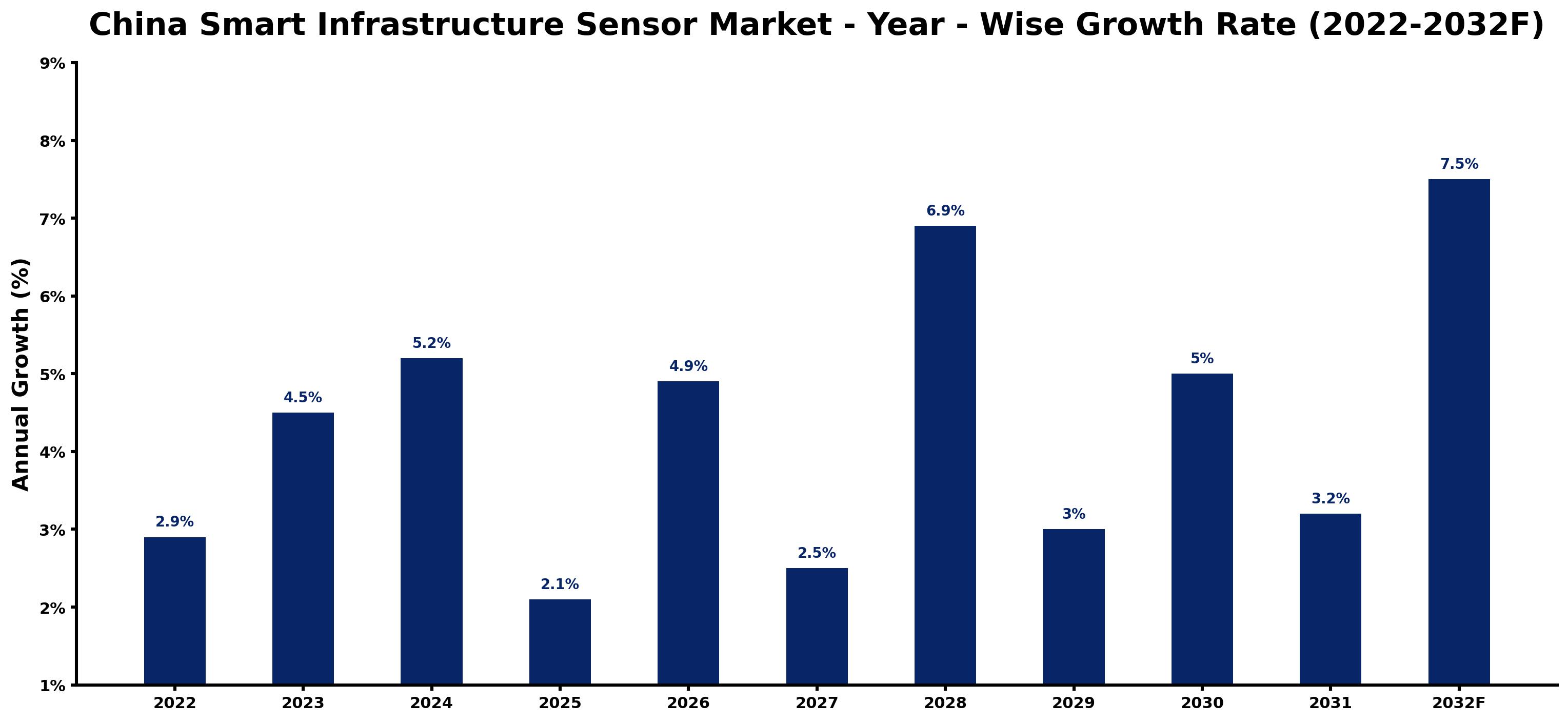
The following table presents the estimated annual growth rate for each year together with the principal factor influencing market performance.
| Year | Estimated Annual Growth (%) | Market Rationale |
| 2022 | 2.9 | The market experienced steady demand from civil engineers focusing on infrastructure safety. |
| 2023 | 4.5 | Growth accelerated due to increased investments in smart infrastructure projects across urban areas. |
| 2024 | 5.2 | Demand continued to rise as more municipalities adopted smart monitoring technologies. |
| 2025 | 2.1 | Growth slowed as some projects faced delays in implementation and funding adjustments. |
| 2026 | 4.9 | The market is expected to rebound as new government initiatives promote smart technology adoption. |
| 2027 | 2.5 | Growth is projected to slow again, influenced by project completion timelines and market adjustments. |
| 2028 | 6.9 | Demand is anticipated to surge as the government increases funding for smart infrastructure upgrades. |
| 2029 | 3.0 | Growth will slow as projects reach completion, leading to market stabilisation. |
| 2030 | 5.0 | Demand is expected to increase again with renewed focus on urban resilience initiatives. |
| 2031 | 3.2 | Growth is projected to slow slightly as the market adjusts to new standards and regulations. |
| 2032 | 7.5 | The market is expected to peak with strong demand from ongoing infrastructure projects and technology upgrades. |
Note: Market size estimations and growth projections presented in this report are based on 6Wresearch's proprietary forecasting methodology, utilizing the latest available industry data, government publications, and primary research inputs.
China Smart Infrastructure Sensor Market Synopsis
The China Smart Infrastructure Sensor Market includes advanced devices that monitor the structural integrity of various infrastructures. These sensors identify changes in strain, tilt, moisture, and vibrations, ensuring safety and compliance in critical structures. The market is growing due to increased investments in smart infrastructure, particularly from civil engineers and municipal authorities. In 2022, smart infrastructure investments rose by 12%, demonstrating a strong commitment to modernising urban environments. The 'Smart City' initiative is encouraging the adoption of these technologies throughout the country.
Market Dynamics Impact Analysis (2026–2032)
| Factor | Type | Impact | Primary Segment Affected |
| Rising investments in smart infrastructure projects are driving demand for monitoring technologies. | Driver | High | Transportation Structures |
| The need for enhanced safety in critical infrastructure is increasing the demand for smart sensors. | Driver | High | Bridge Load Monitoring |
| Growing urbanisation is creating a need for advanced monitoring solutions in cities. | Opportunity | High | Buildings |
| Increased focus on disaster resilience is promoting the use of smart sensors in infrastructure. | Opportunity | High | Earthquake Resistance |
| High initial costs of smart sensor installation may deter some municipalities from investing. | Restraint | Medium | Moisture Sensors |
| Limited awareness among smaller infrastructure developers can restrict market growth. | Restraint | Medium | Vibration Sensors |
| The Smart Infrastructure Sensor Market in China faces challenges related to integration of new technologies. | Challenge | High | Tilt Sensors |
| Regulatory compliance can complicate the adoption of smart sensor technologies. | Challenge | Medium | Strain Sensors |
Evaluation of Drivers in China Smart Infrastructure Sensor Market (2026–2032)
The main growth drivers and the segments they affect most are set out below.
| Drivers | Primary Segment Affected | Why It Matters (Evidence) |
| Increased government funding for smart city initiatives is boosting sensor adoption. | Strain Sensors | In 2023, the government allocated 200 million yuan for upgrades, prompting municipalities to invest in monitoring technologies. |
| Rising urbanisation is driving demand for smart monitoring in city infrastructure. | Buildings | Over 60% of urban municipalities have adopted smart monitoring technologies, leading to more sensor purchases. |
| The need for safety in transportation structures is increasing the use of smart sensors. | Transportation Structures | China has over 1,000 major bridges equipped with smart sensors for load monitoring, enhancing safety. |
| Growing civil engineering projects are creating demand for real-time monitoring solutions. | Civil Engineers | In 2022, there were 250,000 civil engineering projects utilizing smart sensors, indicating strong demand. |
| The push for sustainable infrastructure is promoting smart sensor technologies. | Earthquake Resistance | The 'Green Building Action Plan' encourages the use of smart sensors in new constructions, driving purchases. |
The Smart Infrastructure Sensor market in China is expanding as investments in smart infrastructure projects, urbanisation, and safety requirements drive demand. In 2022, smart infrastructure investments increased by 12%, leading municipalities to adopt advanced monitoring technologies. More than 60% of urban municipalities have implemented smart monitoring, boosting purchases. Safety in transportation structures is improving, with over 1,000 major bridges equipped with smart sensors for load monitoring. Civil engineering projects, with 250,000 using smart sensors in 2022, highlight the growing need for these technologies.
Evaluation of Restraints in China Smart Infrastructure Sensor Market
The following restraints limit how fast demand can grow.
| Market Restraint | Primary Segment Affected | Why It Matters (Evidence) |
| High initial costs of smart sensor installation may deter municipalities from investing. | Moisture Sensors | In many cases, the upfront investment can be a barrier for smaller municipalities, limiting sensor adoption. |
| Limited awareness among smaller infrastructure developers can restrict market growth. | Vibration Sensors | Without adequate knowledge of benefits, smaller developers may hesitate to implement smart monitoring solutions. |
| Integration of new technologies can be challenging for existing infrastructure systems. | Tilt Sensors | Many older systems are not compatible with modern smart sensors, complicating upgrades and installations. |
| Regulatory compliance can complicate the adoption of smart sensor technologies. | Strain Sensors | Stringent standards may require additional testing and certification, delaying implementation for buyers. |
| Market fluctuations can impact funding for infrastructure projects. | Transportation Structures | Economic uncertainties may lead to budget cuts, affecting planned sensor installations. |
China Smart Infrastructure Sensor Market Challenges
The China Smart Infrastructure Sensor Market faces a few practical problems, and the first is intense competition among producers. This competition arises from a surge of new entrants, which drives down prices and squeezes profit margins for manufacturers. Consequently, many suppliers struggle to maintain operations, risking supply shortages for civil engineers and municipal authorities. Rising raw material costs, which increased by 15% last year, further strain production budgets for manufacturers. The rapid pace of technological advancements compels producers to innovate continuously, often causing delays in product launches. Compliance with standards like ISO 9001 raises operational costs for manufacturers, ultimately leading to higher prices for buyers.
Trends in the China Smart Infrastructure Sensor Market
Buyers and suppliers in the China Smart Infrastructure Sensor Market are adjusting to the following trends.
- Increased Adoption of Smart Monitoring: In 2023, over 60% of urban municipalities in China adopted smart monitoring technologies, reflecting a shift in infrastructure management. This trend shows a growing reliance on advanced sensors for urban safety and efficiency.
- Growing Focus on Disaster Resilience: Since 2022, there has been a notable increase in the use of smart sensors for earthquake resistance. This focus is driven by the need to improve infrastructure resilience in seismic zones.
- Emergence of Smart City Initiatives: The 'Smart City' initiative launched in 2022 is promoting the integration of smart sensors in urban planning. This programme aims to improve urban resilience and efficiency by 2030.
- Shift Towards Enhanced Safety Standards: Civil engineers are increasingly prioritising safety in infrastructure projects, with 250,000 projects using smart sensors in 2022. This shift is driving demand for advanced monitoring solutions across various sectors.
Investment Opportunities in the China Smart Infrastructure Sensor Market
Several openings in the China Smart Infrastructure Sensor Market merit attention from investors.
- Infrastructure Developers Seeking Advanced Solutions: Infrastructure developers are increasingly looking for smart sensors to improve project efficiency. With 250,000 civil engineering projects in 2022, there is strong demand for these technologies.
- Supply of Smart Monitoring Technologies: The growing need for moisture sensors in urban areas presents a significant opportunity. Municipal authorities are actively seeking solutions to monitor water infrastructure effectively.
- Entry into the Market through Partnerships: Now is an ideal time for local partnerships in the smart sensor market. The 'Smart City' initiative promotes collaboration between technology providers and municipalities.
- Focus on Urban Resilience Initiatives: The government's commitment to enhancing urban resilience creates opportunities for smart sensor suppliers. With a budget of 500 million yuan allocated in 2022, investment in these technologies is expected to rise.
Government Initiatives in the China Smart Infrastructure Sensor Market
In 2023, the Ministry of Housing and Urban-Rural Development updated the 'Urban Infrastructure Development Guidelines' to mandate smart monitoring systems in new buildings. This update builds on previous regulations, ensuring that all new constructions incorporate advanced monitoring technologies for safety and compliance. By establishing these guidelines, the government aims to improve urban infrastructure quality and resilience against potential hazards. The 'Smart Transportation System Plan' launched in 2021 by the Ministry of Transport aims to integrate smart sensors in all new transport projects, targeting completion by 2025. This initiative is supported by the National Development and Reform Commission, which allocated 500 million yuan to promote smart technology adoption across various infrastructure projects.
The 'Smart City Pilot Program' initiated in 2023 promotes the adoption of smart sensors in urban areas, targeting 100 pilot cities by 2025. The Ministry of Science and Technology oversees this initiative, which encourages municipalities to implement smart monitoring solutions, enhancing urban safety and efficiency. This programme is expected to provide funding and resources for local governments to integrate smart technologies into their infrastructure projects.
Future Insight of the China Smart Infrastructure Sensor Market
The China Smart Infrastructure Sensor Market will undergo significant transformations by 2032, influenced by several forward-looking factors. The 'National Smart Infrastructure Development Plan' aims to improve urban resilience by 2030, prompting increased adoption of smart sensors across various projects. The 'Smart City' initiative will catalyse investments in smart infrastructure, creating new opportunities for suppliers. By 2025, over 250,000 civil engineering projects are expected to incorporate smart sensors, driving demand and reinforcing their critical role in infrastructure development.
Market Segmentation Analysis
Each segment group is reviewed below, with the leader by share and the fastest grower by CAGR.
By Sensor Type – Strain Sensors Dominated, Moisture Sensors Expected to Grow Fastest
According to Dhaval Chaurasia, Assistant Manager at 6Wresearch, with a 44% revenue share in 2025, Strain Sensors was the largest sensor type category. Strain Sensors dominate the market share due to their vital role in real-time monitoring of structural integrity, particularly in critical infrastructure projects. Their extensive use in over 1,000 major bridges across China underscores their importance in ensuring safety and reliability. Over 2026–2032, Moisture Sensors are expected to post the fastest growth, at a CAGR of 7.4%. Moisture Sensors are experiencing rapid growth driven by their essential function in detecting leaks in pipelines and buildings, a need increasingly recognised in urban infrastructure. The government's commitment to smart infrastructure upgrades is significantly enhancing their adoption rates. Suppliers should prioritise advancements in moisture sensor technology to cater to the rising demand from infrastructure projects.
By Monitoring Feature – Bridge Load Monitoring Dominated, Water Leak Detection Expected to Grow Fastest
Bridge Load Monitoring accounted for a 43% market share by monitoring feature in 2025. Bridge Load Monitoring holds the largest market share as it is crucial for ensuring safety in bridge operations, particularly given China's vast network of bridges. The implementation of smart sensors in over 1,000 major bridges highlights the necessity of this monitoring feature. Water Leak Detection is projected to grow fastest, at a CAGR of 6.1% during 2026–2032. Water Leak Detection is the fastest-growing segment, essential for maintaining infrastructure integrity, especially as urban areas expand and face increased pressure on existing systems. The focus on smart infrastructure upgrades is further propelling this growth. Suppliers must focus on developing advanced water leak detection solutions to capitalise on this expanding market segment.
By Infrastructure Type – Transportation Structures Dominated, Pipelines & Tunnels Expected to Grow Fastest
Transportation Structures took a 34% share of infrastructure type in 2025, more than any other category. Transportation Structures capture the largest market share as they are key infrastructure requiring constant monitoring to ensure safety and efficiency. The extensive investments in smart sensors for high-speed rail networks highlight their importance in this category. The quickest growth will come from Pipelines & Tunnels, forecast to expand at a CAGR of 7.3% between 2026 and 2032. Pipelines & Tunnels are the fastest-growing segment, driven by the critical need for operational safety and maintenance in these essential infrastructures. The increasing number of civil engineering projects utilising smart sensors supports this rapid growth. This indicates that suppliers should tailor their offerings to address the specific needs of pipeline and tunnel monitoring solutions.
By End User – Civil Engineers Dominated, Infrastructure Developers Expected to Grow Fastest
In 2025, Civil Engineers led the end user split with a 47% share. Civil Engineers represent the largest market share as they are the primary users of smart sensors for design and monitoring across various projects. Their involvement in over 250,000 civil engineering projects illustrates their pivotal role in the market. Infrastructure Developers are set to record the highest CAGR in this split, 6.9% over 2026–2032. Infrastructure Developers are the fastest-growing user group, integral to planning and executing new projects that increasingly rely on smart sensor technology. The surge in infrastructure developments is significantly driving their demand. This suggests that suppliers should engage more closely with infrastructure developers to align their products with changing project needs.
Key Attractiveness of the Report
- 10 Years of Market Numbers
- Historical Data Starting from 2022 to 2025
- Base Year 2025
- Forecast Data until 2032
- Key Performance Indicators Impacting the Market
- Major Upcoming Developments and Projects
Key Highlights of the Report:
- China Smart Infrastructure Sensor Market Outlook
- Market Size of China Smart Infrastructure Sensor Market, 2025
- Forecast of China Smart Infrastructure Sensor Market, 2032
- Historical Data and Forecast of China Smart Infrastructure Sensor Revenues & Volume for the Period 2022 - 2032F
- China Smart Infrastructure Sensor Market Trend Evolution
- China Smart Infrastructure Sensor Market Drivers and Challenges
- China Smart Infrastructure Sensor Price Trends
- China Smart Infrastructure Sensor Porter's Five Forces
- China Smart Infrastructure Sensor Industry Life Cycle
- Historical Data and Forecast of China Smart Infrastructure Sensor Market Revenues & Volume By Sensor Type for the Period 2022 - 2032F
- Historical Data and Forecast of China Smart Infrastructure Sensor Market Revenues & Volume By Strain Sensors for the Period 2022 - 2032F
- Historical Data and Forecast of China Smart Infrastructure Sensor Market Revenues & Volume By Tilt Sensors for the Period 2022 - 2032F
- Historical Data and Forecast of China Smart Infrastructure Sensor Market Revenues & Volume By Moisture Sensors for the Period 2022 - 2032F
- Historical Data and Forecast of China Smart Infrastructure Sensor Market Revenues & Volume By Vibration Sensors for the Period 2022 - 2032F
- Historical Data and Forecast of China Smart Infrastructure Sensor Market Revenues & Volume By Monitoring Feature for the Period 2022 - 2032F
- Historical Data and Forecast of China Smart Infrastructure Sensor Market Revenues & Volume By Bridge Load Monitoring for the Period 2022 - 2032F
- Historical Data and Forecast of China Smart Infrastructure Sensor Market Revenues & Volume By Earthquake Resistance for the Period 2022 - 2032F
- Historical Data and Forecast of China Smart Infrastructure Sensor Market Revenues & Volume By Water Leak Detection for the Period 2022 - 2032F
- Historical Data and Forecast of China Smart Infrastructure Sensor Market Revenues & Volume By Early Fault Detection for the Period 2022 - 2032F
- Historical Data and Forecast of China Smart Infrastructure Sensor Market Revenues & Volume By Infrastructure Type for the Period 2022 - 2032F
- Historical Data and Forecast of China Smart Infrastructure Sensor Market Revenues & Volume By Transportation Structures for the Period 2022 - 2032F
- Historical Data and Forecast of China Smart Infrastructure Sensor Market Revenues & Volume By Buildings for the Period 2022 - 2032F
- Historical Data and Forecast of China Smart Infrastructure Sensor Market Revenues & Volume By Pipelines & Tunnels for the Period 2022 - 2032F
- Historical Data and Forecast of China Smart Infrastructure Sensor Market Revenues & Volume By Industrial Foundations for the Period 2022 - 2032F
- Historical Data and Forecast of China Smart Infrastructure Sensor Market Revenues & Volume By End User for the Period 2022 - 2032F
- Historical Data and Forecast of China Smart Infrastructure Sensor Market Revenues & Volume By Civil Engineers for the Period 2022 - 2032F
- Historical Data and Forecast of China Smart Infrastructure Sensor Market Revenues & Volume By Municipal Authorities for the Period 2022 - 2032F
- Historical Data and Forecast of China Smart Infrastructure Sensor Market Revenues & Volume By Water Authorities for the Period 2022 - 2032F
- Historical Data and Forecast of China Smart Infrastructure Sensor Market Revenues & Volume By Infrastructure Developers for the Period 2022 - 2032F
- China Smart Infrastructure Sensor Import Export Trade Statistics
- Market Opportunity Assessment By Sensor Type
- Market Opportunity Assessment By Monitoring Feature
- Market Opportunity Assessment By Infrastructure Type
- Market Opportunity Assessment By End User
- China Smart Infrastructure Sensor Top Companies Market Share
- China Smart Infrastructure Sensor Competitive Benchmarking By Technical and Operational Parameters
- China Smart Infrastructure Sensor Company Profiles
- China Smart Infrastructure Sensor Key Strategic Recommendations
Market Covered
This report examines the market across the segments below.
By Sensor Type
- Strain Sensors
- Tilt Sensors
- Moisture Sensors
- Vibration Sensors
By Monitoring Feature
- Bridge Load Monitoring
- Earthquake Resistance
- Water Leak Detection
- Early Fault Detection
By Infrastructure Type
- Transportation Structures
- Buildings
- Pipelines & Tunnels
- Industrial Foundations
By End User
- Civil Engineers
- Municipal Authorities
- Water Authorities
- Infrastructure Developers































