India Smart Inventory Management Market Size & Growth Rate
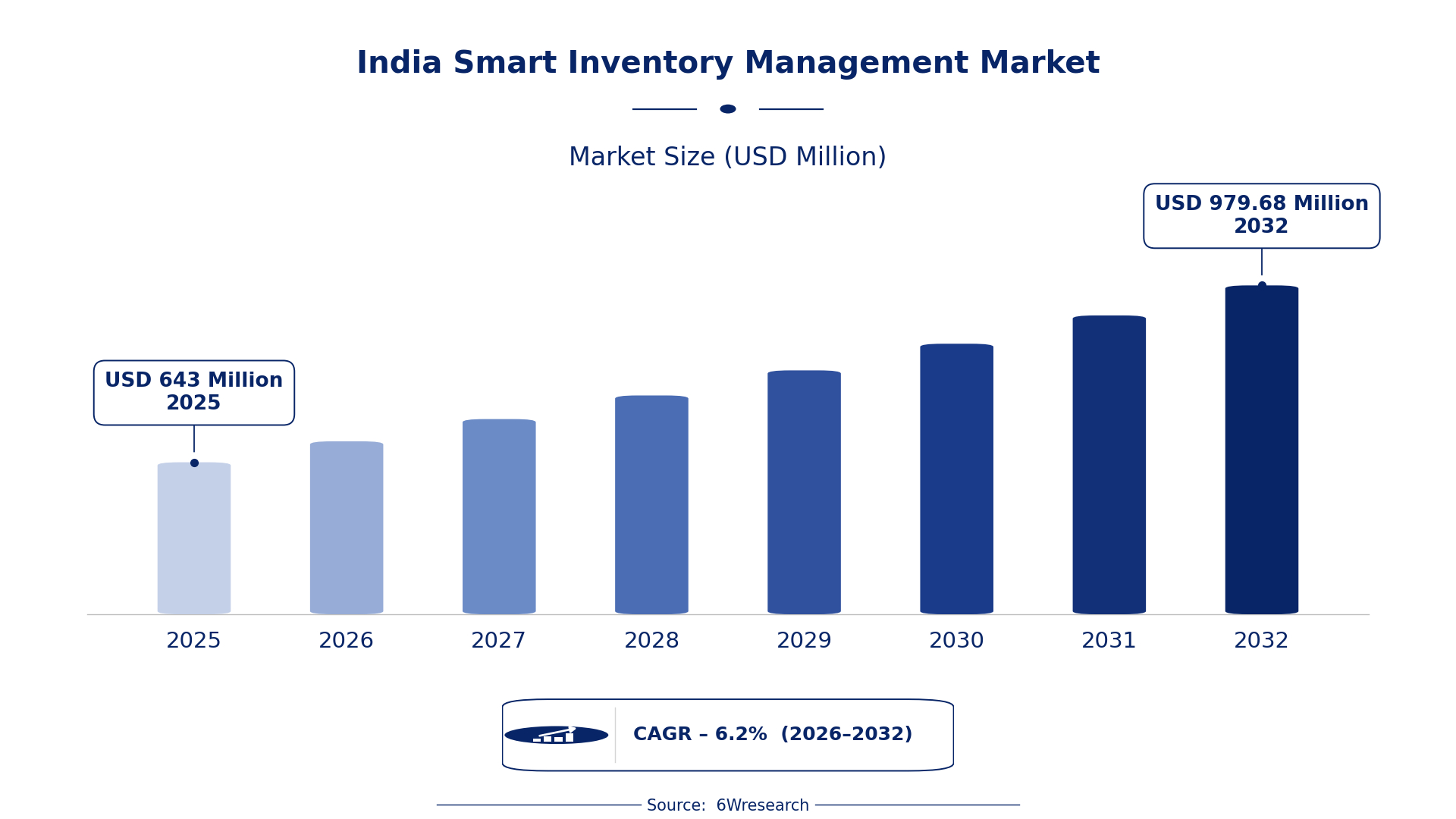
According to 6Wresearch internal database and industry insights, the India Smart Inventory Management Market was valued at USD 643.0 million in 2025 and is projected to reach USD 979.68 million by 2032, growing at a CAGR of approximately 6.2% during 2026–2032.
India Smart Inventory Management Market Highlights
| Report Metric | Details |
| Report Name | India Smart Inventory Management Market |
| Market Size 2025 | USD 643.0 million |
| Market Size 2032 | USD 979.68 million |
| Absolute Growth 2025–2032 | USD 336.68 million |
| CAGR 2026–2032 | 6.2% |
| Peak Annual Growth | 8.6% in 2027 |
| Forecast Period | 2026–2032 |
| Historical Data | 2022–2025 |
| Base Year | 2025 |
| Leading Solution Type, 2025 | RFID-Based Systems (35% share) |
| Leading Smart Feature, 2025 | Auto Stock Update (50% share) |
| Leading Industry Usage, 2025 | Warehousing (43% share) |
| Leading End User, 2025 | Logistics Companies (45% share) |
| Fastest-Growing Solution Type | AI Reorder Prediction (7.5% CAGR) |
| Fastest-Growing Smart Feature | Demand Forecasting (8.4% CAGR) |
| Fastest-Growing Industry Usage | Supermarkets (7.8% CAGR) |
| Fastest-Growing End User | FMCG Firms (7.7% CAGR) |
| Growing Sector | FMCG Sector |
| Key End Users | Logistics Companies, FMCG Firms, Inventory Managers, Supply Chain Integrators |
India Smart Inventory Management Market Year-wise Growth Rate and Key Drivers (2022–2032)
This graph illustrates the annual growth rates of the market from 2022 to 2032, highlighting a steady upward trajectory and projected market expansion over the forecast period.
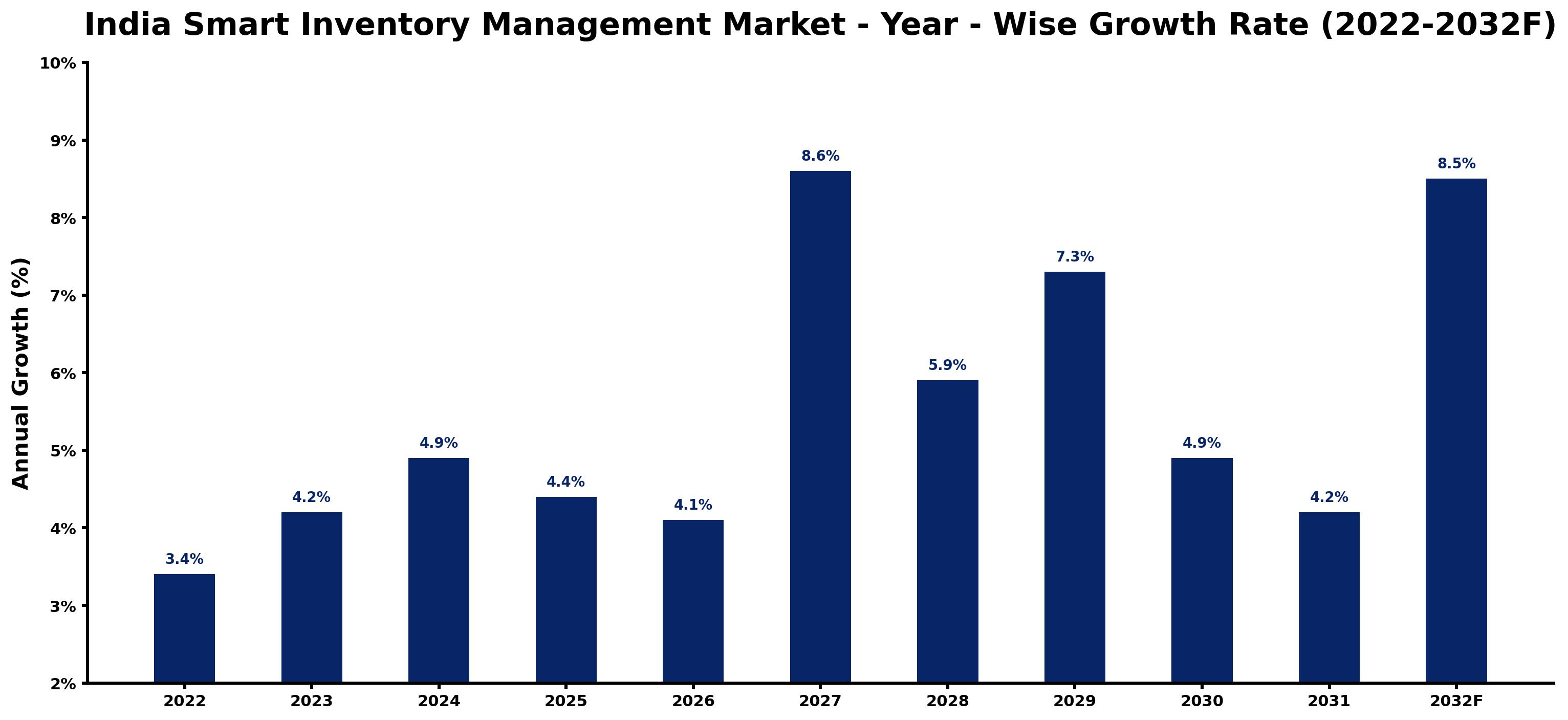
The table below sets out the estimated growth rate for each year and the main factor behind it.
| Year | Estimated Annual Growth (%) | Market Rationale |
| 2022 | 3.4 | The market experienced steady growth due to increased technology adoption among retailers. |
| 2023 | 4.2 | Demand accelerated as over 85% of retailers embraced technology for inventory management. |
| 2024 | 4.9 | Growth continued as the FMCG sector expanded, reaching $220 billion by 2025. |
| 2025 | 4.4 | A slight slowdown occurred as inventory management practices began to stabilise. |
| 2026 | 4.1 | The market maintained growth as the logistics sector projected to reach $215 billion by 2026. |
| 2027 | 8.6 | Demand surged, driven by the peak adoption of smart inventory solutions in various sectors. |
| 2028 | 5.9 | Growth slowed as market maturity set in following rapid technological integration. |
| 2029 | 7.3 | Demand increased again as supermarkets adopted advanced inventory management tools. |
| 2030 | 4.9 | Growth decelerated as the market adjusted to evolving consumer needs and preferences. |
| 2031 | 4.2 | A further slowdown occurred as companies optimised existing inventory systems. |
| 2032 | 8.5 | Demand is expected to rise again as new technologies enhance inventory management efficiency. |
Note: Market size estimations and growth projections presented in this report are based on 6Wresearch's proprietary forecasting methodology, utilizing the latest available industry data, government publications, and primary research inputs.
India Smart Inventory Management Market Synopsis
Smart Inventory Management in India encompasses technology solutions that optimise inventory control through real-time data and analytics. This includes advanced technologies like RFID, AI, and IoT, which improve stock accuracy and streamline supply chain efficiency. The India Smart Inventory Management Market is expanding due to increasing demand from the FMCG sector and logistics companies. Additionally, initiatives like 'Digital India' are encouraging technology adoption across various sectors.
Market Dynamics Impact Analysis (2026–2032)
| Factor | Type | Impact | Primary Segment Affected |
| Increasing adoption of RFID technology for accurate tracking | Driver | High | RFID-Based Systems |
| Automation in stock replenishment through AI | Driver | High | AI Reorder Prediction |
| Growing demand for efficient inventory solutions in logistics | Opportunity | High | Logistics Companies |
| Expansion of the warehousing sector requiring advanced management tools | Opportunity | High | Warehousing |
| Challenges in integrating new technologies into existing systems | Restraint | Medium | IoT-Connected Scanners |
| High initial costs associated with smart inventory systems | Restraint | Medium | Computer Vision Tools |
| Limited availability of skilled workforce for system implementation | Challenge | High | Inventory Managers |
| Regulatory hurdles in technology adoption for inventory management | Challenge | Medium | Supply Chain Integrators |
Evaluation of Drivers in India Smart Inventory Management Market (2026–2032)
The table below links each growth driver to the segment it affects and the evidence for it.
| Drivers | Primary Segment Affected | Why It Matters (Evidence) |
| Rising FMCG sector driving inventory management needs | RFID-Based Systems | The FMCG sector is expected to grow to $220 billion by 2025, increasing demand for accurate tracking solutions. |
| Automation of stock replenishment | AI Reorder Prediction | AI-driven solutions help retailers manage stock levels efficiently, responding to demand patterns. |
| Logistics sector expansion | Logistics Companies | The logistics sector is projected to reach $215 billion by 2026, boosting demand for smart inventory solutions. |
| Technological integration in warehousing | Warehousing | The Indian warehousing market is projected to grow at a CAGR of 10% from 2023 to 2028, driving inventory management demand. |
| Government initiatives promoting technology adoption | IoT-Connected Scanners | The 'Digital India' initiative enhances technology adoption, encouraging businesses to implement smart inventory solutions. |
The Smart Inventory Management market in India is expanding due to rising demand from the FMCG sector, automation in stock replenishment, and growth in the logistics sector. The FMCG sector is anticipated to reach $220 billion by 2025, significantly increasing the need for efficient inventory solutions. Automation through AI is enabling retailers to manage stock levels effectively, responding to demand patterns. Furthermore, the logistics sector is expected to grow to $215 billion by 2026, further boosting the demand for smart inventory solutions.
Evaluation of Restraints in India Smart Inventory Management Market
Below mentioned are some major restraints and their influence on market dynamics.
| Market Restraint | Primary Segment Affected | Why It Matters (Evidence) |
| Integration challenges with existing inventory systems | IoT-Connected Scanners | Many businesses face difficulties in adapting new technologies to their current inventory management processes, delaying implementation. |
| High initial investment costs for smart systems | Computer Vision Tools | The costs associated with implementing advanced inventory management solutions can deter smaller businesses from adopting these technologies. |
| Limited skilled workforce for technology implementation | Inventory Managers | A shortage of qualified professionals to manage and implement smart inventory systems can hinder market growth. |
| Regulatory compliance issues in technology adoption | Supply Chain Integrators | Navigating regulatory requirements can complicate the adoption of new inventory management technologies. |
| Concerns over data security in smart systems | AI Reorder Prediction | Businesses may hesitate to adopt AI solutions due to fears about data breaches and privacy issues. |
India Smart Inventory Management Market Challenges
The India Smart Inventory Management market encounters regulatory hurdles that hinder technology adoption, costing retailers up to 15% in lost sales due to inefficiencies. Supply chain disruptions lead to inventory shortages, compelling businesses to maintain excess stock, which can inflate holding costs by 20%. A lack of skilled professionals in advanced inventory technologies hampers operational efficiency, resulting in training periods that can extend by 30%. High initial investments for smart inventory systems deter smaller retailers, restricting their competitiveness in an increasingly demanding market.
Trends in the India Smart Inventory Management Market
Below mentioned are some of the trends shaping the India Smart Inventory Management Market growth.
- Shift from Traditional to Smart Inventory Systems: The adoption of smart inventory systems is increasing as businesses seek efficiency. The 'Digital India' initiative is driving this change, with over 85% of retailers adopting technology for inventory management in 2023.
- Increased Use of AI in Inventory Management: AI-driven solutions are becoming essential for stock replenishment. As of 2023, AI Reorder Prediction is projected to grow at a CAGR of 7.5%, reflecting its growing importance in the market.
- Expansion of Warehousing Capabilities: The warehousing sector is evolving to meet growing demands. The Indian warehousing market is expected to grow at a CAGR of 10% from 2023 to 2028, highlighting the need for advanced inventory solutions.
- Integration of IoT in Inventory Management: IoT technologies are increasingly being integrated into inventory systems. This trend is supported by the 'Make in India' program, which encourages local manufacturing of smart inventory solutions.
Investment Opportunities in the India Smart Inventory Management Market
The following opportunities in the India Smart Inventory Management Market pair current demand with a clear way in.
- Partnerships for Local Manufacturing: With the 'Make in India' initiative, there is a growing opportunity for local partnerships in smart inventory solutions. The FMCG sector's projected growth to $220 billion by 2025 highlights the need for efficient inventory systems.
- Investment in AI Solutions: The increasing demand for AI-driven inventory management presents a valuable investment opportunity. Logistics companies are looking for advanced solutions to improve efficiency, with the sector expected to grow significantly.
- Expansion into Supermarkets: Investing in workforce training for smart inventory management is essential. As the market grows, skilled professionals will be needed to implement and manage these systems effectively.
- Enhancing Data Security Measures: Investing in robust data security solutions is crucial as businesses adopt smart inventory systems. With rising concerns over data breaches, companies must ensure compliance to gain consumer trust.
Government Initiatives in the India Smart Inventory Management Market
The National Logistics Policy, launched in 2022, aims to improve logistics efficiency and reduce costs for inventory management. This policy encourages the adoption of advanced technologies in logistics and inventory systems, benefiting producers by streamlining operations. The Digital India initiative, launched in 2020, promotes the adoption of digital technologies across various sectors, positively impacting inventory management practices. The Make in India program, updated in 2021, supports local manufacturing, which is important for developing smart inventory solutions and improving supply chain efficiency.
The Ministry of Commerce oversees the implementation of the National Logistics Policy, which funds projects aimed at improving logistics and inventory management processes. The Ministry of Electronics and Information Technology supports the Startup India initiative, which encourages tech-driven inventory management solutions. Furthermore, the National Institute of Fashion Technology has updated its curriculum to include smart inventory management practices, preparing future professionals for the evolving market. These initiatives enhance the skill set of the workforce, ensuring readiness for advanced inventory solutions.
Future Insight of the India Smart Inventory Management Market
By 2032, buyers and suppliers in the India Smart Inventory Management market can expect improved operational efficiency driven by the 'Digital India' initiative, which encourages technology adoption across various sectors. The logistics sector will grow significantly, stimulating demand for advanced inventory solutions. The National Logistics Policy will simplify processes, reducing operational delays. Educational institutions will incorporate smart inventory management into their curricula, preparing a skilled workforce to address future challenges.
Market Segmentation Analysis
The report offers a comprehensive study of the following market segments and their leading categories in the market.
By Solution Type – RFID-Based Systems Dominated, AI Reorder Prediction Expected to Grow Fastest
According to Dhaval Chaurasia, Assistant Manager at 6Wresearch, with a 35% revenue share in 2025, RFID-Based Systems was the largest solution type category. RFID-Based Systems hold the largest share in the India Smart Inventory Management Market as they enable accurate real-time inventory tracking, essential for sectors like warehousing. The widespread adoption of technology among over 85% of Indian retailers illustrates the critical role RFID plays in optimising inventory control. AI Reorder Prediction is set to record the highest CAGR in this split, 7.5% over 2026–2032. AI Reorder Prediction is experiencing rapid growth as it automates stock replenishment based on demand patterns, which is vital for sectors like FMCG projected to reach $220 billion by 2025. The synergy between RFID systems and AI solutions will further solidify RFID's market lead. Suppliers should focus on enhancing RFID capabilities while integrating AI solutions to address the growing demand for efficient inventory management.
By Smart Feature – Auto Stock Update Dominated, Demand Forecasting Expected to Grow Fastest
In 2025, Auto Stock Update led the smart feature split with a 50% share. Auto Stock Update leads the market by ensuring that inventory levels are automatically adjusted with each sale, which is crucial for maintaining stock accuracy in dynamic environments. The increasing technology adoption for inventory management underscores the importance of this feature across various sectors. Demand Forecasting is projected to grow fastest, at a CAGR of 8.4% during 2026–2032. Demand Forecasting is set to grow swiftly as it accurately predicts future inventory needs based on historical data, which is essential for optimising stock levels. This trend indicates a shift towards data-driven inventory practices, reinforcing the relevance of Auto Stock Update. Buyers should prioritise solutions that integrate robust auto stock update and demand forecasting features to enhance operational efficiency.
By Industry Usage – Warehousing Dominated, Supermarkets Expected to Grow Fastest
Warehousing took a 43% share of industry usage in 2025, more than any other category. Warehousing commands the largest market share due to its essential role in efficiently managing large inventories, particularly as the logistics sector is projected to reach $215 billion by 2026. The increasing demand for smart inventory solutions in warehousing highlights its pivotal role in effective supply chain management. Over 2026–2032, Supermarkets are expected to post the fastest growth, at a CAGR of 7.8%. Supermarkets are experiencing the fastest growth as they require effective management of diverse product ranges and quick turnover, driven by the expanding FMCG sector. As supermarkets increasingly adopt advanced inventory solutions, the strength of warehousing will continue to grow. Suppliers should tailor their offerings to meet the specific requirements of warehousing and supermarket operations to capture greater market share.
By End User – Logistics Companies Dominated, FMCG Firms Expected to Grow Fastest
The largest end user category in 2025 was Logistics Companies, with a 45% share of total revenue. Logistics Companies are the leading end users in the market, as they need efficient supply chain operations and precise inventory tracking to meet rising demands. Initiatives like the National Logistics Policy highlight the critical role of logistics in smart inventory management. The quickest growth will come from FMCG Firms, forecast to expand at a CAGR of 7.7% between 2026 and 2032. FMCG Firms are witnessing the fastest growth as they need to manage fast-moving consumer goods effectively, especially with the projected expansion of the FMCG sector. This trend will increase reliance on logistics companies, enabling them to enhance their market share. Buyers in the FMCG sector should seek partnerships with logistics companies that offer advanced inventory management solutions.
Key Attractiveness of the Report
- 10 Years of Market Numbers
- Historical Data Starting from 2022 to 2025
- Base Year 2025
- Forecast Data until 2032
- Key Performance Indicators Impacting the Market
- Major Upcoming Developments and Projects
Key Highlights of the Report:
- India Smart Inventory Management Market Outlook
- Market Size of India Smart Inventory Management Market, 2025
- Forecast of India Smart Inventory Management Market, 2032
- Historical Data and Forecast of India Smart Inventory Management Revenues & Volume for the Period 2022 - 2032F
- India Smart Inventory Management Market Trend Evolution
- India Smart Inventory Management Market Drivers and Challenges
- India Smart Inventory Management Price Trends
- India Smart Inventory Management Porter's Five Forces
- India Smart Inventory Management Industry Life Cycle
- Historical Data and Forecast of India Smart Inventory Management Market Revenues & Volume By Solution Type for the Period 2022 - 2032F
- Historical Data and Forecast of India Smart Inventory Management Market Revenues & Volume By RFID-Based Systems for the Period 2022 - 2032F
- Historical Data and Forecast of India Smart Inventory Management Market Revenues & Volume By AI Reorder Prediction for the Period 2022 - 2032F
- Historical Data and Forecast of India Smart Inventory Management Market Revenues & Volume By Computer Vision Tools for the Period 2022 - 2032F
- Historical Data and Forecast of India Smart Inventory Management Market Revenues & Volume By IoT-Connected Scanners for the Period 2022 - 2032F
- Historical Data and Forecast of India Smart Inventory Management Market Revenues & Volume By Smart Feature for the Period 2022 - 2032F
- Historical Data and Forecast of India Smart Inventory Management Market Revenues & Volume By Auto Stock Update for the Period 2022 - 2032F
- Historical Data and Forecast of India Smart Inventory Management Market Revenues & Volume By Demand Forecasting for the Period 2022 - 2032F
- Historical Data and Forecast of India Smart Inventory Management Market Revenues & Volume By Real-Time Shelf Monitoring for the Period 2022 - 2032F
- Historical Data and Forecast of India Smart Inventory Management Market Revenues & Volume By Location + Quantity Sync for the Period 2022 - 2032F
- Historical Data and Forecast of India Smart Inventory Management Market Revenues & Volume By Industry Usage for the Period 2022 - 2032F
- Historical Data and Forecast of India Smart Inventory Management Market Revenues & Volume By Warehousing for the Period 2022 - 2032F
- Historical Data and Forecast of India Smart Inventory Management Market Revenues & Volume By Retail Stores for the Period 2022 - 2032F
- Historical Data and Forecast of India Smart Inventory Management Market Revenues & Volume By Supermarkets for the Period 2022 - 2032F
- Historical Data and Forecast of India Smart Inventory Management Market Revenues & Volume By Distribution Hubs for the Period 2022 - 2032F
- Historical Data and Forecast of India Smart Inventory Management Market Revenues & Volume By End User for the Period 2022 - 2032F
- Historical Data and Forecast of India Smart Inventory Management Market Revenues & Volume By Logistics Companies for the Period 2022 - 2032F
- Historical Data and Forecast of India Smart Inventory Management Market Revenues & Volume By FMCG Firms for the Period 2022 - 2032F
- Historical Data and Forecast of India Smart Inventory Management Market Revenues & Volume By Inventory Managers for the Period 2022 - 2032F
- Historical Data and Forecast of India Smart Inventory Management Market Revenues & Volume By Supply Chain Integrators for the Period 2022 - 2032F
- India Smart Inventory Management Import Export Trade Statistics
- Market Opportunity Assessment By Solution Type
- Market Opportunity Assessment By Smart Feature
- Market Opportunity Assessment By Industry Usage
- Market Opportunity Assessment By End User
- India Smart Inventory Management Top Companies Market Share
- India Smart Inventory Management Competitive Benchmarking By Technical and Operational Parameters
- India Smart Inventory Management Company Profiles
- India Smart Inventory Management Key Strategic Recommendations
Market Covered
The report offers an extensive study of the following market segments.
By Solution Type
- RFID-Based Systems
- AI Reorder Prediction
- Computer Vision Tools
- IoT-Connected Scanners
By Smart Feature
- Auto Stock Update
- Demand Forecasting
- Real-Time Shelf Monitoring
- Location + Quantity Sync
By Industry Usage
- Warehousing
- Retail Stores
- Supermarkets
- Distribution Hubs
By End User
- Logistics Companies
- FMCG Firms
- Inventory Managers
- Supply Chain Integrators































