China Smart Inventory Management Market Size & Growth Rate
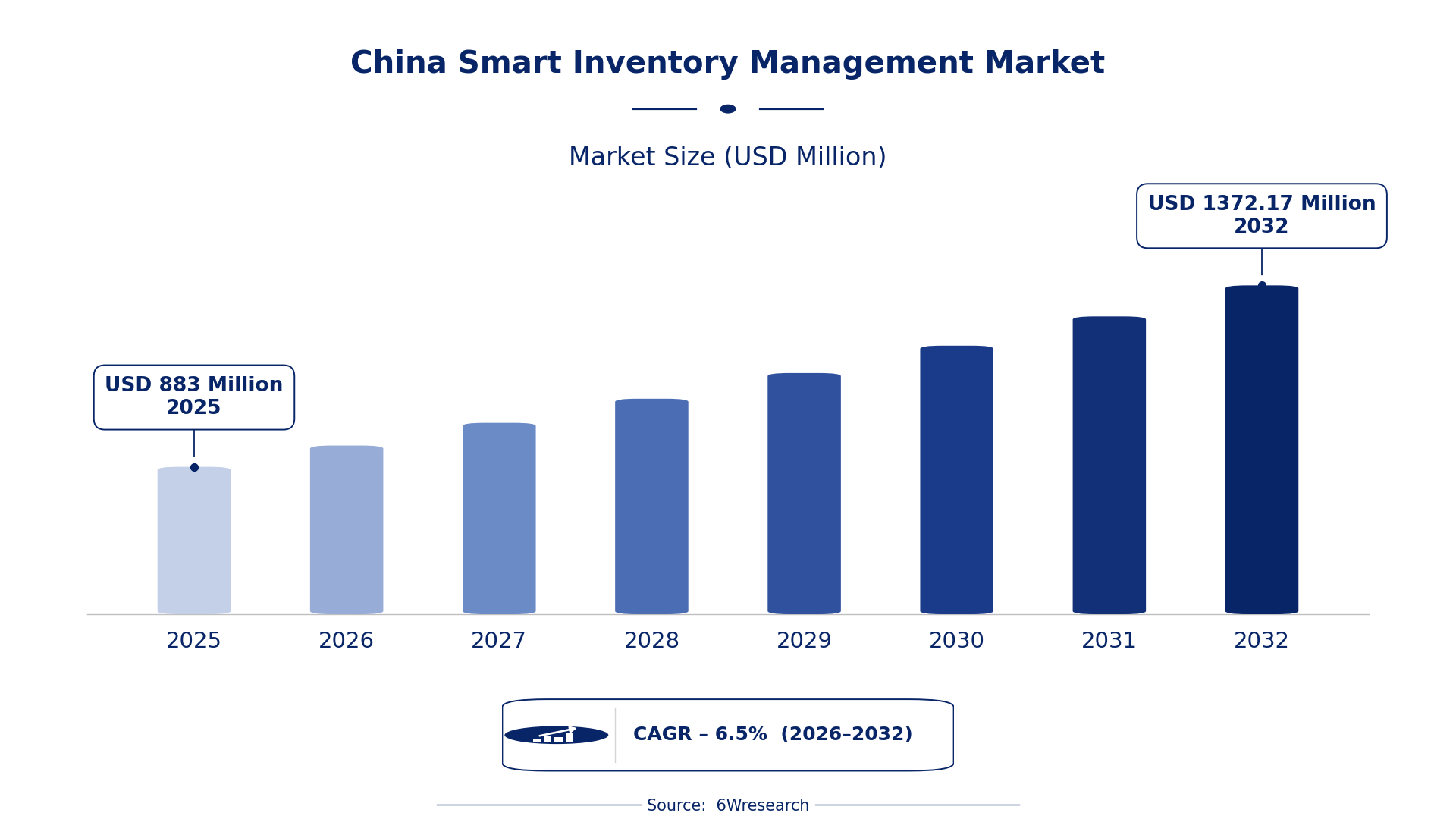
According to 6Wresearch internal database and industry insights, the China Smart Inventory Management Market was valued at USD 883.0 million in 2025 and is projected to reach USD 1,372.17 million by 2032, growing at a CAGR of approximately 6.5% during 2026–2032.
China Smart Inventory Management Market Highlights
| Report Metric | Details |
| Report Name | China Smart Inventory Management Market |
| Market Size 2025 | USD 883.0 million |
| Market Size 2032 | USD 1,372.17 million |
| Absolute Growth 2025–2032 | USD 489.17 million |
| CAGR 2026–2032 | 6.5% |
| Peak Annual Growth | 8.7% in 2026 |
| Forecast Period | 2026–2032 |
| Historical Data | 2022–2025 |
| Base Year | 2025 |
| Leading Solution Type, 2025 | RFID-Based Systems (51% share) |
| Leading Smart Feature, 2025 | Auto Stock Update (52% share) |
| Leading Industry Usage, 2025 | Retail Stores (41% share) |
| Leading End User, 2025 | Logistics Companies (41% share) |
| Fastest-Growing Solution Type | AI Reorder Prediction (8.6% CAGR) |
| Fastest-Growing Smart Feature | Demand Forecasting (7.9% CAGR) |
| Fastest-Growing Industry Usage | Warehousing (8.7% CAGR) |
| Fastest-Growing End User | FMCG Firms (8.8% CAGR) |
| Growing Sector | Logistics |
| Key End Users | Logistics Companies, Retail Stores, FMCG Firms, Inventory Managers |
China Smart Inventory Management Market Year-wise Growth Rate and Key Drivers (2022–2032)
This graph illustrates the annual growth rates of the market from 2022 to 2032, highlighting a steady upward trajectory and projected market expansion over the forecast period.
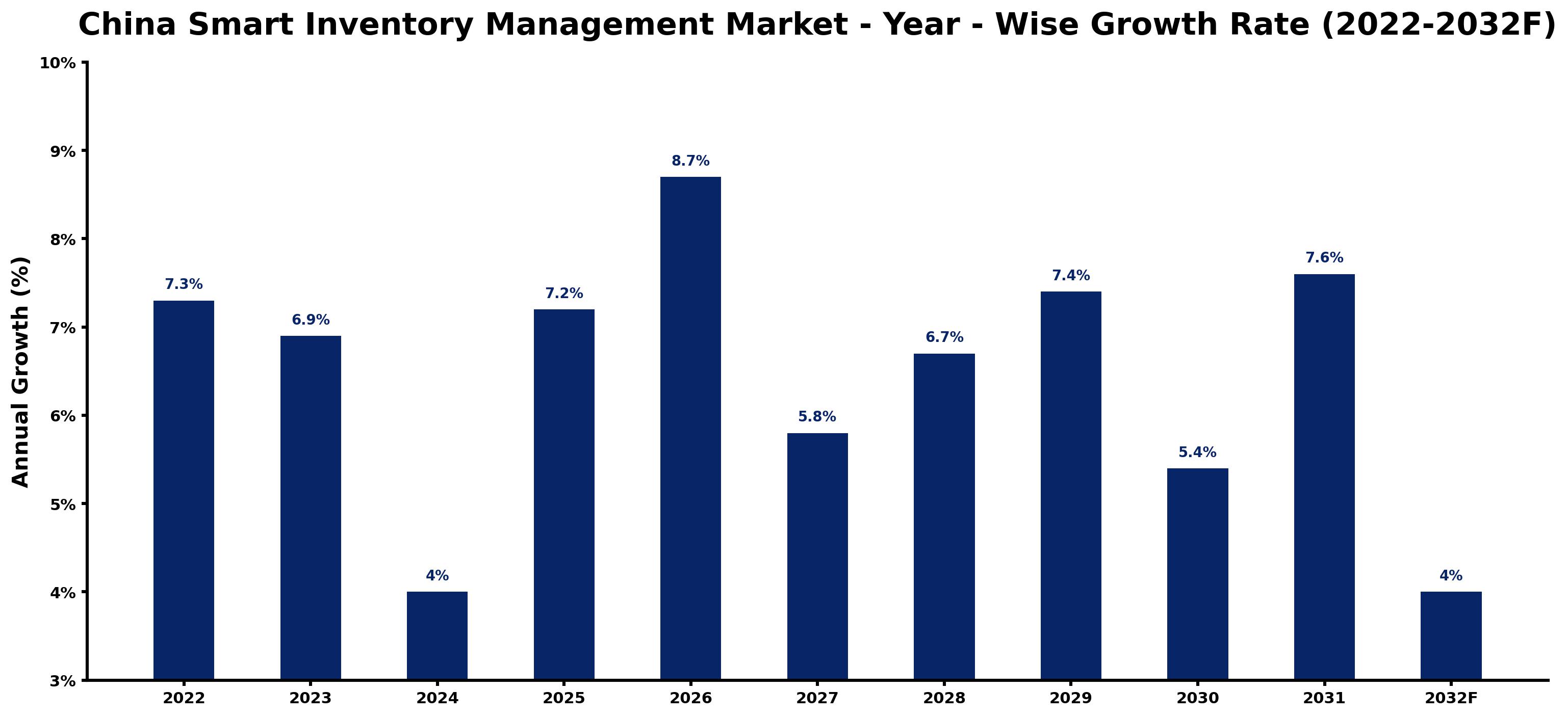
Below, each year's estimated growth is shown next to the factor that most influenced it.
| Year | Estimated Annual Growth (%) | Market Rationale |
| 2022 | 7.3 | The retail sector was valued at approximately 5 trillion USD, driving demand for smart inventory solutions. |
| 2023 | 6.9 | Integration of smart inventory solutions by over 80% of logistics companies indicates a growing trend. |
| 2024 | 4.0 | The market experienced slower growth as technological adoption began to stabilise in various sectors. |
| 2025 | 7.2 | Increased investments in smart inventory technologies led to a resurgence in growth rates. |
| 2026 | 8.7 | The launch of the 'Smart Logistics Development Plan' spurred advancements in inventory management. |
| 2027 | 5.8 | Growth slowed as market saturation began to affect new technology adoption rates. |
| 2028 | 6.7 | A renewed focus on AI technologies in inventory management contributed to a recovery in growth. |
| 2029 | 7.4 | Rising demand in logistics and retail sectors led to increased purchases of smart inventory solutions. |
| 2030 | 5.4 | Growth slowed again as companies reassessed their inventory strategies amid changing market conditions. |
| 2031 | 7.6 | The market saw faster growth as logistics companies expanded their smart inventory capabilities. |
| 2032 | 4.0 | A stabilisation in growth occurred as the market matured and adoption rates plateaued. |
Note: Market size estimations and growth projections presented in this report are based on 6Wresearch's proprietary forecasting methodology, utilizing the latest available industry data, government publications, and primary research inputs.
China Smart Inventory Management Market Synopsis
Smart Inventory Management in China involves the use of advanced technologies such as RFID, AI, and IoT to optimise inventory control and logistics. This approach boosts operational efficiency, lowers costs, and improves customer satisfaction. Key investments in smart technologies and supportive government initiatives are primary contributors to this growth.
Market Dynamics Impact Analysis (2026–2032)
| Factor | Type | Impact | Primary Segment Affected |
| Integration of RFID systems enhances real-time tracking capabilities. | Driver | High | RFID-Based Systems |
| Growing demand for AI technologies improves inventory forecasting accuracy. | Driver | High | AI Reorder Prediction |
| The logistics sector's rapid expansion presents opportunities for smart inventory solutions. | Opportunity | High | Logistics Companies |
| Retail stores increasingly seek automation to enhance operational efficiency. | Opportunity | High | Retail Stores |
| High initial investment costs deter smaller businesses from adopting smart inventory solutions. | Restraint | Medium | FMCG Firms |
| Lack of skilled workforce limits effective implementation of smart inventory technologies. | Restraint | Medium | Inventory Managers |
| The Smart Inventory Management Market in China faces challenges from rapid technological changes. | Challenge | High | Logistics Companies |
| Competition from traditional inventory management methods hampers market penetration. | Challenge | Medium | Retail Stores |
Evaluation of Drivers in China Smart Inventory Management Market (2026–2032)
Below mentioned are some major drivers and their influence on market dynamics.
| Drivers | Primary Segment Affected | Why It Matters (Evidence) |
| Increased efficiency in inventory tracking through RFID systems. | RFID-Based Systems | The installed base of RFID systems in China is estimated at 200 million units by 2023, leading to higher adoption rates. |
| Improved demand forecasting capabilities using AI technologies. | AI Reorder Prediction | AI technologies are being implemented in 60% of inventory systems by 2025, improving stock management. |
| Growing logistics sector driving demand for smart inventory solutions. | Logistics Companies | China's logistics industry is projected to reach 5.5 trillion USD by 2025, necessitating efficient inventory management. |
| Retail sector's need for automation boosts smart inventory adoption. | Retail Stores | In 2022, the retail sector in China was valued at approximately 5 trillion USD, encouraging technology integration. |
| Demand for real-time data in inventory management. | IoT-Connected Scanners | The IoT market in China is expected to grow to 1 trillion USD by 2025, impacting inventory management. |
Market growth for Smart Inventory Management in China is underpinned by rising end-use demand from the retail and logistics sectors. The installed base of RFID systems is estimated at 200 million units by 2023, improving real-time tracking capabilities. AI technologies are being implemented in 60% of inventory systems by 2025, improving forecasting accuracy. China's logistics industry is on track to reach 5.5 trillion USD by 2025, driving further demand for smart solutions. The retail sector, valued at approximately 5 trillion USD in 2022, is increasingly adopting automation to streamline operations.
Evaluation of Restraints in China Smart Inventory Management Market
The key brakes on demand, and where they bite hardest, are shown below.
| Market Restraint | Primary Segment Affected | Why It Matters (Evidence) |
| High initial investment costs for smart inventory systems. | FMCG Firms | The average investment for implementing smart inventory solutions can exceed 1 million USD, limiting adoption. |
| Limited skilled workforce for technology implementation. | Inventory Managers | The need for specialised training in smart inventory technologies creates barriers for effective deployment. |
| Resistance to change from traditional inventory management practices. | Logistics Companies | Many logistics firms are hesitant to shift from established methods, impacting market growth. |
| Inconsistent regulatory standards across regions. | Retail Stores | Variations in local regulations can complicate the implementation of smart inventory solutions. |
| Market saturation leading to slower adoption rates. | Logistics Companies | As more companies adopt smart technologies, the growth rate may decline due to increased competition. |
China Smart Inventory Management Market Challenges
The China Smart Inventory Management market faces several obstacles, starting with high initial costs for advanced systems, which can exceed 500,000 USD, limiting adoption. Suppliers are struggling to keep pace with the rapid demand for smart inventory solutions, as over 80% of logistics companies are integrating these systems by 2023, leading to potential stock shortages for retailers. A shortage of skilled technicians hinders effective implementation, as many workers lack expertise in AI and IoT, causing delays for companies relying on these technologies. Intense competition among providers drives down prices and reduces margins, restricting investment in new technologies for suppliers.
Trends in the China Smart Inventory Management Market
The trends below show where the China Smart Inventory Management Market is heading.
- Shift towards AI-Driven Inventory Management: The adoption of AI technologies is on the rise, with an expected implementation rate of 60% by 2025. This trend is particularly noticeable among logistics firms aiming to improve forecasting accuracy.
- Growing Integration of IoT in Inventory Systems: The IoT market in China is projected to reach 1 trillion USD by 2025, influencing inventory management. This trend is especially prominent in retail environments seeking real-time data.
- Expansion of RFID Technology in Logistics: With an estimated 200 million RFID systems installed by 2023, logistics companies are increasingly embracing this technology for real-time tracking. This integration boosts operational efficiency.
- Increased Automation in Retail Inventory Management: Retail stores are focusing on automation, with Auto Stock Update leading the market with a 52% share in 2025. This trend reflects the industry's drive for improved efficiency.
Investment Opportunities in the China Smart Inventory Management Market
Below are the investment opportunities with the strongest case in the China Smart Inventory Management Market.
- Growth Potential in Logistics: With the logistics industry projected to reach 5.5 trillion USD by 2025, there is a considerable opportunity for smart inventory solutions. Investing in logistics companies can yield substantial returns.
- Collaborative Partnerships for Technology Integration: Now is an opportune time to form joint ventures with local firms to promote the adoption of smart inventory technology. Collaboration can ease market entry and lower implementation costs.
- Focus on Retail Automation: Retail stores are increasingly on the lookout for automation solutions, creating opportunities for suppliers of smart inventory technologies. Engaging with retail associations can provide valuable insights.
- Investment in Workforce Training and Development: As the demand for skilled workers rises, investing in training programmes for smart inventory systems can help address workforce shortages. Collaborating with educational institutions can enhance workforce readiness.
Government Initiatives in the China Smart Inventory Management Market
The 'Smart Logistics Development Plan' launched by the Ministry of Industry and Information Technology in 2021 promotes the integration of smart technologies in logistics and inventory management. This initiative builds on the '14th Five-Year Plan for Digital Economy Development,' which aims to advance digital transformation across industries, including inventory management. Both initiatives support the adoption of advanced technologies and improve operational efficiencies in the sector. The 'National Standard for Inventory Management' was revised in 2020 to enhance inventory practices across sectors, ensuring compliance with modern standards.
The State Administration for Market Regulation oversees the 'Smart Supply Chain Initiative,' which funds the adoption of smart inventory technologies in retail and logistics. This initiative complements the 'Digital Economy Promotion Law' enacted in 2021, facilitating the growth of digital technologies across industries. The agency's focus on funding innovative projects helps drive the integration of smart solutions in inventory management. In 2023, the Ministry approved funding for over 100 projects aimed at improving smart inventory practices, benefiting producers and buyers alike.
Future Insight of the China Smart Inventory Management Market
The China Smart Inventory Management market will experience substantial changes by 2032, driven by the integration of AI technologies in 60% of inventory systems, which will enhance operational efficiency. The updated National Standard for Inventory Management will simplify processes, while the 'Smart Logistics Development Plan' will encourage innovation across the supply chain. Investments in smart inventory technologies in Guangdong province are expected to exceed 1 billion USD, enabling advancements in logistics. These developments will allow buyers to achieve better inventory turnover rates and assist suppliers in delivering more efficient solutions.
Market Segmentation Analysis
Each segment group is reviewed below, with the leader by share and the fastest grower by CAGR.
By Solution Type – RFID-Based Systems Dominated, AI Reorder Prediction Expected to Grow Fastest
According to Dhaval Chaurasia, Assistant Manager at 6Wresearch, with a 51% revenue share in 2025, RFID-Based Systems was the largest solution type category. RFID-Based Systems hold the largest market share due to their critical role in providing real-time tracking of inventory items, which enhances operational efficiency. With an estimated installed base of 200 million RFID systems in China by 2023, these solutions are widely adopted across various industries. Over 2026–2032, AI Reorder Prediction is expected to post the fastest growth, at a CAGR of 8.6%. AI Reorder Prediction is experiencing rapid growth as it allows businesses to predict stock needs accurately based on historical data, thus improving inventory management. The expected implementation of AI technologies in 60% of inventory systems by 2025 underscores the strong growth potential for this segment. Suppliers should focus on developing RFID solutions to leverage their established market share while also addressing the growing demand for predictive inventory capabilities.
By Smart Feature – Auto Stock Update Dominated, Demand Forecasting Expected to Grow Fastest
Auto Stock Update accounted for a 52% market share by smart feature in 2025. Auto Stock Update commands the largest share because it automates inventory updates, significantly reducing manual errors and enhancing operational efficiency. This feature is crucial for businesses aiming to streamline their inventory processes and improve accuracy. The quickest growth will come from Demand Forecasting, forecast to expand at a CAGR of 7.9% between 2026 and 2032. Demand Forecasting is the fastest-growing feature as it is vital for predicting future inventory needs, enabling companies to respond quickly to market changes. The increasing reliance on data-driven strategies in inventory management fuels this growth. Buyers should prioritise the adoption of smart features that improve automation and forecasting to optimise their inventory management practices.
By Industry Usage – Retail Stores Dominated, Warehousing Expected to Grow Fastest
In 2025, Retail Stores led the industry usage split with a 41% share. Retail Stores represent the largest segment as they rely heavily on smart inventory solutions to manage their inventory effectively in a competitive market. This sector's demand for efficient inventory management is underscored by the retail industry's valuation of approximately 5 trillion USD in 2022. Warehousing is set to record the highest CAGR in this split, 8.7% over 2026–2032. Warehousing is the fastest-growing industry usage, driven by the need to manage large volumes of stock efficiently in response to rising e-commerce demands. The logistics industry's projected growth to 5.5 trillion USD by 2025 further propels this segment's expansion. Suppliers should tailor their offerings to meet the specific needs of warehousing operations to capitalise on this growth opportunity.
By End User – Logistics Companies Dominated, FMCG Firms Expected to Grow Fastest
The largest end user category in 2025 was Logistics Companies, with a 41% share of total revenue. Logistics Companies dominate the market as they heavily rely on smart inventory solutions to enhance operational efficiency and reduce costs. With over 80% of logistics firms integrating smart inventory solutions by 2023, this segment is crucial for the industry's growth. FMCG Firms are projected to grow fastest, at a CAGR of 8.8% during 2026–2032. FMCG Firms represent the fastest-growing end user segment, as they require effective inventory management to handle the rapid turnover of fast-moving consumer goods. The heightened focus on optimising supply chains in the FMCG sector drives this swift expansion. Suppliers should tailor their offerings to meet the specific needs of FMCG firms, capitalising on the increasing demand for efficient inventory management solutions.
Key Attractiveness of the Report
- 10 Years of Market Numbers
- Historical Data Starting from 2022 to 2025
- Base Year 2025
- Forecast Data until 2032
- Key Performance Indicators Impacting the Market
- Major Upcoming Developments and Projects
Key Highlights of the Report:
- China Smart Inventory Management Market Outlook
- Market Size of China Smart Inventory Management Market, 2025
- Forecast of China Smart Inventory Management Market, 2032
- Historical Data and Forecast of China Smart Inventory Management Revenues & Volume for the Period 2022 - 2032F
- China Smart Inventory Management Market Trend Evolution
- China Smart Inventory Management Market Drivers and Challenges
- China Smart Inventory Management Price Trends
- China Smart Inventory Management Porter's Five Forces
- China Smart Inventory Management Industry Life Cycle
- Historical Data and Forecast of China Smart Inventory Management Market Revenues & Volume By Solution Type for the Period 2022 - 2032F
- Historical Data and Forecast of China Smart Inventory Management Market Revenues & Volume By RFID-Based Systems for the Period 2022 - 2032F
- Historical Data and Forecast of China Smart Inventory Management Market Revenues & Volume By AI Reorder Prediction for the Period 2022 - 2032F
- Historical Data and Forecast of China Smart Inventory Management Market Revenues & Volume By Computer Vision Tools for the Period 2022 - 2032F
- Historical Data and Forecast of China Smart Inventory Management Market Revenues & Volume By IoT-Connected Scanners for the Period 2022 - 2032F
- Historical Data and Forecast of China Smart Inventory Management Market Revenues & Volume By Smart Feature for the Period 2022 - 2032F
- Historical Data and Forecast of China Smart Inventory Management Market Revenues & Volume By Auto Stock Update for the Period 2022 - 2032F
- Historical Data and Forecast of China Smart Inventory Management Market Revenues & Volume By Demand Forecasting for the Period 2022 - 2032F
- Historical Data and Forecast of China Smart Inventory Management Market Revenues & Volume By Real-Time Shelf Monitoring for the Period 2022 - 2032F
- Historical Data and Forecast of China Smart Inventory Management Market Revenues & Volume By Location + Quantity Sync for the Period 2022 - 2032F
- Historical Data and Forecast of China Smart Inventory Management Market Revenues & Volume By Industry Usage for the Period 2022 - 2032F
- Historical Data and Forecast of China Smart Inventory Management Market Revenues & Volume By Warehousing for the Period 2022 - 2032F
- Historical Data and Forecast of China Smart Inventory Management Market Revenues & Volume By Retail Stores for the Period 2022 - 2032F
- Historical Data and Forecast of China Smart Inventory Management Market Revenues & Volume By Supermarkets for the Period 2022 - 2032F
- Historical Data and Forecast of China Smart Inventory Management Market Revenues & Volume By Distribution Hubs for the Period 2022 - 2032F
- Historical Data and Forecast of China Smart Inventory Management Market Revenues & Volume By End User for the Period 2022 - 2032F
- Historical Data and Forecast of China Smart Inventory Management Market Revenues & Volume By Logistics Companies for the Period 2022 - 2032F
- Historical Data and Forecast of China Smart Inventory Management Market Revenues & Volume By FMCG Firms for the Period 2022 - 2032F
- Historical Data and Forecast of China Smart Inventory Management Market Revenues & Volume By Inventory Managers for the Period 2022 - 2032F
- Historical Data and Forecast of China Smart Inventory Management Market Revenues & Volume By Supply Chain Integrators for the Period 2022 - 2032F
- China Smart Inventory Management Import Export Trade Statistics
- Market Opportunity Assessment By Solution Type
- Market Opportunity Assessment By Smart Feature
- Market Opportunity Assessment By Industry Usage
- Market Opportunity Assessment By End User
- China Smart Inventory Management Top Companies Market Share
- China Smart Inventory Management Competitive Benchmarking By Technical and Operational Parameters
- China Smart Inventory Management Company Profiles
- China Smart Inventory Management Key Strategic Recommendations
Market Covered
Segments analysed in this report are listed below.
By Solution Type
- RFID-Based Systems
- AI Reorder Prediction
- Computer Vision Tools
- IoT-Connected Scanners
By Smart Feature
- Auto Stock Update
- Demand Forecasting
- Real-Time Shelf Monitoring
- Location + Quantity Sync
By Industry Usage
- Warehousing
- Retail Stores
- Supermarkets
- Distribution Hubs
By End User
- Logistics Companies
- FMCG Firms
- Inventory Managers
- Supply Chain Integrators































