India Smart Irrigation Systems Market Size & Growth Rate
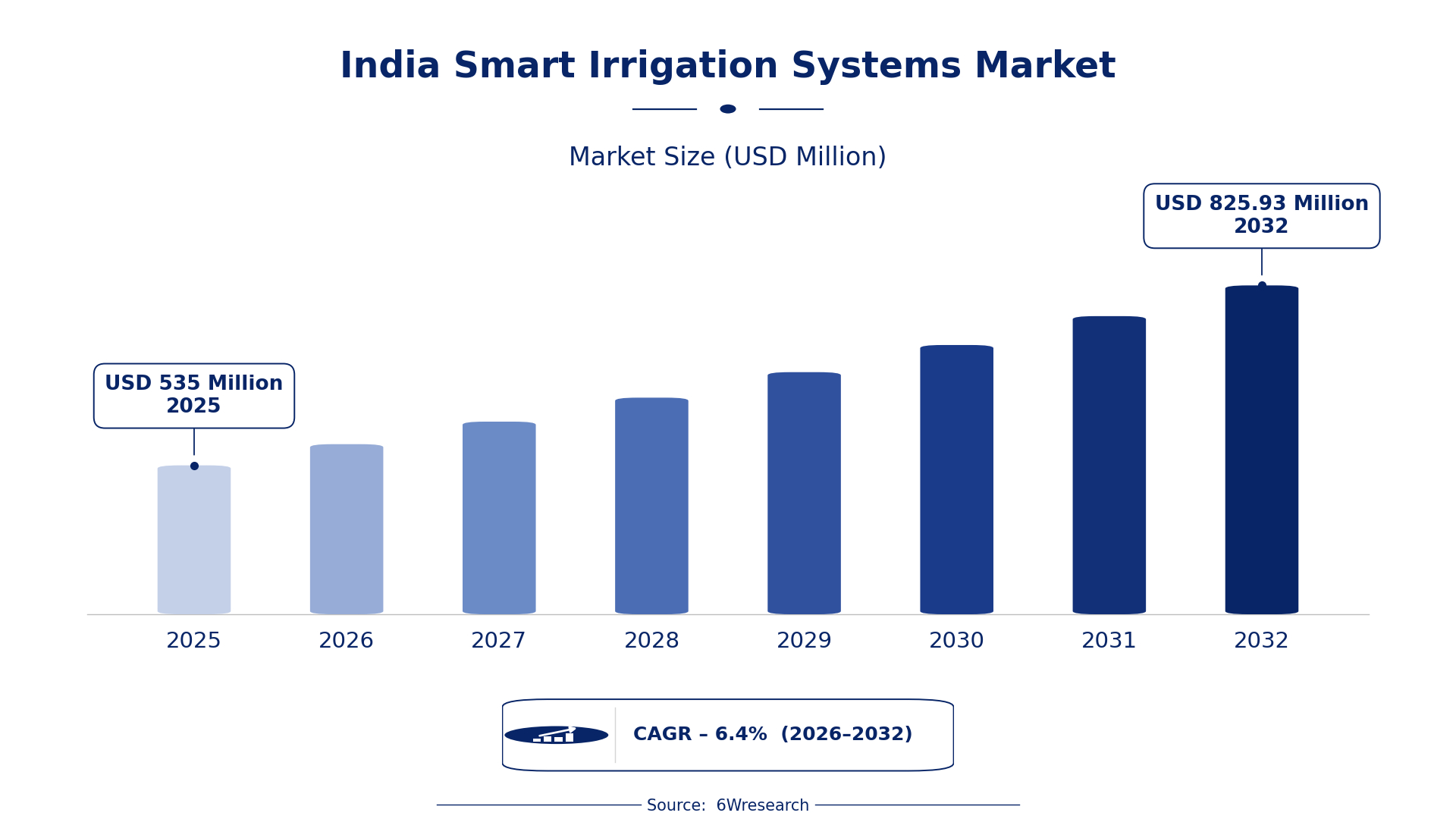
According to 6Wresearch internal database and industry insights, the India Smart Irrigation Systems Market was valued at USD 535.0 million in 2025 and is projected to reach USD 825.93 million by 2032, growing at a CAGR of approximately 6.4% during 2026–2032.
India Smart Irrigation Systems Market Highlights
| Report Metric | Details |
| Report Name | India Smart Irrigation Systems Market |
| Market Size 2025 | USD 535.0 million |
| Market Size 2032 | USD 825.93 million |
| Absolute Growth 2025–2032 | USD 290.93 million |
| CAGR 2026–2032 | 6.4% |
| Peak Annual Growth | 8.9% in 2026 |
| Forecast Period | 2026–2032 |
| Historical Data | 2022–2025 |
| Base Year | 2025 |
| Leading System Type, 2025 | Drip Smart Systems (40% share) |
| Leading Feature, 2025 | Sensor-Guided Flow (40% share) |
| Leading Control Type, 2025 | App-Based (33% share) |
| Leading End User, 2025 | Fruit & Vegetable Farms (47% share) |
| Fastest-Growing System Type | Soil-Linked Controllers (9.2% CAGR) |
| Fastest-Growing Feature | Moisture Sensor Feedback (8.5% CAGR) |
| Fastest-Growing Control Type | AI Decision Engine (8.1% CAGR) |
| Fastest-Growing End User | Agri Cooperatives (8.1% CAGR) |
| Growing Sector | Agri Cooperatives |
| Key End Users | Fruit & Vegetable Farms, Commercial Agri Firms, Agri Cooperatives, Landscape Contractors |
India Smart Irrigation Systems Market Year-wise Growth Rate and Key Drivers (2022–2032)
This graph illustrates the annual growth rates of the market from 2022 to 2032, highlighting a steady upward trajectory and projected market expansion over the forecast period.
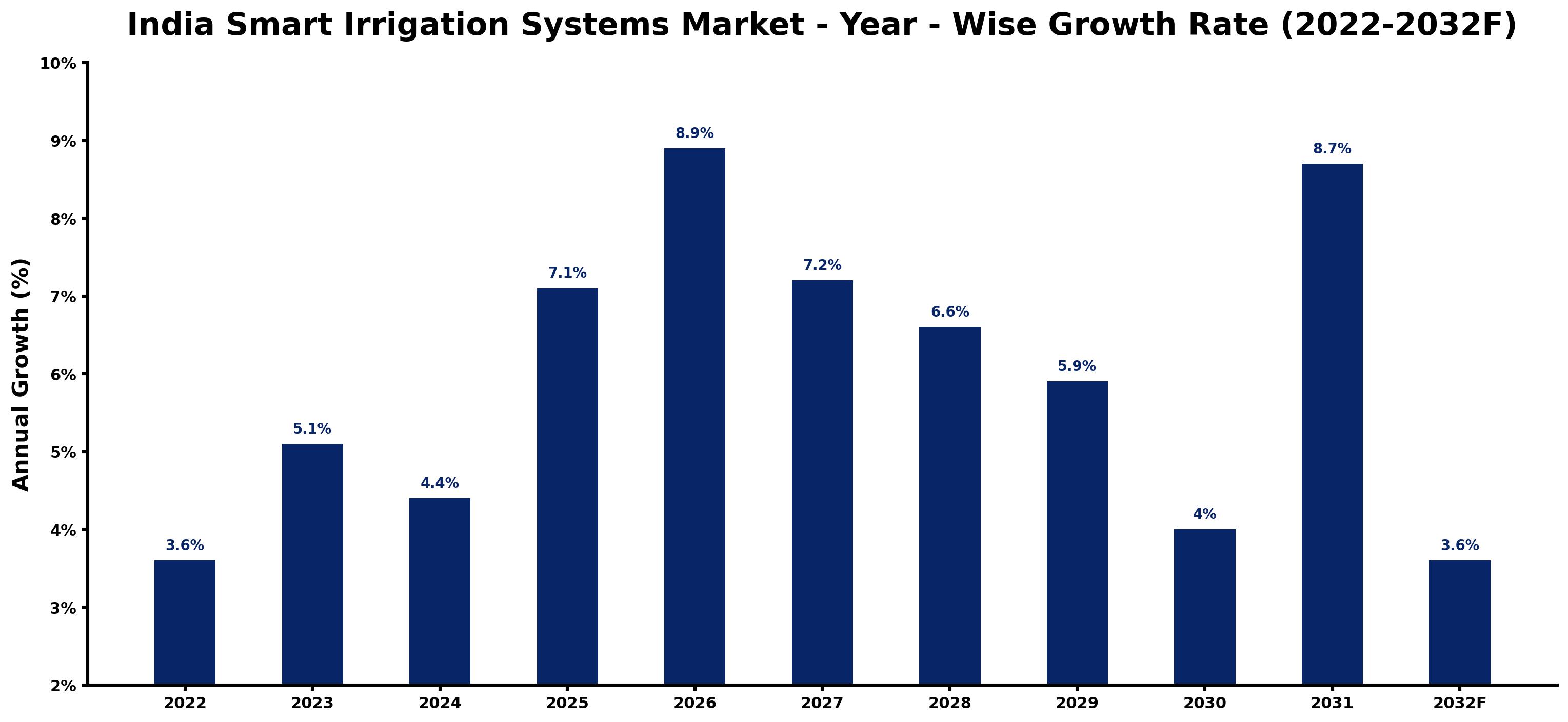
Below, each year's estimated growth is shown next to the factor that most influenced it.
| Year | Estimated Annual Growth (%) | Market Rationale |
| 2022 | 3.6 | The market experienced steady growth due to ongoing agricultural practices and irrigation needs. |
| 2023 | 5.1 | Demand increased as farmers sought efficient irrigation solutions amidst rising water scarcity. |
| 2024 | 4.4 | Adoption of smart systems slowed as some farmers hesitated to invest in new technologies. |
| 2025 | 7.1 | Growth accelerated with heightened awareness of water conservation and efficiency benefits. |
| 2026 | 8.9 | A peak in growth occurred as government initiatives promoted smart irrigation adoption. |
| 2027 | 7.2 | Market growth slowed slightly as farmers adjusted to new technologies and practices. |
| 2028 | 6.6 | Continued adoption of smart systems led to further growth, albeit at a slower pace. |
| 2029 | 5.9 | Demand for smart irrigation systems remained strong, with farmers increasingly recognising their value. |
| 2030 | 4.0 | Growth decelerated as market saturation began to affect new installations. |
| 2031 | 8.7 | A resurgence in growth was driven by renewed investments in irrigation infrastructure. |
| 2032 | 3.6 | The market stabilised as mature adoption patterns emerged among farmers. |
Note: Market size estimations and growth projections presented in this report are based on 6Wresearch's proprietary forecasting methodology, utilizing the latest available industry data, government publications, and primary research inputs.
India Smart Irrigation Systems Market Synopsis
Smart Irrigation Systems Market in India encompasses advanced irrigation technologies that optimise water usage in agriculture. These systems combine IoT devices with existing irrigation infrastructure, improving crop yield while conserving water. The market is expanding due to rising agricultural demands and government initiatives that promote efficient irrigation practices. With over 140 million hectares of arable land, the need for smart irrigation solutions is pressing. The Indian agricultural sector employs around 58% of the workforce, underscoring the importance of these systems.
Market Dynamics Impact Analysis (2026–2032)
| Factor | Type | Impact | Primary Segment Affected |
| Government initiatives promoting efficient irrigation practices. | Driver | High | Drip Smart Systems |
| Rising water scarcity driving the need for efficient irrigation solutions. | Driver | High | Soil-Linked Controllers |
| Increasing investment in smart irrigation technologies by agricultural cooperatives. | Opportunity | Medium | Agri Cooperatives |
| Growing demand for sustainable farming practices among landscape contractors. | Opportunity | Medium | Landscape Contractors |
| High initial investment costs for smart irrigation systems. | Restraint | High | Sprinkler IoT Systems |
| Limited awareness among farmers regarding smart irrigation benefits. | Restraint | Medium | Fruit & Vegetable Farms |
| The Smart Irrigation Systems Market in India faces challenges due to high costs. | Challenge | High | Commercial Agri Firms |
| Technological integration issues hinder widespread adoption of smart systems. | Challenge | Medium | Satellite-Aided Systems |
Evaluation of Drivers in India Smart Irrigation Systems Market (2026–2032)
The factors lifting demand, and the evidence behind each, are summarised below.
| Drivers | Primary Segment Affected | Why It Matters (Evidence) |
| Government initiatives like the Pradhan Mantri Krishi Sinchai Yojana promote smart irrigation. | Drip Smart Systems | This initiative allocates INR 50,000 crores to improve irrigation efficiency, encouraging farmers to adopt smart systems. |
| Rising water scarcity increases demand for efficient irrigation solutions. | Soil-Linked Controllers | With India's population projected to reach 1.5 billion by 2030, efficient water use becomes critical. |
| Investment from agricultural cooperatives in smart irrigation technologies boosts adoption. | Agri Cooperatives | These cooperatives support farmers in implementing modern irrigation techniques, improving overall productivity. |
| Growing awareness of sustainable farming practices among contractors drives demand. | Commercial Agri Firms | Contractors increasingly seek efficient irrigation solutions to maintain landscapes, improving service offerings. |
| Technological advancements in IoT and automation improve smart irrigation system capabilities. | Sprinkler IoT Systems | These advancements lead to more precise watering schedules, attracting more users to adopt smart systems. |
Approximately 58% of the workforce is employed in agriculture, highlighting the critical need for efficient irrigation. The Indian agricultural sector is projected to see a 30% increase in drip irrigation adoption, driven by the necessity for water conservation. Investment from agricultural cooperatives is boosting the adoption of smart irrigation technologies, improving overall productivity. Additionally, growing awareness of sustainable farming practices among contractors is driving demand for efficient irrigation solutions.
Evaluation of Restraints in India Smart Irrigation Systems Market
The key brakes on demand, and where they bite hardest, are shown below.
| Market Restraint | Primary Segment Affected | Why It Matters (Evidence) |
| High initial investment costs for smart irrigation systems. | Sprinkler IoT Systems | Such costs can deter farmers from adopting new technologies, limiting market growth. |
| Limited awareness among farmers regarding smart irrigation benefits. | Fruit & Vegetable Farms | Many farmers are unaware of the efficiency gains, hindering widespread adoption. |
| Supply chain disruptions affecting component availability. | Satellite-Aided Systems | Dependence on imported components can lead to delays in manufacturing, impacting timely access. |
| Regulatory compliance challenges for producers. | Drip Smart Systems | Producers struggle to meet established guidelines, delaying product launches. |
| Skills shortages in operating advanced technologies. | Agri Cooperatives | Many farmers lack the necessary training to effectively use smart irrigation systems. |
India Smart Irrigation Systems Market Challenges
Buyers in the India Smart Irrigation Systems Market encounter several practical issues, starting with regulatory compliance. The Bureau of Indian Standards has set guidelines for smart irrigation systems, yet many buyers find it challenging to navigate these regulations, potentially delaying project timelines by up to six months. Supply chain disruptions follow, as reliance on imported components can lead to shortages, affecting producers who require timely access to materials for manufacturing. Rising costs present another hurdle; producers report material price increases of around 15%, which ultimately raises system prices for farmers. Finally, a shortage of skilled labour restricts the effective use of these technologies, leaving many farmers unable to optimise their irrigation practices.
Trends in the India Smart Irrigation Systems Market
Below mentioned are some of the trends shaping the India Smart Irrigation Systems Market growth.
- Shift Towards IoT-Driven Solutions: Maharashtra is seeing a shift towards IoT-driven smart irrigation solutions, with a 30% increase in adoption among farmers in 2022. This trend facilitates better water management and improvements in crop yield.
- Growing Preference for Automated Systems: Fruit and vegetable farms are increasingly embracing automated irrigation systems, with a 40% share projected by 2025. This change boosts efficiency and lowers labour costs for farmers.
- Rise of Data-Driven Irrigation Management: The adoption of data-driven irrigation management is increasing, with 25% of farmers in Maharashtra using moisture sensor feedback systems in 2023. This trend enhances water efficiency and crop monitoring.
- Increased Focus on Sustainable Practices: Since 2020, there has been a heightened focus on sustainable farming practices, with the Soil Health Card Scheme promoting efficient irrigation methods. This initiative aims to boost productivity while conserving water.
Investment Opportunities in the India Smart Irrigation Systems Market
The following opportunities in the India Smart Irrigation Systems Market pair current demand with a clear way in.
- Supply of Advanced Sensor Technologies: There is a rising demand for advanced sensor technologies in smart irrigation systems, projected to increase by 25% in 2025. Agricultural cooperatives are seeking these technologies to enhance efficiency.
- Investment in Training Programs for Farmers: With 58% of the workforce in agriculture, there is a chance to invest in training programs for farmers on smart irrigation systems. This can greatly improve adoption rates.
- Partnerships with Local Agricultural Cooperatives: Now is an opportune moment to establish partnerships with local agricultural cooperatives to supply smart irrigation solutions. These cooperatives are actively pursuing modern technologies to support their members.
- Expansion of Micro-Irrigation Projects: The Indian government's goal to expand micro-irrigation to 10 million hectares by 2025 presents an opportunity for suppliers. Collaborating with local partners can facilitate market entry.
Government Initiatives in the India Smart Irrigation Systems Market
The Pradhan Mantri Krishi Sinchai Yojana, initiated by the Ministry of Agriculture in 2015, aims to improve irrigation efficiency with a budget of INR 50,000 crores. This initiative builds on previous laws by providing substantial funding for modern irrigation techniques, including smart irrigation systems. The National Agriculture Policy 2020 further stresses the need for modern irrigation methods, ensuring that smart irrigation technologies are prioritised in agricultural practices.
The Ministry of Agriculture has allocated INR 10,000 crores for irrigation infrastructure development as part of the Digital India initiative. This programme encourages the adoption of technology in agriculture, including smart irrigation systems, to boost productivity. The Soil Health Card Scheme promotes sustainable farming practices, ensuring that farmers receive guidance on efficient irrigation methods.
Future Insight of the India Smart Irrigation Systems Market
By 2032, the India Smart Irrigation Systems Market will undergo notable changes driven by several key factors. The Pradhan Mantri Krishi Sinchai Yojana aims to expand micro-irrigation to 10 million hectares by 2025, improving accessibility for farmers. The integration of IoT devices will increase, facilitating better water management and enhanced crop yields. Research from the Indian Council of Agricultural Research will continue to advance smart irrigation technologies, ensuring they meet the evolving needs of agriculture. As India's population approaches 1.5 billion by 2030, the demand for efficient irrigation solutions will grow substantially.
Market Segmentation Analysis
Each segment group is reviewed below, with the leader by share and the fastest grower by CAGR.
By System Type – Drip Smart Systems Dominated, Soil-Linked Controllers Expected to Grow Fastest
According to Dhaval Chaurasia, Assistant Manager at 6Wresearch, Drip Smart Systems took a 40% share of system type in 2025, more than any other category. Drip Smart Systems hold the largest market share due to their ability to deliver precise water to crops, which is essential for optimising irrigation in India's vast arable regions. The notable 30% increase in adoption among farmers in 2022 exemplifies their effectiveness in improving agricultural yields. Soil-Linked Controllers are projected to grow fastest, at a CAGR of 9.2% during 2026–2032. Soil-Linked Controllers are experiencing the fastest growth as they adjust watering based on real-time soil moisture, ensuring effective irrigation. The emphasis on water conservation in regions like Maharashtra drives this trend, positioning these controllers as crucial for sustainable farming practices. Suppliers should focus on developing Soil-Linked Controllers to meet the rising demand for efficient irrigation solutions.
By Feature – Sensor-Guided Flow Dominated, Moisture Sensor Feedback Expected to Grow Fastest
Sensor-Guided Flow accounted for a 40% market share by feature in 2025. Sensor-Guided Flow leads the market because it directly influences water usage efficiency in smart irrigation systems, making it vital for farmers. This feature aligns with initiatives like the Pradhan Mantri Krishi Sinchai Yojana, which promote effective irrigation practices. The quickest growth will come from Moisture Sensor Feedback, forecast to expand at a CAGR of 8.5% between 2026 and 2032. Moisture Sensor Feedback is rapidly gaining traction as it provides essential real-time data that enhances irrigation efficiency. The growing adoption of IoT technologies in agriculture significantly fuels this growth, allowing for more precise water management. Buyers should invest in systems equipped with advanced moisture sensor feedback to optimise their irrigation practices.
By Control Type – App-Based Dominated, AI Decision Engine Expected to Grow Fastest
In 2025, App-Based led the control type split with a 33% share. App-Based control types dominate the market as they allow users to manage irrigation remotely, significantly improving accessibility for farmers. This capability is critical in a country where efficient irrigation solutions are essential for a large segment of the agricultural workforce. AI Decision Engine is set to record the highest CAGR in this split, 8.1% over 2026–2032. AI Decision Engine technology is witnessing rapid growth as it optimises irrigation schedules through detailed data analysis, fulfilling the need for precision in water management. The increasing incorporation of AI into agricultural practices is a key factor propelling this segment's expansion. Suppliers must enhance their app-based solutions to incorporate AI features, ensuring they cater to the evolving needs of modern farmers.
By End User – Fruit & Vegetable Farms Dominated, Agri Cooperatives Expected to Grow Fastest
Fruit & Vegetable Farms held a 47% share of the India Smart Irrigation Systems Market by end user in 2025. Fruit & Vegetable Farms represent the largest share as they directly utilise smart irrigation for improved crop yields and water savings, essential for their operations. The agricultural sector employs approximately 58% of the workforce, highlighting the importance of these farms in the economy. Over 2026–2032, Agri Cooperatives are expected to post the fastest growth, at a CAGR of 8.1%. Agri Cooperatives are the fastest-growing segment as they implement smart irrigation to effectively support their member farmers. The push for sustainable practices among cooperatives is driving this growth, particularly in regions focused on water conservation. Suppliers should target agri cooperatives to expand their market share, as these entities are increasingly adopting smart irrigation technologies.
Key Attractiveness of the Report
- 10 Years of Market Numbers
- Historical Data Starting from 2022 to 2025
- Base Year 2025
- Forecast Data until 2032
- Key Performance Indicators Impacting the Market
- Major Upcoming Developments and Projects
Key Highlights of the Report:
- India Smart Irrigation Systems Market Outlook
- Market Size of India Smart Irrigation Systems Market, 2025
- Forecast of India Smart Irrigation Systems Market, 2032
- Historical Data and Forecast of India Smart Irrigation Systems Revenues & Volume for the Period 2022 - 2032F
- India Smart Irrigation Systems Market Trend Evolution
- India Smart Irrigation Systems Market Drivers and Challenges
- India Smart Irrigation Systems Price Trends
- India Smart Irrigation Systems Porter's Five Forces
- India Smart Irrigation Systems Industry Life Cycle
- Historical Data and Forecast of India Smart Irrigation Systems Market Revenues & Volume By System Type for the Period 2022 - 2032F
- Historical Data and Forecast of India Smart Irrigation Systems Market Revenues & Volume By Drip Smart Systems for the Period 2022 - 2032F
- Historical Data and Forecast of India Smart Irrigation Systems Market Revenues & Volume By Sprinkler IoT Systems for the Period 2022 - 2032F
- Historical Data and Forecast of India Smart Irrigation Systems Market Revenues & Volume By Soil-Linked Controllers for the Period 2022 - 2032F
- Historical Data and Forecast of India Smart Irrigation Systems Market Revenues & Volume By Satellite-Aided Systems for the Period 2022 - 2032F
- Historical Data and Forecast of India Smart Irrigation Systems Market Revenues & Volume By Feature for the Period 2022 - 2032F
- Historical Data and Forecast of India Smart Irrigation Systems Market Revenues & Volume By Sensor-Guided Flow for the Period 2022 - 2032F
- Historical Data and Forecast of India Smart Irrigation Systems Market Revenues & Volume By Scheduled Watering for the Period 2022 - 2032F
- Historical Data and Forecast of India Smart Irrigation Systems Market Revenues & Volume By Moisture Sensor Feedback for the Period 2022 - 2032F
- Historical Data and Forecast of India Smart Irrigation Systems Market Revenues & Volume By Crop-Wide Monitoring for the Period 2022 - 2032F
- Historical Data and Forecast of India Smart Irrigation Systems Market Revenues & Volume By Control Type for the Period 2022 - 2032F
- Historical Data and Forecast of India Smart Irrigation Systems Market Revenues & Volume By App-Based for the Period 2022 - 2032F
- Historical Data and Forecast of India Smart Irrigation Systems Market Revenues & Volume By Weather Synced for the Period 2022 - 2032F
- Historical Data and Forecast of India Smart Irrigation Systems Market Revenues & Volume By Embedded Microcontrollers for the Period 2022 - 2032F
- Historical Data and Forecast of India Smart Irrigation Systems Market Revenues & Volume By AI Decision Engine for the Period 2022 - 2032F
- Historical Data and Forecast of India Smart Irrigation Systems Market Revenues & Volume By End User for the Period 2022 - 2032F
- Historical Data and Forecast of India Smart Irrigation Systems Market Revenues & Volume By Fruit & Vegetable Farms for the Period 2022 - 2032F
- Historical Data and Forecast of India Smart Irrigation Systems Market Revenues & Volume By Landscape Contractors for the Period 2022 - 2032F
- Historical Data and Forecast of India Smart Irrigation Systems Market Revenues & Volume By Agri Cooperatives for the Period 2022 - 2032F
- Historical Data and Forecast of India Smart Irrigation Systems Market Revenues & Volume By Commercial Agri Firms for the Period 2022 - 2032F
- India Smart Irrigation Systems Import Export Trade Statistics
- Market Opportunity Assessment By System Type
- Market Opportunity Assessment By Feature
- Market Opportunity Assessment By Control Type
- Market Opportunity Assessment By End User
- India Smart Irrigation Systems Top Companies Market Share
- India Smart Irrigation Systems Competitive Benchmarking By Technical and Operational Parameters
- India Smart Irrigation Systems Company Profiles
- India Smart Irrigation Systems Key Strategic Recommendations
Market Covered
The report offers an extensive study of the following market segments.
By System Type
- Drip Smart Systems
- Sprinkler IoT Systems
- Soil-Linked Controllers
- Satellite-Aided Systems
By Feature
- Sensor-Guided Flow
- Scheduled Watering
- Moisture Sensor Feedback
- Crop-Wide Monitoring
By Control Type
- App-Based
- Weather Synced
- Embedded Microcontrollers
- AI Decision Engine
By End User
- Fruit & Vegetable Farms
- Landscape Contractors
- Agri Cooperatives
- Commercial Agri Firms































