China Smart Irrigation Systems Market Size & Growth Rate
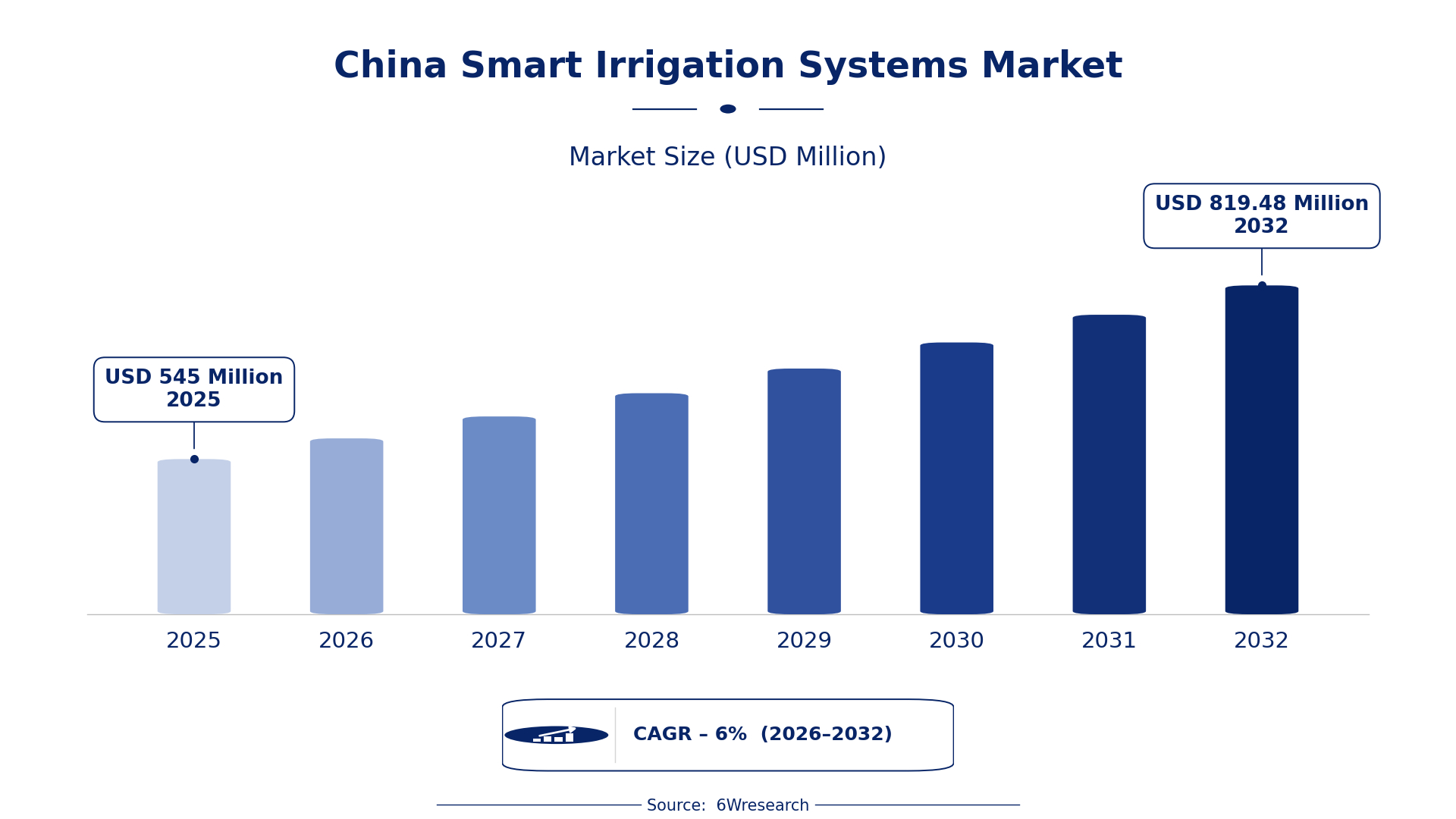
According to 6Wresearch internal database and industry insights, the China Smart Irrigation Systems Market was valued at USD 545.0 million in 2025 and is projected to reach USD 819.48 million by 2032, growing at a CAGR of approximately 6% during 2026–2032.
China Smart Irrigation Systems Market Highlights
| Report Metric | Details |
| Report Name | China Smart Irrigation Systems Market |
| Market Size 2025 | USD 545.0 million |
| Market Size 2032 | USD 819.48 million |
| Absolute Growth 2025–2032 | USD 274.48 million |
| CAGR 2026–2032 | 6% |
| Peak Annual Growth | 7.8% in 2028 |
| Forecast Period | 2026–2032 |
| Historical Data | 2022–2025 |
| Base Year | 2025 |
| Leading System Type, 2025 | Drip Smart Systems (34% share) |
| Leading Feature, 2025 | Sensor-Guided Flow (47% share) |
| Leading Control Type, 2025 | App-Based (42% share) |
| Leading End User, 2025 | Fruit & Vegetable Farms (50% share) |
| Fastest-Growing System Type | Soil-Linked Controllers (8.2% CAGR) |
| Fastest-Growing Feature | Moisture Sensor Feedback (8.3% CAGR) |
| Fastest-Growing End User | Agri Cooperatives (8.8% CAGR) |
| Growing Sector | Agriculture |
| Key End Users | Fruit & Vegetable Farms, Landscape Contractors, Commercial Agri Firms, Agri Cooperatives |
China Smart Irrigation Systems Market Year-wise Growth Rate and Key Drivers (2022–2032)
This graph illustrates the annual growth rates of the market from 2022 to 2032, highlighting a steady upward trajectory and projected market expansion over the forecast period.
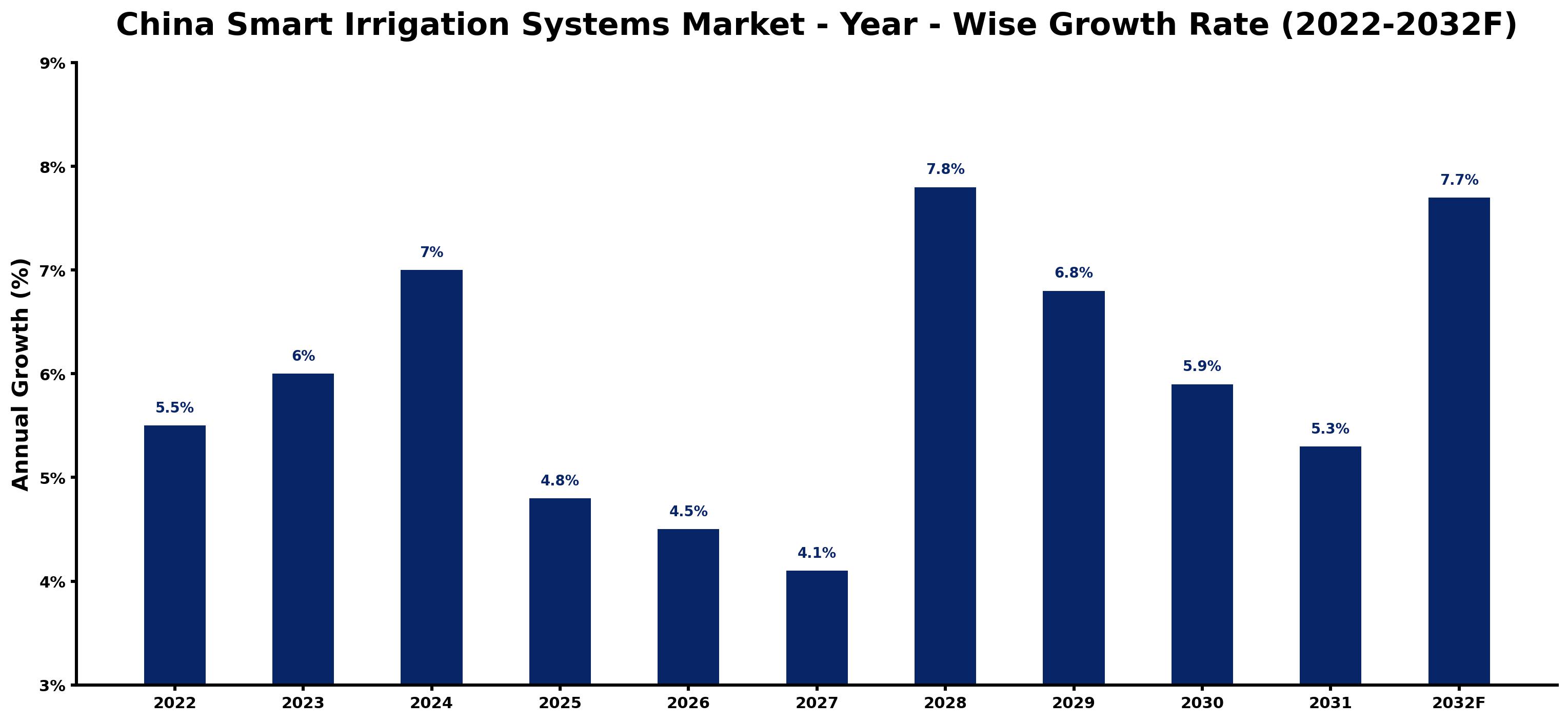
Year by year, the estimates below pair each growth rate with the development that shaped it.
| Year | Estimated Annual Growth (%) | Market Rationale |
| 2022 | 5.5 | The market experienced solid growth due to rising awareness of water conservation techniques. |
| 2023 | 6.0 | Increased installations were supported by the Agricultural Technology Promotion Plan promoting smart irrigation technologies. |
| 2024 | 7.0 | The market grew faster as the Agricultural Technology Promotion Plan gained traction among farmers. |
| 2025 | 4.8 | Growth slowed as the National Agricultural Technology Promotion Plan encouraged early adopters in urban areas. |
| 2026 | 4.5 | A further slowdown is expected as competition intensifies among existing suppliers in the market. |
| 2027 | 4.1 | The market will continue to grow, albeit at a slower rate, as farmers seek cost-effective solutions. |
| 2028 | 7.8 | A surge in growth is expected as advanced sensor technologies are introduced in irrigation systems. |
| 2029 | 6.8 | The market growth is projected to slow as the focus shifts to improving system efficiency and integration. |
| 2030 | 5.9 | Demand is expected to remain steady, supported by ongoing investments in agricultural modernization initiatives. |
| 2031 | 5.3 | The market will continue to grow, driven by increasing adoption of IoT technologies in farming. |
| 2032 | 7.7 | A faster growth rate is projected as new standards for water-saving irrigation are implemented. |
Note: Market size estimations and growth projections presented in this report are based on 6Wresearch's proprietary forecasting methodology, utilizing the latest available industry data, government publications, and primary research inputs.
China Smart Irrigation Systems Market Synopsis
Smart Irrigation Systems in China optimise water usage in agriculture through advanced technology, including sensors and controllers. These systems are designed to improve crop yield, conserve water, and reduce labour costs. The China Smart Irrigation Systems Market is experiencing robust growth due to increasing demand from fruit and vegetable farms, supported by government initiatives like the Smart Agriculture Development Plan. With over 30% of vegetable farms adopting these systems by 2023, the market is projected to exceed 2 billion yuan in annual demand by 2025.
Market Dynamics Impact Analysis (2026–2032)
| Factor | Type | Impact | Primary Segment Affected |
| Growing government support for smart irrigation technologies | Driver | High | Drip Smart Systems |
| Rising adoption of water-saving practices among farmers | Driver | High | Soil-Linked Controllers |
| Increasing demand for efficient agriculture solutions | Opportunity | High | Commercial Agri Firms |
| Expansion of urban landscaping projects requiring smart irrigation | Opportunity | Medium | Landscape Contractors |
| High initial investment costs for smart irrigation systems | Restraint | High | Sprinkler IoT Systems |
| Limited awareness of advanced irrigation technologies among small farmers | Restraint | Medium | Agri Cooperatives |
| Buyers face challenges in integrating new technologies with existing systems | Challenge | High | Fruit & Vegetable Farms |
| Suppliers struggle with maintaining competitive pricing in a crowded market | Challenge | Medium | Commercial Agri Firms |
Evaluation of Drivers in China Smart Irrigation Systems Market (2026–2032)
Below mentioned are some major drivers and their influence on market dynamics.
| Drivers | Primary Segment Affected | Why It Matters (Evidence) |
| Government initiatives promoting smart irrigation adoption | Drip Smart Systems | The Agricultural Technology Promotion Plan aims for a 30% increase in smart irrigation use by 2025, encouraging installations among farmers. |
| Growing focus on water conservation practices | Soil-Linked Controllers | With over 200 million hectares of arable land, farmers are increasingly adopting technologies that save water and improve efficiency. |
| Rising consumer demand for sustainable agricultural practices | Commercial Agri Firms | The average water savings reported by users of smart irrigation systems is 30% annually, leading firms to invest in these technologies. |
| Technological advancements in sensor and control systems | Sensor-Guided Flow | The installed base of smart irrigation systems reached 5 million units by 2023, reflecting the growing demand for precision agriculture. |
| Increasing urban agricultural projects requiring efficient irrigation | Agri Cooperatives | Urban agricultural projects are adopting smart irrigation solutions, further driving demand for advanced systems. |
The Yangtze River Delta region is a key area for deploying these technologies, where over 30% of vegetable farms have adopted smart irrigation systems. The focus on water conservation is prompting farmers to invest in these solutions, as they seek to improve efficiency and reduce costs.
Evaluation of Restraints in China Smart Irrigation Systems Market
Below mentioned are some major restraints and their influence on market dynamics.
| Market Restraint | Primary Segment Affected | Why It Matters (Evidence) |
| High initial costs of smart irrigation systems | Sprinkler IoT Systems | The average investment for smart irrigation systems can be substantial, often exceeding 200,000 yuan, deterring small farmers from adoption. |
| Limited knowledge about advanced irrigation technologies | Agri Cooperatives | Many small-scale farmers lack awareness of the benefits and functionalities of smart irrigation systems, hindering adoption. |
| Integration challenges with existing irrigation systems | Fruit & Vegetable Farms | Farmers face difficulties in adapting new technologies to their current setups, leading to hesitance in adoption. |
| Intense competition among suppliers affecting pricing | Commercial Agri Firms | The crowded market forces suppliers to lower prices, impacting profitability and sustainability for many producers. |
| Regulatory compliance costs for new technologies | Drip Smart Systems | Compliance with national standards like GB/T 50084-2017 increases operational costs for producers, affecting pricing. |
China Smart Irrigation Systems Market Challenges
Buyers in the China smart irrigation systems market face high initial costs, with installations averaging 200,000 yuan per unit, which deters smaller farms from adopting these technologies. Regulatory compliance with standards like GB/T 50084-2017 demands substantial investment in certified systems, delaying implementation for many agricultural firms. Buyers often perceive smart irrigation as an unnecessary expense, pressured by competition from traditional irrigation methods, which can lead to missed opportunities for long-term savings. Suppliers struggle with rapid technological advancements, forcing them to innovate continuously, which strains resources and complicates pricing strategies.
Trends in the China Smart Irrigation Systems Market
The trends below show where the China Smart Irrigation Systems Market is heading.
- Shift towards IoT-Enabled Smart Irrigation: China is increasingly adopting IoT-enabled smart irrigation systems, improving water management efficiency. By 2023, over 30% of vegetable farms are using such systems, backed by the Agricultural Technology Promotion Plan.
- Transition from Traditional to Sensor-Based Systems: Since 2022, there has been a notable shift from traditional irrigation methods to sensor-based systems. This change is driven by the need for precise water management, with reported average water savings of 30% annually.
- Emergence of App-Based Control Solutions: App-based control solutions have gained popularity among farmers, allowing for easier management of irrigation systems. By 2025, app-based systems are expected to hold a 42% market share, reflecting user preferences.
- Increasing Demand for Water-Saving Technologies: The demand for water-saving technologies is rising among agricultural producers, particularly in the Yangtze River Delta region. The average savings reported by users is 30% annually, driving further adoption.
Investment Opportunities in the China Smart Irrigation Systems Market
Some of the investment opportunities in the China Smart Irrigation Systems Market are mentioned below.
- Fruit & Vegetable Farms Seeking Efficiency: Fruit and vegetable farms are increasingly looking for efficient irrigation solutions. With an expected demand exceeding 2 billion yuan by 2025, suppliers can enter through partnerships with local cooperatives.
- Joint Ventures for Smart Irrigation Implementation: Establishing joint ventures with local agricultural firms can facilitate the introduction of smart irrigation systems. The Agricultural Technology Promotion Plan provides a supportive framework for such collaborations.
- Supplying Advanced Sensor Technologies: There is a growing need for advanced sensor technologies in irrigation systems. Suppliers can target the Yangtze River Delta region, where adoption rates are rising.
- Investing in Urban Agricultural Solutions: Urban agricultural projects are increasingly adopting smart irrigation solutions. Suppliers can enter this market by collaborating with agricultural cooperatives to provide tailored systems.
Government Initiatives in the China Smart Irrigation Systems Market
The 'Smart Agriculture Development Plan (2021-2025)' launched by the Ministry of Agriculture aims to increase smart irrigation use by 30%. This initiative incentivises farmers to modernise their systems, promoting greater efficiency. The updated 'National Agricultural Technology Promotion Plan' in 2022 includes incentives for adopting smart irrigation technologies, enhancing sustainability across the sector. These measures support producers in improving their irrigation practices and overall productivity, addressing the need for efficient solutions.
The National Agricultural Technology Extension and Service Center oversees smart irrigation initiatives, approving funding for projects that enhance water-saving technologies. In 2022, the 'Irrigation Modernization Program' received a budget of 500 million yuan to upgrade irrigation systems in rural areas. This funding is essential for supporting farmers in adopting modern practices. Furthermore, the Ministry of Ecology and Environment initiated the 'Water Conservation Action Plan' in 2023, aiming to reduce water consumption by 20% by 2025, further promoting smart irrigation technologies.
Future Insight of the China Smart Irrigation Systems Market
The outlook for the China smart irrigation systems market is set to evolve by 2032, driven by several key developments. The Agricultural Technology Promotion Plan aims to boost adoption rates, targeting installations to exceed 5 million units. The government's commitment of 1 billion yuan for agricultural modernisation will facilitate the integration of advanced technologies in farming practices. As more than 30% of vegetable farms currently utilise smart irrigation, the trend towards IoT in agriculture is expected to accelerate, enhancing efficiency and promoting water conservation.
Market Segmentation Analysis
The report offers a comprehensive study of the following market segments and their leading categories in the market.
By System Type – Drip Smart Systems Dominated, Soil-Linked Controllers Expected to Grow Fastest
According to Dhaval Chaurasia, Assistant Manager at 6Wresearch, Drip Smart Systems held a 34% share of the China Smart Irrigation Systems Market by system type in 2025. Drip Smart Systems dominate the market share in China due to their efficient water delivery directly to plant roots, which is crucial for maximising crop yield. This technology is widely adopted, particularly in regions with significant agricultural activity, highlighting its essential role in modern farming practices. The quickest growth will come from Soil-Linked Controllers, forecast to expand at a CAGR of 8.2% between 2026 and 2032. Soil-Linked Controllers are rapidly growing as they provide precise soil moisture monitoring, essential for effective irrigation scheduling. The increasing focus on optimising water usage in agriculture significantly fuels this segment's expansion, ensuring its continued relevance in the market. Suppliers should enhance offerings related to Soil-Linked Controllers to meet the rising demand in the smart irrigation systems market.
By Feature – Sensor-Guided Flow Dominated, Moisture Sensor Feedback Expected to Grow Fastest
In 2025, Sensor-Guided Flow led the feature split with a 47% share. Sensor-Guided Flow features lead the market due to their capability to adjust water flow based on real-time data, vital for effective irrigation management. This technology appeals to users seeking precise control over their water usage, particularly in high-demand agricultural settings. Over 2026–2032, Moisture Sensor Feedback is expected to post the fastest growth, at a CAGR of 8.3%. Moisture Sensor Feedback is experiencing rapid growth as it guarantees optimal soil moisture levels, a critical factor for maintaining crop health and yield. The increasing emphasis on sustainable farming practices drives the adoption of this feature, making it a key area for development. Buyers should integrate Moisture Sensor Feedback into their systems to enhance efficiency and productivity.
By Control Type – App-Based Dominated and Is Expected to Record the Fastest Growth
App-Based took a 42% share of control type in 2025, more than any other category. App-Based control systems lead the market due to their user-friendly interface, allowing farmers to manage irrigation easily from their devices. This convenience has resulted in widespread acceptance among users looking for efficient solutions. The same category is also set to grow fastest, at a CAGR of 8.2% during 2026–2032. App-Based systems are also the fastest-growing segment, as their ease of use continues to attract more users in the agricultural sector. The ongoing trend towards digitalisation in farming ensures this segment's sustained growth. Suppliers must continue to innovate app-based solutions to cater to the increasing demand for accessible smart irrigation management.
By End User – Fruit & Vegetable Farms Dominated, Agri Cooperatives Expected to Grow Fastest
The largest end user category in 2025 was Fruit & Vegetable Farms, with a 50% share of total revenue. Fruit & Vegetable Farms account for the largest market share as they rely heavily on smart irrigation systems to maximise crop yield and conserve water. The substantial size of this sector and its specific resource needs drive the demand for advanced irrigation solutions tailored to their requirements. Agri Cooperatives are set to record the highest CAGR in this split, 8.8% over 2026–2032. Agri Cooperatives are the fastest-growing end user segment, as they implement smart irrigation systems to optimise shared resources among their members. This collaborative farming approach is gaining traction, significantly boosting this segment's growth and attracting more investment. Suppliers should target Agri Cooperatives to capitalise on the increasing interest in shared agricultural technologies.
Key Attractiveness of the Report
- 10 Years of Market Numbers
- Historical Data Starting from 2022 to 2025
- Base Year 2025
- Forecast Data until 2032
- Key Performance Indicators Impacting the Market
- Major Upcoming Developments and Projects
Key Highlights of the Report:
- China Smart Irrigation Systems Market Outlook
- Market Size of China Smart Irrigation Systems Market, 2025
- Forecast of China Smart Irrigation Systems Market, 2032
- Historical Data and Forecast of China Smart Irrigation Systems Revenues & Volume for the Period 2022 - 2032F
- China Smart Irrigation Systems Market Trend Evolution
- China Smart Irrigation Systems Market Drivers and Challenges
- China Smart Irrigation Systems Price Trends
- China Smart Irrigation Systems Porter's Five Forces
- China Smart Irrigation Systems Industry Life Cycle
- Historical Data and Forecast of China Smart Irrigation Systems Market Revenues & Volume By System Type for the Period 2022 - 2032F
- Historical Data and Forecast of China Smart Irrigation Systems Market Revenues & Volume By Drip Smart Systems for the Period 2022 - 2032F
- Historical Data and Forecast of China Smart Irrigation Systems Market Revenues & Volume By Sprinkler IoT Systems for the Period 2022 - 2032F
- Historical Data and Forecast of China Smart Irrigation Systems Market Revenues & Volume By Soil-Linked Controllers for the Period 2022 - 2032F
- Historical Data and Forecast of China Smart Irrigation Systems Market Revenues & Volume By Satellite-Aided Systems for the Period 2022 - 2032F
- Historical Data and Forecast of China Smart Irrigation Systems Market Revenues & Volume By Feature for the Period 2022 - 2032F
- Historical Data and Forecast of China Smart Irrigation Systems Market Revenues & Volume By Sensor-Guided Flow for the Period 2022 - 2032F
- Historical Data and Forecast of China Smart Irrigation Systems Market Revenues & Volume By Scheduled Watering for the Period 2022 - 2032F
- Historical Data and Forecast of China Smart Irrigation Systems Market Revenues & Volume By Moisture Sensor Feedback for the Period 2022 - 2032F
- Historical Data and Forecast of China Smart Irrigation Systems Market Revenues & Volume By Crop-Wide Monitoring for the Period 2022 - 2032F
- Historical Data and Forecast of China Smart Irrigation Systems Market Revenues & Volume By Control Type for the Period 2022 - 2032F
- Historical Data and Forecast of China Smart Irrigation Systems Market Revenues & Volume By App-Based for the Period 2022 - 2032F
- Historical Data and Forecast of China Smart Irrigation Systems Market Revenues & Volume By Weather Synced for the Period 2022 - 2032F
- Historical Data and Forecast of China Smart Irrigation Systems Market Revenues & Volume By Embedded Microcontrollers for the Period 2022 - 2032F
- Historical Data and Forecast of China Smart Irrigation Systems Market Revenues & Volume By AI Decision Engine for the Period 2022 - 2032F
- Historical Data and Forecast of China Smart Irrigation Systems Market Revenues & Volume By End User for the Period 2022 - 2032F
- Historical Data and Forecast of China Smart Irrigation Systems Market Revenues & Volume By Fruit & Vegetable Farms for the Period 2022 - 2032F
- Historical Data and Forecast of China Smart Irrigation Systems Market Revenues & Volume By Landscape Contractors for the Period 2022 - 2032F
- Historical Data and Forecast of China Smart Irrigation Systems Market Revenues & Volume By Agri Cooperatives for the Period 2022 - 2032F
- Historical Data and Forecast of China Smart Irrigation Systems Market Revenues & Volume By Commercial Agri Firms for the Period 2022 - 2032F
- China Smart Irrigation Systems Import Export Trade Statistics
- Market Opportunity Assessment By System Type
- Market Opportunity Assessment By Feature
- Market Opportunity Assessment By Control Type
- Market Opportunity Assessment By End User
- China Smart Irrigation Systems Top Companies Market Share
- China Smart Irrigation Systems Competitive Benchmarking By Technical and Operational Parameters
- China Smart Irrigation Systems Company Profiles
- China Smart Irrigation Systems Key Strategic Recommendations
Market Covered
The report offers an extensive study of the following market segments.
By System Type
- Drip Smart Systems
- Sprinkler IoT Systems
- Soil-Linked Controllers
- Satellite-Aided Systems
By Feature
- Sensor-Guided Flow
- Scheduled Watering
- Moisture Sensor Feedback
- Crop-Wide Monitoring
By Control Type
- App-Based
- Weather Synced
- Embedded Microcontrollers
- AI Decision Engine
By End User
- Fruit & Vegetable Farms
- Landscape Contractors
- Agri Cooperatives
- Commercial Agri Firms































