India Smart Logistics Software Market Size & Growth Rate
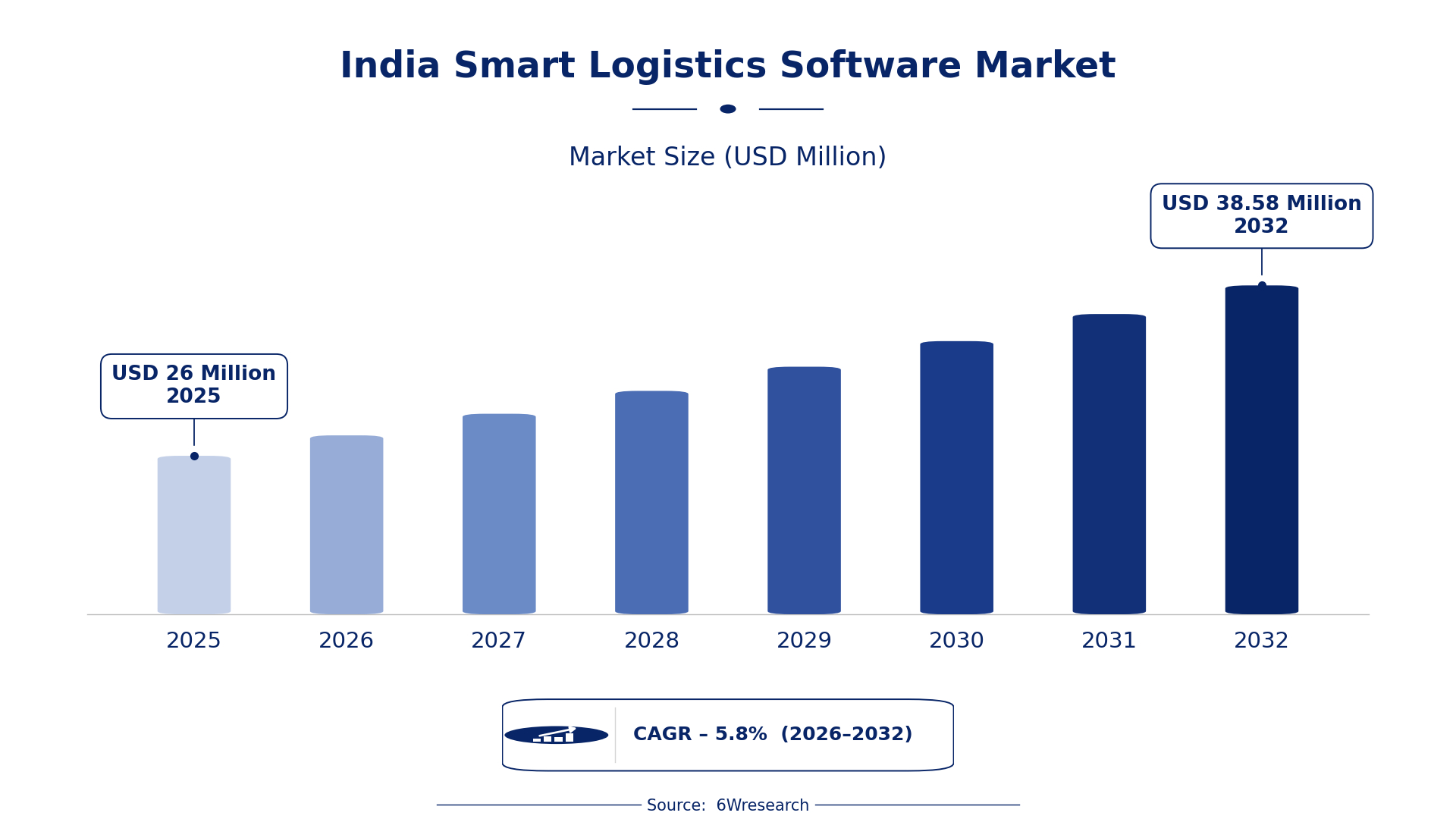
According to 6Wresearch internal database and industry insights, the India Smart Logistics Software Market was valued at USD 26.0 million in 2025 and is projected to reach USD 38.58 million by 2032, growing at a CAGR of approximately 5.8% during 2026–2032.
India Smart Logistics Software Market Highlights
| Report Metric | Details |
| Report Name | India Smart Logistics Software Market |
| Market Size 2025 | USD 26.0 million |
| Market Size 2032 | USD 38.58 million |
| Absolute Growth 2025–2032 | USD 12.58 million |
| CAGR 2026–2032 | 5.8% |
| Peak Annual Growth | 7.6% in 2027 |
| Forecast Period | 2026–2032 |
| Historical Data | 2022–2025 |
| Base Year | 2025 |
| Leading Software Type, 2025 | Route Optimization AI (38% share) |
| Leading Smart Feature, 2025 | Live Delivery Visibility (42% share) |
| Leading Integration Platform, 2025 | GPS + Predictive Models (41% share) |
| Leading End User, 2025 | E-Commerce Firms (42% share) |
| Fastest-Growing Software Type | Last-Mile Tracking (8.1% CAGR) |
| Fastest-Growing Integration Platform | IoT + Cloud (7.9% CAGR) |
| Fastest-Growing End User | Logistics Companies (7.0% CAGR) |
| Growing Sector | Logistics Companies |
| Key End Users | E-Commerce Firms, Logistics Companies, Transport Aggregators, Supply Chain Managers |
India Smart Logistics Software Market Year-wise Growth Rate and Key Drivers (2022–2032)
This graph illustrates the annual growth rates of the market from 2022 to 2032, highlighting a steady upward trajectory and projected market expansion over the forecast period.
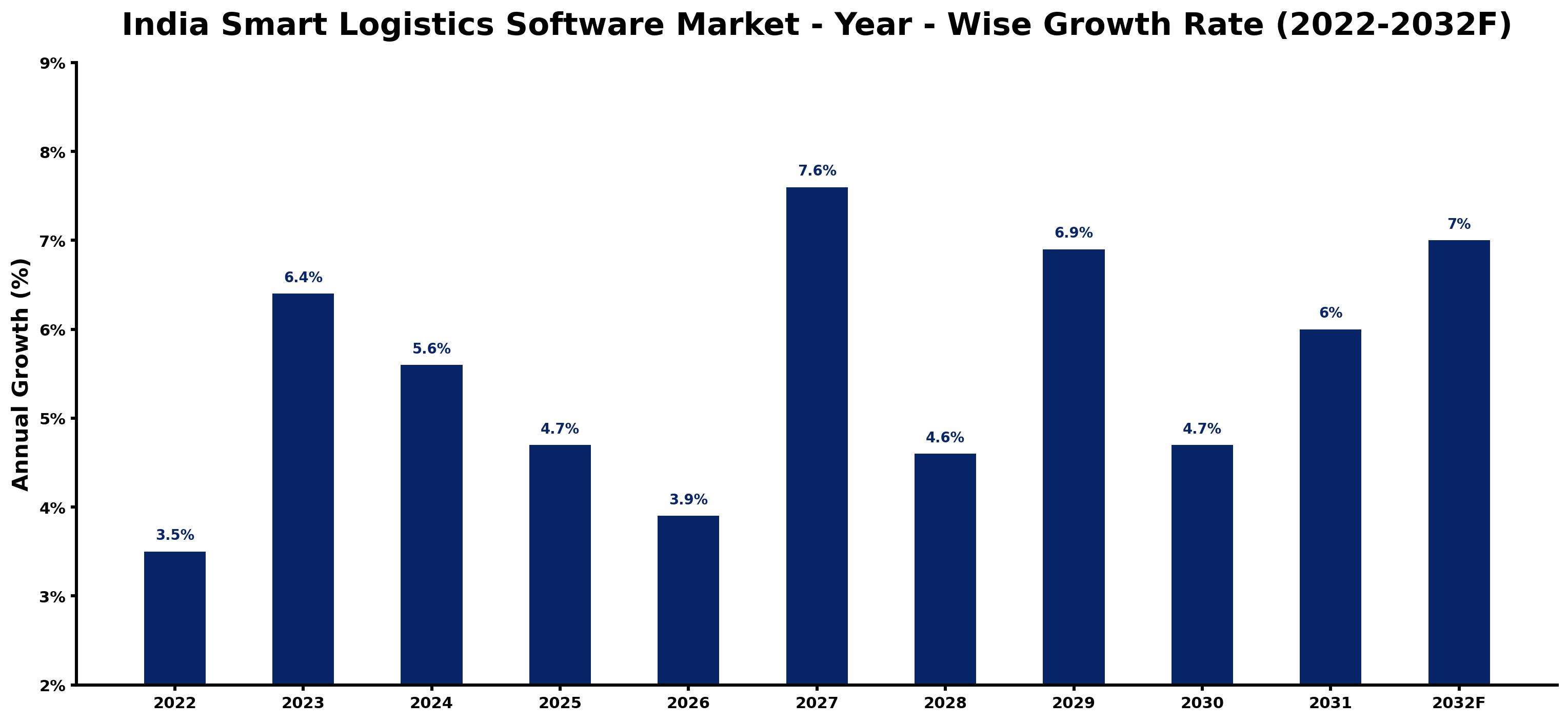
Annual growth estimates for each year appear below with the principal reason behind them, explaining the shifts that set the pace of the market.
| Year | Estimated Annual Growth (%) | Market Rationale |
| 2022 | 3.5 | The logistics sector saw steady growth driven by rising domestic demand from e-commerce firms. |
| 2023 | 6.4 | Accelerated growth stemmed from increased e-commerce activity and logistics investments from various sectors. |
| 2024 | 5.6 | A slowdown occurred as logistics firms adjusted to market conditions following rapid growth. |
| 2025 | 4.7 | Market expansion continued but at a slower pace due to operational challenges faced by firms. |
| 2026 | 3.9 | Demand growth is anticipated to decelerate as firms focus on efficiency improvements and integration. |
| 2027 | 7.6 | A rebound in growth will be driven by substantial investments in technology and infrastructure. |
| 2028 | 4.6 | Growth is projected to slow again as the market stabilises after rapid expansion periods. |
| 2029 | 6.9 | Increased demand from logistics companies will lead to a faster growth rate as e-commerce expands. |
| 2030 | 4.7 | Growth will slow as firms face challenges in scaling operations efficiently to meet demand. |
| 2031 | 6.0 | A resurgence in growth will be supported by rising e-commerce demands and improved logistics solutions. |
| 2032 | 7.0 | The market is expected to grow as logistics firms adopt advanced technologies and real-time tracking. |
Note: Market size estimations and growth projections presented in this report are based on 6Wresearch's proprietary forecasting methodology, utilizing the latest available industry data, government publications, and primary research inputs.
India Smart Logistics Software Market Synopsis
The Smart Logistics Software Market in India encompasses various technological solutions designed to optimise logistics operations through route optimisation, inventory management, and last-mile delivery. Key buyers include logistics companies, e-commerce firms, and supply chain managers. This market is expanding due to strong domestic demand driven by the e-commerce sector, projected to reach $200 billion by 2026, alongside the National Logistics Policy aiming to improve efficiency in logistics operations.
Market Dynamics Impact Analysis (2026–2032)
| Factor | Type | Impact | Primary Segment Affected |
| Increasing e-commerce activity drives demand for logistics solutions. | Driver | High | E-Commerce Firms |
| Investment in logistics infrastructure enhances operational capabilities. | Driver | High | Logistics Companies |
| The logistics sector is expanding rapidly, creating opportunities for software providers. | Opportunity | High | Logistics Companies |
| Growing demand for real-time tracking solutions presents a market gap. | Opportunity | High | Transport Aggregators |
| High competition among software providers can limit pricing power. | Restraint | Medium | Route Optimization AI |
| Skill gaps in the workforce may hinder the adoption of advanced solutions. | Restraint | Medium | Logistics Companies |
| The Smart Logistics Software Market in India faces challenges from outdated systems. | Challenge | High | Logistics Companies |
| Integration issues with existing systems can delay software implementation. | Challenge | Medium | E-Commerce Firms |
Evaluation of Drivers in India Smart Logistics Software Market (2026–2032)
Key forces behind demand, with the segment each one moves most, are listed below.
| Drivers | Primary Segment Affected | Why It Matters (Evidence) |
| Rising e-commerce sales increase demand for logistics software solutions. | E-Commerce Firms | The e-commerce market in India is expected to grow to $200 billion by 2026, driving logistics demand. |
| Investment in logistics parks improves operational efficiency. | Logistics Companies | India has over 1,000 logistics parks, enhancing infrastructure and service delivery capabilities. |
| Adoption of real-time tracking solutions boosts operational transparency. | Transport Aggregators | Over 60% of logistics firms in India are adopting real-time tracking solutions to improve service. |
| Government initiatives support logistics sector growth. | Logistics Companies | The National Logistics Policy aims to reduce logistics costs to 8% of GDP by 2025, encouraging investment. |
| Technological advancements in AI improve logistics efficiency. | Logistics Companies | AI-driven solutions are critical for optimising routes and managing inventory effectively. |
Market growth for Smart Logistics Software in India is underpinned by rising e-commerce sales, increased investments in logistics parks, and the adoption of real-time tracking solutions. E-commerce sales are driving logistics demand as firms seek to improve delivery capabilities. With over 1,000 logistics parks across the country, operational efficiency improves, allowing logistics firms to serve customers better. More than 60% of logistics firms are adopting real-time tracking solutions, which boosts transparency and customer satisfaction. Investments in AI technologies will streamline operations, leading to increased spending on logistics software.
Evaluation of Restraints in India Smart Logistics Software Market
The table below lists the restraints and the evidence behind each.
| Market Restraint | Primary Segment Affected | Why It Matters (Evidence) |
| High competition among software providers limits pricing power. | Route Optimization AI | Intense competition can lead to price wars, impacting profit margins for providers. |
| Skill gaps in the workforce hinder the adoption of advanced solutions. | Logistics Companies | The Logistics Skill Council aims to train 1 million workers by 2025, addressing skill shortages. |
| Integration issues with existing systems can delay software implementation. | E-Commerce Firms | Many firms struggle to integrate new solutions with legacy systems, causing delays. |
| Outdated systems limit operational efficiency. | Logistics Companies | Many logistics firms continue to rely on legacy systems that hinder performance. |
| Regulatory compliance can increase operational costs. | Logistics Companies | Compliance with standards like ISO 9001 requires investment in quality management. |
India Smart Logistics Software Market Challenges
The India Smart Logistics Software Market faces fierce competition, with numerous providers competing for market share, resulting in aggressive pricing strategies that squeeze profit margins for suppliers. Compliance with regulations, such as ISO 9001, can delay software deployment, costing buyers valuable time in a sector that relies on promptness. Buyers encounter challenges in integrating advanced technologies, as over 60% of logistics firms lack real-time tracking capabilities, causing operational delays. Rising logistics infrastructure costs, highlighted by the government's ₹1,000 crore investment in 2023, impose additional financial pressures on producers, ultimately increasing software prices for end-users.
Trends in the India Smart Logistics Software Market
Buyers and suppliers in the India Smart Logistics Software Market are adjusting to the following trends.
- Shift towards Real-Time Tracking Solutions: The adoption of real-time tracking solutions is on the rise among logistics firms, with over 60% currently utilising these technologies. This shift enhances operational transparency and customer satisfaction.
- E-Commerce Firms Emphasising Logistics Efficiency: E-commerce firms are placing greater emphasis on logistics efficiency to meet escalating customer expectations. This trend aligns with the anticipated growth of the e-commerce market to $200 billion by 2026.
- Integration of AI in Logistics Operations: The integration of AI technologies in logistics operations is becoming increasingly common, with firms leveraging AI for route optimisation and inventory management. This trend is driven by the necessity for improved operational efficiency.
- Government Initiatives Supporting Logistics Infrastructure: The National Logistics Policy aims to improve logistics infrastructure across India, targeting a reduction in logistics costs to 8% of GDP by 2025. This policy is set to drive notable advancements in the sector.
Investment Opportunities in the India Smart Logistics Software Market
The following opportunities in the India Smart Logistics Software Market pair current demand with a clear way in.
- Gap in Real-Time Tracking Solutions: With over 60% of logistics firms adopting real-time tracking, there exists an opportunity for software providers to address this gap. The demand for transparency in logistics operations is fuelling this need.
- Investment in AI-Driven Logistics Software: Investing in AI-driven logistics software can enhance operational efficiency. Logistics companies are increasingly seeking solutions that optimise routes and manage inventory effectively.
- E-Commerce Firms Seeking Efficient Logistics Solutions: E-commerce firms require advanced logistics solutions to handle their growing delivery demands. This presents an opportunity for software providers to serve this expanding market.
- Timing for Logistics Infrastructure Development: The government's allocation of ₹1,000 crore for logistics infrastructure development in 2023 presents a timely opportunity for investment in logistics solutions. This funding will bolster operational capabilities across the sector.
Government Initiatives in the India Smart Logistics Software Market
The National Logistics Policy, launched by the Ministry of Commerce in 2022, aims to reduce logistics costs to 8% of GDP by 2025. This policy encourages logistics firms to adopt more efficient practices and invest in technology, ultimately improving operational efficiency. Compliance with this policy will be essential for firms seeking to remain competitive in the market. The government also focuses on enhancing logistics infrastructure, which is vital for supporting the growing demand in the sector.
In 2023, the government allocated ₹1,000 crore for logistics infrastructure development, administered by the Ministry of Road Transport and Highways. This funding supports projects aimed at improving logistics connectivity and efficiency across various states. Additionally, the Logistics Skill Council, established in 2020, is focused on training 1 million workers by 2025, ensuring that the workforce is equipped with the necessary skills to meet the demands of the evolving logistics sector.
Future Insight of the India Smart Logistics Software Market
By 2032, suppliers and buyers in the India Smart Logistics Software Market will experience substantial advancements driven by the National Logistics Policy and the Smart Cities Mission, which focus on improving urban logistics frameworks. The e-commerce sector is projected to grow to $200 billion by 2026, further amplifying the need for efficient logistics solutions. The uptake of real-time tracking solutions is likely to increase, enhancing delivery performance and operational workflows. Initiatives from the Logistics Skill Council will cultivate a more skilled workforce, preparing the industry for future technological challenges.
Market Segmentation Analysis
The analysis below covers each segmentation, its leading category in 2025 and its fastest-growing category through 2032.
By Software Type – Route Optimization AI Dominated, Last-Mile Tracking Expected to Grow Fastest
According to Dhaval Chaurasia, Assistant Manager at 6Wresearch, with a 38% revenue share in 2025, Route Optimization AI was the largest software type category. Route Optimization holds the largest market share in India because it is essential for improving delivery efficiency and reducing operational costs. The e-commerce market's expected growth to $200 billion by 2026 significantly boosts the demand for this software. Over 2026–2032, Last-Mile Tracking is expected to post the fastest growth, at a CAGR of 8.1%. Last-Mile Tracking is experiencing rapid growth as it directly addresses the critical need for timely deliveries and customer satisfaction. With over 60% of logistics firms adopting real-time tracking solutions, this trend is set to continue expanding. Suppliers should focus on developing advanced tracking solutions to meet the increasing demand from logistics firms.
By Smart Feature – Live Delivery Visibility Dominated and Is Expected to Record the Fastest Growth
In 2025, Live Delivery Visibility led the smart feature split with a 42% share. Live Delivery Visibility commands a significant market share due to its crucial role in maintaining transparency in logistics operations. This feature is increasingly sought after by logistics firms aiming to enhance customer trust and service quality. Live Delivery Visibility is also forecast to expand faster than any other category, at a CAGR of 7.2% over 2026–2032. As Live Delivery Visibility is both the leader and fastest-growing feature, its importance will continue to expand with rising expectations for transparency in delivery processes. This dual role reinforces its critical position in the market. Buyers will benefit from investing in solutions that offer enhanced visibility to stay competitive in the logistics sector.
By Integration Platform – GPS + Predictive Models Dominated, IoT + Cloud Expected to Grow Fastest
GPS + Predictive Models accounted for a 41% market share by integration platform in 2025. GPS + Predictive Models dominate the market share as they are foundational for route optimization and fleet management, which are crucial for logistics firms. Their established use in over 1,000 logistics parks across India underscores their importance in operational efficiency. The quickest growth will come from IoT + Cloud, forecast to expand at a CAGR of 7.9% between 2026 and 2032. The IoT + Cloud integration platform is experiencing rapid growth as it supports logistics operations within a broader technological ecosystem. Its adoption is vital for firms looking to leverage advanced data analytics and connectivity. Suppliers should prioritise developing IoT and cloud-based solutions to cater to the evolving needs of logistics companies.
By End User – E-Commerce Firms Dominated, Logistics Companies Expected to Grow Fastest
E-Commerce Firms took a 42% share of end user in 2025, more than any other category. E-Commerce Firms represent the largest share of the market as they are major users of smart logistics solutions driven by high delivery demands. The growth of e-commerce in India necessitates advanced logistics software to efficiently manage increasing volumes. Logistics Companies are set to record the highest CAGR in this split, 7.0% over 2026–2032. Logistics Companies are the fastest-growing segment as they increasingly adopt smart logistics solutions to enhance operational efficiency. Their direct engagement with logistics software positions them well for future growth as demand escalates. Suppliers must tailor their offerings to meet the specific needs of logistics companies to capitalise on this growth opportunity.
Key Attractiveness of the Report
- 10 Years of Market Numbers
- Historical Data Starting from 2022 to 2025
- Base Year 2025
- Forecast Data until 2032
- Key Performance Indicators Impacting the Market
- Major Upcoming Developments and Projects
Key Highlights of the Report:
- India Smart Logistics Software Market Outlook
- Market Size of India Smart Logistics Software Market, 2025
- Forecast of India Smart Logistics Software Market, 2032
- Historical Data and Forecast of India Smart Logistics Software Revenues & Volume for the Period 2022 - 2032F
- India Smart Logistics Software Market Trend Evolution
- India Smart Logistics Software Market Drivers and Challenges
- India Smart Logistics Software Price Trends
- India Smart Logistics Software Porter's Five Forces
- India Smart Logistics Software Industry Life Cycle
- Historical Data and Forecast of India Smart Logistics Software Market Revenues & Volume By Software Type for the Period 2022 - 2032F
- Historical Data and Forecast of India Smart Logistics Software Market Revenues & Volume By Route Optimization AI for the Period 2022 - 2032F
- Historical Data and Forecast of India Smart Logistics Software Market Revenues & Volume By Inventory AI Modules for the Period 2022 - 2032F
- Historical Data and Forecast of India Smart Logistics Software Market Revenues & Volume By Last-Mile Tracking for the Period 2022 - 2032F
- Historical Data and Forecast of India Smart Logistics Software Market Revenues & Volume By Fleet Efficiency Tools for the Period 2022 - 2032F
- Historical Data and Forecast of India Smart Logistics Software Market Revenues & Volume By Smart Feature for the Period 2022 - 2032F
- Historical Data and Forecast of India Smart Logistics Software Market Revenues & Volume By Real-Time Traffic Adjustment for the Period 2022 - 2032F
- Historical Data and Forecast of India Smart Logistics Software Market Revenues & Volume By Demand-Based Reallocation for the Period 2022 - 2032F
- Historical Data and Forecast of India Smart Logistics Software Market Revenues & Volume By Live Delivery Visibility for the Period 2022 - 2032F
- Historical Data and Forecast of India Smart Logistics Software Market Revenues & Volume By Fuel + Maintenance Analytics for the Period 2022 - 2032F
- Historical Data and Forecast of India Smart Logistics Software Market Revenues & Volume By Integration Platform for the Period 2022 - 2032F
- Historical Data and Forecast of India Smart Logistics Software Market Revenues & Volume By GPS + Predictive Models for the Period 2022 - 2032F
- Historical Data and Forecast of India Smart Logistics Software Market Revenues & Volume By ERP Systems for the Period 2022 - 2032F
- Historical Data and Forecast of India Smart Logistics Software Market Revenues & Volume By App + Dashboard for the Period 2022 - 2032F
- Historical Data and Forecast of India Smart Logistics Software Market Revenues & Volume By IoT + Cloud for the Period 2022 - 2032F
- Historical Data and Forecast of India Smart Logistics Software Market Revenues & Volume By End User for the Period 2022 - 2032F
- Historical Data and Forecast of India Smart Logistics Software Market Revenues & Volume By Logistics Companies for the Period 2022 - 2032F
- Historical Data and Forecast of India Smart Logistics Software Market Revenues & Volume By Supply Chain Managers for the Period 2022 - 2032F
- Historical Data and Forecast of India Smart Logistics Software Market Revenues & Volume By E-Commerce Firms for the Period 2022 - 2032F
- Historical Data and Forecast of India Smart Logistics Software Market Revenues & Volume By Transport Aggregators for the Period 2022 - 2032F
- India Smart Logistics Software Import Export Trade Statistics
- Market Opportunity Assessment By Software Type
- Market Opportunity Assessment By Smart Feature
- Market Opportunity Assessment By Integration Platform
- Market Opportunity Assessment By End User
- India Smart Logistics Software Top Companies Market Share
- India Smart Logistics Software Competitive Benchmarking By Technical and Operational Parameters
- India Smart Logistics Software Company Profiles
- India Smart Logistics Software Key Strategic Recommendations
Market Covered
The report offers an extensive study of the following market segments.
By Software Type
- Route Optimization AI
- Inventory AI Modules
- Last-Mile Tracking
- Fleet Efficiency Tools
By Smart Feature
- Real-Time Traffic Adjustment
- Demand-Based Reallocation
- Live Delivery Visibility
- Fuel + Maintenance Analytics
By Integration Platform
- GPS + Predictive Models
- ERP Systems
- App + Dashboard
- IoT + Cloud
By End User
- Logistics Companies
- Supply Chain Managers
- E-Commerce Firms
- Transport Aggregators































