China Smart Logistics Software Market Size & Growth Rate
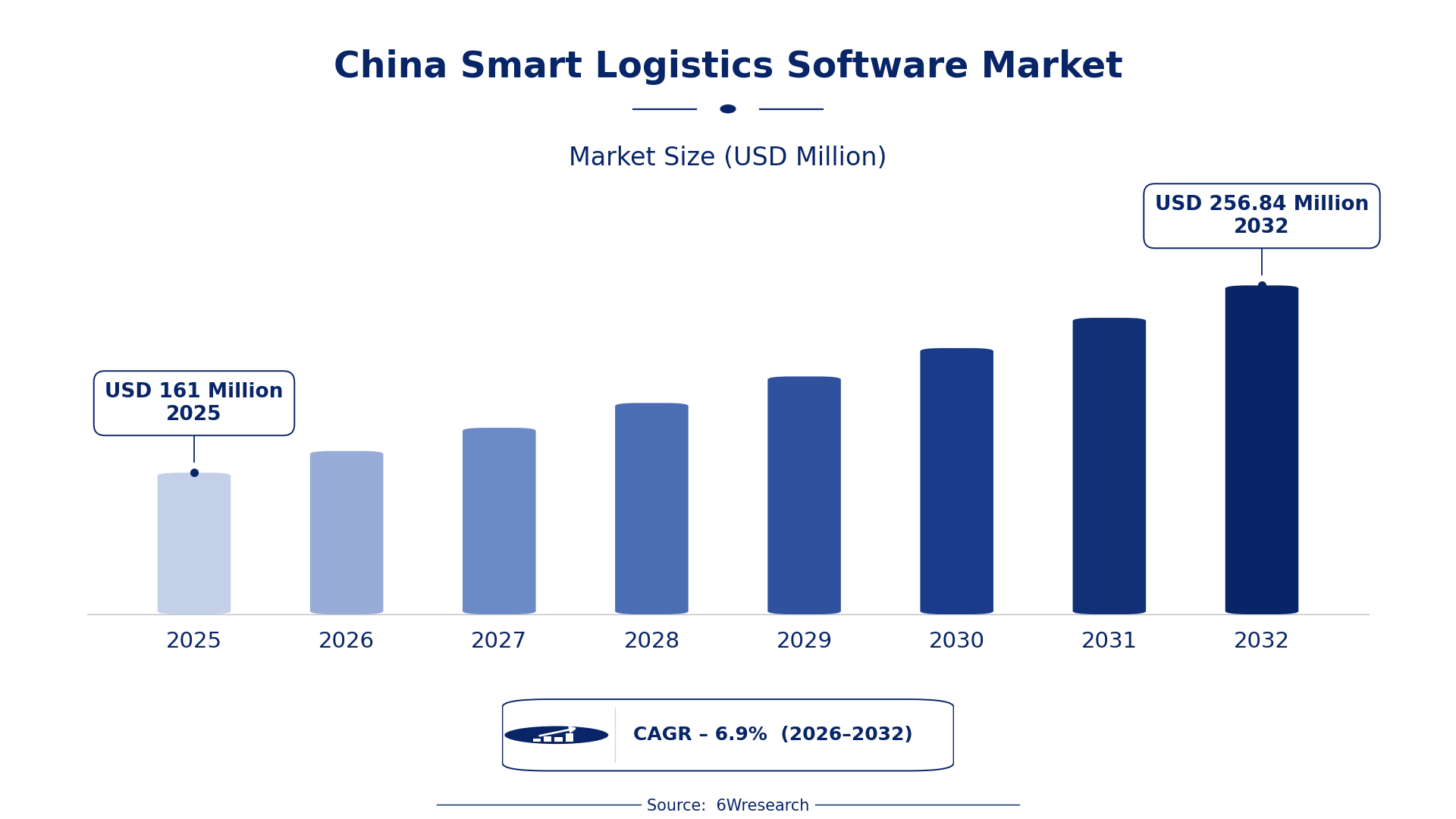
According to 6Wresearch internal database and industry insights, the China Smart Logistics Software Market was valued at USD 161.0 million in 2025 and is projected to reach USD 256.84 million by 2032, growing at a CAGR of approximately 6.9% during 2026–2032.
China Smart Logistics Software Market Highlights
| Report Metric | Details |
| Report Name | China Smart Logistics Software Market |
| Market Size 2025 | USD 161.0 million |
| Market Size 2032 | USD 256.84 million |
| Absolute Growth 2025–2032 | USD 95.84 million |
| CAGR 2026–2032 | 6.9% |
| Peak Annual Growth | 9.5% in 2026 |
| Forecast Period | 2026–2032 |
| Historical Data | 2022–2025 |
| Base Year | 2025 |
| Leading Software Type, 2025 | Route Optimization AI (37% share) |
| Leading Smart Feature, 2025 | Real-Time Traffic Adjustment (35% share) |
| Leading Integration Platform, 2025 | GPS + Predictive Models (36% share) |
| Leading End User, 2025 | Logistics Companies (43% share) |
| Fastest-Growing Software Type | Last-Mile Tracking (9.0% CAGR) |
| Fastest-Growing Smart Feature | Live Delivery Visibility (9.0% CAGR) |
| Fastest-Growing End User | E-Commerce Firms (9.5% CAGR) |
| Growing Sector | Logistics |
| Key End Users | Logistics Companies, E-Commerce Firms, Supply Chain Managers, Transport Aggregators |
China Smart Logistics Software Market Year-wise Growth Rate and Key Drivers (2022–2032)
This graph illustrates the annual growth rates of the market from 2022 to 2032, highlighting a steady upward trajectory and projected market expansion over the forecast period.
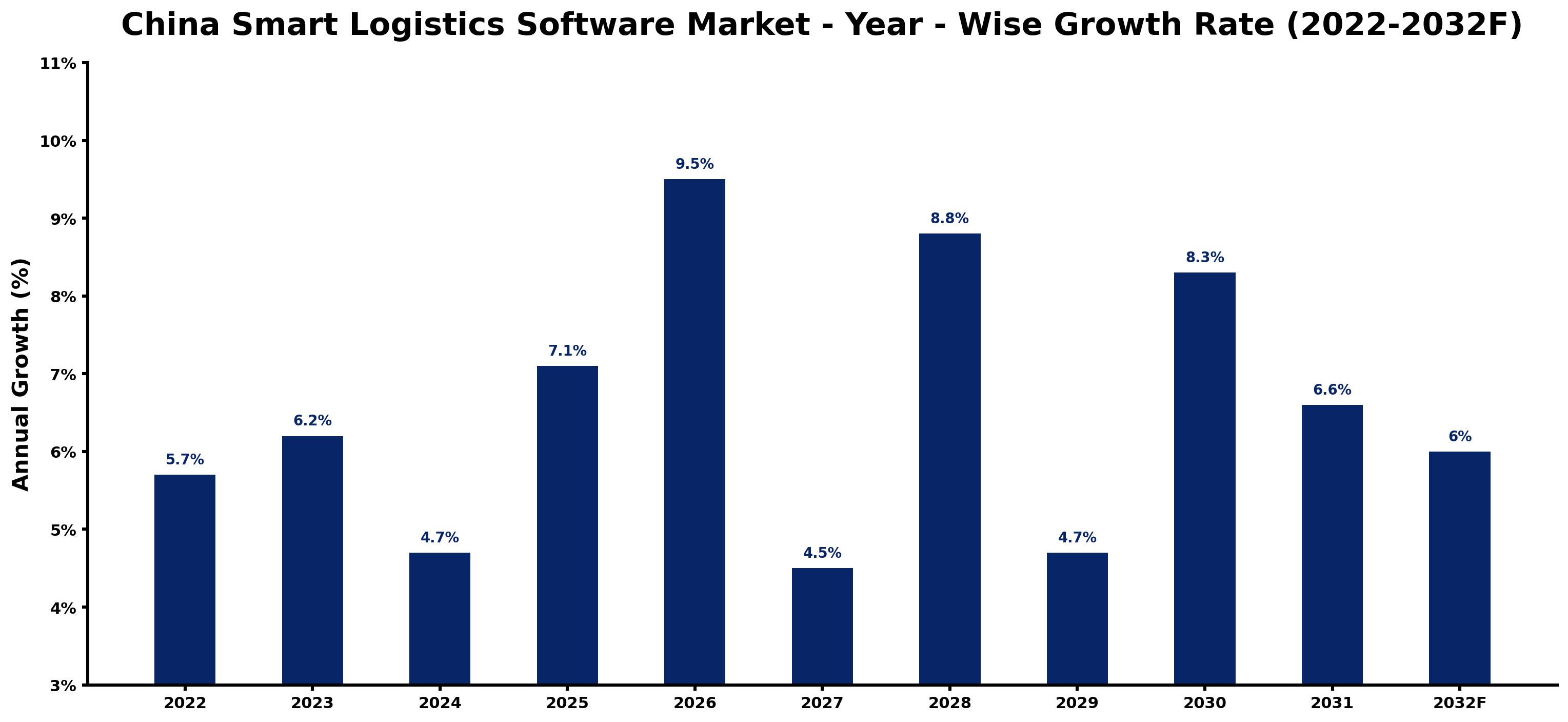
The table below sets out the estimated growth rate for each year and the main factor behind it.
| Year | Estimated Annual Growth (%) | Market Rationale |
| 2022 | 5.7 | The market experienced steady growth due to increasing adoption of smart logistics solutions among logistics firms. |
| 2023 | 6.2 | Demand accelerated as e-commerce surged, prompting logistics companies to invest in operational efficiency. |
| 2024 | 4.7 | Growth slowed as firms faced integration challenges with existing systems and technologies. |
| 2025 | 7.1 | The market rebounded with substantial investments in smart logistics software following the 'Smart Logistics Development Plan'. |
| 2026 | 9.5 | A peak in growth is expected as logistics firms rapidly adopt advanced software solutions to optimise operations. |
| 2027 | 4.5 | Growth will decelerate as the market begins to stabilise after the initial surge in adoption. |
| 2028 | 8.8 | Demand is projected to increase again as logistics companies focus on enhancing last-mile delivery efficiency. |
| 2029 | 4.7 | Growth will slow as the market adjusts to the saturation of initial software implementations. |
| 2030 | 8.3 | A resurgence in demand is expected, driven by the ongoing expansion of e-commerce and logistics services. |
| 2031 | 6.6 | Growth will moderate as companies refine their logistics strategies and software capabilities. |
| 2032 | 6.0 | The market is projected to continue growing as firms invest in innovative technologies to improve logistics efficiency. |
Note: Market size estimations and growth projections presented in this report are based on 6Wresearch's proprietary forecasting methodology, utilizing the latest available industry data, government publications, and primary research inputs.
China Smart Logistics Software Market Synopsis
The China Smart Logistics Software Market includes digital solutions that optimise logistics operations through technologies like AI and IoT. This software manages inventory, tracks deliveries in real-time, and improves route efficiency. Rapid growth is underway, driven by the booming e-commerce sector, projected to exceed 40 trillion yuan by 2025. Over 70% of logistics companies are embracing smart solutions to boost efficiency, supported by the 'Smart Logistics Development Plan' aimed at refining operational processes.
Market Dynamics Impact Analysis (2026–2032)
| Factor | Type | Impact | Primary Segment Affected |
| Increasing adoption of AI technologies in logistics operations | Driver | High | Route Optimization AI |
| Growth in e-commerce driving demand for logistics solutions | Driver | High | Last-Mile Tracking |
| Emerging demand for real-time delivery tracking solutions | Opportunity | Medium | Live Delivery Visibility |
| Investment in logistics parks and infrastructure development | Opportunity | High | Fleet Efficiency Tools |
| Integration challenges with legacy systems | Restraint | High | Inventory AI Modules |
| High competition among logistics software providers | Restraint | Medium | GPS + Predictive Models |
| Shortage of skilled personnel in smart logistics | Challenge | High | Logistics Companies |
| Rapid technological advancements leading to obsolescence | Challenge | Medium | E-Commerce Firms |
Evaluation of Drivers in China Smart Logistics Software Market (2026–2032)
The table below links each growth driver to the segment it affects and the evidence for it.
| Drivers | Primary Segment Affected | Why It Matters (Evidence) |
| Growing investment in AI technologies for logistics | Route Optimization AI | This investment improves delivery efficiency, with logistics companies increasing their software budgets by 20% in 2023. |
| Surge in e-commerce activities | Last-Mile Tracking | The e-commerce sector's projected value of over 40 trillion yuan by 2025 drives demand for efficient last-mile solutions. |
| Rising need for real-time tracking capabilities | Live Delivery Visibility | Integration of real-time tracking technologies in 60% of logistics operations boosts customer satisfaction. |
| Government initiatives promoting smart logistics | Fleet Efficiency Tools | The 'Smart Logistics Development Plan' aims for a 20% efficiency improvement by 2025, encouraging software adoption. |
| Expansion of logistics parks in key regions | GPS + Predictive Models | Over 200 logistics parks are implementing smart solutions, increasing demand for advanced route planning technologies. |
Expansion of the Smart Logistics Software market in China is backed by rising investment in AI technologies, which improves delivery efficiency and drives demand. The e-commerce sector, projected to exceed 40 trillion yuan by 2025, fuels the need for efficient logistics solutions. In 2023, logistics companies increased their software budgets by 20%, reflecting their commitment to adopting advanced technologies. The integration of real-time tracking technologies in 60% of logistics operations has improved customer satisfaction. The 'Digital Economy Development Strategy' aims for a 20% efficiency improvement by 2025, further encouraging software adoption.
Evaluation of Restraints in China Smart Logistics Software Market
The following restraints limit how fast demand can grow.
| Market Restraint | Primary Segment Affected | Why It Matters (Evidence) |
| Integration challenges with existing legacy systems | Inventory AI Modules | Many logistics firms struggle to integrate new software with outdated systems, causing operational delays. |
| Intense competition among software providers | GPS + Predictive Models | High competition pressures pricing and innovation, making it difficult for new entrants to gain market share. |
| Shortage of skilled personnel in smart logistics | Logistics Companies | The logistics workforce is estimated at 30 million, yet there is a growing need for skilled personnel in smart logistics. |
| Rapid technological advancements leading to obsolescence | E-Commerce Firms | E-commerce firms face challenges in keeping up with fast-paced technology changes, risking outdated systems. |
| High initial investment costs for software adoption | Last-Mile Tracking | Logistics companies often hesitate to invest due to the significant upfront costs associated with new technologies. |
China Smart Logistics Software Market Challenges
Buyers and suppliers in the China Smart Logistics Software market encounter a pressing skills shortage, with around 30 million workers lacking proficiency in advanced digital solutions. This issue arises from the rapid pace of technological change, causing delays in software adoption and increasing operational costs for producers. Technology integration presents another challenge, as over 70% of logistics firms are still in the process of implementing smart solutions, which hampers efficiency and raises expenses for buyers. Supply chain disruptions are exacerbated by reliance on outdated methods, leading to delivery delays that negatively impact customer satisfaction and loyalty.
Trends in the China Smart Logistics Software Market
Below mentioned are some of the trends shaping the China Smart Logistics Software Market growth.
- Shift Towards Real-Time Tracking: Logistics companies are increasingly adopting real-time tracking technologies to enhance delivery visibility. In 2023, 60% of logistics operations integrated such technologies, boosting customer satisfaction and operational transparency.
- Growing Focus on AI Integration: The logistics sector is prioritising AI technologies for operational efficiency. The 'Smart Logistics Development Plan' initiated in 2022 aims to improve logistics efficiency by 20% by 2025, driving further investment in AI solutions.
- Increased Demand for Last-Mile Solutions: As e-commerce continues to expand, the demand for last-mile tracking solutions has surged. Last-mile delivery services saw a 15% increase in urban areas in 2023, underscoring the need for efficient logistics.
- Expansion of Logistics Parks: China is seeing a rise in logistics parks, particularly in Guangdong province, which hosts numerous e-commerce firms. Over 200 logistics parks are implementing smart solutions, enhancing overall logistics capabilities.
Investment Opportunities in the China Smart Logistics Software Market
Investors looking at the China Smart Logistics Software Market should consider the following areas.
- Investment in Logistics Parks: Guangdong province is a major hub for logistics companies, hosting numerous e-commerce firms. With over 200 logistics parks implementing smart solutions, there is a strong opportunity to invest in infrastructure development.
- Partnerships for Software Integration: Logistics companies are seeking partners for software integration, particularly for AI and IoT technologies. Establishing joint ventures can facilitate entry into this growing market, supported by the 'Smart Logistics Development Plan'.
- Supply of Last-Mile Tracking Solutions: With the e-commerce sector projected to exceed 40 trillion yuan by 2025, there is a strong demand for last-mile tracking solutions. Companies can provide innovative technologies to logistics firms focusing on efficiency.
- Development of AI-Driven Software: The ongoing push for AI integration in logistics presents an opportunity to develop AI-driven software solutions. The 'Smart Supply Chain Innovation Action Plan' encourages innovation, making it an ideal time to invest.
Government Initiatives in the China Smart Logistics Software Market
The 'Smart Logistics Development Plan' launched by the Ministry of Transport in 2022 aims to improve logistics efficiency by 20% by 2025. This plan encourages logistics companies to adopt smart technologies and streamline operational processes. Additionally, the 'Digital Economy Development Strategy' approved by the National Development and Reform Commission in 2021 promotes the integration of AI in logistics, further supporting the growth of smart logistics software. These measures collectively aim to modernise the logistics sector and drive efficiency improvements.
The National Development and Reform Commission oversees the implementation of the 'Digital Economy Development Strategy', which funds projects aimed at promoting smart logistics technologies. The Ministry of Transport also approves initiatives under the 'Smart Logistics Development Plan', focusing on enhancing logistics efficiency. In 2023, the State Council introduced the 'Green Logistics Development Plan', which encourages sustainable practices in logistics operations, targeting a 30% reduction in carbon emissions by 2030. These agencies play a vital role in funding and approving projects that improve logistics capabilities.
Future Insight of the China Smart Logistics Software Market
The China Smart Logistics Software market will undergo transformative changes by 2032, driven by the 'Smart Logistics Development Plan' aiming for a 30% efficiency improvement. Real-time tracking technologies will be integrated into 70% of logistics operations, enhancing delivery accuracy and customer service. The 'National Intelligent Logistics System' will promote the integration of AI and IoT, streamlining processes and reducing costs for both buyers and suppliers. The government's 'Digital Economy Development Strategy' will further accelerate the adoption of smart logistics technologies, encouraging innovation and competitiveness in the industry.
Market Segmentation Analysis
The report offers a comprehensive study of the following market segments and their leading categories in the market.
By Software Type – Route Optimization AI Dominated, Last-Mile Tracking Expected to Grow Fastest
According to Dhaval Chaurasia, Assistant Manager at 6Wresearch, Route Optimization AI held a 37% share of the China Smart Logistics Software Market by software type in 2025. Route Optimization holds the largest share as it is essential for logistics companies aiming to improve delivery efficiency and reduce operational costs. For instance, over 70% of logistics firms in China have adopted this technology to streamline their operations. Last-Mile Tracking is projected to grow fastest, at a CAGR of 9.0% during 2026–2032. Last-Mile Tracking is experiencing rapid growth due to the increasing demand for enhanced customer satisfaction and visibility in delivery processes. The Ministry of Transport reported a 15% rise in last-mile delivery services in urban areas in 2023, driving this trend. This indicates that suppliers should focus on developing advanced last-mile tracking solutions to meet the growing expectations of logistics companies.
By Smart Feature – Real-Time Traffic Adjustment Dominated, Live Delivery Visibility Expected to Grow Fastest
With a 35% revenue share in 2025, Real-Time Traffic Adjustment was the largest smart feature category. Real-Time Traffic Adjustment has the largest share as it supports logistics operations by optimising routes based on current traffic conditions. This feature is crucial for logistics companies looking to enhance their operational efficiency and service delivery. Live Delivery Visibility is set to record the highest CAGR in this split, 9.0% over 2026–2032. Live Delivery Visibility is growing quickly as it directly addresses the need for improved customer communication and operational transparency. With the rise of e-commerce, real-time visibility has become vital for firms to keep customers informed about their orders. Suppliers must prioritise the development of live delivery visibility features to cater to the increasing demand from logistics providers.
By Integration Platform – GPS + Predictive Models Dominated and Is Expected to Record the Fastest Growth
GPS + Predictive Models accounted for a 36% market share by integration platform in 2025. GPS + Predictive Models dominates the market share as it is integral for effective route planning and efficiency in logistics operations. This combination allows logistics companies to anticipate delays and optimise their delivery routes effectively. The same category are also set to grow fastest, at a CAGR of 9.4% during 2026–2032. GPS + Predictive Models is also the fastest-growing segment, as its capabilities are increasingly recognised for enhancing operational efficiency. The ongoing integration of advanced technologies further supports its rapid adoption in the logistics sector. This suggests that suppliers should continue to innovate within the GPS and predictive modelling space to maintain competitive advantage.
By End User – Logistics Companies Dominated, E-Commerce Firms Expected to Grow Fastest
Logistics Companies took a 43% share of end user in 2025, more than any other category. Logistics Companies represent the largest share of the market as they are the primary users of smart logistics solutions, driving the demand for software that enhances operational efficiency. With China's logistics industry projected to reach 18 trillion yuan by 2025, these companies are pivotal in this growth. The quickest growth will come from E-Commerce Firms, forecast to expand at a CAGR of 9.5% between 2026 and 2032. E-Commerce Firms are the fastest-growing segment, relying heavily on logistics software for efficient order fulfilment in the booming online shopping sector. The e-commerce market in China is expected to exceed 40 trillion yuan by 2025, fuelling this demand. This highlights the need for suppliers to tailor solutions specifically for e-commerce firms to capitalise on their rapid growth.
Key Attractiveness of the Report
- 10 Years of Market Numbers
- Historical Data Starting from 2022 to 2025
- Base Year 2025
- Forecast Data until 2032
- Key Performance Indicators Impacting the Market
- Major Upcoming Developments and Projects
Key Highlights of the Report:
- China Smart Logistics Software Market Outlook
- Market Size of China Smart Logistics Software Market, 2025
- Forecast of China Smart Logistics Software Market, 2032
- Historical Data and Forecast of China Smart Logistics Software Revenues & Volume for the Period 2022 - 2032F
- China Smart Logistics Software Market Trend Evolution
- China Smart Logistics Software Market Drivers and Challenges
- China Smart Logistics Software Price Trends
- China Smart Logistics Software Porter's Five Forces
- China Smart Logistics Software Industry Life Cycle
- Historical Data and Forecast of China Smart Logistics Software Market Revenues & Volume By Software Type for the Period 2022 - 2032F
- Historical Data and Forecast of China Smart Logistics Software Market Revenues & Volume By Route Optimization AI for the Period 2022 - 2032F
- Historical Data and Forecast of China Smart Logistics Software Market Revenues & Volume By Inventory AI Modules for the Period 2022 - 2032F
- Historical Data and Forecast of China Smart Logistics Software Market Revenues & Volume By Last-Mile Tracking for the Period 2022 - 2032F
- Historical Data and Forecast of China Smart Logistics Software Market Revenues & Volume By Fleet Efficiency Tools for the Period 2022 - 2032F
- Historical Data and Forecast of China Smart Logistics Software Market Revenues & Volume By Smart Feature for the Period 2022 - 2032F
- Historical Data and Forecast of China Smart Logistics Software Market Revenues & Volume By Real-Time Traffic Adjustment for the Period 2022 - 2032F
- Historical Data and Forecast of China Smart Logistics Software Market Revenues & Volume By Demand-Based Reallocation for the Period 2022 - 2032F
- Historical Data and Forecast of China Smart Logistics Software Market Revenues & Volume By Live Delivery Visibility for the Period 2022 - 2032F
- Historical Data and Forecast of China Smart Logistics Software Market Revenues & Volume By Fuel + Maintenance Analytics for the Period 2022 - 2032F
- Historical Data and Forecast of China Smart Logistics Software Market Revenues & Volume By Integration Platform for the Period 2022 - 2032F
- Historical Data and Forecast of China Smart Logistics Software Market Revenues & Volume By GPS + Predictive Models for the Period 2022 - 2032F
- Historical Data and Forecast of China Smart Logistics Software Market Revenues & Volume By ERP Systems for the Period 2022 - 2032F
- Historical Data and Forecast of China Smart Logistics Software Market Revenues & Volume By App + Dashboard for the Period 2022 - 2032F
- Historical Data and Forecast of China Smart Logistics Software Market Revenues & Volume By IoT + Cloud for the Period 2022 - 2032F
- Historical Data and Forecast of China Smart Logistics Software Market Revenues & Volume By End User for the Period 2022 - 2032F
- Historical Data and Forecast of China Smart Logistics Software Market Revenues & Volume By Logistics Companies for the Period 2022 - 2032F
- Historical Data and Forecast of China Smart Logistics Software Market Revenues & Volume By Supply Chain Managers for the Period 2022 - 2032F
- Historical Data and Forecast of China Smart Logistics Software Market Revenues & Volume By E-Commerce Firms for the Period 2022 - 2032F
- Historical Data and Forecast of China Smart Logistics Software Market Revenues & Volume By Transport Aggregators for the Period 2022 - 2032F
- China Smart Logistics Software Import Export Trade Statistics
- Market Opportunity Assessment By Software Type
- Market Opportunity Assessment By Smart Feature
- Market Opportunity Assessment By Integration Platform
- Market Opportunity Assessment By End User
- China Smart Logistics Software Top Companies Market Share
- China Smart Logistics Software Competitive Benchmarking By Technical and Operational Parameters
- China Smart Logistics Software Company Profiles
- China Smart Logistics Software Key Strategic Recommendations
Market Covered
Segments analysed in this report are listed below.
By Software Type
- Route Optimization AI
- Inventory AI Modules
- Last-Mile Tracking
- Fleet Efficiency Tools
By Smart Feature
- Real-Time Traffic Adjustment
- Demand-Based Reallocation
- Live Delivery Visibility
- Fuel + Maintenance Analytics
By Integration Platform
- GPS + Predictive Models
- ERP Systems
- App + Dashboard
- IoT + Cloud
By End User
- Logistics Companies
- Supply Chain Managers
- E-Commerce Firms
- Transport Aggregators































