India Smart Manufacturing Equipment Market Size & Growth Rate
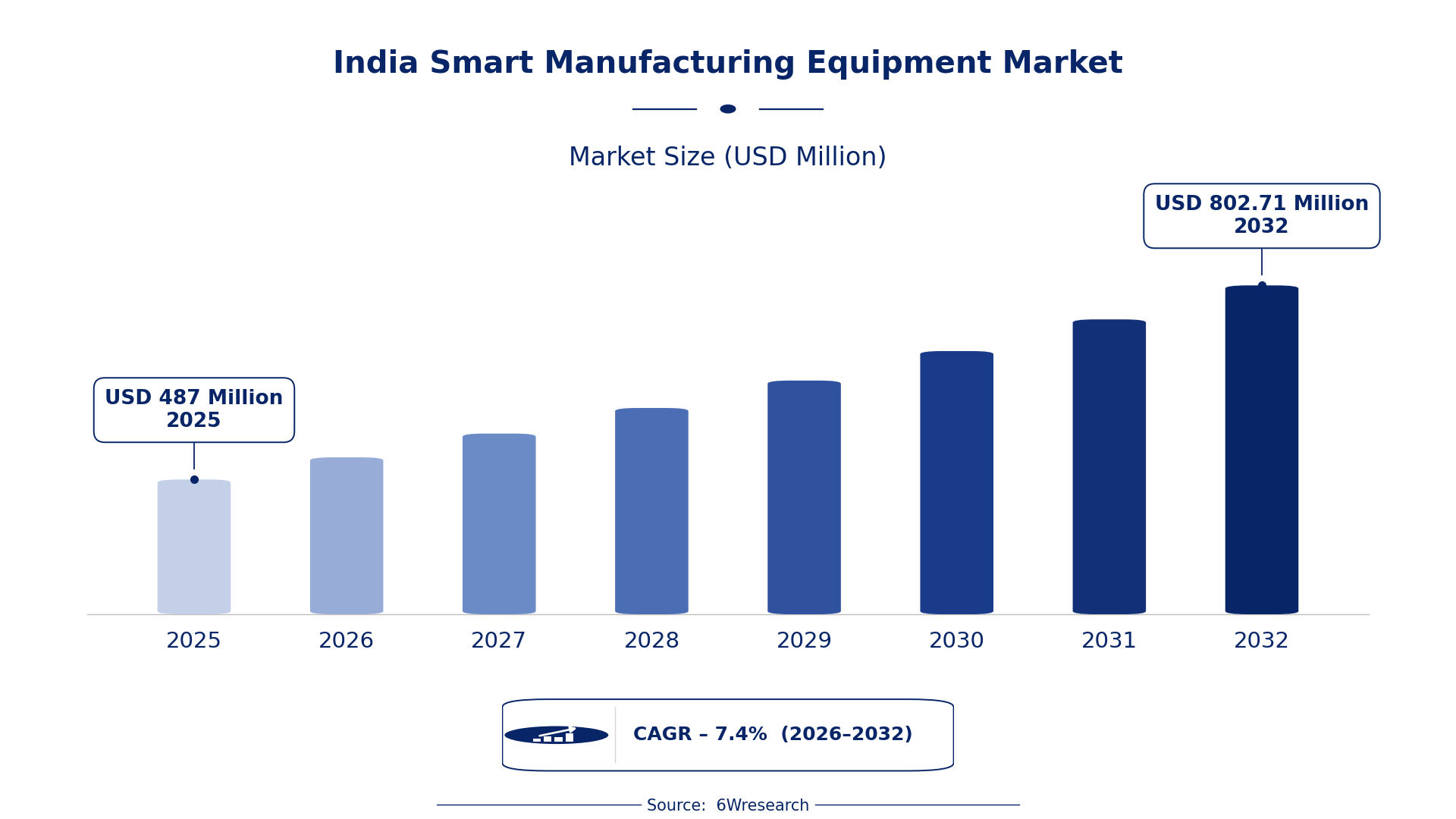
According to 6Wresearch internal database and industry insights, the India Smart Manufacturing Equipment Market was valued at USD 487.0 million in 2025 and is projected to reach USD 802.71 million by 2032, growing at a CAGR of approximately 7.4% during 2026–2032.
India Smart Manufacturing Equipment Market Highlights
| Report Metric | Details |
| Report Name | India Smart Manufacturing Equipment Market |
| Market Size 2025 | USD 487.0 million |
| Market Size 2032 | USD 802.71 million |
| Absolute Growth 2025–2032 | USD 315.71 million |
| CAGR 2026–2032 | 7.4% |
| Peak Annual Growth | 9.7% in 2030 |
| Forecast Period | 2026–2032 |
| Historical Data | 2022–2025 |
| Base Year | 2025 |
| Leading Equipment Type, 2025 | CNC Machines (42% share) |
| Leading Smart Feature, 2025 | Predictive Maintenance (44% share) |
| Leading Control Technology, 2025 | IoT + AI Monitoring (52% share) |
| Leading End User, 2025 | Automotive OEMs (43% share) |
| Fastest-Growing Equipment Type | Smart Welding Equipment (8.8% CAGR) |
| Fastest-Growing Smart Feature | Quality Control AI (9.6% CAGR) |
| Fastest-Growing Control Technology | Vision Sensors + ML (9.7% CAGR) |
| Fastest-Growing End User | Heavy Manufacturing (8.5% CAGR) |
| Growing Sector | Heavy Manufacturing |
| Key End Users | Automotive OEMs, Heavy Manufacturing, Industrial Robotics, Aerospace Plants |
India Smart Manufacturing Equipment Market Year-wise Growth Rate and Key Drivers (2022–2032)
This graph illustrates the annual growth rates of the market from 2022 to 2032, highlighting a steady upward trajectory and projected market expansion over the forecast period.
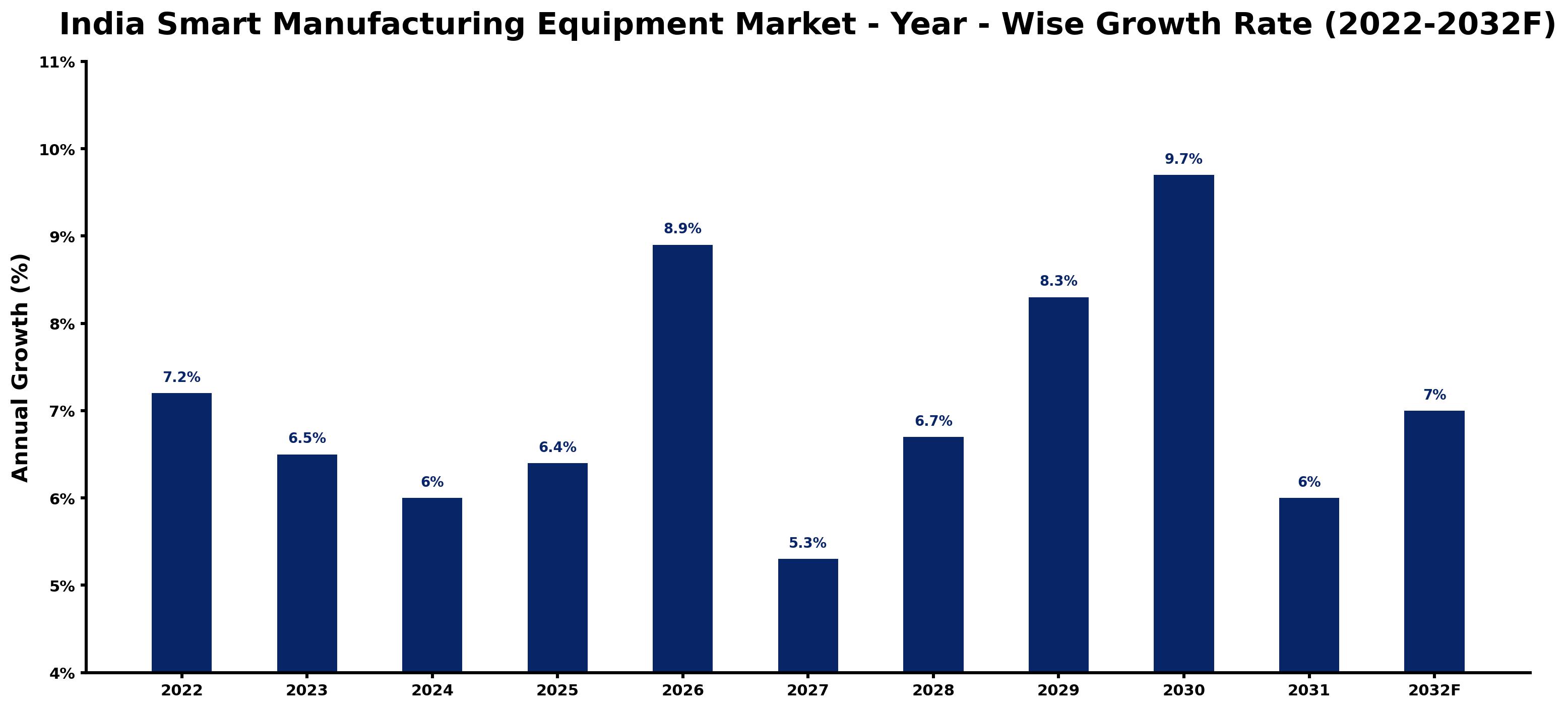
The table below sets out the estimated growth rate for each year and the main factor behind it.
| Year | Estimated Annual Growth (%) | Market Rationale |
| 2022 | 7.2 | The market experienced solid growth due to increasing adoption of smart technologies by manufacturers. |
| 2023 | 6.5 | Growth slowed as manufacturers adjusted to new technologies and market dynamics. |
| 2024 | 6.0 | The market continued to grow, albeit at a slower pace, as firms focused on efficiency. |
| 2025 | 6.4 | Growth accelerated as more manufacturers invested in smart equipment and automation. |
| 2026 | 8.9 | Demand surged with the rising implementation of IoT technologies across sectors. |
| 2027 | 5.3 | Growth slowed as companies faced challenges in integrating advanced systems. |
| 2028 | 6.7 | An increase in investments in smart manufacturing led to a rebound in growth. |
| 2029 | 8.3 | The market expanded further as manufacturers sought to enhance productivity. |
| 2030 | 9.7 | Peak growth occurred as the adoption of smart technologies reached new heights. |
| 2031 | 6.0 | Growth slowed as the market began to stabilise after rapid expansion. |
| 2032 | 7.0 | Demand increased again as manufacturers adapted to evolving technological needs. |
Note: Market size estimations and growth projections presented in this report are based on 6Wresearch's proprietary forecasting methodology, utilizing the latest available industry data, government publications, and primary research inputs.
India Smart Manufacturing Equipment Market Synopsis
Smart Manufacturing Equipment in India includes advanced machinery that integrates digital technologies to improve production efficiency. This equipment utilises IoT, AI, and automation systems, optimising processes and enhancing product quality. The India Smart Manufacturing Equipment Market is expanding due to initiatives like 'Make in India' and the National Manufacturing Policy, which aim to strengthen domestic manufacturing capabilities. By 2025, more than 70% of manufacturers are projected to invest in AI and machine learning technologies, further driving demand. The automotive and heavy manufacturing sectors are primary contributors to this growth.
Market Dynamics Impact Analysis (2026–2032)
| Factor | Type | Impact | Primary Segment Affected |
| Increasing adoption of IoT technologies among manufacturers | Driver | High | CNC Machines |
| Rising investments in automation and smart technologies | Driver | High | Smart Welding Equipment |
| Growing demand for advanced manufacturing solutions | Opportunity | High | 3D Printers with AI |
| Expansion of the automotive sector requiring precision manufacturing | Opportunity | High | Flexible Manufacturing Units |
| Challenges in workforce training for advanced technologies | Restraint | Medium | Industrial Robotics |
| High initial investment costs for smart manufacturing equipment | Restraint | High | Automotive OEMs |
| Integration issues with existing manufacturing processes | Challenge | High | Heavy Manufacturing |
| Limited awareness of smart technologies among small manufacturers | Challenge | Medium | Aerospace Plants |
Evaluation of Drivers in India Smart Manufacturing Equipment Market (2026–2032)
The main growth drivers and the segments they affect most are set out below.
| Drivers | Primary Segment Affected | Why It Matters (Evidence) |
| Growing demand for precision in manufacturing processes | CNC Machines | Over 50% of manufacturers are adopting IoT technologies, increasing purchases of CNC machines for greater precision. |
| Need for improved welding quality and efficiency | Smart Welding Equipment | The automotive sector's expansion drives demand for smart welding solutions, with a projected growth of 8.8% in this segment. |
| Rising need for rapid prototyping capabilities | 3D Printers with AI | The 3D printing market is projected to grow at a CAGR of 20% from 2023 to 2028, leading to increased demand for AI-integrated printers. |
| Demand for adaptable production lines | Flexible Manufacturing Units | The focus on efficiency in manufacturing processes is prompting higher investments in flexible manufacturing solutions, with growth expected in this area. |
| Focus on predictive maintenance to reduce downtime | Predictive Maintenance | More than 70% of manufacturers are investing in AI technologies, driving the need for predictive maintenance solutions. |
Market growth for Smart Manufacturing Equipment in India is underpinned by rising investments in automation, expanding demand from the automotive sector, and increasing adoption of IoT technologies. Many manufacturers are integrating IoT into their operations, which improves efficiency and drives the need for advanced equipment. The automotive sector is projected to account for 43% of the market share in 2025, resulting in higher demand for precision tools. The 3D printing market is anticipated to grow at a CAGR of 20% from 2023 to 2028, further increasing the need for AI-integrated printers. As manufacturers focus on reducing downtime, predictive maintenance solutions are becoming essential, with a majority of firms investing in AI and machine learning technologies by 2025.
Evaluation of Restraints in India Smart Manufacturing Equipment Market
The table below lists the restraints and the evidence behind each.
| Market Restraint | Primary Segment Affected | Why It Matters (Evidence) |
| High initial costs for advanced machinery | CNC Machines | Initial investments can consume over 40% of annual budgets, limiting adoption of smart technologies. |
| Skills shortages in advanced technologies | Smart Welding Equipment | Over 60% of workers lack adequate training in IoT and AI, delaying implementation. |
| A leading supplier on outdated technology | Flexible Manufacturing Units | Many facilities still use older systems, leading to a 25% increase in operational downtime. |
| Supply chain disruptions | 3D Printers with AI | Disruptions often extend project timelines by up to four months for manufacturers. |
| Limited access to financing for upgrades | Predictive Maintenance | Small manufacturers struggle to secure funding for necessary equipment upgrades. |
India Smart Manufacturing Equipment Market Challenges
The India Smart Manufacturing Equipment Market encounters several practical challenges, starting with the high costs associated with advanced machinery. Many manufacturers discover that initial investments can consume over 40% of their annual budgets, limiting their capacity to adopt smart technologies. Skills shortages present another hurdle, as more than 60% of workers lack sufficient training in IoT and AI, which hampers the implementation of efficient systems. Numerous facilities still depend on outdated technology, resulting in a 25% increase in operational downtime for producers. Supply chain disruptions complicate matters further, often extending project timelines by up to four months for manufacturers.
Trends in the India Smart Manufacturing Equipment Market
Four trends stand out in the India Smart Manufacturing Equipment Market.
- Shift towards IoT Integration in Manufacturing: Since 2023, manufacturers have increasingly embraced IoT technologies, with over 50% already implementing these systems. This shift improves operational efficiency and real-time monitoring capabilities.
- Rise of AI in Quality Control: Beginning in 2023, the use of AI for quality control has surged, with 70% of manufacturers investing in these technologies. This trend enhances product consistency and reduces defects.
- Growth of 3D Printing Applications: The 3D printing market is expanding rapidly, projected to grow at a CAGR of 20% from 2023 to 2028. This growth is driven by the demand for rapid prototyping across various industries.
- Increased Focus on Predictive Maintenance: From 2023 onwards, predictive maintenance solutions are being widely adopted, as over 70% of manufacturers aim to reduce downtime. This trend is crucial for improving production efficiency.
Investment Opportunities in the India Smart Manufacturing Equipment Market
Investors looking at the India Smart Manufacturing Equipment Market should consider the following areas.
- Supply of Predictive Maintenance Solutions: With over 70% of manufacturers investing in AI technologies by 2025, there is a strong demand for predictive maintenance solutions. Collaborating with automotive OEMs in India can facilitate market entry.
- Investment in Smart Welding Equipment: Now is an opportune moment for investing in smart welding equipment, as the sector is projected to grow significantly. Heavy manufacturing facilities in India are seeking advanced solutions.
- Development of IoT-Enabled CNC Machines: The demand for IoT-enabled CNC machines is increasing, with a projected market share of 42% by 2025. Partnering with industrial robotics firms can enhance market penetration.
- Expansion of AI-Integrated 3D Printers: The 3D printing market is set to grow at a CAGR of 20% from 2023 to 2028. Focusing on AI-integrated printers can attract buyers in the automotive sector.
Government Initiatives in the India Smart Manufacturing Equipment Market
The 'Make in India' initiative promotes advanced manufacturing technologies, aiming to improve production capabilities across various sectors. Launched in 2014, it encourages investment in smart manufacturing equipment. The National Manufacturing Policy, established in 2011, targets a 25% contribution of the manufacturing sector to GDP by 2025, driving demand for smart technologies. The 'Production Linked Incentive Scheme', initiated in 2020, incentivises manufacturers to adopt advanced technologies, further boosting the market.
The Ministry of Heavy Industries and Public Enterprises oversees the implementation of smart manufacturing initiatives, approving projects that enhance production capabilities. The 'Digital India' programme, launched in 2015, funds various digital transformation projects, ensuring manufacturers adopt modern technologies. The 'Skill India' initiative focuses on training workers in advanced manufacturing technologies, aiming to create a skilled workforce by 2025. This initiative is crucial for ensuring that the workforce can effectively utilise smart manufacturing equipment.
Future Insight of the India Smart Manufacturing Equipment Market
Several forward-looking factors should support the India Smart Manufacturing Equipment Market over the coming years. The 'Make in India' initiative will drive the adoption of advanced manufacturing technologies, improving production capabilities across various sectors. By 2025, over 70% of manufacturers are expected to invest in AI and machine learning, enhancing operational efficiencies. The National Manufacturing Policy aims to boost the sector's GDP contribution to 25%, creating strong demand for smart equipment. The 'Skill India' initiative will train millions of workers, ensuring a skilled workforce ready to embrace these advancements.
Market Segmentation Analysis
The report offers a comprehensive study of the following market segments and their leading categories in the market.
By Equipment Type – CNC Machines Dominated, Smart Welding Equipment Expected to Grow Fastest
According to Dhaval Chaurasia, Assistant Manager at 6Wresearch, CNC Machines held a 42% share of the India Smart Manufacturing Equipment Market by equipment type in 2025. CNC Machines hold the largest share in the India Smart Manufacturing Equipment Market as they are essential for precision manufacturing processes, particularly in the automotive industry. Their widespread use across various manufacturing facilities ensures high-quality production and operational efficiency. Over 2026–2032, Smart Welding Equipment is expected to post the fastest growth, at a CAGR of 8.8%. Smart Welding Equipment is experiencing rapid growth due to its integration of advanced technology that enhances welding quality, which is crucial for meeting the increasing demands of efficient manufacturing solutions. This growth is further propelled by the rising trend of automation in heavy industries. Suppliers should prioritise smart welding technologies to align with the increasing demand from manufacturers.
By Smart Feature – Predictive Maintenance Dominated, Quality Control AI Expected to Grow Fastest
Predictive Maintenance took a 44% share of smart feature in 2025, more than any other category. Predictive Maintenance leads the market share by significantly reducing unexpected machine failures, making it essential for manufacturers focused on operational efficiency. Its broad adoption across various sectors underscores its critical role in maintaining production continuity and optimising manufacturing processes. Quality Control AI is projected to grow fastest, at a CAGR of 9.6% during 2026–2032. Quality Control AI is witnessing the fastest growth as it ensures product quality through automated inspection, which is becoming increasingly vital for manufacturers aiming for higher standards. The growing emphasis on quality assurance is driving this segment's expansion. Buyers should invest in Quality Control AI to enhance product consistency and minimise defects.
By Control Technology – IoT + AI Monitoring Dominated, Vision Sensors + ML Expected to Grow Fastest
The largest control technology category in 2025 was IoT + AI Monitoring, with a 52% share of total revenue. IoT + AI Monitoring holds the largest share as it enables real-time machine monitoring, which is crucial for optimising manufacturing operations. Its increasing adoption among manufacturers reflects the need for enhanced operational visibility and efficiency in production processes. Vision Sensors + ML is set to record the highest CAGR in this split, 9.7% over 2026–2032. Vision Sensors + ML are experiencing rapid growth, significantly improving quality assurance processes through advanced inspection capabilities. The demand for higher quality standards in manufacturing is driving the adoption of this control technology. Suppliers should focus on developing Vision Sensors + ML to meet the market's quality assurance requirements.
By End User – Automotive OEMs Dominated, Heavy Manufacturing Expected to Grow Fastest
In 2025, Automotive OEMs led the end user split with a 43% share. Automotive OEMs account for the largest market share, being major users of advanced manufacturing technologies that streamline production processes. Their continuous investment in smart manufacturing solutions highlights their pivotal role in driving market growth and innovation. The quickest growth will come from Heavy Manufacturing, forecast to expand at a CAGR of 8.5% between 2026 and 2032. Heavy Manufacturing is the fastest-growing end user, increasingly adopting smart equipment to enhance productivity and efficiency. The ongoing industrial growth in India is encouraging heavy manufacturers to integrate advanced technologies into their operations. Suppliers should customise their offerings to address the specific needs of heavy manufacturing to capture this expanding segment.
Key Attractiveness of the Report
- 10 Years of Market Numbers
- Historical Data Starting from 2022 to 2025
- Base Year 2025
- Forecast Data until 2032
- Key Performance Indicators Impacting the Market
- Major Upcoming Developments and Projects
Key Highlights of the Report:
- India Smart Manufacturing Equipment Market Outlook
- Market Size of India Smart Manufacturing Equipment Market, 2025
- Forecast of India Smart Manufacturing Equipment Market, 2032
- Historical Data and Forecast of India Smart Manufacturing Equipment Revenues & Volume for the Period 2022 - 2032F
- India Smart Manufacturing Equipment Market Trend Evolution
- India Smart Manufacturing Equipment Market Drivers and Challenges
- India Smart Manufacturing Equipment Price Trends
- India Smart Manufacturing Equipment Porter's Five Forces
- India Smart Manufacturing Equipment Industry Life Cycle
- Historical Data and Forecast of India Smart Manufacturing Equipment Market Revenues & Volume By Equipment Type for the Period 2022 - 2032F
- Historical Data and Forecast of India Smart Manufacturing Equipment Market Revenues & Volume By CNC Machines for the Period 2022 - 2032F
- Historical Data and Forecast of India Smart Manufacturing Equipment Market Revenues & Volume By Smart Welding Equipment for the Period 2022 - 2032F
- Historical Data and Forecast of India Smart Manufacturing Equipment Market Revenues & Volume By Flexible Manufacturing Units for the Period 2022 - 2032F
- Historical Data and Forecast of India Smart Manufacturing Equipment Market Revenues & Volume By 3D Printers with AI for the Period 2022 - 2032F
- Historical Data and Forecast of India Smart Manufacturing Equipment Market Revenues & Volume By Smart Feature for the Period 2022 - 2032F
- Historical Data and Forecast of India Smart Manufacturing Equipment Market Revenues & Volume By Predictive Maintenance for the Period 2022 - 2032F
- Historical Data and Forecast of India Smart Manufacturing Equipment Market Revenues & Volume By Quality Control AI for the Period 2022 - 2032F
- Historical Data and Forecast of India Smart Manufacturing Equipment Market Revenues & Volume By Adaptive Workflow for the Period 2022 - 2032F
- Historical Data and Forecast of India Smart Manufacturing Equipment Market Revenues & Volume By Real-Time Feedback Loop for the Period 2022 - 2032F
- Historical Data and Forecast of India Smart Manufacturing Equipment Market Revenues & Volume By Control Technology for the Period 2022 - 2032F
- Historical Data and Forecast of India Smart Manufacturing Equipment Market Revenues & Volume By IoT + AI Monitoring for the Period 2022 - 2032F
- Historical Data and Forecast of India Smart Manufacturing Equipment Market Revenues & Volume By Vision Sensors + ML for the Period 2022 - 2032F
- Historical Data and Forecast of India Smart Manufacturing Equipment Market Revenues & Volume By Edge + Cloud Integration for the Period 2022 - 2032F
- Historical Data and Forecast of India Smart Manufacturing Equipment Market Revenues & Volume By AI Slicing Software for the Period 2022 - 2032F
- Historical Data and Forecast of India Smart Manufacturing Equipment Market Revenues & Volume By End User for the Period 2022 - 2032F
- Historical Data and Forecast of India Smart Manufacturing Equipment Market Revenues & Volume By Automotive OEMs for the Period 2022 - 2032F
- Historical Data and Forecast of India Smart Manufacturing Equipment Market Revenues & Volume By Heavy Manufacturing for the Period 2022 - 2032F
- Historical Data and Forecast of India Smart Manufacturing Equipment Market Revenues & Volume By Industrial Robotics for the Period 2022 - 2032F
- Historical Data and Forecast of India Smart Manufacturing Equipment Market Revenues & Volume By Aerospace Plants for the Period 2022 - 2032F
- India Smart Manufacturing Equipment Import Export Trade Statistics
- Market Opportunity Assessment By Equipment Type
- Market Opportunity Assessment By Smart Feature
- Market Opportunity Assessment By Control Technology
- Market Opportunity Assessment By End User
- India Smart Manufacturing Equipment Top Companies Market Share
- India Smart Manufacturing Equipment Competitive Benchmarking By Technical and Operational Parameters
- India Smart Manufacturing Equipment Company Profiles
- India Smart Manufacturing Equipment Key Strategic Recommendations
Market Covered
The report offers an extensive study of the following market segments.
By Equipment Type
- CNC Machines
- Smart Welding Equipment
- Flexible Manufacturing Units
- 3D Printers with AI
By Smart Feature
- Predictive Maintenance
- Quality Control AI
- Adaptive Workflow
- Real-Time Feedback Loop
By Control Technology
- IoT + AI Monitoring
- Vision Sensors + ML
- Edge + Cloud Integration
- AI Slicing Software
By End User
- Automotive OEMs
- Heavy Manufacturing
- Industrial Robotics
- Aerospace Plants































