China Smart Manufacturing Equipment Market Size & Growth Rate
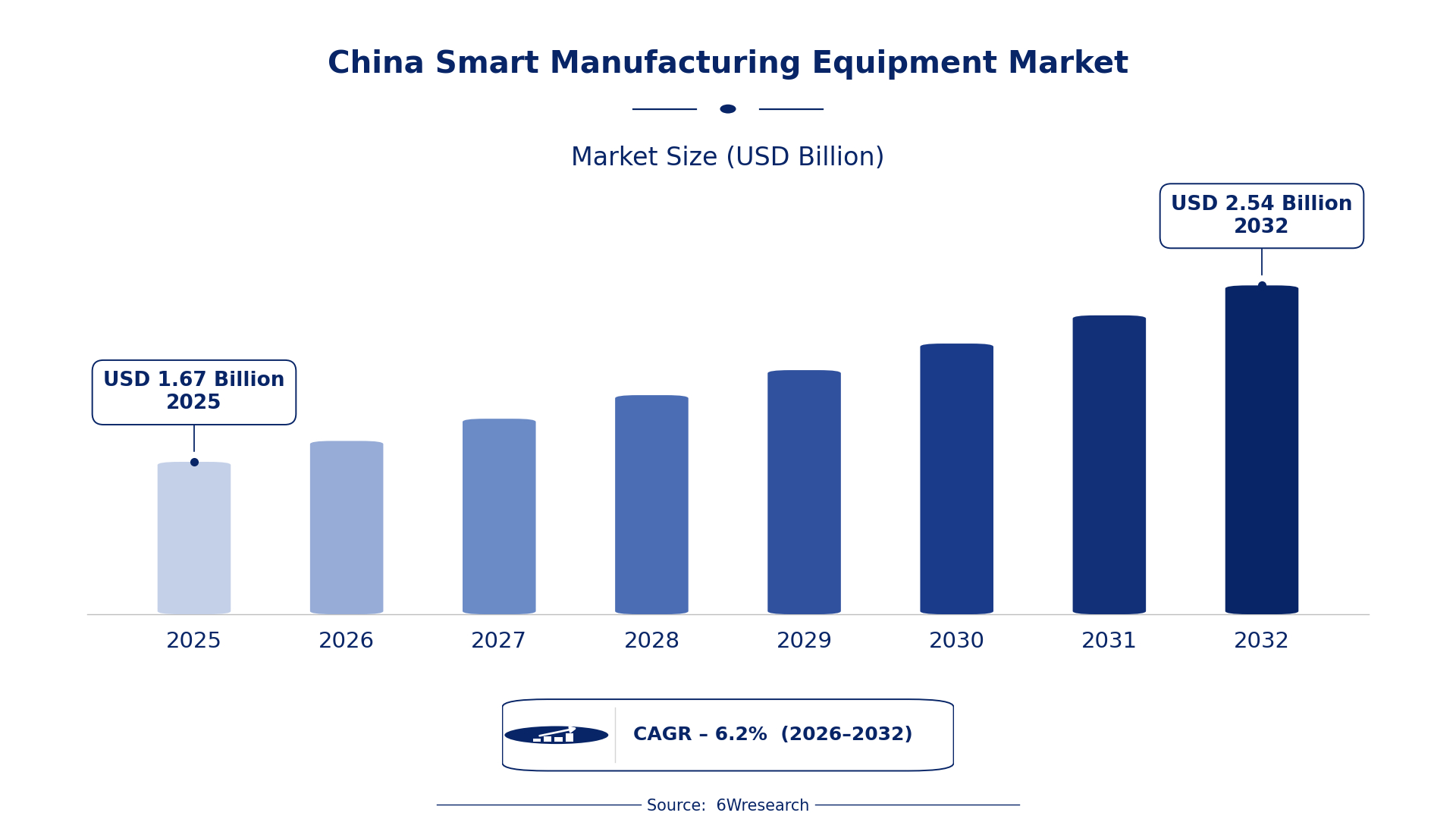
According to 6Wresearch internal database and industry insights, the China Smart Manufacturing Equipment Market was valued at USD 1.67 billion in 2025 and is projected to reach USD 2.54 billion by 2032, growing at a CAGR of approximately 6.2% during 2026–2032.
China Smart Manufacturing Equipment Market Highlights
| Report Metric | Details |
| Report Name | China Smart Manufacturing Equipment Market |
| Market Size 2025 | USD 1.67 billion |
| Market Size 2032 | USD 2.54 billion |
| Absolute Growth 2025–2032 | USD 0.87 billion |
| CAGR 2026–2032 | 6.2% |
| Peak Annual Growth | 8.4% in 2028 |
| Forecast Period | 2026–2032 |
| Historical Data | 2022–2025 |
| Base Year | 2025 |
| Leading Equipment Type, 2025 | CNC Machines (50% share) |
| Leading Smart Feature, 2025 | Predictive Maintenance (47% share) |
| Leading Control Technology, 2025 | IoT + AI Monitoring (47% share) |
| Leading End User, 2025 | Automotive OEMs (48% share) |
| Fastest-Growing Equipment Type | 3D Printers with AI (8.6% CAGR) |
| Fastest-Growing Control Technology | Vision Sensors + ML (8.6% CAGR) |
| Fastest-Growing End User | Industrial Robotics (8.4% CAGR) |
| Growing Sector | Industrial Robotics |
| Key End Users | Automotive OEMs, Heavy Manufacturing, Industrial Robotics, Aerospace Plants |
China Smart Manufacturing Equipment Market Year-wise Growth Rate and Key Drivers (2022–2032)
This graph illustrates the annual growth rates of the market from 2022 to 2032, highlighting a steady upward trajectory and projected market expansion over the forecast period.

Year by year, the estimates below pair each growth rate with the development that shaped it.
| Year | Estimated Annual Growth (%) | Market Rationale |
| 2022 | 7.5 | The market experienced strong demand from automotive OEMs, driving growth in smart manufacturing equipment. |
| 2023 | 4.4 | A temporary dip in investment from large manufacturers in the automotive sector slowed growth. |
| 2024 | 4.0 | Investment in smart manufacturing technologies continued, but at a slower pace than before. |
| 2025 | 4.6 | A recovery in demand from automotive OEMs and increased investments in technology upgrades boosted growth. |
| 2026 | 6.5 | Renewed interest is expected as manufacturers adopt IoT technologies to improve production efficiency. |
| 2027 | 4.1 | Growth is projected to slow as manufacturers face challenges integrating advanced technologies into existing systems. |
| 2028 | 8.4 | Peak growth will be driven by investments in smart manufacturing initiatives and automation. |
| 2029 | 6.6 | A slight slowdown is anticipated as manufacturers adjust to evolving technological standards. |
| 2030 | 4.7 | Growth is expected to decelerate as companies focus on optimizing existing technologies. |
| 2031 | 6.9 | An increase in demand from industrial robotics and automation sectors will accelerate market growth once more. |
| 2032 | 6.1 | The market is projected to continue growing as investments in smart manufacturing technologies remain strong. |
Note: Market size estimations and growth projections presented in this report are based on 6Wresearch's proprietary forecasting methodology, utilizing the latest available industry data, government publications, and primary research inputs.
China Smart Manufacturing Equipment Market Synopsis
The China Smart Manufacturing Equipment Market encompasses advanced technologies designed to improve production efficiency and quality. This includes CNC machines, smart welding equipment, and AI-integrated 3D printers. The market is projected to reach 1 trillion yuan by 2025, driven by substantial demand from the automotive sector, which accounts for approximately 30% of the market. Ongoing investments in technology upgrades and the implementation of initiatives like 'Made in China 2025' further fuel market growth.
Market Dynamics Impact Analysis (2026–2032)
| Factor | Type | Impact | Primary Segment Affected |
| Increasing adoption of IoT technologies by large manufacturers | Driver | High | IoT + AI Monitoring |
| Growing demand for predictive maintenance solutions to minimize downtime | Driver | High | Predictive Maintenance |
| Investment opportunities in smart manufacturing technologies are rising | Opportunity | High | CNC Machines |
| The need for automation in the automotive sector creates demand for smart equipment | Opportunity | High | Automotive OEMs |
| High costs associated with upgrading legacy systems can limit adoption | Restraint | Medium | Flexible Manufacturing Units |
| Limited availability of skilled workforce for advanced technologies constrains growth | Restraint | Medium | 3D Printers with AI |
| Buyers face challenges integrating new technologies with existing systems | Challenge | High | Smart Welding Equipment |
| Suppliers struggle with fluctuating demand from key sectors like automotive | Challenge | High | CNC Machines |
Evaluation of Drivers in China Smart Manufacturing Equipment Market (2026–2032)
The table below links each growth driver to the segment it affects and the evidence for it.
| Drivers | Primary Segment Affected | Why It Matters (Evidence) |
| Investment in IoT technologies improves production efficiency | IoT + AI Monitoring | Over 70% of large manufacturers adopted IoT technologies by 2023, leading to increased demand. |
| Demand for predictive maintenance reduces equipment downtime | Predictive Maintenance | The automotive sector's focus on efficiency drives the need for predictive maintenance solutions. |
| Growing automotive sector boosts demand for CNC machines | CNC Machines | The automotive sector accounts for approximately 30% of smart manufacturing equipment demand. |
| Technological advancements improve manufacturing processes | 3D Printers with AI | Investment in smart manufacturing technologies is projected to exceed 500 billion yuan by 2025. |
| Increased focus on quality control drives AI adoption | Quality Control AI | Quality Control AI technologies are increasingly adopted in electronics manufacturing, growing at 15% annually. |
Growth in the Smart Manufacturing Equipment market in China is rooted in increasing investments and strong end-use demand. The automotive sector, accounting for about 30% of the market, is a key driver of advanced technology adoption. By 2023, more than 70% of large manufacturers had embraced IoT technologies, boosting production efficiency. Investment in smart manufacturing technologies is set to surpass 500 billion yuan by 2025, generating additional demand. The emphasis on predictive maintenance solutions reduces downtime, creating a positive market environment.
Evaluation of Restraints in China Smart Manufacturing Equipment Market
The following restraints limit how fast demand can grow.
| Market Restraint | Primary Segment Affected | Why It Matters (Evidence) |
| High costs of upgrading legacy systems limit adoption | Flexible Manufacturing Units | Manufacturers face financial barriers when integrating new technologies with existing systems. |
| Limited skilled workforce hampers technology integration | 3D Printers with AI | The shortage of skilled workers delays the implementation of advanced manufacturing technologies. |
| Integration challenges with existing systems hinder growth | Smart Welding Equipment | Buyers struggle to incorporate new technologies into their current manufacturing processes. |
| Fluctuating demand from key sectors affects suppliers | CNC Machines | Suppliers face uncertainty as demand from the automotive sector varies. |
| Regulatory compliance adds complexity to operations | Quality Control AI | Manufacturers must navigate complex regulations, increasing operational costs. |
China Smart Manufacturing Equipment Market Challenges
Buyers in the China smart manufacturing equipment market encounter regulatory challenges due to stringent compliance standards, which can extend project timelines by as much as six months. Suppliers face a skills gap, with only 20% of the workforce skilled in advanced manufacturing technologies, leading to inefficiencies that elevate operational costs for producers. High integration costs for new technologies pose a burden for buyers, with initial investments averaging around 800,000 yuan, complicating upgrades for smaller firms. Rapid technological advancements also leave many suppliers struggling to keep pace, resulting in outdated equipment that does not meet buyers' needs.
Trends in the China Smart Manufacturing Equipment Market
The trends below show where the China Smart Manufacturing Equipment Market is heading.
- Shift towards IoT Integration in Manufacturing: By 2023, over 70% of large manufacturers in China had adopted IoT technologies, enhancing efficiency and data collection. This trend indicates a shift towards smarter production processes.
- Rise of Predictive Maintenance Solutions: The automotive sector is quickly embracing predictive maintenance technologies, driving demand for smart manufacturing equipment. The market for predictive maintenance is anticipated to grow substantially.
- Focus on Quality Control AI Technologies: Quality Control AI technologies are increasingly being adopted in electronics manufacturing, with an annual growth rate of 15%. This trend ensures improved product quality and compliance with industry standards.
- Expansion of Smart Manufacturing Pilot Programs: In 2021, the 'Smart Manufacturing Pilot Program' was launched to support sector innovation. This initiative is expected to spur further advancements in smart manufacturing technologies.
Investment Opportunities in the China Smart Manufacturing Equipment Market
Some of the investment opportunities in the China Smart Manufacturing Equipment Market are mentioned below.
- Investment in Smart Manufacturing Technologies: With investment projected to exceed 500 billion yuan by 2025, suppliers have an opportunity to provide advanced equipment. Automotive OEMs are key buyers in this space.
- Development of Smart Manufacturing Demonstration Zones: The creation of Smart Manufacturing Demonstration Zones presents an opportunity for companies to showcase their technologies. This initiative promotes innovation and attracts investment in Guangdong province.
- Growing Demand for 3D Printing Solutions: The market for AI-integrated 3D printers is expanding, fueled by the need for rapid prototyping. Manufacturers in the aerospace and automotive sectors are increasingly investing in these technologies.
- Focus on Quality Control Solutions: The rising focus on quality control offers opportunities for suppliers of AI technologies. Electronics manufacturers are particularly keen on solutions that ensure compliance with standards.
Government Initiatives in the China Smart Manufacturing Equipment Market
The 'Made in China 2025' initiative, launched in 2015, aims to boost the adoption of smart manufacturing technologies across industries. In 2021, the Ministry of Industry and Information Technology introduced the 'Smart Manufacturing Innovation and Development Plan' to encourage technological advancements. The National Development and Reform Commission approved the 'Guidelines for the Development of Industrial Internet' in 2022, improving smart manufacturing capabilities. Additionally, the 'Smart Manufacturing Demonstration Zone' program was initiated in 2020 to showcase best practices in smart manufacturing, further promoting innovation in the sector.
Buyers in the automotive sector benefit from the 'Smart Manufacturing Pilot Program' initiated by the Ministry of Industry and Information Technology in 2021, which provides funding for innovative projects. In 2023, the government allocated 200 million yuan for the 'Smart Manufacturing Equipment Development Fund', aimed at supporting research and development in smart manufacturing technologies. This funding aids manufacturers in adopting advanced equipment and refining production processes, ensuring competitiveness in the market.
Future Insight of the China Smart Manufacturing Equipment Market
By 2032, the China smart manufacturing equipment market will evolve, driven by the 'Made in China 2025' initiative, which aims to enhance automation across various sectors. Investment in smart manufacturing technologies is expected to exceed 600 billion yuan, improving production efficiency. The rise of IoT integration will lead to a marked increase in real-time data analytics adoption among manufacturers, enhancing decision-making processes. The Smart Manufacturing Pilot Program will further promote innovation, ensuring that the market adapts to the demands of a rapidly changing industrial environment.
Market Segmentation Analysis
The analysis below covers each segmentation, its leading category in 2025 and its fastest-growing category through 2032.
By Equipment Type – CNC Machines Dominated, 3D Printers with AI Expected to Grow Fastest
According to Dhaval Chaurasia, Assistant Manager at 6Wresearch, with a 50% revenue share in 2025, CNC Machines was the largest equipment type category. CNC machines hold the largest market share in China as they are extensively used for precision machining across various industries, including automotive and electronics. With over 1 million units installed, they play a crucial role in enhancing production efficiency and quality. 3D Printers with AI is projected to grow fastest, at a CAGR of 8.6% during 2026–2032. The rapid growth of 3D printers stems from their effectiveness in rapid prototyping and production, especially in sectors like consumer goods and healthcare. As manufacturers aim to innovate and streamline processes, the demand for these machines will likely surge. Suppliers should focus on expanding their CNC machine offerings while also capitalising on the growing demand for 3D printing solutions.
By Smart Feature – Predictive Maintenance Dominated and Is Expected to Record the Fastest Growth
The largest smart feature category in 2025 was Predictive Maintenance, with a 47% share of total revenue. Predictive maintenance leads the smart feature segment as it is essential for minimising equipment downtime and optimising overall performance. Its widespread adoption among large manufacturers highlights its critical role in enhancing operational efficiency. Its lead should widen, with a projected CAGR of 8.4% during 2026–2032, the highest in this split. The continued acceleration of predictive maintenance is driven by its importance in ensuring equipment reliability and reducing operational costs, which are vital for maintaining competitiveness. As more manufacturers implement this technology, its market presence will strengthen. Buyers should prioritise suppliers that offer effective predictive maintenance solutions to enhance operational efficiency and minimise unexpected downtimes.
By Control Technology – IoT + AI Monitoring Dominated, Vision Sensors + ML Expected to Grow Fastest
IoT + AI Monitoring accounted for a 47% market share by control technology in 2025. IoT and AI monitoring dominate the control technology segment, enabling real-time monitoring and data collection that are vital for modern manufacturing. This technology is widely adopted across industries, improving operational visibility and decision-making capabilities. Vision Sensors + ML is set to record the highest CAGR in this split, 8.6% over 2026–2032. Vision sensors are experiencing rapid growth as they are increasingly utilised for quality inspection and automation in manufacturing processes. This trend indicates a shift towards more intelligent quality control systems, driving expansion in this segment. Suppliers should invest in advanced vision sensor technologies to meet the rising demand for automated quality inspection solutions.
By End User – Automotive OEMs Dominated, Industrial Robotics Expected to Grow Fastest
In 2025, Automotive OEMs led the end user split with a 48% share. Automotive OEMs represent the largest share of the end user segment, leveraging smart manufacturing technologies to enhance production efficiency and product quality. Their significant investments in automation are key drivers of demand for advanced manufacturing solutions. The quickest growth will come from Industrial Robotics, forecast to expand at a CAGR of 8.4% between 2026 and 2032. Industrial robotics is the fastest-growing segment among end users, driven by the increasing need for automation across various manufacturing sectors. As companies strive to boost productivity and reduce labour costs, the adoption of industrial robotics is expected to rise significantly. Suppliers should tailor their offerings to meet the specific automation needs of automotive OEMs and the expanding industrial robotics market.
Key Attractiveness of the Report
- 10 Years of Market Numbers
- Historical Data Starting from 2022 to 2025
- Base Year 2025
- Forecast Data until 2032
- Key Performance Indicators Impacting the Market
- Major Upcoming Developments and Projects
Key Highlights of the Report:
- China Smart Manufacturing Equipment Market Outlook
- Market Size of China Smart Manufacturing Equipment Market, 2025
- Forecast of China Smart Manufacturing Equipment Market, 2032
- Historical Data and Forecast of China Smart Manufacturing Equipment Revenues & Volume for the Period 2022 - 2032F
- China Smart Manufacturing Equipment Market Trend Evolution
- China Smart Manufacturing Equipment Market Drivers and Challenges
- China Smart Manufacturing Equipment Price Trends
- China Smart Manufacturing Equipment Porter's Five Forces
- China Smart Manufacturing Equipment Industry Life Cycle
- Historical Data and Forecast of China Smart Manufacturing Equipment Market Revenues & Volume By Equipment Type for the Period 2022 - 2032F
- Historical Data and Forecast of China Smart Manufacturing Equipment Market Revenues & Volume By CNC Machines for the Period 2022 - 2032F
- Historical Data and Forecast of China Smart Manufacturing Equipment Market Revenues & Volume By Smart Welding Equipment for the Period 2022 - 2032F
- Historical Data and Forecast of China Smart Manufacturing Equipment Market Revenues & Volume By Flexible Manufacturing Units for the Period 2022 - 2032F
- Historical Data and Forecast of China Smart Manufacturing Equipment Market Revenues & Volume By 3D Printers with AI for the Period 2022 - 2032F
- Historical Data and Forecast of China Smart Manufacturing Equipment Market Revenues & Volume By Smart Feature for the Period 2022 - 2032F
- Historical Data and Forecast of China Smart Manufacturing Equipment Market Revenues & Volume By Predictive Maintenance for the Period 2022 - 2032F
- Historical Data and Forecast of China Smart Manufacturing Equipment Market Revenues & Volume By Quality Control AI for the Period 2022 - 2032F
- Historical Data and Forecast of China Smart Manufacturing Equipment Market Revenues & Volume By Adaptive Workflow for the Period 2022 - 2032F
- Historical Data and Forecast of China Smart Manufacturing Equipment Market Revenues & Volume By Real-Time Feedback Loop for the Period 2022 - 2032F
- Historical Data and Forecast of China Smart Manufacturing Equipment Market Revenues & Volume By Control Technology for the Period 2022 - 2032F
- Historical Data and Forecast of China Smart Manufacturing Equipment Market Revenues & Volume By IoT + AI Monitoring for the Period 2022 - 2032F
- Historical Data and Forecast of China Smart Manufacturing Equipment Market Revenues & Volume By Vision Sensors + ML for the Period 2022 - 2032F
- Historical Data and Forecast of China Smart Manufacturing Equipment Market Revenues & Volume By Edge + Cloud Integration for the Period 2022 - 2032F
- Historical Data and Forecast of China Smart Manufacturing Equipment Market Revenues & Volume By AI Slicing Software for the Period 2022 - 2032F
- Historical Data and Forecast of China Smart Manufacturing Equipment Market Revenues & Volume By End User for the Period 2022 - 2032F
- Historical Data and Forecast of China Smart Manufacturing Equipment Market Revenues & Volume By Automotive OEMs for the Period 2022 - 2032F
- Historical Data and Forecast of China Smart Manufacturing Equipment Market Revenues & Volume By Heavy Manufacturing for the Period 2022 - 2032F
- Historical Data and Forecast of China Smart Manufacturing Equipment Market Revenues & Volume By Industrial Robotics for the Period 2022 - 2032F
- Historical Data and Forecast of China Smart Manufacturing Equipment Market Revenues & Volume By Aerospace Plants for the Period 2022 - 2032F
- China Smart Manufacturing Equipment Import Export Trade Statistics
- Market Opportunity Assessment By Equipment Type
- Market Opportunity Assessment By Smart Feature
- Market Opportunity Assessment By Control Technology
- Market Opportunity Assessment By End User
- China Smart Manufacturing Equipment Top Companies Market Share
- China Smart Manufacturing Equipment Competitive Benchmarking By Technical and Operational Parameters
- China Smart Manufacturing Equipment Company Profiles
- China Smart Manufacturing Equipment Key Strategic Recommendations
Market Covered
Segments analysed in this report are listed below.
By Equipment Type
- CNC Machines
- Smart Welding Equipment
- Flexible Manufacturing Units
- 3D Printers with AI
By Smart Feature
- Predictive Maintenance
- Quality Control AI
- Adaptive Workflow
- Real-Time Feedback Loop
By Control Technology
- IoT + AI Monitoring
- Vision Sensors + ML
- Edge + Cloud Integration
- AI Slicing Software
By End User
- Automotive OEMs
- Heavy Manufacturing
- Industrial Robotics
- Aerospace Plants































