India Smart Manufacturing Robot Market Size & Growth Rate
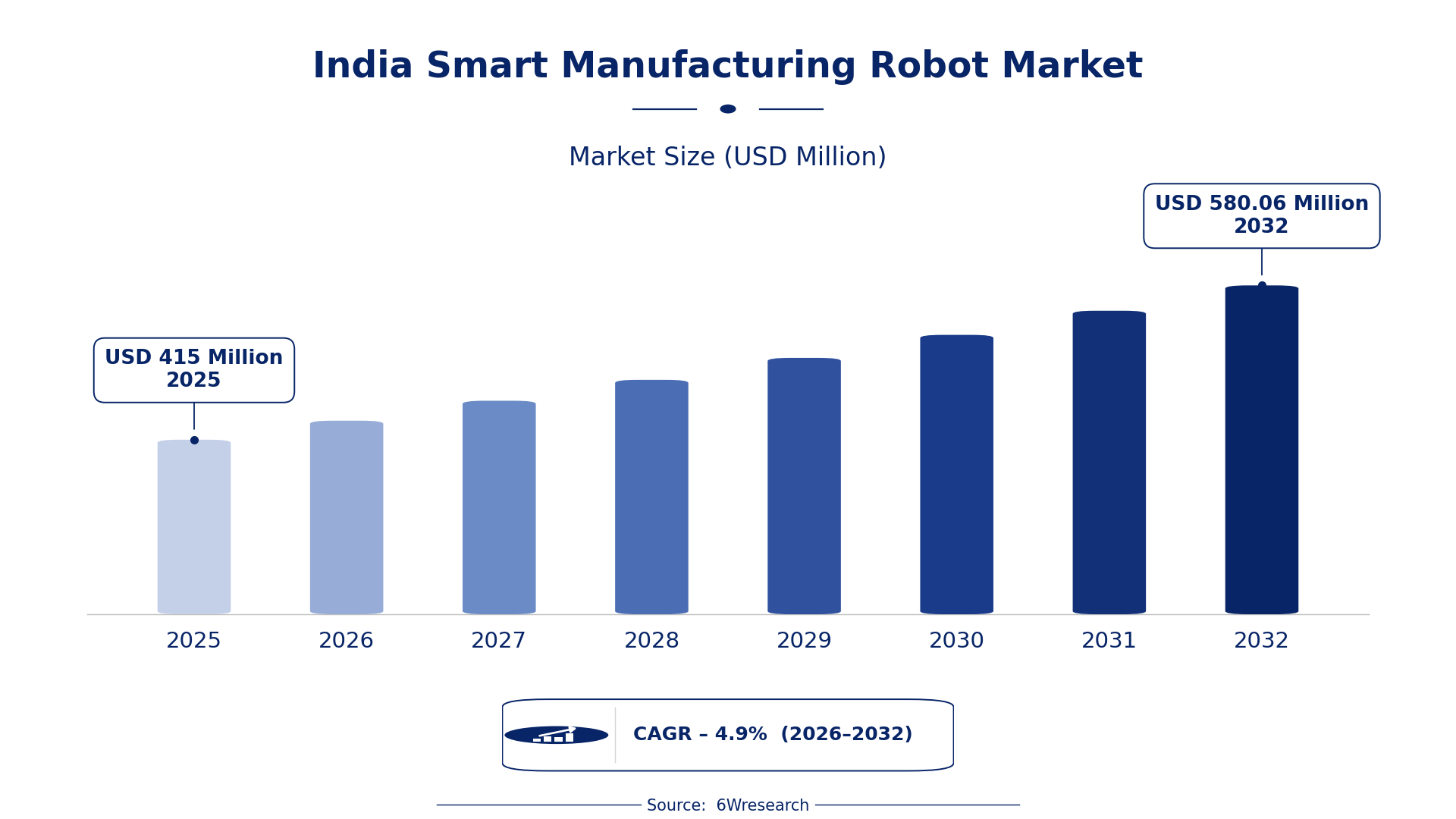
According to 6Wresearch internal database and industry insights, the India Smart Manufacturing Robot Market was valued at USD 415.0 million in 2025 and is projected to reach USD 580.06 million by 2032, growing at a CAGR of approximately 4.9% during 2026–2032.
India Smart Manufacturing Robot Market Highlights
| Report Metric | Details |
| Report Name | India Smart Manufacturing Robot Market |
| Market Size 2025 | USD 415.0 million |
| Market Size 2032 | USD 580.06 million |
| Absolute Growth 2025–2032 | USD 165.06 million |
| CAGR 2026–2032 | 4.9% |
| Peak Annual Growth | 7.3% in 2027 |
| Forecast Period | 2026–2032 |
| Historical Data | 2022–2025 |
| Base Year | 2025 |
| Leading Robot Type, 2025 | Collaborative Robots (43% share) |
| Leading Application Area, 2025 | Assembly + Packaging (53% share) |
| Leading Intelligence Feature, 2025 | Safe Human Interaction (42% share) |
| Leading End User, 2025 | Smart Factories (38% share) |
| Fastest-Growing Robot Type | AI Welding Robots (6.9% CAGR) |
| Fastest-Growing Application Area | Metal Fabrication (6.7% CAGR) |
| Fastest-Growing Intelligence Feature | Pattern Recognition (7.5% CAGR) |
| Fastest-Growing End User | Automotive Plants (6.4% CAGR) |
| Growing Sector | Metal Fabrication |
| Key End Users | Assembly + Packaging, Metal Fabrication, Material Handling, Autonomous Navigation |
India Smart Manufacturing Robot Market Year-wise Growth Rate and Key Drivers (2022–2032)
This graph illustrates the annual growth rates of the market from 2022 to 2032, highlighting a steady upward trajectory and projected market expansion over the forecast period.
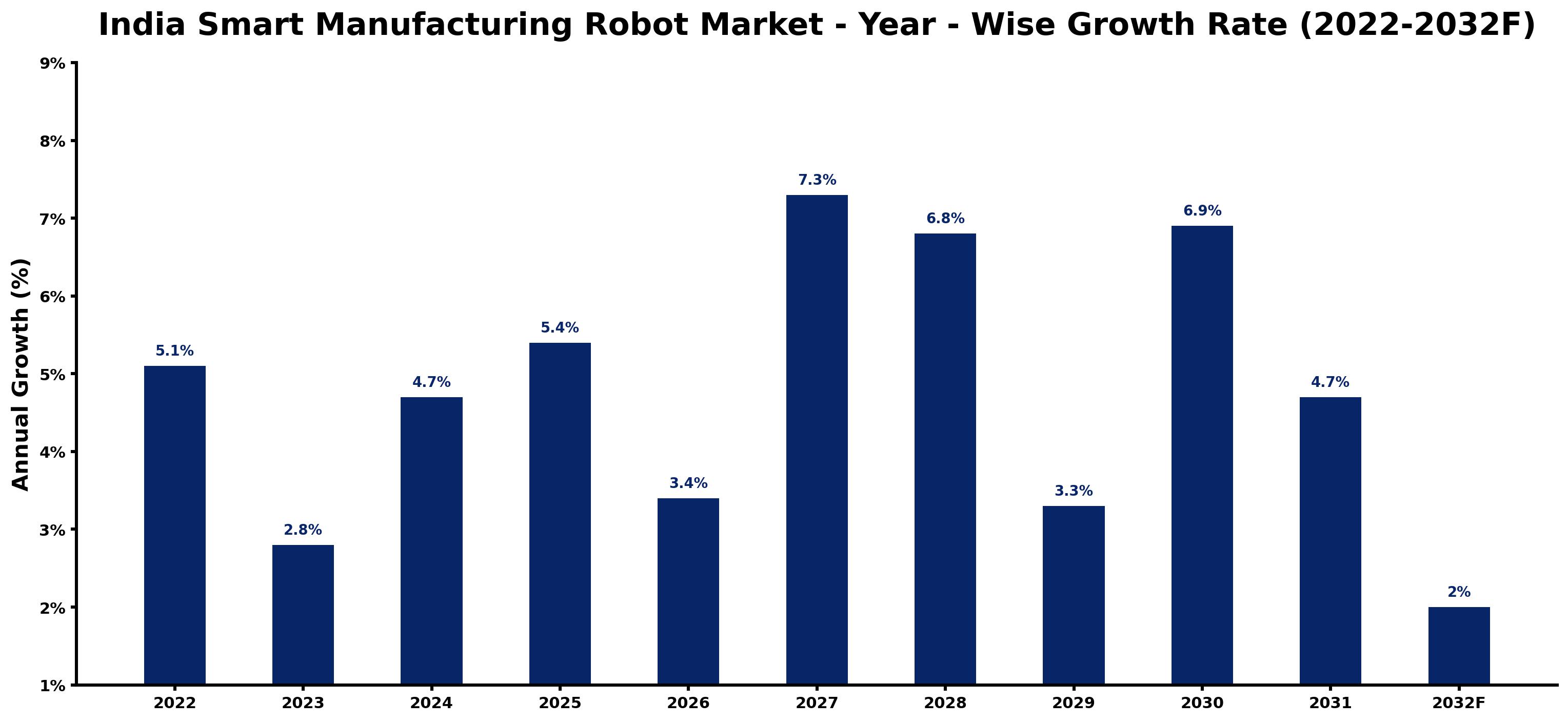
Each row of the following table gives one year's estimated growth and the event or demand shift that explains it.
| Year | Estimated Annual Growth (%) | Market Rationale |
| 2022 | 5.1 | The market experienced steady growth due to increased automation in various sectors, particularly in automotive and electronics. |
| 2023 | 2.8 | Growth slowed as some industries reassessed their automation investments amid economic uncertainties, particularly in Maharashtra and Tamil Nadu. |
| 2024 | 4.7 | Demand picked up as manufacturers sought efficiency improvements through automation technologies, driven by the 'Make in India' initiative. |
| 2025 | 5.4 | The automotive sector's expansion boosted the market's growth rate this year, with investments in smart factories. |
| 2026 | 3.4 | Adoption rates are expected to slow as companies face challenges in integrating new technologies into existing systems. |
| 2027 | 7.3 | A surge in demand for collaborative robots in automotive plants will drive substantial growth, reflecting the sector's expansion. |
| 2028 | 6.8 | Growth is expected to slow as the market adjusts to new technological advancements and user needs, particularly in electronics assembly. |
| 2029 | 3.3 | Demand is projected to slow as manufacturers face challenges in workforce training for new technologies, affecting productivity. |
| 2030 | 6.9 | Increased investments in smart factories will revitalise growth in the market this year, enhancing operational efficiency. |
| 2031 | 4.7 | Growth is expected to slow as the market stabilises following rapid technological advancements in previous years, particularly in robotics. |
| 2032 | 2.0 | The market will continue to grow, albeit at a slower pace as industries mature in automation, particularly in automotive. |
Note: Market size estimations and growth projections presented in this report are based on 6Wresearch's proprietary forecasting methodology, utilizing the latest available industry data, government publications, and primary research inputs.
India Smart Manufacturing Robot Market Synopsis
Smart Manufacturing Robots in India are sophisticated automated systems that improve efficiency and precision in manufacturing settings. These robots incorporate robotics, artificial intelligence, and machine learning technologies, serving various functions such as assembly, welding, and material handling. The India Smart Manufacturing Robot Market is growing, propelled by demand from sectors like automotive and electronics. The 'Make in India' initiative promotes the adoption of these technologies, while more than 1,500 smart factories are integrating automation solutions to enhance productivity and competitiveness.
Market Dynamics Impact Analysis (2026–2032)
| Factor | Type | Impact | Primary Segment Affected |
| Increasing demand for automation in automotive plants | Driver | High | Collaborative Robots |
| Growth in smart factory implementations across various sectors | Driver | High | Assembly + Packaging |
| Rising investment in robotics training programs | Opportunity | Medium | Electronics Assembly |
| Expansion of the Production-Linked Incentive Scheme for electronics | Opportunity | High | Smart Factories |
| High initial investment costs for automation technologies | Restraint | High | Mobile Manufacturing Robots |
| Limited availability of skilled workforce for advanced robotics | Restraint | Medium | AI Welding Robots |
| The Smart Manufacturing Robot Market in India faces significant integration challenges | Challenge | High | Pick-and-Place Robots |
| Supply chain disruptions affecting timely delivery of components | Challenge | Medium | Material Handling |
Evaluation of Drivers in India Smart Manufacturing Robot Market (2026–2032)
The main growth drivers and the segments they affect most are set out below.
| Drivers | Primary Segment Affected | Why It Matters (Evidence) |
| Increased automotive production | Collaborative Robots | The automotive sector accounts for approximately 7.1% of India's GDP, driving demand for automation solutions. |
| Growing smart factory implementations | Assembly + Packaging | Over 1,500 smart factories are adopting automation technologies, leading to increased purchases of smart manufacturing robots. |
| Investment in robotics training | Electronics Assembly | Training programs from the Electronics Sector Skill Council of India are equipping the workforce with essential skills. |
| Support from government initiatives | Smart Factories | The 'Make in India' initiative encourages the adoption of smart manufacturing technologies, enhancing competitiveness. |
| Rising demand for precision in manufacturing | AI Welding Robots | The need for high-quality welding processes boosts demand for advanced welding robots in the automotive sector. |
Expansion of the Smart Manufacturing Robot market in India is backed by increasing automotive production, growing smart factory implementations, and investments in workforce training. The automotive sector contributes approximately 7.1% to the GDP, which drives demand for automation solutions. Additionally, over 1,500 smart factories are adopting automation technologies, leading to increased purchases of smart manufacturing robots. The need for high-quality welding processes further fuels the demand for AI welding robots, as manufacturers seek to improve operational efficiency and quality control.
Evaluation of Restraints in India Smart Manufacturing Robot Market
Below mentioned are some major restraints and their influence on market dynamics.
| Market Restraint | Primary Segment Affected | Why It Matters (Evidence) |
| High initial investment costs for automation technologies | Mobile Manufacturing Robots | The upfront costs deter some manufacturers from adopting advanced robotics, impacting their operational efficiency. |
| Limited availability of skilled workforce for advanced robotics | AI Welding Robots | A shortage of trained personnel hampers the effective implementation of AI welding solutions, delaying projects. |
| Integration challenges with existing systems | Pick-and-Place Robots | Many manufacturers struggle to integrate new robots with legacy systems, slowing adoption and increasing costs. |
| Supply chain disruptions affecting timely delivery of components | Material Handling | Delays in component delivery lead to extended project timelines, impacting overall operational efficiency. |
| Regulatory compliance hurdles for robotics implementation | Collaborative Robots | Compliance with safety standards complicates the deployment of collaborative robots, delaying projects. |
India Smart Manufacturing Robot Market Challenges
The India Smart Manufacturing Robot Market faces a critical skills shortage that limits producers' capacity to implement advanced robotics. Many manufacturers struggle to find qualified workers due to insufficient training programs, which can delay production timelines and increase operational costs by up to 15%. Technology integration remains uneven, particularly in Maharashtra, where producers encounter difficulties in deploying smart manufacturing robots, resulting in inefficiencies that reduce their competitive advantage. Buyers experience rising costs as fluctuating prices for robotics components can inflate project budgets by 20%, making investments in automation less appealing. Competition is intensifying, with new entrants driving down prices and squeezing margins for established producers, compelling them to innovate to retain market share.
Trends in the India Smart Manufacturing Robot Market
Four trends stand out in the India Smart Manufacturing Robot Market.
- Shift Towards Collaborative Robotics: By 2025, the use of collaborative robots is expected to increase, especially in automotive plants, which are leading adopters of smart manufacturing technologies. This trend stems from the need for enhanced productivity and safety in manufacturing environments.
- Growth of Smart Factories: The emergence of smart factories is reshaping manufacturing in India, with numerous facilities adopting automation technologies. This trend is supported by the 'Make in India' initiative, which seeks to elevate domestic manufacturing capabilities and efficiency.
- Increased Focus on Robotics Training: The Electronics Sector Skill Council of India is working to improve workforce capabilities through training programs for robotics and automation. This initiative is crucial as the average annual growth rate for robotics in India is projected at 30% starting in 2023.
- Expansion of the Production-Linked Incentive Scheme: The Indian government has allocated ₹10,000 crore for the Production-Linked Incentive Scheme for electronics, which is anticipated to stimulate further investment in smart manufacturing technologies and robotics, benefiting local manufacturers.
Investment Opportunities in the India Smart Manufacturing Robot Market
Several openings in the India Smart Manufacturing Robot Market merit attention from investors.
- Growing Demand for Automation Solutions: With a significant gap in automation solutions, particularly in automotive plants, there is a strong demand for collaborative robots. Investing in this sector can meet the needs of manufacturers looking to enhance productivity and efficiency.
- Investment in Robotics Training Programs: The Electronics Sector Skill Council of India is focusing on enhancing workforce skills, creating opportunities for training providers. This is important as the market for robotics is projected to grow at an average annual rate of 30%.
- Expansion of Smart Manufacturing in Electronics: The 'Make in India' initiative encourages electronics manufacturers to adopt smart technologies. Suppliers can enter this market by partnering with local firms to provide automation solutions that meet industry needs.
- Increased Funding for Smart Manufacturing Initiatives: The Indian government has allocated substantial funding for smart manufacturing initiatives, creating opportunities for technology providers. Engaging with government schemes can facilitate market entry and growth for new entrants.
Government Initiatives in the India Smart Manufacturing Robot Market
The Bureau of Indian Standards has set guidelines for robotics in manufacturing, ensuring compliance and safety in the deployment of smart manufacturing robots. This measure standardises practices across the industry, promoting broader adoption of automation technologies. The National Policy on Electronics aims to enhance electronics manufacturing by 2025, supporting the integration of smart manufacturing robots in production processes and boosting competitiveness. Additionally, the Indian government has allocated ₹10,000 crore for the Production-Linked Incentive Scheme, expected to drive investment in smart manufacturing solutions.
The Ministry of Heavy Industries and Public Enterprises plays a crucial role in advancing smart manufacturing initiatives through funding and approvals. This agency has been pivotal in facilitating investments in automation technologies, ensuring that manufacturers can effectively implement advanced robotics solutions. The Electronics Sector Skill Council of India offers training and certification programs, equipping the workforce with the skills necessary to operate and maintain smart manufacturing robots. This support is crucial for enhancing industry capabilities and ensuring successful implementation of automation technologies.
Future Insight of the India Smart Manufacturing Robot Market
By 2032, buyers and suppliers in the India Smart Manufacturing Robot Market can anticipate substantial advancements driven by supportive government initiatives and industry standards. The National Policy on Electronics aims to bolster electronics manufacturing, stimulating demand for automation solutions. Collaborative robots are forecasted to experience a 50% increase in usage within the automotive sector, improving production efficiency. The average annual growth rate for robotics is projected at 30%, indicating a strong trend towards greater adoption and investment in smart manufacturing technologies.
Market Segmentation Analysis
The report offers a comprehensive study of the following market segments and their leading categories in the market.
By Robot Type – Collaborative Robots Dominated, AI Welding Robots Expected to Grow Fastest
According to Dhaval Chaurasia, Assistant Manager at 6Wresearch, Collaborative Robots took a 43% share of robot type in 2025, more than any other category. Collaborative robots hold the largest market share in India as they are essential for enhancing productivity by working alongside human operators. Their widespread use in smart factories, which focus on automation and efficiency, highlights their critical role in the industry. Over 2026–2032, AI Welding Robots are expected to post the fastest growth, at a CAGR of 6.9%. AI welding robots are experiencing rapid growth due to their ability to improve the precision and speed of welding tasks, particularly in the automotive sector. The increasing demand for high-quality welding solutions is propelling this segment forward. Suppliers should concentrate on developing collaborative and AI welding robots to meet the rising demand in India's smart manufacturing market.
By Application Area – Assembly + Packaging Dominated, Metal Fabrication Expected to Grow Fastest
Assembly + Packaging accounted for a 53% market share by application area in 2025. The assembly and packaging application area commands the largest market share as it is crucial for streamlining production processes across various industries. This segment benefits from the high volume of products that require efficient assembly lines, especially in smart factories. Metal Fabrication is set to record the highest CAGR in this split, 6.7% over 2026–2032. Metal fabrication is the fastest-growing application area, driven by the need for precision in manufacturing metal components, particularly in the automotive sector. The surge in automotive production significantly fuels this growth. Buyers in the metal fabrication sector should invest in advanced robotic solutions to enhance efficiency and maintain competitiveness in the market.
By Intelligence Feature – Safe Human Interaction Dominated, Pattern Recognition Expected to Grow Fastest
With a 42% revenue share in 2025, Safe Human Interaction was the largest intelligence feature category. Safe human interaction is the leading intelligence feature, as it is essential for ensuring collaborative work environments where robots and humans can work side by side. This feature is critical in smart factories that prioritise worker safety and productivity. Pattern Recognition is projected to grow fastest, at a CAGR of 7.5% during 2026–2032. Pattern recognition is the fastest-growing intelligence feature, enabling robots to identify and process items effectively, which is increasingly important in various manufacturing processes. The push for automation in smart factories is driving this growth. Suppliers must invest in developing robots with advanced pattern recognition capabilities to cater to the evolving needs of manufacturers.
By End User – Smart Factories Dominated, Automotive Plants Expected to Grow Fastest
Smart Factories held a 38% share of the India Smart Manufacturing Robot Market by end user in 2025. Smart factories dominate the market share as they embody the future of automated manufacturing, integrating advanced technologies for improved efficiency. The proliferation of smart factories across India underscores the increasing trend towards automation in the manufacturing sector. The quickest growth will come from Automotive Plants, forecast to expand at a CAGR of 6.4% between 2026 and 2032. Automotive plants represent the fastest-growing end user segment, propelled by substantial investments in smart manufacturing technologies aimed at enhancing production efficiency and quality. The expansion of the automotive industry in India plays a key role in this growth. Manufacturers should prioritise the integration of smart technologies in automotive plants to capitalise on the rising demand for automation.
Key Attractiveness of the Report
- 10 Years of Market Numbers
- Historical Data Starting from 2022 to 2025
- Base Year 2025
- Forecast Data until 2032
- Key Performance Indicators Impacting the Market
- Major Upcoming Developments and Projects
Key Highlights of the Report:
- India Smart Manufacturing Robot Market Outlook
- Market Size of India Smart Manufacturing Robot Market, 2025
- Forecast of India Smart Manufacturing Robot Market, 2032
- Historical Data and Forecast of India Smart Manufacturing Robot Revenues & Volume for the Period 2022 - 2032F
- India Smart Manufacturing Robot Market Trend Evolution
- India Smart Manufacturing Robot Market Drivers and Challenges
- India Smart Manufacturing Robot Price Trends
- India Smart Manufacturing Robot Porter's Five Forces
- India Smart Manufacturing Robot Industry Life Cycle
- Historical Data and Forecast of India Smart Manufacturing Robot Market Revenues & Volume By Robot Type for the Period 2022 - 2032F
- Historical Data and Forecast of India Smart Manufacturing Robot Market Revenues & Volume By Collaborative Robots for the Period 2022 - 2032F
- Historical Data and Forecast of India Smart Manufacturing Robot Market Revenues & Volume By AI Welding Robots for the Period 2022 - 2032F
- Historical Data and Forecast of India Smart Manufacturing Robot Market Revenues & Volume By Pick-and-Place Robots for the Period 2022 - 2032F
- Historical Data and Forecast of India Smart Manufacturing Robot Market Revenues & Volume By Mobile Manufacturing Robots for the Period 2022 - 2032F
- Historical Data and Forecast of India Smart Manufacturing Robot Market Revenues & Volume By Application Area for the Period 2022 - 2032F
- Historical Data and Forecast of India Smart Manufacturing Robot Market Revenues & Volume By Assembly + Packaging for the Period 2022 - 2032F
- Historical Data and Forecast of India Smart Manufacturing Robot Market Revenues & Volume By Metal Fabrication for the Period 2022 - 2032F
- Historical Data and Forecast of India Smart Manufacturing Robot Market Revenues & Volume By Material Handling for the Period 2022 - 2032F
- Historical Data and Forecast of India Smart Manufacturing Robot Market Revenues & Volume By Autonomous Navigation for the Period 2022 - 2032F
- Historical Data and Forecast of India Smart Manufacturing Robot Market Revenues & Volume By Intelligence Feature for the Period 2022 - 2032F
- Historical Data and Forecast of India Smart Manufacturing Robot Market Revenues & Volume By Safe Human Interaction for the Period 2022 - 2032F
- Historical Data and Forecast of India Smart Manufacturing Robot Market Revenues & Volume By Pattern Recognition for the Period 2022 - 2032F
- Historical Data and Forecast of India Smart Manufacturing Robot Market Revenues & Volume By Vision-Guided AI for the Period 2022 - 2032F
- Historical Data and Forecast of India Smart Manufacturing Robot Market Revenues & Volume By Sensor Fusion + Mapping for the Period 2022 - 2032F
- Historical Data and Forecast of India Smart Manufacturing Robot Market Revenues & Volume By End User for the Period 2022 - 2032F
- Historical Data and Forecast of India Smart Manufacturing Robot Market Revenues & Volume By Smart Factories for the Period 2022 - 2032F
- Historical Data and Forecast of India Smart Manufacturing Robot Market Revenues & Volume By Automotive Plants for the Period 2022 - 2032F
- Historical Data and Forecast of India Smart Manufacturing Robot Market Revenues & Volume By Electronics Assembly for the Period 2022 - 2032F
- Historical Data and Forecast of India Smart Manufacturing Robot Market Revenues & Volume By Factory Automation for the Period 2022 - 2032F
- India Smart Manufacturing Robot Import Export Trade Statistics
- Market Opportunity Assessment By Robot Type
- Market Opportunity Assessment By Application Area
- Market Opportunity Assessment By Intelligence Feature
- Market Opportunity Assessment By End User
- India Smart Manufacturing Robot Top Companies Market Share
- India Smart Manufacturing Robot Competitive Benchmarking By Technical and Operational Parameters
- India Smart Manufacturing Robot Company Profiles
- India Smart Manufacturing Robot Key Strategic Recommendations
Market Covered
The report offers an extensive study of the following market segments.
By Robot Type
- Collaborative Robots
- AI Welding Robots
- Pick-and-Place Robots
- Mobile Manufacturing Robots
By Application Area
- Assembly + Packaging
- Metal Fabrication
- Material Handling
- Autonomous Navigation
By Intelligence Feature
- Safe Human Interaction
- Pattern Recognition
- Vision-Guided AI
- Sensor Fusion + Mapping
By End User
- Smart Factories
- Automotive Plants
- Electronics Assembly
- Factory Automation































