China Smart Manufacturing Robot Market Size & Growth Rate
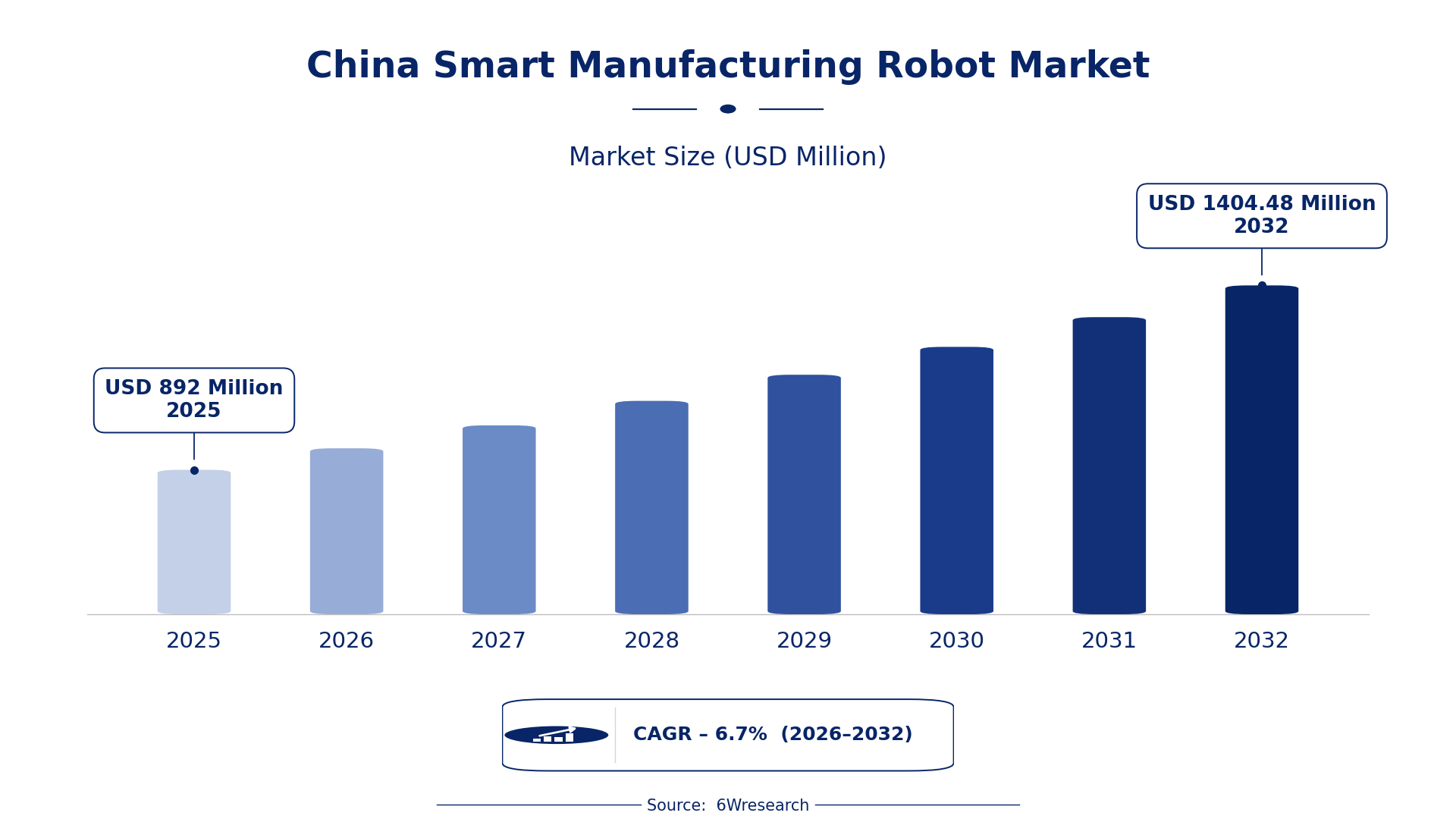
According to 6Wresearch internal database and industry insights, the China Smart Manufacturing Robot Market was valued at USD 892.0 million in 2025 and is projected to reach USD 1,404.48 million by 2032, growing at a CAGR of approximately 6.7% during 2026–2032.
China Smart Manufacturing Robot Market Highlights
| Report Metric | Details |
| Report Name | China Smart Manufacturing Robot Market |
| Market Size 2025 | USD 892.0 million |
| Market Size 2032 | USD 1,404.48 million |
| Absolute Growth 2025–2032 | USD 512.48 million |
| CAGR 2026–2032 | 6.7% |
| Peak Annual Growth | 8.9% in 2026 |
| Forecast Period | 2026–2032 |
| Historical Data | 2022–2025 |
| Base Year | 2025 |
| Leading Robot Type, 2025 | Collaborative Robots (51% share) |
| Leading Application Area, 2025 | Assembly + Packaging (41% share) |
| Leading Intelligence Feature, 2025 | Safe Human Interaction (43% share) |
| Leading End User, 2025 | Smart Factories (47% share) |
| Fastest-Growing Robot Type | Pick-and-Place Robots (8.7% CAGR) |
| Fastest-Growing Application Area | Material Handling (8.4% CAGR) |
| Fastest-Growing Intelligence Feature | Vision-Guided AI (8.6% CAGR) |
| Fastest-Growing End User | Electronics Assembly (9.5% CAGR) |
| Growing Sector | Smart Factories |
| Key End Users | Automotive Plants, Electronics Assembly, Factory Automation, Smart Factories |
China Smart Manufacturing Robot Market Year-wise Growth Rate and Key Drivers (2022–2032)
This graph illustrates the annual growth rates of the market from 2022 to 2032, highlighting a steady upward trajectory and projected market expansion over the forecast period.
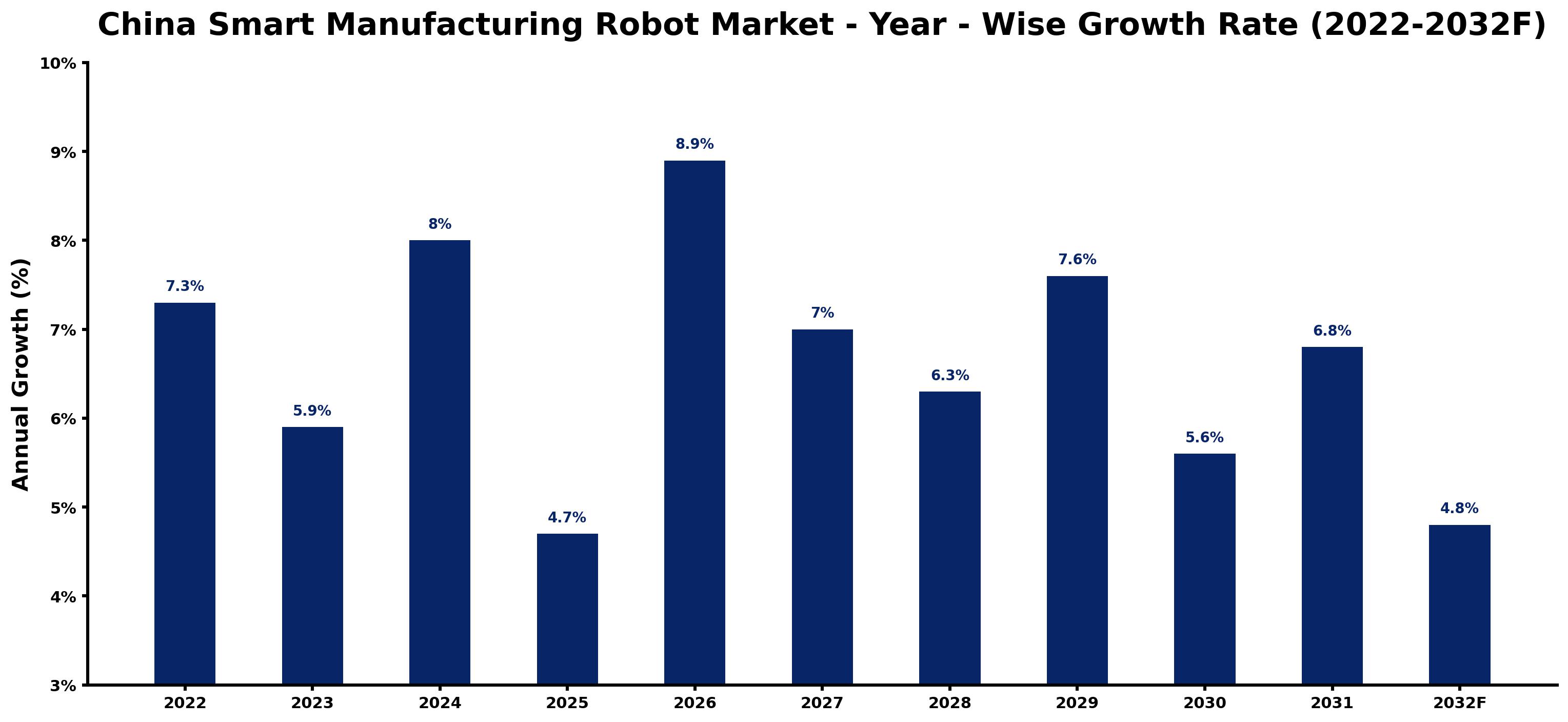
The following table presents the estimated annual growth rate for each year together with the principal factor influencing market performance.
| Year | Estimated Annual Growth (%) | Market Rationale |
| 2022 | 7.3 | The market experienced steady growth due to rising demand from domestic manufacturers, particularly in the automotive sector. |
| 2023 | 5.9 | Growth slowed as the market adjusted to increased automation adoption rates from the automotive sector, driven by the 'Made in China 2025' initiative. |
| 2024 | 8.0 | A resurgence in demand was driven by the automotive sector's expansion and new smart factory implementations, which increased the need for smart robotics. |
| 2025 | 4.7 | Growth slowed again as manufacturers faced challenges in scaling operations amidst rising costs and complex compliance requirements. |
| 2026 | 8.9 | The market is expected to peak with substantial investments in smart manufacturing technologies, particularly in the automotive sector. |
| 2027 | 7.0 | Growth is projected to slow as the market stabilises after rapid expansion in smart factory adoption and operational optimisations. |
| 2028 | 6.3 | Demand is expected to decelerate as manufacturers optimise existing technologies and processes, focusing on efficiency improvements. |
| 2029 | 7.6 | An uptick in growth is projected as new automotive plants implement smart solutions and automation technologies, boosting overall demand. |
| 2030 | 5.6 | Growth is expected to slow as the market faces challenges in meeting automation targets set by government initiatives, particularly in the electronics sector. |
| 2031 | 6.8 | Demand is projected to increase again as manufacturers adopt advanced robotics solutions to improve productivity and efficiency. |
| 2032 | 4.8 | Growth is expected to slow as the market matures, focusing on efficiency and integration of smart technologies across various sectors. |
Note: Market size estimations and growth projections presented in this report are based on 6Wresearch's proprietary forecasting methodology, utilizing the latest available industry data, government publications, and primary research inputs.
China Smart Manufacturing Robot Market Synopsis
Smart Manufacturing Robots in China are advanced automation technologies designed to optimise manufacturing processes through robotics and AI. These robots play a crucial role in assembly, welding, and material handling, produced using precision engineering. The China Smart Manufacturing Robot Market was valued at approximately 50 billion USD in 2022, driven by strong demand from domestic manufacturers and substantial investments in automation technology. The automotive sector is the largest user, accounting for over 30% of total demand, reflecting a robust shift towards automation in manufacturing.
Market Dynamics Impact Analysis (2026–2032)
| Factor | Type | Impact | Primary Segment Affected |
| Increased investments in automation technology drive demand for smart manufacturing robots. | Driver | High | Smart Factories |
| The automotive sector's expansion necessitates advanced robotics for production efficiency. | Driver | High | Automotive Plants |
| The Guangdong province is rapidly expanding its smart manufacturing capabilities, creating opportunities for suppliers. | Opportunity | High | Electronics Assembly |
| The growing number of smart factories in China presents a significant market entry opportunity. | Opportunity | High | Smart Factories |
| High initial investment costs can deter smaller manufacturers from adopting smart robotics. | Restraint | Medium | Factory Automation |
| Limited skilled workforce in robotics technology hampers market growth potential. | Restraint | Medium | Collaborative Robots |
| The Smart Manufacturing Robot Market in China faces challenges related to regulatory compliance. | Challenge | High | AI Welding Robots |
| Supply chain disruptions can delay the delivery of critical components for smart robots. | Challenge | High | Pick-and-Place Robots |
Evaluation of Drivers in China Smart Manufacturing Robot Market (2026–2032)
The factors lifting demand, and the evidence behind each, are summarised below.
| Drivers | Primary Segment Affected | Why It Matters (Evidence) |
| Rising demand for automation in the automotive sector increases robot adoption. | Automotive Plants | The automotive sector accounted for over 30% of total demand in 2022. |
| The expansion of smart factories drives the need for advanced robotics. | Smart Factories | China has over 200 smart factories operational as of 2023. |
| Government initiatives promote the adoption of smart manufacturing technologies. | Electronics Assembly | The 'Made in China 2025' initiative aims to improve manufacturing competitiveness. |
| Increased production efficiency leads to higher demand for smart manufacturing robots. | Factory Automation | Smart factories are expected to increase productivity by 30% by 2025. |
| Technological advancements in robotics improve operational capabilities. | Collaborative Robots | ISO 10218 ensures safety and efficiency in robot operations. |
Growth in the Smart Manufacturing Robot market in China comes from strong end-use demand, particularly in the automotive sector, which accounted for over 30% of total demand in 2022. The expansion of smart factories, with over 200 operational in 2023, drives the need for advanced robotics. Improved production efficiency leads to higher demand for smart manufacturing robots, with smart factories projected to boost productivity by 30% by 2025. Technological advancements in robotics, supported by ISO 10218, improve operational capabilities, further stimulating market growth.
Evaluation of Restraints in China Smart Manufacturing Robot Market
The main factors holding the market back are set out below.
| Market Restraint | Primary Segment Affected | Why It Matters (Evidence) |
| High initial investment costs deter smaller manufacturers from adopting smart robotics. | Factory Automation | Many smaller manufacturers struggle to afford the upfront costs associated with automation. |
| Limited skilled workforce in robotics technology hampers market growth potential. | Collaborative Robots | The shortage of skilled workers affects the implementation of advanced robotics, limiting growth. |
| Regulatory compliance can be complex and time-consuming for manufacturers. | AI Welding Robots | Manufacturers must navigate various standards, such as ISO 10218, to ensure compliance. |
| Supply chain disruptions delay the delivery of critical components for smart robots. | Pick-and-Place Robots | Global supply chain issues have impacted the availability of essential robotics components. |
| Market saturation in certain regions may limit growth opportunities. | Smart Factories | In regions with many established smart factories, new entrants face stiff competition. |
China Smart Manufacturing Robot Market Challenges
The China Smart Manufacturing Robot Market encounters several practical challenges, starting with intense competition among local manufacturers. This rivalry drives down prices, complicating efforts for suppliers to maintain profit margins, which may lead to reduced investment in technology. Regulatory hurdles pose additional obstacles; compliance with ISO 10218 and other standards can delay product launches and raise costs for new entrants. Buyers in the automotive sector face inconsistent availability of advanced robots, disrupting production schedules and potentially resulting in millions in lost revenue. Supply chain disruptions, exacerbated by global events, can cause delays in sourcing components, affecting manufacturers' ability to meet demand effectively.
Trends in the China Smart Manufacturing Robot Market
Several trends are reshaping the China Smart Manufacturing Robot Market; the most important are set out below.
- Shift from Traditional to Smart Manufacturing: China is transitioning from traditional manufacturing methods to smart manufacturing solutions, propelled by the 'Made in China 2025' initiative. In 2023, 70% of new automotive plants implemented smart manufacturing technologies, which improves production efficiency and competitiveness.
- Increasing Adoption of Collaborative Robots: Since 2021, there has been a notable rise in the adoption of collaborative robots in manufacturing. The automotive sector is leading this trend, with a significant share of collaborative robots being used to improve productivity and safety in assembly lines.
- Growth of AI-Driven Robotics: The integration of artificial intelligence in robotics has gained momentum, particularly in the electronics assembly sector. By 2023, the demand for AI-driven robots increased significantly, with a projected growth rate of 8.6% through 2032.
- Expansion of Smart Factories: The establishment of smart factories is accelerating, particularly in the Guangdong province. As of 2023, this region houses numerous automotive and electronics plants, contributing to the overall growth of smart manufacturing in China.
Investment Opportunities in the China Smart Manufacturing Robot Market
Below are the investment opportunities with the strongest case in the China Smart Manufacturing Robot Market.
- Investment in Smart Factories: With over 200 smart factories operational, there is a strong opportunity for investment in automation technologies. The Guangdong province is a key region for this investment, as it houses many automotive and electronics plants.
- Supply of AI-Driven Robotics: The growing demand for AI-driven robotics presents a strong opportunity for suppliers. The electronics assembly industry, employing over 5 million workers, is a prime target for these advanced solutions.
- Automation Technology Development: The government's allocation of 10 billion RMB for the 'Smart Manufacturing Innovation Fund' highlights the opportunity for developing automation technologies. Collaborating with local partners can facilitate market entry.
- Enhancing Production Efficiency: As smart factories aim to increase productivity by 30% by 2025, there is a demand for technologies that improve production efficiency. Targeting automotive plants can yield substantial returns.
Government Initiatives in the China Smart Manufacturing Robot Market
The 'Made in China 2025' initiative, launched by the State Council in 2015, aims to boost the competitiveness of the manufacturing sector through advanced technologies. This initiative promotes the adoption of smart manufacturing solutions, ensuring that manufacturers align with global standards. Additionally, the 'Intelligent Manufacturing Development Plan' introduced in 2021 focuses on integrating smart technologies across various industries, further supporting the growth of smart manufacturing robots. The 'Robot Industry Development Plan' was approved by the National Development and Reform Commission in 2021, targeting a 25% increase in domestic robot production by 2025, enabling manufacturers to improve their production capabilities.
The National Development and Reform Commission oversees the implementation of various initiatives, including the 'Smart Manufacturing Innovation Fund' launched in 2022. This fund allocates 10 billion RMB to support research and development in automation technologies. Furthermore, the Ministry of Industry and Information Technology approves projects under the 'Robot Industry Development Plan,' which targets a 25% increase in domestic robot production by 2025, enabling manufacturers to enhance their production capabilities.
Future Insight of the China Smart Manufacturing Robot Market
Several forward-looking factors should support the China Smart Manufacturing Robot Market through 2032. The government's 'Intelligent Manufacturing Development Plan' aims to boost technological capabilities, ensuring a more competitive manufacturing sector. Investments in automation technologies are projected to increase, with smart factories expected to rise to over 300 by 2030. The '14th Five-Year Plan' prioritises digital transformation, improving operational efficiency across industries. As the automotive sector continues to adopt smart manufacturing solutions, suppliers will likely see increased demand for advanced robotics.
Market Segmentation Analysis
Each segment group is reviewed below, with the leader by share and the fastest grower by CAGR.
By Robot Type – Collaborative Robots Dominated, Pick-and-Place Robots Expected to Grow Fastest
According to Dhaval Chaurasia, Assistant Manager at 6Wresearch, the largest robot type category in 2025 was Collaborative Robots, with a 51% share of total revenue. Collaborative Robots dominate the market share as they are designed to work alongside human operators, significantly improving productivity in various manufacturing environments. Their application in sectors such as automotive assembly showcases their effectiveness in enhancing operational efficiency. Over 2026–2032, Pick-and-Place Robots are expected to post the fastest growth, at a CAGR of 8.7%. Pick-and-Place Robots are witnessing rapid growth due to the increasing demand for automation in sorting and packaging tasks. The expansion of e-commerce and logistics operations has driven their adoption, underscoring their vital role in modern manufacturing. Suppliers should prioritise the development of advanced features in Pick-and-Place Robots to cater to the rising automation needs across industries.
By Application Area – Assembly + Packaging Dominated, Material Handling Expected to Grow Fastest
Assembly + Packaging held a 41% share of the China Smart Manufacturing Robot Market by application area in 2025. The Assembly + Packaging segment holds the largest market share as it is essential for optimising production lines in multiple sectors, particularly automotive and electronics. Its importance in enhancing operational efficiency positions it as a key area for manufacturers investing in automation technologies. Material Handling is set to record the highest CAGR in this split, 8.4% over 2026–2032. Material Handling is the fastest-growing application area, fuelled by the demand for efficient logistics solutions within manufacturing settings. The complexities of supply chains and the growth of e-commerce are significant factors driving this segment's rapid expansion. Buyers should explore advanced Material Handling solutions to streamline their logistics and improve overall manufacturing efficiency.
By Intelligence Feature – Safe Human Interaction Dominated, Vision-Guided AI Expected to Grow Fastest
In 2025, Safe Human Interaction led the intelligence feature split with a 43% share. Safe Human Interaction is the leading intelligence feature, as it plays a crucial role in enhancing workplace safety, a priority for manufacturers integrating smart robotics. This emphasis on safety is particularly vital in sectors like automotive and electronics, where human-robot collaboration is common. Vision-Guided AI is projected to grow fastest, at a CAGR of 8.6% during 2026–2032. Vision-Guided AI is rapidly gaining traction due to its capability to improve quality control processes in manufacturing. As companies aim for higher product quality standards, the demand for this technology is anticipated to increase significantly. Suppliers must focus on enhancing Vision-Guided AI capabilities to address the growing quality assurance requirements from manufacturers.
By End User – Smart Factories Dominated, Electronics Assembly Expected to Grow Fastest
Smart Factories accounted for a 47% market share by end user in 2025. Smart Factories capture the largest market share as they are essential for the implementation of smart manufacturing technologies across various sectors. Their role in integrating automation solutions makes them a focal point for investments in the smart manufacturing ecosystem. The quickest growth will come from Electronics Assembly, forecast to expand at a CAGR of 9.5% between 2026 and 2032. Electronics Assembly is the fastest-growing end user, driven by the increasing demand for electronic components and devices. The rapid technological advancements in the electronics sector are propelling the need for automation solutions to meet production requirements. Buyers in the electronics sector should invest in automation technologies to optimise their assembly processes and maintain a competitive edge.
Key Attractiveness of the Report
- 10 Years of Market Numbers
- Historical Data Starting from 2022 to 2025
- Base Year 2025
- Forecast Data until 2032
- Key Performance Indicators Impacting the Market
- Major Upcoming Developments and Projects
Key Highlights of the Report:
- China Smart Manufacturing Robot Market Outlook
- Market Size of China Smart Manufacturing Robot Market, 2025
- Forecast of China Smart Manufacturing Robot Market, 2032
- Historical Data and Forecast of China Smart Manufacturing Robot Revenues & Volume for the Period 2022 - 2032F
- China Smart Manufacturing Robot Market Trend Evolution
- China Smart Manufacturing Robot Market Drivers and Challenges
- China Smart Manufacturing Robot Price Trends
- China Smart Manufacturing Robot Porter's Five Forces
- China Smart Manufacturing Robot Industry Life Cycle
- Historical Data and Forecast of China Smart Manufacturing Robot Market Revenues & Volume By Robot Type for the Period 2022 - 2032F
- Historical Data and Forecast of China Smart Manufacturing Robot Market Revenues & Volume By Collaborative Robots for the Period 2022 - 2032F
- Historical Data and Forecast of China Smart Manufacturing Robot Market Revenues & Volume By AI Welding Robots for the Period 2022 - 2032F
- Historical Data and Forecast of China Smart Manufacturing Robot Market Revenues & Volume By Pick-and-Place Robots for the Period 2022 - 2032F
- Historical Data and Forecast of China Smart Manufacturing Robot Market Revenues & Volume By Mobile Manufacturing Robots for the Period 2022 - 2032F
- Historical Data and Forecast of China Smart Manufacturing Robot Market Revenues & Volume By Application Area for the Period 2022 - 2032F
- Historical Data and Forecast of China Smart Manufacturing Robot Market Revenues & Volume By Assembly + Packaging for the Period 2022 - 2032F
- Historical Data and Forecast of China Smart Manufacturing Robot Market Revenues & Volume By Metal Fabrication for the Period 2022 - 2032F
- Historical Data and Forecast of China Smart Manufacturing Robot Market Revenues & Volume By Material Handling for the Period 2022 - 2032F
- Historical Data and Forecast of China Smart Manufacturing Robot Market Revenues & Volume By Autonomous Navigation for the Period 2022 - 2032F
- Historical Data and Forecast of China Smart Manufacturing Robot Market Revenues & Volume By Intelligence Feature for the Period 2022 - 2032F
- Historical Data and Forecast of China Smart Manufacturing Robot Market Revenues & Volume By Safe Human Interaction for the Period 2022 - 2032F
- Historical Data and Forecast of China Smart Manufacturing Robot Market Revenues & Volume By Pattern Recognition for the Period 2022 - 2032F
- Historical Data and Forecast of China Smart Manufacturing Robot Market Revenues & Volume By Vision-Guided AI for the Period 2022 - 2032F
- Historical Data and Forecast of China Smart Manufacturing Robot Market Revenues & Volume By Sensor Fusion + Mapping for the Period 2022 - 2032F
- Historical Data and Forecast of China Smart Manufacturing Robot Market Revenues & Volume By End User for the Period 2022 - 2032F
- Historical Data and Forecast of China Smart Manufacturing Robot Market Revenues & Volume By Smart Factories for the Period 2022 - 2032F
- Historical Data and Forecast of China Smart Manufacturing Robot Market Revenues & Volume By Automotive Plants for the Period 2022 - 2032F
- Historical Data and Forecast of China Smart Manufacturing Robot Market Revenues & Volume By Electronics Assembly for the Period 2022 - 2032F
- Historical Data and Forecast of China Smart Manufacturing Robot Market Revenues & Volume By Factory Automation for the Period 2022 - 2032F
- China Smart Manufacturing Robot Import Export Trade Statistics
- Market Opportunity Assessment By Robot Type
- Market Opportunity Assessment By Application Area
- Market Opportunity Assessment By Intelligence Feature
- Market Opportunity Assessment By End User
- China Smart Manufacturing Robot Top Companies Market Share
- China Smart Manufacturing Robot Competitive Benchmarking By Technical and Operational Parameters
- China Smart Manufacturing Robot Company Profiles
- China Smart Manufacturing Robot Key Strategic Recommendations
Market Covered
This report examines the market across the segments below.
By Robot Type
- Collaborative Robots
- AI Welding Robots
- Pick-and-Place Robots
- Mobile Manufacturing Robots
By Application Area
- Assembly + Packaging
- Metal Fabrication
- Material Handling
- Autonomous Navigation
By Intelligence Feature
- Safe Human Interaction
- Pattern Recognition
- Vision-Guided AI
- Sensor Fusion + Mapping
By End User
- Smart Factories
- Automotive Plants
- Electronics Assembly
- Factory Automation































