India Smart Material Handling Robots Market Size & Growth Rate
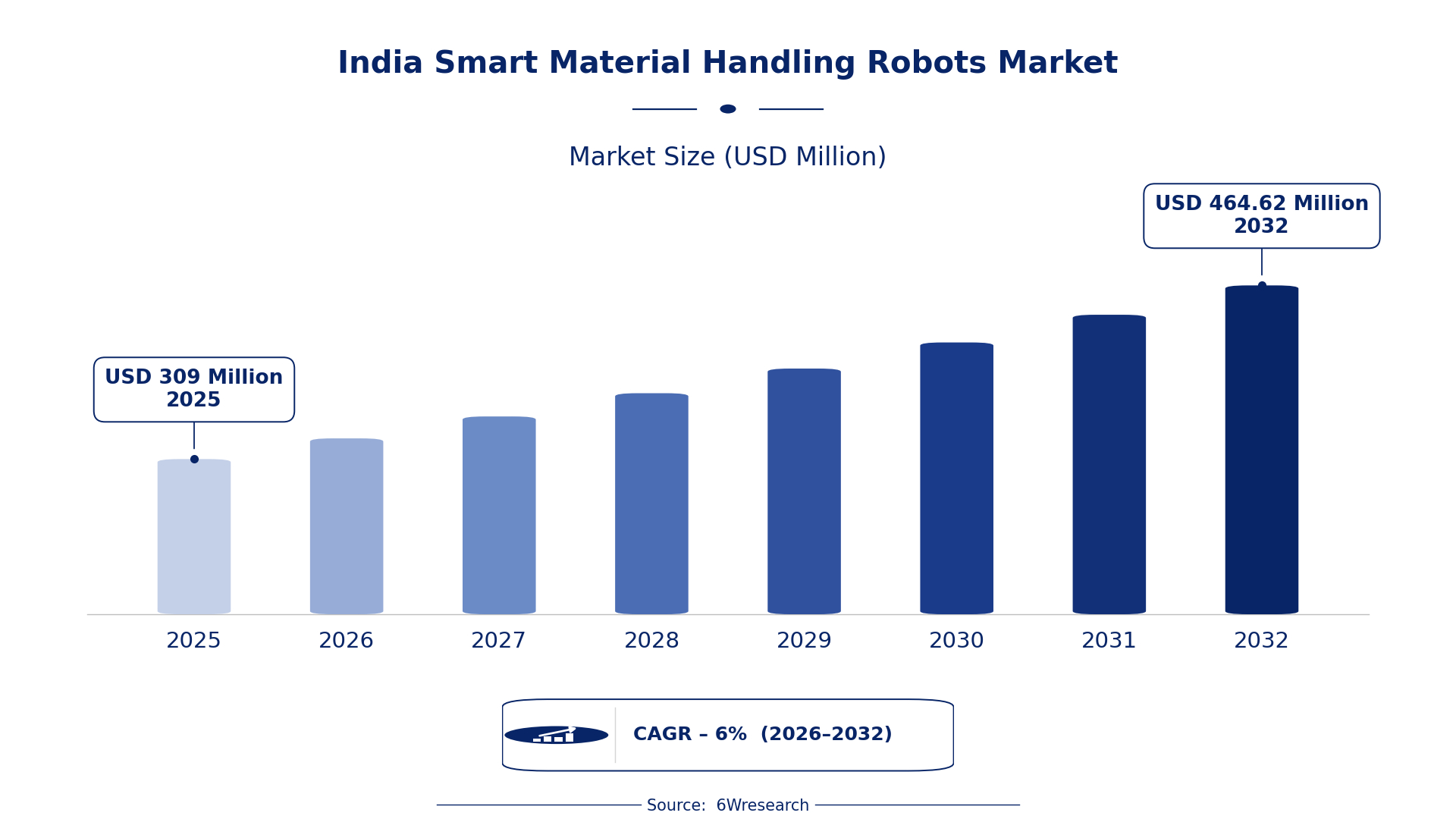
According to 6Wresearch internal database and industry insights, the India Smart Material Handling Robots Market was valued at USD 309.0 million in 2025 and is projected to reach USD 464.62 million by 2032, growing at a CAGR of approximately 6% during 2026–2032.
India Smart Material Handling Robots Market Highlights
| Report Metric | Details |
| Report Name | India Smart Material Handling Robots Market |
| Market Size 2025 | USD 309.0 million |
| Market Size 2032 | USD 464.62 million |
| Absolute Growth 2025–2032 | USD 155.62 million |
| CAGR 2026–2032 | 6% |
| Peak Annual Growth | 8.0% in 2026 |
| Forecast Period | 2026–2032 |
| Historical Data | 2022–2025 |
| Base Year | 2025 |
| Leading Robot Type, 2025 | Autonomous Mobile Robots (46% share) |
| Leading Smart Feature, 2025 | Path Optimization AI (47% share) |
| Leading Navigation Tech, 2025 | Lidar + SLAM (47% share) |
| Leading End User, 2025 | Logistics Centers (44% share) |
| Fastest-Growing Robot Type | Sorting Robots (8.2% CAGR) |
| Fastest-Growing Smart Feature | AI-Based Object Sorting (7.1% CAGR) |
| Fastest-Growing Navigation Tech | Camera + AI (8.5% CAGR) |
| Fastest-Growing End User | Smart Warehouses (8.5% CAGR) |
| Growing Sector | Logistics |
| Key End Users | Logistics Centers, Manufacturing Plants, E-commerce Fulfillment, Smart Warehouses |
India Smart Material Handling Robots Market Year-wise Growth Rate and Key Drivers (2022–2032)
This graph illustrates the annual growth rates of the market from 2022 to 2032, highlighting a steady upward trajectory and projected market expansion over the forecast period.
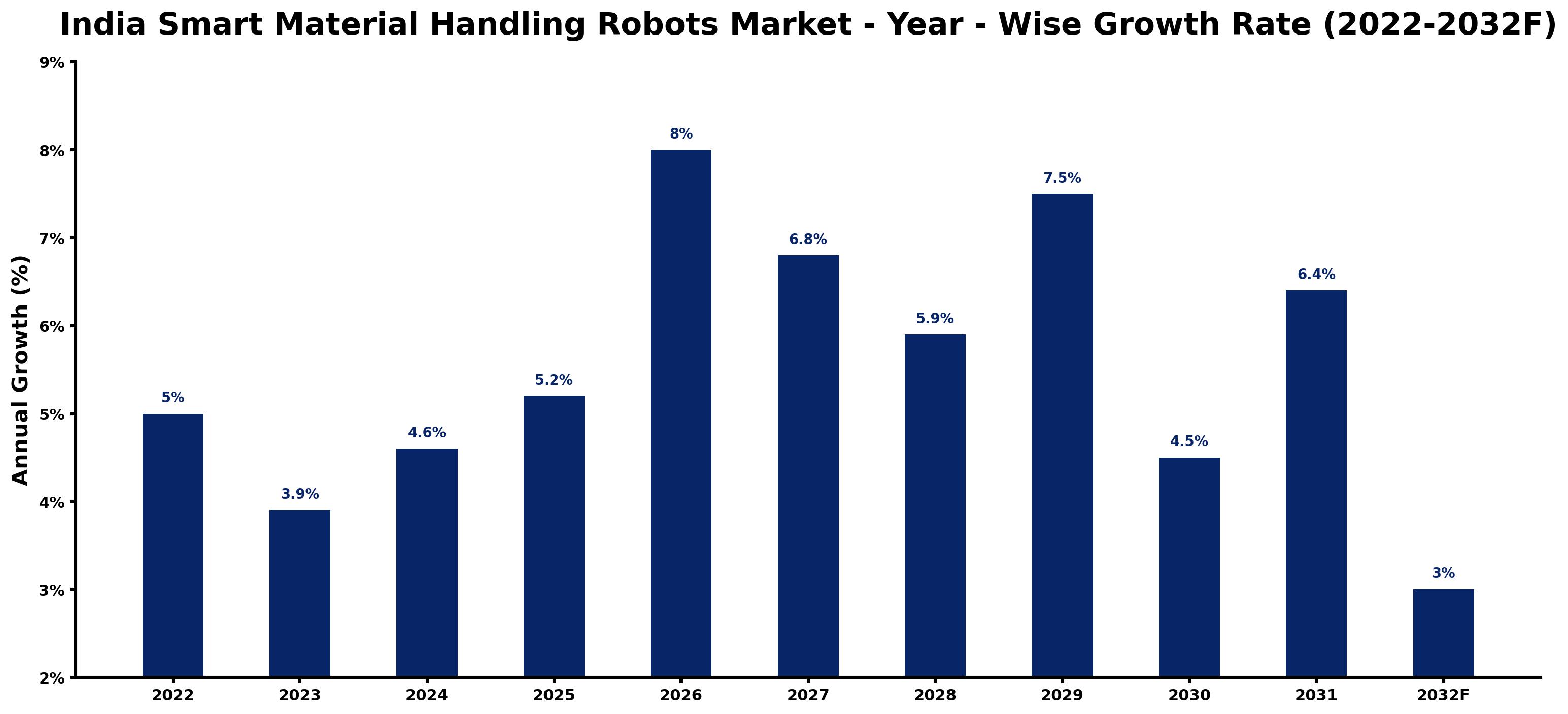
The following table presents the estimated annual growth rate for each year together with the principal factor influencing market performance.
| Year | Estimated Annual Growth (%) | Market Rationale |
| 2022 | 5.0 | The market experienced steady growth, driven by the National Robotics Mission promoting robotics research and development. |
| 2023 | 3.9 | Growth slowed as companies adjusted to new safety standards established by the Bureau of Indian Standards. |
| 2024 | 4.6 | Demand increased due to rising investments in smart warehouses, projected to grow at 30% from 2023 to 2030. |
| 2025 | 5.2 | The market grew faster as e-commerce expanded, increasing the need for sorting robots in logistics centers. |
| 2026 | 8.0 | A peak in growth occurred, supported by the 'Make in India' initiative promoting local robotics manufacturing. |
| 2027 | 6.8 | Growth slowed as the market matured and competition intensified among local suppliers in robotics. |
| 2028 | 5.9 | Investment in smart warehouses is expected to maintain positive growth rates, driven by increasing automation. |
| 2029 | 7.5 | Demand surged as smart warehouses became more prevalent across the country, enhancing logistics efficiency. |
| 2030 | 4.5 | Growth slowed as the market approached saturation in certain segments, particularly in robotics deployment. |
| 2031 | 6.4 | Increased adoption of AI technologies in robotics is expected to spur growth once again in this year. |
| 2032 | 3.0 | The market is expected to grow at a slower rate as it stabilises, influenced by ongoing automation trends. |
Note: Market size estimations and growth projections presented in this report are based on 6Wresearch's proprietary forecasting methodology, utilizing the latest available industry data, government publications, and primary research inputs.
India Smart Material Handling Robots Market Synopsis
Smart Material Handling Robots in India are advanced automated systems designed to facilitate the movement and management of materials across various sectors. These robots utilise robotics technology, AI algorithms, and sensor systems to improve operational efficiency. The India Smart Material Handling Robots Market is expanding due to rising investments in automation and the growing e-commerce sector. The 'Make in India' initiative and the National Robotics Mission are key drivers behind this growth, promoting local manufacturing and innovation in the sector.
Market Dynamics Impact Analysis (2026–2032)
| Factor | Type | Impact | Primary Segment Affected |
| Increasing automation in logistics centers enhances operational efficiency. | Driver | High | Autonomous Mobile Robots |
| Growing demand for sorting robots driven by e-commerce expansion. | Driver | High | Sorting Robots |
| High demand for robotics training due to the Skill India Mission. | Opportunity | Medium | Collaborative Loaders |
| Investment in smart warehouses is projected to grow at a CAGR of 30%. | Opportunity | High | Smart Warehouses |
| Safety standards may limit the speed of robotics adoption. | Restraint | Medium | Robotic Forklifts |
| High initial investment costs can deter small businesses from automation. | Restraint | High | Sorting Robots |
| The Smart Material Handling Robots market faces a skills gap in the workforce. | Challenge | High | Autonomous Mobile Robots |
| Competition from international suppliers can hinder local market growth. | Challenge | Medium | Robotic Forklifts |
Evaluation of Drivers in India Smart Material Handling Robots Market (2026–2032)
The main growth drivers and the segments they affect most are set out below.
| Drivers | Primary Segment Affected | Why It Matters (Evidence) |
| Rising investments in automation technologies. | Sorting Robots | E-commerce in India is projected to reach $200 billion by 2026, increasing demand for efficient sorting solutions. |
| Increased adoption of smart warehouses. | Autonomous Mobile Robots | Over 50% of Indian manufacturing plants are adopting automation technologies by 2025, driving demand for mobile robots. |
| Support from the 'Make in India' initiative. | Robotic Forklifts | This initiative promotes local manufacturing, improving production capabilities and reducing costs for suppliers. |
| Growth in logistics centers across India. | Collaborative Loaders | Autonomous Mobile Robots are increasingly used in over 1,000 logistics centers, boosting demand for collaborative solutions. |
| Advancements in AI and robotics technology. | Path Optimization AI | The Indian Institute of Technology is leading research on AI-based object sorting technologies since 2021, improving sorting accuracy. |
E-commerce in India is projected to reach $200 billion by 2026, driving demand for efficient sorting solutions. Over 50% of Indian manufacturing plants are adopting automation technologies by 2025, which will increase the need for mobile robots. Research on AI-based object sorting technologies at the Indian Institute of Technology since 2021 is improving sorting accuracy, which benefits logistics operations.
Evaluation of Restraints in India Smart Material Handling Robots Market
The following restraints limit how fast demand can grow.
| Market Restraint | Primary Segment Affected | Why It Matters (Evidence) |
| Safety standards may limit the speed of robotics adoption. | Robotic Forklifts | The Bureau of Indian Standards issued new safety standards for robotic systems in 2021, requiring compliance from manufacturers. |
| High initial investment costs can deter small businesses from automation. | Sorting Robots | Many small logistics firms struggle with the capital needed for advanced robotic systems, slowing their adoption. |
| Limited skilled workforce hampers robotics deployment. | Autonomous Mobile Robots | The Skill India Mission aims to train over 1 million individuals in robotics by 2025, but gaps remain in training. |
| Regulatory compliance can delay project timelines. | Collaborative Loaders | Manufacturers must navigate complex regulations, which can extend the time to market for new products. |
| Competition from international suppliers can hinder local market growth. | Robotic Forklifts | Local manufacturers face challenges competing with well-established international brands that dominate the market. |
India Smart Material Handling Robots Market Challenges
The India Smart Material Handling Robots market encounters a significant supply challenge due to insufficient local manufacturing capabilities, which delays product availability for producers and increases reliance on imports. Competitive pressures among domestic manufacturers result in aggressive pricing strategies, compelling some suppliers to compromise on quality, ultimately impacting buyers who require dependable solutions. Escalating raw material costs, influenced by global supply chain disruptions, are raising expenses for producers, leading to higher prices for buyers investing in automation. A notable skills gap in robotics engineering persists, with the Indian government targeting 1 million jobs by 2025, yet current shortages impede advanced solution development for producers.
Trends in the India Smart Material Handling Robots Market
Four trends stand out in the India Smart Material Handling Robots Market.
- Shift towards AI-Based Object Sorting: AI-Based Object Sorting technologies are becoming increasingly prevalent in logistics operations, with the Indian Institute of Technology leading research in this area. This trend is expected to improve sorting accuracy and efficiency, benefiting logistics centers.
- Transition from Traditional to Smart Warehouses: Smart Warehouses are gaining traction in India as companies seek to improve inventory management and order fulfillment. With a projected growth rate of 30% from 2023 to 2030, this shift indicates a strong market opportunity for suppliers of automation technologies.
- Emergence of Collaborative Robots: Collaborative robots are expected to account for 25% of the total robotics market in India by 2025, reflecting a growing trend towards automation in manufacturing. This shift is driven by the need for efficiency and safety in production environments.
- Prioritisation of Robotics Safety Standards: New safety standards for robotic systems were issued by the Bureau of Indian Standards in 2021, ensuring safe operation in industrial environments. This focus on safety is essential for gaining buyer trust and expanding market reach.
Investment Opportunities in the India Smart Material Handling Robots Market
Investors looking at the India Smart Material Handling Robots Market should consider the following areas.
- Gap in Robotics Training: With the Skill India Mission aiming to train over 1 million individuals by 2025, there is an opportunity for training providers to fill the skills gap in robotics. This presents a chance to develop educational programmes tailored to industry needs.
- Growing Demand for Smart Warehouses: The projected growth of smart warehouses at 30% from 2023 to 2030 presents an opportunity for suppliers of automation technologies to enter this expanding market. Collaborating with logistics centres can facilitate successful market entry.
- Investment in Robotics Manufacturing: The 'Make in India' initiative creates a favourable environment for investments in robotics manufacturing, with local production capabilities being improved. Suppliers can explore partnerships with local manufacturers to capitalise on this initiative.
- Expansion of E-commerce Fulfillment Centers: As e-commerce in India is projected to reach $200 billion by 2026, there is a growing need for efficient sorting robots in fulfilment centres. Suppliers can target logistics firms to provide tailored automation solutions.
Government Initiatives in the India Smart Material Handling Robots Market
The 'Make in India' initiative, launched in 2014, continues to encourage domestic manufacturing of robotics technologies, improving local production capabilities. The National Robotics Mission, initiated in 2020 by the Ministry of Electronics and Information Technology, promotes research and development in robotics with a focus on industry applications. Additionally, the Production Linked Incentive Scheme, launched in 2021, aims to boost manufacturing in robotics and automation sectors, providing financial incentives to manufacturers to improve production.
The Skill India Mission aims to train over 1 million individuals in robotics and automation technologies by 2025, improving workforce capabilities in India. The Ministry of Heavy Industries and Public Enterprises oversees this initiative, which funds skill development programmes and partnerships with educational institutions. Furthermore, the Bureau of Indian Standards issued new safety standards for robotic systems in 2021, ensuring safe operation in industrial environments and requiring compliance from manufacturers.
Future Insight of the India Smart Material Handling Robots Market
By 2032, buyers and suppliers in the India Smart Material Handling Robots market can expect substantial advancements driven by the 'Make in India' initiative, which will strengthen local production. The National Robotics Mission will stimulate research and development, paving the way for new robotics technologies. E-commerce is projected to reach $200 billion by 2026, significantly increasing demand for efficient sorting solutions. The adoption of smart warehouses is anticipated to rise, enhancing logistics optimisation for buyers as automation becomes more prevalent.
Market Segmentation Analysis
The report offers a comprehensive study of the following market segments and their leading categories in the market.
By Robot Type – Autonomous Mobile Robots Dominated, Sorting Robots Expected to Grow Fastest
According to Dhaval Chaurasia, Assistant Manager at 6Wresearch, in 2025, Autonomous Mobile Robots led the robot type split with a 46% share. Autonomous Mobile Robots hold the largest market share because they are extensively utilised for material transport in warehouses, showcasing their importance in logistics operations. Their widespread adoption in over 1,000 logistics centres across India underlines their critical role in enhancing efficiency. Sorting Robots are projected to grow fastest, at a CAGR of 8.2% during 2026–2032. Sorting Robots are experiencing rapid growth, primarily driven by the anticipated rise of e-commerce in India, projected to reach $200 billion by 2026. This growth in e-commerce will significantly boost the demand for automated sorting solutions, further accelerating this segment's expansion. Suppliers should focus on developing advanced sorting technologies to meet the increasing demand from the booming e-commerce sector.
By Smart Feature – Path Optimization AI Dominated, AI-Based Object Sorting Expected to Grow Fastest
Path Optimization AI accounted for a 47% market share by smart feature in 2025. Path Optimization leads in market share as it significantly enhances the efficiency of robot navigation, making it essential for various automated systems. Its effectiveness in improving operational performance in logistics ensures that robots can navigate complex environments effectively. Over 2026–2032, AI-Based Object Sorting is expected to post the fastest growth, at a CAGR of 7.1%. AI-Based Object Sorting is the fastest-growing feature, as it enhances sorting accuracy and speed, particularly in logistics applications. The ongoing trend towards automation in warehouses will continue to drive the demand for this technology. Buyers should consider investing in robots equipped with advanced sorting capabilities to optimise their logistics operations.
By Navigation Tech – Lidar + SLAM Dominated, Camera + AI Expected to Grow Fastest
With a 47% revenue share in 2025, Lidar + SLAM was the largest navigation tech category. Lidar + SLAM technology commands the largest market share due to its crucial role in navigation and obstacle avoidance within dynamic environments. Its reliability in ensuring safe and efficient robot movement is vital for logistics applications. The quickest growth will come from Camera + AI, forecast to expand at a CAGR of 8.5% between 2026 and 2032. Camera + AI is emerging as the fastest-growing navigation technology, significantly improving object recognition and navigation tasks, which are essential for modern automated systems. The increasing complexity of logistics environments is a key factor contributing to this demand. Suppliers must prioritise advancements in camera and AI technologies to remain competitive in the navigation technology market.
By End User – Logistics Centers Dominated, Smart Warehouses Expected to Grow Fastest
Logistics Centers held a 44% share of the India Smart Material Handling Robots Market by end user in 2025. Logistics Centers dominate the market share as they are heavily utilised for efficient goods handling and distribution. The growing adoption of automation within these centres highlights their vital role in optimising supply chain operations. Smart Warehouses are set to record the highest CAGR in this split, 8.5% over 2026–2032. Smart Warehouses are the fastest-growing end user segment, driven by the need for enhanced inventory management and order fulfilment solutions. As businesses increasingly transition to smart operations, this segment is poised for rapid expansion. Buyers should explore investments in smart warehouse solutions to improve operational efficiency and address rising consumer demands.
Key Attractiveness of the Report
- 10 Years of Market Numbers
- Historical Data Starting from 2022 to 2025
- Base Year 2025
- Forecast Data until 2032
- Key Performance Indicators Impacting the Market
- Major Upcoming Developments and Projects
Key Highlights of the Report:
- India Smart Material Handling Robots Market Outlook
- Market Size of India Smart Material Handling Robots Market, 2025
- Forecast of India Smart Material Handling Robots Market, 2032
- Historical Data and Forecast of India Smart Material Handling Robots Revenues & Volume for the Period 2022 - 2032F
- India Smart Material Handling Robots Market Trend Evolution
- India Smart Material Handling Robots Market Drivers and Challenges
- India Smart Material Handling Robots Price Trends
- India Smart Material Handling Robots Porter's Five Forces
- India Smart Material Handling Robots Industry Life Cycle
- Historical Data and Forecast of India Smart Material Handling Robots Market Revenues & Volume By Robot Type for the Period 2022 - 2032F
- Historical Data and Forecast of India Smart Material Handling Robots Market Revenues & Volume By Autonomous Mobile Robots for the Period 2022 - 2032F
- Historical Data and Forecast of India Smart Material Handling Robots Market Revenues & Volume By Robotic Forklifts for the Period 2022 - 2032F
- Historical Data and Forecast of India Smart Material Handling Robots Market Revenues & Volume By Collaborative Loaders for the Period 2022 - 2032F
- Historical Data and Forecast of India Smart Material Handling Robots Market Revenues & Volume By Sorting Robots for the Period 2022 - 2032F
- Historical Data and Forecast of India Smart Material Handling Robots Market Revenues & Volume By Smart Feature for the Period 2022 - 2032F
- Historical Data and Forecast of India Smart Material Handling Robots Market Revenues & Volume By Path Optimization AI for the Period 2022 - 2032F
- Historical Data and Forecast of India Smart Material Handling Robots Market Revenues & Volume By Load Detection for the Period 2022 - 2032F
- Historical Data and Forecast of India Smart Material Handling Robots Market Revenues & Volume By Safe Human Interaction for the Period 2022 - 2032F
- Historical Data and Forecast of India Smart Material Handling Robots Market Revenues & Volume By AI-Based Object Sorting for the Period 2022 - 2032F
- Historical Data and Forecast of India Smart Material Handling Robots Market Revenues & Volume By Navigation Tech for the Period 2022 - 2032F
- Historical Data and Forecast of India Smart Material Handling Robots Market Revenues & Volume By Lidar + SLAM for the Period 2022 - 2032F
- Historical Data and Forecast of India Smart Material Handling Robots Market Revenues & Volume By Weight + Vision Sensors for the Period 2022 - 2032F
- Historical Data and Forecast of India Smart Material Handling Robots Market Revenues & Volume By Proximity Sensors for the Period 2022 - 2032F
- Historical Data and Forecast of India Smart Material Handling Robots Market Revenues & Volume By Camera + AI for the Period 2022 - 2032F
- Historical Data and Forecast of India Smart Material Handling Robots Market Revenues & Volume By End User for the Period 2022 - 2032F
- Historical Data and Forecast of India Smart Material Handling Robots Market Revenues & Volume By Logistics Centers for the Period 2022 - 2032F
- Historical Data and Forecast of India Smart Material Handling Robots Market Revenues & Volume By Manufacturing Plants for the Period 2022 - 2032F
- Historical Data and Forecast of India Smart Material Handling Robots Market Revenues & Volume By Smart Warehouses for the Period 2022 - 2032F
- Historical Data and Forecast of India Smart Material Handling Robots Market Revenues & Volume By E-commerce Fulfillment for the Period 2022 - 2032F
- India Smart Material Handling Robots Import Export Trade Statistics
- Market Opportunity Assessment By Robot Type
- Market Opportunity Assessment By Smart Feature
- Market Opportunity Assessment By Navigation Tech
- Market Opportunity Assessment By End User
- India Smart Material Handling Robots Top Companies Market Share
- India Smart Material Handling Robots Competitive Benchmarking By Technical and Operational Parameters
- India Smart Material Handling Robots Company Profiles
- India Smart Material Handling Robots Key Strategic Recommendations
Market Covered
The report offers an extensive study of the following market segments.
By Robot Type
- Autonomous Mobile Robots
- Robotic Forklifts
- Collaborative Loaders
- Sorting Robots
By Smart Feature
- Path Optimization AI
- Load Detection
- Safe Human Interaction
- AI-Based Object Sorting
By Navigation Tech
- Lidar + SLAM
- Weight + Vision Sensors
- Proximity Sensors
- Camera + AI
By End User
- Logistics Centers
- Manufacturing Plants
- Smart Warehouses
- E-commerce Fulfillment































