China Smart Material Handling Robots Market Size & Growth Rate
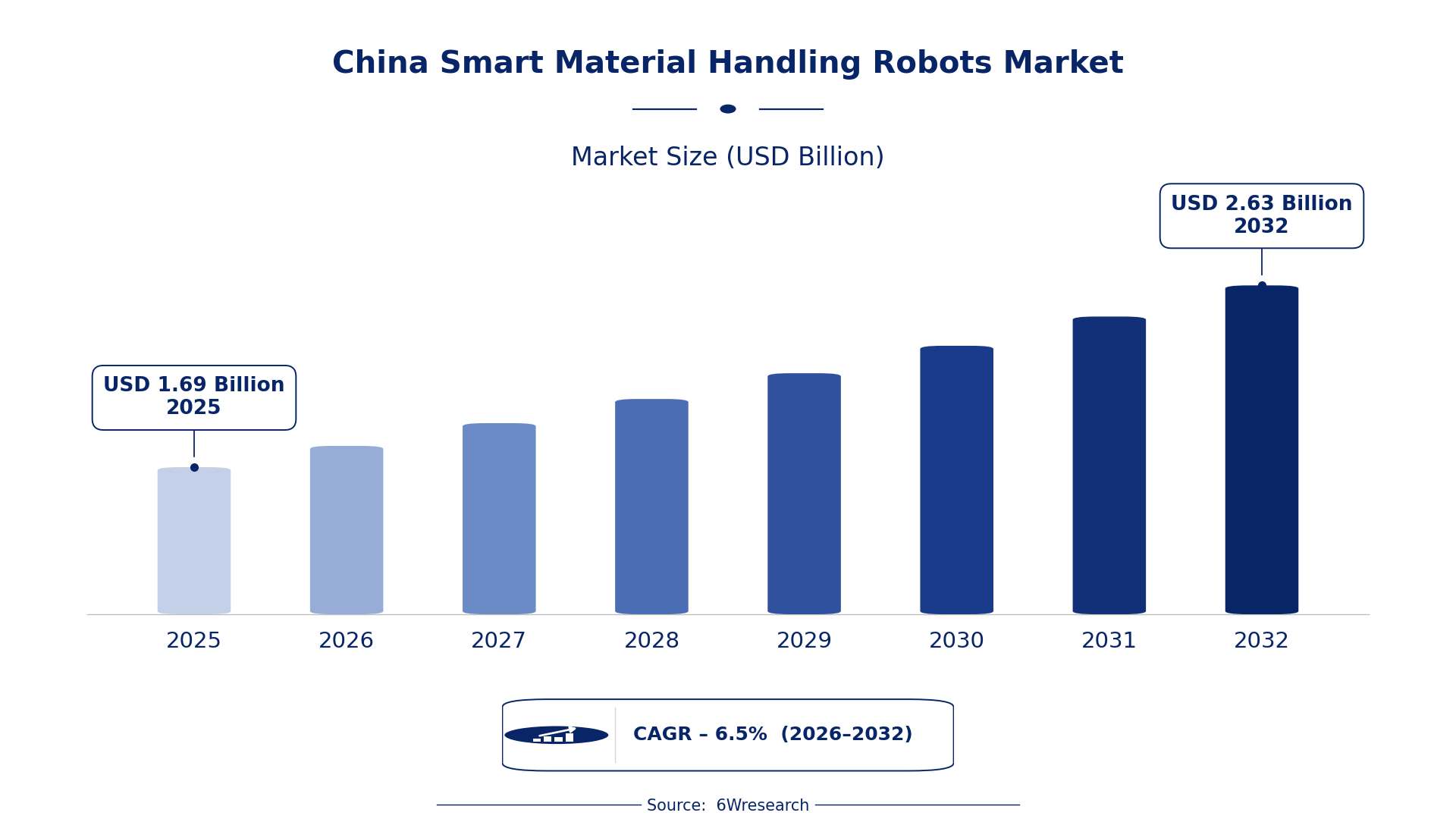
According to 6Wresearch internal database and industry insights, the China Smart Material Handling Robots Market was valued at USD 1.69 billion in 2025 and is projected to reach USD 2.63 billion by 2032, growing at a CAGR of approximately 6.5% during 2026–2032.
China Smart Material Handling Robots Market Highlights
| Report Metric | Details |
| Report Name | China Smart Material Handling Robots Market |
| Market Size 2025 | USD 1.69 billion |
| Market Size 2032 | USD 2.63 billion |
| Absolute Growth 2025–2032 | USD 0.94 billion |
| CAGR 2026–2032 | 6.5% |
| Peak Annual Growth | 8.5% in 2032 |
| Forecast Period | 2026–2032 |
| Historical Data | 2022–2025 |
| Base Year | 2025 |
| Leading Robot Type, 2025 | Autonomous Mobile Robots (37% share) |
| Leading Smart Feature, 2025 | Path Optimization AI (47% share) |
| Leading Navigation Tech, 2025 | Lidar + SLAM (49% share) |
| Leading End User, 2025 | Logistics Centers (46% share) |
| Fastest-Growing Robot Type | Collaborative Loaders (8.5% CAGR) |
| Fastest-Growing Smart Feature | AI-Based Object Sorting (9.0% CAGR) |
| Fastest-Growing Navigation Tech | Camera + AI (7.9% CAGR) |
| Fastest-Growing End User | Smart Warehouses (8.2% CAGR) |
| Growing Sector | Logistics and Warehousing |
| Key End Users | Logistics Centers, Manufacturing Plants, E-commerce Fulfillment, Smart Warehouses |
China Smart Material Handling Robots Market Year-wise Growth Rate and Key Drivers (2022–2032)
This graph illustrates the annual growth rates of the market from 2022 to 2032, highlighting a steady upward trajectory and projected market expansion over the forecast period.
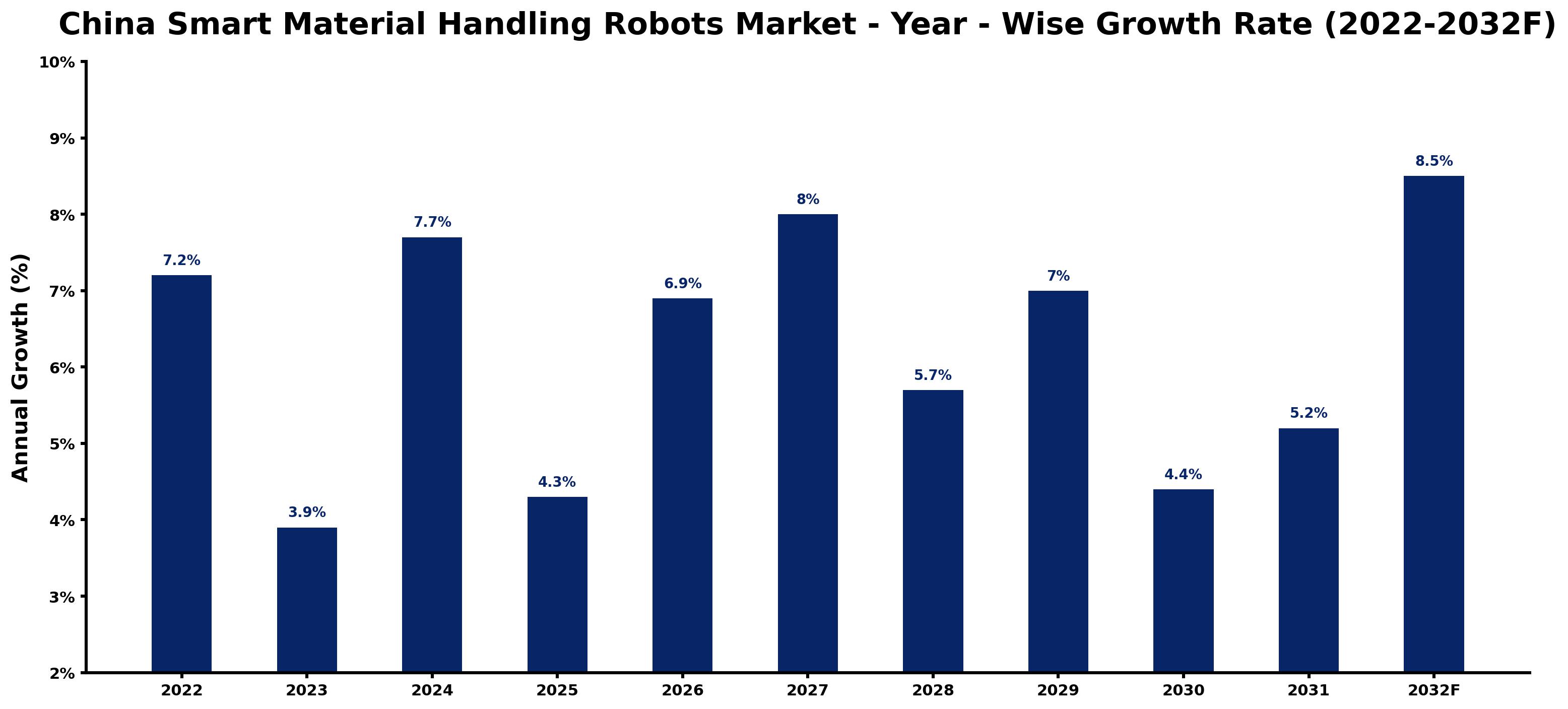
The table below sets out the estimated growth rate for each year and the main factor behind it.
| Year | Estimated Annual Growth (%) | Market Rationale |
| 2022 | 7.2 | The market experienced steady growth, driven by the 'Robotics Industry Development Plan' promoting automation. |
| 2023 | 3.9 | Growth slowed as the logistics industry faced temporary disruptions due to supply chain challenges. |
| 2024 | 7.7 | Demand surged as investments in automation technologies gained momentum in various industries. |
| 2025 | 4.3 | Growth decelerated as the market adjusted to previous high levels of investment in automation. |
| 2026 | 6.9 | Investment in smart material handling robots rose as companies focused on operational efficiency. |
| 2027 | 8.0 | Demand increased due to the expansion of logistics centers and smart warehouses across urban areas. |
| 2028 | 5.7 | Growth slowed as the market began to stabilise after several years of rapid expansion. |
| 2029 | 7.0 | A renewed focus on automation in manufacturing spurred demand for smart material handling robots. |
| 2030 | 4.4 | Growth decelerated as companies reassessed their automation strategies in light of market conditions. |
| 2031 | 5.2 | Demand rose again as logistics centers adopted more advanced automation technologies. |
| 2032 | 8.5 | The market peaked as investments in robotics reached new heights, driven by e-commerce growth. |
Note: Market size estimations and growth projections presented in this report are based on 6Wresearch's proprietary forecasting methodology, utilizing the latest available industry data, government publications, and primary research inputs.
China Smart Material Handling Robots Market Synopsis
The China Smart Material Handling Robots Market encompasses automated systems designed for transporting, sorting, and managing materials. These robots utilise advanced robotics technology, integrating AI and navigation systems to improve efficiency in logistics and manufacturing. The market is expanding due to the booming e-commerce sector and the increasing need for automation in manufacturing. By 2025, the logistics industry is projected to reach a value of 2 trillion yuan, further driving demand for these robots. As the number of smart warehouses exceeds 10,000, the market is set for substantial growth.
Market Dynamics Impact Analysis (2026–2032)
| Factor | Type | Impact | Primary Segment Affected |
| Growing investments in automation technologies are driving demand for smart material handling robots. | Driver | High | Autonomous Mobile Robots |
| The rising e-commerce sector is creating a need for efficient material handling solutions. | Driver | High | Logistics Centers |
| The increasing number of smart warehouses presents opportunities for automation suppliers. | Opportunity | High | Smart Warehouses |
| The push for enhanced operational efficiency in manufacturing creates demand for advanced robots. | Opportunity | High | Manufacturing Plants |
| High initial costs of smart material handling robots can deter small businesses from investing. | Restraint | Medium | Robotic Forklifts |
| Limited awareness and understanding of automation benefits can slow market adoption. | Restraint | Medium | Collaborative Loaders |
| The market faces challenges related to skilled labor shortages in robotics and automation. | Challenge | High | Sorting Robots |
| Technological advancements require continuous investment, which can strain budgets for some firms. | Challenge | Medium | Autonomous Mobile Robots |
Evaluation of Drivers in China Smart Material Handling Robots Market (2026–2032)
Below mentioned are some major drivers and their influence on market dynamics.
| Drivers | Primary Segment Affected | Why It Matters (Evidence) |
| Increased investment in automation technologies is boosting demand for smart material handling robots. | Robotic Forklifts | China's manufacturing sector will invest over 500 billion yuan in automation technologies by 2025. |
| The e-commerce sector's rapid growth is driving the need for efficient logistics solutions. | E-commerce Fulfillment | The logistics industry in China is expected to reach a value of 2 trillion yuan by 2025. |
| The expansion of logistics centers is creating a strong demand for automation. | Logistics Centers | China has over 200 logistics centers employing advanced automation technologies as of 2023. |
| The rise of smart warehouses is pushing for more advanced material handling solutions. | Smart Warehouses | The number of smart warehouses in China will exceed 10,000 by 2025. |
| The integration of AI in robotics improves operational efficiency, driving demand. | Autonomous Mobile Robots | The 'Artificial Intelligence Innovation Action Plan' was approved in 2023 to promote AI in robotics. |
Growth across the Smart Material Handling Robots market in China is anchored in increased investment in automation technologies, rising e-commerce demand, and the expansion of logistics centers. The manufacturing sector will invest over 500 billion yuan in automation technologies by 2025, driving purchases of smart material handling robots. The logistics industry is set to reach a value of 2 trillion yuan by 2025, further boosting demand. Over 200 logistics centers are employing advanced automation technologies, creating a strong market for these robots. The anticipated growth of smart warehouses, which will exceed 10,000 by 2025, will also drive demand for efficient material handling solutions.
Evaluation of Restraints in China Smart Material Handling Robots Market
The key brakes on demand, and where they bite hardest, are shown below.
| Market Restraint | Primary Segment Affected | Why It Matters (Evidence) |
| High initial costs of smart material handling robots can deter small businesses from investing. | Robotic Forklifts | The average investment required for automation can be prohibitive for smaller logistics operators. |
| Limited awareness and understanding of automation benefits can slow market adoption. | Collaborative Loaders | Many potential users remain unaware of the efficiency gains that smart robots can provide. |
| Skilled labor shortages in robotics and automation can hinder market growth. | Sorting Robots | A lack of trained personnel limits the ability to implement and maintain advanced robotic systems. |
| Technological advancements require continuous investment, which can strain budgets for some firms. | Autonomous Mobile Robots | Smaller companies may struggle to keep up with rapid technological changes in robotics. |
| Regulatory compliance can complicate the deployment of smart material handling robots. | E-commerce Fulfillment | New safety and operational standards can delay the implementation of automation technologies. |
China Smart Material Handling Robots Market Challenges
The China Smart Material Handling Robots market faces several practical problems, beginning with technology integration challenges. Many logistics centers struggle to upgrade outdated infrastructure, which delays automation efforts and raises operational costs for buyers. Regulatory compliance with the updated National Standard for Industrial Robots can increase expenses for manufacturers, impacting their pricing strategies. Buyers in the logistics sector experience inconsistent availability of smart material handling robots, leading to operational delays and higher costs, especially with the adoption rate remaining around 30% as of 2023.
Trends in the China Smart Material Handling Robots Market
The trends below show where the China Smart Material Handling Robots Market is heading.
- Shift to Automated Logistics: Logistics centres are increasingly adopting smart material handling robots to boost efficiency. By 2025, the number of smart warehouses in China is anticipated to exceed 10,000, reflecting this trend.
- Increased AI Integration: The integration of AI technologies in smart material handling robots is becoming more common. The 'Artificial Intelligence Innovation Action Plan' launched in 2023 has a budget of 10 billion yuan to support this transition.
- Expansion of Smart Warehouses: Smart warehouses are rapidly proliferating across urban areas in China, driven by the e-commerce boom. The logistics industry is projected to reach a value of 2 trillion yuan by 2025, propelling this growth.
- Focus on Efficiency: Manufacturers are prioritising operational efficiency through automation. The 'Smart Manufacturing Development Strategy' aims to increase automation in manufacturing by 30% by 2025.
Investment Opportunities in the China Smart Material Handling Robots Market
The following opportunities in the China Smart Material Handling Robots Market pair current demand with a clear way in.
- Investment in Smart Warehouses: With the logistics industry projected to reach 2 trillion yuan by 2025, investing in smart warehouse technologies offers a strong opportunity. Logistics centres are actively seeking efficient automation solutions.
- Automation in Manufacturing: The manufacturing sector's anticipated investment of over 500 billion yuan in automation technologies presents a prime opportunity for suppliers. Collaborating with local manufacturers can facilitate market entry.
- Robotic Forklifts Demand: The growing need for efficient material handling in warehouses creates an opportunity to supply robotic forklifts. Many logistics centres are aiming to upgrade their operations to meet this demand.
- Collaborative Loaders for Improved Productivity: The rising trend of collaborative robots in manufacturing provides a chance to supply innovative solutions. Manufacturers are increasingly seeking ways to enhance productivity through automation.
Government Initiatives in the China Smart Material Handling Robots Market
In 2022, the Ministry of Industry and Information Technology launched the 'Robotics Industry Development Plan' to stimulate the robotics sector. This initiative focuses on innovation and integration, aiming to increase the adoption of smart material handling robots across various industries. The plan encourages investment in research and development, ensuring that producers meet the latest technological standards. It also aims to streamline the approval processes for new robotic technologies, facilitating quicker market entry for new solutions. This initiative is expected to significantly advance the robotics sector in China.
In 2023, the State Council approved the 'Artificial Intelligence Innovation Action Plan' with a budget of 10 billion yuan. This plan promotes AI integration in robotics, providing funding for projects that enhance automation capabilities. The Ministry of Science and Technology oversees this initiative, ensuring that funding is directed towards impactful research and development projects. This support is crucial for producers aiming to innovate and improve their offerings in the smart material handling robots market.
Future Insight of the China Smart Material Handling Robots Market
The China Smart Material Handling Robots market will experience significant transformations by 2032, driven by initiatives like the Robotics Industry Development Plan and the Smart Manufacturing Innovation Strategy. By 2025, over 10,000 smart warehouses are expected to operate, enhancing efficiency for suppliers and pushing buyers towards more automated solutions. The urban population density will continue to drive demand for these robots, while increased investment in automation technologies will support the growth of the market. Updated safety and efficiency standards will further influence operational practices.
Market Segmentation Analysis
The analysis below covers each segmentation, its leading category in 2025 and its fastest-growing category through 2032.
By Robot Type – Autonomous Mobile Robots Dominated, Collaborative Loaders Expected to Grow Fastest
According to Dhaval Chaurasia, Assistant Manager at 6Wresearch, Autonomous Mobile Robots held a 37% share of the China Smart Material Handling Robots Market by robot type in 2025. Autonomous Mobile Robots hold the largest market share due to their extensive application in transporting materials across logistics and manufacturing sectors. Their effectiveness is highlighted by the installed base of approximately 100,000 units, showcasing their crucial role in enhancing operational efficiency. Collaborative Loaders are projected to grow fastest, at a CAGR of 8.5% during 2026–2032. Collaborative Loaders are rapidly gaining popularity as they significantly improve productivity in manufacturing environments, which are increasingly adopting automation. The projected investment of over 500 billion yuan in automation technologies by the manufacturing sector by 2025 will further accelerate this growth. This indicates that suppliers should focus on advancing both Autonomous Mobile Robots and Collaborative Loaders to meet the rising demand.
By Smart Feature – Path Optimization AI Dominated, AI-Based Object Sorting Expected to Grow Fastest
With a 47% revenue share in 2025, Path Optimization AI was the largest smart feature category. Path Optimization AI commands the largest market share as it is vital for enhancing the navigation efficiency of smart material handling robots, making them more effective in diverse operational contexts. Its integration into numerous systems across logistics and manufacturing facilities solidifies its leading position. Over 2026–2032, AI-Based Object Sorting is expected to post the fastest growth, at a CAGR of 9.0%. AI-Based Object Sorting is experiencing the fastest growth because it significantly improves sorting efficiency in dynamic environments, which is essential for the increasing number of smart warehouses. The anticipated rise to over 10,000 smart warehouses by 2025 will further drive this segment's expansion. Suppliers should prioritise the development of AI-Based Object Sorting technologies to capitalise on the rapid growth in smart warehousing.
By Navigation Tech – Lidar + SLAM Dominated, Camera + AI Expected to Grow Fastest
Lidar + SLAM accounted for a 49% market share by navigation tech in 2025. Lidar + SLAM technology captures the largest market share as it is widely utilised for precise navigation in smart material handling robots, ensuring reliable operation in complex environments. Its established application in logistics centers reinforces its strong market position. The quickest growth will come from Camera + AI, forecast to expand at a CAGR of 7.9% between 2026 and 2032. Camera + AI technology is witnessing rapid growth as it enhances robot functionality and meets the increasing demand for advanced navigation solutions. Its integration into various applications is likely to accelerate adoption in the near future. Suppliers must invest in Camera + AI technologies to align with the changing navigation needs of smart material handling robots.
By End User – Logistics Centers Dominated, Smart Warehouses Expected to Grow Fastest
Logistics Centers took a 46% share of end user in 2025, more than any other category. Logistics Centers represent the largest share of the market as they extensively utilise smart material handling robots for efficient material handling and streamlined operations. The high adoption rate of around 30% in these centers underscores their importance in the logistics industry. Smart Warehouses are set to record the highest CAGR in this split, 8.2% over 2026–2032. Smart Warehouses are experiencing the fastest growth as they increasingly rely on robots for inventory management and order fulfillment, driven by the booming e-commerce sector. The expected increase in smart warehouses to over 10,000 by 2025 will further fuel this growth. This indicates that suppliers should focus on tailoring solutions for Smart Warehouses to meet the rising demand for automation in inventory management.
Key Attractiveness of the Report
- 10 Years of Market Numbers
- Historical Data Starting from 2022 to 2025
- Base Year 2025
- Forecast Data until 2032
- Key Performance Indicators Impacting the Market
- Major Upcoming Developments and Projects
Key Highlights of the Report:
- China Smart Material Handling Robots Market Outlook
- Market Size of China Smart Material Handling Robots Market, 2025
- Forecast of China Smart Material Handling Robots Market, 2032
- Historical Data and Forecast of China Smart Material Handling Robots Revenues & Volume for the Period 2022 - 2032F
- China Smart Material Handling Robots Market Trend Evolution
- China Smart Material Handling Robots Market Drivers and Challenges
- China Smart Material Handling Robots Price Trends
- China Smart Material Handling Robots Porter's Five Forces
- China Smart Material Handling Robots Industry Life Cycle
- Historical Data and Forecast of China Smart Material Handling Robots Market Revenues & Volume By Robot Type for the Period 2022 - 2032F
- Historical Data and Forecast of China Smart Material Handling Robots Market Revenues & Volume By Autonomous Mobile Robots for the Period 2022 - 2032F
- Historical Data and Forecast of China Smart Material Handling Robots Market Revenues & Volume By Robotic Forklifts for the Period 2022 - 2032F
- Historical Data and Forecast of China Smart Material Handling Robots Market Revenues & Volume By Collaborative Loaders for the Period 2022 - 2032F
- Historical Data and Forecast of China Smart Material Handling Robots Market Revenues & Volume By Sorting Robots for the Period 2022 - 2032F
- Historical Data and Forecast of China Smart Material Handling Robots Market Revenues & Volume By Smart Feature for the Period 2022 - 2032F
- Historical Data and Forecast of China Smart Material Handling Robots Market Revenues & Volume By Path Optimization AI for the Period 2022 - 2032F
- Historical Data and Forecast of China Smart Material Handling Robots Market Revenues & Volume By Load Detection for the Period 2022 - 2032F
- Historical Data and Forecast of China Smart Material Handling Robots Market Revenues & Volume By Safe Human Interaction for the Period 2022 - 2032F
- Historical Data and Forecast of China Smart Material Handling Robots Market Revenues & Volume By AI-Based Object Sorting for the Period 2022 - 2032F
- Historical Data and Forecast of China Smart Material Handling Robots Market Revenues & Volume By Navigation Tech for the Period 2022 - 2032F
- Historical Data and Forecast of China Smart Material Handling Robots Market Revenues & Volume By Lidar + SLAM for the Period 2022 - 2032F
- Historical Data and Forecast of China Smart Material Handling Robots Market Revenues & Volume By Weight + Vision Sensors for the Period 2022 - 2032F
- Historical Data and Forecast of China Smart Material Handling Robots Market Revenues & Volume By Proximity Sensors for the Period 2022 - 2032F
- Historical Data and Forecast of China Smart Material Handling Robots Market Revenues & Volume By Camera + AI for the Period 2022 - 2032F
- Historical Data and Forecast of China Smart Material Handling Robots Market Revenues & Volume By End User for the Period 2022 - 2032F
- Historical Data and Forecast of China Smart Material Handling Robots Market Revenues & Volume By Logistics Centers for the Period 2022 - 2032F
- Historical Data and Forecast of China Smart Material Handling Robots Market Revenues & Volume By Manufacturing Plants for the Period 2022 - 2032F
- Historical Data and Forecast of China Smart Material Handling Robots Market Revenues & Volume By Smart Warehouses for the Period 2022 - 2032F
- Historical Data and Forecast of China Smart Material Handling Robots Market Revenues & Volume By E-commerce Fulfillment for the Period 2022 - 2032F
- China Smart Material Handling Robots Import Export Trade Statistics
- Market Opportunity Assessment By Robot Type
- Market Opportunity Assessment By Smart Feature
- Market Opportunity Assessment By Navigation Tech
- Market Opportunity Assessment By End User
- China Smart Material Handling Robots Top Companies Market Share
- China Smart Material Handling Robots Competitive Benchmarking By Technical and Operational Parameters
- China Smart Material Handling Robots Company Profiles
- China Smart Material Handling Robots Key Strategic Recommendations
Market Covered
Segments analysed in this report are listed below.
By Robot Type
- Autonomous Mobile Robots
- Robotic Forklifts
- Collaborative Loaders
- Sorting Robots
By Smart Feature
- Path Optimization AI
- Load Detection
- Safe Human Interaction
- AI-Based Object Sorting
By Navigation Tech
- Lidar + SLAM
- Weight + Vision Sensors
- Proximity Sensors
- Camera + AI
By End User
- Logistics Centers
- Manufacturing Plants
- Smart Warehouses
- E-commerce Fulfillment































