India Smart Material Handling Systems Market Size & Growth Rate
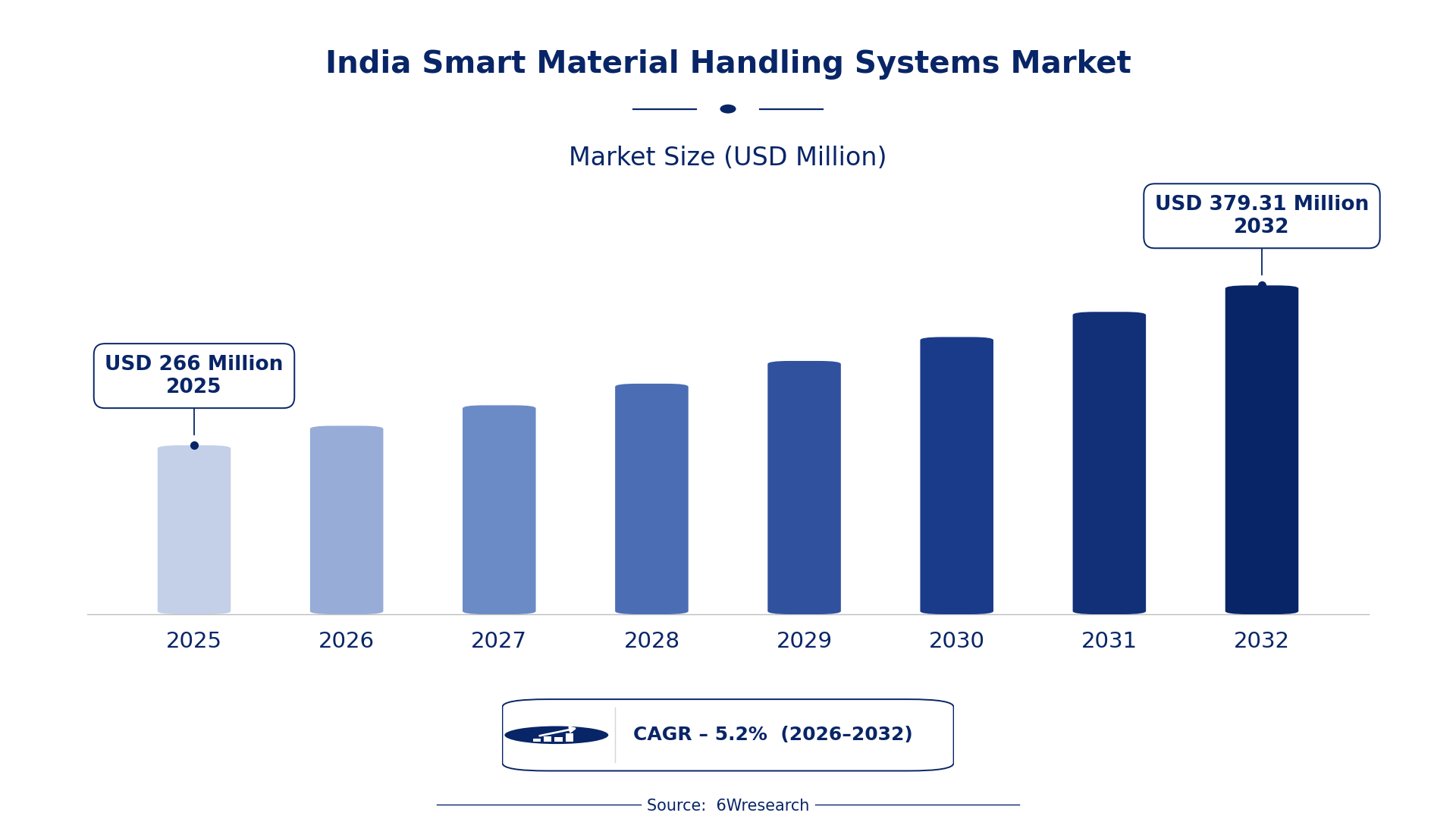
According to 6Wresearch internal database and industry insights, the India Smart Material Handling Systems Market was valued at USD 266.0 million in 2025 and is projected to reach USD 379.31 million by 2032, growing at a CAGR of approximately 5.2% during 2026–2032.
India Smart Material Handling Systems Market Highlights
| Report Metric | Details |
| Report Name | India Smart Material Handling Systems Market |
| Market Size 2025 | USD 266.0 million |
| Market Size 2032 | USD 379.31 million |
| Absolute Growth 2025–2032 | USD 113.31 million |
| CAGR 2026–2032 | 5.2% |
| Peak Annual Growth | 6.5% in 2030 |
| Forecast Period | 2026–2032 |
| Historical Data | 2022–2025 |
| Base Year | 2025 |
| Leading System Type, 2025 | AGV Conveyor Systems (41% share) |
| Leading Smart Feature, 2025 | Intelligent Route Planning (42% share) |
| Leading Control Platform, 2025 | IoT + HMI (46% share) |
| Leading End User, 2025 | Logistics Operators (52% share) |
| Fastest-Growing System Type | AI-Powered Palletizers (7.3% CAGR) |
| Fastest-Growing Smart Feature | Object Identification (7.8% CAGR) |
| Fastest-Growing Control Platform | Sensor Fusion + AI (6.6% CAGR) |
| Fastest-Growing End User | Distribution Warehouses (7.9% CAGR) |
| Growing Sector | Distribution Warehouses |
| Key End Users | Logistics Operators, Shipping Yards, Distribution Warehouses, Retail Chains |
India Smart Material Handling Systems Market Year-wise Growth Rate and Key Drivers (2022–2032)
This graph illustrates the annual growth rates of the market from 2022 to 2032, highlighting a steady upward trajectory and projected market expansion over the forecast period.
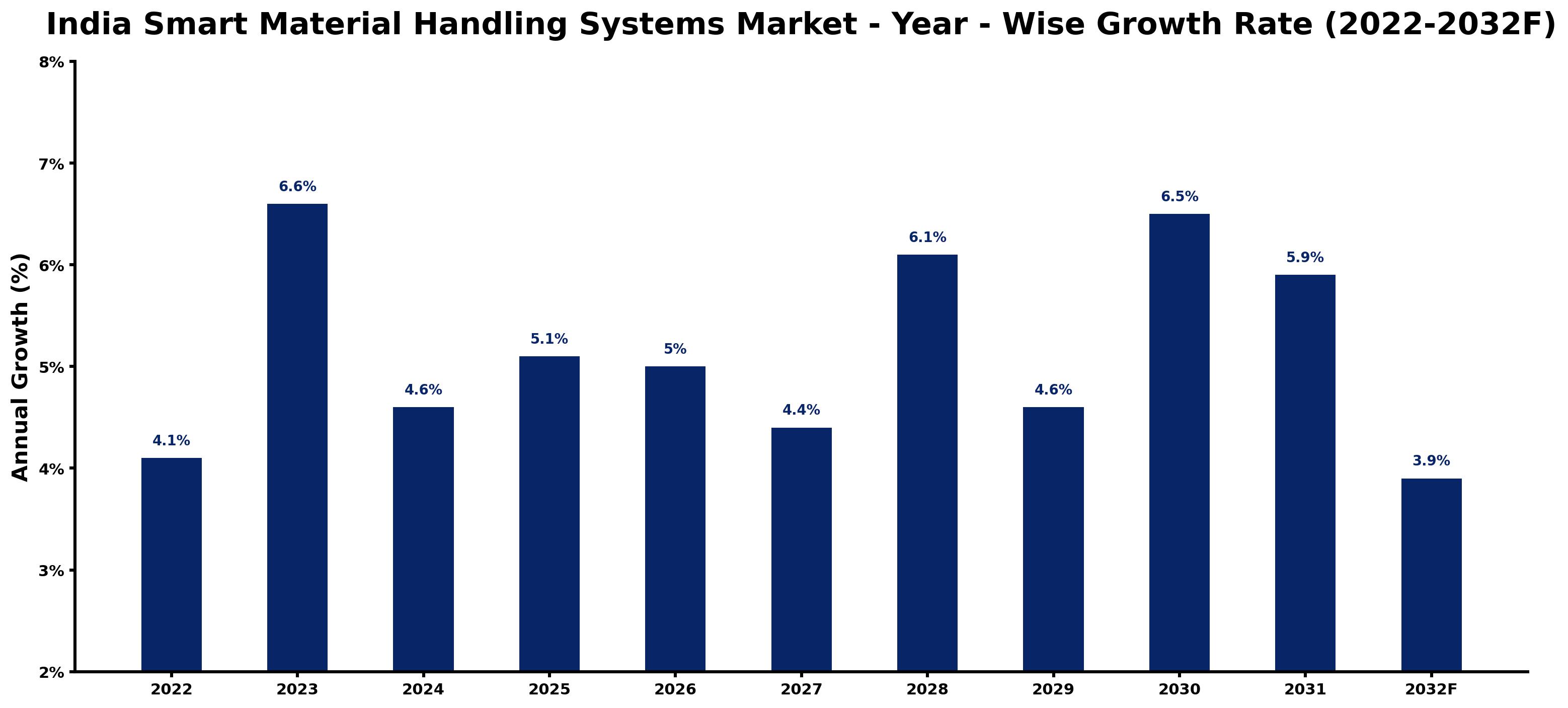
Annual growth estimates for each year appear below with the principal reason behind them, explaining the shifts that set the pace of the market.
| Year | Estimated Annual Growth (%) | Market Rationale |
| 2022 | 4.1 | The market experienced steady growth driven by increasing automation in logistics. |
| 2023 | 6.6 | A surge in demand for efficient material handling systems boosted market growth significantly. |
| 2024 | 4.6 | Growth slowed as firms adjusted to supply chain challenges and market conditions. |
| 2025 | 5.1 | A rise in e-commerce and logistics investments contributed to faster growth. |
| 2026 | 5.0 | The market growth rate moderated as companies focused on optimising existing systems. |
| 2027 | 4.4 | Continued investment in automation technologies led to a further slowdown in growth. |
| 2028 | 6.1 | Increased adoption of smart technologies revitalised market growth momentum. |
| 2029 | 4.6 | Growth decelerated as the market began to stabilise after rapid expansions. |
| 2030 | 6.5 | A renewed focus on efficiency in logistics spurred a significant growth peak. |
| 2031 | 5.9 | Market growth slowed as companies consolidated their investments and strategies. |
| 2032 | 3.9 | The market is expected to grow at a slower rate as it matures and stabilises. |
Note: Market size estimations and growth projections presented in this report are based on 6Wresearch's proprietary forecasting methodology, utilizing the latest available industry data, government publications, and primary research inputs.
India Smart Material Handling Systems Market Synopsis
Smart Material Handling Systems Market in India encompasses advanced technologies designed to automate and optimise material movement and storage. These systems, utilising robotics, AI, and IoT, improve logistics efficiency and inventory management. The market is expanding due to rising demand from logistics operators and substantial investments in infrastructure development.
Market Dynamics Impact Analysis (2026–2032)
| Factor | Type | Impact | Primary Segment Affected |
| Rising investments in logistics infrastructure are enhancing efficiency. | Driver | High | AGV Conveyor Systems |
| Increased demand for automation in warehouses is driving growth. | Driver | High | AI-Powered Palletizers |
| Integration of smart systems in distribution centres presents new opportunities. | Opportunity | High | Smart Bin Systems |
| The rapid growth of e-commerce is creating demand for efficient handling systems. | Opportunity | High | Distribution Warehouses |
| High initial costs of smart systems may deter some buyers. | Restraint | Medium | Sensorized Cranes |
| Limited awareness of smart technologies affects adoption rates. | Restraint | Medium | Intelligent Route Planning |
| The Smart Material Handling Systems Market in India faces a few practical problems, including high initial costs. | Challenge | High | AGV Conveyor Systems |
| Competition from traditional systems may hinder market penetration. | Challenge | Medium | AI-Powered Palletizers |
Evaluation of Drivers in India Smart Material Handling Systems Market (2026–2032)
Below mentioned are some major drivers and their influence on market dynamics.
| Drivers | Primary Segment Affected | Why It Matters (Evidence) |
| Investment in logistics infrastructure is increasing demand for automation. | AGV Conveyor Systems | The Indian government has allocated ₹1 trillion for infrastructure development, leading to higher demand for efficient material handling. |
| Growing e-commerce sector drives the need for automation in warehouses. | AI-Powered Palletizers | The expansion of the e-commerce sector is pushing logistics operators to adopt advanced handling systems for improved efficiency. |
| Rising urban population density increases demand for efficient logistics solutions. | Smart Bin Systems | Urban areas with high population density require smart systems to manage inventory effectively. |
| Technological advancements in AI and IoT are improving system capabilities. | Intelligent Route Planning | The integration of AI and IoT in logistics is expected to increase by 30% by 2025, boosting demand for smart systems. |
| Increased focus on reducing logistics costs is driving system adoption. | Sensorized Cranes | The Indian government aims to reduce logistics costs to 8% of GDP by 2025, encouraging investment in smart systems. |
The Smart Material Handling Systems market in India is growing due to rising investments in logistics infrastructure, which enhances operational efficiency. The booming e-commerce sector is compelling logistics operators to adopt advanced handling systems, further propelling growth. Increasing urban population density necessitates efficient inventory management solutions. Technological advancements in AI and IoT are making these systems more appealing to buyers, improving their capabilities and operational effectiveness.
Evaluation of Restraints in India Smart Material Handling Systems Market
The main factors holding the market back are set out below.
| Market Restraint | Primary Segment Affected | Why It Matters (Evidence) |
| High initial costs of smart systems may deter some buyers. | Sensorized Cranes | The average investment required for smart systems can be substantial, affecting adoption rates among smaller firms. |
| Limited awareness of smart technologies affects adoption rates. | Intelligent Route Planning | Many potential users lack knowledge of the benefits of smart systems, which slows market penetration. |
| Existing manual handling methods remain prevalent, making it challenging for smart systems to gain market share. | AGV Conveyor Systems | Competition from traditional systems may hinder market penetration as firms are reluctant to change. |
| Supply chain disruptions can impact the availability of smart systems. | AI-Powered Palletizers | Global supply chain issues have delayed the delivery of advanced handling systems, affecting sales. |
| Regulatory hurdles may slow down the approval process for new technologies. | Smart Bin Systems | Compliance with various standards can delay the implementation of smart systems in logistics. |
India Smart Material Handling Systems Market Challenges
The India Smart Material Handling Systems market faces practical challenges, with intense competition being a primary issue. Many suppliers struggle to differentiate their offerings, resulting in price wars that erode margins for producers. A shortage of skilled workers hampers growth, as the logistics workforce of over 22 million often lacks expertise in advanced technologies, delaying system implementation for buyers. Technology adoption remains inconsistent; while IoT use is expected to rise by 30% by 2025, many firms still rely on outdated methods, limiting operational efficiency. Buyers also encounter high integration costs, which can exceed ₹5 million for modern systems, deterring investment in automation.
Trends in the India Smart Material Handling Systems Market
Below mentioned are some of the trends shaping the India Smart Material Handling Systems Market growth.
- Logistics Operators Embracing Automation: Logistics operators in Maharashtra are increasingly adopting smart material handling systems to improve efficiency. The warehousing market is expected to reach $30 billion by 2025, reflecting this trend.
- Integration of Smart Bin Systems in Distribution Centres: Distribution centres in Delhi NCR are integrating Smart Bin Systems to enhance inventory management. This shift is driven by the growing need for real-time data on stock levels.
- Rise of AI-Powered Palletizers in FMCG Sectors: The FMCG sector is increasingly utilising AI-Powered Palletizers to automate product stacking. This trend is driven by the need for improved throughput and efficiency in operations.
- Growth of IoT in Logistics: The adoption of IoT technologies in logistics is projected to increase by 30% by 2025. This shift is crucial for improving operational efficiency in smart material handling.
Investment Opportunities in the India Smart Material Handling Systems Market
Below are the investment opportunities with the strongest case in the India Smart Material Handling Systems Market.
- Maharashtra's Logistics Sector: Maharashtra's logistics sector presents a strong opportunity for investment in smart material handling systems. The growing demand for efficient solutions is supported by the government's infrastructure initiatives.
- Timing for Smart Bin Systems: Now is an ideal time to invest in Smart Bin Systems, as distribution centres are increasingly integrating these technologies. The demand for real-time inventory data presents substantial opportunities.
- Supply of AI-Powered Palletizers: Investing in AI-Powered Palletizers can meet the growing demand in the FMCG sector. With the sector's rapid growth, suppliers can benefit from partnerships with logistics operators.
- Entry via Local Partnerships: Entering the Indian market through local partnerships can ease the adoption of smart material handling systems. Collaborating with regional logistics operators can enhance market penetration.
Government Initiatives in the India Smart Material Handling Systems Market
The National Logistics Policy, launched by the Ministry of Commerce in 2022, aims to reduce logistics costs to 8% of GDP by 2025. This policy encourages the adoption of smart material handling systems by promoting efficiency and technological advancements in logistics. Additionally, the Make in India initiative, introduced in 2014, supports local manufacturing of these systems, ensuring that domestic producers meet quality standards. The Pradhan Mantri Gati Shakti National Master Plan, announced in 2021, focuses on integrated infrastructure development, which will enhance the operational capabilities of logistics firms. These measures create a more conducive environment for the growth of smart material handling systems in India.
Logistics operators are benefiting from the Smart Cities Mission initiated by the Ministry of Housing and Urban Affairs in 2015, which promotes technological advancements in urban logistics. This mission supports the integration of smart material handling systems in urban distribution networks, improving efficiency and reducing costs. The Ministry of Road Transport and Highways oversees logistics infrastructure development, facilitating funding for projects that incorporate advanced handling technologies. Furthermore, the National Institute of Industrial Engineering (NITIE) offers programs related to logistics management, helping to develop a skilled workforce that can effectively implement these systems. These initiatives are crucial for enhancing the capabilities of logistics operators across the country.
Future Insight of the India Smart Material Handling Systems Market
By 2032, transformative changes in the India Smart Material Handling Systems market will reshape operations for buyers and suppliers. The National Logistics Policy will improve infrastructure, aiming to cut logistics costs to 8% of GDP. The Make in India initiative will support local manufacturing, ensuring a steady supply of advanced solutions. The integration of automated systems in freight handling will streamline logistics operations, while the expansion of the e-commerce sector will further boost demand for material handling technologies.
Market Segmentation Analysis
The analysis below covers each segmentation, its leading category in 2025 and its fastest-growing category through 2032.
By System Type – AGV Conveyor Systems Dominated, AI-Powered Palletizers Expected to Grow Fastest
According to Dhaval Chaurasia, Assistant Manager at 6Wresearch, AGV Conveyor Systems accounted for a 41% market share by system type in 2025. AGV Conveyor Systems maintain the largest share in the India Smart Material Handling Systems Market because they are crucial for automating material transport in warehouses. Their extensive deployment in major logistics hubs, particularly in Maharashtra, underscores their importance in enhancing operational efficiency. AI-Powered Palletizers are set to record the highest CAGR in this split, 7.3% over 2026–2032. AI-Powered Palletizers are growing rapidly as they automate product stacking, significantly boosting throughput in fast-moving consumer goods operations. This growth is driven by the rising demand for efficiency in high-volume distribution environments. Suppliers should focus on advancing AGV Conveyor Systems while also exploring opportunities in AI-Powered Palletizers to address increasing market demand.
By Smart Feature – Intelligent Route Planning Dominated, Object Identification Expected to Grow Fastest
With a 42% revenue share in 2025, Intelligent Route Planning was the largest smart feature category. Intelligent Route Planning leads the market by optimising the movement of goods, which is vital for reducing transit times in logistics operations. Its proven effectiveness in enhancing delivery schedules makes it a preferred choice among logistics operators. The quickest growth will come from Object Identification, forecast to expand at a CAGR of 7.8% between 2026 and 2032. Object Identification is witnessing rapid growth as it facilitates accurate tracking and management of inventory, a critical requirement in the expanding e-commerce sector. The increasing complexity of supply chains further fuels this demand. Buyers should prioritise systems featuring advanced Object Identification capabilities to enhance inventory management and operational efficiency.
By Control Platform – IoT + HMI Dominated, Sensor Fusion + AI Expected to Grow Fastest
The largest control platform category in 2025 was IoT + HMI, with a 46% share of total revenue. IoT + HMI is the leading control platform due to its ability to enable real-time monitoring and control of smart material handling systems, essential for effective operations. Its integration into various logistics applications has solidified its market share. Sensor Fusion + AI is projected to grow fastest, at a CAGR of 6.6% during 2026–2032. Sensor Fusion + AI is the fastest-growing platform as it significantly improves the accuracy of material handling operations, especially in settings requiring high precision. The increasing complexity of logistics operations accelerates this rapid adoption. Suppliers need to invest in developing solutions that incorporate Sensor Fusion + AI to maintain competitiveness in the market.
By End User – Logistics Operators Dominated, Distribution Warehouses Expected to Grow Fastest
Logistics Operators took a 52% share of end user in 2025, more than any other category. Logistics Operators dominate the market as they are the primary users of smart material handling systems, leveraging them to enhance operational efficiency. Their substantial presence in the logistics sector ensures a consistent demand for these systems. Over 2026–2032, Distribution Warehouses are expected to post the fastest growth, at a CAGR of 7.9%. Distribution Warehouses are experiencing the fastest growth due to their dependence on smart material handling systems for effective inventory management, particularly as e-commerce continues to expand. This trend highlights the necessity for advanced solutions in warehousing. Suppliers should tailor their offerings to meet the specific requirements of Distribution Warehouses to capitalise on this growth opportunity.
Key Attractiveness of the Report
- 10 Years of Market Numbers
- Historical Data Starting from 2022 to 2025
- Base Year 2025
- Forecast Data until 2032
- Key Performance Indicators Impacting the Market
- Major Upcoming Developments and Projects
Key Highlights of the Report:
- India Smart Material Handling Systems Market Outlook
- Market Size of India Smart Material Handling Systems Market, 2025
- Forecast of India Smart Material Handling Systems Market, 2032
- Historical Data and Forecast of India Smart Material Handling Systems Revenues & Volume for the Period 2022 - 2032F
- India Smart Material Handling Systems Market Trend Evolution
- India Smart Material Handling Systems Market Drivers and Challenges
- India Smart Material Handling Systems Price Trends
- India Smart Material Handling Systems Porter's Five Forces
- India Smart Material Handling Systems Industry Life Cycle
- Historical Data and Forecast of India Smart Material Handling Systems Market Revenues & Volume By System Type for the Period 2022 - 2032F
- Historical Data and Forecast of India Smart Material Handling Systems Market Revenues & Volume By AGV Conveyor Systems for the Period 2022 - 2032F
- Historical Data and Forecast of India Smart Material Handling Systems Market Revenues & Volume By Sensorized Cranes for the Period 2022 - 2032F
- Historical Data and Forecast of India Smart Material Handling Systems Market Revenues & Volume By AI-Powered Palletizers for the Period 2022 - 2032F
- Historical Data and Forecast of India Smart Material Handling Systems Market Revenues & Volume By Smart Bin Systems for the Period 2022 - 2032F
- Historical Data and Forecast of India Smart Material Handling Systems Market Revenues & Volume By Smart Feature for the Period 2022 - 2032F
- Historical Data and Forecast of India Smart Material Handling Systems Market Revenues & Volume By Intelligent Route Planning for the Period 2022 - 2032F
- Historical Data and Forecast of India Smart Material Handling Systems Market Revenues & Volume By Load Stability Control for the Period 2022 - 2032F
- Historical Data and Forecast of India Smart Material Handling Systems Market Revenues & Volume By Object Identification for the Period 2022 - 2032F
- Historical Data and Forecast of India Smart Material Handling Systems Market Revenues & Volume By Capacity & Weight Alerts for the Period 2022 - 2032F
- Historical Data and Forecast of India Smart Material Handling Systems Market Revenues & Volume By Control Platform for the Period 2022 - 2032F
- Historical Data and Forecast of India Smart Material Handling Systems Market Revenues & Volume By IoT + HMI for the Period 2022 - 2032F
- Historical Data and Forecast of India Smart Material Handling Systems Market Revenues & Volume By Sensor Fusion + AI for the Period 2022 - 2032F
- Historical Data and Forecast of India Smart Material Handling Systems Market Revenues & Volume By Camera + ML for the Period 2022 - 2032F
- Historical Data and Forecast of India Smart Material Handling Systems Market Revenues & Volume By RFID + IoT for the Period 2022 - 2032F
- Historical Data and Forecast of India Smart Material Handling Systems Market Revenues & Volume By End User for the Period 2022 - 2032F
- Historical Data and Forecast of India Smart Material Handling Systems Market Revenues & Volume By Logistics Operators for the Period 2022 - 2032F
- Historical Data and Forecast of India Smart Material Handling Systems Market Revenues & Volume By Shipping Yards for the Period 2022 - 2032F
- Historical Data and Forecast of India Smart Material Handling Systems Market Revenues & Volume By Distribution Warehouses for the Period 2022 - 2032F
- Historical Data and Forecast of India Smart Material Handling Systems Market Revenues & Volume By Retail Chains for the Period 2022 - 2032F
- India Smart Material Handling Systems Import Export Trade Statistics
- Market Opportunity Assessment By System Type
- Market Opportunity Assessment By Smart Feature
- Market Opportunity Assessment By Control Platform
- Market Opportunity Assessment By End User
- India Smart Material Handling Systems Top Companies Market Share
- India Smart Material Handling Systems Competitive Benchmarking By Technical and Operational Parameters
- India Smart Material Handling Systems Company Profiles
- India Smart Material Handling Systems Key Strategic Recommendations
Market Covered
The report offers an extensive study of the following market segments.
By System Type
- AGV Conveyor Systems
- Sensorized Cranes
- AI-Powered Palletizers
- Smart Bin Systems
By Smart Feature
- Intelligent Route Planning
- Load Stability Control
- Object Identification
- Capacity & Weight Alerts
By Control Platform
- IoT + HMI
- Sensor Fusion + AI
- Camera + ML
- RFID + IoT
By End User
- Logistics Operators
- Shipping Yards
- Distribution Warehouses
- Retail Chains































