China Smart Material Handling Systems Market Size & Growth Rate
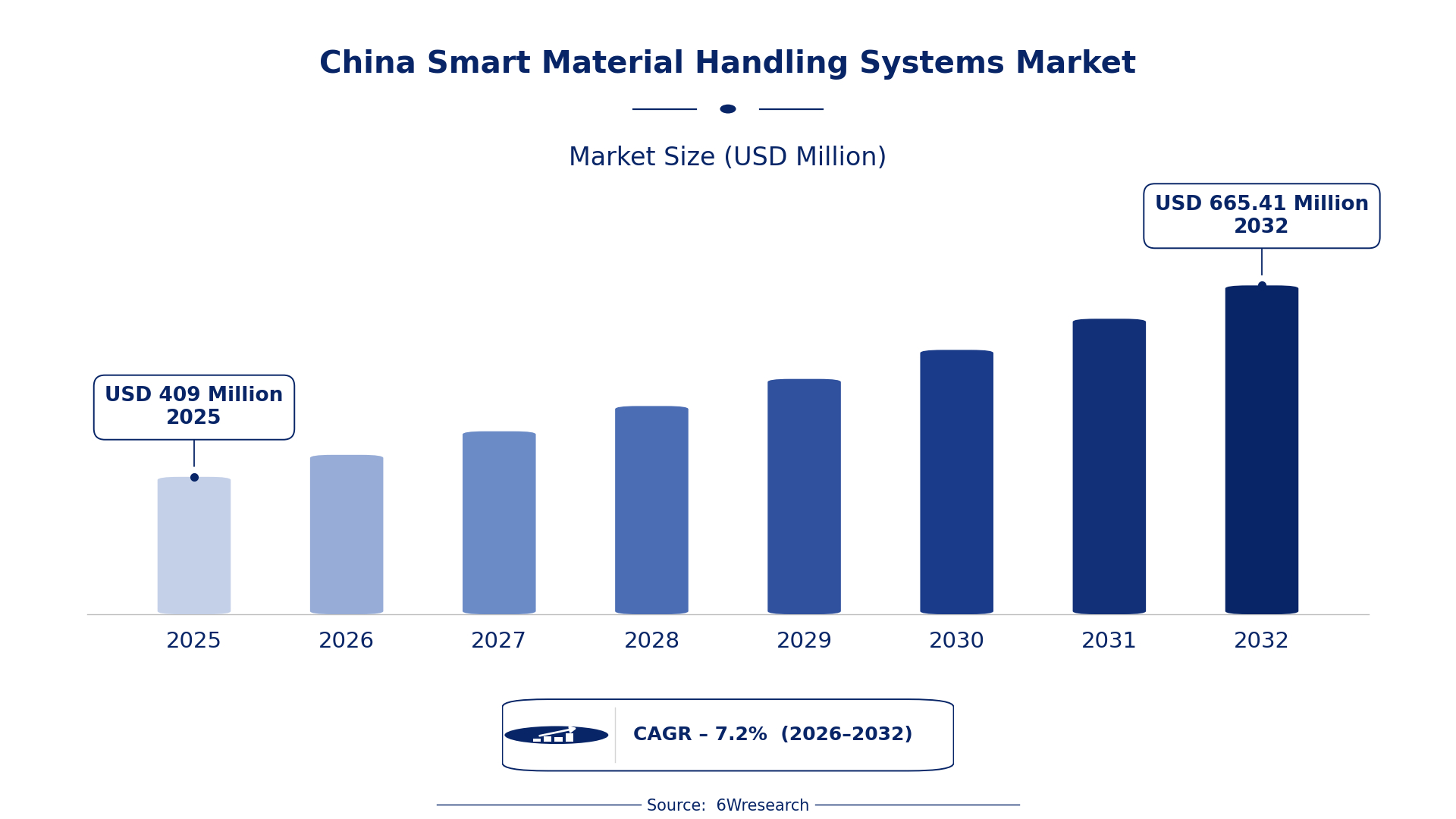
According to 6Wresearch internal database and industry insights, the China Smart Material Handling Systems Market was valued at USD 409.0 million in 2025 and is projected to reach USD 665.41 million by 2032, growing at a CAGR of approximately 7.2% during 2026–2032.
China Smart Material Handling Systems Market Highlights
| Report Metric | Details |
| Report Name | China Smart Material Handling Systems Market |
| Market Size 2025 | USD 409.0 million |
| Market Size 2032 | USD 665.41 million |
| Absolute Growth 2025–2032 | USD 256.41 million |
| CAGR 2026–2032 | 7.2% |
| Peak Annual Growth | 9.1% in 2032 |
| Forecast Period | 2026–2032 |
| Historical Data | 2022–2025 |
| Base Year | 2025 |
| Leading System Type, 2025 | AGV Conveyor Systems (41% share) |
| Leading Smart Feature, 2025 | Intelligent Route Planning (50% share) |
| Leading Control Platform, 2025 | IoT + HMI (43% share) |
| Leading End User, 2025 | Logistics Operators (40% share) |
| Fastest-Growing System Type | AI-Powered Palletizers (8.9% CAGR) |
| Fastest-Growing Smart Feature | Object Identification (8.7% CAGR) |
| Fastest-Growing Control Platform | Sensor Fusion + AI (9.9% CAGR) |
| Fastest-Growing End User | Distribution Warehouses (9.4% CAGR) |
| Growing Sector | logistics |
| Key End Users | logistics operators, distribution warehouses, shipping yards, retail chains |
China Smart Material Handling Systems Market Year-wise Growth Rate and Key Drivers (2022–2032)
This graph illustrates the annual growth rates of the market from 2022 to 2032, highlighting a steady upward trajectory and projected market expansion over the forecast period.
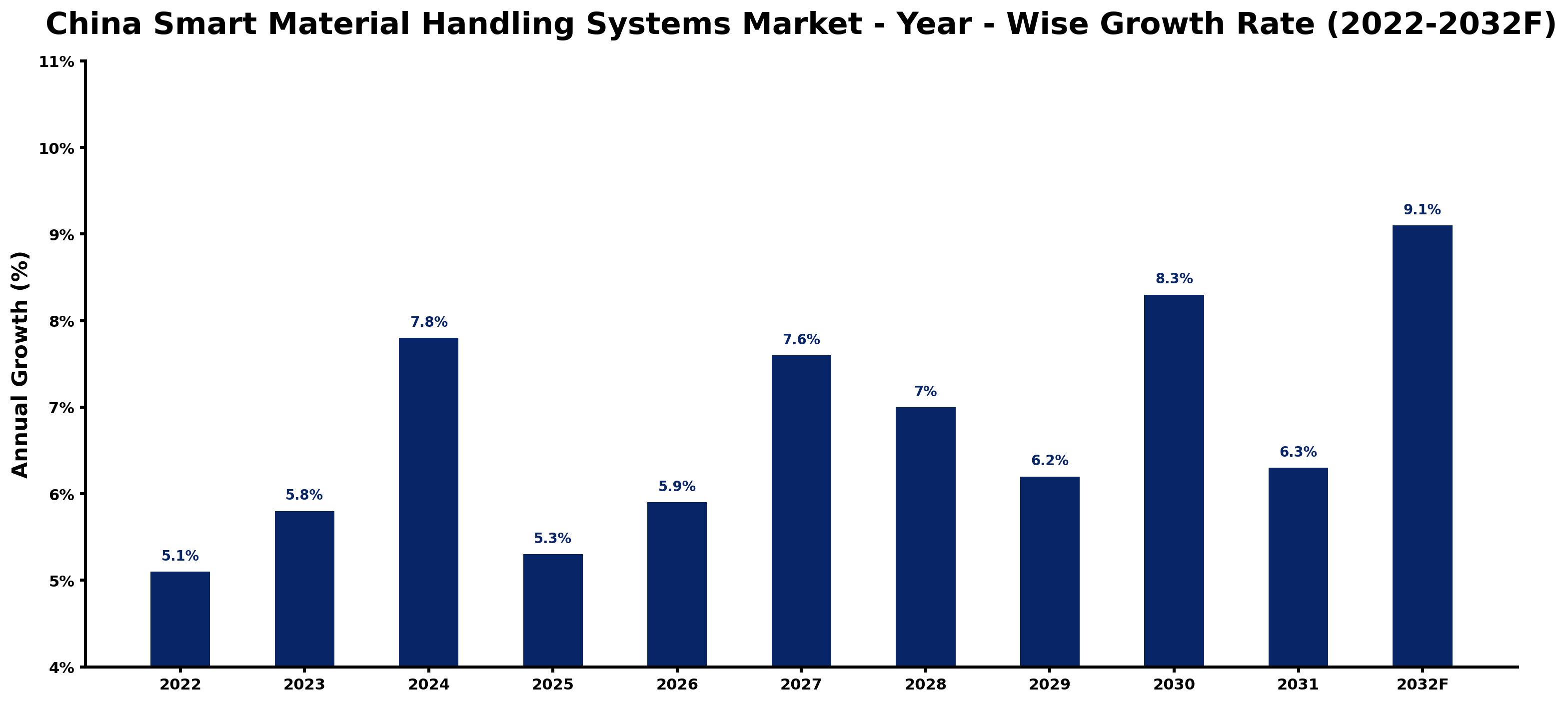
Below, each year's estimated growth is shown next to the factor that most influenced it.
| Year | Estimated Annual Growth (%) | Market Rationale |
| 2022 | 5.1 | The market experienced steady growth as automation began gaining traction in logistics operations. |
| 2023 | 5.8 | Increased adoption of automated systems among logistics operators contributed to faster growth this year. |
| 2024 | 7.8 | The market saw heightened demand driven by the implementation of the 'Smart Logistics Development Plan'. |
| 2025 | 5.3 | Growth slowed as some sectors adjusted to the rapid pace of automation adoption. |
| 2026 | 5.9 | Demand is expected to increase again as logistics operators focus on improving operational efficiency through automation. |
| 2027 | 7.6 | The market will benefit from rising investments in smart material handling technologies across various sectors. |
| 2028 | 7.0 | Growth is projected to slow slightly as the market begins to stabilise after rapid expansion in previous years. |
| 2029 | 6.2 | Continued investment in automation technologies will lead to further growth, albeit at a slower pace. |
| 2030 | 8.3 | The market is expected to rebound with increased demand for AI-Powered Palletizers in major urban areas. |
| 2031 | 6.3 | Growth will slow as market maturity sets in, reflecting a more stable adoption rate. |
| 2032 | 9.1 | The market is projected to peak as the demand for smart systems reaches new heights. |
Note: Market size estimations and growth projections presented in this report are based on 6Wresearch's proprietary forecasting methodology, utilizing the latest available industry data, government publications, and primary research inputs.
China Smart Material Handling Systems Market Synopsis
Smart Material Handling Systems in China encompass automated solutions that improve logistics and warehouse efficiency. These systems utilise advanced robotics, AI, and IoT technologies for tasks such as inventory management and goods movement. The China Smart Material Handling Systems Market is projected to grow substantially, driven by the logistics industry's expansion, which is expected to reach a value of 15 trillion RMB by 2025. Increased automation and the adoption of advanced technologies are key factors propelling this growth.
Market Dynamics Impact Analysis (2026–2032)
| Factor | Type | Impact | Primary Segment Affected |
| Increased automation in logistics operations | Driver | High | AGV Conveyor Systems |
| Growing demand for AI-driven solutions | Driver | High | AI-Powered Palletizers |
| Rising investment in smart logistics technologies | Opportunity | High | Distribution Warehouses |
| Expansion of logistics operators adopting smart systems | Opportunity | Medium | Logistics Operators |
| High initial investment costs for smart systems | Restraint | High | Smart Bin Systems |
| Limited awareness of advanced technologies among smaller players | Restraint | Medium | Sensorized Cranes |
| Competition from traditional handling methods | Challenge | High | Shipping Yards |
| Supply chain disruptions affecting technology deployment | Challenge | Medium | Distribution Warehouses |
Evaluation of Drivers in China Smart Material Handling Systems Market (2026–2032)
Key forces behind demand, with the segment each one moves most, are listed below.
| Drivers | Primary Segment Affected | Why It Matters (Evidence) |
| Increased adoption of AGV systems | AGV Conveyor Systems | As of 2023, the adoption rate of AGV systems in warehouses is estimated at 40%, prompting logistics operators to invest more. |
| Demand for AI-Powered Palletizers | AI-Powered Palletizers | The demand for AI-Powered Palletizers has increased by 30% in major cities, leading to higher purchases from distribution centres. |
| Investment in smart logistics technologies | Distribution Warehouses | Total investment in smart logistics technologies reached approximately 200 billion RMB in 2022, enhancing operational capabilities. |
| Implementation of the Smart Logistics Development Plan | Logistics Operators | The plan aims for 50% automation by 2025, driving logistics operators to upgrade their systems. |
| Growth in the logistics industry | Shipping Yards | China's logistics industry is projected to reach a value of 15 trillion RMB by 2025, increasing demand for smart systems. |
Market growth for Smart Material Handling Systems in China is underpinned by increased adoption of AGV systems, rising demand for AI-Powered Palletizers, and significant investment in smart logistics technologies. The adoption rate of AGV systems in warehouses is estimated at 40%, prompting logistics operators to invest more. In 2022, total investment in smart logistics technologies reached approximately 200 billion RMB, improving operational capabilities for logistics operators. Demand for AI-Powered Palletizers surged by 30% in major cities, resulting in higher purchases from distribution centres. The logistics industry is projected to reach a value of 15 trillion RMB by 2025, further driving the need for advanced material handling systems.
Evaluation of Restraints in China Smart Material Handling Systems Market
The following restraints limit how fast demand can grow.
| Market Restraint | Primary Segment Affected | Why It Matters (Evidence) |
| High initial investment costs for automation systems | Smart Bin Systems | The initial costs deter smaller logistics operators from adopting smart systems, limiting market growth potential. |
| Limited awareness of advanced technologies | Sensorized Cranes | Many smaller players lack knowledge about the benefits of smart systems, hindering their adoption. |
| Competition from traditional handling methods | Shipping Yards | Established methods remain prevalent, making it challenging for smart systems to penetrate the market. |
| Supply chain disruptions affecting technology deployment | Distribution Warehouses | Disruptions can delay the implementation of smart systems, affecting operational efficiency. |
| Regulatory hurdles in technology integration | AI-Powered Palletizers | Compliance with regulations can slow down the adoption of new technologies among operators. |
China Smart Material Handling Systems Market Challenges
The China Smart Material Handling Systems market faces a few practical problems, starting with high initial costs that can exceed 10 million RMB, deterring many producers from investing in automation. Over 70% of distribution warehouses report difficulties in technology integration, as they struggle to merge new automated solutions with existing infrastructure, which leads to operational inefficiencies. Buyers encounter a shortage of skilled personnel, with 50% indicating challenges in hiring qualified workers to manage advanced systems, resulting in decreased productivity. Furthermore, reliance on imported technologies can cause supply chain disruptions, delaying implementation and increasing operational costs for logistics operators.
Trends in the China Smart Material Handling Systems Market
Below mentioned are some of the trends shaping the China Smart Material Handling Systems Market growth.
- Logistics Operators Embracing Automation: Logistics operators are increasingly adopting smart material handling systems to improve efficiency. As of 2023, over 70% of distribution warehouses in China utilise automated systems, reflecting a notable shift in operational practices.
- Rise of Intelligent Solutions: The demand for AI-Powered Palletizers has surged, with a 30% increase noted in major cities. This trend highlights the growing reliance on intelligent systems for efficient inventory management and throughput.
- Yangtze River Delta Leading in Deployment: The Yangtze River Delta region is at the forefront of smart material handling system deployment. This area has seen substantial investments, contributing to the overall growth of the market.
- Shift Towards Intelligent Route Planning: Since 2021, Intelligent Route Planning has become a priority for logistics operators aiming to optimise transport paths. This approach has led to improved efficiency and reduced operational costs.
Investment Opportunities in the China Smart Material Handling Systems Market
Below are the investment opportunities with the strongest case in the China Smart Material Handling Systems Market.
- Investment in Smart Technologies: With the logistics industry projected to reach 15 trillion RMB by 2025, there is an opportunity to invest in smart material handling systems. Logistics operators are actively seeking advanced solutions to improve efficiency.
- Growing Demand for AI Solutions: The demand for AI-Powered Palletizers has increased by 30% in major cities, presenting an opportunity for suppliers to meet this rising need. Engaging with distribution centres can facilitate market entry.
- Expansion in the Yangtze River Delta: The Yangtze River Delta region is a key area for smart material handling system deployment, with substantial investments ongoing. Suppliers can enter this market by partnering with local logistics operators.
- Focus on Automation in Shipping Yards: The recent push for automation in shipping yards aims for a 30% efficiency increase by 2025, creating opportunities for technology providers. Collaborating with shipping yard operators can yield fruitful partnerships.
Government Initiatives in the China Smart Material Handling Systems Market
The 'Smart Logistics Development Plan' launched by the Ministry of Industry and Information Technology in 2021 aims to promote automation in logistics. This initiative sets a target of 50% automation by 2025, encouraging logistics operators to invest in smart material handling systems. The plan supports the integration of advanced technologies, creating a more efficient logistics environment. By establishing clear goals, it guides industry players towards adopting innovative solutions that improve operational efficiency.
In 2022, the National Development and Reform Commission approved the '2022 Smart Manufacturing Promotion Plan' with a budget of 100 billion RMB. This initiative focuses on encouraging investment in smart material handling systems, providing funding for projects that improve automation in logistics and manufacturing. Agencies involved in this plan will oversee approvals and funding allocations, ensuring that the targeted investments lead to tangible improvements in the sector.
Future Insight of the China Smart Material Handling Systems Market
The China Smart Material Handling Systems market is expected to evolve significantly by 2032, driven by initiatives like the 'Smart Logistics Development Plan' and 'Made in China 2025'. These programmes will promote automation in logistics and manufacturing, contributing to a projected investment of around 200 billion RMB in smart logistics technologies by 2025. The establishment of the National Standard for Intelligent Logistics Systems will standardise practices, improving operational efficiency. Advancements in robotics and AI will refine warehouse processes, enabling buyers to enhance productivity and suppliers to expand their market reach.
Market Segmentation Analysis
Each segment group is reviewed below, with the leader by share and the fastest grower by CAGR.
By System Type – AGV Conveyor Systems Dominated, AI-Powered Palletizers Expected to Grow Fastest
According to Dhaval Chaurasia, Assistant Manager at 6Wresearch, the largest system type category in 2025 was AGV Conveyor Systems, with a 41% share of total revenue. AGV Conveyor Systems command the largest market share as they are implemented in over 70% of distribution warehouses in China, significantly improving operational efficiency. Their ability to automate material transport is crucial for logistics operators, especially in high-demand areas like the Yangtze River Delta region. Over 2026–2032, AI-Powered Palletizers are expected to post the fastest growth, at a CAGR of 8.9%. The growing demand for AI-Powered Palletizers, which has surged by 30% in major cities, is primarily driven by the need for increased throughput in logistics operations. This trend positions AI-Powered Palletizers for continued growth, as they signify a shift towards more advanced automation solutions. Suppliers should focus on developing AI-Powered Palletizers to cater to the increasing demand in urban logistics.
By Smart Feature – Intelligent Route Planning Dominated, Object Identification Expected to Grow Fastest
Intelligent Route Planning took a 50% share of smart feature in 2025, more than any other category. Intelligent Route Planning leads the market due to its effectiveness in optimising transport paths, which reduces both time and costs essential for logistics efficiency. This feature is increasingly integrated into smart material handling systems, enhancing operations in busy distribution centres. Object Identification is set to record the highest CAGR in this split, 8.7% over 2026–2032. Object Identification is experiencing rapid growth as it plays a crucial role in facilitating accurate inventory tracking, a vital requirement in the expanding logistics sector. The reported 15% increase in smart logistics adoption in 2023 further fuels the demand for this feature, highlighting its significance. Buyers should prioritise systems equipped with Object Identification capabilities to enhance inventory management and operational accuracy.
By Control Platform – IoT + HMI Dominated, Sensor Fusion + AI Expected to Grow Fastest
IoT + HMI accounted for a 43% market share by control platform in 2025. IoT + HMI holds the largest market share as it integrates real-time monitoring, which is essential for effectively managing smart material handling systems. This platform is widely adopted across various sectors, ensuring seamless communication between users and devices. Sensor Fusion + AI is projected to grow fastest, at a CAGR of 9.9% during 2026–2032. Sensor Fusion + AI is rapidly gaining traction as it improves decision-making by combining data from various sensors, addressing the need for more sophisticated control platforms. The increasing complexity of logistics operations drives this growth, indicating a shift towards smarter solutions. Suppliers must invest in advanced Sensor Fusion + AI technologies to meet the evolving demands of the logistics industry.
By End User – Logistics Operators Dominated, Distribution Warehouses Expected to Grow Fastest
With a 40% revenue share in 2025, Logistics Operators was the largest end user category. Logistics Operators account for the largest share of the market as they heavily rely on smart material handling systems for efficient goods handling and transport. Their critical role in the supply chain ensures a steady demand for automation solutions across the industry. The quickest growth will come from Distribution Warehouses, forecast to expand at a CAGR of 9.4% between 2026 and 2032. Distribution Warehouses are swiftly adopting smart material handling systems to streamline operations and reduce labour costs, reflecting a broader trend towards automation in logistics. This segment's growth is further supported by government initiatives promoting smart logistics development. Buyers in distribution warehouses should seek advanced automation solutions to improve operational efficiency and cost-effectiveness.
Key Attractiveness of the Report
- 10 Years of Market Numbers
- Historical Data Starting from 2022 to 2025
- Base Year 2025
- Forecast Data until 2032
- Key Performance Indicators Impacting the Market
- Major Upcoming Developments and Projects
Key Highlights of the Report:
- China Smart Material Handling Systems Market Outlook
- Market Size of China Smart Material Handling Systems Market, 2025
- Forecast of China Smart Material Handling Systems Market, 2032
- Historical Data and Forecast of China Smart Material Handling Systems Revenues & Volume for the Period 2022 - 2032F
- China Smart Material Handling Systems Market Trend Evolution
- China Smart Material Handling Systems Market Drivers and Challenges
- China Smart Material Handling Systems Price Trends
- China Smart Material Handling Systems Porter's Five Forces
- China Smart Material Handling Systems Industry Life Cycle
- Historical Data and Forecast of China Smart Material Handling Systems Market Revenues & Volume By System Type for the Period 2022 - 2032F
- Historical Data and Forecast of China Smart Material Handling Systems Market Revenues & Volume By AGV Conveyor Systems for the Period 2022 - 2032F
- Historical Data and Forecast of China Smart Material Handling Systems Market Revenues & Volume By Sensorized Cranes for the Period 2022 - 2032F
- Historical Data and Forecast of China Smart Material Handling Systems Market Revenues & Volume By AI-Powered Palletizers for the Period 2022 - 2032F
- Historical Data and Forecast of China Smart Material Handling Systems Market Revenues & Volume By Smart Bin Systems for the Period 2022 - 2032F
- Historical Data and Forecast of China Smart Material Handling Systems Market Revenues & Volume By Smart Feature for the Period 2022 - 2032F
- Historical Data and Forecast of China Smart Material Handling Systems Market Revenues & Volume By Intelligent Route Planning for the Period 2022 - 2032F
- Historical Data and Forecast of China Smart Material Handling Systems Market Revenues & Volume By Load Stability Control for the Period 2022 - 2032F
- Historical Data and Forecast of China Smart Material Handling Systems Market Revenues & Volume By Object Identification for the Period 2022 - 2032F
- Historical Data and Forecast of China Smart Material Handling Systems Market Revenues & Volume By Capacity & Weight Alerts for the Period 2022 - 2032F
- Historical Data and Forecast of China Smart Material Handling Systems Market Revenues & Volume By Control Platform for the Period 2022 - 2032F
- Historical Data and Forecast of China Smart Material Handling Systems Market Revenues & Volume By IoT + HMI for the Period 2022 - 2032F
- Historical Data and Forecast of China Smart Material Handling Systems Market Revenues & Volume By Sensor Fusion + AI for the Period 2022 - 2032F
- Historical Data and Forecast of China Smart Material Handling Systems Market Revenues & Volume By Camera + ML for the Period 2022 - 2032F
- Historical Data and Forecast of China Smart Material Handling Systems Market Revenues & Volume By RFID + IoT for the Period 2022 - 2032F
- Historical Data and Forecast of China Smart Material Handling Systems Market Revenues & Volume By End User for the Period 2022 - 2032F
- Historical Data and Forecast of China Smart Material Handling Systems Market Revenues & Volume By Logistics Operators for the Period 2022 - 2032F
- Historical Data and Forecast of China Smart Material Handling Systems Market Revenues & Volume By Shipping Yards for the Period 2022 - 2032F
- Historical Data and Forecast of China Smart Material Handling Systems Market Revenues & Volume By Distribution Warehouses for the Period 2022 - 2032F
- Historical Data and Forecast of China Smart Material Handling Systems Market Revenues & Volume By Retail Chains for the Period 2022 - 2032F
- China Smart Material Handling Systems Import Export Trade Statistics
- Market Opportunity Assessment By System Type
- Market Opportunity Assessment By Smart Feature
- Market Opportunity Assessment By Control Platform
- Market Opportunity Assessment By End User
- China Smart Material Handling Systems Top Companies Market Share
- China Smart Material Handling Systems Competitive Benchmarking By Technical and Operational Parameters
- China Smart Material Handling Systems Company Profiles
- China Smart Material Handling Systems Key Strategic Recommendations
Market Covered
This report examines the market across the segments below.
By System Type
- AGV Conveyor Systems
- Sensorized Cranes
- AI-Powered Palletizers
- Smart Bin Systems
By Smart Feature
- Intelligent Route Planning
- Load Stability Control
- Object Identification
- Capacity & Weight Alerts
By Control Platform
- IoT + HMI
- Sensor Fusion + AI
- Camera + ML
- RFID + IoT
By End User
- Logistics Operators
- Shipping Yards
- Distribution Warehouses
- Retail Chains































