India Smart Public Transit Systems Market Size & Growth Rate
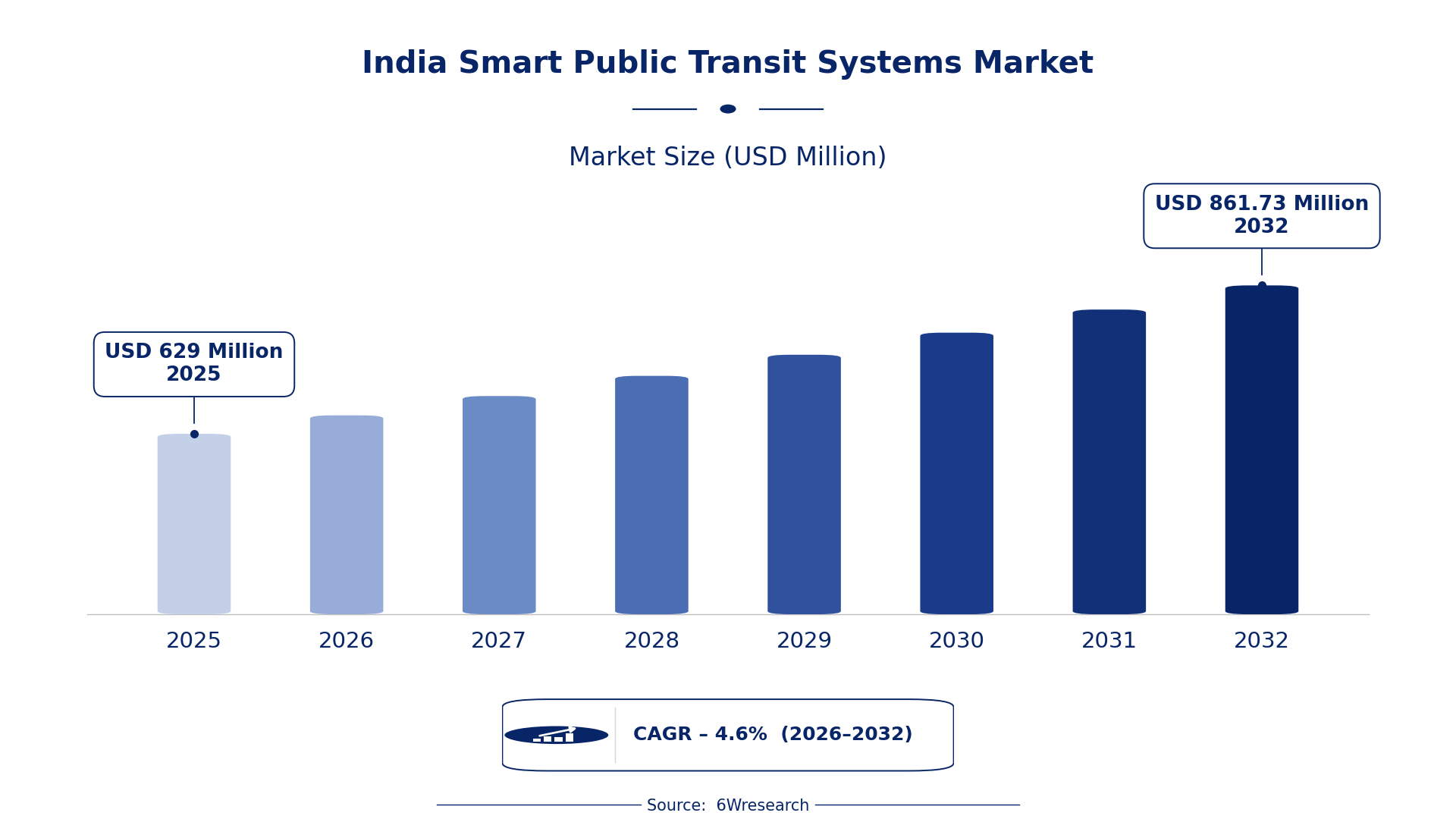
According to 6Wresearch internal database and industry insights, the India Smart Public Transit Systems Market was valued at USD 629.0 million in 2025 and is projected to reach USD 861.73 million by 2032, growing at a CAGR of approximately 4.6% during 2026–2032.
India Smart Public Transit Systems Market Highlights
| Report Metric | Details |
| Report Name | India Smart Public Transit Systems Market |
| Market Size 2025 | USD 629.0 million |
| Market Size 2032 | USD 861.73 million |
| Absolute Growth 2025–2032 | USD 232.73 million |
| CAGR 2026–2032 | 4.6% |
| Peak Annual Growth | 6.1% in 2029 |
| Forecast Period | 2026–2032 |
| Historical Data | 2022–2025 |
| Base Year | 2025 |
| Leading Transit Type, 2025 | Smart Bus Systems (40% share) |
| Leading Smart Feature, 2025 | Live Tracking & Schedule (43% share) |
| Leading User Interface, 2025 | App + GPS (37% share) |
| Leading End User, 2025 | City Authorities (54% share) |
| Fastest-Growing Transit Type | AI Traffic Control (6.5% CAGR) |
| Fastest-Growing Smart Feature | Real-Time Flow Optimization (5.9% CAGR) |
| Fastest-Growing User Interface | Mobile Wallet (6.5% CAGR) |
| Fastest-Growing End User | Transport Planners (6.3% CAGR) |
| Growing Sector | Urban Mobility |
| Key End Users | City Authorities, Transport Planners, Commuters, Metro Authorities |
India Smart Public Transit Systems Market Year-wise Growth Rate and Key Drivers (2022–2032)
This graph illustrates the annual growth rates of the market from 2022 to 2032, highlighting a steady upward trajectory and projected market expansion over the forecast period.
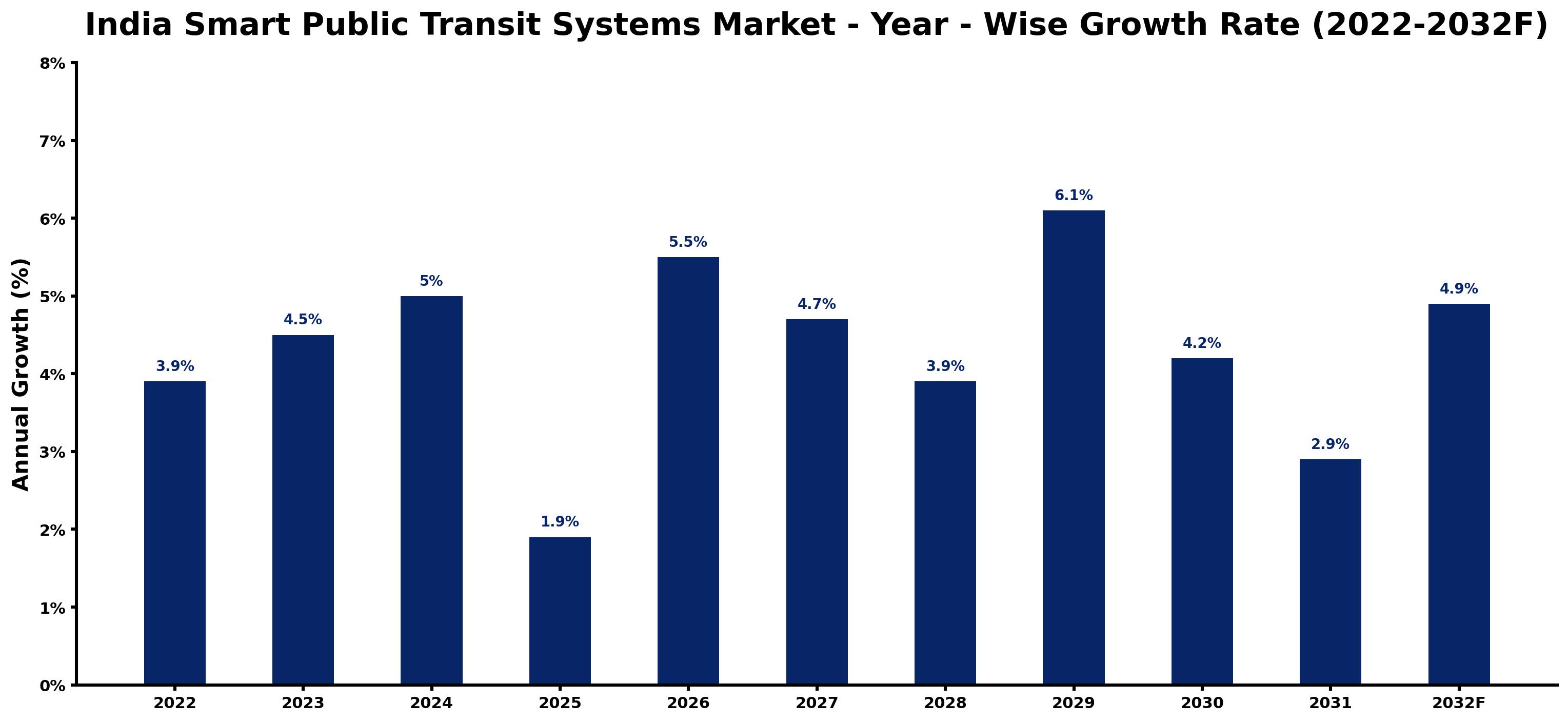
The following table presents the estimated annual growth rate for each year together with the principal factor influencing market performance.
| Year | Estimated Annual Growth (%) | Market Rationale |
| 2022 | 3.9 | The market experienced steady growth due to ongoing urbanisation and infrastructure investments. |
| 2023 | 4.5 | Demand increased as more cities adopted smart transit solutions for efficiency. |
| 2024 | 5.0 | Growth accelerated with the implementation of AI traffic control systems in urban areas. |
| 2025 | 1.9 | A slowdown occurred as some projects faced delays in funding and execution. |
| 2026 | 5.5 | Investment in smart bus systems surged, driving demand for advanced technologies. |
| 2027 | 4.7 | Growth slowed as cities focused on integrating existing systems and technologies. |
| 2028 | 3.9 | The market continued to grow, supported by the expansion of real-time tracking systems. |
| 2029 | 6.1 | A peak in growth was observed as urban areas implemented comprehensive smart transit solutions. |
| 2030 | 4.2 | Growth slowed as the market matured and competition intensified among providers. |
| 2031 | 2.9 | The market continued to grow at a slower rate as urban transit systems became standardised. |
| 2032 | 4.9 | Demand increased again as new smart transit projects were initiated across various states. |
Note: Market size estimations and growth projections presented in this report are based on 6Wresearch's proprietary forecasting methodology, utilizing the latest available industry data, government publications, and primary research inputs.
India Smart Public Transit Systems Market Synopsis
Smart Public Transit Systems in India encompass advanced technologies aimed at improving urban transportation efficiency. These systems include smart buses, AI traffic control, and contactless fare systems, enhancing commuter experiences and optimising traffic flow. The India Smart Public Transit Systems Market is growing due to urbanisation, with over 1,300 smart bus systems implemented across major cities. The Smart Cities Mission, targeting 100 smart cities by 2023, drives this expansion.
Market Dynamics Impact Analysis (2026–2032)
| Factor | Type | Impact | Primary Segment Affected |
| Investment in smart bus systems and AI traffic control enhances urban mobility. | Driver | High | Smart Bus Systems |
| Growing reliance on public transport among urban commuters increases demand. | Driver | High | City Authorities |
| The gap in efficient transit solutions presents opportunities for investment. | Opportunity | High | Smart Transit Terminals |
| The rising urban population necessitates improved public transport solutions. | Opportunity | High | Commuters |
| Funding delays hinder the timely implementation of smart transit projects. | Restraint | High | AI Traffic Control |
| Integration challenges with existing systems slow down market growth. | Restraint | Medium | Contactless Fare System |
| The Smart Public Transit Systems market faces regulatory hurdles in implementation. | Challenge | High | Smart Transit Terminals |
| Technological integration issues can delay project timelines and increase costs. | Challenge | Medium | Real-Time Flow Optimization |
Evaluation of Drivers in India Smart Public Transit Systems Market (2026–2032)
The table below links each growth driver to the segment it affects and the evidence for it.
| Drivers | Primary Segment Affected | Why It Matters (Evidence) |
| Investment in smart bus systems is increasing, leading to improved urban mobility. | Smart Bus Systems | Over 1,300 smart bus systems have been implemented across major cities, providing better public transport options. |
| AI traffic control systems are being adopted, improving traffic management. | AI Traffic Control | These systems have reduced congestion by 30% in pilot areas, facilitating smoother transit operations and enhancing efficiency. |
| Contactless fare systems are gaining traction, facilitating efficient payments. | Contactless Fare System | Adoption is underway in 20 metro systems nationwide, streamlining fare collection processes and improving user experience. |
| Real-time tracking systems are operational, enhancing commuter experience. | Live Tracking & Schedule | These systems are currently active in 15 major Indian cities, providing timely information to commuters and optimising transit schedules. |
| Mobile wallet integration is part of the Digital India initiative, promoting cashless transactions. | Mobile Wallet | This initiative supports the transition to smart payment systems, improving convenience for users and enhancing overall service. |
Growth in the Smart Public Transit Systems market in India comes from increased investment in smart bus systems, which improve urban mobility. The implementation of smart bus systems across major cities is driving commuter reliance on public transport, with over 1,300 systems now operational. AI traffic control systems have been widely adopted, reducing congestion by 30% in pilot areas, which improves traffic management. Real-time tracking systems operational in major urban areas further optimise commuter experiences, driving demand for these advanced technologies.
Evaluation of Restraints in India Smart Public Transit Systems Market
Below mentioned are some major restraints and their influence on market dynamics.
| Market Restraint | Primary Segment Affected | Why It Matters (Evidence) |
| Funding delays hinder timely implementation of smart transit projects. | Smart Transit Terminals | Government funding for smart transit projects has increased by 25% in the last two years, yet delays persist. |
| Integration challenges with existing systems slow down market growth. | Contactless Fare System | Existing infrastructure often lacks compatibility with new technologies, complicating integration efforts and delaying progress. |
| Regulatory hurdles can impede the rollout of smart transit initiatives. | AI Traffic Control | Compliance with updated standards can delay project approvals, affecting implementation timelines and overall efficiency. |
| Technological integration issues can lead to increased costs and delays. | Real-Time Flow Optimization | Complexities in merging old and new systems can slow progress and inflate project budgets, impacting service delivery. |
| Limited public awareness about smart transit benefits affects adoption rates. | Smart Bus Systems | Many commuters remain unaware of the advantages of smart technologies, hindering widespread acceptance and usage. |
India Smart Public Transit Systems Market Challenges
The India Smart Public Transit Systems market faces a critical skills shortage, with over 60% of transit authorities struggling to recruit qualified personnel for system implementation. This issue arises from insufficient training programmes in urban mobility technologies, causing project delays and escalating costs for producers. Intense competition for government funding has led to fragmented initiatives, resulting in buyers experiencing inconsistent service quality across various regions. Supply chain disruptions have hindered the timely acquisition of essential components, forcing producers to extend project timelines by up to six months, impacting service delivery for urban commuters.
Trends in the India Smart Public Transit Systems Market
Below mentioned are some of the trends shaping the India Smart Public Transit Systems Market growth.
- Shift to AI Traffic Control Systems: The implementation of AI traffic control systems is becoming widespread, improving traffic management. As of 2023, these systems have reduced congestion by 30% in pilot areas, benefiting urban commuters.
- Adoption of Contactless Fare Systems: Contactless fare systems are increasingly being adopted across metro systems in India. Currently, 20 metro systems have implemented these solutions, improving user convenience and payment efficiency.
- Expansion of Smart Transit Terminals: Smart Transit Terminals are being developed in five major states, including Maharashtra and Karnataka. This initiative aims to modernise facilities, improving the overall transit experience for passengers.
- Integration of Mobile Wallets in Public Transport: The Digital India initiative has led to the integration of mobile wallets in public transport systems. This shift supports cashless transactions, focusing on improving user convenience.
Investment Opportunities in the India Smart Public Transit Systems Market
Investors looking at the India Smart Public Transit Systems Market should consider the following areas.
- Investment in Smart Bus Systems: With over 1,300 smart bus systems implemented, there is a growing opportunity to invest in further advancements. City authorities are keen to adopt technologies that improve urban mobility and enhance commuter experiences.
- Development of Smart Transit Terminals: The need for modern transit facilities is clear, with a projected increase in urban commuters. Investing in smart transit terminals in states like Maharashtra can significantly improve user experience and operational efficiency.
- Expansion of AI Traffic Control Systems: As cities aim to reduce congestion, there is a clear opportunity to supply AI traffic control solutions. Urban planners are actively seeking technologies that improve traffic flow and management to enhance transit efficiency.
- Integration of Real-Time Tracking Solutions: The demand for real-time tracking systems is on the rise, especially in major urban areas. Collaborating with local authorities can facilitate the introduction of these solutions, improving service delivery.
Government Initiatives in the India Smart Public Transit Systems Market
The Smart Cities Mission, initiated by the Ministry of Housing and Urban Affairs in 2015, aims to improve urban infrastructure, including smart transit systems, with a budget of ₹48,000 crore. This initiative has led to the implementation of over 1,300 smart bus systems across major cities, enhancing public transport options. The National Urban Transport Policy was revised in 2021 to promote sustainable urban mobility solutions, encouraging cities to adopt advanced technologies in public transit. Additionally, the Intelligent Transport System (ITS) Policy launched in 2020 integrates smart technologies in public transit, further supporting the development of smart transit systems.
The National Institute of Urban Affairs conducts research on smart transit systems, providing valuable insights for policymakers. The Digital India initiative, launched in 2015, includes provisions for implementing smart payment systems in public transport, focusing on cashless transactions. The Atal Mission for Rejuvenation and Urban Transformation (AMRUT) was updated in 2022 to incorporate smart transit solutions in urban planning, ensuring that new developments align with modern mobility needs. The Ministry of Housing and Urban Affairs oversees the Smart Cities Mission, approving funding for urban infrastructure projects that include smart transit systems.
Future Insight of the India Smart Public Transit Systems Market
Several forward-looking factors are expected to support the India Smart Public Transit Systems market over the coming years. The Smart Cities Mission aims to develop 100 smart cities by 2023, driving substantial investment in urban transit. By 2025, over 200 million urban residents will benefit from these smart transit initiatives, enhancing the overall commuter experience. The integration of advanced technologies will streamline operations, while updated policies will promote sustainable mobility solutions, creating a more efficient and accessible public transport framework.
Market Segmentation Analysis
Each segment group is reviewed below, with the leader by share and the fastest grower by CAGR.
By Transit Type – Smart Bus Systems Dominated, AI Traffic Control Expected to Grow Fastest
According to Dhaval Chaurasia, Assistant Manager at 6Wresearch, Smart Bus Systems held a 40% share of the India Smart Public Transit Systems Market by transit type in 2025. Smart Bus Systems dominate the market due to their extensive implementation across over 1,300 cities, providing efficient public transport solutions. This widespread adoption is crucial for urban commuters, with over 50% relying on these systems for daily travel. Over 2026–2032, AI Traffic Control is expected to post the fastest growth, at a CAGR of 6.5%. AI Traffic Control is experiencing rapid growth as it significantly enhances traffic management, with pilot areas reporting a 30% reduction in congestion. This efficiency not only improves transit times but also attracts further investment in smart technologies. Suppliers should focus on integrating AI solutions to capitalise on the growing demand for smart transit technologies.
By Smart Feature – Live Tracking & Schedule Dominated, Real-Time Flow Optimization Expected to Grow Fastest
With a 43% revenue share in 2025, Live Tracking & Schedule was the largest smart feature category. Live Tracking & Schedule holds the largest share as it empowers commuters with real-time information, facilitating better travel decisions. This feature is essential in urban areas where timely updates can significantly improve the commuter experience. Real-Time Flow Optimization is set to record the highest CAGR in this split, 5.9% over 2026–2032. Real-Time Flow Optimization is the fastest-growing feature, as it directly addresses the need for improved traffic flow, thus reducing delays. With urban transport ridership projected to reach 1 billion trips per day by 2030, this feature's importance is set to rise. Buyers should prioritise systems incorporating real-time flow optimization to enhance operational efficiency and commuter satisfaction.
By User Interface – App + GPS Dominated, Mobile Wallet Expected to Grow Fastest
App + GPS accounted for a 37% market share by user interface in 2025. App + GPS leads the market as it provides users with essential navigation and transit updates, making it indispensable for modern commuters. The integration of these technologies has become a standard expectation among urban transit users. Mobile Wallet is projected to grow fastest, at a CAGR of 6.5% during 2026–2032. Mobile Wallet is rapidly gaining traction, driven by the Digital India initiative promoting cashless transactions. This feature enhances user convenience, aligning with the increasing preference for seamless payment solutions in public transport. Suppliers must ensure that their systems support mobile wallet integration to meet evolving consumer preferences for cashless payments.
By End User – City Authorities Dominated, Transport Planners Expected to Grow Fastest
The largest end user category in 2025 was City Authorities, with a 54% share of total revenue. City Authorities command the largest share as they leverage smart systems to enhance urban mobility and manage infrastructure effectively. Their role is pivotal in driving the adoption of smart public transit solutions across major urban centres. The quickest growth will come from Transport Planners, forecast to expand at a CAGR of 6.3% between 2026 and 2032. Transport Planners are the fastest-growing segment, utilising data-driven insights to optimise public transport planning. As urban populations grow, the demand for efficient transport planning will continue to rise, further boosting this segment. Suppliers should engage with transport planners to provide tailored solutions that meet the specific needs of urban transit systems.
Key Attractiveness of the Report
- 10 Years of Market Numbers
- Historical Data Starting from 2022 to 2025
- Base Year 2025
- Forecast Data until 2032
- Key Performance Indicators Impacting the Market
- Major Upcoming Developments and Projects
Key Highlights of the Report:
- India Smart Public Transit Systems Market Outlook
- Market Size of India Smart Public Transit Systems Market, 2025
- Forecast of India Smart Public Transit Systems Market, 2032
- Historical Data and Forecast of India Smart Public Transit Systems Revenues & Volume for the Period 2022 - 2032F
- India Smart Public Transit Systems Market Trend Evolution
- India Smart Public Transit Systems Market Drivers and Challenges
- India Smart Public Transit Systems Price Trends
- India Smart Public Transit Systems Porter's Five Forces
- India Smart Public Transit Systems Industry Life Cycle
- Historical Data and Forecast of India Smart Public Transit Systems Market Revenues & Volume By Transit Type for the Period 2022 - 2032F
- Historical Data and Forecast of India Smart Public Transit Systems Market Revenues & Volume By Smart Bus Systems for the Period 2022 - 2032F
- Historical Data and Forecast of India Smart Public Transit Systems Market Revenues & Volume By AI Traffic Control for the Period 2022 - 2032F
- Historical Data and Forecast of India Smart Public Transit Systems Market Revenues & Volume By Contactless Fare System for the Period 2022 - 2032F
- Historical Data and Forecast of India Smart Public Transit Systems Market Revenues & Volume By Smart Transit Terminals for the Period 2022 - 2032F
- Historical Data and Forecast of India Smart Public Transit Systems Market Revenues & Volume By Smart Feature for the Period 2022 - 2032F
- Historical Data and Forecast of India Smart Public Transit Systems Market Revenues & Volume By Live Tracking & Schedule for the Period 2022 - 2032F
- Historical Data and Forecast of India Smart Public Transit Systems Market Revenues & Volume By Real-Time Flow Optimization for the Period 2022 - 2032F
- Historical Data and Forecast of India Smart Public Transit Systems Market Revenues & Volume By QR/NFC Ticketing for the Period 2022 - 2032F
- Historical Data and Forecast of India Smart Public Transit Systems Market Revenues & Volume By Passenger Density Analytics for the Period 2022 - 2032F
- Historical Data and Forecast of India Smart Public Transit Systems Market Revenues & Volume By User Interface for the Period 2022 - 2032F
- Historical Data and Forecast of India Smart Public Transit Systems Market Revenues & Volume By App + GPS for the Period 2022 - 2032F
- Historical Data and Forecast of India Smart Public Transit Systems Market Revenues & Volume By Central Dashboard for the Period 2022 - 2032F
- Historical Data and Forecast of India Smart Public Transit Systems Market Revenues & Volume By Mobile Wallet for the Period 2022 - 2032F
- Historical Data and Forecast of India Smart Public Transit Systems Market Revenues & Volume By CCTV + AI for the Period 2022 - 2032F
- Historical Data and Forecast of India Smart Public Transit Systems Market Revenues & Volume By End User for the Period 2022 - 2032F
- Historical Data and Forecast of India Smart Public Transit Systems Market Revenues & Volume By City Authorities for the Period 2022 - 2032F
- Historical Data and Forecast of India Smart Public Transit Systems Market Revenues & Volume By Transport Planners for the Period 2022 - 2032F
- Historical Data and Forecast of India Smart Public Transit Systems Market Revenues & Volume By Commuters for the Period 2022 - 2032F
- Historical Data and Forecast of India Smart Public Transit Systems Market Revenues & Volume By Metro Authorities for the Period 2022 - 2032F
- India Smart Public Transit Systems Import Export Trade Statistics
- Market Opportunity Assessment By Transit Type
- Market Opportunity Assessment By Smart Feature
- Market Opportunity Assessment By User Interface
- Market Opportunity Assessment By End User
- India Smart Public Transit Systems Top Companies Market Share
- India Smart Public Transit Systems Competitive Benchmarking By Technical and Operational Parameters
- India Smart Public Transit Systems Company Profiles
- India Smart Public Transit Systems Key Strategic Recommendations
Market Covered
The report offers an extensive study of the following market segments.
By Transit Type
- Smart Bus Systems
- AI Traffic Control
- Contactless Fare System
- Smart Transit Terminals
By Smart Feature
- Live Tracking & Schedule
- Real-Time Flow Optimization
- QR/NFC Ticketing
- Passenger Density Analytics
By User Interface
- App + GPS
- Central Dashboard
- Mobile Wallet
- CCTV + AI
By End User
- City Authorities
- Transport Planners
- Commuters
- Metro Authorities































