China Smart Public Transit Systems Market Size & Growth Rate
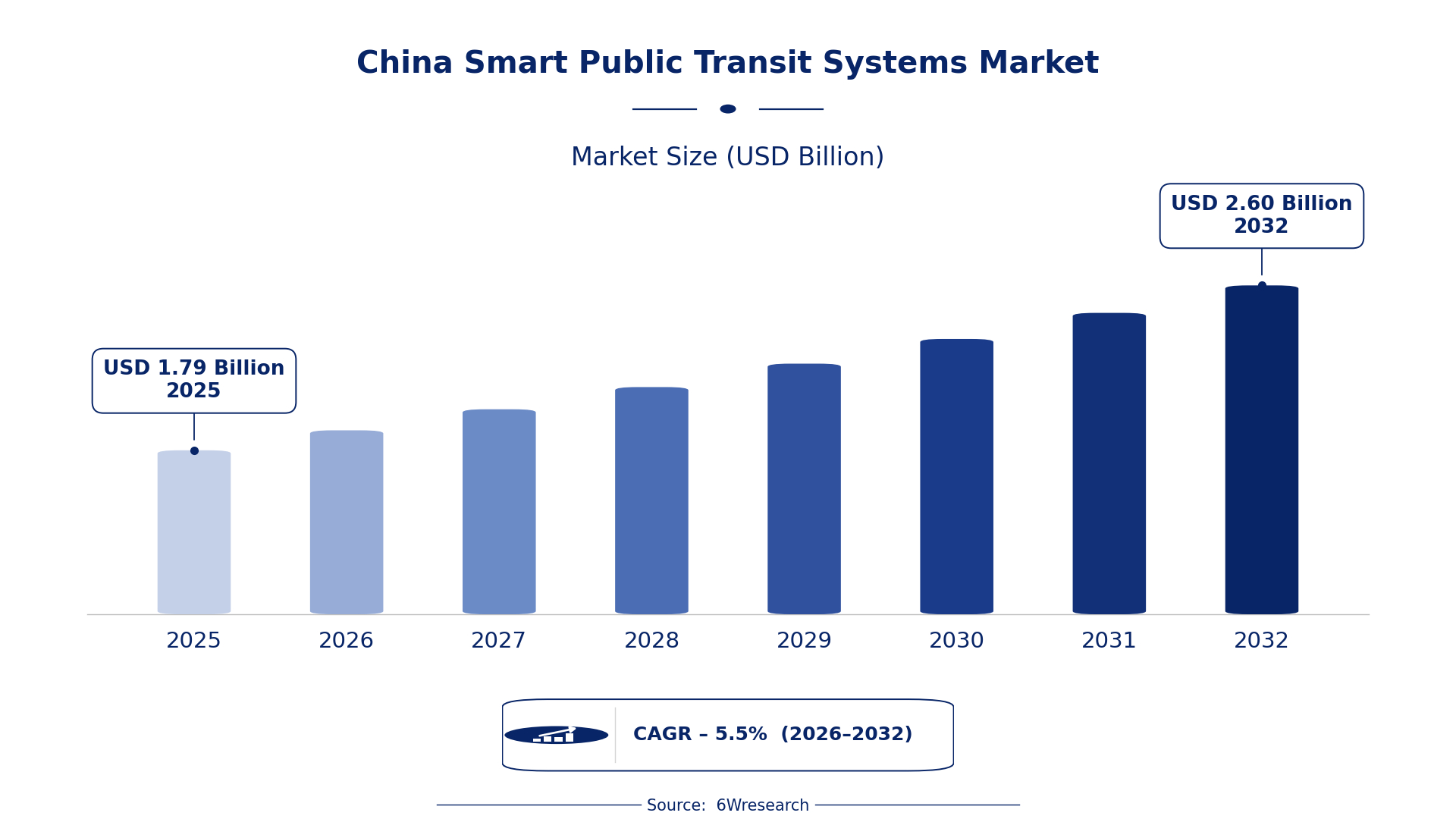
According to 6Wresearch internal database and industry insights, the China Smart Public Transit Systems Market was valued at USD 1.79 billion in 2025 and is projected to reach USD 2.60 billion by 2032, growing at a CAGR of approximately 5.5% during 2026–2032.
China Smart Public Transit Systems Market Highlights
| Report Metric | Details |
| Report Name | China Smart Public Transit Systems Market |
| Market Size 2025 | USD 1.79 billion |
| Market Size 2032 | USD 2.60 billion |
| Absolute Growth 2025–2032 | USD 0.81 billion |
| CAGR 2026–2032 | 5.5% |
| Peak Annual Growth | 8.0% in 2028 |
| Forecast Period | 2026–2032 |
| Historical Data | 2022–2025 |
| Base Year | 2025 |
| Leading Transit Type, 2025 | Smart Bus Systems (45% share) |
| Leading Smart Feature, 2025 | Live Tracking & Schedule (39% share) |
| Leading User Interface, 2025 | App + GPS (33% share) |
| Leading End User, 2025 | City Authorities (47% share) |
| Fastest-Growing Transit Type | AI Traffic Control (7.6% CAGR) |
| Fastest-Growing Smart Feature | Real-Time Flow Optimization (7.9% CAGR) |
| Fastest-Growing User Interface | Mobile Wallet (7.5% CAGR) |
| Fastest-Growing End User | Transport Planners (6.8% CAGR) |
| Growing Sector | Transport Planners |
| Key End Users | City Authorities, Transport Planners, Metro Authorities, Commuters |
China Smart Public Transit Systems Market Year-wise Growth Rate and Key Drivers (2022–2032)
This graph illustrates the annual growth rates of the market from 2022 to 2032, highlighting a steady upward trajectory and projected market expansion over the forecast period.
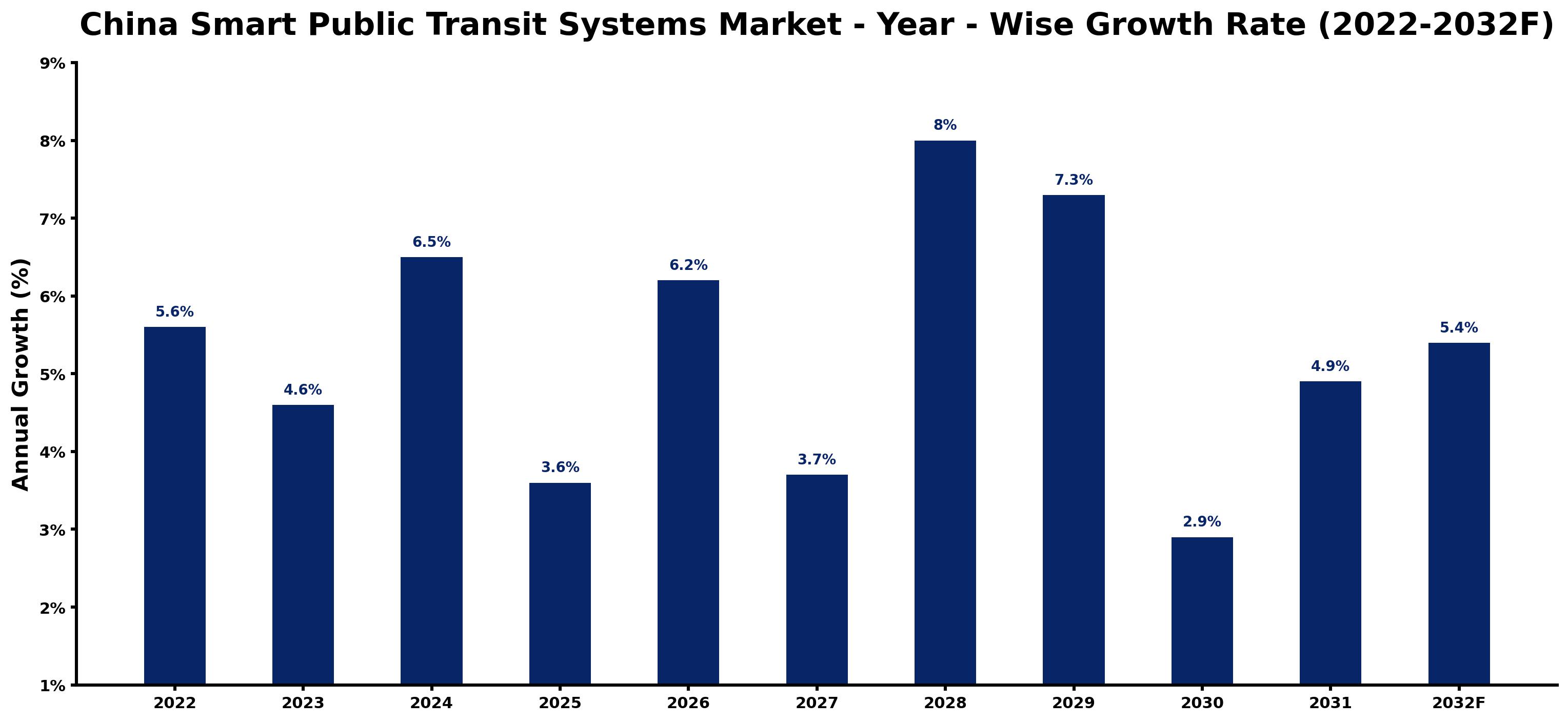
Below, each year's estimated growth is shown next to the factor that most influenced it.
| Year | Estimated Annual Growth (%) | Market Rationale |
| 2022 | 5.6 | The market experienced steady growth due to rising urbanisation and demand for efficient transit solutions. |
| 2023 | 4.6 | Investment in smart transit systems slowed slightly as cities adapted to previous implementations and infrastructure changes. |
| 2024 | 6.5 | Growth accelerated as cities expanded smart bus systems and integrated advanced technologies into public transport. |
| 2025 | 3.6 | The market saw a slowdown as cities focused on optimising existing systems rather than introducing new technologies. |
| 2026 | 6.2 | Increased investment in AI Traffic Control systems is anticipated to drive demand for smarter traffic management solutions across urban areas. |
| 2027 | 3.7 | Growth is projected to slow as urban planners encounter challenges integrating new technologies with legacy systems. |
| 2028 | 8.0 | The market is expected to peak as cities implement advanced smart transit solutions, enhancing overall urban mobility. |
| 2029 | 7.3 | Demand growth will slow as the market matures and cities concentrate on maintaining existing systems. |
| 2030 | 2.9 | The market growth rate is projected to decrease as cities prioritise budget allocations for other urban infrastructure projects. |
| 2031 | 4.9 | Growth is expected to resume as urban authorities recognise the need to modernise transit systems to meet rising commuter expectations. |
| 2032 | 5.4 | The market is projected to continue growing as advancements in technology and urban mobility initiatives gain traction. |
Note: Market size estimations and growth projections presented in this report are based on 6Wresearch's proprietary forecasting methodology, utilizing the latest available industry data, government publications, and primary research inputs.
China Smart Public Transit Systems Market Synopsis
Smart Public Transit Systems in China incorporate advanced technologies that improve urban transportation efficiency. These systems optimise traffic flow, enhance passenger experience, and provide real-time data access for transit authorities. The China Smart Public Transit Systems Market is growing due to a rapidly urbanising population and substantial investments in public infrastructure. In 2023, the urban population reached 1.4 billion, driving demand for efficient transit solutions. The Ministry of Transport reported a 15% increase in smart transit investments, highlighting the commitment to modernising urban mobility.
Market Dynamics Impact Analysis (2026–2032)
| Factor | Type | Impact | Primary Segment Affected |
| Urban population growth drives demand for efficient transit solutions. | Driver | High | Smart Bus Systems |
| Integration of AI in traffic management enhances operational efficiency. | Driver | High | AI Traffic Control |
| Growing demand for contactless payment systems in urban transit. | Opportunity | High | Contactless Fare System |
| Expansion of smart transit terminals to accommodate increasing passenger volumes. | Opportunity | High | Smart Transit Terminals |
| High costs associated with upgrading existing transit infrastructure. | Restraint | High | Smart Bus Systems |
| Limited public awareness of the benefits of smart transit technologies. | Restraint | Medium | AI Traffic Control |
| Challenges in integrating new technologies with existing systems. | Challenge | High | Contactless Fare System |
| Regulatory hurdles in implementing advanced technologies across cities. | Challenge | Medium | Smart Transit Terminals |
Evaluation of Drivers in China Smart Public Transit Systems Market (2026–2032)
The factors lifting demand, and the evidence behind each, are summarised below.
| Drivers | Primary Segment Affected | Why It Matters (Evidence) |
| Urban population growth | Smart Bus Systems | China's urban population reached 1.4 billion in 2023, increasing demand for efficient public transport. |
| Investment in AI Traffic Control systems | AI Traffic Control | The implementation of AI Traffic Control systems in urban areas is expected to enhance traffic management efficiency. |
| Rise in contactless payment adoption | Contactless Fare System | In 2023, 70% of public transport users in Beijing utilised contactless fare systems, improving user convenience. |
| Implementation of smart transit terminals | Smart Transit Terminals | Shanghai's smart transit terminals handle over 1 million passengers daily, showcasing their importance in urban mobility. |
| Real-time tracking features in buses | Live Tracking & Schedule | Real-time tracking features are now standard in 80% of new public buses in major cities, improving operational efficiency. |
Expansion of the Smart Public Transit Systems market in China is supported by increasing urban populations, heightened investments in technology, and growing user demand for efficient transit solutions. In 2023, China's urban population reached 1.4 billion, which fuels the need for advanced public transport systems. The AI Traffic Control System in Guangzhou improved traffic management, prompting further investments. Real-time tracking features are standard in 80% of new public buses in major cities, which boosts operational efficiency. The integration of smart transit terminals in Shanghai, handling over 1 million passengers daily, illustrates their importance in urban mobility.
Evaluation of Restraints in China Smart Public Transit Systems Market
The table below lists the restraints and the evidence behind each.
| Market Restraint | Primary Segment Affected | Why It Matters (Evidence) |
| Supply chain disruptions | Smart Bus Systems | Rapid urbanisation strains existing infrastructure, delaying project completions and raising operational expenses by up to 20%. |
| Uneven development across cities | AI Traffic Control | Competition for smart transit investments limits access for smaller municipalities, which struggle to secure funding. |
| Lack of standardisation in technologies | Contactless Fare System | Integration challenges lead to increased training costs of approximately 15% for operational staff. |
| Rising costs of advanced technologies | Smart Transit Terminals | A 15% increase in smart transit investments forces public transport operators to reconsider budget allocations. |
| Inadequate infrastructure for integration | Live Tracking & Schedule | Cities face difficulties in incorporating new technologies with existing systems, impacting service delivery. |
China Smart Public Transit Systems Market Challenges
Buyers and suppliers in the China Smart Public Transit Systems market face supply chain disruptions caused by rapid urbanisation, which strains existing infrastructure and delays project completions, costing up to 20% more for transit authorities. Competition among cities for limited smart transit investments has intensified, resulting in uneven development and restricting access for smaller municipalities that struggle to secure funding. Buyers encounter difficulties due to the lack of standardisation in smart transit technologies, complicating integration and leading to increased training costs of approximately 15% for operational staff. Rising expenses for advanced technologies, driven by a 15% increase in investments, force public transport operators to reassess budget allocations and operational strategies.
Trends in the China Smart Public Transit Systems Market
Several trends are reshaping the China Smart Public Transit Systems Market; the most important are set out below.
- Shift to Real-Time Tracking: Real-time tracking features are becoming standard in public transit systems across China, improving operational efficiency. In 2023, 80% of new public buses in major cities have adopted this technology, enhancing passenger experience.
- Growth of Contactless Fare Systems: Contactless fare systems are increasingly being adopted in urban areas, facilitating payments for users. In 2023, 70% of public transport users in Beijing utilised these systems, reflecting a trend towards convenience.
- Integration of Smart Transit Terminals: Smart transit terminals are being integrated to streamline urban mobility. In Shanghai, these terminals handle over 1 million passengers daily, demonstrating their critical role in improving public transport efficiency.
- Expansion of AI Traffic Control Systems: AI Traffic Control Systems are gaining traction in urban centres, optimising traffic management. In Guangzhou, the implementation of such systems led to a 20% reduction in congestion in 2023.
Investment Opportunities in the China Smart Public Transit Systems Market
Below are the investment opportunities with the strongest case in the China Smart Public Transit Systems Market.
- Investment in Smart Bus Systems: With a growing urban population, there is an opportunity to invest in smart bus systems. Over 50 cities in China have implemented these systems, indicating a strong demand for efficient public transport solutions.
- Development of AI Traffic Control Solutions: The increasing need for efficient traffic management presents an opportunity to develop AI Traffic Control solutions. Cities like Guangzhou are leading the way, with a 20% reduction in congestion reported in 2023.
- Enhancement of Contactless Fare Systems: The rise in contactless payment adoption creates an opportunity for suppliers to enhance these systems. In 2023, 70% of public transport users in Beijing utilised contactless fare systems, highlighting demand for convenience.
- Implementation of Smart Transit Terminals: The need for integrated transport solutions offers an opportunity to supply smart transit terminals. Shanghai's terminals, handling over 1 million passengers daily, showcase the demand for efficient urban mobility solutions.
Government Initiatives in the China Smart Public Transit Systems Market
The 'Smart City Development Plan' by the Ministry of Housing and Urban-Rural Development, launched in 2021, aims to improve urban mobility through smart transit systems. This initiative encourages cities to adopt advanced technologies, thereby increasing public transport efficiency. The plan allocates funding for infrastructure improvements, supporting the integration of smart features in transit systems. In 2022, the National Development and Reform Commission approved a 100 billion yuan budget for smart public transit infrastructure improvements, driving development in this sector.
In 2023, the Ministry of Transport launched the 'Urban Mobility Improvement Initiative' to promote smart public transit technologies nationwide. This initiative is expected to fund various projects aimed at improving urban mobility. The National Transportation Safety Administration oversees the implementation of CCTV + AI systems in public transit, ensuring safety and security. The 'Public Transport Enhancement Program', initiated by the State Council in 2020, focuses on expanding smart transit systems across 50 cities by 2025.
Future Insight of the China Smart Public Transit Systems Market
The China Smart Public Transit Systems market will undergo substantial changes by 2032, driven by the National Development and Reform Commission's 'Smart City Development Plan' and increased funding from the Central Government. By 2025, over 50 cities are expected to implement smart bus systems, which will enhance urban mobility and efficiency. The integration of advanced data analytics will allow transit authorities to optimise services based on real-time passenger data, improving user satisfaction. As urban populations expand, the demand for integrated multimodal transport solutions will significantly influence future developments.
Market Segmentation Analysis
Each segment group is reviewed below, with the leader by share and the fastest grower by CAGR.
By Transit Type – Smart Bus Systems Dominated, AI Traffic Control Expected to Grow Fastest
According to Dhaval Chaurasia, Assistant Manager at 6Wresearch, Smart Bus Systems took a 45% share of transit type in 2025, more than any other category. Smart Bus Systems hold the largest market share in China, implemented in over 50 cities to accommodate the growing urban population. This established network is crucial for daily commuters, particularly in areas like Shanghai where smart bus operations are extensive. The quickest growth will come from AI Traffic Control, forecast to expand at a CAGR of 7.6% between 2026 and 2032. AI Traffic Control is witnessing rapid growth, evidenced by a 20% reduction in traffic congestion in Guangzhou. As urban areas increasingly adopt these systems, the demand for smart bus solutions will continue to expand, reinforcing the dominance of Smart Bus Systems. Suppliers should enhance smart bus technologies to meet the rising urban transit demands.
By Smart Feature – Live Tracking & Schedule Dominated, Real-Time Flow Optimization Expected to Grow Fastest
With a 39% revenue share in 2025, Live Tracking & Schedule was the largest smart feature category. Live Tracking & Schedule features dominate the market share, significantly improving passenger experience and operational efficiency, now standard in 80% of new public buses. This widespread adoption underscores the necessity of real-time information for urban commuters. Real-Time Flow Optimization is projected to grow fastest, at a CAGR of 7.9% during 2026–2032. Real-Time Flow Optimization is rapidly gaining traction, as cities aim to reduce congestion and improve transit efficiency, with notable implementations in major urban centres. This trend indicates a growing demand for smart features that enhance transit operations. Buyers will increasingly seek smart features that boost operational efficiency and passenger satisfaction.
By User Interface – App + GPS Dominated, Mobile Wallet Expected to Grow Fastest
App + GPS held a 33% share of the China Smart Public Transit Systems Market by user interface in 2025. The App + GPS interface leads in market share by providing enhanced accessibility and navigation for users, making it integral to smart public transit systems. This user-friendly approach is vital for engaging the urban population in technology-driven environments. Mobile Wallet is set to record the highest CAGR in this split, 7.5% over 2026–2032. Mobile Wallet solutions are experiencing swift growth, supported by over 300 million mobile wallet users in China, facilitating seamless cashless transactions for transit. As digital payment methods gain traction, this segment is poised for significant expansion. Vendors should focus on developing user-friendly interfaces that cater to the increasing demand for digital payment options.
By End User – City Authorities Dominated, Transport Planners Expected to Grow Fastest
The largest end user category in 2025 was City Authorities, with a 47% share of total revenue. City Authorities represent the largest market share as primary users of smart public transit systems, driving investments and initiatives that enhance urban mobility. Their role in implementing smart transit projects is crucial for improving overall transit efficiency. Over 2026–2032, Transport Planners are expected to post the fastest growth, at a CAGR of 6.8%. Transport Planners are experiencing the fastest growth, utilising data analytics to inform infrastructure development and enhance transit services. As urbanisation continues, their demand for advanced planning tools will rise, further solidifying the position of City Authorities. Suppliers should tailor solutions to meet the specific needs of city authorities and transport planners to capitalise on market opportunities.
Key Attractiveness of the Report
- 10 Years of Market Numbers
- Historical Data Starting from 2022 to 2025
- Base Year 2025
- Forecast Data until 2032
- Key Performance Indicators Impacting the Market
- Major Upcoming Developments and Projects
Key Highlights of the Report:
- China Smart Public Transit Systems Market Outlook
- Market Size of China Smart Public Transit Systems Market, 2025
- Forecast of China Smart Public Transit Systems Market, 2032
- Historical Data and Forecast of China Smart Public Transit Systems Revenues & Volume for the Period 2022 - 2032F
- China Smart Public Transit Systems Market Trend Evolution
- China Smart Public Transit Systems Market Drivers and Challenges
- China Smart Public Transit Systems Price Trends
- China Smart Public Transit Systems Porter's Five Forces
- China Smart Public Transit Systems Industry Life Cycle
- Historical Data and Forecast of China Smart Public Transit Systems Market Revenues & Volume By Transit Type for the Period 2022 - 2032F
- Historical Data and Forecast of China Smart Public Transit Systems Market Revenues & Volume By Smart Bus Systems for the Period 2022 - 2032F
- Historical Data and Forecast of China Smart Public Transit Systems Market Revenues & Volume By AI Traffic Control for the Period 2022 - 2032F
- Historical Data and Forecast of China Smart Public Transit Systems Market Revenues & Volume By Contactless Fare System for the Period 2022 - 2032F
- Historical Data and Forecast of China Smart Public Transit Systems Market Revenues & Volume By Smart Transit Terminals for the Period 2022 - 2032F
- Historical Data and Forecast of China Smart Public Transit Systems Market Revenues & Volume By Smart Feature for the Period 2022 - 2032F
- Historical Data and Forecast of China Smart Public Transit Systems Market Revenues & Volume By Live Tracking & Schedule for the Period 2022 - 2032F
- Historical Data and Forecast of China Smart Public Transit Systems Market Revenues & Volume By Real-Time Flow Optimization for the Period 2022 - 2032F
- Historical Data and Forecast of China Smart Public Transit Systems Market Revenues & Volume By QR/NFC Ticketing for the Period 2022 - 2032F
- Historical Data and Forecast of China Smart Public Transit Systems Market Revenues & Volume By Passenger Density Analytics for the Period 2022 - 2032F
- Historical Data and Forecast of China Smart Public Transit Systems Market Revenues & Volume By User Interface for the Period 2022 - 2032F
- Historical Data and Forecast of China Smart Public Transit Systems Market Revenues & Volume By App + GPS for the Period 2022 - 2032F
- Historical Data and Forecast of China Smart Public Transit Systems Market Revenues & Volume By Central Dashboard for the Period 2022 - 2032F
- Historical Data and Forecast of China Smart Public Transit Systems Market Revenues & Volume By Mobile Wallet for the Period 2022 - 2032F
- Historical Data and Forecast of China Smart Public Transit Systems Market Revenues & Volume By CCTV + AI for the Period 2022 - 2032F
- Historical Data and Forecast of China Smart Public Transit Systems Market Revenues & Volume By End User for the Period 2022 - 2032F
- Historical Data and Forecast of China Smart Public Transit Systems Market Revenues & Volume By City Authorities for the Period 2022 - 2032F
- Historical Data and Forecast of China Smart Public Transit Systems Market Revenues & Volume By Transport Planners for the Period 2022 - 2032F
- Historical Data and Forecast of China Smart Public Transit Systems Market Revenues & Volume By Commuters for the Period 2022 - 2032F
- Historical Data and Forecast of China Smart Public Transit Systems Market Revenues & Volume By Metro Authorities for the Period 2022 - 2032F
- China Smart Public Transit Systems Import Export Trade Statistics
- Market Opportunity Assessment By Transit Type
- Market Opportunity Assessment By Smart Feature
- Market Opportunity Assessment By User Interface
- Market Opportunity Assessment By End User
- China Smart Public Transit Systems Top Companies Market Share
- China Smart Public Transit Systems Competitive Benchmarking By Technical and Operational Parameters
- China Smart Public Transit Systems Company Profiles
- China Smart Public Transit Systems Key Strategic Recommendations
Market Covered
This report examines the market across the segments below.
By Transit Type
- Smart Bus Systems
- AI Traffic Control
- Contactless Fare System
- Smart Transit Terminals
By Smart Feature
- Live Tracking & Schedule
- Real-Time Flow Optimization
- QR/NFC Ticketing
- Passenger Density Analytics
By User Interface
- App + GPS
- Central Dashboard
- Mobile Wallet
- CCTV + AI
By End User
- City Authorities
- Transport Planners
- Commuters
- Metro Authorities































