India Smart Train Technologies Market Size & Growth Rate
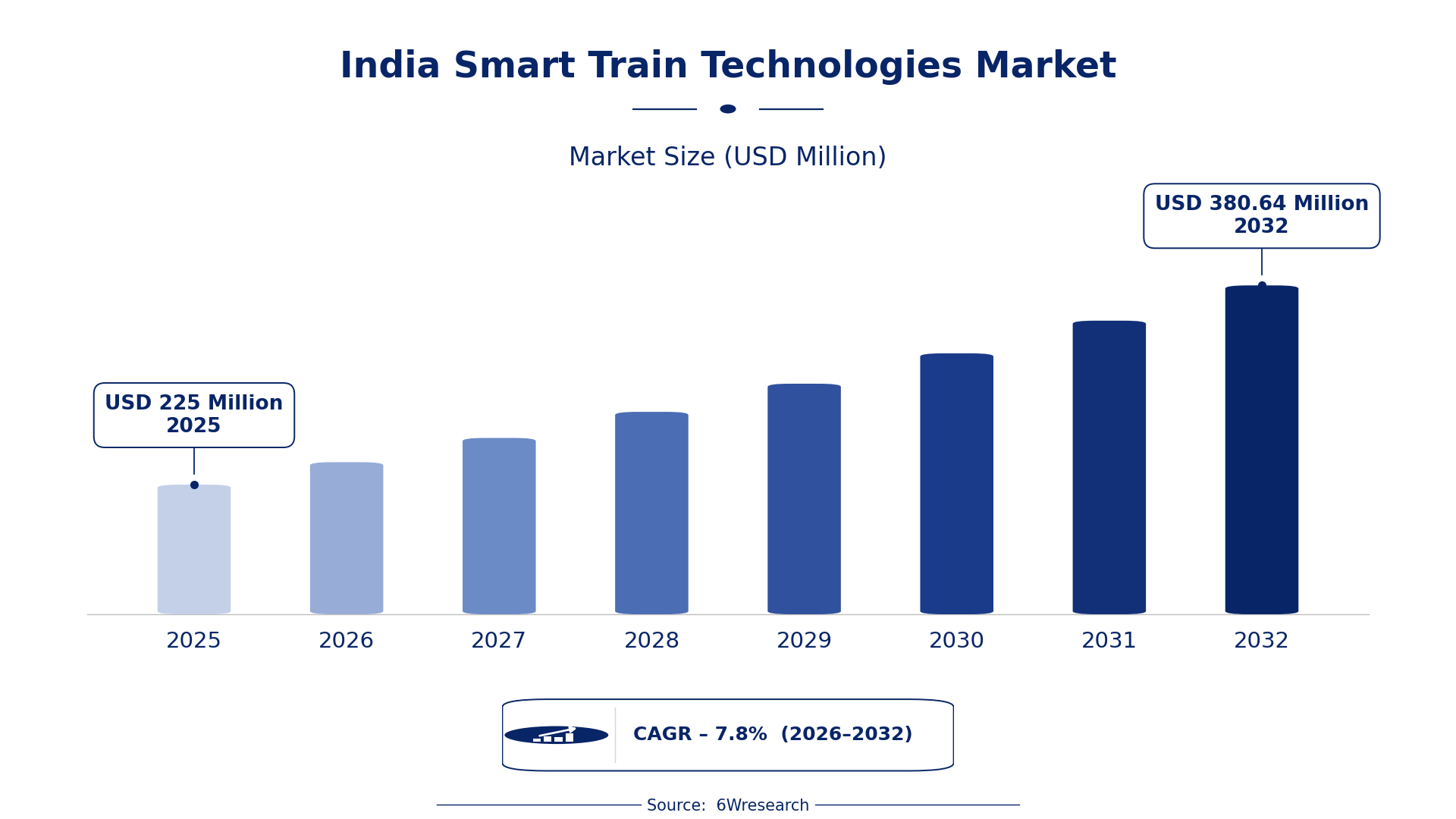
According to 6Wresearch internal database and industry insights, the India Smart Train Technologies Market was valued at USD 225.0 million in 2025 and is projected to reach USD 380.64 million by 2032, growing at a CAGR of approximately 7.8% during 2026–2032.
India Smart Train Technologies Market Highlights
| Report Metric | Details |
| Report Name | India Smart Train Technologies Market |
| Market Size 2025 | USD 225.0 million |
| Market Size 2032 | USD 380.64 million |
| Absolute Growth 2025–2032 | USD 155.64 million |
| CAGR 2026–2032 | 7.8% |
| Peak Annual Growth | 9.5% in 2027 |
| Forecast Period | 2026–2032 |
| Historical Data | 2022–2025 |
| Base Year | 2025 |
| Leading Technology Type, 2025 | Train Control Systems (39% share) |
| Leading Smart Feature, 2025 | Speed & Collision Avoidance (47% share) |
| Leading Connectivity, 2025 | GSM-R / LTE-R (40% share) |
| Leading End User, 2025 | Railway Operators (56% share) |
| Fastest-Growing Technology Type | Predictive Maintenance AI (10.3% CAGR) |
| Fastest-Growing Smart Feature | Fault Forecasting (9.6% CAGR) |
| Fastest-Growing Connectivity | Sensor + Analytics (10.1% CAGR) |
| Fastest-Growing End User | Metro Rail Services (9.9% CAGR) |
| Growing Sector | Metro Rail Services |
| Key End Users | Railway Operators, Metro Rail Services, Smart Rail Operators, Urban Commuters |
India Smart Train Technologies Market Year-wise Growth Rate and Key Drivers (2022–2032)
This graph illustrates the annual growth rates of the market from 2022 to 2032, highlighting a steady upward trajectory and projected market expansion over the forecast period.
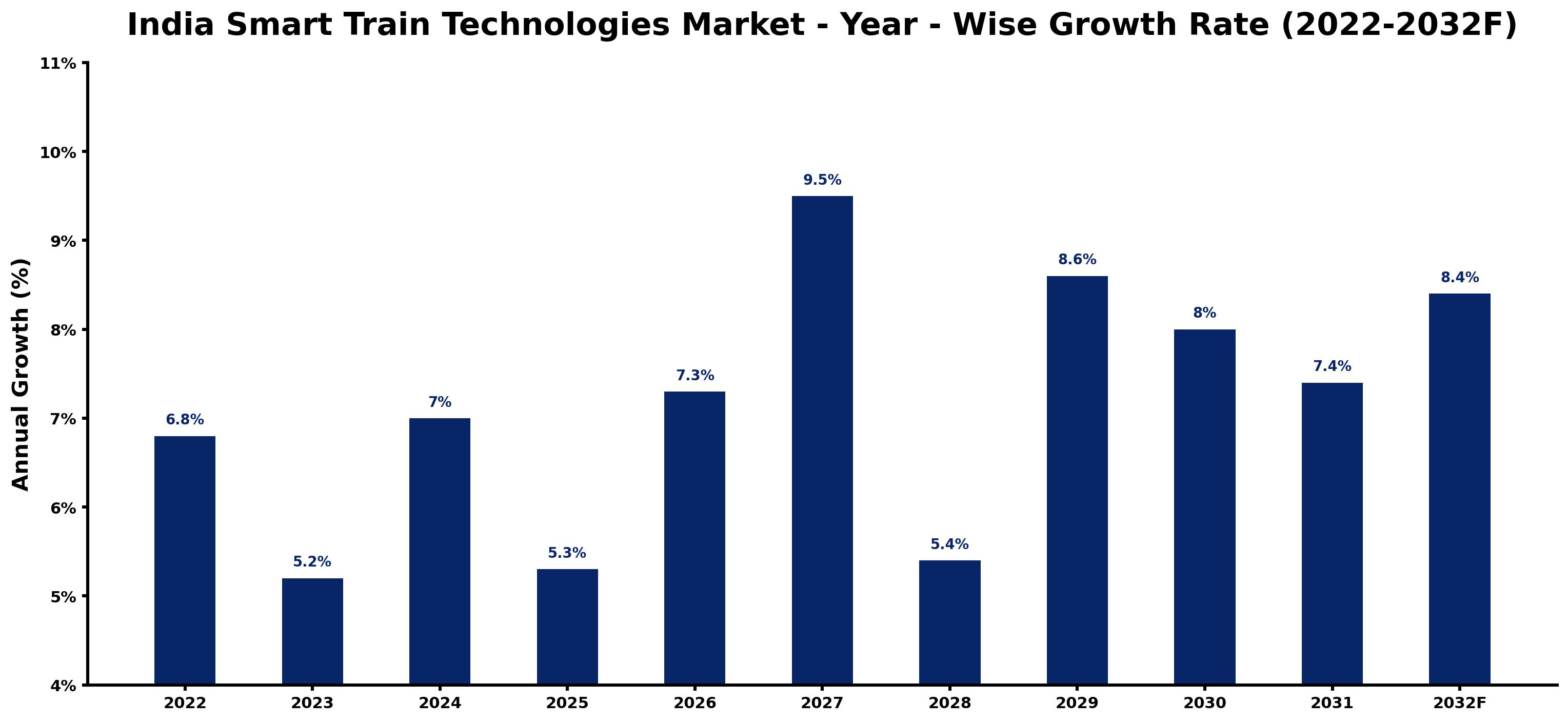
Annual growth estimates for each year appear below with the principal reason behind them, explaining the shifts that set the pace of the market.
| Year | Estimated Annual Growth (%) | Market Rationale |
| 2022 | 6.8 | The market experienced solid growth due to increased investment in railway infrastructure. |
| 2023 | 5.2 | Growth slowed as the market adjusted to new safety protocols and technology standards. |
| 2024 | 7.0 | Demand accelerated with the implementation of advanced train control systems across major routes. |
| 2025 | 5.3 | Market growth slowed again as projects faced delays in funding and execution. |
| 2026 | 7.3 | Growth is expected to pick up as predictive maintenance technologies gain traction among railway operators. |
| 2027 | 9.5 | The market is projected to peak with investments in smart ticketing and passenger information systems. |
| 2028 | 5.4 | Growth is expected to moderate as the Digital India programme begins to influence technology adoption. |
| 2029 | 8.6 | Demand will increase again as urban rail services expand in metropolitan areas. |
| 2030 | 8.0 | Growth is projected to moderate as the market adjusts to new operational standards and technologies. |
| 2031 | 7.4 | Demand will continue to grow, driven by ongoing investments in railway safety measures. |
| 2032 | 8.4 | The market is expected to rise further as smart technologies become standard in rail operations. |
Note: Market size estimations and growth projections presented in this report are based on 6Wresearch's proprietary forecasting methodology, utilizing the latest available industry data, government publications, and primary research inputs.
India Smart Train Technologies Market Synopsis
Smart Train Technologies Market in India encompasses advanced systems designed to improve rail transportation efficiency and safety. These technologies include software, hardware, and communication systems for train control and predictive maintenance. The Smart Train Technologies Market is projected to grow, driven by the National Rail Plan 2030 and substantial government funding. With over ₹1.5 trillion allocated for railway infrastructure development, demand is rising from railway operators and urban commuters alike. The integration of smart ticketing systems further boosts market potential.
Market Dynamics Impact Analysis (2026–2032)
| Factor | Type | Impact | Primary Segment Affected |
| Growing investment in railway infrastructure development | Driver | High | Train Control Systems |
| Implementation of smart ticketing systems enhances passenger experience | Driver | High | Smart Ticketing |
| Expansion of urban rail services in metropolitan areas | Opportunity | High | Metro Rail Services |
| Integration of predictive maintenance technologies in operations | Opportunity | High | Predictive Maintenance AI |
| Delays in project execution due to funding issues | Restraint | Medium | Passenger Info Systems |
| Challenges in adopting advanced communication systems | Restraint | Medium | Train Control Systems |
| The need for substantial investment in technology upgrades | Challenge | High | Train Control Systems |
| Competition from alternative transportation modes | Challenge | Medium | Urban Commuters |
Evaluation of Drivers in India Smart Train Technologies Market (2026–2032)
Key forces behind demand, with the segment each one moves most, are listed below.
| Drivers | Primary Segment Affected | Why It Matters (Evidence) |
| Increased government funding for railway infrastructure | Train Control Systems | The Indian government allocated ₹1.5 trillion for railway development, boosting demand for advanced control systems. |
| Implementation of the National Rail Plan 2030 | Smart Ticketing | This plan aims to improve passenger convenience, leading to increased adoption of smart ticketing solutions. |
| Rising urban population driving demand for metro services | Metro Rail Services | As urban areas expand, the need for efficient rail solutions increases, prompting investments in smart technologies. |
| Adoption of AI in predictive maintenance | Predictive Maintenance AI | The use of AI is expected to reduce maintenance costs by 20-30%, encouraging railway operators to invest. |
| Growing focus on safety protocols in rail operations | Passenger Info Systems | Increased safety measures result in higher demand for real-time passenger information systems. |
Expansion of the Smart Train Technologies market in India is backed by increased funding and rising urbanisation. The National Rail Plan 2030 aims to improve passenger convenience through smart ticketing, prompting railway operators to invest in these solutions. The adoption of AI in predictive maintenance is expected to reduce costs by 20-30%, further driving demand. As urban populations grow, the need for efficient metro rail services increases, prompting further investments in smart technologies.
Evaluation of Restraints in India Smart Train Technologies Market
The main factors holding the market back are set out below.
| Market Restraint | Primary Segment Affected | Why It Matters (Evidence) |
| Delays in project execution due to funding issues | Passenger Info Systems | Funding delays hinder the timely implementation of passenger information systems, affecting service quality. |
| Challenges in adopting advanced communication systems | Train Control Systems | The integration of systems like GSM-R is complex, resulting in slower adoption rates among operators. |
| High initial investment costs for smart technologies | Smart Ticketing | The upfront costs associated with implementing smart ticketing systems can deter some railway operators. |
| Limited training and expertise in smart technologies | Predictive Maintenance AI | A shortage of skilled personnel hampers the effective deployment of predictive maintenance solutions. |
| Regulatory hurdles in technology adoption | Train Control Systems | Strict regulations can delay the approval and implementation of new train control technologies. |
India Smart Train Technologies Market Challenges
The India Smart Train Technologies Market struggles primarily with the slow adoption of advanced systems among buyers, largely due to insufficient training and awareness. This lack of understanding leads to inefficient operations for railway operators, delaying the implementation of essential smart technologies. High initial costs present another obstacle; for example, the ₹1.5 trillion allocated for railway infrastructure development in 2022 falls short of covering the full integration of these technologies. Regulatory challenges also arise, as adherence to the Bureau of Indian Standards can extend project timelines for suppliers, impacting metro services in cities like Delhi and Mumbai.
Trends in the India Smart Train Technologies Market
Four trends stand out in the India Smart Train Technologies Market.
- Shift towards Smart Ticketing Solutions: In 2022, the Indian government launched the Smart Ticketing system as part of the National Rail Plan 2030, aiming to enhance passenger convenience. This initiative is expected to streamline ticketing processes across the rail network.
- Increased Adoption of Predictive Maintenance: Railway operators are increasingly embracing predictive maintenance AI, with an anticipated reduction in maintenance costs by 20-30%. This trend is crucial for boosting operational efficiency and minimising downtime.
- Expansion of Metro Rail Services: Metro Rail Services in cities like Delhi and Mumbai are swiftly integrating smart technologies to enhance urban transit. This integration is expected to substantially improve service delivery and passenger experience.
- Focus on Safety Protocols: The Railway Safety Management System introduced in 2023 aims to bolster safety measures across the rail network. This initiative is crucial for ensuring passenger safety and operational efficiency.
Investment Opportunities in the India Smart Train Technologies Market
Several openings in the India Smart Train Technologies Market merit attention from investors.
- Investment in Smart Ticketing Systems: With the Smart Ticketing system as part of the National Rail Plan 2030, there is an opportunity for suppliers to offer advanced ticketing solutions. Railway operators are eager to enhance passenger convenience.
- Development of Predictive Maintenance Solutions: The increasing demand for efficient maintenance in rail operations presents an opportunity to provide predictive maintenance technologies. Railway operators are keen to minimise downtime and costs associated with maintenance.
- Expansion of Urban Rail Services: As urban populations expand, there is a pressing need for efficient metro rail solutions. Suppliers can collaborate with local governments to incorporate smart technologies in urban rail systems.
- Enhancement of Passenger Information Systems: Railway operators are investing in passenger information systems to elevate service quality. Suppliers can enter this market by delivering advanced communication technologies.
Government Initiatives in the India Smart Train Technologies Market
The National Rail Plan 2030, initiated by the Ministry of Railways in 2020, aims to modernise railway infrastructure and services. This plan includes provisions for implementing smart technologies across the network, which will improve operational efficiency. The updated National Policy on Railways in 2021 focuses on sustainable and smart rail solutions, encouraging the adoption of advanced systems. Furthermore, the Atmanirbhar Bharat initiative promotes self-reliance in railway technology development, supporting local innovation and production.
Railway operators benefit from the Railway Safety Management System approved in 2023, which enhances safety measures across the network. The Digital India programme aims to implement smart technologies in public transportation, including railways, by 2025. Agencies like the Ministry of Railways oversee the funding and approval of projects aimed at integrating these technologies. The Indian Railway Institute of Signal Engineering and Telecommunications provides training in smart technologies, ensuring a skilled workforce for future developments.
Future Insight of the India Smart Train Technologies Market
The India Smart Train Technologies Market is expected to evolve by 2032, driven by the Smart Cities Mission and the National Rail Plan 2030. The integration of AI in predictive maintenance is projected to reduce maintenance costs by 20-30%, improving efficiency for railway operators. The Railway Safety Management System launched in 2023 will strengthen safety protocols, encouraging greater passenger trust. Training initiatives at the Indian Railway Institute of Signal Engineering and Telecommunications will develop a skilled workforce, ensuring the smooth adoption of advanced technologies throughout the railway network.
Market Segmentation Analysis
Each segment group is reviewed below, with the leader by share and the fastest grower by CAGR.
By Technology Type – Train Control Systems Dominated, Predictive Maintenance AI Expected to Grow Fastest
According to Dhaval Chaurasia, Assistant Manager at 6Wresearch, Train Control Systems took a 39% share of technology type in 2025, more than any other category. Train Control Systems hold the largest market share as they are indispensable for safe and efficient operations across India's extensive railway network of over 67,000 km. The strong demand from railway operators for reliable control mechanisms solidifies their dominant position in the Smart Train Technologies market. Predictive Maintenance AI is set to record the highest CAGR in this split, 10.3% over 2026–2032. Predictive Maintenance is rapidly gaining traction due to its ability to lower maintenance costs by 20-30%, appealing to operators focused on budget optimisation. This emphasis on cost-efficiency in railway operations will further enhance its market prominence. Suppliers should prioritise the development of advanced predictive maintenance solutions to cater to the rising demand from railway operators.
By Smart Feature – Speed & Collision Avoidance Dominated, Fault Forecasting Expected to Grow Fastest
Speed & Collision Avoidance accounted for a 47% market share by smart feature in 2025. Speed & Collision Avoidance features dominate the market because they are crucial for ensuring safety during train operations, which is a top priority for railway authorities. As safety regulations become more stringent, the reliance on these technologies will continue to strengthen, reinforcing their market share. The quickest growth will come from Fault Forecasting, forecast to expand at a CAGR of 9.6% between 2026 and 2032. Fault Forecasting is experiencing the fastest growth as it allows operators to predict and prevent system failures, thereby improving overall operational reliability. The increasing focus on safety and efficiency in urban rail systems is propelling this segment forward. Buyers will gain significant advantages by investing in fault forecasting technologies to enhance safety and minimise unexpected downtimes.
By Connectivity – GSM-R / LTE-R Dominated, Sensor + Analytics Expected to Grow Fastest
In 2025, GSM-R / LTE-R led the connectivity split with a 40% share. GSM-R / LTE-R technologies lead the connectivity segment by providing essential communication systems that ensure reliable operations across India's vast railway network. Their established use among railway operators reinforces their dominant position in the Smart Train Technologies market. Sensor + Analytics is projected to grow fastest, at a CAGR of 10.1% during 2026–2032. Sensor + Analytics is witnessing rapid growth as it is vital for monitoring train performance and safety, which is becoming increasingly important in modern rail operations. The integration of smart technologies into rail systems is driving this segment's expansion. Suppliers should concentrate on improving sensor and analytics solutions to meet the growing interest from railway operators.
By End User – Railway Operators Dominated, Metro Rail Services Expected to Grow Fastest
Railway Operators held a 56% share of the India Smart Train Technologies Market by end user in 2025. Railway Operators represent the largest share of the end-user segment as they are the primary consumers of smart train technologies aimed at boosting operational efficiency. Their ongoing investments in technology upgrades further solidify their leading position in this market. Over 2026–2032, Metro Rail Services are expected to post the fastest growth, at a CAGR of 9.9%. Metro Rail Services are the fastest-growing end-user segment due to their need for smart technologies to improve urban transit solutions. The push for smart city initiatives is accelerating the adoption of these technologies in metropolitan areas. Suppliers should tailor their offerings to meet the specific needs of metro rail services to capitalise on this growth opportunity.
Key Attractiveness of the Report
- 10 Years of Market Numbers
- Historical Data Starting from 2022 to 2025
- Base Year 2025
- Forecast Data until 2032
- Key Performance Indicators Impacting the Market
- Major Upcoming Developments and Projects
Key Highlights of the Report:
- India Smart Train Technologies Market Outlook
- Market Size of India Smart Train Technologies Market, 2025
- Forecast of India Smart Train Technologies Market, 2032
- Historical Data and Forecast of India Smart Train Technologies Revenues & Volume for the Period 2022 - 2032F
- India Smart Train Technologies Market Trend Evolution
- India Smart Train Technologies Market Drivers and Challenges
- India Smart Train Technologies Price Trends
- India Smart Train Technologies Porter's Five Forces
- India Smart Train Technologies Industry Life Cycle
- Historical Data and Forecast of India Smart Train Technologies Market Revenues & Volume By Technology Type for the Period 2022 - 2032F
- Historical Data and Forecast of India Smart Train Technologies Market Revenues & Volume By Train Control Systems for the Period 2022 - 2032F
- Historical Data and Forecast of India Smart Train Technologies Market Revenues & Volume By Passenger Info Systems for the Period 2022 - 2032F
- Historical Data and Forecast of India Smart Train Technologies Market Revenues & Volume By Predictive Maintenance AI for the Period 2022 - 2032F
- Historical Data and Forecast of India Smart Train Technologies Market Revenues & Volume By Smart Ticketing for the Period 2022 - 2032F
- Historical Data and Forecast of India Smart Train Technologies Market Revenues & Volume By Smart Feature for the Period 2022 - 2032F
- Historical Data and Forecast of India Smart Train Technologies Market Revenues & Volume By Speed & Collision Avoidance for the Period 2022 - 2032F
- Historical Data and Forecast of India Smart Train Technologies Market Revenues & Volume By Real-Time Updates for the Period 2022 - 2032F
- Historical Data and Forecast of India Smart Train Technologies Market Revenues & Volume By Fault Forecasting for the Period 2022 - 2032F
- Historical Data and Forecast of India Smart Train Technologies Market Revenues & Volume By Contactless Boarding for the Period 2022 - 2032F
- Historical Data and Forecast of India Smart Train Technologies Market Revenues & Volume By Connectivity for the Period 2022 - 2032F
- Historical Data and Forecast of India Smart Train Technologies Market Revenues & Volume By GSM-R / LTE-R for the Period 2022 - 2032F
- Historical Data and Forecast of India Smart Train Technologies Market Revenues & Volume By Digital Screens + GPS for the Period 2022 - 2032F
- Historical Data and Forecast of India Smart Train Technologies Market Revenues & Volume By Sensor + Analytics for the Period 2022 - 2032F
- Historical Data and Forecast of India Smart Train Technologies Market Revenues & Volume By QR + NFC + Mobile App for the Period 2022 - 2032F
- Historical Data and Forecast of India Smart Train Technologies Market Revenues & Volume By End User for the Period 2022 - 2032F
- Historical Data and Forecast of India Smart Train Technologies Market Revenues & Volume By Railway Operators for the Period 2022 - 2032F
- Historical Data and Forecast of India Smart Train Technologies Market Revenues & Volume By Metro Rail Services for the Period 2022 - 2032F
- Historical Data and Forecast of India Smart Train Technologies Market Revenues & Volume By Smart Rail Operators for the Period 2022 - 2032F
- Historical Data and Forecast of India Smart Train Technologies Market Revenues & Volume By Urban Commuters for the Period 2022 - 2032F
- India Smart Train Technologies Import Export Trade Statistics
- Market Opportunity Assessment By Technology Type
- Market Opportunity Assessment By Smart Feature
- Market Opportunity Assessment By Connectivity
- Market Opportunity Assessment By End User
- India Smart Train Technologies Top Companies Market Share
- India Smart Train Technologies Competitive Benchmarking By Technical and Operational Parameters
- India Smart Train Technologies Company Profiles
- India Smart Train Technologies Key Strategic Recommendations
Market Covered
The report offers an extensive study of the following market segments.
By Technology Type
- Train Control Systems
- Passenger Info Systems
- Predictive Maintenance AI
- Smart Ticketing
By Smart Feature
- Speed & Collision Avoidance
- Real-Time Updates
- Fault Forecasting
- Contactless Boarding
By Connectivity
- GSM-R / LTE-R
- Digital Screens + GPS
- Sensor + Analytics
- QR + NFC + Mobile App
By End User
- Railway Operators
- Metro Rail Services
- Smart Rail Operators
- Urban Commuters































