China Smart Train Technologies Market Size & Growth Rate
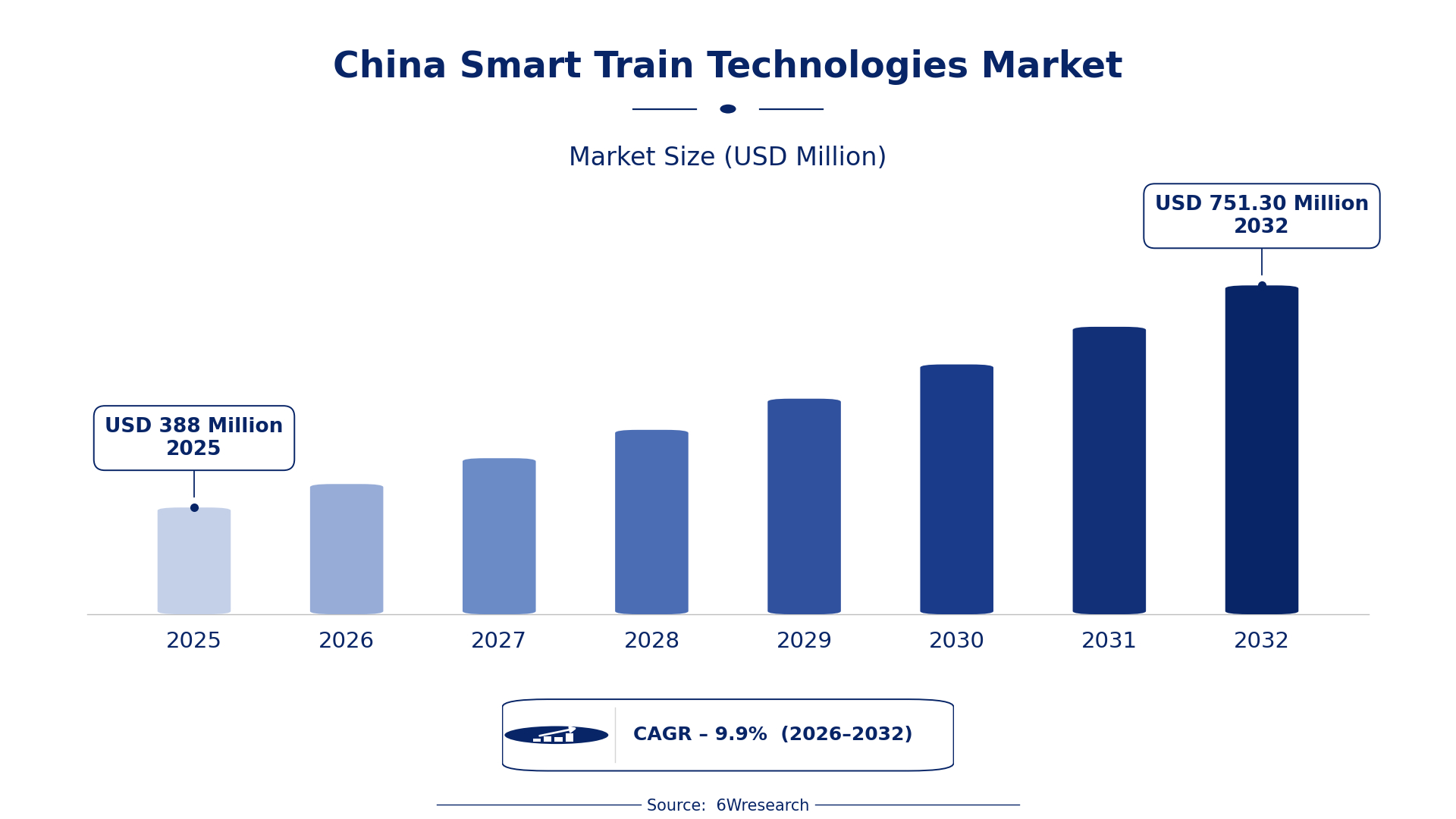
According to 6Wresearch internal database and industry insights, the China Smart Train Technologies Market was valued at USD 388.0 million in 2025 and is projected to reach USD 751.30 million by 2032, growing at a CAGR of approximately 9.9% during 2026–2032.
China Smart Train Technologies Market Highlights
| Report Metric | Details |
| Report Name | China Smart Train Technologies Market |
| Market Size 2025 | USD 388.0 million |
| Market Size 2032 | USD 751.30 million |
| Absolute Growth 2025–2032 | USD 363.30 million |
| CAGR 2026–2032 | 9.9% |
| Peak Annual Growth | 12.2% in 2027 |
| Forecast Period | 2026–2032 |
| Historical Data | 2022–2025 |
| Base Year | 2025 |
| Leading Technology Type, 2025 | Train Control Systems (48% share) |
| Leading Smart Feature, 2025 | Speed & Collision Avoidance (45% share) |
| Leading Connectivity, 2025 | GSM-R / LTE-R (34% share) |
| Leading End User, 2025 | Railway Operators (34% share) |
| Fastest-Growing Technology Type | Predictive Maintenance AI (12.0% CAGR) |
| Fastest-Growing Smart Feature | Fault Forecasting (12.1% CAGR) |
| Fastest-Growing Connectivity | Sensor + Analytics (12.0% CAGR) |
| Fastest-Growing End User | Metro Rail Services (12.5% CAGR) |
| Growing Sector | Urban Rail Services |
| Key End Users | Railway Operators, Metro Rail Services, Urban Commuters |
China Smart Train Technologies Market Year-wise Growth Rate and Key Drivers (2022–2032)
This graph illustrates the annual growth rates of the market from 2022 to 2032, highlighting a steady upward trajectory and projected market expansion over the forecast period.
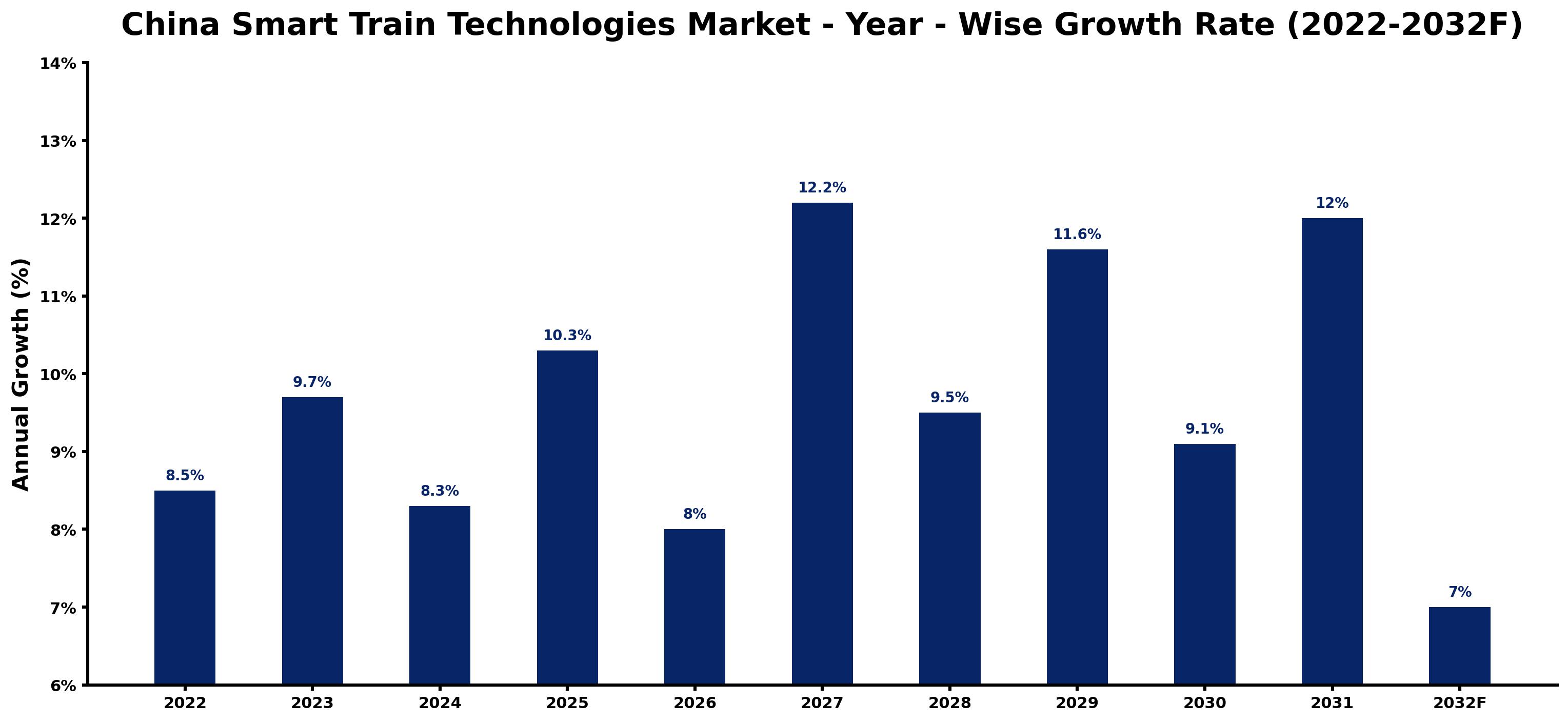
The table below sets out the estimated growth rate for each year and the main factor behind it.
| Year | Estimated Annual Growth (%) | Market Rationale |
| 2022 | 8.5 | The market experienced steady growth due to ongoing infrastructure investments in rail systems, particularly in urban areas. |
| 2023 | 9.7 | Demand surged as urban commuters increasingly adopted smart ticketing solutions, enhancing operational efficiency. |
| 2024 | 8.3 | A slight slowdown occurred as the market adjusted to rapid expansions in technology integration across various regions. |
| 2025 | 10.3 | Growth rebounded with significant investments in smart rail infrastructure across major cities, improving service delivery. |
| 2026 | 8.0 | The market is expected to slow as companies face challenges in integrating advanced technologies into existing systems. |
| 2027 | 12.2 | A surge in demand is projected due to the implementation of advanced train control systems under the National Smart Transportation Development Plan. |
| 2028 | 9.5 | Growth is expected to slow as the market stabilises after the previous year's peak demand, particularly in major urban centres. |
| 2029 | 11.6 | Demand is anticipated to increase as metro rail services expand smart technology adoption, driven by user preferences. |
| 2030 | 9.1 | A slowdown is expected as the market adjusts to the saturation of certain technologies, affecting smaller operators. |
| 2031 | 12.0 | Growth is projected to accelerate again due to rising investments in predictive maintenance solutions, enhancing operational reliability. |
| 2032 | 7.0 | The market is expected to grow at a slower pace as it matures and stabilises, particularly in the Guangdong province. |
Note: Market size estimations and growth projections presented in this report are based on 6Wresearch's proprietary forecasting methodology, utilizing the latest available industry data, government publications, and primary research inputs.
China Smart Train Technologies Market Synopsis
Smart Train Technologies in China encompass advanced systems that improve the efficiency and safety of train operations. These technologies integrate AI, IoT, and communication systems, focusing on train control, predictive maintenance, and passenger information. With 70% of urban commuters using these systems in 2022, demand is expected to grow further as the National Smart Transportation Development Plan aims to enhance rail systems by 2025.
Market Dynamics Impact Analysis (2026–2032)
| Factor | Type | Impact | Primary Segment Affected |
| Increasing investments in smart rail infrastructure | Driver | High | Train Control Systems |
| Growing urban commuter base adopting smart ticketing solutions | Driver | High | Smart Ticketing |
| Expansion of smart technologies in urban rail systems | Opportunity | High | Metro Rail Services |
| Pilot projects in Guangdong province for smart train technologies | Opportunity | Medium | Passenger Info Systems |
| Challenges in technology integration for existing systems | Restraint | High | Predictive Maintenance AI |
| Limited funding for smaller rail operators to adopt new technologies | Restraint | Medium | Smart Ticketing |
| Difficulty in standardising technologies across different regions | Challenge | High | GSM-R / LTE-R |
| High costs associated with upgrading legacy systems | Challenge | Medium | Train Control Systems |
Evaluation of Drivers in China Smart Train Technologies Market (2026–2032)
The factors lifting demand, and the evidence behind each, are summarised below.
| Drivers | Primary Segment Affected | Why It Matters (Evidence) |
| Infrastructure investments in smart rail systems | Train Control Systems | China has over 38,000 kilometers of high-speed rail lines operational, driving demand for advanced control systems. |
| Adoption of smart ticketing solutions by urban commuters | Smart Ticketing | In 2022, 70% of urban commuters in major cities used smart ticketing, increasing demand. |
| Implementation of real-time updates in metro services | Passenger Info Systems | The Beijing Metro has implemented real-time updates in 100% of its trains since 2021, improving user experience. |
| Growth of predictive maintenance technologies | Predictive Maintenance AI | The 14th Five-Year Plan emphasises intelligent transportation systems, boosting demand for predictive maintenance. |
| Expansion of digital screens for passenger information | Digital Screens + GPS | Urban rail systems have seen a 30% increase in the use of digital screens for passenger information. |
Growth across the Smart Train Technologies market in China is anchored in infrastructure investments, rising urban commuter adoption of smart ticketing solutions, and the implementation of real-time updates in metro services. In 2022, 70% of urban commuters in major cities used smart ticketing, driving demand for advanced systems. The National Smart Transportation Development Plan prioritises the development of intelligent transportation systems, further supporting the market. With over 38,000 kilometers of high-speed rail lines operational, the need for advanced train control systems continues to rise, particularly as urban populations grow and seek efficient travel options.
Evaluation of Restraints in China Smart Train Technologies Market
Below mentioned are some major restraints and their influence on market dynamics.
| Market Restraint | Primary Segment Affected | Why It Matters (Evidence) |
| Challenges in integrating new technologies with legacy systems | Train Control Systems | Many operators face difficulties in upgrading existing systems, leading to delays in technology adoption and increased costs. |
| Limited funding for smaller rail operators | Smart Ticketing | Smaller operators often lack the budget to invest in smart ticketing solutions, hindering overall market growth and innovation. |
| Variability in technology standards across regions | GSM-R / LTE-R | Different regions may adopt varying standards, complicating interoperability and integration for railway operators. |
| High costs associated with upgrading existing infrastructure | Predictive Maintenance AI | The financial burden of upgrading legacy systems can deter investment in predictive maintenance technologies, impacting service quality. |
| Slow regulatory approvals for new technologies | Passenger Info Systems | Regulatory hurdles can delay the implementation of advanced passenger information systems, affecting user experience. |
China Smart Train Technologies Market Challenges
Buyers and suppliers in the China Smart Train Technologies market face intense competition that drives down prices, affecting profit margins for producers. This competition arises from rapid technological advancements in the sector, compelling producers to invest heavily in R&D, which can delay product development timelines. Regulatory requirements, such as ISO 9001 certification, introduce compliance costs that can prolong time to market, hindering suppliers' ability to launch new products. Buyers also encounter challenges in integrating advanced systems, leading to increased operational costs and potential service disruptions for railway operators.
Trends in the China Smart Train Technologies Market
Several trends are reshaping the China Smart Train Technologies Market; the most important are set out below.
- 30% Increase in Digital Screens for Passenger Information: China's urban rail systems have experienced a 30% rise in the use of digital screens for passenger information, highlighting a growing commitment to modernising rail services and improving the commuter experience.
- Shift Towards Smart Ticketing Solutions: Smart ticketing solutions are increasingly common, with 70% of urban commuters adopting them in 2022. This trend is transforming how passengers access rail services and pay for travel, boosting operational efficiency.
- Expansion of Real-Time Updates in Metro Services: The Beijing Metro has introduced real-time updates in all its trains since 2021, enhancing passenger information dissemination. This trend reflects a broader movement towards improving service reliability and user satisfaction.
- Innovative Pilot Projects in Guangdong Province: Guangdong province is at the forefront of adopting smart train technologies with several pilot projects. These initiatives are establishing benchmarks for smart rail implementation across the country, demonstrating effective technology integration.
Investment Opportunities in the China Smart Train Technologies Market
The following opportunities in the China Smart Train Technologies Market pair current demand with a clear way in.
- Gap in Smart Ticketing Solutions Adoption: With 70% of urban commuters using smart ticketing, there remains a gap for further adoption. Investing in partnerships with local rail operators can facilitate entry into this growing market, enhancing user convenience.
- Rising Demand for Predictive Maintenance Technologies: The demand for predictive maintenance AI is increasing, with a projected growth rate of 12.0%. Collaborating with railway operators can improve service offerings and operational efficiency, reducing downtime.
- Expansion of Smart Rail Infrastructure: Shanghai's investment of 5 billion CNY in smart rail infrastructure presents a valuable opportunity. Suppliers can enter through joint ventures with local firms to meet the growing demand for advanced systems.
- Development of Advanced Passenger Info Systems: The increasing need for real-time updates creates an opportunity for suppliers of passenger info systems. Engaging with metro services can establish a foothold in this expanding sector, improving user experience.
Government Initiatives in the China Smart Train Technologies Market
The 14th Five-Year Plan for Transportation, released by the State Council in 2021, prioritises the development of intelligent transportation systems, including rail. This plan aims to improve the efficiency and safety of rail operations through advanced technologies. The National Smart Transportation Development Plan, also issued in 2021, supports the integration of modern solutions into existing rail systems. These frameworks provide clear guidance for investment and development in the smart train technologies sector, encouraging collaboration among stakeholders.
The 14th Five-Year Plan allocates substantial funding for smart transportation initiatives, focusing on rail systems. Projects funded under this plan aim to improve connectivity and operational efficiency in urban and regional rail networks. The Ministry also approves standards for smart technologies, facilitating their integration into existing systems, thus benefiting both producers and buyers.
Future Insight of the China Smart Train Technologies Market
The China Smart Train Technologies market is poised for substantial evolution by 2032, driven by the National Smart Transportation Development Plan and the 14th Five-Year Plan, which prioritise intelligent transportation systems. By 2025, smart ticketing solutions will cover 80% of urban rail networks, improving user experience and operational efficiency. Pilot projects in Guangdong will showcase new technologies, while advancements in AI and IoT will streamline train operations. Investments in smart rail infrastructure will further solidify China's leadership in the global smart train technology sector.
Market Segmentation Analysis
The analysis below covers each segmentation, its leading category in 2025 and its fastest-growing category through 2032.
By Technology Type – Train Control Systems Dominated, Predictive Maintenance AI Expected to Grow Fastest
According to Dhaval Chaurasia, Assistant Manager at 6Wresearch, in 2025, Train Control Systems led the technology type split with a 48% share. Train Control Systems hold the largest share due to their critical role in ensuring safe and efficient operations across China's vast rail network. With over 38,000 kilometers of high-speed rail lines operational, these systems are indispensable for managing complex train schedules. Over 2026–2032, Predictive Maintenance AI is expected to post the fastest growth, at a CAGR of 12.0%. Predictive Maintenance is rapidly gaining traction as it directly addresses the pressing need to reduce downtime and maintenance costs, particularly with the increasing number of trains in service. This technology's importance is highlighted by the railway industry's ongoing investments in smart solutions. Suppliers should enhance their predictive maintenance offerings to meet the growing demand from railway operators.
By Smart Feature – Speed & Collision Avoidance Dominated, Fault Forecasting Expected to Grow Fastest
With a 45% revenue share in 2025, Speed & Collision Avoidance was the largest smart feature category. Speed & Collision Avoidance features dominate the market share as they are vital for ensuring safety in train operations, particularly in high-density urban areas. The heightened focus on safety standards has made these features essential for operators managing busy rail systems. Fault Forecasting is projected to grow fastest, at a CAGR of 12.1% during 2026–2032. Fault Forecasting is experiencing significant growth as it enables proactive maintenance strategies, thereby minimising the risk of delays and accidents. The increasing demand for reliable rail services in urban environments is driving this trend. Buyers should invest in advanced fault forecasting technologies to improve operational reliability and safety.
By Connectivity – GSM-R / LTE-R Dominated, Sensor + Analytics Expected to Grow Fastest
GSM-R / LTE-R took a 34% share of connectivity in 2025, more than any other category. GSM-R / LTE-R technologies lead the market share as they are essential for reliable communication within rail networks, facilitating seamless operations across various train systems. Their established presence in the industry provides a robust communication framework necessary for both safety and efficiency. The quickest growth will come from Sensor + Analytics, forecast to expand at a CAGR of 12.0% between 2026 and 2032. Sensor + Analytics is the fastest-growing segment, propelled by the rising demand for real-time monitoring and improvements in operational efficiency. As rail networks expand, the need for advanced analytics to optimise performance becomes increasingly critical. Suppliers should focus on developing sensor and analytics solutions to address the rising needs of railway operators.
By End User – Railway Operators Dominated, Metro Rail Services Expected to Grow Fastest
The largest end user category in 2025 was Railway Operators, with a 34% share of total revenue. Railway Operators command the largest market share as the primary users of smart train technologies, leveraging these systems to enhance both operational efficiency and safety. Their substantial investments in technology upgrades underline their crucial role in the market. Metro Rail Services are set to record the highest CAGR in this split, 12.5% over 2026–2032. Metro Rail Services are the fastest-growing end user segment, driven by increasing urbanisation and the demand for efficient public transport solutions. The rapid expansion of metro networks in major cities significantly fuels this growth. Suppliers should tailor their solutions to meet the specific needs of metro rail services to capitalise on this growth opportunity.
Key Attractiveness of the Report
- 10 Years of Market Numbers
- Historical Data Starting from 2022 to 2025
- Base Year 2025
- Forecast Data until 2032
- Key Performance Indicators Impacting the Market
- Major Upcoming Developments and Projects
Key Highlights of the Report:
- China Smart Train Technologies Market Outlook
- Market Size of China Smart Train Technologies Market, 2025
- Forecast of China Smart Train Technologies Market, 2032
- Historical Data and Forecast of China Smart Train Technologies Revenues & Volume for the Period 2022 - 2032F
- China Smart Train Technologies Market Trend Evolution
- China Smart Train Technologies Market Drivers and Challenges
- China Smart Train Technologies Price Trends
- China Smart Train Technologies Porter's Five Forces
- China Smart Train Technologies Industry Life Cycle
- Historical Data and Forecast of China Smart Train Technologies Market Revenues & Volume By Technology Type for the Period 2022 - 2032F
- Historical Data and Forecast of China Smart Train Technologies Market Revenues & Volume By Train Control Systems for the Period 2022 - 2032F
- Historical Data and Forecast of China Smart Train Technologies Market Revenues & Volume By Passenger Info Systems for the Period 2022 - 2032F
- Historical Data and Forecast of China Smart Train Technologies Market Revenues & Volume By Predictive Maintenance AI for the Period 2022 - 2032F
- Historical Data and Forecast of China Smart Train Technologies Market Revenues & Volume By Smart Ticketing for the Period 2022 - 2032F
- Historical Data and Forecast of China Smart Train Technologies Market Revenues & Volume By Smart Feature for the Period 2022 - 2032F
- Historical Data and Forecast of China Smart Train Technologies Market Revenues & Volume By Speed & Collision Avoidance for the Period 2022 - 2032F
- Historical Data and Forecast of China Smart Train Technologies Market Revenues & Volume By Real-Time Updates for the Period 2022 - 2032F
- Historical Data and Forecast of China Smart Train Technologies Market Revenues & Volume By Fault Forecasting for the Period 2022 - 2032F
- Historical Data and Forecast of China Smart Train Technologies Market Revenues & Volume By Contactless Boarding for the Period 2022 - 2032F
- Historical Data and Forecast of China Smart Train Technologies Market Revenues & Volume By Connectivity for the Period 2022 - 2032F
- Historical Data and Forecast of China Smart Train Technologies Market Revenues & Volume By GSM-R / LTE-R for the Period 2022 - 2032F
- Historical Data and Forecast of China Smart Train Technologies Market Revenues & Volume By Digital Screens + GPS for the Period 2022 - 2032F
- Historical Data and Forecast of China Smart Train Technologies Market Revenues & Volume By Sensor + Analytics for the Period 2022 - 2032F
- Historical Data and Forecast of China Smart Train Technologies Market Revenues & Volume By QR + NFC + Mobile App for the Period 2022 - 2032F
- Historical Data and Forecast of China Smart Train Technologies Market Revenues & Volume By End User for the Period 2022 - 2032F
- Historical Data and Forecast of China Smart Train Technologies Market Revenues & Volume By Railway Operators for the Period 2022 - 2032F
- Historical Data and Forecast of China Smart Train Technologies Market Revenues & Volume By Metro Rail Services for the Period 2022 - 2032F
- Historical Data and Forecast of China Smart Train Technologies Market Revenues & Volume By Smart Rail Operators for the Period 2022 - 2032F
- Historical Data and Forecast of China Smart Train Technologies Market Revenues & Volume By Urban Commuters for the Period 2022 - 2032F
- China Smart Train Technologies Import Export Trade Statistics
- Market Opportunity Assessment By Technology Type
- Market Opportunity Assessment By Smart Feature
- Market Opportunity Assessment By Connectivity
- Market Opportunity Assessment By End User
- China Smart Train Technologies Top Companies Market Share
- China Smart Train Technologies Competitive Benchmarking By Technical and Operational Parameters
- China Smart Train Technologies Company Profiles
- China Smart Train Technologies Key Strategic Recommendations
Market Covered
This report examines the market across the segments below.
By Technology Type
- Train Control Systems
- Passenger Info Systems
- Predictive Maintenance AI
- Smart Ticketing
By Smart Feature
- Speed & Collision Avoidance
- Real-Time Updates
- Fault Forecasting
- Contactless Boarding
By Connectivity
- GSM-R / LTE-R
- Digital Screens + GPS
- Sensor + Analytics
- QR + NFC + Mobile App
By End User
- Railway Operators
- Metro Rail Services
- Smart Rail Operators
- Urban Commuters































