India Smart Urban Transit Market Size & Growth Rate
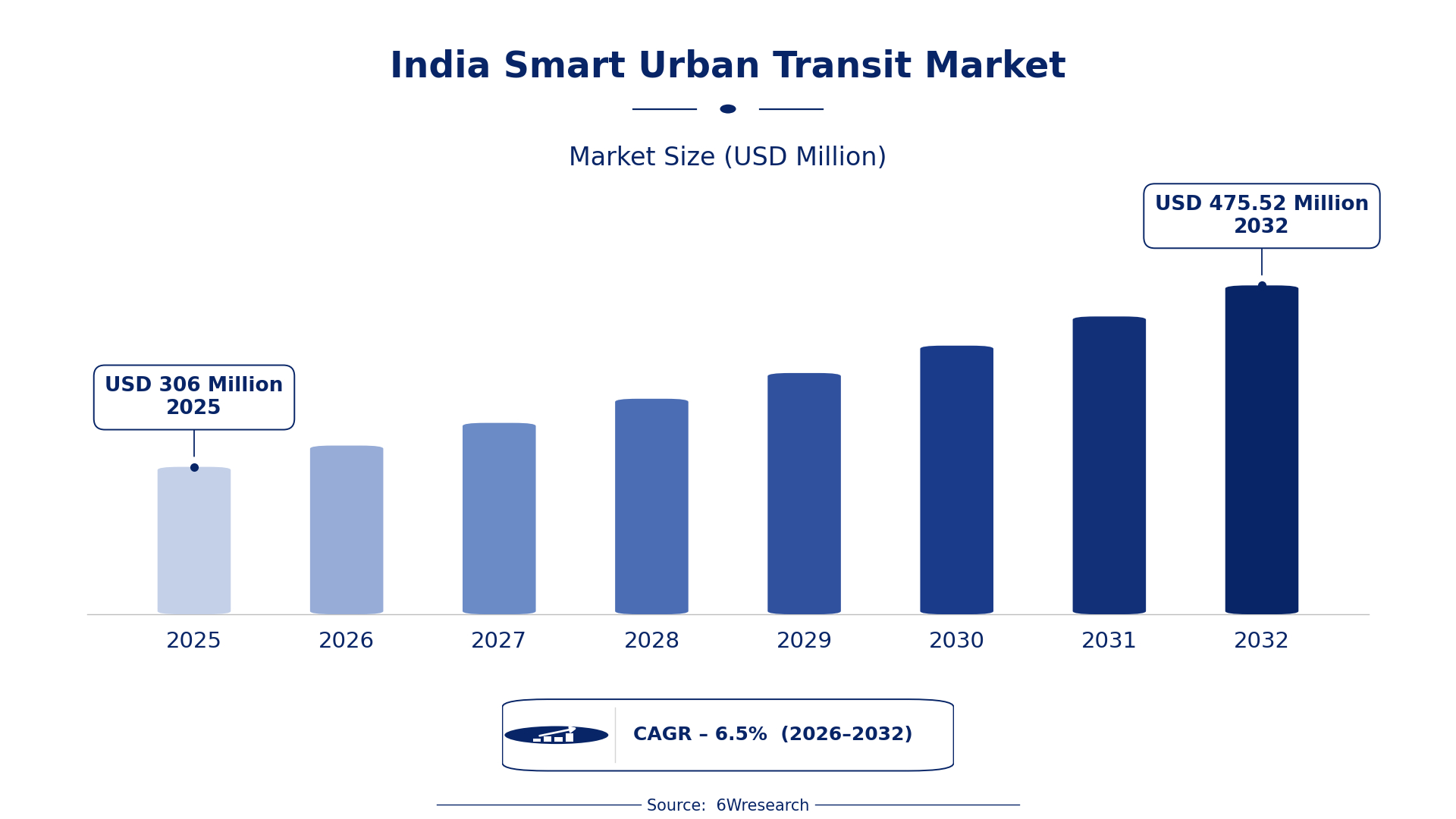
According to 6Wresearch internal database and industry insights, the India Smart Urban Transit Market was valued at USD 306.0 million in 2025 and is projected to reach USD 475.52 million by 2032, growing at a CAGR of approximately 6.5% during 2026–2032.
India Smart Urban Transit Market Highlights
| Report Metric | Details |
| Report Name | India Smart Urban Transit Market |
| Market Size 2025 | USD 306.0 million |
| Market Size 2032 | USD 475.52 million |
| Absolute Growth 2025–2032 | USD 169.52 million |
| CAGR 2026–2032 | 6.5% |
| Peak Annual Growth | 8.8% in 2026 |
| Forecast Period | 2026–2032 |
| Historical Data | 2022–2025 |
| Base Year | 2025 |
| Leading Transit Type, 2025 | Metro & Light Rail (41% share) |
| Leading Smart Feature, 2025 | Live Route Optimization (41% share) |
| Leading Communication System, 2025 | GPS + Cloud (47% share) |
| Leading End User, 2025 | City Transport Boards (43% share) |
| Fastest-Growing Transit Type | Last-Mile Vehicles (8.3% CAGR) |
| Fastest-Growing Smart Feature | AI Delay Prediction (8.4% CAGR) |
| Fastest-Growing Communication System | Centralized AI (7.9% CAGR) |
| Fastest-Growing End User | Commuters (8.2% CAGR) |
| Growing Sector | Urban Mobility Solutions |
| Key End Users | City Transport Boards, Commuters, Urban Planners |
India Smart Urban Transit Market Year-wise Growth Rate and Key Drivers (2022–2032)
This graph illustrates the annual growth rates of the market from 2022 to 2032, highlighting a steady upward trajectory and projected market expansion over the forecast period.
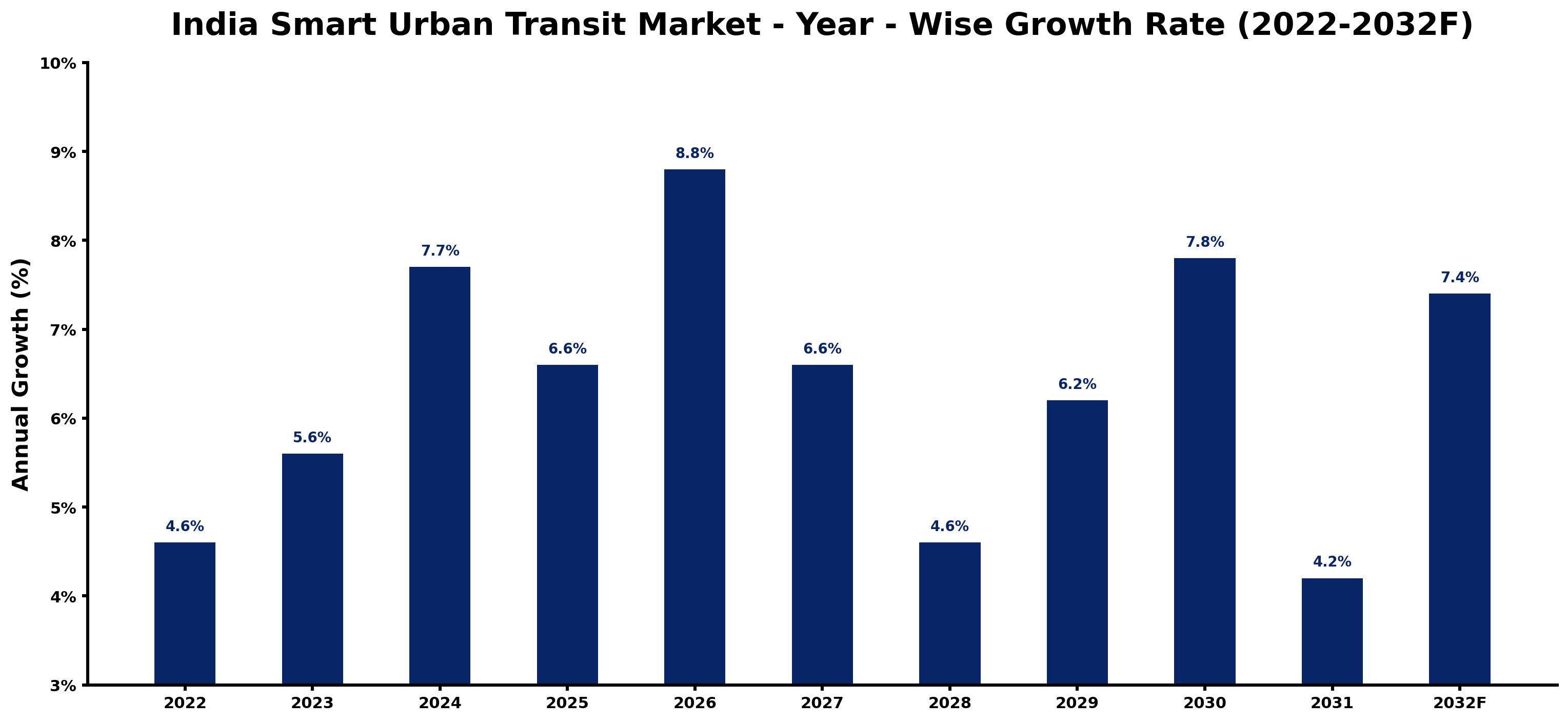
Each row of the following table gives one year's estimated growth and the event or demand shift that explains it.
| Year | Estimated Annual Growth (%) | Market Rationale |
| 2022 | 4.6 | The market showed steady growth with urbanization driving demand for efficient transit solutions. |
| 2023 | 5.6 | Increased investments in metro systems contributed to faster growth compared to the previous year. |
| 2024 | 7.7 | The expansion of metro networks led to notable growth as urban populations increased. |
| 2025 | 6.6 | Despite a slowdown, ongoing projects maintained growth momentum in urban transit solutions. |
| 2026 | 8.8 | The introduction of smart technologies is expected to spur higher growth rates in the market. |
| 2027 | 6.6 | Growth is projected to slow as the market adjusts to the rapid expansion of previous years. |
| 2028 | 4.6 | Continued urbanization is expected to keep growth steady, despite a further slowdown in rate. |
| 2029 | 6.2 | The rise in commuter numbers is projected to drive demand, resulting in faster growth again. |
| 2030 | 7.8 | Investment in electric buses and infrastructure will support a rebound in growth rates. |
| 2031 | 4.2 | Growth is anticipated to slow as the market faces challenges in infrastructure development. |
| 2032 | 7.4 | The market is expected to grow faster as new projects and technologies are implemented. |
Note: Market size estimations and growth projections presented in this report are based on 6Wresearch's proprietary forecasting methodology, utilizing the latest available industry data, government publications, and primary research inputs.
India Smart Urban Transit Market Synopsis
Smart Urban Transit in India includes advanced transportation systems that enhance urban mobility. These systems, such as Bus Rapid Transit and Metro & Light Rail, aim to improve efficiency and reduce congestion. The India Smart Urban Transit Market is growing due to urbanisation and government initiatives. The Smart Cities Mission seeks to develop 100 smart cities, driving the demand for effective transit solutions. In addition, the projected urban population of 600 million by 2031 further increases the need for efficient urban transport systems.
Market Dynamics Impact Analysis (2026–2032)
| Factor | Type | Impact | Primary Segment Affected |
| Growing urban population and investment in metro systems drive demand for efficient transit solutions. | Driver | High | Metro & Light Rail |
| The demand for electric buses is increasing due to government incentives and environmental concerns. | Driver | High | App-Based Ticketing |
| The expansion of metro networks presents opportunities for investment in infrastructure. | Opportunity | High | Metro & Light Rail |
| The introduction of smart ticketing solutions can enhance user experience and increase ridership. | Opportunity | High | App-Based Ticketing |
| High initial investment costs for infrastructure can limit project initiation and expansion. | Restraint | Medium | Bus Rapid Transit |
| Regulatory approvals for new transit projects can delay implementation timelines. | Restraint | Medium | Metro & Light Rail |
| Limited public awareness of new transit options can slow adoption rates. | Challenge | Medium | Last-Mile Vehicles |
| Infrastructure challenges in rapidly urbanizing areas can impede transit system development. | Challenge | High | Bus Rapid Transit |
Evaluation of Drivers in India Smart Urban Transit Market (2026–2032)
The factors lifting demand, and the evidence behind each, are summarised below.
| Drivers | Primary Segment Affected | Why It Matters (Evidence) |
| Investment in metro systems is increasing as urban areas expand, leading to higher demand for transit solutions. | Metro & Light Rail | India has over 700 km of operational metro rail systems, serving millions daily. |
| Government incentives for electric buses are driving demand for sustainable transit options. | App-Based Ticketing | The Indian government allocated INR 1,000 crore for electric buses under the FAME II scheme. |
| The Smart Cities Mission is developing urban infrastructure, including smart transit systems. | Bus Rapid Transit | The Smart Cities Mission has a budget of INR 48,000 crore to improve urban transit. |
| The introduction of app-based ticketing is projected to streamline fare collection and increase ridership. | App-Based Ticketing | This is expected to boost ridership by 20% by 2025. |
| Urban planners are increasingly focusing on integrated transport solutions to improve mobility. | Last-Mile Vehicles | Over 50 cities in India are planning Bus Rapid Transit systems to enhance urban mobility. |
The Smart Urban Transit market in India is growing as urban populations rise and infrastructure investment increases. The Smart Cities Mission, with a budget of INR 48,000 crore, is developing advanced transit systems nationwide. Funding for electric buses under the FAME II scheme is stimulating demand for sustainable transport. With over 700 km of operational metro systems, the need for efficient transit solutions is on the rise. The introduction of app-based ticketing is expected to boost ridership by 20% by 2025, improving user convenience and operational efficiency.
Evaluation of Restraints in India Smart Urban Transit Market
Below mentioned are some major restraints and their influence on market dynamics.
| Market Restraint | Primary Segment Affected | Why It Matters (Evidence) |
| High initial costs for infrastructure projects can deter investment and slow market growth. | Bus Rapid Transit | The expansion of metro networks requires substantial financial commitment, limiting new projects. |
| Regulatory hurdles can delay the approval process for new transit systems. | Metro & Light Rail | Approval from the Ministry of Housing and Urban Affairs can prolong project timelines. |
| Limited public awareness of new transit options can slow adoption rates. | Last-Mile Vehicles | Commuters may be unaware of the benefits of integrated transit solutions. |
| Infrastructure challenges in urban areas can impede the development of transit systems. | Bus Rapid Transit | Rapid urbanization leads to congestion and complicates project execution. |
| Competition for funding among various urban projects can limit resources for transit initiatives. | Metro & Light Rail | Limited budgets can restrict the scope of transit system expansions. |
India Smart Urban Transit Market Challenges
Producers in the India Smart Urban Transit market face challenges with technology integration, as outdated systems can delay project timelines by up to 18 months. Regulatory hurdles pose obstacles for producers, with complex approval processes from the Ministry of Housing and Urban Affairs leading to project delays that can result in millions in lost revenue. Importers encounter supply chain disruptions for essential components, causing a 30% increase in project costs for urban transit initiatives. Buyers are experiencing rising costs due to fluctuating investment in infrastructure, with recent allocations showing a 20% decrease in funding for new projects, impacting service expansion.
Trends in the India Smart Urban Transit Market
The trends below show where the India Smart Urban Transit Market is heading.
- Shift towards Integrated Transit Solutions: City Transport Boards are increasingly adopting integrated transit solutions to improve urban mobility. The Smart Cities Mission is driving this shift with a budget of INR 48,000 crore, promoting connectivity.
- Increase in Electric Bus Adoption: The Indian government allocated INR 1,000 crore under the FAME II scheme to promote electric buses. This initiative aims to reduce emissions and improve urban air quality.
- Growth of App-Based Ticketing Systems: The introduction of app-based ticketing is transforming fare collection in urban transit. This is expected to increase ridership by 20% by 2025, improving user convenience.
- Expansion of Metro Networks: Bengaluru's Namma Metro project is expanding with a budget of INR 15,000 crore for Phase 2. This growth reflects the increasing demand for efficient mass transit solutions.
Investment Opportunities in the India Smart Urban Transit Market
The following opportunities in the India Smart Urban Transit Market pair current demand with a clear way in.
- Investment in Electric Bus Infrastructure: With the government's allocation of INR 1,000 crore for electric buses, there is an opportunity to invest in charging infrastructure. City Transport Boards are key buyers, and local partnerships can facilitate entry.
- Development of Smart Ticketing Systems: The projected increase in ridership by 20% by 2025 highlights the need for smart ticketing solutions. Urban Developers are seeking solutions to improve user experience and streamline operations.
- Expansion of Metro and Light Rail Systems: The ongoing expansion of metro systems presents a promising opportunity for investment in infrastructure. City Transport Boards are looking for partners to implement these projects effectively.
- Last-Mile Connectivity Solutions: As urban populations grow, there is a need for effective last-mile connectivity solutions. Commuters are increasingly seeking options that connect them to transit hubs, creating a demand for innovative services.
Government Initiatives in the India Smart Urban Transit Market
The Atal Mission for Rejuvenation and Urban Transformation (AMRUT), launched in 2015, focuses on improving urban transport infrastructure across 500 cities with a budget of INR 50,000 crore. This initiative supports the development of Smart Urban Transit systems by promoting sustainable urban mobility and integration of transport modes. The National Urban Transport Policy, updated in 2020, further enhances these objectives by encouraging public-private partnerships for infrastructure development.
The Ministry of Housing and Urban Affairs oversees urban transport policies and initiatives, approving projects under various schemes. The FAME II scheme promotes electric vehicle adoption, including electric buses, providing funding for infrastructure development. This allows producers to invest in modern transit solutions, improving the overall urban transport framework.
Future Insight of the India Smart Urban Transit Market
The India Smart Urban Transit market is set for transformative changes by 2032, driven by the government's Smart Cities Mission, which aims to develop 100 smart cities with advanced transit solutions. Urban population growth, projected to reach 600 million by 2031, will significantly boost demand for efficient transportation systems. The introduction of electric buses under the FAME II scheme, with an allocation of INR 1,500 crore, will promote sustainable urban mobility. Improved ticketing systems are expected to increase ridership by 20% by 2025, enhancing overall operational efficiency.
Market Segmentation Analysis
The report offers a comprehensive study of the following market segments and their leading categories in the market.
By Transit Type – Metro & Light Rail Dominated, Last-Mile Vehicles Expected to Grow Fastest
According to Dhaval Chaurasia, Assistant Manager at 6Wresearch, Metro & Light Rail took a 41% share of transit type in 2025, more than any other category. Metro & Light Rail holds a substantial market share as it serves millions in densely populated cities like Delhi, which boasts one of the largest metro networks globally. The operational metro rail systems, exceeding 700 km, provide reliable and efficient transportation essential for urban residents. The quickest growth will come from Last-Mile Vehicles, forecast to expand at a CAGR of 8.3% between 2026 and 2032. Last-Mile Vehicles are gaining rapid traction due to the urgent need for seamless connectivity to transit hubs, with over 50 cities planning initiatives to enhance urban mobility. This segment's growth will likely continue as urban populations expand, further increasing the demand for effective last-mile solutions. Suppliers should focus on creating integrated solutions that connect last-mile vehicles with existing transit systems to capitalise on the rising demand.
By Smart Feature – Live Route Optimization Dominated, AI Delay Prediction Expected to Grow Fastest
Live Route Optimization held a 41% share of the India Smart Urban Transit Market by smart feature in 2025. Live Route Optimization leads the market share as it significantly improves service efficiency and reduces wait times for commuters, making it a crucial component of urban transit systems. This technology is increasingly embraced by transit authorities to enhance operational performance and customer satisfaction. AI Delay Prediction is set to record the highest CAGR in this split, 8.4% over 2026–2032. AI Delay Prediction is experiencing the fastest growth, driven by the demand for real-time updates that enhance user experience, particularly as app-based ticketing becomes more prevalent. This trend mirrors the broader shift towards digital solutions in urban transit. Investing in advanced smart features like AI Delay Prediction can provide suppliers with a competitive edge in the evolving urban transit market.
By Communication System – GPS + Cloud Dominated, Centralized AI Expected to Grow Fastest
With a 47% revenue share in 2025, GPS + Cloud was the largest communication system category. GPS + Cloud technology commands the largest market share due to its essential role in real-time tracking and management of transit fleets, which is vital for effective urban mobility. This system is widely implemented across various transit networks, ensuring efficient operations and reliable service. Centralized AI is projected to grow fastest, at a CAGR of 7.9% during 2026–2032. Centralized AI is the fastest-growing communication system, as it optimises operations and enhances service delivery, aligning with the increasing demand for smart urban transit solutions. The integration of advanced technologies into communication systems is expected to improve overall user satisfaction. Suppliers should prioritise the development of Centralized AI solutions to meet the rising demand for efficient communication systems in urban transit.
By End User – City Transport Boards Dominated, Commuters Expected to Grow Fastest
City Transport Boards accounted for a 43% market share by end user in 2025. City Transport Boards dominate the market share as they are crucial in planning and implementing urban transit solutions, ensuring systems cater to the needs of growing urban populations. Their involvement is essential in promoting the adoption of advanced transit technologies and improving service delivery. Over 2026–2032, Commuters are expected to post the fastest growth, at a CAGR of 8.2%. The Commuters segment is rapidly expanding, reflecting the increasing urban population projected to reach 600 million by 2031, which drives the demand for effective public transport solutions. As urban transit becomes more critical, the emphasis on enhancing the commuter experience will intensify. Understanding commuter needs will be vital for suppliers aiming to develop solutions that effectively address the challenges of urban mobility.
Key Attractiveness of the Report
- 10 Years of Market Numbers
- Historical Data Starting from 2022 to 2025
- Base Year 2025
- Forecast Data until 2032
- Key Performance Indicators Impacting the Market
- Major Upcoming Developments and Projects
Key Highlights of the Report:
- India Smart Urban Transit Market Outlook
- Market Size of India Smart Urban Transit Market, 2025
- Forecast of India Smart Urban Transit Market, 2032
- Historical Data and Forecast of India Smart Urban Transit Revenues & Volume for the Period 2022 - 2032F
- India Smart Urban Transit Market Trend Evolution
- India Smart Urban Transit Market Drivers and Challenges
- India Smart Urban Transit Price Trends
- India Smart Urban Transit Porter's Five Forces
- India Smart Urban Transit Industry Life Cycle
- Historical Data and Forecast of India Smart Urban Transit Market Revenues & Volume By Transit Type for the Period 2022 - 2032F
- Historical Data and Forecast of India Smart Urban Transit Market Revenues & Volume By Bus Rapid Transit for the Period 2022 - 2032F
- Historical Data and Forecast of India Smart Urban Transit Market Revenues & Volume By Metro & Light Rail for the Period 2022 - 2032F
- Historical Data and Forecast of India Smart Urban Transit Market Revenues & Volume By App-Based Ticketing for the Period 2022 - 2032F
- Historical Data and Forecast of India Smart Urban Transit Market Revenues & Volume By Last-Mile Vehicles for the Period 2022 - 2032F
- Historical Data and Forecast of India Smart Urban Transit Market Revenues & Volume By Smart Feature for the Period 2022 - 2032F
- Historical Data and Forecast of India Smart Urban Transit Market Revenues & Volume By Live Route Optimization for the Period 2022 - 2032F
- Historical Data and Forecast of India Smart Urban Transit Market Revenues & Volume By AI Delay Prediction for the Period 2022 - 2032F
- Historical Data and Forecast of India Smart Urban Transit Market Revenues & Volume By QR & App Integration for the Period 2022 - 2032F
- Historical Data and Forecast of India Smart Urban Transit Market Revenues & Volume By Shared Micro-Mobility Data for the Period 2022 - 2032F
- Historical Data and Forecast of India Smart Urban Transit Market Revenues & Volume By Communication System for the Period 2022 - 2032F
- Historical Data and Forecast of India Smart Urban Transit Market Revenues & Volume By GPS + Cloud for the Period 2022 - 2032F
- Historical Data and Forecast of India Smart Urban Transit Market Revenues & Volume By Centralized AI for the Period 2022 - 2032F
- Historical Data and Forecast of India Smart Urban Transit Market Revenues & Volume By NFC/QR for the Period 2022 - 2032F
- Historical Data and Forecast of India Smart Urban Transit Market Revenues & Volume By Dockless + App for the Period 2022 - 2032F
- Historical Data and Forecast of India Smart Urban Transit Market Revenues & Volume By End User for the Period 2022 - 2032F
- Historical Data and Forecast of India Smart Urban Transit Market Revenues & Volume By City Transport Boards for the Period 2022 - 2032F
- Historical Data and Forecast of India Smart Urban Transit Market Revenues & Volume By Urban Developers for the Period 2022 - 2032F
- Historical Data and Forecast of India Smart Urban Transit Market Revenues & Volume By Commuters for the Period 2022 - 2032F
- Historical Data and Forecast of India Smart Urban Transit Market Revenues & Volume By Urban Planners for the Period 2022 - 2032F
- India Smart Urban Transit Import Export Trade Statistics
- Market Opportunity Assessment By Transit Type
- Market Opportunity Assessment By Smart Feature
- Market Opportunity Assessment By Communication System
- Market Opportunity Assessment By End User
- India Smart Urban Transit Top Companies Market Share
- India Smart Urban Transit Competitive Benchmarking By Technical and Operational Parameters
- India Smart Urban Transit Company Profiles
- India Smart Urban Transit Key Strategic Recommendations
Market Covered
Segments analysed in this report are listed below.
By Transit Type
- Bus Rapid Transit
- Metro & Light Rail
- App-Based Ticketing
- Last-Mile Vehicles
By Smart Feature
- Live Route Optimization
- AI Delay Prediction
- QR & App Integration
- Shared Micro-Mobility Data
By Communication System
- GPS + Cloud
- Centralized AI
- NFC/QR
- Dockless + App
By End User
- City Transport Boards
- Urban Developers
- Commuters
- Urban Planners































