China Smart Urban Transit Market Size & Growth Rate
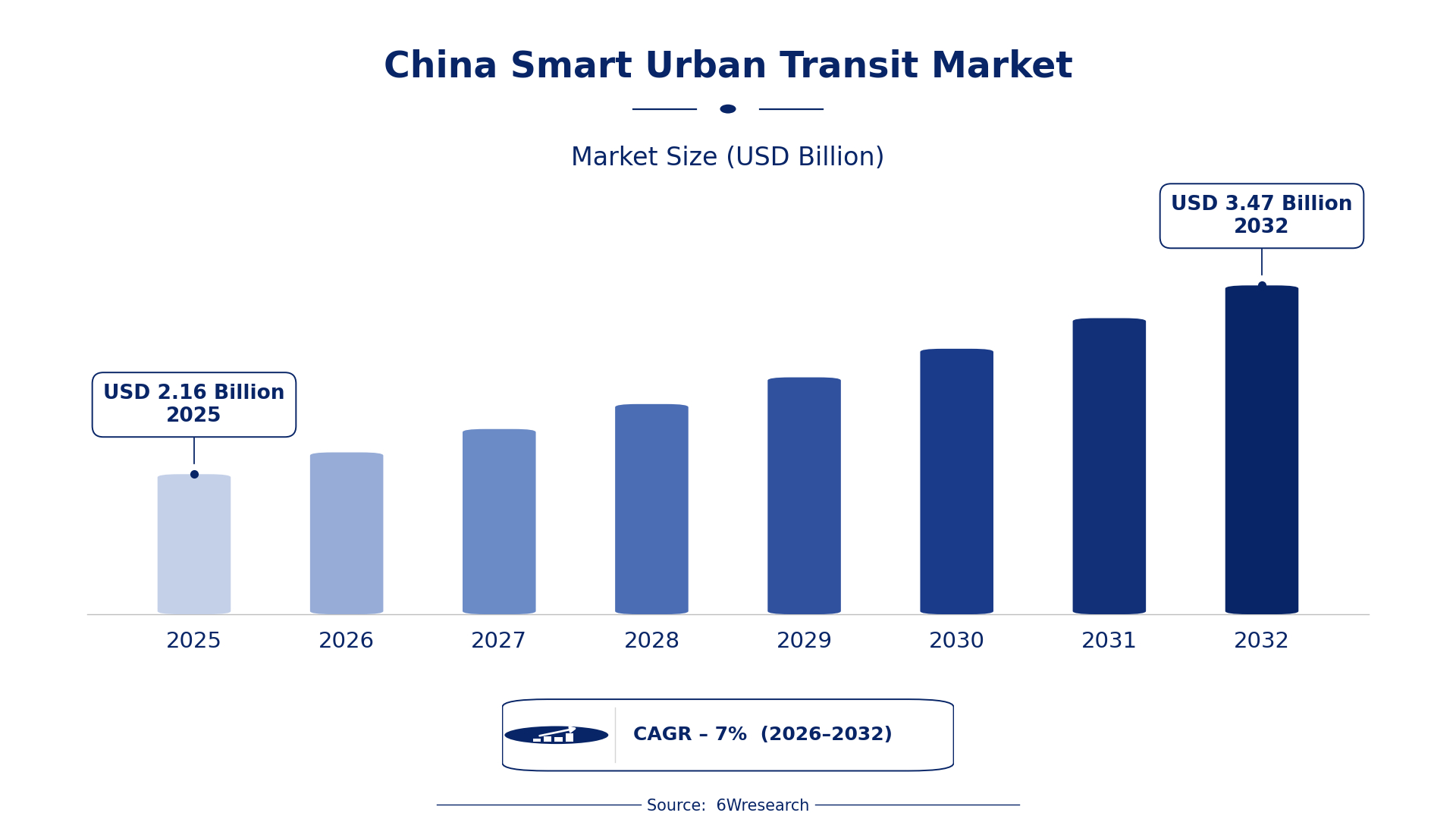
According to 6Wresearch internal database and industry insights, the China Smart Urban Transit Market was valued at USD 2.16 billion in 2025 and is projected to reach USD 3.47 billion by 2032, growing at a CAGR of approximately 7% during 2026–2032.
China Smart Urban Transit Market Highlights
| Report Metric | Details |
| Report Name | China Smart Urban Transit Market |
| Market Size 2025 | USD 2.16 billion |
| Market Size 2032 | USD 3.47 billion |
| Absolute Growth 2025–2032 | USD 1.31 billion |
| CAGR 2026–2032 | 7% |
| Peak Annual Growth | 8.3% in 2029 |
| Forecast Period | 2026–2032 |
| Historical Data | 2022–2025 |
| Base Year | 2025 |
| Leading Transit Type, 2025 | Metro & Light Rail (44% share) |
| Leading Smart Feature, 2025 | Live Route Optimization (51% share) |
| Leading Communication System, 2025 | GPS + Cloud (39% share) |
| Leading End User, 2025 | City Transport Boards (49% share) |
| Fastest-Growing Transit Type | Last-Mile Vehicles (8.3% CAGR) |
| Fastest-Growing Smart Feature | AI Delay Prediction (9.5% CAGR) |
| Fastest-Growing Communication System | Centralized AI (9.0% CAGR) |
| Fastest-Growing End User | Commuters (8.5% CAGR) |
| Growing Sector | Public Transport |
| Key End Users | City Transport Boards, Commuters, Urban Developers, Urban Planners |
China Smart Urban Transit Market Year-wise Growth Rate and Key Drivers (2022–2032)
This graph illustrates the annual growth rates of the market from 2022 to 2032, highlighting a steady upward trajectory and projected market expansion over the forecast period.
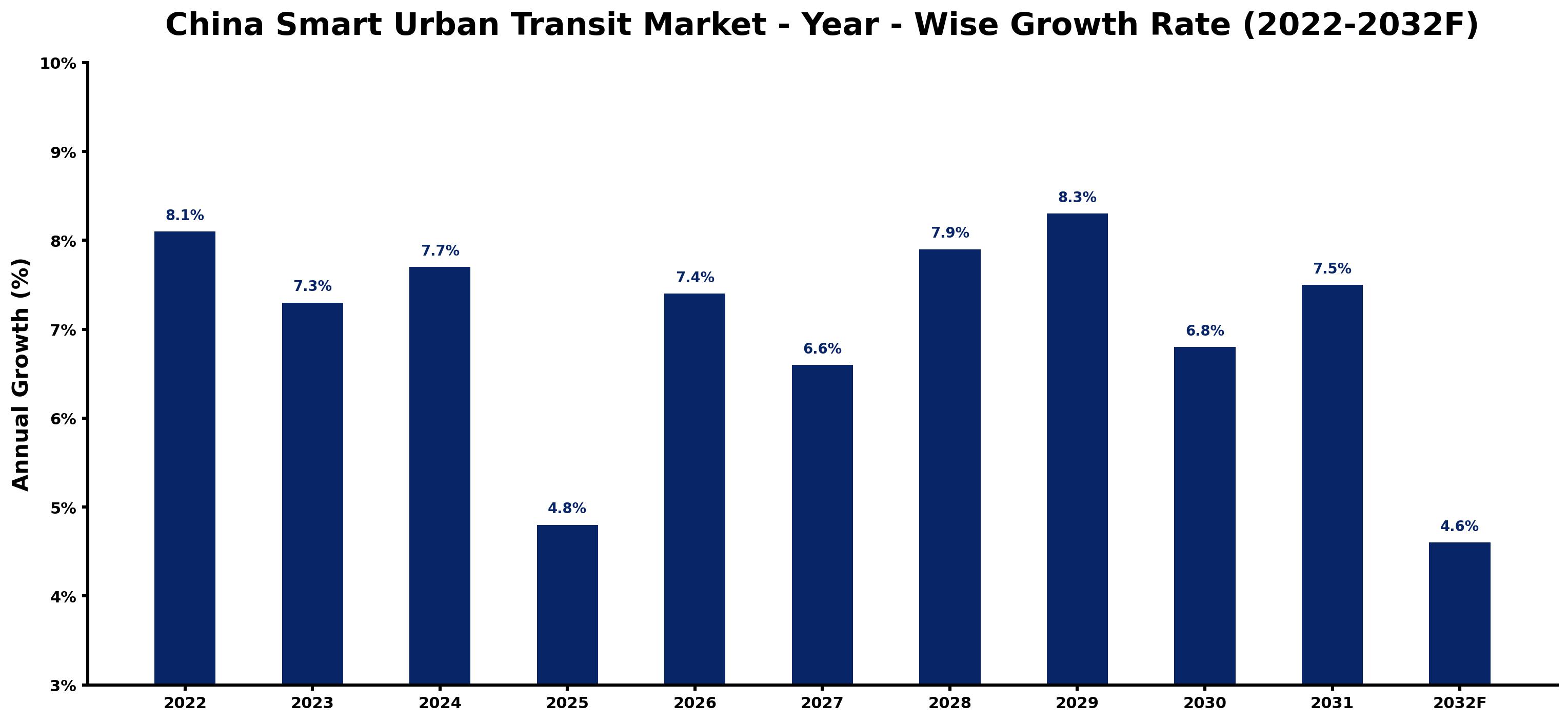
Annual growth estimates for each year appear below with the principal reason behind them, explaining the shifts that set the pace of the market.
| Year | Estimated Annual Growth (%) | Market Rationale |
| 2022 | 8.1 | The market experienced strong demand due to urban population growth and infrastructure investments. |
| 2023 | 7.3 | Growth slowed as the market adjusted to the previous year's peak activity and projects were finalised. |
| 2024 | 7.7 | Demand increased as cities expanded their public transit infrastructure projects and adopted new technologies. |
| 2025 | 4.8 | Growth slowed again as investments became more cautious amid economic factors and budget constraints. |
| 2026 | 7.4 | Demand is expected to rise as new smart technologies are integrated into transit systems, improving efficiency. |
| 2027 | 6.6 | Growth is projected to slow due to the maturation of existing transit projects and limited funding sources. |
| 2028 | 7.9 | Demand will increase as cities adopt more AI-driven transit solutions, improving operational efficiency. |
| 2029 | 8.3 | The market is expected to peak as urban transit investments reach new heights, driven by government initiatives. |
| 2030 | 6.8 | Growth is projected to slow as cities focus on optimizing existing transit systems and managing resources effectively. |
| 2031 | 7.5 | Demand will rise again with renewed investments in smart urban transit, supported by local government initiatives. |
| 2032 | 4.6 | Growth is expected to slow as the Urban Transit Development Plan 2021-2025 continues to influence project implementations. |
Note: Market size estimations and growth projections presented in this report are based on 6Wresearch's proprietary forecasting methodology, utilizing the latest available industry data, government publications, and primary research inputs.
China Smart Urban Transit Market Synopsis
Smart Urban Transit in China encompasses technologies and systems aimed at enhancing urban mobility through effective public transport solutions. This includes infrastructure such as bus rapid transit and metro systems, along with features like live route optimisation. The China Smart Urban Transit Market is growing due to increasing urban populations and substantial investments in public transport infrastructure. In 2023, China's urban population reached 1.4 billion, creating a pressing need for improved transit solutions. The government's Urban Transit Development Plan 2021-2025 seeks to boost urban mobility, further driving market expansion.
Market Dynamics Impact Analysis (2026–2032)
| Factor | Type | Impact | Primary Segment Affected |
| Urban population growth drives demand for efficient public transport solutions. | Driver | High | Bus Rapid Transit |
| Investment in smart technologies enhances transit efficiency and user experience. | Driver | High | Metro & Light Rail |
| Growing urban population creates a need for improved transit options. | Opportunity | High | App-Based Ticketing |
| Investment in electric buses presents opportunities for green transit solutions. | Opportunity | High | Last-Mile Vehicles |
| High initial costs of smart transit technology can deter investments. | Restraint | Medium | Metro & Light Rail |
| Infrastructure challenges in rapidly urbanizing areas can limit expansion. | Restraint | Medium | Metro & Light Rail |
| Competition for funding among various urban projects can limit resources. | Challenge | Medium | Metro & Light Rail |
| Technological integration issues can delay project implementations. | Challenge | Medium | Bus Rapid Transit |
Evaluation of Drivers in China Smart Urban Transit Market (2026–2032)
The factors lifting demand, and the evidence behind each, are summarised below.
| Drivers | Primary Segment Affected | Why It Matters (Evidence) |
| Urban population growth | Bus Rapid Transit | China's urban population reached 1.4 billion in 2023, increasing demand for efficient transit solutions. |
| Investment in smart technologies | Metro & Light Rail | The Urban Transit Development Plan 2021-2025 aims to integrate smart technologies into urban transit, improving efficiency and user experience. |
| Increased public transit usage | App-Based Ticketing | In 2022, 60% of urban commuters in China used public transit as their primary mode of transport, driving demand for better systems. |
| Government subsidies for electric buses | Last-Mile Vehicles | The Hangzhou government introduced subsidies for electric buses in 2023, promoting cleaner transit options and expanding the market. |
| Expansion of existing transit networks | Metro & Light Rail | The Tianjin Metro plans to expand its network by 100 kilometers by 2025 to accommodate growing demand for urban mobility. |
The Smart Urban Transit market in China is growing on the back of urban population expansion, increased public transit usage, and investments in smart technologies. In 2023, the urban population reached 1.4 billion, which drives demand for efficient transit solutions. In 2022, 60% of urban commuters used public transit as their primary mode of transport, highlighting the need for improved systems. The Guangdong province implemented smart traffic management systems, improving transit efficiency across major cities. The Tianjin Metro plans to expand its network by 100 kilometers by 2025 to meet the increasing demand for urban mobility.
Evaluation of Restraints in China Smart Urban Transit Market
The main factors holding the market back are set out below.
| Market Restraint | Primary Segment Affected | Why It Matters (Evidence) |
| High initial costs of implementing smart transit technologies can deter investments. | Metro & Light Rail | The adoption of advanced technologies often requires substantial upfront capital, limiting accessibility for some cities. |
| Infrastructure challenges in rapidly urbanizing areas can limit expansion. | Metro & Light Rail | Rapid urbanization can outpace infrastructure development, making it difficult to implement new systems effectively. |
| Competition for funding among various urban projects can limit resources. | City Transport Boards | City Transport Boards often face budget constraints, impacting their ability to invest in new transit solutions. |
| Technological integration issues can delay project implementations. | Bus Rapid Transit | Challenges in integrating new technologies with existing systems can lead to project delays and increased costs. |
| Regulatory hurdles can complicate the approval process for new transit projects. | Metro & Light Rail | Complex regulatory requirements can slow down the implementation of new transit initiatives. |
China Smart Urban Transit Market Challenges
The China Smart Urban Transit market faces critical supply chain disruptions that can delay infrastructure projects for producers. With the urban population reaching 1.4 billion, demand for efficient transit solutions is surging, yet material shortages can extend project timelines by up to six months. Compliance with the Urban Transit Development Plan 2021-2025 adds regulatory costs for suppliers, potentially increasing project expenses by 15%. Technological integration is hindered by outdated systems, which can postpone the implementation of smart features and negatively impact cities' mobility improvements. A shortage of skilled workers in smart transit technologies can slow progress, forcing companies to invest in lengthy training programmes.
Trends in the China Smart Urban Transit Market
The trends below show where the China Smart Urban Transit Market is heading.
- Shift to Smart Ticketing Solutions: China is increasingly adopting app-based ticketing systems to streamline urban transit access. In 2022, 60% of urban commuters used public transit, highlighting the need for efficient solutions.
- Expansion of Electric Bus Fleets: Since 2023, cities like Hangzhou have introduced subsidies to promote electric buses, reducing emissions and improving urban air quality. The government aims to increase public transport's share in urban travel to 50% by 2030.
- Integration of AI in Transit Operations: Starting in 2021, cities have begun integrating AI technologies for real-time transit management. The Guangdong province implemented smart traffic management systems, improving transit efficiency across major cities.
- Focus on Sustainable Urban Mobility: The Smart City Initiative launched in 2021 aims to integrate sustainable practices into urban transit. By 2025, cities are expected to adopt ISO 37120 standards for sustainable urban development metrics.
Investment Opportunities in the China Smart Urban Transit Market
Several openings in the China Smart Urban Transit Market merit attention from investors.
- Partnerships for Smart Transit Solutions: Now is an opportune moment to invest in smart transit technologies, as cities seek effective solutions. Collaborating with City Transport Boards can facilitate the adoption of new systems, addressing urban mobility challenges.
- Supply of Electric Buses: With the government's push for electric buses, there is a strong opportunity to supply these vehicles. The Hangzhou government introduced subsidies in 2023, making it an ideal time for manufacturers to enter the market.
- Investment in AI-Driven Solutions: The rising demand for AI in transit operations presents an opportunity for technology providers. By partnering with urban developers, suppliers can improve transit efficiency and user experience.
- Expansion of Last-Mile Connectivity: As cities expand, the demand for last-mile solutions is increasing. Investing in last-mile vehicles can meet the needs of commuters, especially in densely populated areas.
Government Initiatives in the China Smart Urban Transit Market
The 'Urban Transit Development Plan 2021-2025' by the National Development and Reform Commission aims to improve urban mobility with a focus on sustainability and efficiency. This plan builds on previous measures by setting clear targets for public transport integration and investment. It encourages cities to adopt smart technologies to improve transit systems and reduce congestion. The plan also emphasises the importance of environmental sustainability in urban transit development, ensuring that new projects meet modern standards.
In 2023, the Ministry of Transport allocated 50 billion yuan to support public transit infrastructure projects. This funding will be used to improve accessibility and enhance the quality of urban transit services. The agency oversees the implementation of various transit initiatives, ensuring that cities meet their development targets. The funding aims to support the integration of advanced technologies into urban transit systems, allowing for better service delivery and user satisfaction.
Future Insight of the China Smart Urban Transit Market
Several forward-looking factors should support the China Smart Urban Transit market over the coming years. The Urban Transit Development Plan is expected to stimulate investments exceeding 200 billion yuan, enhancing infrastructure significantly. The Hangzhou government's subsidies for electric buses will encourage cleaner transit options, improving urban mobility. By 2030, the Ministry of Transport's goal to increase public transport's share in urban travel to 50% will drive the development of efficient transit systems, ultimately enhancing accessibility for urban residents.
Market Segmentation Analysis
Each segment group is reviewed below, with the leader by share and the fastest grower by CAGR.
By Transit Type – Metro & Light Rail Dominated, Last-Mile Vehicles Expected to Grow Fastest
According to Dhaval Chaurasia, Assistant Manager at 6Wresearch, in 2025, Metro & Light Rail led the transit type split with a 44% share. Metro and Light Rail systems command a large market share because they effectively transport high volumes of passengers in densely populated areas. For instance, the Beijing Subway, with its extensive network exceeding 700 kilometers, serves millions daily, showcasing its importance in urban mobility. Last-Mile Vehicles are projected to grow fastest, at a CAGR of 8.3% during 2026–2032. Last-Mile Vehicles are witnessing rapid growth as they provide essential connectivity between major transit hubs and final destinations. The surge in demand for these vehicles aligns with China's urban population of 1.4 billion in 2023, highlighting the need for seamless transport solutions. Suppliers should consider integrating last-mile vehicles with existing transit systems to seize new market opportunities.
By Smart Feature – Live Route Optimization Dominated, AI Delay Prediction Expected to Grow Fastest
Live Route Optimization took a 51% share of smart feature in 2025, more than any other category. Live Route Optimization holds a significant market share as it improves transit efficiency by adjusting routes in real-time according to traffic conditions. This capability is vital for urban transit systems focused on reducing congestion and enhancing the commuter experience. Over 2026–2032, AI Delay Prediction is expected to post the fastest growth, at a CAGR of 9.5%. AI Delay Prediction is growing quickly due to its ability to forecast transit delays, which significantly enhances user experience and planning. This feature's alignment with national initiatives, such as the 'Smart City Initiative,' is likely to accelerate its adoption further. Investing in advanced smart features like AI Delay Prediction can provide suppliers with a competitive edge in the urban transit market.
By Communication System – GPS + Cloud Dominated, Centralized AI Expected to Grow Fastest
The largest communication system category in 2025 was GPS + Cloud, with a 39% share of total revenue. GPS and Cloud technology lead the communication system segment because they are crucial for real-time tracking and management of transit vehicles. This technology ensures operational efficiency and timely service delivery, which are essential in urban transit environments. The quickest growth will come from Centralized AI, forecast to expand at a CAGR of 9.0% between 2026 and 2032. Centralized AI is emerging as the fastest-growing component as it optimises transit operations and enhances user experiences through improved data management. The increasing complexity of urban transit networks necessitates such advanced solutions. Suppliers should focus on developing Centralized AI solutions to meet the growing demands of urban transit management.
By End User – City Transport Boards Dominated, Commuters Expected to Grow Fastest
City Transport Boards held a 49% share of the China Smart Urban Transit Market by end user in 2025. City Transport Boards dominate the market share as they are the primary decision-makers in public transport planning and implementation. Their strategic initiatives directly influence the adoption of smart urban transit solutions across cities in China. Commuters are set to record the highest CAGR in this split, 8.5% over 2026–2032. Commuters represent the fastest-growing segment as they are the end-users of urban transit systems, driving demand for more efficient and user-friendly transport options. The increasing reliance on public transit, with 60% of urban commuters using it as their primary mode, highlights this trend. Understanding commuter needs will be vital for suppliers looking to tailor their offerings in the smart urban transit market.
Key Attractiveness of the Report
- 10 Years of Market Numbers
- Historical Data Starting from 2022 to 2025
- Base Year 2025
- Forecast Data until 2032
- Key Performance Indicators Impacting the Market
- Major Upcoming Developments and Projects
Key Highlights of the Report:
- China Smart Urban Transit Market Outlook
- Market Size of China Smart Urban Transit Market, 2025
- Forecast of China Smart Urban Transit Market, 2032
- Historical Data and Forecast of China Smart Urban Transit Revenues & Volume for the Period 2022 - 2032F
- China Smart Urban Transit Market Trend Evolution
- China Smart Urban Transit Market Drivers and Challenges
- China Smart Urban Transit Price Trends
- China Smart Urban Transit Porter's Five Forces
- China Smart Urban Transit Industry Life Cycle
- Historical Data and Forecast of China Smart Urban Transit Market Revenues & Volume By Transit Type for the Period 2022 - 2032F
- Historical Data and Forecast of China Smart Urban Transit Market Revenues & Volume By Bus Rapid Transit for the Period 2022 - 2032F
- Historical Data and Forecast of China Smart Urban Transit Market Revenues & Volume By Metro & Light Rail for the Period 2022 - 2032F
- Historical Data and Forecast of China Smart Urban Transit Market Revenues & Volume By App-Based Ticketing for the Period 2022 - 2032F
- Historical Data and Forecast of China Smart Urban Transit Market Revenues & Volume By Last-Mile Vehicles for the Period 2022 - 2032F
- Historical Data and Forecast of China Smart Urban Transit Market Revenues & Volume By Smart Feature for the Period 2022 - 2032F
- Historical Data and Forecast of China Smart Urban Transit Market Revenues & Volume By Live Route Optimization for the Period 2022 - 2032F
- Historical Data and Forecast of China Smart Urban Transit Market Revenues & Volume By AI Delay Prediction for the Period 2022 - 2032F
- Historical Data and Forecast of China Smart Urban Transit Market Revenues & Volume By QR & App Integration for the Period 2022 - 2032F
- Historical Data and Forecast of China Smart Urban Transit Market Revenues & Volume By Shared Micro-Mobility Data for the Period 2022 - 2032F
- Historical Data and Forecast of China Smart Urban Transit Market Revenues & Volume By Communication System for the Period 2022 - 2032F
- Historical Data and Forecast of China Smart Urban Transit Market Revenues & Volume By GPS + Cloud for the Period 2022 - 2032F
- Historical Data and Forecast of China Smart Urban Transit Market Revenues & Volume By Centralized AI for the Period 2022 - 2032F
- Historical Data and Forecast of China Smart Urban Transit Market Revenues & Volume By NFC/QR for the Period 2022 - 2032F
- Historical Data and Forecast of China Smart Urban Transit Market Revenues & Volume By Dockless + App for the Period 2022 - 2032F
- Historical Data and Forecast of China Smart Urban Transit Market Revenues & Volume By End User for the Period 2022 - 2032F
- Historical Data and Forecast of China Smart Urban Transit Market Revenues & Volume By City Transport Boards for the Period 2022 - 2032F
- Historical Data and Forecast of China Smart Urban Transit Market Revenues & Volume By Urban Developers for the Period 2022 - 2032F
- Historical Data and Forecast of China Smart Urban Transit Market Revenues & Volume By Commuters for the Period 2022 - 2032F
- Historical Data and Forecast of China Smart Urban Transit Market Revenues & Volume By Urban Planners for the Period 2022 - 2032F
- China Smart Urban Transit Import Export Trade Statistics
- Market Opportunity Assessment By Transit Type
- Market Opportunity Assessment By Smart Feature
- Market Opportunity Assessment By Communication System
- Market Opportunity Assessment By End User
- China Smart Urban Transit Top Companies Market Share
- China Smart Urban Transit Competitive Benchmarking By Technical and Operational Parameters
- China Smart Urban Transit Company Profiles
- China Smart Urban Transit Key Strategic Recommendations
Market Covered
This report examines the market across the segments below.
By Transit Type
- Bus Rapid Transit
- Metro & Light Rail
- App-Based Ticketing
- Last-Mile Vehicles
By Smart Feature
- Live Route Optimization
- AI Delay Prediction
- QR & App Integration
- Shared Micro-Mobility Data
By Communication System
- GPS + Cloud
- Centralized AI
- NFC/QR
- Dockless + App
By End User
- City Transport Boards
- Urban Developers
- Commuters
- Urban Planners































