India Smart Water Management Systems Market Size & Growth Rate
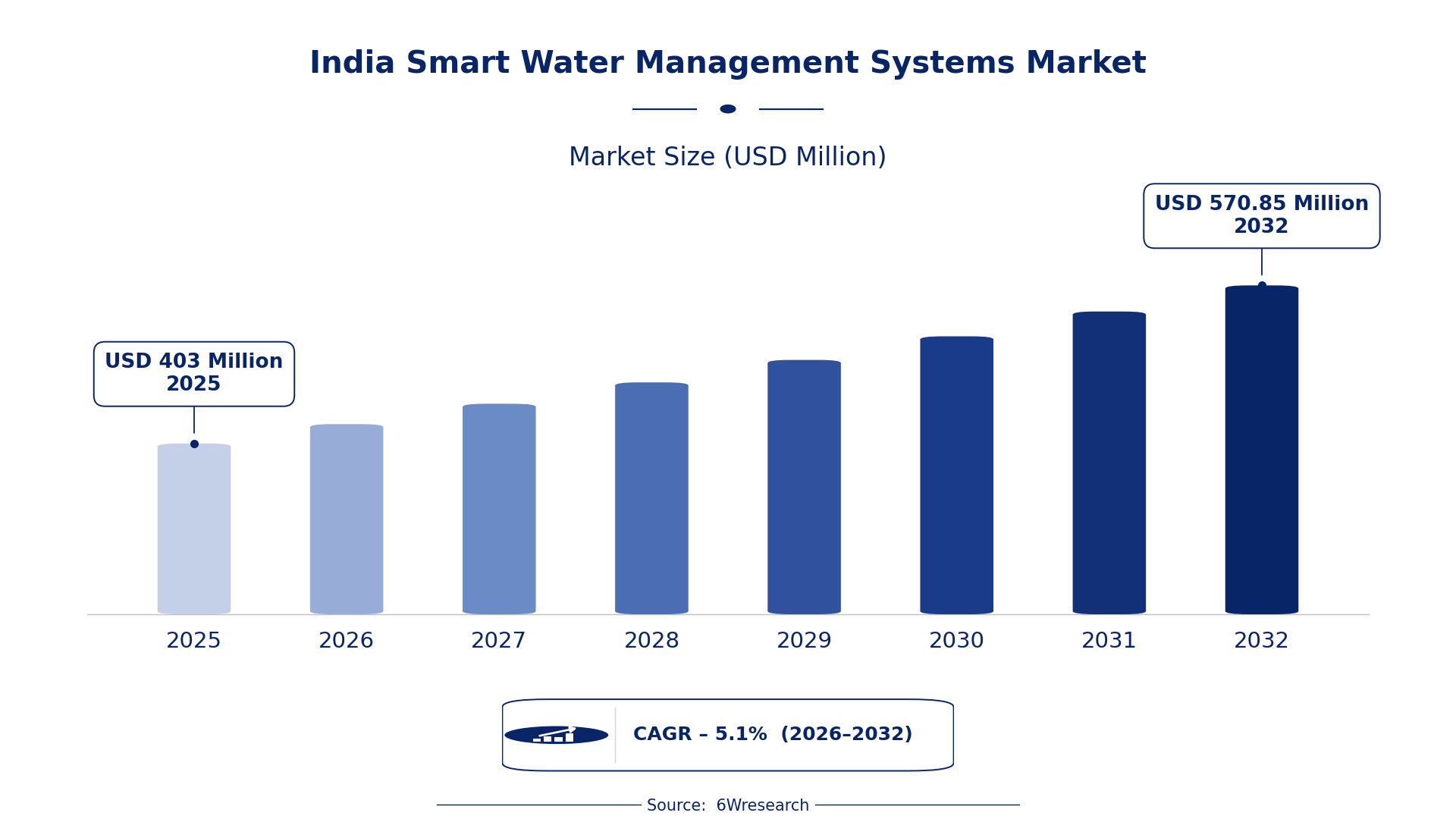
According to 6Wresearch internal database and industry insights, the India Smart Water Management Systems Market was valued at USD 403.0 million in 2025 and is projected to reach USD 570.85 million by 2032, growing at a CAGR of approximately 5.1% during 2026–2032.
India Smart Water Management Systems Market Highlights
| Report Metric | Details |
| Report Name | India Smart Water Management Systems Market |
| Market Size 2025 | USD 403.0 million |
| Market Size 2032 | USD 570.85 million |
| Absolute Growth 2025–2032 | USD 167.85 million |
| CAGR 2026–2032 | 5.1% |
| Peak Annual Growth | 7.6% in 2029 |
| Forecast Period | 2026–2032 |
| Historical Data | 2022–2025 |
| Base Year | 2025 |
| Leading System Type, 2025 | Smart Water Meters (36% share) |
| Leading Smart Feature, 2025 | Real-Time Alerts (48% share) |
| Leading Monitoring Tech, 2025 | IoT + App (41% share) |
| Leading End User, 2025 | City Utilities (51% share) |
| Fastest-Growing System Type | Leak Detection Systems (6.5% CAGR) |
| Fastest-Growing Smart Feature | Contaminant Analysis (7.4% CAGR) |
| Fastest-Growing Monitoring Tech | AI Chemical Sensing (7.3% CAGR) |
| Fastest-Growing End User | Water Boards (7.2% CAGR) |
| Growing Sector | Urban Water Management |
| Key End Users | City Utilities, Water Boards, Industrial Plants, Residential Areas |
India Smart Water Management Systems Market Year-wise Growth Rate and Key Drivers (2022–2032)
This graph illustrates the annual growth rates of the market from 2022 to 2032, highlighting a steady upward trajectory and projected market expansion over the forecast period.
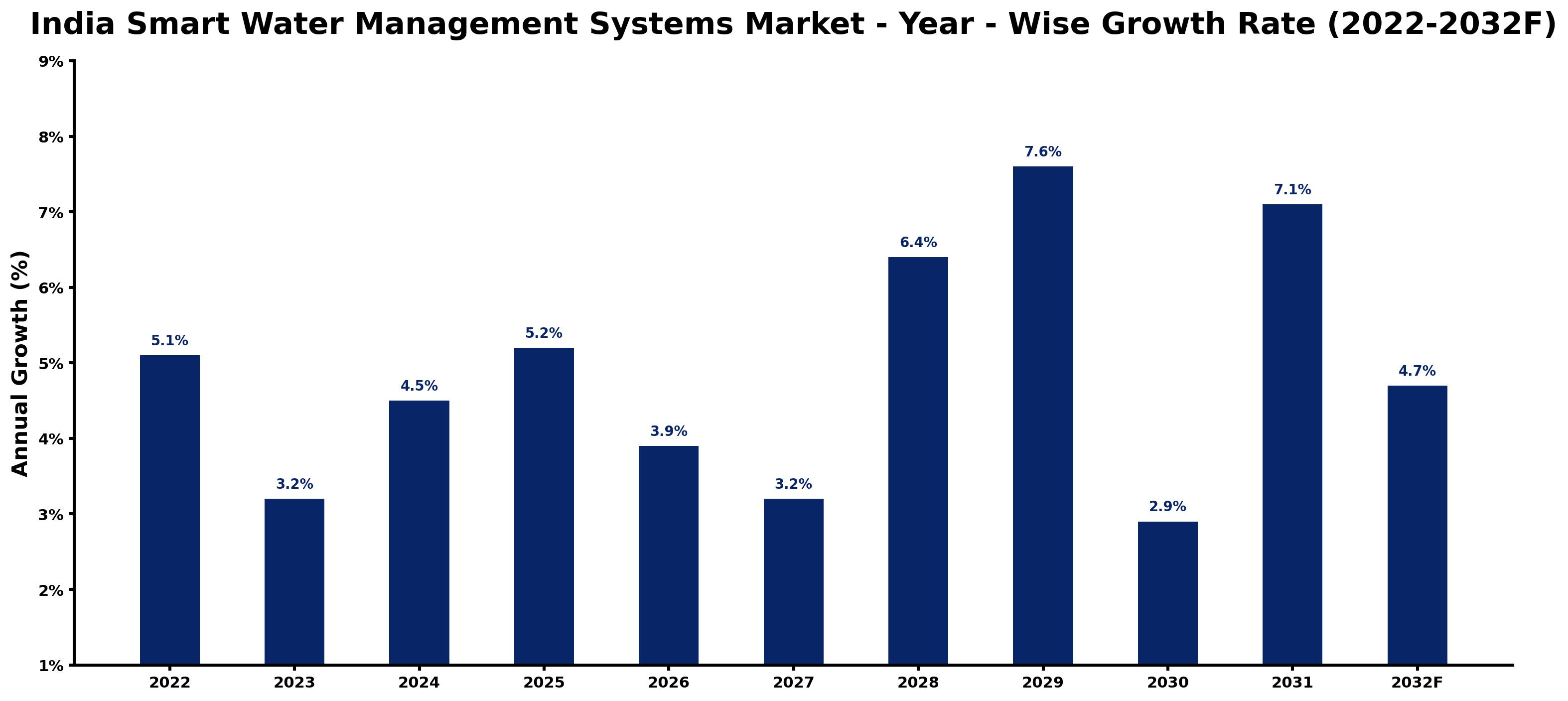
The following table presents the estimated annual growth rate for each year together with the principal factor influencing market performance.
| Year | Estimated Annual Growth (%) | Market Rationale |
| 2022 | 5.1 | The market experienced steady growth due to increasing urbanisation and water demand. |
| 2023 | 3.2 | Growth slowed as urban utilities faced challenges in implementing smart technologies. |
| 2024 | 4.5 | Demand rose as cities began adopting advanced monitoring systems for efficiency. |
| 2025 | 5.2 | Urban water management projects gained momentum, boosting market growth significantly. |
| 2026 | 3.9 | Growth slowed as some regions struggled with technology integration and funding. |
| 2027 | 3.2 | Continued investment in smart systems led to a further slowdown in growth. |
| 2028 | 6.4 | The market rebounded with heightened focus on leak detection and quality monitoring. |
| 2029 | 7.6 | A peak in demand occurred as cities accelerated smart water management initiatives. |
| 2030 | 2.9 | Growth slowed again as the market adjusted to new operational standards. |
| 2031 | 7.1 | Demand surged as urban areas prioritised efficient water distribution systems. |
| 2032 | 4.7 | Growth slowed as the market stabilised after rapid expansions in previous years. |
Note: Market size estimations and growth projections presented in this report are based on 6Wresearch's proprietary forecasting methodology, utilizing the latest available industry data, government publications, and primary research inputs.
India Smart Water Management Systems Market Synopsis
Smart Water Management Systems in India incorporate advanced technologies aimed at optimising water resource management. These systems employ IoT devices, sensors, and data analytics for functions such as leak detection and quality monitoring. The India Smart Water Management Systems Market is growing due to rising urbanisation and government initiatives like the Smart Cities Mission, which seeks to improve urban water management through technology. With India's urban population expected to reach 600 million by 2031, the demand for efficient water management solutions is set to increase substantially.
Market Dynamics Impact Analysis (2026–2032)
| Factor | Type | Impact | Primary Segment Affected |
| Increasing urban population necessitating efficient water management solutions. | Driver | High | City Utilities |
| Technological advancements in IoT and data analytics improving system capabilities. | Driver | High | Smart Water Meters |
| Growing investment in urban infrastructure projects enhancing water supply systems. | Opportunity | High | Distribution Management |
| Rising awareness among consumers about water conservation and efficiency. | Opportunity | Medium | Quality Monitoring Units |
| High initial investment costs for implementing smart water systems. | Restraint | High | Leak Detection Systems |
| Limited technical expertise in some urban local bodies hindering adoption. | Restraint | Medium | Real-Time Alerts |
| The Smart Water Management Systems market in India faces a few practical problems, including regulatory hurdles. | Challenge | High | Distribution Management |
| Competition from traditional water management methods may impede market growth. | Challenge | Medium | Smart Water Meters |
Evaluation of Drivers in India Smart Water Management Systems Market (2026–2032)
The table below links each growth driver to the segment it affects and the evidence for it.
| Drivers | Primary Segment Affected | Why It Matters (Evidence) |
| Growing urban population increasing water demand. | City Utilities | India's urban population is expected to reach 600 million by 2031, driving demand for efficient water management solutions. |
| Technological advancements in IoT and data analytics. | Smart Water Meters | Smart water meters can reduce water losses by up to 30% in urban areas, prompting utilities to invest in these technologies. |
| Government initiatives supporting smart water projects. | Distribution Management | The Smart Cities Mission includes funding for smart water management systems, improving urban infrastructure and service delivery. |
| Rising consumer awareness about water conservation. | Quality Monitoring Units | Increased focus on safe drinking water standards leads to higher demand for quality monitoring solutions, ensuring compliance. |
| Financial assistance for urban water supply projects. | Leak Detection Systems | The Indian government allocated ₹20,000 crore for urban water supply projects under AMRUT, stimulating investment in smart technologies. |
The urban population is projected to reach 600 million by 2031, driving demand for efficient water management solutions. Smart water meters can reduce water losses by up to 30% in urban areas, prompting utilities to invest in these technologies. The Smart Cities Mission provides funding for smart water management systems, improving urban infrastructure. Rising consumer awareness about water conservation is further propelling demand for quality monitoring units, ensuring safe drinking water standards are met.
Evaluation of Restraints in India Smart Water Management Systems Market
The table below lists the restraints and the evidence behind each.
| Market Restraint | Primary Segment Affected | Why It Matters (Evidence) |
| High initial investment costs for smart water systems. | Leak Detection Systems | The implementation of smart water systems requires substantial capital, which can deter utilities from investing in modern technologies. |
| Limited technical expertise in urban local bodies. | Real-Time Alerts | Some local bodies lack the necessary skills to implement and maintain smart water technologies effectively, hindering adoption. |
| Regulatory hurdles affecting project approvals. | Distribution Management | Complex approval processes can delay the deployment of smart water management systems, impacting timely implementation for local bodies. |
| Competition from traditional water management methods. | Smart Water Meters | Many utilities still rely on conventional systems, limiting the adoption of smarter solutions and delaying modernisation efforts. |
| Slow integration of technology into existing infrastructure. | Quality Monitoring Units | Legacy systems can hinder the adoption of new smart water management technologies, complicating upgrades. |
India Smart Water Management Systems Market Challenges
The India Smart Water Management Systems market encounters several practical issues, with supply chain inefficiencies being a primary concern. Many urban utilities grapple with outdated infrastructure, resulting in water losses of up to 30% in cities, which directly affects service delivery for millions. Regulatory hurdles complicate project execution; the absence of standardised guidelines can delay approvals, hindering timely implementation for over 4,000 local bodies. Competition among providers intensifies the challenge, as numerous firms vie for contracts, leading to price wars that can compromise service quality for buyers. High operational costs linked to advanced technologies discourage smaller utilities from adopting smart solutions, restricting their capacity to modernise water management practices.
Trends in the India Smart Water Management Systems Market
Four trends stand out in the India Smart Water Management Systems Market.
- Shift towards IoT-enabled Water Management Solutions: The Smart Cities Mission has led to increased adoption of IoT-enabled water management systems in urban areas. With over 4,000 urban local bodies requiring smart solutions, the trend supports efficiency and sustainability.
- Increased Focus on Water Quality Monitoring: In 2021, the National Water Quality Monitoring Programme was launched to ensure safe drinking water across India. This initiative has led to a rise in demand for quality monitoring units, with urban utilities prioritising safety.
- Growth of Real-Time Alerts Systems: The demand for Real-Time Alerts systems has surged as urban utilities seek immediate responses to water issues. These systems are essential for efficient water management, particularly in metropolitan areas like Delhi.
- Expansion of Leak Detection Technologies: The need for Leak Detection Systems has grown as urban areas face increasing water loss. Smart technologies in this segment are projected to grow at a CAGR of 6.5% from 2026 to 2032.
Investment Opportunities in the India Smart Water Management Systems Market
The following opportunities in the India Smart Water Management Systems Market pair current demand with a clear way in.
- Investment in Urban Water Supply Projects: The Indian government has allocated ₹20,000 crore for urban water supply projects under AMRUT, creating a valuable investment opportunity for suppliers of smart water management systems.
- Partnerships with City Utilities: City Utilities are actively seeking innovative solutions to improve water management. Collaborating with local partners can ease market entry and project implementation.
- Focus on Rural Water Supply Improvements: The Jal Jeevan Mission aims to provide functional tap water connections to every rural household by 2024, presenting opportunities for companies offering smart water solutions.
- Expansion in Metropolitan Areas: With metropolitan cities like Delhi and Mumbai prioritising smart water management, suppliers can target these regions to meet the growing demand for efficient systems.
Government Initiatives in the India Smart Water Management Systems Market
The National Water Policy 2022, introduced by the Ministry of Jal Shakti, aims to promote sustainable water management practices across India. This policy builds on the previous framework by emphasising technology adoption and efficient resource management. It encourages urban utilities to implement smart water management systems, ensuring improved service delivery and resource conservation. The policy also establishes guidelines for water quality monitoring, further supporting the development of smart technologies in the sector. The government aims for a 30% reduction in water losses through these initiatives by 2030.
The Jal Jeevan Mission, launched in 2019, aims to provide functional tap water connections to every rural household by 2024. The Ministry of Jal Shakti oversees this initiative, which enhances water access and encourages the adoption of smart water management solutions. Additionally, the Smart Cities Mission, initiated in 2015, includes funding for smart water management systems in selected cities, improving urban infrastructure and service delivery. The government has allocated ₹500 crore for this mission, facilitating the implementation of advanced technologies in urban areas.
Future Insight of the India Smart Water Management Systems Market
By 2032, the India Smart Water Management Systems market will experience substantial advancements driven by government initiatives and technological progress. The National Water Policy will continue to advocate for efficient practices, while the Smart Cities Mission will promote modern water management solutions. Urban utilities will increasingly adopt IoT-enabled systems, particularly in metropolitan areas, to optimise water distribution and reduce operational costs. The Central Water Commission's endorsement of modern technologies will further ease the transition to smarter water management approaches.
Market Segmentation Analysis
The analysis below covers each segmentation, its leading category in 2025 and its fastest-growing category through 2032.
By System Type – Smart Water Meters Dominated, Leak Detection Systems Expected to Grow Fastest
According to Dhaval Chaurasia, Assistant Manager at 6Wresearch, Smart Water Meters accounted for a 36% market share by system type in 2025. Smart Water Meters hold the largest market share due to their importance in providing accurate billing and tracking water consumption in urban areas. As India's urban population expands, the need for precise data on water usage becomes increasingly critical. Over 2026–2032, Leak Detection Systems are expected to post the fastest growth, at a CAGR of 6.5%. Leak Detection Systems are experiencing rapid growth because they are essential for identifying leaks and preventing significant water loss, which can be as high as 30% in urban environments. The increasing adoption of these systems by urban utilities is likely to further enhance their market share. Suppliers should focus on advancing leak detection technologies to cater to the growing needs of urban utilities.
By Smart Feature – Real-Time Alerts Dominated, Contaminant Analysis Expected to Grow Fastest
In 2025, Real-Time Alerts led the smart feature split with a 48% share. Real-Time Alerts command the largest market share as they are vital for prompt responses to water-related issues, ensuring efficient management of water resources. This feature is particularly crucial for urban utilities that must maintain service quality amid rising demand. The quickest growth will come from Contaminant Analysis, forecast to expand at a CAGR of 7.4% between 2026 and 2032. Contaminant Analysis is the fastest-growing segment, driven by its essential role in ensuring water safety, especially in metropolitan areas like Delhi and Mumbai. The rising public awareness regarding water quality is likely to increase the demand for such advanced analysis systems. Buyers should consider investing in contaminant analysis technologies to improve water safety and adhere to regulatory standards.
By Monitoring Tech – IoT + App Dominated, AI Chemical Sensing Expected to Grow Fastest
IoT + App held a 41% share of the India Smart Water Management Systems Market by monitoring tech in 2025. IoT + App solutions lead the market as they enable remote monitoring and management of water systems, essential for urban utilities. The integration of IoT technology supports efficient water management practices, aligning with national policies that promote smart solutions. AI Chemical Sensing is projected to grow fastest, at a CAGR of 7.3% during 2026–2032. AI Chemical Sensing is gaining traction for its ability to detect water contaminants, addressing a critical need for safe water supply. As urban populations increase, the demand for advanced monitoring technologies will continue to rise. Suppliers should prioritise developing AI-driven monitoring technologies to address the growing safety concerns in urban water management.
By End User – City Utilities Dominated, Water Boards Expected to Grow Fastest
City Utilities took a 51% share of end user in 2025, more than any other category. City Utilities account for the largest market share as they are the main users of smart water management systems, tasked with providing water services to vast populations. With over 4,000 urban local bodies in India, the demand for smart solutions is substantial and growing. Water Boards are set to record the highest CAGR in this split, 7.2% over 2026–2032. Water Boards are witnessing the fastest growth as they manage water quality and distribution, which is becoming increasingly important in urban settings. The heightened focus on improving water quality monitoring is propelling their adoption of advanced systems. Suppliers should tailor their offerings to meet the specific needs of Water Boards, enhancing their operational efficiency and water quality management.
Key Attractiveness of the Report
- 10 Years of Market Numbers
- Historical Data Starting from 2022 to 2025
- Base Year 2025
- Forecast Data until 2032
- Key Performance Indicators Impacting the Market
- Major Upcoming Developments and Projects
Key Highlights of the Report:
- India Smart Water Management Systems Market Outlook
- Market Size of India Smart Water Management Systems Market, 2025
- Forecast of India Smart Water Management Systems Market, 2032
- Historical Data and Forecast of India Smart Water Management Systems Revenues & Volume for the Period 2022 - 2032F
- India Smart Water Management Systems Market Trend Evolution
- India Smart Water Management Systems Market Drivers and Challenges
- India Smart Water Management Systems Price Trends
- India Smart Water Management Systems Porter's Five Forces
- India Smart Water Management Systems Industry Life Cycle
- Historical Data and Forecast of India Smart Water Management Systems Market Revenues & Volume By System Type for the Period 2022 - 2032F
- Historical Data and Forecast of India Smart Water Management Systems Market Revenues & Volume By Leak Detection Systems for the Period 2022 - 2032F
- Historical Data and Forecast of India Smart Water Management Systems Market Revenues & Volume By Smart Water Meters for the Period 2022 - 2032F
- Historical Data and Forecast of India Smart Water Management Systems Market Revenues & Volume By Distribution Management for the Period 2022 - 2032F
- Historical Data and Forecast of India Smart Water Management Systems Market Revenues & Volume By Quality Monitoring Units for the Period 2022 - 2032F
- Historical Data and Forecast of India Smart Water Management Systems Market Revenues & Volume By Smart Feature for the Period 2022 - 2032F
- Historical Data and Forecast of India Smart Water Management Systems Market Revenues & Volume By Real-Time Alerts for the Period 2022 - 2032F
- Historical Data and Forecast of India Smart Water Management Systems Market Revenues & Volume By Usage & Billing Insights for the Period 2022 - 2032F
- Historical Data and Forecast of India Smart Water Management Systems Market Revenues & Volume By Pressure Regulation for the Period 2022 - 2032F
- Historical Data and Forecast of India Smart Water Management Systems Market Revenues & Volume By Contaminant Analysis for the Period 2022 - 2032F
- Historical Data and Forecast of India Smart Water Management Systems Market Revenues & Volume By Monitoring Tech for the Period 2022 - 2032F
- Historical Data and Forecast of India Smart Water Management Systems Market Revenues & Volume By Pressure + Flow Sensors for the Period 2022 - 2032F
- Historical Data and Forecast of India Smart Water Management Systems Market Revenues & Volume By IoT + App for the Period 2022 - 2032F
- Historical Data and Forecast of India Smart Water Management Systems Market Revenues & Volume By Cloud + Edge Sync for the Period 2022 - 2032F
- Historical Data and Forecast of India Smart Water Management Systems Market Revenues & Volume By AI Chemical Sensing for the Period 2022 - 2032F
- Historical Data and Forecast of India Smart Water Management Systems Market Revenues & Volume By End User for the Period 2022 - 2032F
- Historical Data and Forecast of India Smart Water Management Systems Market Revenues & Volume By City Utilities for the Period 2022 - 2032F
- Historical Data and Forecast of India Smart Water Management Systems Market Revenues & Volume By Residential Areas for the Period 2022 - 2032F
- Historical Data and Forecast of India Smart Water Management Systems Market Revenues & Volume By Water Boards for the Period 2022 - 2032F
- Historical Data and Forecast of India Smart Water Management Systems Market Revenues & Volume By Industrial Plants for the Period 2022 - 2032F
- India Smart Water Management Systems Import Export Trade Statistics
- Market Opportunity Assessment By System Type
- Market Opportunity Assessment By Smart Feature
- Market Opportunity Assessment By Monitoring Tech
- Market Opportunity Assessment By End User
- India Smart Water Management Systems Top Companies Market Share
- India Smart Water Management Systems Competitive Benchmarking By Technical and Operational Parameters
- India Smart Water Management Systems Company Profiles
- India Smart Water Management Systems Key Strategic Recommendations
Market Covered
The report offers an extensive study of the following market segments.
By System Type
- Leak Detection Systems
- Smart Water Meters
- Distribution Management
- Quality Monitoring Units
By Smart Feature
- Real-Time Alerts
- Usage & Billing Insights
- Pressure Regulation
- Contaminant Analysis
By Monitoring Tech
- Pressure + Flow Sensors
- IoT + App
- Cloud + Edge Sync
- AI Chemical Sensing
By End User
- City Utilities
- Residential Areas
- Water Boards
- Industrial Plants































