China Smart Water Management Systems Market Size & Growth Rate
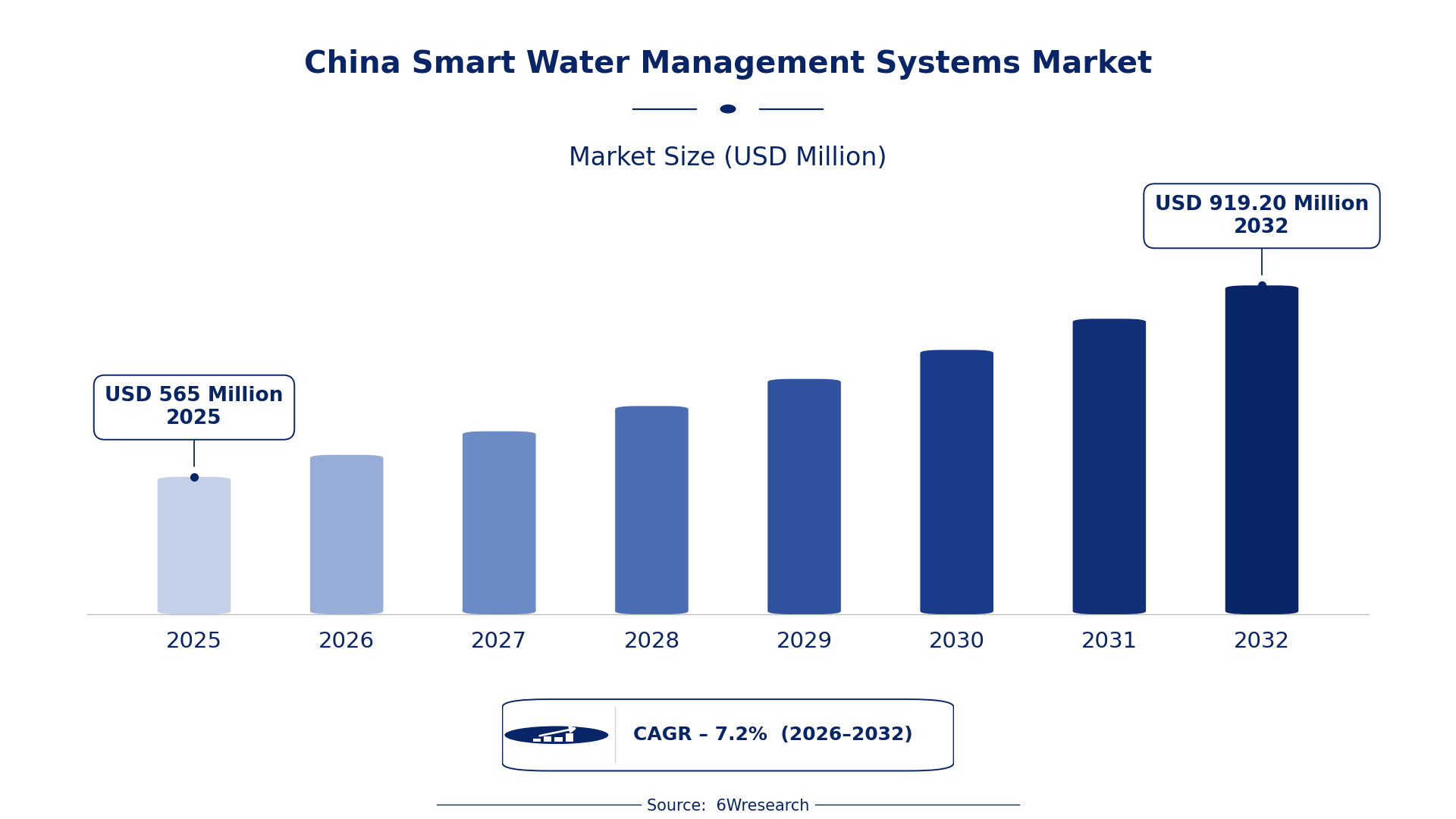
According to 6Wresearch internal database and industry insights, the China Smart Water Management Systems Market was valued at USD 565.0 million in 2025 and is projected to reach USD 919.20 million by 2032, growing at a CAGR of approximately 7.2% during 2026–2032.
China Smart Water Management Systems Market Highlights
| Report Metric | Details |
| Report Name | China Smart Water Management Systems Market |
| Market Size 2025 | USD 565.0 million |
| Market Size 2032 | USD 919.20 million |
| Absolute Growth 2025–2032 | USD 354.20 million |
| CAGR 2026–2032 | 7.2% |
| Peak Annual Growth | 9.6% in 2027 |
| Forecast Period | 2026–2032 |
| Historical Data | 2022–2025 |
| Base Year | 2025 |
| Leading System Type, 2025 | Smart Water Meters (48% share) |
| Leading Smart Feature, 2025 | Real-Time Alerts (42% share) |
| Leading Monitoring Tech, 2025 | IoT + App (43% share) |
| Leading End User, 2025 | City Utilities (40% share) |
| Fastest-Growing System Type | Quality Monitoring Units (9.2% CAGR) |
| Fastest-Growing Smart Feature | Contaminant Analysis (9.5% CAGR) |
| Fastest-Growing Monitoring Tech | AI Chemical Sensing (8.6% CAGR) |
| Fastest-Growing End User | Industrial Plants (9.1% CAGR) |
| Growing Sector | Industrial Plants |
| Key End Users | City Utilities, Water Boards, Industrial Plants, Residential Areas |
China Smart Water Management Systems Market Year-wise Growth Rate and Key Drivers (2022–2032)
This graph illustrates the annual growth rates of the market from 2022 to 2032, highlighting a steady upward trajectory and projected market expansion over the forecast period.
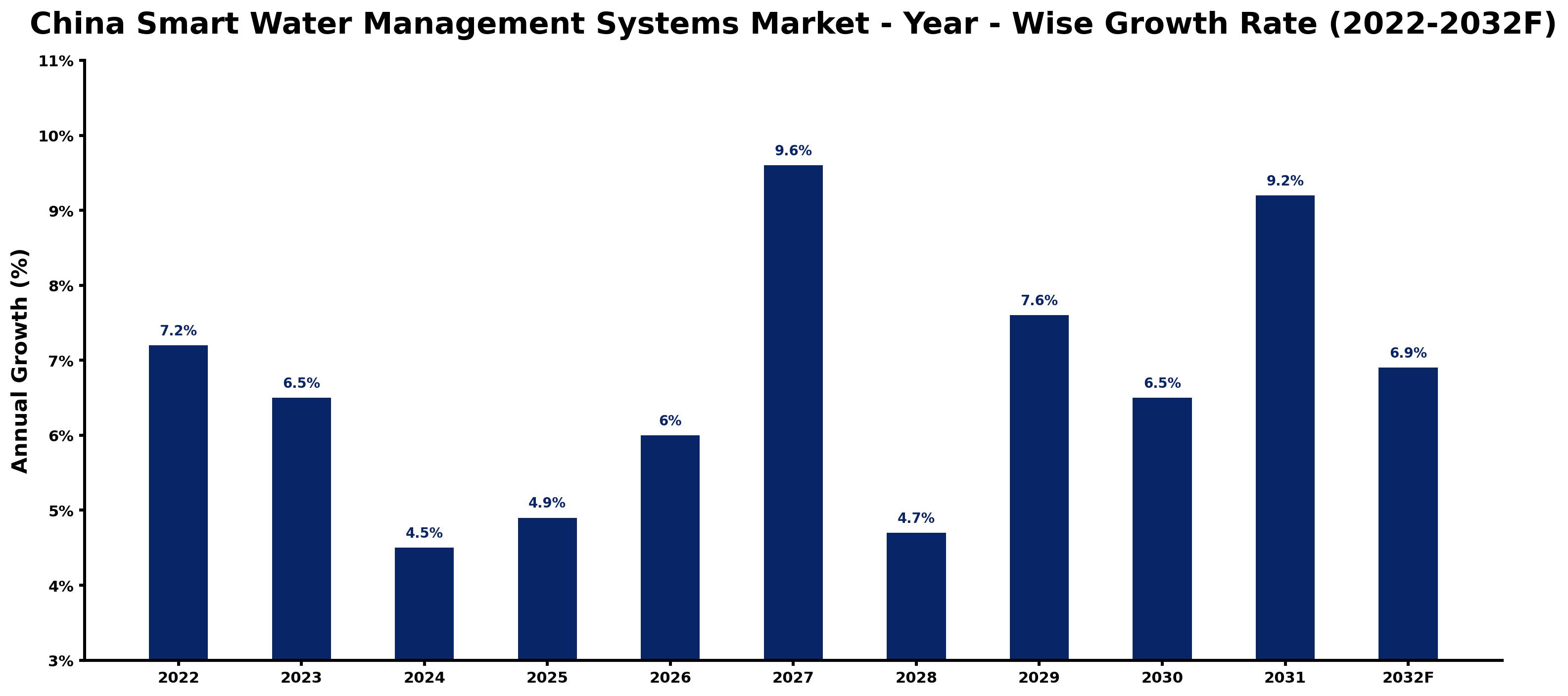
Annual growth estimates for each year appear below with the principal reason behind them, explaining the shifts that set the pace of the market.
| Year | Estimated Annual Growth (%) | Market Rationale |
| 2022 | 7.2 | The market saw strong adoption of smart water management systems driven by urbanisation. |
| 2023 | 6.5 | Demand growth slowed as the market adjusted to the previous year's rapid expansion. |
| 2024 | 4.5 | Continued investment in infrastructure led to further market growth, albeit at a slower pace. |
| 2025 | 4.9 | A resurgence in demand for efficient water systems accelerated growth as urbanisation continued. |
| 2026 | 6.0 | Increased government support for smart technologies is expected to spur further growth in the market. |
| 2027 | 9.6 | The peak growth rate is projected to be driven by heightened investments in smart water management technologies. |
| 2028 | 4.7 | Growth is expected to slow as the market begins to stabilise after the peak in 2027. |
| 2029 | 7.6 | A renewed focus on sustainability and efficiency will lead to a rebound in market growth. |
| 2030 | 6.5 | Growth is projected to slow again as the market adjusts to previous surges in demand. |
| 2031 | 9.2 | Investment in smart water systems is expected to increase, driving a faster growth rate than the previous year. |
| 2032 | 6.9 | The market growth rate is projected to slow as it approaches maturity, but demand will remain strong. |
Note: Market size estimations and growth projections presented in this report are based on 6Wresearch's proprietary forecasting methodology, utilizing the latest available industry data, government publications, and primary research inputs.
China Smart Water Management Systems Market Synopsis
Smart Water Management Systems in China optimise water distribution and improve quality monitoring through advanced technologies. These systems integrate IoT devices, sensors, and data analytics for functions like leak detection and consumption monitoring. The China Smart Water Management Systems Market is expanding due to rising urbanisation, with a population in urban areas reaching 900 million in 2022. Government initiatives, such as the 14th Five-Year Plan, emphasise sustainable water management, driving demand further. With over 1,000 city utilities implementing these systems, the market is set for continued growth.
Market Dynamics Impact Analysis (2026–2032)
| Factor | Type | Impact | Primary Segment Affected |
| Government initiatives promoting smart water technologies | Driver | High | Smart Water Meters |
| Urban population growth increasing demand for efficient water systems | Driver | High | Leak Detection Systems |
| Investment in smart water management technologies by industrial plants | Opportunity | High | Industrial Plants |
| Growing focus on sustainability in urban water management | Opportunity | High | City Utilities |
| High initial investment costs for smart water systems | Restraint | Medium | Quality Monitoring Units |
| Limited awareness about smart water management benefits among consumers | Restraint | Medium | Usage & Billing Insights |
| The Smart Water Management Systems market in China faces a few practical problems, including regulatory compliance challenges. | Challenge | High | Distribution Management |
| Inadequate infrastructure in some regions hampers system implementation. | Challenge | High | Pressure Regulation |
Evaluation of Drivers in China Smart Water Management Systems Market (2026–2032)
The factors lifting demand, and the evidence behind each, are summarised below.
| Drivers | Primary Segment Affected | Why It Matters (Evidence) |
| Government support for smart water management initiatives | Smart Water Meters | The National Development and Reform Commission's promotion of smart water management initiatives has led to increased adoption since 2021, with smart meters covering over 70% of households in urban areas. |
| Urbanisation driving demand for efficient water systems | Leak Detection Systems | The urban population in China reached 900 million in 2022, increasing the need for effective water management solutions and leak detection systems to minimise losses. |
| Investment by industrial plants in smart technologies | Industrial Plants | Over 60% of industrial plants in China are investing in smart water management technologies by 2025, improving operational efficiency and reducing water wastage. |
| Focus on sustainability in urban areas | City Utilities | The 14th Five-Year Plan emphasises water conservation, prompting city utilities to adopt advanced water management systems to meet sustainability targets. |
| Technological advancements in monitoring and management | Quality Monitoring Units | The introduction of IoT and AI technologies is improving the efficiency of water quality monitoring systems, enhancing compliance with new standards. |
The urban population reached 900 million in 2022, necessitating efficient water management systems to reduce waste. More than 60% of industrial plants are investing in smart technologies by 2025, which will improve operational efficiency. The 14th Five-Year Plan emphasises sustainability, encouraging city utilities to implement advanced water solutions.
Evaluation of Restraints in China Smart Water Management Systems Market
The key brakes on demand, and where they bite hardest, are shown below.
| Market Restraint | Primary Segment Affected | Why It Matters (Evidence) |
| High initial costs for system implementation | Smart Water Meters | Urban utilities often struggle to secure funding for advanced technologies, delaying the adoption of efficient water management solutions. |
| Fluctuating regulatory standards | Quality Monitoring Units | Suppliers encounter challenges from fluctuating regulatory standards, leading to increased compliance costs and project delays for utilities. |
| Competition among local manufacturers | Leak Detection Systems | Intensifying competition among local manufacturers results in price wars that can erode profit margins for producers. |
| Limited awareness of smart technologies | Distribution Management | Many city utilities lack awareness of the benefits of smart technologies, hindering their adoption and implementation. |
| Inadequate infrastructure for smart systems | Real-Time Alerts | Existing infrastructure in some regions is not compatible with advanced smart water management systems, limiting their effectiveness. |
China Smart Water Management Systems Market Challenges
The China Smart Water Management Systems market faces a few practical problems, beginning with buyers facing high initial costs for system implementation. Urban utilities often struggle to secure funding, which can delay the adoption of efficient water management solutions by up to 18 months. Suppliers encounter challenges from fluctuating regulatory standards, resulting in increased compliance costs that can add 15% to project budgets for utilities. Competition among local manufacturers intensifies as they strive to innovate, leading to price wars that can erode profit margins by as much as 20% for producers.
Trends in the China Smart Water Management Systems Market
Four trends stand out in the China Smart Water Management Systems Market.
- Increased Adoption of Quality Monitoring Units: Quality monitoring units are gaining traction as the Ministry of Ecology and Environment sets higher standards for water quality in urban areas, with a target of 30% reduction in water wastage by 2025.
- Rise of Real-Time Monitoring Systems: Real-time monitoring systems are becoming essential in urban areas, with the Yangtze River Delta region leading investments in smart water technologies, reflecting a shift towards proactive water management.
- Focus on Sustainable Water Practices: City utilities are prioritising sustainability, driven by the National Water Conservation Action Plan, which aims for improved water efficiency across urban areas, targeting a 30% reduction in wastage by 2025.
- Shift towards IoT Integration in Water Management: In 2023, over 70% of households in Beijing and Shanghai adopted smart water meters, showcasing a shift towards IoT integration in urban water management.
Investment Opportunities in the China Smart Water Management Systems Market
Below are the investment opportunities with the strongest case in the China Smart Water Management Systems Market.
- Investment in Quality Monitoring Technologies: The 14th Five-Year Plan's emphasis on water quality presents an opportunity to invest in advanced quality monitoring technologies, particularly in regions with stringent regulations and a target of 30% reduction in water wastage.
- Expansion in Industrial Water Management: As over 60% of industrial plants are expected to invest in smart technologies by 2025, suppliers can target this segment to provide efficient water management solutions, enhancing operational efficiency.
- Implementation of IoT Solutions: The introduction of IoT solutions in urban water management systems offers a chance for technology providers to collaborate with city utilities to enhance efficiency and compliance with new standards.
- Growing Demand for Smart Water Meters: With over 1,000 city utilities implementing smart water management systems, there is a significant opportunity to supply smart water meters, especially in urban areas where efficiency is critical.
Government Initiatives in the China Smart Water Management Systems Market
The National Water Conservation Action Plan, initiated in 2022, aims to improve water efficiency in urban areas by focusing on smart meter installations and advanced technologies. This plan is overseen by the National Development and Reform Commission, which targets a 30% reduction in water wastage by 2025. The Ministry of Ecology and Environment also plays a significant role in setting standards for water quality monitoring, ensuring compliance with these new technologies, which directly impacts smart water management systems and their buyers.
In 2021, the Ministry of Ecology and Environment launched the 'Smart Water Quality Monitoring Program' with a budget allocation of 300 million RMB for technology upgrades. This program aims to improve water safety across urban areas. Additionally, the 'Water Pollution Prevention and Control Action Plan' updated in 2023 focuses on integrating smart technologies in monitoring water quality across major cities. The Ministry of Housing and Urban-Rural Development introduced guidelines in 2023 to promote IoT solutions in urban water management systems, facilitating enhanced efficiency and compliance.
Future Insight of the China Smart Water Management Systems Market
Several forward-looking factors should support the China Smart Water Management Systems market over the coming years. The government’s 14th Five-Year Plan prioritises water conservation technologies, driving investment in advanced infrastructure. By 2025, over 60% of industrial plants are expected to invest in smart water management technologies, prompting a shift towards more efficient practices. The allocation of 500 million RMB for smart water projects in 2023 will catalyse development, while the adoption of ISO 24512:2007 guidelines will enhance water quality monitoring across urban areas.
Market Segmentation Analysis
The report offers a comprehensive study of the following market segments and their leading categories in the market.
By System Type – Smart Water Meters Dominated, Quality Monitoring Units Expected to Grow Fastest
According to Dhaval Chaurasia, Assistant Manager at 6Wresearch, Smart Water Meters accounted for a 48% market share by system type in 2025. Smart Water Meters hold the largest market share due to their critical role in accurate billing and consumption tracking within urban environments. Their widespread adoption in cities like Beijing and Shanghai, where over 70% of households use them, showcases their importance in effective water management. Quality Monitoring Units are set to record the highest CAGR in this split, 9.2% over 2026–2032. Quality Monitoring Units are experiencing rapid growth, driven by increasing concerns over safe drinking water standards. The regulatory push from the Ministry of Ecology and Environment is leading to heightened investments in these essential systems, solidifying their role in urban water management. This means suppliers should enhance the features of Quality Monitoring Units to meet regulatory demands and consumer needs.
By Smart Feature – Real-Time Alerts Dominated, Contaminant Analysis Expected to Grow Fastest
Real-Time Alerts took a 42% share of smart feature in 2025, more than any other category. Real-Time Alerts dominate the market share as they are vital for immediate response to water quality issues, ensuring public safety. Their integration into smart water systems has become standard practice among city utilities, reflecting their critical role in water management. The quickest growth will come from Contaminant Analysis, forecast to expand at a CAGR of 9.5% between 2026 and 2032. Contaminant Analysis is growing swiftly as public health concerns drive demand for advanced monitoring solutions. The emphasis on safe drinking water has led to increased investments in technologies that can detect harmful substances effectively. Buyers will benefit from suppliers offering advanced contaminant analysis features that align with health and safety regulations.
By Monitoring Tech – IoT + App Dominated, AI Chemical Sensing Expected to Grow Fastest
IoT + App held a 43% share of the China Smart Water Management Systems Market by monitoring tech in 2025. IoT + App technology commands the largest market share as it allows for efficient remote management and monitoring of water systems, essential for urban utilities. This technology supports real-time data collection, significantly boosting operational efficiency across various urban areas. AI Chemical Sensing is projected to grow fastest, at a CAGR of 8.6% during 2026–2032. AI Chemical Sensing is witnessing the fastest growth due to its advanced capabilities in detecting harmful substances in water. As urban populations grow and concerns about water quality intensify, the demand for this technology is anticipated to surge. Suppliers should focus on advancing AI Chemical Sensing technologies to effectively meet the increasing market demand.
By End User – City Utilities Dominated, Industrial Plants Expected to Grow Fastest
In 2025, City Utilities led the end user split with a 40% share. City Utilities represent the largest market share as they are the main users of smart water systems, tasked with managing urban water distribution. The implementation of these systems by over 1,000 city utilities highlights their crucial role in the market. Over 2026–2032, Industrial Plants are expected to post the fastest growth, at a CAGR of 9.1%. Industrial Plants are the fastest-growing segment, as they increasingly seek efficient water usage and monitoring solutions to comply with environmental regulations. Their projected investments in smart water technologies are expected to rise significantly by 2025. This indicates that suppliers must customise solutions specifically for industrial plants to leverage this growing demand.
Key Attractiveness of the Report
- 10 Years of Market Numbers
- Historical Data Starting from 2022 to 2025
- Base Year 2025
- Forecast Data until 2032
- Key Performance Indicators Impacting the Market
- Major Upcoming Developments and Projects
Key Highlights of the Report:
- China Smart Water Management Systems Market Outlook
- Market Size of China Smart Water Management Systems Market, 2025
- Forecast of China Smart Water Management Systems Market, 2032
- Historical Data and Forecast of China Smart Water Management Systems Revenues & Volume for the Period 2022 - 2032F
- China Smart Water Management Systems Market Trend Evolution
- China Smart Water Management Systems Market Drivers and Challenges
- China Smart Water Management Systems Price Trends
- China Smart Water Management Systems Porter's Five Forces
- China Smart Water Management Systems Industry Life Cycle
- Historical Data and Forecast of China Smart Water Management Systems Market Revenues & Volume By System Type for the Period 2022 - 2032F
- Historical Data and Forecast of China Smart Water Management Systems Market Revenues & Volume By Leak Detection Systems for the Period 2022 - 2032F
- Historical Data and Forecast of China Smart Water Management Systems Market Revenues & Volume By Smart Water Meters for the Period 2022 - 2032F
- Historical Data and Forecast of China Smart Water Management Systems Market Revenues & Volume By Distribution Management for the Period 2022 - 2032F
- Historical Data and Forecast of China Smart Water Management Systems Market Revenues & Volume By Quality Monitoring Units for the Period 2022 - 2032F
- Historical Data and Forecast of China Smart Water Management Systems Market Revenues & Volume By Smart Feature for the Period 2022 - 2032F
- Historical Data and Forecast of China Smart Water Management Systems Market Revenues & Volume By Real-Time Alerts for the Period 2022 - 2032F
- Historical Data and Forecast of China Smart Water Management Systems Market Revenues & Volume By Usage & Billing Insights for the Period 2022 - 2032F
- Historical Data and Forecast of China Smart Water Management Systems Market Revenues & Volume By Pressure Regulation for the Period 2022 - 2032F
- Historical Data and Forecast of China Smart Water Management Systems Market Revenues & Volume By Contaminant Analysis for the Period 2022 - 2032F
- Historical Data and Forecast of China Smart Water Management Systems Market Revenues & Volume By Monitoring Tech for the Period 2022 - 2032F
- Historical Data and Forecast of China Smart Water Management Systems Market Revenues & Volume By Pressure + Flow Sensors for the Period 2022 - 2032F
- Historical Data and Forecast of China Smart Water Management Systems Market Revenues & Volume By IoT + App for the Period 2022 - 2032F
- Historical Data and Forecast of China Smart Water Management Systems Market Revenues & Volume By Cloud + Edge Sync for the Period 2022 - 2032F
- Historical Data and Forecast of China Smart Water Management Systems Market Revenues & Volume By AI Chemical Sensing for the Period 2022 - 2032F
- Historical Data and Forecast of China Smart Water Management Systems Market Revenues & Volume By End User for the Period 2022 - 2032F
- Historical Data and Forecast of China Smart Water Management Systems Market Revenues & Volume By City Utilities for the Period 2022 - 2032F
- Historical Data and Forecast of China Smart Water Management Systems Market Revenues & Volume By Residential Areas for the Period 2022 - 2032F
- Historical Data and Forecast of China Smart Water Management Systems Market Revenues & Volume By Water Boards for the Period 2022 - 2032F
- Historical Data and Forecast of China Smart Water Management Systems Market Revenues & Volume By Industrial Plants for the Period 2022 - 2032F
- China Smart Water Management Systems Import Export Trade Statistics
- Market Opportunity Assessment By System Type
- Market Opportunity Assessment By Smart Feature
- Market Opportunity Assessment By Monitoring Tech
- Market Opportunity Assessment By End User
- China Smart Water Management Systems Top Companies Market Share
- China Smart Water Management Systems Competitive Benchmarking By Technical and Operational Parameters
- China Smart Water Management Systems Company Profiles
- China Smart Water Management Systems Key Strategic Recommendations
Market Covered
This report examines the market across the segments below.
By System Type
- Leak Detection Systems
- Smart Water Meters
- Distribution Management
- Quality Monitoring Units
By Smart Feature
- Real-Time Alerts
- Usage & Billing Insights
- Pressure Regulation
- Contaminant Analysis
By Monitoring Tech
- Pressure + Flow Sensors
- IoT + App
- Cloud + Edge Sync
- AI Chemical Sensing
By End User
- City Utilities
- Residential Areas
- Water Boards
- Industrial Plants































