India Smart Water Purification Devices Market Size & Growth Rate
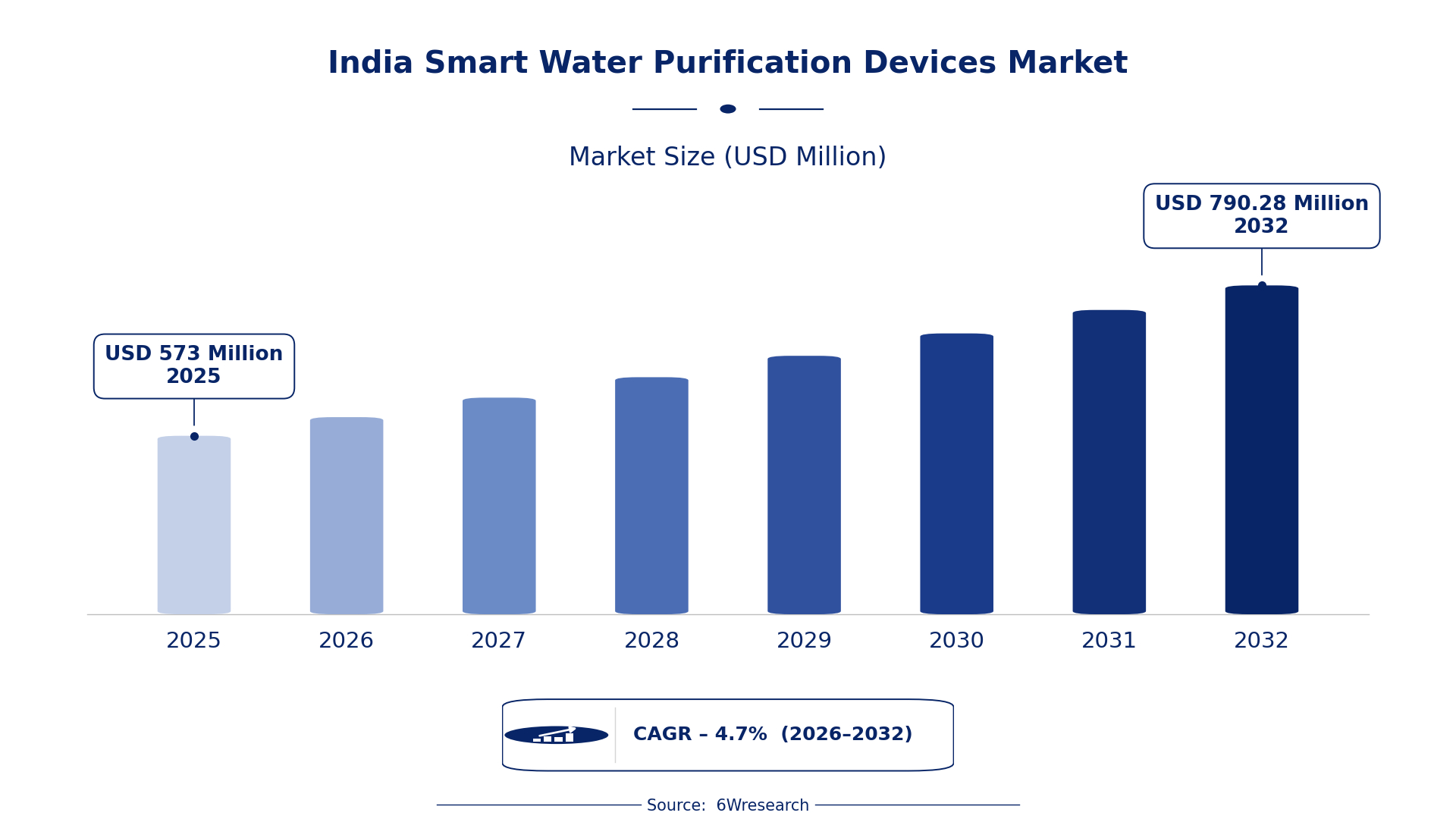
According to 6Wresearch internal database and industry insights, the India Smart Water Purification Devices Market was valued at USD 573.0 million in 2025 and is projected to reach USD 790.28 million by 2032, growing at a CAGR of approximately 4.7% during 2026–2032.
India Smart Water Purification Devices Market Highlights
| Report Metric | Details |
| Report Name | India Smart Water Purification Devices Market |
| Market Size 2025 | USD 573.0 million |
| Market Size 2032 | USD 790.28 million |
| Absolute Growth 2025–2032 | USD 217.28 million |
| CAGR 2026–2032 | 4.7% |
| Peak Annual Growth | 6.2% in 2026 |
| Forecast Period | 2026–2032 |
| Historical Data | 2022–2025 |
| Base Year | 2025 |
| Leading Purifier Type, 2025 | RO + UV Systems (38% share) |
| Leading Smart Feature, 2025 | Filter Life Alerts (44% share) |
| Leading Detection Mechanism, 2025 | TDS/UV Sensors (43% share) |
| Leading End User, 2025 | Households (35% share) |
| Fastest-Growing Purifier Type | AI-Based Purifiers (6.7% CAGR) |
| Fastest-Growing Detection Mechanism | ML + Real-Time Sensing (6.7% CAGR) |
| Fastest-Growing End User | Offices (7.1% CAGR) |
| Growing Sector | Household Water Purification |
| Key End Users | Households, Offices, Rural/Urban Kiosks |
India Smart Water Purification Devices Market Year-wise Growth Rate and Key Drivers (2022–2032)
This graph illustrates the annual growth rates of the market from 2022 to 2032, highlighting a steady upward trajectory and projected market expansion over the forecast period.
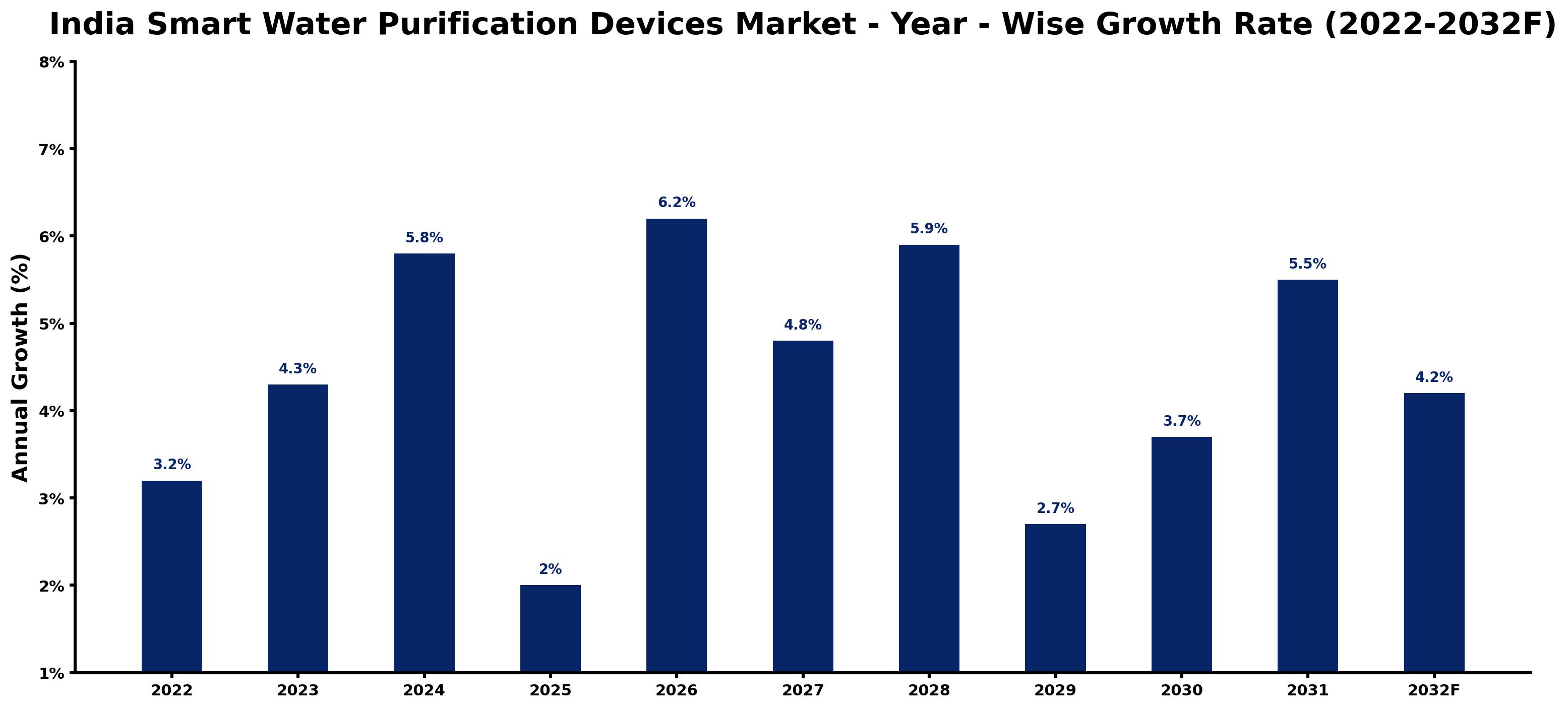
Annual growth estimates for each year appear below with the principal reason behind them, explaining the shifts that set the pace of the market.
| Year | Estimated Annual Growth (%) | Market Rationale |
| 2022 | 3.2 | The market experienced steady growth due to rising health awareness among consumers. |
| 2023 | 4.3 | Increased urbanisation led to faster adoption of water purification devices in households. |
| 2024 | 5.8 | The launch of the Jal Jeevan Mission boosted demand for safe drinking water solutions. |
| 2025 | 2.0 | Growth slowed as market adjustments occurred following rapid expansions in previous years. |
| 2026 | 6.2 | The introduction of advanced AI-based purifiers spurred renewed interest and investment. |
| 2027 | 4.8 | Demand continued to rise, though at a slower pace due to market saturation. |
| 2028 | 5.9 | Urban households increasingly opted for smart water purification technologies, enhancing growth. |
| 2029 | 2.7 | Growth slowed again as the market began to stabilise after previous peaks. |
| 2030 | 3.7 | Renewed focus on public health initiatives led to increased spending on purification devices. |
| 2031 | 5.5 | Consumer demand rose as awareness of water quality issues continued to grow. |
| 2032 | 4.2 | Growth slowed slightly as the market matured, but demand for innovation remains high. |
Note: Market size estimations and growth projections presented in this report are based on 6Wresearch's proprietary forecasting methodology, utilizing the latest available industry data, government publications, and primary research inputs.
India Smart Water Purification Devices Market Synopsis
Smart Water Purification Devices Market in India includes advanced systems that filter and purify drinking water using technologies such as reverse osmosis and ultraviolet light. These devices play a crucial role in household water purification, office supply, and public access points. The market is expanding due to a population exceeding 1.4 billion, with over 50% of urban households employing purification solutions. Initiatives like the Jal Jeevan Mission aim to ensure safe drinking water for all by 2024, further stimulating demand. This combination of elements promises a strong market outlook.
Market Dynamics Impact Analysis (2026–2032)
| Factor | Type | Impact | Primary Segment Affected |
| Rising health awareness and urbanisation drive demand for water purification solutions. | Driver | High | RO + UV Systems |
| The increasing installation of public water ATMs enhances access to clean water. | Driver | High | Public Water ATMs |
| The gap in affordable clean water solutions creates opportunities for new entrants. | Opportunity | High | Public Water ATMs |
| Growing demand for smart home integration opens avenues for AI-based purifiers. | Opportunity | High | AI-Based Purifiers |
| High costs of advanced purification technologies limit market penetration. | Restraint | High | AI-Based Purifiers |
| Consumer hesitance towards new technologies can slow adoption rates. | Restraint | Medium | App-Connected Filters |
| Limited infrastructure in rural areas hampers distribution of purification devices. | Challenge | High | Public Water ATMs |
| Regulatory compliance and certification can delay product launches. | Challenge | Medium | RO + UV Systems |
Evaluation of Drivers in India Smart Water Purification Devices Market (2026–2032)
Key forces behind demand, with the segment each one moves most, are listed below.
| Drivers | Primary Segment Affected | Why It Matters (Evidence) |
| Increased urbanisation leads to higher demand for water purification devices. | Households | Over 50% of urban households now use water purification devices, driving market growth. |
| The Jal Jeevan Mission aims to provide safe drinking water to rural households. | Public Water ATMs | This initiative has led to the installation of public water ATMs in over 100 cities. |
| Rising health awareness prompts consumers to invest in water purification solutions. | AI-Based Purifiers | The average urban household spends around 10% of its income on these solutions. |
| Technological advancements in purification systems attract consumer interest. | RO + UV Systems | Smart water purifiers equipped with IoT technology are becoming increasingly popular. |
| Government initiatives promote the installation of smart purification systems. | RO + UV Systems | The Smart Cities Mission encourages urban areas to adopt advanced water purification technologies. |
More than half of urban households now use some form of water purification device, reflecting a shift in consumer behaviour. The Jal Jeevan Mission aims to provide safe drinking water to every rural household by 2024, further driving demand. Urban households allocate approximately 10% of their income to these solutions, indicating a strong commitment to health and safety. Technological advancements, such as IoT-enabled smart purifiers, are also attracting user interest and convenience.
Evaluation of Restraints in India Smart Water Purification Devices Market
The following restraints limit how fast demand can grow.
| Market Restraint | Primary Segment Affected | Why It Matters (Evidence) |
| High costs of advanced purification technologies limit market penetration. | AI-Based Purifiers | These technologies can be prohibitively expensive for many consumers, slowing adoption. |
| Consumer hesitance towards new technologies can slow adoption rates. | App-Connected Filters | Many consumers prefer traditional systems, impacting the growth of smart features. |
| Limited infrastructure in rural areas hampers distribution of purification devices. | Public Water ATMs | This lack of infrastructure restricts access to clean water in remote regions. |
| Regulatory compliance and certification can delay product launches. | RO + UV Systems | Manufacturers face challenges in meeting stringent safety standards, affecting time-to-market. |
| Market saturation in urban areas can limit growth potential. | Households | As more households adopt purification devices, the growth rate may slow. |
India Smart Water Purification Devices Market Challenges
The India Smart Water Purification Devices Market still has to solve a few problems, and the first is skills shortages. A lack of trained technicians hampers installation and maintenance, leading to service delays for buyers and increased downtime. Many buyers face high costs, as over 50% of urban households spend around 10% of their income on water purification solutions, which limits access for lower-income groups. Intense competition among suppliers drives prices down, but this often results in compromised quality, negatively affecting long-term buyer satisfaction. Regulatory compliance with standards from the Bureau of Indian Standards complicates product launches for manufacturers, causing delays.
Trends in the India Smart Water Purification Devices Market
Below mentioned are some of the trends shaping the India Smart Water Purification Devices Market growth.
- Shift Towards AI-Based Purifiers: Since 2022, AI-based purifiers have gained traction in metropolitan areas, driven by their efficiency. This segment is projected to grow at a CAGR of 6.7% from 2026 to 2032, reflecting a shift in consumer preferences.
- Increased Adoption of Smart Features: The Smart Cities Mission has led to a rise in smart water purification systems in urban areas. By 2025, smart features like Filter Life Alerts are expected to account for 44% of the market, improving user convenience.
- Public Water ATMs Expanding Access: Public water ATMs are being installed in over 100 cities, improving access to clean water. This initiative supports the goal of providing safe drinking water to all, positively impacting community health.
- Growth of IoT-Enabled Devices: From 2023, IoT technology in purification devices is becoming more common, improving user experience. This shift is anticipated to drive demand as consumers seek smarter solutions for water safety.
Investment Opportunities in the India Smart Water Purification Devices Market
Several openings in the India Smart Water Purification Devices Market merit attention from investors.
- Growing Demand for Affordable Clean Water Solutions: With over 1.4 billion people, India faces a gap in affordable clean water solutions. Public water ATMs represent a key opportunity, particularly in urban areas, where demand is high.
- Investment in AI-Based Purifiers: AI-based purifiers are gaining popularity due to their efficiency and smart home integration. Targeting metropolitan areas for these products offers a valuable opportunity for suppliers.
- Expansion of Smart Features in Water Purifiers: As consumer interest in smart technology grows, there is a need for advanced features in purification devices. Focusing on urban households can help capture this emerging market.
- Infrastructure Development for Rural Access: The ongoing Jal Jeevan Mission presents an opportunity to invest in purification solutions for rural areas. Collaborating with local governments can facilitate market entry and expansion.
Government Initiatives in the India Smart Water Purification Devices Market
The Smart Cities Mission promotes the installation of smart water purification systems in urban areas, improving public health. This initiative supports the development of advanced purification technologies, ensuring compliance with safety standards. Local governments are encouraged to adopt these systems, resulting in increased funding for projects that improve water quality. Agencies involved in the implementation of these schemes provide necessary approvals and support for manufacturers, ensuring a streamlined process for market entry.
The Jal Jeevan Mission aims to provide piped water supply to every rural household by 2024. This initiative is crucial for enhancing access to safe drinking water and is expected to drive demand for purification devices. The Ministry of Jal Shakti oversees this mission, ensuring that funds are allocated effectively to support rural infrastructure development. Local authorities are responsible for implementing these projects, facilitating partnerships with manufacturers to meet community needs.
Future Insight of the India Smart Water Purification Devices Market
The India Smart Water Purification Devices Market will see transformative changes by 2032, primarily driven by the government's Jal Jeevan Mission, which aims to provide safe drinking water to all households. This initiative will significantly increase demand for smart purification devices, particularly in rural areas. By 2025, IoT-enabled devices will enhance user interaction and operational efficiency, with over 100 cities already benefiting from public water ATMs. The National Mission for Clean Ganga will further propel advancements in purification technology, ensuring improved water quality and creating new opportunities for suppliers.
Market Segmentation Analysis
Each segment group is reviewed below, with the leader by share and the fastest grower by CAGR.
By Purifier Type – RO + UV Systems Dominated, AI-Based Purifiers Expected to Grow Fastest
According to Dhaval Chaurasia, Assistant Manager at 6Wresearch, the largest purifier type category in 2025 was RO + UV Systems, with a 38% share of total revenue. RO + UV systems dominate the market due to their effectiveness in removing contaminants, making them essential for both household and commercial use. Their widespread adoption, with over 50% of urban households relying on these systems, solidifies their leading market share. The quickest growth will come from AI-Based Purifiers, forecast to expand at a CAGR of 6.7% between 2026 and 2032. The growing interest in AI-based purifiers indicates a shift towards smarter solutions that improve user convenience and operational efficiency. As health awareness continues to rise, this segment is poised for rapid growth, further enhancing the lead of RO + UV systems. Suppliers should focus on integrating advanced technologies into their water purification devices to meet the increasing consumer demand for smarter solutions.
By Smart Feature – Filter Life Alerts Dominated and Is Expected to Record the Fastest Growth
Filter Life Alerts accounted for a 44% market share by smart feature in 2025. Filter life alerts are a key feature in smart water purification devices, providing users with timely reminders for maintenance. This functionality is particularly appealing to consumers who prioritise convenience and efficient management of their purification systems. Its lead should widen, with a projected CAGR of 6.5% during 2026–2032, the highest in this split. The ongoing popularity of filter life alerts highlights a consumer preference for proactive maintenance solutions, which can lead to further enhancements in user experience. This trend signifies a strong market inclination towards features that simplify upkeep. Manufacturers should prioritise the development of user-friendly maintenance features to enhance customer satisfaction in smart water purification devices.
By Detection Mechanism – TDS/UV Sensors Dominated, ML + Real-Time Sensing Expected to Grow Fastest
TDS/UV Sensors held a 43% share of the India Smart Water Purification Devices Market by detection mechanism in 2025. TDS and UV sensors are crucial for ensuring the safety and quality of drinking water, making them essential components in smart water purification devices. Their prevalent use in households underscores their importance in maintaining health standards and fostering consumer trust. ML + Real-Time Sensing is set to record the highest CAGR in this split, 6.7% over 2026–2032. While ML and real-time sensing technologies are emerging, their current market presence is limited. Future growth will hinge on technological advancements and greater consumer acceptance of these new detection methods. Investing in cutting-edge detection technologies will be vital for suppliers looking to stay competitive in the smart water purification market.
By End User – Households Dominated, Offices Expected to Grow Fastest
In 2025, Households led the end user split with a 35% share. Households represent the largest segment in the smart water purification devices market, driven by the urgent need for safe drinking water in urban areas. This primary market holds a substantial share of overall demand, emphasising the critical role of water quality in daily life. Over 2026–2032, Offices are expected to post the fastest growth, at a CAGR of 7.1%. Offices are increasingly acknowledging the importance of water purification for employee health and safety, leading to a swift rise in demand for these devices in commercial settings. This trend is likely to continue as workplace wellness initiatives gain momentum. Suppliers should tailor their products to meet the specific needs of office environments, which could help increase their market share.
Key Attractiveness of the Report
- 10 Years of Market Numbers
- Historical Data Starting from 2022 to 2025
- Base Year 2025
- Forecast Data until 2032
- Key Performance Indicators Impacting the Market
- Major Upcoming Developments and Projects
Key Highlights of the Report:
- India Smart Water Purification Devices Market Outlook
- Market Size of India Smart Water Purification Devices Market, 2025
- Forecast of India Smart Water Purification Devices Market, 2032
- Historical Data and Forecast of India Smart Water Purification Devices Revenues & Volume for the Period 2022 - 2032F
- India Smart Water Purification Devices Market Trend Evolution
- India Smart Water Purification Devices Market Drivers and Challenges
- India Smart Water Purification Devices Price Trends
- India Smart Water Purification Devices Porter's Five Forces
- India Smart Water Purification Devices Industry Life Cycle
- Historical Data and Forecast of India Smart Water Purification Devices Market Revenues & Volume By Purifier Type for the Period 2022 - 2032F
- Historical Data and Forecast of India Smart Water Purification Devices Market Revenues & Volume By RO + UV Systems for the Period 2022 - 2032F
- Historical Data and Forecast of India Smart Water Purification Devices Market Revenues & Volume By AI-Based Purifiers for the Period 2022 - 2032F
- Historical Data and Forecast of India Smart Water Purification Devices Market Revenues & Volume By App-Connected Filters for the Period 2022 - 2032F
- Historical Data and Forecast of India Smart Water Purification Devices Market Revenues & Volume By Public Water ATMs for the Period 2022 - 2032F
- Historical Data and Forecast of India Smart Water Purification Devices Market Revenues & Volume By Smart Feature for the Period 2022 - 2032F
- Historical Data and Forecast of India Smart Water Purification Devices Market Revenues & Volume By Filter Life Alerts for the Period 2022 - 2032F
- Historical Data and Forecast of India Smart Water Purification Devices Market Revenues & Volume By Water Quality Classification for the Period 2022 - 2032F
- Historical Data and Forecast of India Smart Water Purification Devices Market Revenues & Volume By Usage + Maintenance Logs for the Period 2022 - 2032F
- Historical Data and Forecast of India Smart Water Purification Devices Market Revenues & Volume By Payment + Monitoring for the Period 2022 - 2032F
- Historical Data and Forecast of India Smart Water Purification Devices Market Revenues & Volume By Detection Mechanism for the Period 2022 - 2032F
- Historical Data and Forecast of India Smart Water Purification Devices Market Revenues & Volume By TDS/UV Sensors for the Period 2022 - 2032F
- Historical Data and Forecast of India Smart Water Purification Devices Market Revenues & Volume By ML + Real-Time Sensing for the Period 2022 - 2032F
- Historical Data and Forecast of India Smart Water Purification Devices Market Revenues & Volume By IoT + Cloud Sync for the Period 2022 - 2032F
- Historical Data and Forecast of India Smart Water Purification Devices Market Revenues & Volume By Smart Card/QR + IoT for the Period 2022 - 2032F
- Historical Data and Forecast of India Smart Water Purification Devices Market Revenues & Volume By End User for the Period 2022 - 2032F
- Historical Data and Forecast of India Smart Water Purification Devices Market Revenues & Volume By Households for the Period 2022 - 2032F
- Historical Data and Forecast of India Smart Water Purification Devices Market Revenues & Volume By Offices for the Period 2022 - 2032F
- Historical Data and Forecast of India Smart Water Purification Devices Market Revenues & Volume By Apartments for the Period 2022 - 2032F
- Historical Data and Forecast of India Smart Water Purification Devices Market Revenues & Volume By Rural/Urban Kiosks for the Period 2022 - 2032F
- India Smart Water Purification Devices Import Export Trade Statistics
- Market Opportunity Assessment By Purifier Type
- Market Opportunity Assessment By Smart Feature
- Market Opportunity Assessment By Detection Mechanism
- Market Opportunity Assessment By End User
- India Smart Water Purification Devices Top Companies Market Share
- India Smart Water Purification Devices Competitive Benchmarking By Technical and Operational Parameters
- India Smart Water Purification Devices Company Profiles
- India Smart Water Purification Devices Key Strategic Recommendations
Market Covered
This report examines the market across the segments below.
By Purifier Type
- RO + UV Systems
- AI-Based Purifiers
- App-Connected Filters
- Public Water ATMs
By Smart Feature
- Filter Life Alerts
- Water Quality Classification
- Usage + Maintenance Logs
- Payment + Monitoring
By Detection Mechanism
- TDS/UV Sensors
- ML + Real-Time Sensing
- IoT + Cloud Sync
- Smart Card/QR + IoT
By End User
- Households
- Offices
- Apartments
- Rural/Urban Kiosks































