China Smart Water Purification Devices Market Size & Growth Rate
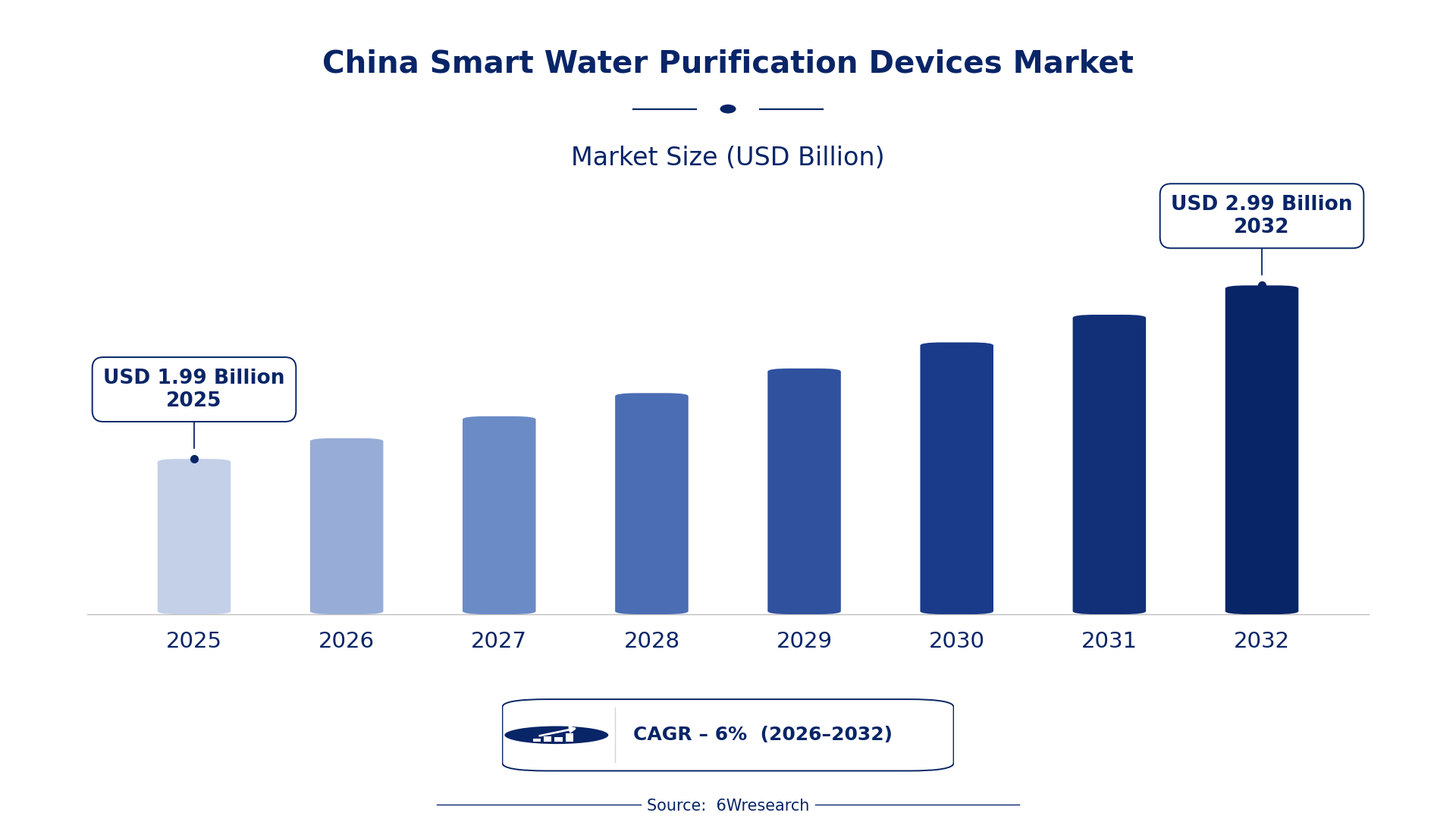
According to 6Wresearch internal database and industry insights, the China Smart Water Purification Devices Market was valued at USD 1.99 billion in 2025 and is projected to reach USD 2.99 billion by 2032, growing at a CAGR of approximately 6% during 2026–2032.
China Smart Water Purification Devices Market Highlights
| Report Metric | Details |
| Report Name | China Smart Water Purification Devices Market |
| Market Size 2025 | USD 1.99 billion |
| Market Size 2032 | USD 2.99 billion |
| Absolute Growth 2025–2032 | USD 1.00 billion |
| CAGR 2026–2032 | 6% |
| Peak Annual Growth | 8.5% in 2032 |
| Forecast Period | 2026–2032 |
| Historical Data | 2022–2025 |
| Base Year | 2025 |
| Leading Purifier Type, 2025 | RO + UV Systems (44% share) |
| Leading Smart Feature, 2025 | Filter Life Alerts (40% share) |
| Leading Detection Mechanism, 2025 | TDS/UV Sensors (48% share) |
| Leading End User, 2025 | Households (43% share) |
| Fastest-Growing Purifier Type | AI-Based Purifiers (7.6% CAGR) |
| Fastest-Growing Smart Feature | Water Quality Classification (7.3% CAGR) |
| Fastest-Growing Detection Mechanism | ML + Real-Time Sensing (8.0% CAGR) |
| Fastest-Growing End User | Rural/Urban Kiosks (7.8% CAGR) |
| Growing Sector | Households |
| Key End Users | Households, Offices, Rural/Urban Kiosks, Municipalities |
China Smart Water Purification Devices Market Year-wise Growth Rate and Key Drivers (2022–2032)
This graph illustrates the annual growth rates of the market from 2022 to 2032, highlighting a steady upward trajectory and projected market expansion over the forecast period.
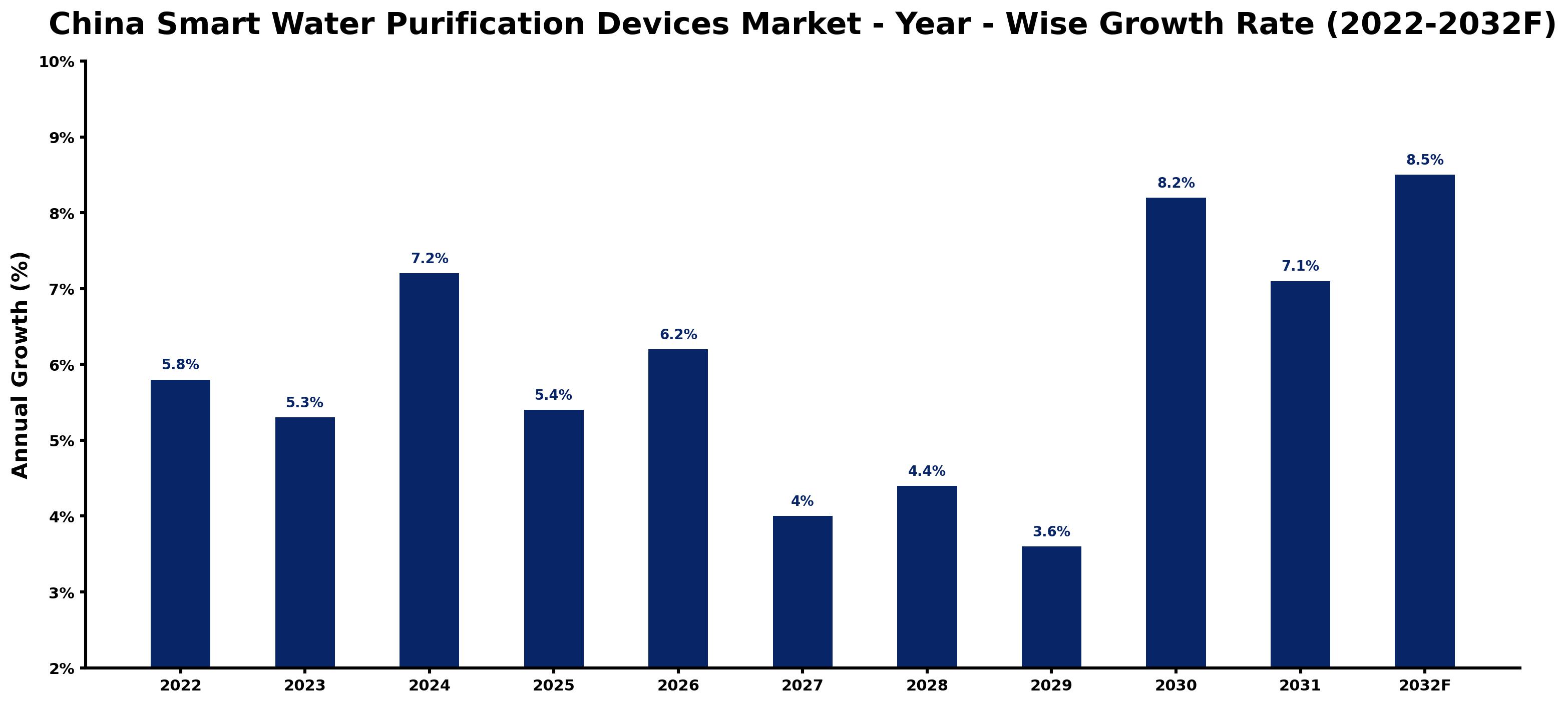
Year by year, the estimates below pair each growth rate with the development that shaped it.
| Year | Estimated Annual Growth (%) | Market Rationale |
| 2022 | 5.8 | The market experienced steady growth due to increasing urbanisation and household demand for clean water solutions. |
| 2023 | 5.3 | Demand slowed as consumers adjusted to rising costs of smart water purification devices. |
| 2024 | 7.2 | Demand surged as more households adopted advanced filtration technologies under the National Drinking Water Quality Standards. |
| 2025 | 5.4 | The market saw a slowdown as competition intensified among device manufacturers. |
| 2026 | 6.2 | Growth is expected to pick up again with rising investments in smart water purification technologies and IoT integration. |
| 2027 | 4.0 | A slowdown is projected as market saturation begins affecting new device sales in urban areas. |
| 2028 | 4.4 | Demand is expected to increase as awareness of water quality issues leads to more purchases of smart devices promoted by the China Water Association. |
| 2029 | 3.6 | Growth is projected to slow again as economic factors influence consumer spending on non-essential items. |
| 2030 | 8.2 | A surge in demand is expected as public water ATMs expand access to clean water in urban regions. |
| 2031 | 7.1 | The market is projected to experience a slowdown as manufacturers face challenges in supply chain management. |
| 2032 | 8.5 | Demand is expected to peak as new technologies in water purification gain widespread acceptance. |
Note: Market size estimations and growth projections presented in this report are based on 6Wresearch's proprietary forecasting methodology, utilizing the latest available industry data, government publications, and primary research inputs.
China Smart Water Purification Devices Market Synopsis
Smart Water Purification Devices in China encompass advanced filtration technologies designed to provide clean drinking water. These devices utilise methods such as reverse osmosis and ultraviolet light, primarily serving households and public water access points. Urbanisation is driving market expansion, with over 50% of urban households using such devices. The ongoing installation of public water ATMs in over 100 cities fuels demand, alongside substantial investments in smart technologies. Integrating IoT technologies enhances user engagement and control over water quality, supporting market growth.
Market Dynamics Impact Analysis (2026–2032)
| Factor | Type | Impact | Primary Segment Affected |
| Urbanisation and population growth are driving the demand for smart water purification devices. | Driver | High | RO + UV Systems |
| The increasing adoption of IoT technologies is enhancing the functionality of purification devices. | Driver | High | AI-Based Purifiers |
| Rising awareness of water quality issues presents opportunities for innovative purification solutions. | Opportunity | High | Public Water ATMs |
| Government subsidies for rural areas encourage investments in smart water purification technologies. | Opportunity | High | App-Connected Filters |
| High initial costs of advanced purification devices may deter some consumers from purchasing. | Restraint | Medium | AI-Based Purifiers |
| Limited access to advanced technologies in rural areas can restrict market growth. | Restraint | Medium | Public Water ATMs |
| The Smart Water Purification Devices market in China faces challenges in supply chain management. | Challenge | High | RO + UV Systems |
| Increasing competition among manufacturers is leading to price wars, affecting profitability. | Challenge | Medium | App-Connected Filters |
Evaluation of Drivers in China Smart Water Purification Devices Market (2026–2032)
The main growth drivers and the segments they affect most are set out below.
| Drivers | Primary Segment Affected | Why It Matters (Evidence) |
| Urbanisation is increasing the need for smart water purification devices in households. | RO + UV Systems | In 2022, the population of urban areas in China reached 900 million, driving demand. |
| The rise of IoT technology is improving device functionality and user engagement. | AI-Based Purifiers | China's IoT market for smart devices is projected to reach $300 billion by 2025. |
| Public health initiatives are promoting the adoption of smart water purification technologies. | Public Water ATMs | The National Health Commission promotes water quality standards under GB 5749-2022. |
| Government subsidies are encouraging investment in smart water purification technologies. | App-Connected Filters | In 2023, the government allocated $10 million for subsidies in rural areas. |
| Consumer awareness of water quality issues is driving demand for purification devices. | RO + UV Systems | Over 50% of urban households are using some form of water purification device. |
The Smart Water Purification Devices market in China is expanding as urbanisation drives demand for clean drinking water solutions. The population of urban areas reached 900 million in 2022, increasing the need for effective purification systems. The rise of IoT technology improves device functionalities, enhancing user engagement.
Evaluation of Restraints in China Smart Water Purification Devices Market
The key brakes on demand, and where they bite hardest, are shown below.
| Market Restraint | Primary Segment Affected | Why It Matters (Evidence) |
| High initial costs of advanced purification devices may deter some consumers from purchasing. | AI-Based Purifiers | The average household in urban areas spends approximately 500 RMB annually on water purification solutions. |
| Limited access to advanced technologies in rural areas can restrict market growth. | Public Water ATMs | Public Water ATMs are being installed in over 100 cities to improve access. |
| Supply chain management challenges can delay device availability and increase costs. | RO + UV Systems | Manufacturers face logistical issues affecting timely delivery of components. |
| Consumer hesitation due to lack of awareness about advanced purification technologies. | AI-Based Purifiers | Many consumers are still unfamiliar with the benefits of AI-based solutions. |
| Intense competition among manufacturers may lead to price wars, affecting profitability. | App-Connected Filters | The market is becoming saturated with various smart water purification options. |
China Smart Water Purification Devices Market Challenges
The China Smart Water Purification Devices market faces a few practical problems, beginning with fierce competition among local manufacturers, which drives prices down and squeezes profit margins for suppliers. A lack of skilled technicians in advanced filtration methods hampers innovation, causing delays for buyers who need effective solutions. Rapid technological changes in purification techniques create a disparity that some suppliers cannot keep up with, resulting in outdated offerings that do not satisfy consumer needs. New regulations under the latest water quality standards increase compliance costs, complicating market entry for emerging players and limiting options for buyers.
Trends in the China Smart Water Purification Devices Market
Buyers and suppliers in the China Smart Water Purification Devices Market are adjusting to the following trends.
- Shift from Traditional to Smart Water Purification: China is increasingly moving towards smart water purification technologies, with public water ATMs being installed in over 100 cities to improve access. This shift enhances water quality management.
- Emergence of IoT-Enabled Water Purification: Since 2021, the integration of IoT technologies in water purification has gained traction, with the IoT market projected to reach $300 billion by 2025. This trend improves user engagement and control over water quality.
- Growing Adoption of AI-Based Purifiers: The adoption of AI-based purifiers has been rising since 2022, driven by their ability to provide intelligent monitoring. This segment is expected to grow at a CAGR of 7.6% through 2032.
- Expansion of Public Water ATMs: The installation of public water ATMs began in 2022, aiming to improve access to clean water in underserved areas. This initiative is expected to reach over 100 cities, enhancing public health outcomes.
Investment Opportunities in the China Smart Water Purification Devices Market
Some of the investment opportunities in the China Smart Water Purification Devices Market are mentioned below.
- $10 million in subsidies for rural areas: With the government allocating $10 million in 2023 for smart water purification technologies, there is an opportunity to supply advanced solutions in rural regions, partnering with local distributors for effective market entry.
- Growing need for smart purification solutions: As over 50% of urban households are now using purification devices, there is an opportunity to provide advanced products, particularly in urban centres where demand is high for new technologies.
- Investment in public water ATMs: The ongoing installation of public water ATMs in over 100 cities presents an opportunity to supply essential purification technologies, targeting municipalities and local governments for collaboration.
- Rising demand for AI-based solutions: With AI-based purifiers expected to grow at a strong rate, there is a chance to invest in this segment, focusing on partnerships with technology firms for development and deployment.
Government Initiatives in the China Smart Water Purification Devices Market
The 'National Drinking Water Quality Standards' introduced in 2022 by the National Health Commission impacts buyers of smart water purification devices. This measure mandates compliance with stringent water quality regulations, ensuring that consumers receive safe drinking water. Manufacturers must adapt their products to meet these standards, improving overall market credibility and consumer trust. The 'Water Pollution Prevention and Control Action Plan' launched in 2021 by the Ministry of Ecology and Environment allocates funding for projects aimed at improving water quality across urban areas, directly benefiting buyers by ensuring cleaner water supplies.
The 'Smart Water Management Strategy' approved in 2023 by the State Council integrates IoT technologies in water purification systems, enhancing operational efficiency. This strategy encourages local governments to adopt smart technologies, ensuring better monitoring of water quality. The Ministry of Housing and Urban-Rural Development announced a budget of $20 million for the installation of public water ATMs in underserved regions in 2022, facilitating access to clean water for communities.
Future Insight of the China Smart Water Purification Devices Market
By 2032, buyers and suppliers in the China Smart Water Purification Devices market can expect advancements due to the government's Clean Water Action Plan and the integration of IoT technologies that enhance product performance. The market will benefit from the installation of over 100 Public Water ATMs, improving access to safe drinking water in urban settings. Manufacturers will increasingly adopt ISO 9001:2015 standards, leading to higher quality products for consumers. The anticipated growth in the smart device sector will stimulate further innovation and development in purification technologies.
Market Segmentation Analysis
The report offers a comprehensive study of the following market segments and their leading categories in the market.
By Purifier Type – RO + UV Systems Dominated, AI-Based Purifiers Expected to Grow Fastest
According to Dhaval Chaurasia, Assistant Manager at 6Wresearch, with a 44% revenue share in 2025, RO + UV Systems was the largest purifier type category. RO + UV systems dominate the market due to their effectiveness in providing clean drinking water for households and offices. Their extensive use in urban areas, where over 50% of households rely on these systems, highlights their essential role in water purification. AI-Based Purifiers are projected to grow fastest, at a CAGR of 7.6% during 2026–2032. The growth of AI-based purifiers is propelled by rising consumer interest in enhanced monitoring capabilities that improve water quality. As urbanisation progresses, the demand for these advanced features will likely attract more consumers, further widening the lead of RO + UV systems. Suppliers should focus on integrating advanced monitoring capabilities into their products to meet the growing consumer demand for smart water purification.
By Smart Feature – Filter Life Alerts Dominated, Water Quality Classification Expected to Grow Fastest
In 2025, Filter Life Alerts led the smart feature split with a 40% share. Filter life alerts hold the largest market share as they help users maintain their purification devices effectively. This feature is particularly valued by consumers who prioritise the longevity and optimal performance of their water purification systems. Over 2026–2032, Water Quality Classification is expected to post the fastest growth, at a CAGR of 7.3%. Water quality classification is experiencing rapid growth due to increasing consumer awareness about the importance of water safety and the need for real-time information. As public health initiatives promote better water standards, this feature is becoming more essential. Suppliers should consider enhancing their product offerings with advanced classification features to align with rising consumer expectations for water quality information.
By Detection Mechanism – TDS/UV Sensors Dominated, ML + Real-Time Sensing Expected to Grow Fastest
The largest detection mechanism category in 2025 was TDS/UV Sensors, with a 48% share of total revenue. TDS/UV sensors are vital for ensuring water safety, making them the leading detection mechanism in the market. Their importance in monitoring water quality resonates with consumers who seek reliable purification solutions. ML + Real-Time Sensing is set to record the highest CAGR in this split, 8.0% over 2026–2032. The demand for real-time sensing technologies is on the rise, driven by consumers' need for immediate feedback on water quality. As the market shifts towards more sophisticated monitoring options, this segment is set for significant growth. Manufacturers should invest in developing advanced sensing technologies to cater to the increasing consumer demand for enhanced water quality monitoring.
By End User – Households Dominated, Rural/Urban Kiosks Expected to Grow Fastest
Households took a 43% share of end user in 2025, more than any other category. Households represent the largest user segment for smart water purification devices, primarily due to the necessity for clean drinking water in urban settings. A substantial portion of the urban population depends on these devices, ensuring a strong market share. The quickest growth will come from Rural/Urban Kiosks, forecast to expand at a CAGR of 7.8% between 2026 and 2032. Rural and urban kiosks are witnessing the fastest growth as they offer essential access to clean water in underserved areas. Government initiatives aimed at improving water access are further propelling this trend. This presents a significant opportunity for suppliers to focus on kiosk installations, especially in rural regions where access to clean water is limited.
Key Attractiveness of the Report
- 10 Years of Market Numbers
- Historical Data Starting from 2022 to 2025
- Base Year 2025
- Forecast Data until 2032
- Key Performance Indicators Impacting the Market
- Major Upcoming Developments and Projects
Key Highlights of the Report:
- China Smart Water Purification Devices Market Outlook
- Market Size of China Smart Water Purification Devices Market, 2025
- Forecast of China Smart Water Purification Devices Market, 2032
- Historical Data and Forecast of China Smart Water Purification Devices Revenues & Volume for the Period 2022 - 2032F
- China Smart Water Purification Devices Market Trend Evolution
- China Smart Water Purification Devices Market Drivers and Challenges
- China Smart Water Purification Devices Price Trends
- China Smart Water Purification Devices Porter's Five Forces
- China Smart Water Purification Devices Industry Life Cycle
- Historical Data and Forecast of China Smart Water Purification Devices Market Revenues & Volume By Purifier Type for the Period 2022 - 2032F
- Historical Data and Forecast of China Smart Water Purification Devices Market Revenues & Volume By RO + UV Systems for the Period 2022 - 2032F
- Historical Data and Forecast of China Smart Water Purification Devices Market Revenues & Volume By AI-Based Purifiers for the Period 2022 - 2032F
- Historical Data and Forecast of China Smart Water Purification Devices Market Revenues & Volume By App-Connected Filters for the Period 2022 - 2032F
- Historical Data and Forecast of China Smart Water Purification Devices Market Revenues & Volume By Public Water ATMs for the Period 2022 - 2032F
- Historical Data and Forecast of China Smart Water Purification Devices Market Revenues & Volume By Smart Feature for the Period 2022 - 2032F
- Historical Data and Forecast of China Smart Water Purification Devices Market Revenues & Volume By Filter Life Alerts for the Period 2022 - 2032F
- Historical Data and Forecast of China Smart Water Purification Devices Market Revenues & Volume By Water Quality Classification for the Period 2022 - 2032F
- Historical Data and Forecast of China Smart Water Purification Devices Market Revenues & Volume By Usage + Maintenance Logs for the Period 2022 - 2032F
- Historical Data and Forecast of China Smart Water Purification Devices Market Revenues & Volume By Payment + Monitoring for the Period 2022 - 2032F
- Historical Data and Forecast of China Smart Water Purification Devices Market Revenues & Volume By Detection Mechanism for the Period 2022 - 2032F
- Historical Data and Forecast of China Smart Water Purification Devices Market Revenues & Volume By TDS/UV Sensors for the Period 2022 - 2032F
- Historical Data and Forecast of China Smart Water Purification Devices Market Revenues & Volume By ML + Real-Time Sensing for the Period 2022 - 2032F
- Historical Data and Forecast of China Smart Water Purification Devices Market Revenues & Volume By IoT + Cloud Sync for the Period 2022 - 2032F
- Historical Data and Forecast of China Smart Water Purification Devices Market Revenues & Volume By Smart Card/QR + IoT for the Period 2022 - 2032F
- Historical Data and Forecast of China Smart Water Purification Devices Market Revenues & Volume By End User for the Period 2022 - 2032F
- Historical Data and Forecast of China Smart Water Purification Devices Market Revenues & Volume By Households for the Period 2022 - 2032F
- Historical Data and Forecast of China Smart Water Purification Devices Market Revenues & Volume By Offices for the Period 2022 - 2032F
- Historical Data and Forecast of China Smart Water Purification Devices Market Revenues & Volume By Apartments for the Period 2022 - 2032F
- Historical Data and Forecast of China Smart Water Purification Devices Market Revenues & Volume By Rural/Urban Kiosks for the Period 2022 - 2032F
- China Smart Water Purification Devices Import Export Trade Statistics
- Market Opportunity Assessment By Purifier Type
- Market Opportunity Assessment By Smart Feature
- Market Opportunity Assessment By Detection Mechanism
- Market Opportunity Assessment By End User
- China Smart Water Purification Devices Top Companies Market Share
- China Smart Water Purification Devices Competitive Benchmarking By Technical and Operational Parameters
- China Smart Water Purification Devices Company Profiles
- China Smart Water Purification Devices Key Strategic Recommendations
Market Covered
The report offers an extensive study of the following market segments.
By Purifier Type
- RO + UV Systems
- AI-Based Purifiers
- App-Connected Filters
- Public Water ATMs
By Smart Feature
- Filter Life Alerts
- Water Quality Classification
- Usage + Maintenance Logs
- Payment + Monitoring
By Detection Mechanism
- TDS/UV Sensors
- ML + Real-Time Sensing
- IoT + Cloud Sync
- Smart Card/QR + IoT
By End User
- Households
- Offices
- Apartments
- Rural/Urban Kiosks































