India Soil Additives Market Size & Growth Rate
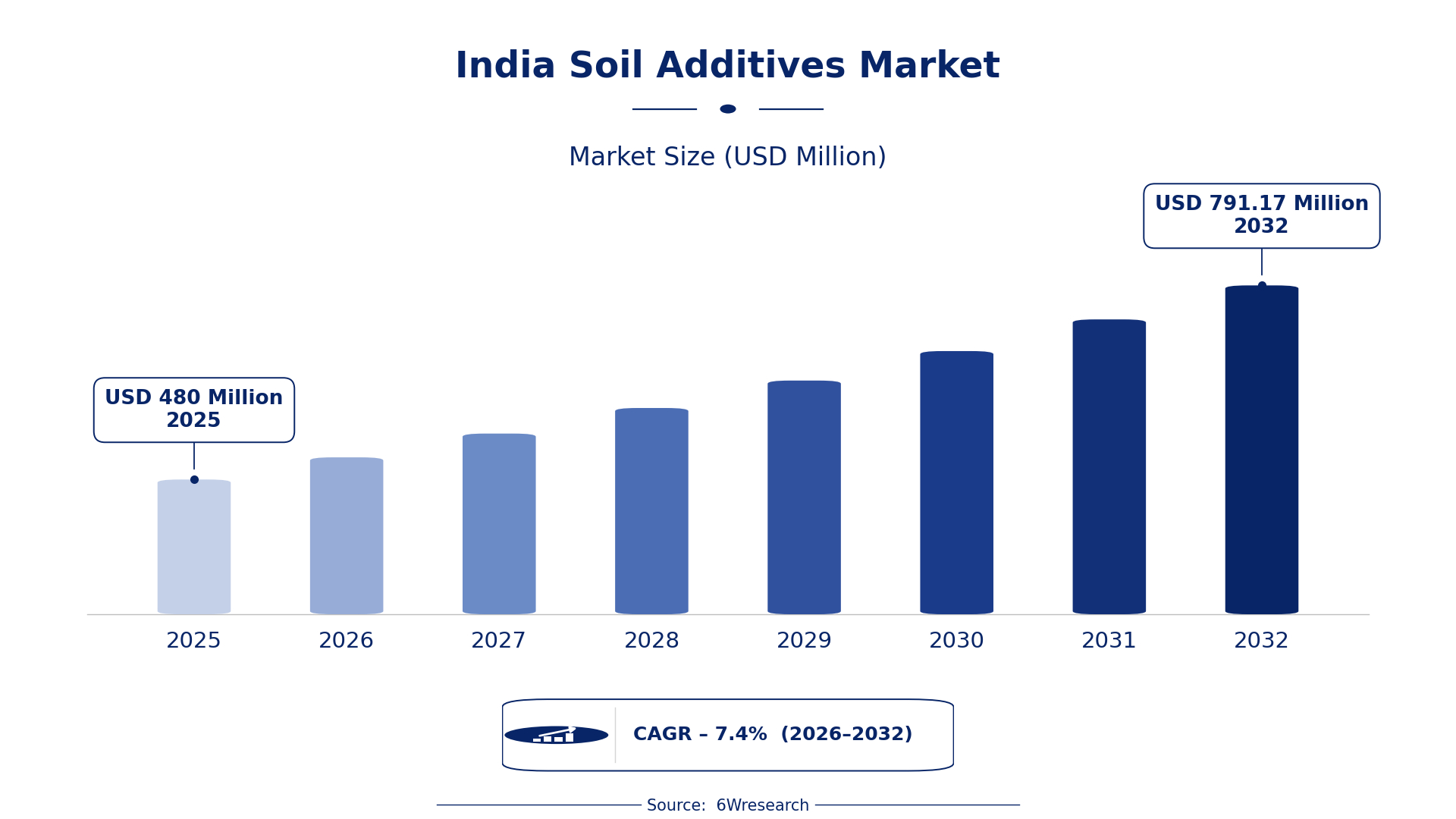
According to 6Wresearch internal database and industry insights, the India Soil Additives Market was valued at USD 480 million in 2025 and is projected to reach USD 791.17 million by 2032, growing at a CAGR of approximately 7.4% during 2026–2032.
India Soil Additives Market Highlights
| Report Metric | Details |
| Report Name | India Soil Additives Market |
| Market Size 2025 | USD 480 million |
| Market Size 2032 | USD 791.17 million |
| Absolute Growth 2025–2032 | USD 311.17 million |
| CAGR 2026–2032 | 7.4% |
| Peak Annual Growth | 9.4% in 2028 |
| Forecast Period | 2026–2032 |
| Historical Data | 2022–2025 |
| Base Year | 2025 |
| Leading Additive Type, 2025 | Organic Additives (45% share) |
| Leading Functionality, 2025 | Nutrient Enrichment (42% share) |
| Leading Crop Type, 2025 | Vegetables (47% share) |
| Leading End User, 2025 | Commercial Farms (50% share) |
| Fastest-Growing Additive Type | Biofertilizers (9.9% CAGR) |
| Fastest-Growing Functionality | Soil Rejuvenation (8.7% CAGR) |
| Fastest-Growing End User | Organic Farmers (8.5% CAGR) |
| Growing Sector | Organic Farming |
| Key End Users | Commercial Farms, Organic Farmers, Agrochemical Companies |
India Soil Additives Market Year-wise Growth Rate and Key Drivers (2022–2032)
This graph illustrates the annual growth rates of the market from 2022 to 2032, highlighting a steady upward trajectory and projected market expansion over the forecast period.
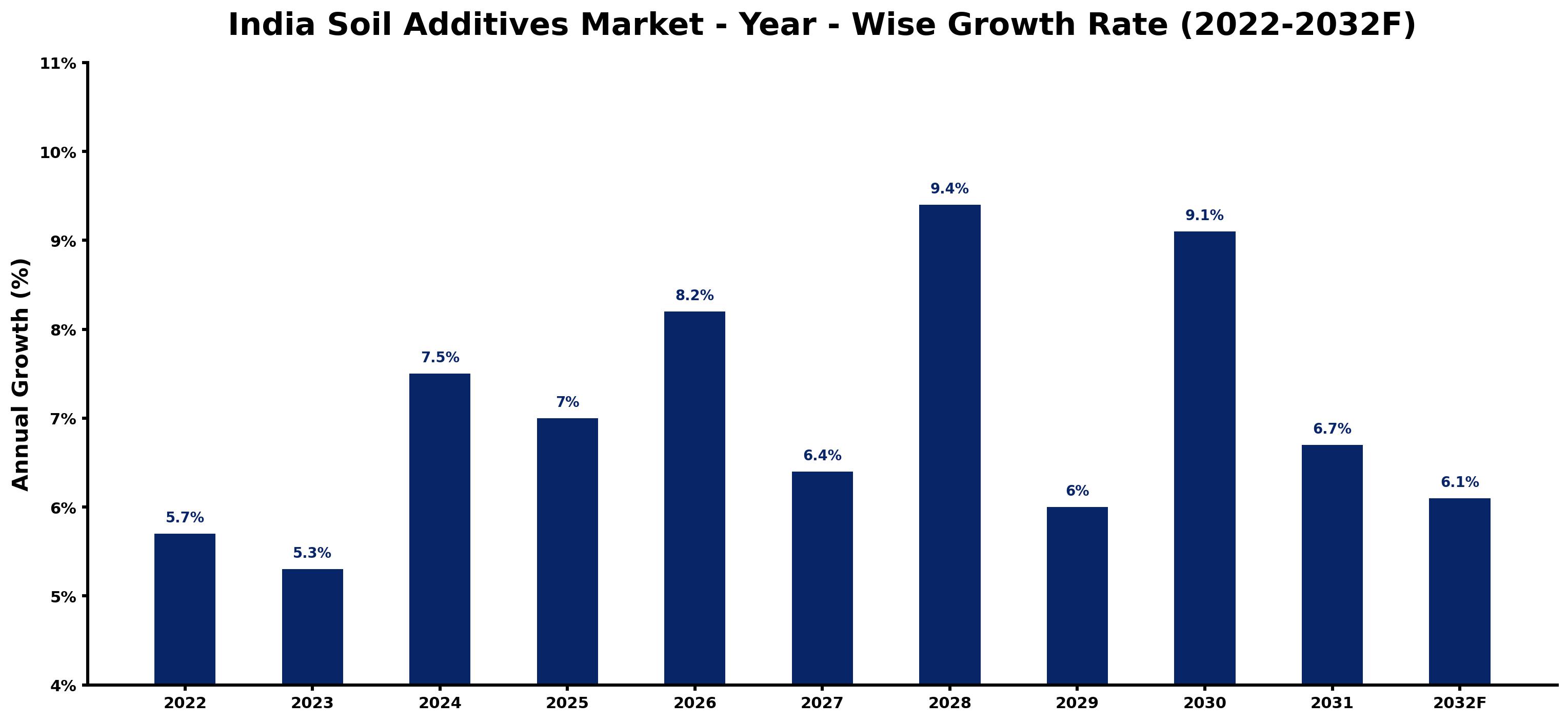
Each row of the following table gives one year's estimated growth and the event or demand shift that explains it.
| Year | Estimated Annual Growth (%) | Market Rationale |
| 2022 | 5.7 | The market experienced steady demand from both smallholder and commercial farms, driven by the need for improved soil health. |
| 2023 | 5.3 | Growth slowed due to fluctuating rainfall impacting soil health across various regions, affecting farmers' ability to manage soil effectively. |
| 2024 | 7.5 | Increased adoption of organic farming practices contributed to a faster growth rate, particularly among commercial farms investing in soil health. |
| 2025 | 7.0 | Demand remained strong as farmers focused on improving soil fertility and crop yields, supported by government initiatives promoting soil health. |
| 2026 | 8.2 | The introduction of new soil health initiatives is expected to spur higher investment in soil additives, particularly in Punjab's agricultural sector. |
| 2027 | 6.4 | Growth is projected to slow as market adjustments occur following rapid expansion in previous years, particularly in organic additives. |
| 2028 | 9.4 | The peak growth year will be driven by heightened awareness of soil health management practices, particularly through the Soil Health Card Scheme. |
| 2029 | 6.0 | A slowdown is anticipated as market conditions begin to stabilise after peak growth, with farmers reassessing their soil management strategies. |
| 2030 | 9.1 | Increased focus on sustainable agriculture practices will lead to renewed interest in soil additives, especially among organic farmers. |
| 2031 | 6.7 | Growth is expected to slow as the market adjusts to previous years' rapid expansions, particularly in the commercial farming sector. |
| 2032 | 6.1 | Demand remains strong, but growth is projected to normalise as the market stabilises, influenced by regulatory measures. |
Note: Market size estimations and growth projections presented in this report are based on 6Wresearch's proprietary forecasting methodology, utilizing the latest available industry data, government publications, and primary research inputs.
India Soil Additives Market Synopsis
Soil Additives in India are substances added to improve soil properties, including organic materials, minerals, and synthetic compounds. They are primarily used for nutrient enrichment and pH balancing, which are vital for enhancing crop yield. The India Soil Additives Market is growing due to rising agricultural productivity demands and the expansion of organic farming practices. With over 140 million hectares of arable land, the market is supported by initiatives like the Soil Health Card Scheme, which promotes balanced fertilizer use and soil health awareness.
Market Dynamics Impact Analysis (2026–2032)
| Factor | Type | Impact | Primary Segment Affected |
| Rising adoption of organic farming practices among farmers | Driver | High | Organic Additives |
| Increased focus on soil health management by commercial farms | Driver | High | Commercial Farms |
| Growing demand for biofertilizers to enhance soil fertility | Opportunity | High | Biofertilizers |
| Expansion of the organic farming sector, projected to reach 10 million hectares by 2025 | Opportunity | High | Organic Additives |
| Regulatory challenges related to the quality of soil additives | Restraint | Medium | Synthetic Additives |
| Fluctuating rainfall patterns affecting soil health and additive effectiveness | Restraint | Medium | Nutrient Enrichment |
| High costs associated with quality soil additives limiting access for small farmers | Challenge | High | Organic Farmers |
| Limited awareness of soil health management practices among some farmers | Challenge | Medium | Commercial Farms |
Evaluation of Drivers in India Soil Additives Market (2026–2032)
The main growth drivers and the segments they affect most are set out below.
| Drivers | Primary Segment Affected | Why It Matters (Evidence) |
| Rising adoption of organic farming practices | Organic Additives | This trend increases demand for organic additives, with the organic farming sector expected to reach 10 million hectares by 2025. |
| Increased investment in sustainable agricultural practices | Biofertilizers | Investment in biofertilizers is growing, with a market growth rate exceeding 15% annually, as farmers seek effective soil fertility solutions. |
| Expansion of commercial farming operations | Commercial Farms | Commercial farms, which accounted for 50% of the market in 2025, are increasing their use of soil additives to enhance productivity. |
| Government initiatives promoting soil health | Nutrient Enrichment | Initiatives like the Soil Health Card Scheme are raising awareness among farmers about the benefits of nutrient enrichment. |
| Focus on pH balancing for optimal nutrient availability | Synthetic Additives | Farmers are investing in synthetic additives to ensure optimal nutrient availability, leading to better crop yields. |
Growth in the Soil Additives market in India is driven by the rising adoption of organic farming, heightened investment in sustainable agricultural practices, and the expansion of commercial farming operations. The organic farming sector is expected to cover 10 million hectares by 2025, significantly boosting demand for organic additives. The popularity of biofertilizers is on the rise, with a market growth rate surpassing 15% annually, as farmers seek effective solutions to enhance soil fertility. Moreover, the emphasis on pH balancing to optimise nutrient availability is prompting farmers to invest in high-quality synthetic additives for improved crop yields.
Evaluation of Restraints in India Soil Additives Market
The following restraints limit how fast demand can grow.
| Market Restraint | Primary Segment Affected | Why It Matters (Evidence) |
| Regulatory challenges regarding quality control of soil additives | Synthetic Additives | The Fertilizer Control Order imposes strict regulations, making compliance costly for producers and limiting market entry. |
| Fluctuating rainfall patterns impacting soil health | Nutrient Enrichment | The average annual rainfall varies significantly, affecting the effectiveness of soil additives in different regions and limiting their use. |
| High costs of quality soil additives limiting access for small farmers | Organic Farmers | Smallholder farmers often struggle to afford premium products, impacting their soil management practices and crop yields. |
| Limited awareness of soil health management practices | Commercial Farms | Some farmers lack knowledge about effective soil management, hindering their purchasing decisions and limiting the adoption of quality additives. |
| Competition from alternative soil management practices | Biofertilizers | Farmers may opt for cheaper, less effective solutions instead of investing in quality biofertilizers, impacting overall soil health. |
India Soil Additives Market Challenges
Buyers and suppliers in the India soil additives market encounter a skills shortage, as many farmers lack training in effective soil management practices. This knowledge gap results in inefficient application of additives, potentially lowering crop yields and wasting resources for smallholder farmers. High costs present another challenge; organic additives can be priced 20-30% higher than conventional options, making them less accessible for budget-conscious farmers. Regulatory compliance complicates operations; the Fertilizer Control Order mandates strict quality checks, causing delays in product availability and increasing operational costs for suppliers. Competition from cheaper synthetic alternatives pressures the market, forcing producers to lower prices, which risks compromising the quality of soil additives available to buyers.
Trends in the India Soil Additives Market
Four trends stand out in the India Soil Additives Market.
- Shift towards Organic Additives: Farmers are increasingly opting for organic additives as they seek sustainable solutions. The organic farming sector is projected to expand to 10 million hectares by 2025, reflecting this trend.
- Adoption of Integrated Soil Health Management: Commercial farms are progressively adopting integrated approaches to soil health management. This shift is particularly notable in Punjab, a major agricultural hub, where initiatives are gaining traction.
- Emergence of Biofertilizers as Preferred Solutions: Biofertilizers are gaining popularity among farmers due to their effectiveness. The market for biofertilizers is growing at over 15% annually, highlighting this emerging preference.
- Growing Demand for Soil Health Assessments: Farmers are increasingly pursuing soil health assessments to optimise productivity. The Soil Health Card Scheme, launched in 2015, has significantly raised awareness and usage of soil health assessments.
Investment Opportunities in the India Soil Additives Market
Below are the investment opportunities with the strongest case in the India Soil Additives Market.
- Government funding for soil health initiatives: The Indian government has allocated INR 2,000 crore for soil health initiatives, creating opportunities for suppliers of soil additives. Local partnerships can facilitate market entry.
- Expansion of organic farming in Punjab: With Punjab being a major agricultural hub, there is a growing need for organic additives. Suppliers can enter the market through local partnerships or joint ventures.
- Increasing demand for biofertilizers: The market for biofertilizers is expected to grow rapidly, presenting opportunities for suppliers. Collaborating with agribusinesses can help reach more farmers.
- Growing interest in soil health management practices: As awareness increases, there is a significant opportunity for suppliers of soil health products. Engaging with local agricultural cooperatives can enhance market access.
Government Initiatives in the India Soil Additives Market
The National Mission for Sustainable Agriculture, initiated in 2020, aims to improve soil health and promote organic farming practices. This initiative builds on previous efforts, including the Soil Health Card Scheme launched in 2015, which supports farmers with soil health assessments and recommendations for balanced fertiliser use. The Fertilizer Control Order, updated in 2021, regulates the quality and use of soil additives, ensuring that producers meet necessary standards for efficacy and safety, which benefits buyers by guaranteeing product reliability.
The Ministry of Agriculture oversees the Soil Health Card Scheme, which funds soil health assessments and provides recommendations for farmers. Additionally, the Indian Council of Agricultural Research (ICAR) conducts research on soil additives to improve crop yield and supports initiatives that promote soil health management. In 2022, the government allocated INR 2,000 crore for soil health initiatives, enabling more comprehensive support for farmers and enhancing their access to quality soil management solutions.
Future Insight of the India Soil Additives Market
The India soil additives market will undergo substantial transformations by 2032, influenced by government initiatives like the Soil Health Card Scheme that encourages balanced fertiliser use. The organic farming sector is projected to grow, reaching 10 million hectares, which will boost demand for organic soil additives. Research from the Indian Council of Agricultural Research will lead to improved formulations that increase crop yields while maintaining soil integrity. Government backing, with an allocation of INR 2,000 crore for soil health initiatives, will further drive advancements in soil management technologies.
Market Segmentation Analysis
The report offers a comprehensive study of the following market segments and their leading categories in the market.
By Additive Type – Organic Additives Dominated, Biofertilizers Expected to Grow Fastest
According to Summon Dutta, Assistant Manager at 6Wresearch, Organic Additives accounted for a 45% market share by additive type in 2025. Organic additives dominate the India Soil Additives Market because they are essential for enhancing soil health and fertility, particularly as the organic farming sector expands. With the sector projected to reach 10 million hectares by 2025, the reliance on organic additives will continue to grow. The quickest growth will come from Biofertilizers, forecast to expand at a CAGR of 9.9% between 2026 and 2032. Biofertilizers are witnessing rapid growth, primarily due to their effectiveness in improving soil fertility through natural biological processes, aligning with the increasing emphasis on sustainable farming. Their market growth rate exceeding 15% annually signals a significant shift towards eco-friendly agricultural solutions. This indicates that suppliers should focus on developing organic and biofertilizer products to meet the rising demand in the market.
By Functionality – Nutrient Enrichment Dominated, Soil Rejuvenation Expected to Grow Fastest
The largest functionality category in 2025 was Nutrient Enrichment, with a 42% share of total revenue. Nutrient enrichment is the leading functionality in the India Soil Additives Market, essential for increasing crop yield and ensuring agricultural productivity. The focus on improving soil nutrient content aligns with the needs of farmers aiming to maximise their harvests in a competitive market. Soil Rejuvenation is set to record the highest CAGR in this split, 8.7% over 2026–2032. Soil rejuvenation is the fastest-growing functionality as it restores soil health and productivity, addressing the challenges posed by soil degradation. The increasing awareness of sustainable farming practices drives this segment's growth as farmers seek to revitalise their soils effectively. This trend suggests that suppliers should invest in products that focus on soil rejuvenation to meet the evolving needs of farmers.
By Crop Type – Vegetables Dominated and Is Expected to Record the Fastest Growth
Vegetables took a 47% share of crop type in 2025, more than any other category. Vegetables are the leading crop type in the India Soil Additives Market, benefiting extensively from soil additives that enhance growth and yield. The strong consumer demand for fresh produce necessitates effective soil management practices among vegetable farmers. Its lead should widen, with a projected CAGR of 8.7% during 2026–2032, the highest in this split. Vegetables also represent the fastest-growing crop type, driven by the rising consumer preference for fresh and organic products. This dual position as both the leader and fastest-growing segment suggests a robust and expanding market for soil additives in vegetable farming. This highlights the need for suppliers to customise their products to assist vegetable farmers in improving soil quality and crop productivity.
By End User – Commercial Farms Dominated, Organic Farmers Expected to Grow Fastest
Commercial Farms held a 50% share of the India Soil Additives Market by end user in 2025. Commercial farms dominate the end user segment of the India Soil Additives Market, as they are the primary consumers of various soil additives to boost productivity. Their scale of operations necessitates the use of effective soil management solutions to maintain competitive yields. Over 2026–2032, Organic Farmers are expected to post the fastest growth, at a CAGR of 8.5%. Organic farmers are the fastest-growing end user segment, relying heavily on soil additives for sustainable agricultural practices. The increasing trend towards organic farming fuels this growth, as these farmers seek to improve soil health without synthetic inputs. This indicates that suppliers should focus on developing solutions specifically for organic farmers to meet their unique requirements.
Key Attractiveness of the Report
- 10 Years of Market Numbers
- Historical Data Starting from 2022 to 2025
- Base Year 2025
- Forecast Data until 2032
- Key Performance Indicators Impacting the Market
- Major Upcoming Developments and Projects
Key Highlights of the Report:
- India Soil Additives Market Outlook
- Market Size of India Soil Additives Market, 2025
- Forecast of India Soil Additives Market, 2032
- Historical Data and Forecast of India Soil Additives Revenues & Volume for the Period 2022 - 2032F
- India Soil Additives Market Trend Evolution
- India Soil Additives Market Drivers and Challenges
- India Soil Additives Price Trends
- India Soil Additives Porter's Five Forces
- India Soil Additives Industry Life Cycle
- Historical Data and Forecast of India Soil Additives Market Revenues & Volume By Additive Type for the Period 2022 - 2032F
- Historical Data and Forecast of India Soil Additives Market Revenues & Volume By Organic Additives for the Period 2022 - 2032F
- Historical Data and Forecast of India Soil Additives Market Revenues & Volume By Synthetic Additives for the Period 2022 - 2032F
- Historical Data and Forecast of India Soil Additives Market Revenues & Volume By Biofertilizers for the Period 2022 - 2032F
- Historical Data and Forecast of India Soil Additives Market Revenues & Volume By Humic Substances for the Period 2022 - 2032F
- Historical Data and Forecast of India Soil Additives Market Revenues & Volume By Functionality for the Period 2022 - 2032F
- Historical Data and Forecast of India Soil Additives Market Revenues & Volume By Nutrient Enrichment for the Period 2022 - 2032F
- Historical Data and Forecast of India Soil Additives Market Revenues & Volume By pH Balancing for the Period 2022 - 2032F
- Historical Data and Forecast of India Soil Additives Market Revenues & Volume By Soil Rejuvenation for the Period 2022 - 2032F
- Historical Data and Forecast of India Soil Additives Market Revenues & Volume By Microbial Activity for the Period 2022 - 2032F
- Historical Data and Forecast of India Soil Additives Market Revenues & Volume By Crop Type for the Period 2022 - 2032F
- Historical Data and Forecast of India Soil Additives Market Revenues & Volume By Vegetables for the Period 2022 - 2032F
- Historical Data and Forecast of India Soil Additives Market Revenues & Volume By Grains for the Period 2022 - 2032F
- Historical Data and Forecast of India Soil Additives Market Revenues & Volume By Pulses for the Period 2022 - 2032F
- Historical Data and Forecast of India Soil Additives Market Revenues & Volume By Oilseeds for the Period 2022 - 2032F
- Historical Data and Forecast of India Soil Additives Market Revenues & Volume By End User for the Period 2022 - 2032F
- Historical Data and Forecast of India Soil Additives Market Revenues & Volume By Organic Farmers for the Period 2022 - 2032F
- Historical Data and Forecast of India Soil Additives Market Revenues & Volume By Commercial Farms for the Period 2022 - 2032F
- Historical Data and Forecast of India Soil Additives Market Revenues & Volume By Agrochemical Companies for the Period 2022 - 2032F
- Historical Data and Forecast of India Soil Additives Market Revenues & Volume By Agribusinesses for the Period 2022 - 2032F
- India Soil Additives Import Export Trade Statistics
- Market Opportunity Assessment By Additive Type
- Market Opportunity Assessment By Functionality
- Market Opportunity Assessment By Crop Type
- Market Opportunity Assessment By End User
- India Soil Additives Top Companies Market Share
- India Soil Additives Competitive Benchmarking By Technical and Operational Parameters
- India Soil Additives Company Profiles
- India Soil Additives Key Strategic Recommendations
Market Covered
This report examines the market across the segments below.
By Additive Type
- Organic Additives
- Synthetic Additives
- Biofertilizers
- Humic Substances
By Functionality
- Nutrient Enrichment
- pH Balancing
- Soil Rejuvenation
- Microbial Activity
By Crop Type
- Vegetables
- Grains
- Pulses
- Oilseeds
By End User
- Organic Farmers
- Commercial Farms
- Agrochemical Companies
- Agribusinesses































