India Soil Pest Control Market Size & Growth Rate
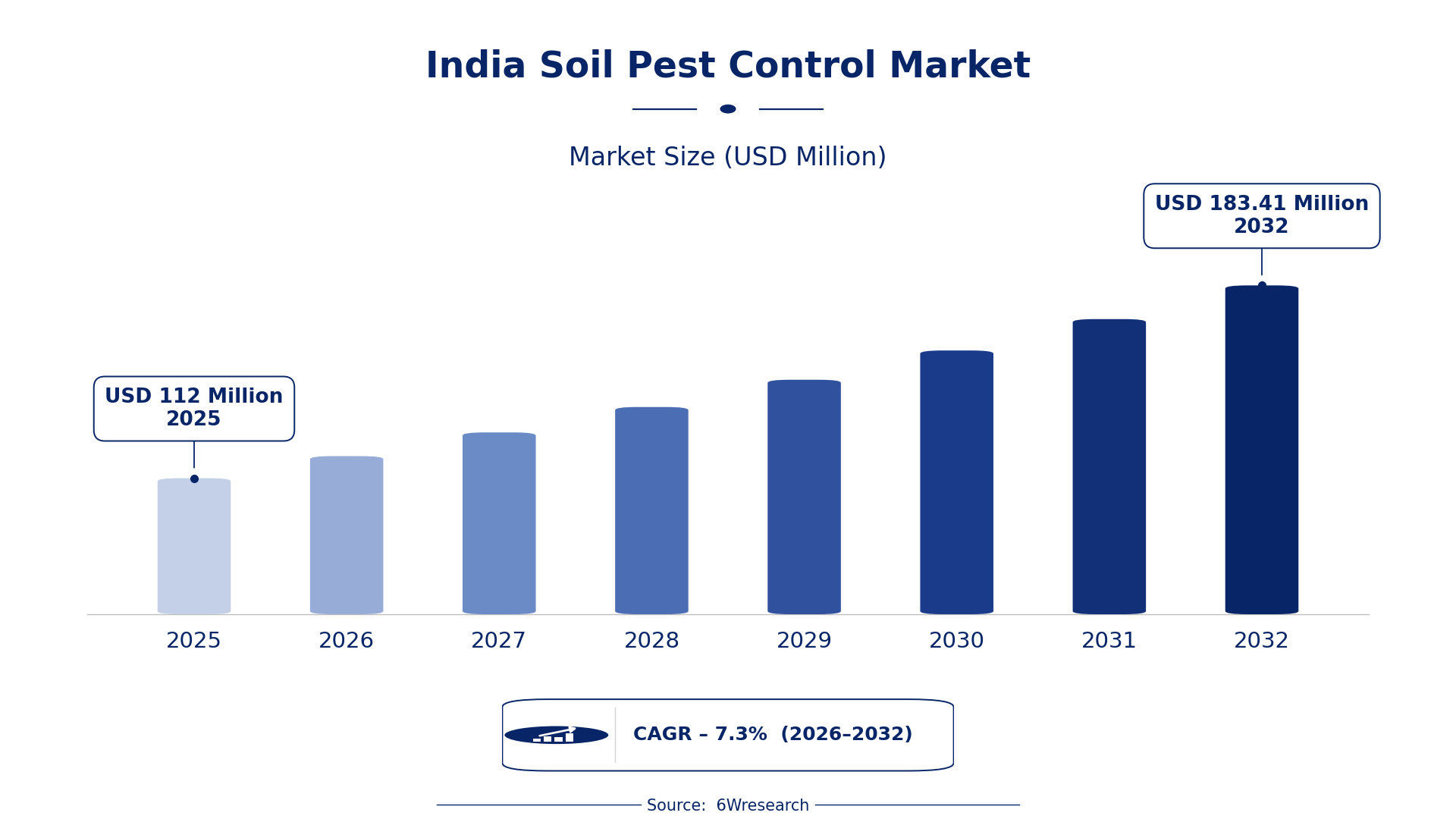
According to 6Wresearch internal database and industry insights, the India Soil Pest Control Market was valued at USD 112.0 million in 2025 and is projected to reach USD 183.41 million by 2032, growing at a CAGR of approximately 7.3% during 2026–2032.
India Soil Pest Control Market Highlights
| Report Metric | Details |
| Report Name | India Soil Pest Control Market |
| Market Size 2025 | USD 112.0 million |
| Market Size 2032 | USD 183.41 million |
| Absolute Growth 2025–2032 | USD 71.41 million |
| CAGR 2026–2032 | 7.3% |
| Peak Annual Growth | 9.6% in 2029 |
| Forecast Period | 2026–2032 |
| Historical Data | 2022–2025 |
| Base Year | 2025 |
| Leading Control Type, 2025 | Insecticides (40% share) |
| Leading Active Ingredient, 2025 | Organophosphates (41% share) |
| Leading Target Pest, 2025 | Soil-Borne Insects (54% share) |
| Leading End User, 2025 | Sugarcane Growers (46% share) |
| Fastest-Growing Control Type | Biocontrol Agents (8.5% CAGR) |
| Fastest-Growing Active Ingredient | Bacillus Thuringiensis (9.6% CAGR) |
| Fastest-Growing Target Pest | Root Rot Pathogens (9.3% CAGR) |
| Fastest-Growing End User | Organic Producers (9.5% CAGR) |
| Growing Sector | Sugarcane Cultivation |
| Key End Users | Sugarcane Growers, Cotton Growers, Organic Producers, Floriculture Farms |
India Soil Pest Control Market Year-wise Growth Rate and Key Drivers (2022–2032)
This graph illustrates the annual growth rates of the market from 2022 to 2032, highlighting a steady upward trajectory and projected market expansion over the forecast period.
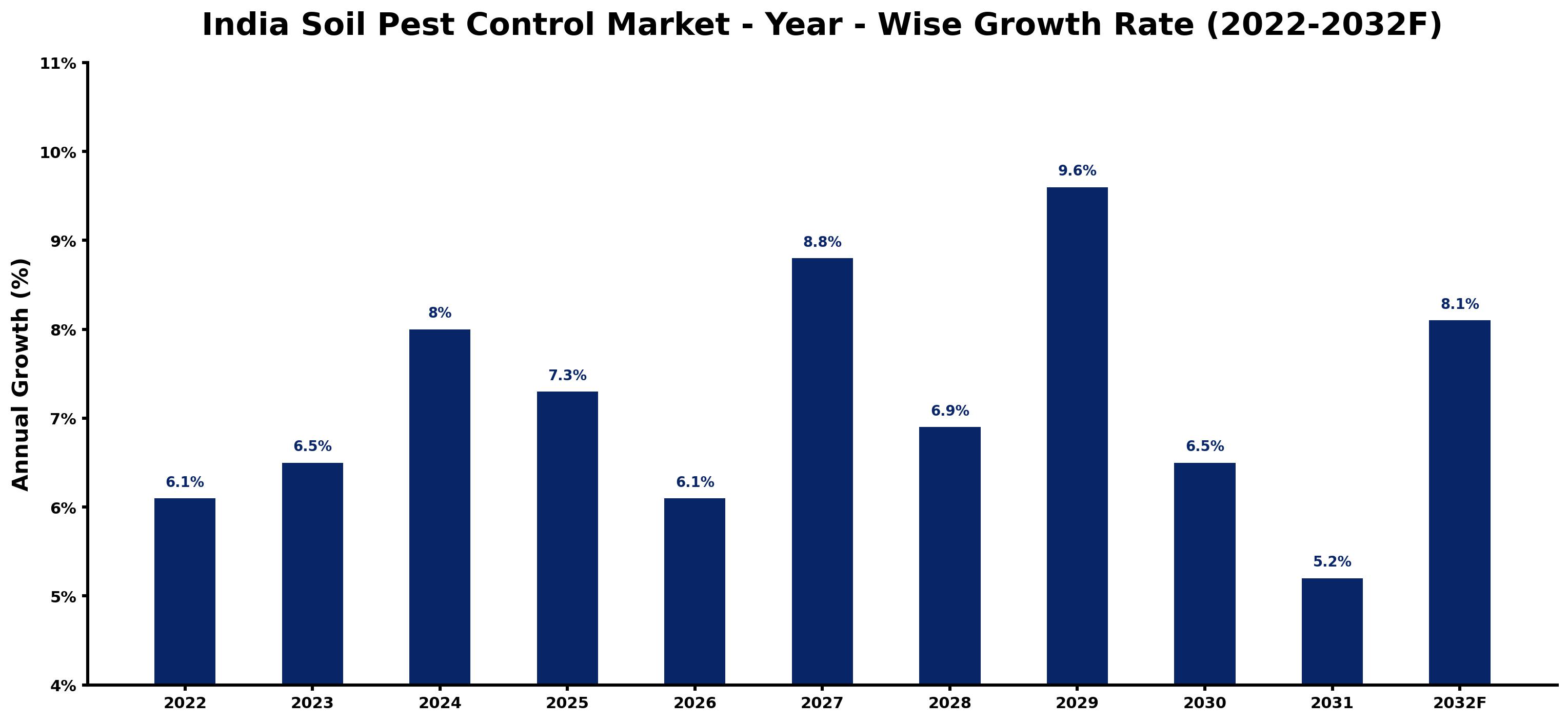
Annual growth estimates for each year appear below with the principal reason behind them, explaining the shifts that set the pace of the market.
| Year | Estimated Annual Growth (%) | Market Rationale |
| 2022 | 6.1 | The market experienced steady growth, driven by increasing agricultural practices. |
| 2023 | 6.5 | Demand for soil pest control products rose, particularly among sugarcane growers. |
| 2024 | 8.0 | The introduction of new pest management technologies boosted market growth significantly. |
| 2025 | 7.3 | Growth slowed as the market adjusted to new regulations and standards. |
| 2026 | 6.1 | The market continued to grow, albeit at a slower pace due to regulatory impacts. |
| 2027 | 8.8 | Increased adoption of biocontrol agents contributed to a rise in market demand. |
| 2028 | 6.9 | Growth decelerated as the market stabilised after rapid expansions in previous years. |
| 2029 | 9.6 | A surge in demand for effective pest management solutions led to peak growth. |
| 2030 | 6.5 | Market growth slowed as competition intensified among pest control products. |
| 2031 | 5.2 | Demand continued to rise, albeit at a slower rate, due to evolving agricultural needs. |
| 2032 | 8.1 | The market is expected to grow faster as organic farming practices gain traction. |
Note: Market size estimations and growth projections presented in this report are based on 6Wresearch's proprietary forecasting methodology, utilizing the latest available industry data, government publications, and primary research inputs.
India Soil Pest Control Market Synopsis
Soil Pest Control in India involves the use of chemicals and biological agents to manage pests that threaten crop health. This includes various formulations, such as liquid and granular types, primarily aimed at protecting crops like sugarcane and cotton. The Soil Pest Control Market is growing due to increasing agricultural productivity demands, especially from sugarcane growers and cotton producers. The rising adoption of biocontrol agents and sustainable practices further drives this growth. With a considerable portion of cultivated land dedicated to these crops, the market is set for ongoing expansion.
Market Dynamics Impact Analysis (2026–2032)
| Factor | Type | Impact | Primary Segment Affected |
| Increasing adoption of biocontrol agents enhances sustainable pest management practices. | Driver | High | Biocontrol Agents |
| Rising agricultural productivity demands drive the need for effective pest control solutions. | Driver | High | Insecticides |
| Growing interest in organic farming creates opportunities for biocontrol products. | Opportunity | High | Biocontrol Agents |
| Investment in pest management technologies is increasing, attracting new suppliers. | Opportunity | High | Insecticides |
| Regulatory challenges hinder the rapid introduction of new pest control products. | Restraint | High | Insecticides |
| Market fluctuations affect pricing and availability of pest control products. | Restraint | Medium | Biocontrol Agents |
| Limited awareness of sustainable pest management practices poses challenges. | Challenge | Medium | Biocontrol Agents |
| Competition among pest control products can lead to price wars, impacting margins. | Challenge | High | Insecticides |
Evaluation of Drivers in India Soil Pest Control Market (2026–2032)
The table below links each growth driver to the segment it affects and the evidence for it.
| Drivers | Primary Segment Affected | Why It Matters (Evidence) |
| Growing agricultural productivity demands require effective pest management solutions. | Insecticides | Approximately 18% of India's GDP comes from agriculture, driving demand for pest control solutions. |
| Increased adoption of biocontrol agents supports sustainable practices in agriculture. | Biocontrol Agents | The use of biocontrol agents has increased by 15% in the last five years, promoting eco-friendly pest management. |
| Rising interest in organic farming creates demand for eco-friendly pest control options. | Biocontrol Agents | The Organic Farming Policy encourages the use of biocontrol agents in farming systems, boosting their adoption. |
| Technological advancements in pest control products improve effectiveness and efficiency. | Insecticides | The National Agricultural Innovation Project funds research in pest control technologies, enhancing product capabilities. |
| The expansion of cultivated land increases the need for effective pest management. | Insecticides | India has over 140 million hectares of cultivated land, necessitating effective pest control measures. |
The Soil Pest Control market in India is expanding as agricultural productivity demands rise, leading to increased adoption of effective pest management solutions. Approximately 18% of India's GDP comes from agriculture, driving demand for pest control products. The National Agricultural Innovation Project funds research in pest control technologies, improving product effectiveness. With over 140 million hectares of cultivated land, the need for efficient pest management continues to grow, prompting farmers to invest in advanced solutions.
Evaluation of Restraints in India Soil Pest Control Market
The main factors holding the market back are set out below.
| Market Restraint | Primary Segment Affected | Why It Matters (Evidence) |
| Regulatory challenges slow the introduction of new pest control products. | Insecticides | The Pesticides Management Bill seeks to regulate pesticide use, impacting product availability and compliance costs for producers. |
| Market fluctuations affect pricing and availability of pest control products. | Biocontrol Agents | The annual agricultural budget for pest management initiatives is approximately ₹1,000 crores, influencing product pricing. |
| Limited awareness of sustainable pest management practices hampers adoption. | Biocontrol Agents | Farmers may lack knowledge about the benefits of biocontrol agents, affecting their usage. |
| High costs associated with advanced pest control technologies can deter investment. | Insecticides | Investments in pest management technologies can be financially burdensome for smallholder farmers. |
| Intense competition among pest control products can lead to price wars, affecting margins. | Insecticides | Competition can reduce profitability for suppliers, impacting their ability to invest in quality products. |
India Soil Pest Control Market Challenges
The India Soil Pest Control Market faces several practical issues, starting with intense competition among producers that drives prices down, squeezing profit margins for farmers. This situation leads to reduced investment in quality soil pest control products, which can negatively impact crop yields. Limited access to modern pest control technologies hampers effective management, causing delays in addressing pest outbreaks for producers. Inadequate training in pest management practices results in ineffective application of solutions, complicating matters for farmers. Buyers also face rising costs due to the Pesticides Management Bill, which raises compliance expenses and restricts product availability, ultimately increasing operational costs by 10%.
Trends in the India Soil Pest Control Market
The trends below show where the India Soil Pest Control Market is heading.
- Shift towards Sustainable Pest Management: There is a notable trend towards sustainable pest management practices in India, particularly through the use of biocontrol agents. The National Mission on Sustainable Agriculture promotes these eco-friendly methods, with a 15% increase in biocontrol agent usage over the last five years.
- Increased Adoption of Organic Farming Practices: Sugarcane growers are increasingly turning to organic farming methods, driving demand for biocontrol products. The Organic Farming Policy, introduced in 2022, encourages sustainable practices, with organic farming methods gaining significant popularity.
- Technological Advancements in Pest Control: The introduction of advanced pest control technologies is reshaping the market. The National Agricultural Innovation Project funds research, leading to new solutions that improve pest management efficiency and effectiveness.
- Growing Demand from Cotton Producers: Cotton growers are placing greater reliance on effective pest control to safeguard their crops. The concentration of cotton production in states like Gujarat and Andhra Pradesh drives demand for pest management solutions.
Investment Opportunities in the India Soil Pest Control Market
Investors looking at the India Soil Pest Control Market should consider the following areas.
- Rising Demand for Biocontrol Agents: With a 15% increase in biocontrol agent usage, there exists a notable opportunity to supply these eco-friendly products. Sugarcane growers show particular interest in sustainable pest management solutions.
- Investment in Pest Management Technologies: The funding for pest control technologies from the National Agricultural Innovation Project presents an opportunity for suppliers to develop innovative products. Collaborating with local agricultural research institutions can facilitate market entry.
- Expansion of Organic Farming: The growing interest in organic farming creates a demand for biocontrol products. Engaging with organic producers can open new markets, especially in regions with high organic crop cultivation.
- Focus on Integrated Pest Management Solutions: There is a need for integrated pest management solutions that combine chemical and biological methods. Collaborating with floriculture farms can provide opportunities to develop tailored pest control strategies.
Government Initiatives in the India Soil Pest Control Market
The Fertilizer (Control) Order regulates the sale of agricultural chemicals, ensuring safety and efficacy in pest control products. The Pesticides Management Bill, introduced in 2020, aims to enhance regulation of pesticide manufacture and use, promoting safer practices. Additionally, the National Mission on Sustainable Agriculture, launched in 2021, seeks to promote eco-friendly pest management practices, focusing on organic farming and biocontrol agents.
The Ministry of Agriculture oversees several initiatives, including the Soil Health Card Scheme, which provides farmers with crucial information on soil health and pest management recommendations. The annual agricultural budget for pest management initiatives is approximately ₹1,000 crores, supporting research and development in pest control technologies. The Indian Council of Agricultural Research also plays a key role in funding research in pest management.
Future Insight of the India Soil Pest Control Market
The India Soil Pest Control Market is expected to develop substantially by 2032, driven by several key factors. The National Mission on Sustainable Agriculture will promote eco-friendly pest control methods, aligning with the increasing emphasis on sustainable practices. Technological advancements, such as precision farming tools, will improve pest management efficiency. The annual agricultural budget for pest management initiatives is projected at ₹1,000 crores, supporting research and development in innovative solutions. The growing trend of organic farming will transform pest control approaches, encouraging the adoption of natural alternatives.
Market Segmentation Analysis
Each segment group is reviewed below, with the leader by share and the fastest grower by CAGR.
By Control Type – Insecticides Dominated, Biocontrol Agents Expected to Grow Fastest
According to Summon Dutta, Assistant Manager at 6Wresearch, Insecticides held a 40% share of the India Soil Pest Control Market by control type in 2025. Insecticides hold the largest share in the India Soil Pest Control Market due to their widespread application among farmers, particularly in regions with high sugarcane and cotton cultivation. For instance, states like Uttar Pradesh and Maharashtra heavily rely on insecticides to manage soil-borne pests effectively. Biocontrol Agents are set to record the highest CAGR in this split, 8.5% over 2026–2032. The biocontrol agents segment is experiencing rapid growth, driven by the increasing demand for sustainable agricultural practices, as highlighted by the 15% rise in their use over the past five years. This trend aligns with government initiatives promoting eco-friendly pest control methods, ensuring a broader acceptance among farmers. Suppliers should focus on developing and marketing biocontrol products to meet the rising demand for sustainable pest management solutions.
By Active Ingredient – Organophosphates Dominated, Bacillus Thuringiensis Expected to Grow Fastest
Organophosphates took a 41% share of active ingredient in 2025, more than any other category. Organophosphates hold the largest market share as they are highly effective against a variety of soil pests, making them essential for farmers in regions with extensive crop production. Their widespread use in states like Uttar Pradesh and Maharashtra underscores their importance in pest management practices. Over 2026–2032, Bacillus Thuringiensis is expected to post the fastest growth, at a CAGR of 9.6%. Bacillus Thuringiensis is experiencing rapid growth due to its recognition as a sustainable pest control option, particularly effective against specific soil pests. The increasing adoption of organic farming methods is driving its popularity among farmers seeking environmentally friendly solutions. Suppliers should focus on developing and promoting biocontrol products to meet the rising demand for sustainable pest management options.
By Target Pest – Soil-Borne Insects Dominated, Root Rot Pathogens Expected to Grow Fastest
With a 54% revenue share in 2025, Soil-Borne Insects was the largest target pest category. Soil-borne insects hold the largest market share due to their significant impact on crop yields, particularly in regions like Punjab and Maharashtra where cultivation is extensive. Farmers actively seek solutions to manage these pests to protect vital crops such as sugarcane and cotton, ensuring optimal production levels. The quickest growth will come from Root Rot Pathogens, forecast to expand at a CAGR of 9.3% between 2026 and 2032. Root rot pathogens represent the fastest-growing segment, driven by increasing awareness of their harmful effects on crop health and the need for effective management strategies. This growth aligns with the rising adoption of sustainable agricultural practices that focus on maintaining soil health and productivity. This trend indicates that suppliers should focus on developing targeted pest control solutions that address the specific challenges posed by root rot pathogens.
By End User – Sugarcane Growers Dominated, Organic Producers Expected to Grow Fastest
Sugarcane Growers accounted for a 46% market share by end user in 2025. Sugarcane growers dominate the market share as they heavily depend on effective pest control measures to ensure high yields and quality produce. The substantial area dedicated to sugarcane cultivation in states like Uttar Pradesh underscores the critical need for reliable pest management solutions. Organic Producers are projected to grow fastest, at a CAGR of 9.5% during 2026–2032. Organic producers are the fastest-growing end user segment, as they increasingly adopt biocontrol agents as part of their integrated pest management strategies. The rise in organic farming reflects a broader trend towards sustainable agricultural practices, which is likely to continue. Suppliers should tailor their offerings to meet the specific needs of organic producers, who are seeking effective and environmentally friendly pest control solutions.
Key Attractiveness of the Report
- 10 Years of Market Numbers
- Historical Data Starting from 2022 to 2025
- Base Year 2025
- Forecast Data until 2032
- Key Performance Indicators Impacting the Market
- Major Upcoming Developments and Projects
Key Highlights of the Report:
- India Soil Pest Control Market Outlook
- Market Size of India Soil Pest Control Market, 2025
- Forecast of India Soil Pest Control Market, 2032
- Historical Data and Forecast of India Soil Pest Control Revenues & Volume for the Period 2022 - 2032F
- India Soil Pest Control Market Trend Evolution
- India Soil Pest Control Market Drivers and Challenges
- India Soil Pest Control Price Trends
- India Soil Pest Control Porter's Five Forces
- India Soil Pest Control Industry Life Cycle
- Historical Data and Forecast of India Soil Pest Control Market Revenues & Volume By Control Type for the Period 2022 - 2032F
- Historical Data and Forecast of India Soil Pest Control Market Revenues & Volume By Nematicides for the Period 2022 - 2032F
- Historical Data and Forecast of India Soil Pest Control Market Revenues & Volume By Insecticides for the Period 2022 - 2032F
- Historical Data and Forecast of India Soil Pest Control Market Revenues & Volume By Biocontrol Agents for the Period 2022 - 2032F
- Historical Data and Forecast of India Soil Pest Control Market Revenues & Volume By Fungal Control for the Period 2022 - 2032F
- Historical Data and Forecast of India Soil Pest Control Market Revenues & Volume By Active Ingredient for the Period 2022 - 2032F
- Historical Data and Forecast of India Soil Pest Control Market Revenues & Volume By Fumigant/Non-Fumigant for the Period 2022 - 2032F
- Historical Data and Forecast of India Soil Pest Control Market Revenues & Volume By Organophosphates for the Period 2022 - 2032F
- Historical Data and Forecast of India Soil Pest Control Market Revenues & Volume By Bacillus Thuringiensis for the Period 2022 - 2032F
- Historical Data and Forecast of India Soil Pest Control Market Revenues & Volume By Trichoderma Formulas for the Period 2022 - 2032F
- Historical Data and Forecast of India Soil Pest Control Market Revenues & Volume By Target Pest for the Period 2022 - 2032F
- Historical Data and Forecast of India Soil Pest Control Market Revenues & Volume By Nematodes for the Period 2022 - 2032F
- Historical Data and Forecast of India Soil Pest Control Market Revenues & Volume By Soil-Borne Insects for the Period 2022 - 2032F
- Historical Data and Forecast of India Soil Pest Control Market Revenues & Volume By Grubs/Beetles for the Period 2022 - 2032F
- Historical Data and Forecast of India Soil Pest Control Market Revenues & Volume By Root Rot Pathogens for the Period 2022 - 2032F
- Historical Data and Forecast of India Soil Pest Control Market Revenues & Volume By End User for the Period 2022 - 2032F
- Historical Data and Forecast of India Soil Pest Control Market Revenues & Volume By Sugarcane Growers for the Period 2022 - 2032F
- Historical Data and Forecast of India Soil Pest Control Market Revenues & Volume By Cotton Growers for the Period 2022 - 2032F
- Historical Data and Forecast of India Soil Pest Control Market Revenues & Volume By Organic Producers for the Period 2022 - 2032F
- Historical Data and Forecast of India Soil Pest Control Market Revenues & Volume By Floriculture Farms for the Period 2022 - 2032F
- India Soil Pest Control Import Export Trade Statistics
- Market Opportunity Assessment By Control Type
- Market Opportunity Assessment By Active Ingredient
- Market Opportunity Assessment By Target Pest
- Market Opportunity Assessment By End User
- India Soil Pest Control Top Companies Market Share
- India Soil Pest Control Competitive Benchmarking By Technical and Operational Parameters
- India Soil Pest Control Company Profiles
- India Soil Pest Control Key Strategic Recommendations
Market Covered
Segments analysed in this report are listed below.
By Control Type
- Nematicides
- Insecticides
- Biocontrol Agents
- Fungal Control
By Active Ingredient
- Fumigant/Non-Fumigant
- Organophosphates
- Bacillus Thuringiensis
- Trichoderma Formulas
By Target Pest
- Nematodes
- Soil-Borne Insects
- Grubs/Beetles
- Root Rot Pathogens
By End User
- Sugarcane Growers
- Cotton Growers
- Organic Producers
- Floriculture Farms































