India Spatial Computing Chips Market Size & Growth Rate
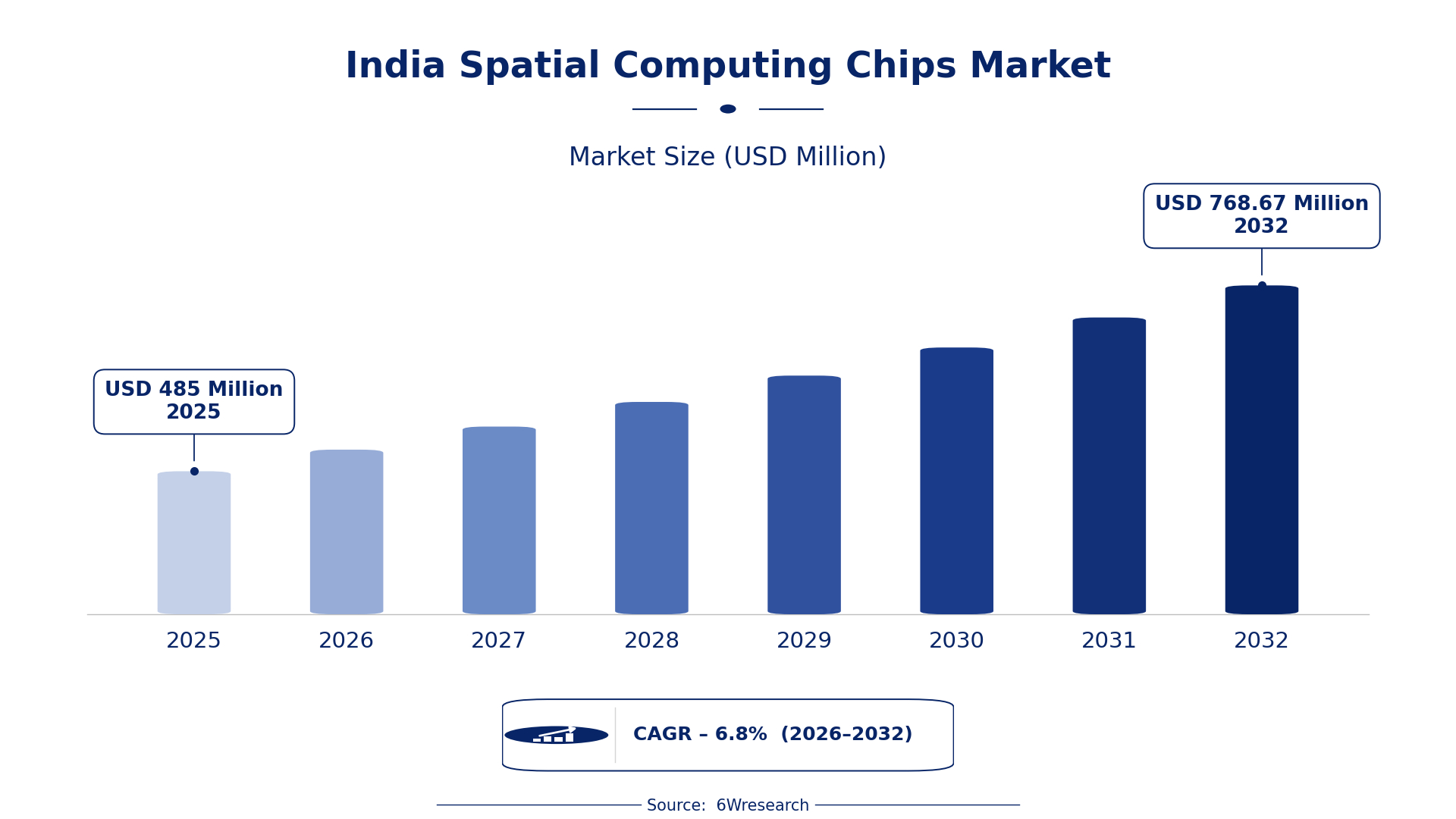
According to 6Wresearch internal database and industry insights, the India Spatial Computing Chips Market was valued at USD 485.0 million in 2025 and is projected to reach USD 768.67 million by 2032, growing at a CAGR of approximately 6.8% during 2026–2032.
India Spatial Computing Chips Market Highlights
| Report Metric | Details |
| Report Name | India Spatial Computing Chips Market |
| Market Size 2025 | USD 485.0 million |
| Market Size 2032 | USD 768.67 million |
| Absolute Growth 2025–2032 | USD 283.67 million |
| CAGR 2026–2032 | 6.8% |
| Peak Annual Growth | 9.4% in 2028 |
| Forecast Period | 2026–2032 |
| Historical Data | 2022–2025 |
| Base Year | 2025 |
| Leading Chip Type, 2025 | AR/VR Chips (39% share) |
| Leading Processing Capability, 2025 | 3D Rendering (35% share) |
| Leading Form Factor, 2025 | SoC (43% share) |
| Leading End User, 2025 | Mixed Reality Device Makers (42% share) |
| Fastest-Growing Chip Type | AI Vision Chips (8.5% CAGR) |
| Fastest-Growing Processing Capability | SLAM + Object Detection (8.6% CAGR) |
| Fastest-Growing Form Factor | Microprocessor/ASIC (8.8% CAGR) |
| Fastest-Growing End User | Robotics Companies (8.3% CAGR) |
| Growing Sector | Robotics |
| Key End Users | Mixed Reality Device Makers, Robotics Companies, Smart Glasses OEMs, Fitness Device Firms |
India Spatial Computing Chips Market Year-wise Growth Rate and Key Drivers (2022–2032)
This graph illustrates the annual growth rates of the market from 2022 to 2032, highlighting a steady upward trajectory and projected market expansion over the forecast period.
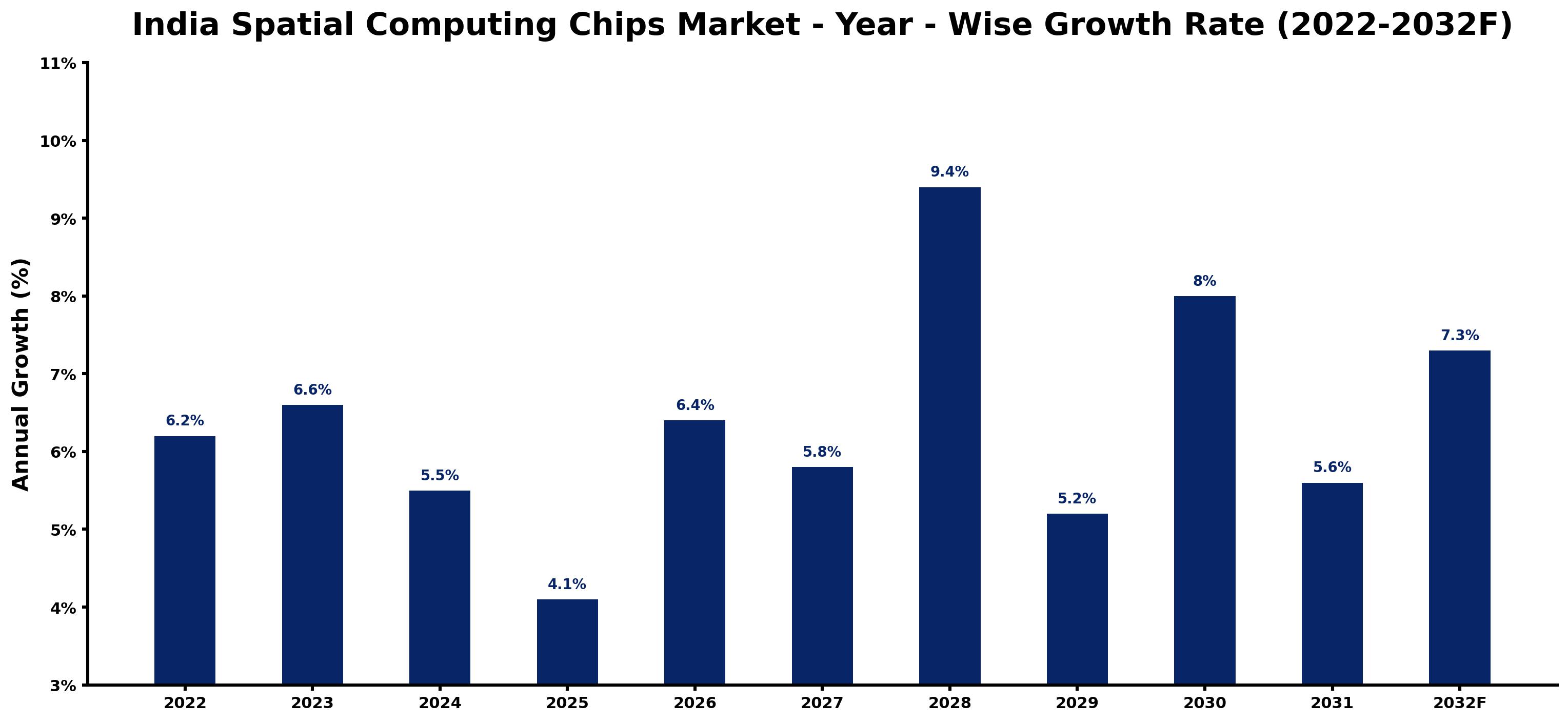
Year by year, the estimates below pair each growth rate with the development that shaped it.
| Year | Estimated Annual Growth (%) | Market Rationale |
| 2022 | 6.2 | The market showed steady growth due to increased interest in AR/VR technologies driven by the Digital India Programme. |
| 2023 | 6.6 | Demand accelerated as the Indian robotics industry began to expand, increasing the need for advanced chips. |
| 2024 | 5.5 | Growth slowed as investments in AR/VR applications faced temporary challenges from supply chain issues. |
| 2025 | 4.1 | The market continued to grow, albeit at a slower pace due to regulatory adjustments affecting production timelines. |
| 2026 | 6.4 | Demand surged as the National Program on AI boosted interest in AI Vision Chips across various sectors. |
| 2027 | 5.8 | The growth rate declined slightly as the market adjusted to new supply dynamics after rapid expansion. |
| 2028 | 9.4 | A peak in growth occurred as investments in immersive technologies reached new heights, particularly in gaming. |
| 2029 | 5.2 | The market experienced a slowdown as demand stabilised after rapid growth, influenced by increased competition. |
| 2030 | 8.0 | Growth increased again as the Digital India initiative continued to promote AR/VR, driving technology adoption. |
| 2031 | 5.6 | The market grew at a slower pace as competition intensified among local producers in the robotics sector. |
| 2032 | 7.3 | Demand is expected to rise as the National Robotics Mission drives innovation and investment in robotics. |
Note: Market size estimations and growth projections presented in this report are based on 6Wresearch's proprietary forecasting methodology, utilizing the latest available industry data, government publications, and primary research inputs.
India Spatial Computing Chips Market Synopsis
The India Spatial Computing Chips Market encompasses specialized semiconductor devices designed for processing spatial data in augmented and virtual reality applications. These chips enable functionalities such as 3D rendering, depth sensing, and motion tracking, catering primarily to technology firms and robotics companies. This market is expanding due to increasing investments in AR/VR technologies and the growing robotics industry. Initiatives like the Digital India Programme and the National Robotics Mission are key drivers of this growth, promoting innovation and increasing demand for advanced chips.
Market Dynamics Impact Analysis (2026–2032)
| Factor | Type | Impact | Primary Segment Affected |
| Increasing investments in AR/VR technologies are driving demand for Spatial Computing Chips. | Driver | High | AR/VR Chips |
| The growth of the Indian robotics industry is creating a need for advanced chips. | Driver | High | AI Vision Chips |
| The rising demand for smart wearable devices presents an opportunity for chip manufacturers. | Opportunity | High | Wearable-Compatible |
| The establishment of tech hubs in states like Karnataka is creating a local demand surge. | Opportunity | High | Mixed Reality Device Makers |
| Supply chain disruptions can delay chip production and delivery timelines. | Restraint | High | Depth-Sensing Chips |
| High manufacturing costs may limit the affordability of advanced chips for buyers. | Restraint | Medium | Motion Tracking Chips |
| Limited local expertise in advanced semiconductor manufacturing poses challenges. | Challenge | High | 3D Rendering |
| Competition from international chip manufacturers can affect market share for local firms. | Challenge | Medium | SoC |
Evaluation of Drivers in India Spatial Computing Chips Market (2026–2032)
Key forces behind demand, with the segment each one moves most, are listed below.
| Drivers | Primary Segment Affected | Why It Matters (Evidence) |
| Growing demand for immersive experiences in gaming and entertainment. | AR/VR Chips | The Indian gaming industry is expected to reach $3 billion by 2024, driving the need for advanced AR/VR technologies. |
| Expansion of robotics applications across various sectors. | AI Vision Chips | The Indian robotics industry is projected to grow at a CAGR of 30%, increasing chip demand for automation. |
| Rising investments in smart wearable devices. | Wearable-Compatible | The market for smart wearables is anticipated to reach $10 billion by 2025, increasing demand for advanced chips. |
| Increased focus on depth sensing for AR applications. | Depth-Sensing Chips | The National Robotics Mission aims to boost innovation, increasing demand for depth-sensing technologies. |
| Technological advancements in chip manufacturing processes. | Motion Tracking Chips | The Electronics Policy 2022 encourages local production of advanced semiconductor technologies, improving supply. |
Market growth in India for Spatial Computing Chips is supported by increasing end-use demand from sectors such as gaming, robotics, and smart devices. The Indian robotics industry is set for substantial growth, which will drive the need for advanced chips to support automation. Investments in smart wearable devices are rising as fitness device companies seek enhanced tracking capabilities. The National Robotics Mission promotes innovation, further increasing the demand for depth-sensing and motion-tracking chips.
Evaluation of Restraints in India Spatial Computing Chips Market
Below mentioned are some major restraints and their influence on market dynamics.
| Market Restraint | Primary Segment Affected | Why It Matters (Evidence) |
| Supply chain disruptions affecting chip availability. | Depth-Sensing Chips | These disruptions can lead to delays in production and delivery, impacting manufacturers' ability to meet demand. |
| High production costs limiting affordability for buyers. | Motion Tracking Chips | Increased costs can deter smaller firms from investing in advanced chip technologies, limiting market growth. |
| Limited local expertise in semiconductor manufacturing. | 3D Rendering | This gap can hinder the development of competitive local chip production capabilities, affecting supply. |
| Regulatory hurdles complicating the approval process for new technologies. | AI Vision Chips | Intense competition from established international manufacturers can affect market penetration for local producers. |
| Fluctuating demand from the robotics sector creating supply shortages. | AR/VR Chips | This instability can lead to unpredictable production schedules, affecting availability for buyers. |
India Spatial Computing Chips Market Challenges
The India Spatial Computing Chips market still has to solve a few problems, and the first is regulatory hurdles. Evolving standards from the Bureau of Indian Standards can delay chip production timelines by up to six months, impacting buyers who depend on timely deliveries. Buyers also struggle with sourcing chips due to fluctuating demand from the rapidly growing robotics sector, projected to expand at a CAGR of 30% from 2023, leading to supply shortages. High production costs, driven by advanced fabrication techniques, can inflate prices by 20% for suppliers, limiting affordability for smaller tech firms. A lack of skilled workers in AR/VR technology training restricts the workforce's ability to meet industry needs, causing project rollout delays for clinics and tech startups.
Trends in the India Spatial Computing Chips Market
Buyers and suppliers in the India Spatial Computing Chips Market are adjusting to the following trends.
- Digital India Programme Boosting AR/VR Adoption: The Digital India Programme, launched in 2020, is driving AR/VR technologies, resulting in increased demand for Spatial Computing Chips as local firms embrace these technologies.
- Growth in Robotics Sector Driving Chip Demand: The Indian robotics industry is projected to grow at a CAGR of 30% from 2023, heightening the need for advanced Spatial Computing Chips to facilitate automation.
- Emergence of Smart Wearables: The rise of smart wearable devices is generating a surge in demand for Spatial Computing Chips, with a projected market growth of 25% in this segment by 2025.
- Karnataka as a Tech Hub: Karnataka has emerged as a hub for tech startups focusing on AR/VR, boosting local demand for Spatial Computing Chips, with an estimated 15% growth in 2023.
Investment Opportunities in the India Spatial Computing Chips Market
Investors looking at the India Spatial Computing Chips Market should consider the following areas.
- $1 Billion Fund for Semiconductor Development: The Indian government's $1 billion fund for semiconductor development offers an opportunity for manufacturers to invest in advanced chip production, targeting the growth of the robotics sector.
- Rising Demand from Fitness Device Firms: As the fitness industry expands, chip manufacturers have an opportunity to supply advanced tracking chips, especially for smart wearable devices.
- Growing Local Manufacturing Needs: The Electronics Policy 2022 promotes local production of semiconductors, creating opportunities for investment in manufacturing facilities throughout India.
- Expansion of AR/VR Applications: With the growth of AR/VR applications, there is a pressing need for advanced chips, particularly from mixed reality device makers, to improve product capabilities.
Government Initiatives in the India Spatial Computing Chips Market
In 2023, the Ministry of Electronics and Information Technology launched the 'Semiconductor Mission' with a budget of $10 billion to promote local chip manufacturing. This initiative aims to enhance domestic production capabilities, benefiting buyers by ensuring a more stable supply of Spatial Computing Chips. The 'National Policy on Electronics 2019' seeks to achieve a $400 billion electronics manufacturing industry by 2025, promoting chip production and innovation in the sector.
The Semiconductor Mission funds local chip production initiatives, while the National Institute of Electronics and Information Technology (NIELIT) provides training on AR/VR technologies, supporting industry growth and ensuring a skilled workforce for chip manufacturing. The Production-Linked Incentive Scheme encourages investment in electronics manufacturing, further strengthening local capabilities.
Future Insight of the India Spatial Computing Chips Market
The India Spatial Computing Chips market is expected to undergo significant evolution by 2032, driven by several key factors. The National Program on AI will stimulate demand for advanced chips across various sectors, integrating them into smart devices. The $1 billion fund for semiconductor development will support local manufacturing, reducing reliance on imports. The Digital India initiative will promote broader adoption of AR/VR technologies, creating new market opportunities. The establishment of the National Robotics Mission will further drive innovation, nurturing a vibrant environment for spatial computing.
Market Segmentation Analysis
Each segment group is reviewed below, with the leader by share and the fastest grower by CAGR.
By Chip Type – AR/VR Chips Dominated, AI Vision Chips Expected to Grow Fastest
According to Summon Dutta, Assistant Manager at 6Wresearch, the largest chip type category in 2025 was AR/VR Chips, with a 39% share of total revenue. AR/VR chips lead the India Spatial Computing Chips Market due to their essential role in rendering immersive experiences for applications such as gaming and training simulations. The government's 'Digital India' initiative has significantly increased demand for these chips, solidifying their market position. AI Vision Chips are projected to grow fastest, at a CAGR of 8.5% during 2026–2032. AI Vision chips are growing rapidly, driven by the rising need for visual recognition technologies across sectors, as indicated by the National Program on AI. This growth is further supported by investments in robotics that are increasingly reliant on advanced visual capabilities. Suppliers should focus on enhancing their AI Vision chip offerings to capitalise on this growth, while buyers can anticipate improved functionalities in their applications.
By Processing Capability – 3D Rendering Dominated, SLAM + Object Detection Expected to Grow Fastest
3D Rendering held a 35% share of the India Spatial Computing Chips Market by processing capability in 2025. 3D rendering holds the largest market share as it is crucial for creating realistic graphics in spatial computing applications like AR and VR. The demand for high-quality visuals, especially in gaming and training, has reinforced its leading position in the market. SLAM + Object Detection is set to record the highest CAGR in this split, 8.6% over 2026–2032. SLAM and object detection are experiencing the fastest growth, spurred by the increasing need for real-time mapping and object recognition in AR applications. This trend is bolstered by advancements in robotics that require precise navigation and interaction capabilities. Investing in SLAM and object detection technologies could yield significant returns for suppliers, while buyers can expect enhanced navigation features in their AR applications.
By Form Factor – SoC Dominated, Microprocessor/ASIC Expected to Grow Fastest
SoC took a 43% share of form factor in 2025, more than any other category. System on Chip (SoC) technology commands the largest market share as it provides a compact solution that integrates multiple functionalities vital for spatial computing. This integration is essential for manufacturers aiming to optimise space and performance in devices like AR headsets. The quickest growth will come from Microprocessor/ASIC, forecast to expand at a CAGR of 8.8% between 2026 and 2032. Microprocessor and ASIC technologies are the fastest-growing form factors, driven by the demand for high-performance processing in advanced spatial computing devices. As applications develop, the need for robust processing capabilities continues to escalate. Suppliers should prioritise the development of Microprocessor and ASIC solutions to meet rising demand, while buyers can leverage these advancements for improved device performance.
By End User – Mixed Reality Device Makers Dominated, Robotics Companies Expected to Grow Fastest
With a 42% revenue share in 2025, Mixed Reality Device Makers was the largest end user category. Mixed reality device makers represent the largest market share as they are the primary users of spatial computing chips for developing innovative products. The increasing consumer interest in mixed reality experiences has led to heightened demand from this segment. Over 2026–2032, Robotics Companies are expected to post the fastest growth, at a CAGR of 8.3%. Robotics companies are the fastest-growing end users, propelled by the rising need for navigation and interaction capabilities in robotic systems. The establishment of the National Robotics Mission has further accelerated this growth, creating a robust market for spatial computing chips. Suppliers should tailor their products to meet the specific needs of robotics companies, while buyers can expect enhanced functionalities that improve robotic performance.
Key Attractiveness of the Report
- 10 Years of Market Numbers
- Historical Data Starting from 2022 to 2025
- Base Year 2025
- Forecast Data until 2032
- Key Performance Indicators Impacting the Market
- Major Upcoming Developments and Projects
Key Highlights of the Report:
- India Spatial Computing Chips Market Outlook
- Market Size of India Spatial Computing Chips Market, 2025
- Forecast of India Spatial Computing Chips Market, 2032
- Historical Data and Forecast of India Spatial Computing Chips Revenues & Volume for the Period 2022 - 2032F
- India Spatial Computing Chips Market Trend Evolution
- India Spatial Computing Chips Market Drivers and Challenges
- India Spatial Computing Chips Price Trends
- India Spatial Computing Chips Porter's Five Forces
- India Spatial Computing Chips Industry Life Cycle
- Historical Data and Forecast of India Spatial Computing Chips Market Revenues & Volume By Chip Type for the Period 2022 - 2032F
- Historical Data and Forecast of India Spatial Computing Chips Market Revenues & Volume By AR/VR Chips for the Period 2022 - 2032F
- Historical Data and Forecast of India Spatial Computing Chips Market Revenues & Volume By AI Vision Chips for the Period 2022 - 2032F
- Historical Data and Forecast of India Spatial Computing Chips Market Revenues & Volume By Depth-Sensing Chips for the Period 2022 - 2032F
- Historical Data and Forecast of India Spatial Computing Chips Market Revenues & Volume By Motion Tracking Chips for the Period 2022 - 2032F
- Historical Data and Forecast of India Spatial Computing Chips Market Revenues & Volume By Processing Capability for the Period 2022 - 2032F
- Historical Data and Forecast of India Spatial Computing Chips Market Revenues & Volume By 3D Rendering for the Period 2022 - 2032F
- Historical Data and Forecast of India Spatial Computing Chips Market Revenues & Volume By SLAM + Object Detection for the Period 2022 - 2032F
- Historical Data and Forecast of India Spatial Computing Chips Market Revenues & Volume By Time-of-Flight for the Period 2022 - 2032F
- Historical Data and Forecast of India Spatial Computing Chips Market Revenues & Volume By IMU-Based for the Period 2022 - 2032F
- Historical Data and Forecast of India Spatial Computing Chips Market Revenues & Volume By Form Factor for the Period 2022 - 2032F
- Historical Data and Forecast of India Spatial Computing Chips Market Revenues & Volume By SoC for the Period 2022 - 2032F
- Historical Data and Forecast of India Spatial Computing Chips Market Revenues & Volume By Microprocessor/ASIC for the Period 2022 - 2032F
- Historical Data and Forecast of India Spatial Computing Chips Market Revenues & Volume By Integrated Circuit for the Period 2022 - 2032F
- Historical Data and Forecast of India Spatial Computing Chips Market Revenues & Volume By Wearable-Compatible for the Period 2022 - 2032F
- Historical Data and Forecast of India Spatial Computing Chips Market Revenues & Volume By End User for the Period 2022 - 2032F
- Historical Data and Forecast of India Spatial Computing Chips Market Revenues & Volume By Mixed Reality Device Makers for the Period 2022 - 2032F
- Historical Data and Forecast of India Spatial Computing Chips Market Revenues & Volume By Robotics Companies for the Period 2022 - 2032F
- Historical Data and Forecast of India Spatial Computing Chips Market Revenues & Volume By Smart Glasses OEMs for the Period 2022 - 2032F
- Historical Data and Forecast of India Spatial Computing Chips Market Revenues & Volume By Fitness Device Firms for the Period 2022 - 2032F
- India Spatial Computing Chips Import Export Trade Statistics
- Market Opportunity Assessment By Chip Type
- Market Opportunity Assessment By Processing Capability
- Market Opportunity Assessment By Form Factor
- Market Opportunity Assessment By End User
- India Spatial Computing Chips Top Companies Market Share
- India Spatial Computing Chips Competitive Benchmarking By Technical and Operational Parameters
- India Spatial Computing Chips Company Profiles
- India Spatial Computing Chips Key Strategic Recommendations
Market Covered
The report offers an extensive study of the following market segments.
By Chip Type
- AR/VR Chips
- AI Vision Chips
- Depth-Sensing Chips
- Motion Tracking Chips
By Processing Capability
- 3D Rendering
- SLAM + Object Detection
- Time-of-Flight
- IMU-Based
By Form Factor
- SoC
- Microprocessor/ASIC
- Integrated Circuit
- Wearable-Compatible
By End User
- Mixed Reality Device Makers
- Robotics Companies
- Smart Glasses OEMs
- Fitness Device Firms































