China Spatial Computing Chips Market Size & Growth Rate
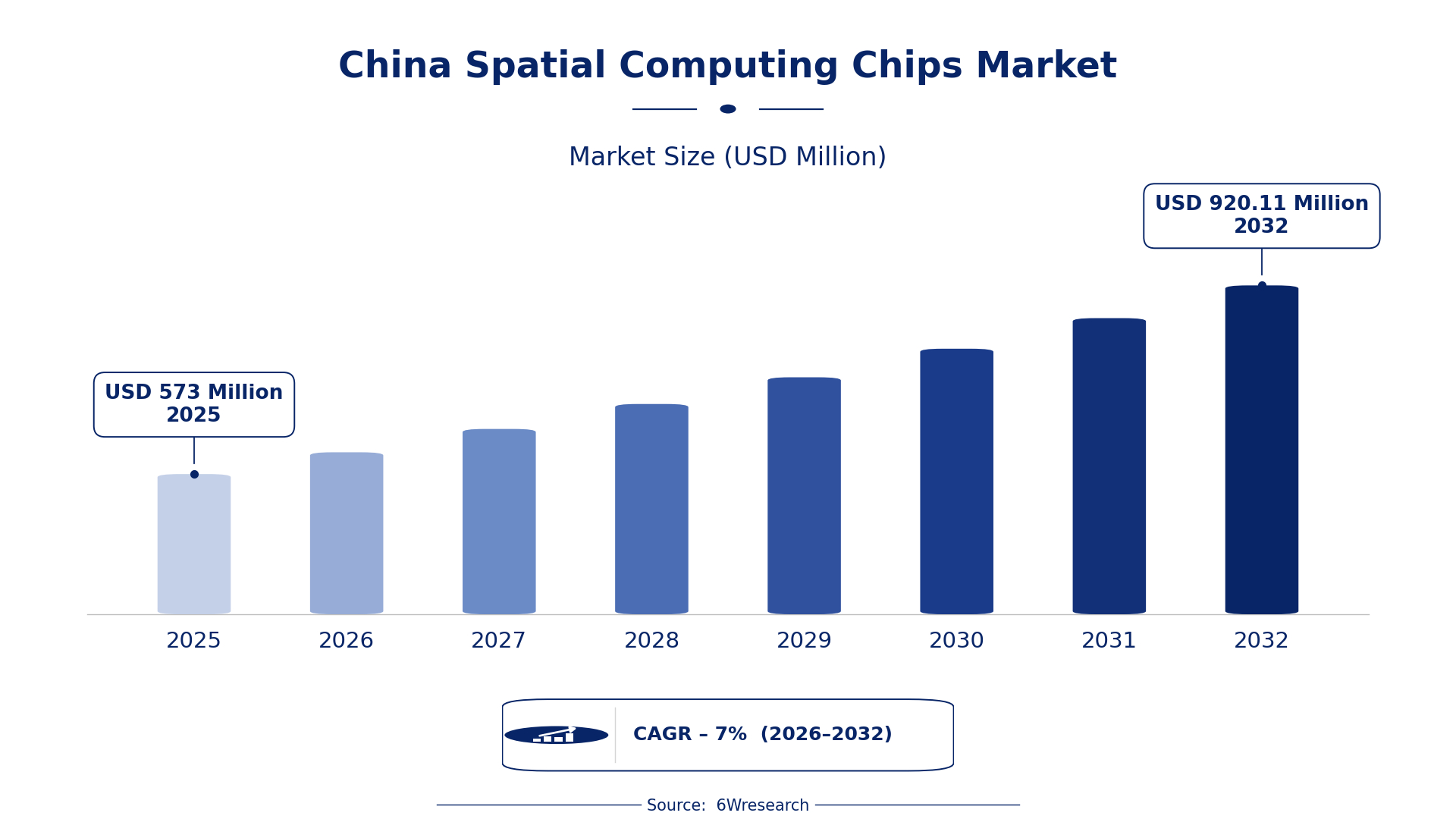
According to 6Wresearch internal database and industry insights, the China Spatial Computing Chips Market was valued at USD 573.0 million in 2025 and is projected to reach USD 920.11 million by 2032, growing at a CAGR of approximately 7% during 2026–2032.
China Spatial Computing Chips Market Highlights
| Report Metric | Details |
| Report Name | China Spatial Computing Chips Market |
| Market Size 2025 | USD 573.0 million |
| Market Size 2032 | USD 920.11 million |
| Absolute Growth 2025–2032 | USD 347.11 million |
| CAGR 2026–2032 | 7% |
| Peak Annual Growth | 9.5% in 2031 |
| Forecast Period | 2026–2032 |
| Historical Data | 2022–2025 |
| Base Year | 2025 |
| Leading Chip Type, 2025 | AR/VR Chips (37% share) |
| Leading Processing Capability, 2025 | 3D Rendering (48% share) |
| Leading Form Factor, 2025 | SoC (38% share) |
| Leading End User, 2025 | Mixed Reality Device Makers (42% share) |
| Fastest-Growing Chip Type | AI Vision Chips (9.1% CAGR) |
| Fastest-Growing Processing Capability | SLAM + Object Detection (8.6% CAGR) |
| Fastest-Growing Form Factor | Wearable-Compatible (9.2% CAGR) |
| Fastest-Growing End User | Robotics Companies (9.5% CAGR) |
| Growing Sector | Robotics Companies |
| Key End Users | Mixed Reality Device Makers, Robotics Companies, Smart Glasses OEMs, Fitness Device Firms |
China Spatial Computing Chips Market Year-wise Growth Rate and Key Drivers (2022–2032)
This graph illustrates the annual growth rates of the market from 2022 to 2032, highlighting a steady upward trajectory and projected market expansion over the forecast period.
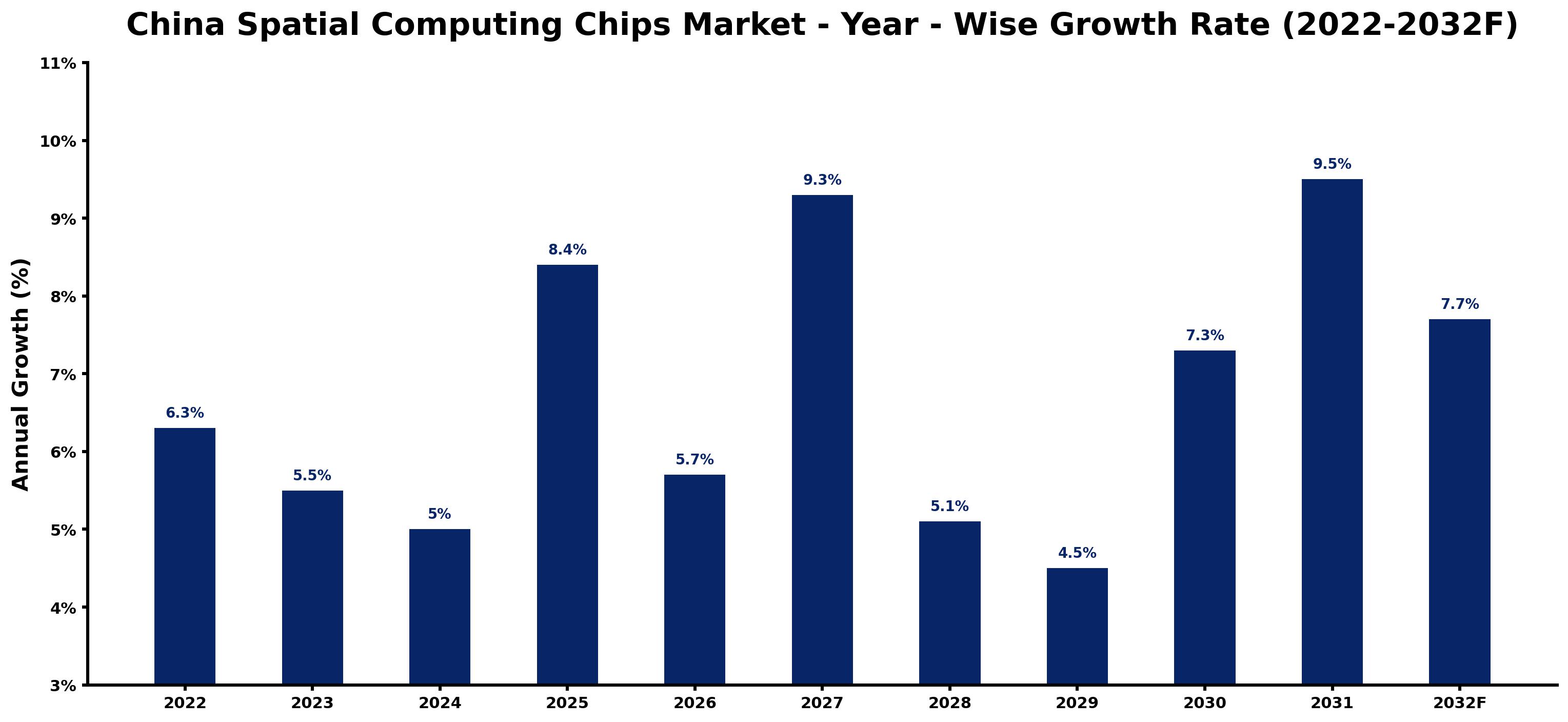
Each row of the following table gives one year's estimated growth and the event or demand shift that explains it.
| Year | Estimated Annual Growth (%) | Market Rationale |
| 2022 | 6.3 | The market experienced solid growth due to increasing interest in AR and VR technologies. |
| 2023 | 5.5 | Growth slowed as the market adjusted to supply chain challenges affecting chip production. |
| 2024 | 5.0 | Demand continued to decrease slightly as companies focused on refining existing technologies. |
| 2025 | 8.4 | A surge in user adoption in the AR/VR market led to accelerated growth in chip demand. |
| 2026 | 5.7 | Growth slowed as manufacturers faced challenges in scaling production to meet rising demand. |
| 2027 | 9.3 | Increased investment in robotics and smart devices drove a rebound in market growth. |
| 2028 | 5.1 | Demand slowed as the market stabilised after rapid expansions driven by new applications. |
| 2029 | 4.5 | Growth continued to slow as the market adjusted to evolving consumer preferences in smart devices. |
| 2030 | 7.3 | A resurgence in interest in immersive technologies boosted demand for spatial computing components. |
| 2031 | 9.5 | The market peaked due to heightened investments in mixed reality applications and AI technologies. |
| 2032 | 7.7 | Growth slowed as the market began to reach saturation in key segments of smart devices. |
Note: Market size estimations and growth projections presented in this report are based on 6Wresearch's proprietary forecasting methodology, utilizing the latest available industry data, government publications, and primary research inputs.
China Spatial Computing Chips Market Synopsis
The China Spatial Computing Chips Market encompasses specialized processors designed for augmented and virtual reality applications. These processors are essential for visual rendering, motion tracking, and AI vision capabilities in devices. The market is expanding due to rising demand from domestic technology companies and ongoing investments in smart devices. By 2025, China's AR/VR market is projected to reach 1.5 billion users, driving further demand for these components. Initiatives like the 'Digital Economy Development Strategy' are also contributing to this growth.
Market Dynamics Impact Analysis (2026–2032)
| Factor | Type | Impact | Primary Segment Affected |
| Increasing user adoption of AR and VR technologies drives demand for spatial computing chips. | Driver | High | AR/VR Chips |
| Rising investments in robotics and smart devices create opportunities for chip manufacturers. | Driver | High | AI Vision Chips |
| The growing market for smart wearable devices presents a significant opportunity for chip suppliers. | Opportunity | High | Wearable-Compatible |
| The push for advanced semiconductor technology creates a gap for investment in new manufacturing processes. | Opportunity | Medium | SoC |
| Supply chain disruptions have affected the availability of essential materials for chip production. | Restraint | High | Depth-Sensing Chips |
| High production costs limit the ability of smaller manufacturers to compete effectively in the market. | Restraint | Medium | Motion Tracking Chips |
| Buyers face challenges in sourcing reliable components due to fluctuating market conditions. | Challenge | High | Mixed Reality Device Makers |
| Suppliers struggle with the rapid pace of technological advancements, making it hard to keep up. | Challenge | Medium | Robotics Companies |
Evaluation of Drivers in China Spatial Computing Chips Market (2026–2032)
The table below links each growth driver to the segment it affects and the evidence for it.
| Drivers | Primary Segment Affected | Why It Matters (Evidence) |
| Growing user base for AR/VR applications increases demand for AR/VR Chips. | AR/VR Chips | China's AR/VR market is projected to reach 1.5 billion users by 2025. |
| Investments in smart devices drive demand for AI Vision Chips. | AI Vision Chips | The smart wearable device market is expected to see over 400 million units sold in 2023. |
| The rise of robotics increases the need for Motion Tracking Chips. | Motion Tracking Chips | Robotics investment in Guangdong is driving demand for these chips. |
| Depth-sensing technology is increasingly adopted in gaming, boosting demand for Depth-Sensing Chips. | Depth-Sensing Chips | Depth-sensing technology is being widely adopted in gaming and entertainment sectors in China. |
| The push for advanced semiconductor technology supports the growth of SoC. | SoC | The 'Made in China 2025' initiative emphasises advanced semiconductor technology development. |
The Spatial Computing Chips market in China is expanding due to rising user adoption of AR and VR technologies, along with increased investments in robotics and smart devices. China's AR/VR market is projected to reach 1.5 billion users by 2025, which will boost chip demand. The smart wearable device market is anticipated to surpass 400 million units sold in 2023, prompting manufacturers to innovate. Investment in robotics, particularly in Guangdong province, is heightening the need for Motion Tracking solutions. The uptake of depth-sensing technology in gaming is also driving demand for these components.
Evaluation of Restraints in China Spatial Computing Chips Market
The table below lists the restraints and the evidence behind each.
| Market Restraint | Primary Segment Affected | Why It Matters (Evidence) |
| Supply chain disruptions affect the availability of materials for chip production. | Depth-Sensing Chips | Production delays have been reported due to shortages in semiconductor materials, impacting delivery schedules. |
| High production costs limit competition among smaller manufacturers. | Motion Tracking Chips | Smaller firms struggle to invest in advanced manufacturing technologies, hindering their market presence. |
| Fluctuating market conditions create sourcing challenges for buyers. | Mixed Reality Device Makers | Buyers often face delays in obtaining reliable components, affecting production timelines. |
| Rapid technological advancements outpace suppliers' capabilities. | Robotics Companies | Suppliers find it difficult to keep up with the fast pace of innovation, delaying new product launches. |
| Regulatory hurdles slow down the approval process for new technologies. | AI Vision Chips | New standards for AR/VR technology are being developed, causing delays in product certifications. |
China Spatial Computing Chips Market Challenges
Buyers and suppliers in the China Spatial Computing Chips market face intense competition from both local and foreign entities, which compresses profit margins and necessitates price reductions. This competition arises from the rapidly growing AR/VR market, projected to reach 1.5 billion users by 2025, compelling producers to lower costs to maintain market share. A shortage of skilled professionals in advanced semiconductor fabrication hampers production efficiency, leading to longer lead times for suppliers and delayed product availability for buyers. Regulatory developments, including the establishment of national AR/VR standards, impose additional compliance costs on producers, which could translate to higher prices for buyers in the short term.
Trends in the China Spatial Computing Chips Market
Several trends are reshaping the China Spatial Computing Chips Market; the most important are set out below.
- Shift towards Advanced Depth-Sensing Technology: The 'Digital Economy Development Strategy' launched in 2023 promotes investment in depth-sensing technology, essential for AR applications. This shift is expected to improve user experiences, with the technology being widely adopted across various sectors, driving market growth.
- Emergence of AI Vision Chips: Since 2021, the 'Artificial Intelligence Innovation Action Plan' has accelerated the development of AI Vision Chips. This trend is reshaping the market, with the AI Vision Chips segment anticipated to grow due to increasing demand for smart surveillance systems, reflecting broader technological advancements.
- Rise of Wearable-Compatible Chips: The growing interest in fitness and health tracking has led to a rise in demand for Wearable-Compatible chips. With over 400 million smart wearable devices expected to be sold in 2023, this segment is becoming increasingly vital for manufacturers aiming to meet consumer needs.
- Focus on Mixed Reality Devices: Mixed Reality Device Makers are prioritising advanced chip technologies to improve user experiences. The installed base of smart glasses in China was estimated at 10 million units in 2023, indicating strong market potential and driving demand for innovative chip solutions.
Investment Opportunities in the China Spatial Computing Chips Market
Below are the investment opportunities with the strongest case in the China Spatial Computing Chips Market.
- Gap in Advanced Chip Technology: With the smart wearable device market expected to see over 400 million units sold in 2023, there is an opportunity for suppliers to invest in advanced chip technologies. Collaborating with Mixed Reality Device Makers can facilitate market entry and spur innovation.
- Timing for Robotics Investment: The increasing investment in robotics presents a timely opportunity for suppliers to provide Motion Tracking and Depth-Sensing Chips. Partnering with leading robotics companies in Guangdong can enhance market presence and drive growth.
- Approval for New Standards: The ongoing development of national standards for AR/VR technology creates an opportunity for suppliers to align their products with regulatory requirements. Engaging with the Standardization Administration of China can facilitate smoother market entry.
- Demand for Enhanced User Experiences: As the installed base of smart glasses reaches 10 million units, there is a growing need for advanced chip technologies. Suppliers can enter this market by collaborating with smart glasses OEMs to develop tailored solutions.
Government Initiatives in the China Spatial Computing Chips Market
The 'New Generation Artificial Intelligence Development Plan', initiated by the Ministry of Industry and Information Technology in 2020, aims to enhance AI capabilities, including spatial computing technologies. This plan mandates that producers invest in advanced technologies to stay competitive, ensuring that spatial computing chips meet evolving industry standards. The initiative is expected to drive innovation and increase the quality of products available in the market, benefiting both producers and consumers. Furthermore, the 'Made in China 2025' initiative emphasises advanced semiconductor technology development, which is essential for the growth of spatial computing applications.
The 'Digital Economy Development Strategy', launched by the National Development and Reform Commission in 2023, promotes investment in digital technologies, including spatial computing. This strategy supports funding for research and development in advanced chip technologies and aims to streamline the approval process for new products. Agencies involved in this initiative will facilitate partnerships between tech firms and research institutions, improving the overall ecosystem for spatial computing development. This collaboration is expected to lead to faster product launches and enhanced market competitiveness.
Future Insight of the China Spatial Computing Chips Market
By 2032, buyers and suppliers in the China Spatial Computing Chips market will experience transformative changes driven by key initiatives like the 'Digital Economy Development Strategy' and the 'Artificial Intelligence Innovation Action Plan'. These programmes will improve the integration of spatial computing in various devices, fostering new applications and expanding market reach. The installed base of smart glasses is projected to exceed 10 million units by 2025, indicating a growing consumer base. The emphasis on advanced semiconductor technologies under the 'Made in China 2025' initiative will further stimulate innovation and competitiveness in this sector.
Market Segmentation Analysis
The analysis below covers each segmentation, its leading category in 2025 and its fastest-growing category through 2032.
By Chip Type – AR/VR Chips Dominated, AI Vision Chips Expected to Grow Fastest
According to Summon Dutta, Assistant Manager at 6Wresearch, AR/VR Chips held a 37% share of the China Spatial Computing Chips Market by chip type in 2025. AR/VR Chips dominate the market share due to their essential role in delivering immersive experiences in augmented and virtual reality applications. The installed base of smart glasses in China, estimated at 10 million units in 2023, underscores the demand for these chips. Over 2026–2032, AI Vision Chips are expected to post the fastest growth, at a CAGR of 9.1%. AI Vision Chips are experiencing rapid growth driven by the increasing need for advanced vision capabilities in various applications. The anticipated rise in smart surveillance systems is a significant factor propelling this segment forward. Suppliers should focus on enhancing their offerings in AI Vision Chips to capture the growing market share.
By Processing Capability – 3D Rendering Dominated, SLAM + Object Detection Expected to Grow Fastest
In 2025, 3D Rendering led the processing capability split with a 48% share. 3D Rendering leads the market share as it is crucial for generating realistic graphics in augmented and virtual reality applications. This capability is fundamental for engaging users and enriching their experiences in spatial computing environments. The quickest growth will come from SLAM + Object Detection, forecast to expand at a CAGR of 8.6% between 2026 and 2032. SLAM + Object Detection is the fastest-growing segment, fuelled by the demand for real-time environment mapping and object recognition in various applications. This technology is vital for improving user interaction in immersive settings, making it increasingly relevant. Buyers should consider investing in solutions that integrate SLAM + Object Detection to remain competitive in the market.
By Form Factor – SoC Dominated, Wearable-Compatible Expected to Grow Fastest
SoC accounted for a 38% market share by form factor in 2025. SoC dominates the market share due to its capacity to integrate multiple functionalities into a single chip, making it suitable for spatial computing applications. This form factor is widely adopted across various devices, improving performance and efficiency. Wearable-Compatible is projected to grow fastest, at a CAGR of 9.2% during 2026–2032. Wearable-Compatible chips are experiencing rapid growth as they are specifically designed for integration into wearable technology. The surge in smart wearable devices, with over 400 million units projected to be sold in 2023, is driving this expansion. Suppliers must focus on developing Wearable-Compatible solutions to meet the increasing market demand.
By End User – Mixed Reality Device Makers Dominated, Robotics Companies Expected to Grow Fastest
With a 42% revenue share in 2025, Mixed Reality Device Makers was the largest end user category. Mixed Reality Device Makers hold the largest market share as they directly utilise spatial computing chips to create advanced mixed reality hardware. Their focus on developing innovative devices drives substantial demand for these chips. Robotics Companies are set to record the highest CAGR in this split, 9.5% over 2026–2032. Robotics Companies are the fastest-growing segment, leveraging spatial computing chips to enhance robotic perception and interaction capabilities. This trend is accelerating as robotics applications expand across multiple sectors, increasing reliance on these technologies. Buyers in the robotics sector should seek partnerships with chip manufacturers to ensure access to the latest technology.
Key Attractiveness of the Report
- 10 Years of Market Numbers
- Historical Data Starting from 2022 to 2025
- Base Year 2025
- Forecast Data until 2032
- Key Performance Indicators Impacting the Market
- Major Upcoming Developments and Projects
Key Highlights of the Report:
- China Spatial Computing Chips Market Outlook
- Market Size of China Spatial Computing Chips Market, 2025
- Forecast of China Spatial Computing Chips Market, 2032
- Historical Data and Forecast of China Spatial Computing Chips Revenues & Volume for the Period 2022 - 2032F
- China Spatial Computing Chips Market Trend Evolution
- China Spatial Computing Chips Market Drivers and Challenges
- China Spatial Computing Chips Price Trends
- China Spatial Computing Chips Porter's Five Forces
- China Spatial Computing Chips Industry Life Cycle
- Historical Data and Forecast of China Spatial Computing Chips Market Revenues & Volume By Chip Type for the Period 2022 - 2032F
- Historical Data and Forecast of China Spatial Computing Chips Market Revenues & Volume By AR/VR Chips for the Period 2022 - 2032F
- Historical Data and Forecast of China Spatial Computing Chips Market Revenues & Volume By AI Vision Chips for the Period 2022 - 2032F
- Historical Data and Forecast of China Spatial Computing Chips Market Revenues & Volume By Depth-Sensing Chips for the Period 2022 - 2032F
- Historical Data and Forecast of China Spatial Computing Chips Market Revenues & Volume By Motion Tracking Chips for the Period 2022 - 2032F
- Historical Data and Forecast of China Spatial Computing Chips Market Revenues & Volume By Processing Capability for the Period 2022 - 2032F
- Historical Data and Forecast of China Spatial Computing Chips Market Revenues & Volume By 3D Rendering for the Period 2022 - 2032F
- Historical Data and Forecast of China Spatial Computing Chips Market Revenues & Volume By SLAM + Object Detection for the Period 2022 - 2032F
- Historical Data and Forecast of China Spatial Computing Chips Market Revenues & Volume By Time-of-Flight for the Period 2022 - 2032F
- Historical Data and Forecast of China Spatial Computing Chips Market Revenues & Volume By IMU-Based for the Period 2022 - 2032F
- Historical Data and Forecast of China Spatial Computing Chips Market Revenues & Volume By Form Factor for the Period 2022 - 2032F
- Historical Data and Forecast of China Spatial Computing Chips Market Revenues & Volume By SoC for the Period 2022 - 2032F
- Historical Data and Forecast of China Spatial Computing Chips Market Revenues & Volume By Microprocessor/ASIC for the Period 2022 - 2032F
- Historical Data and Forecast of China Spatial Computing Chips Market Revenues & Volume By Integrated Circuit for the Period 2022 - 2032F
- Historical Data and Forecast of China Spatial Computing Chips Market Revenues & Volume By Wearable-Compatible for the Period 2022 - 2032F
- Historical Data and Forecast of China Spatial Computing Chips Market Revenues & Volume By End User for the Period 2022 - 2032F
- Historical Data and Forecast of China Spatial Computing Chips Market Revenues & Volume By Mixed Reality Device Makers for the Period 2022 - 2032F
- Historical Data and Forecast of China Spatial Computing Chips Market Revenues & Volume By Robotics Companies for the Period 2022 - 2032F
- Historical Data and Forecast of China Spatial Computing Chips Market Revenues & Volume By Smart Glasses OEMs for the Period 2022 - 2032F
- Historical Data and Forecast of China Spatial Computing Chips Market Revenues & Volume By Fitness Device Firms for the Period 2022 - 2032F
- China Spatial Computing Chips Import Export Trade Statistics
- Market Opportunity Assessment By Chip Type
- Market Opportunity Assessment By Processing Capability
- Market Opportunity Assessment By Form Factor
- Market Opportunity Assessment By End User
- China Spatial Computing Chips Top Companies Market Share
- China Spatial Computing Chips Competitive Benchmarking By Technical and Operational Parameters
- China Spatial Computing Chips Company Profiles
- China Spatial Computing Chips Key Strategic Recommendations
Market Covered
This report examines the market across the segments below.
By Chip Type
- AR/VR Chips
- AI Vision Chips
- Depth-Sensing Chips
- Motion Tracking Chips
By Processing Capability
- 3D Rendering
- SLAM + Object Detection
- Time-of-Flight
- IMU-Based
By Form Factor
- SoC
- Microprocessor/ASIC
- Integrated Circuit
- Wearable-Compatible
By End User
- Mixed Reality Device Makers
- Robotics Companies
- Smart Glasses OEMs
- Fitness Device Firms































