India Specialty Nonwoven Market Size & Growth Rate
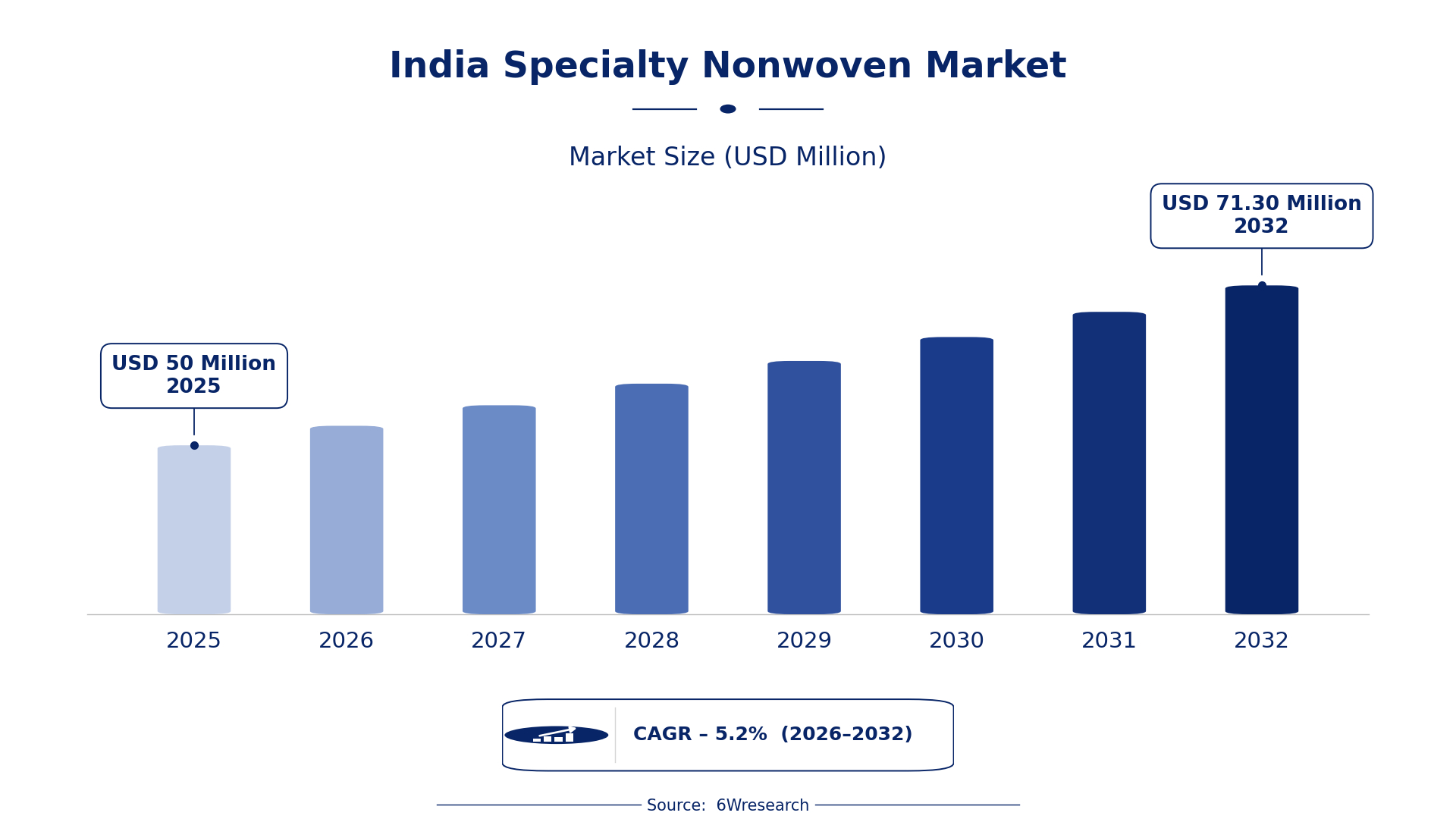
According to 6Wresearch internal database and industry insights, the India Specialty Nonwoven Market was valued at USD 50.0 million in 2025 and is projected to reach USD 71.30 million by 2032, growing at a CAGR of approximately 5.2% during 2026–2032.
India Specialty Nonwoven Market Highlights
| Report Metric | Details |
| Report Name | India Specialty Nonwoven Market |
| Market Size 2025 | USD 50.0 million |
| Market Size 2032 | USD 71.30 million |
| Absolute Growth 2025–2032 | USD 21.30 million |
| CAGR 2026–2032 | 5.2% |
| Peak Annual Growth | 7.4% in 2031 |
| Forecast Period | 2026–2032 |
| Historical Data | 2022–2025 |
| Base Year | 2025 |
| Leading Nonwoven Type, 2025 | Meltblown Nonwoven (43% share) |
| Leading Fabric Technology, 2025 | Polypropylene (37% share) |
| Leading Application Area, 2025 | Disposable Hygiene Products (47% share) |
| Leading End User, 2025 | Diaper Manufacturers (34% share) |
| Fastest-Growing Fabric Technology | Thermoplastic Polymer (6.9% CAGR) |
| Fastest-Growing Application Area | Medical Dressings (7.8% CAGR) |
| Fastest-Growing End User | Hospitals (7.2% CAGR) |
| Growing Sector | Hygiene Products |
| Key End Users | Diaper Manufacturers, Hospitals, Automotive Manufacturers |
India Specialty Nonwoven Market Year-wise Growth Rate and Key Drivers (2022–2032)
This graph illustrates the annual growth rates of the market from 2022 to 2032, highlighting a steady upward trajectory and projected market expansion over the forecast period.
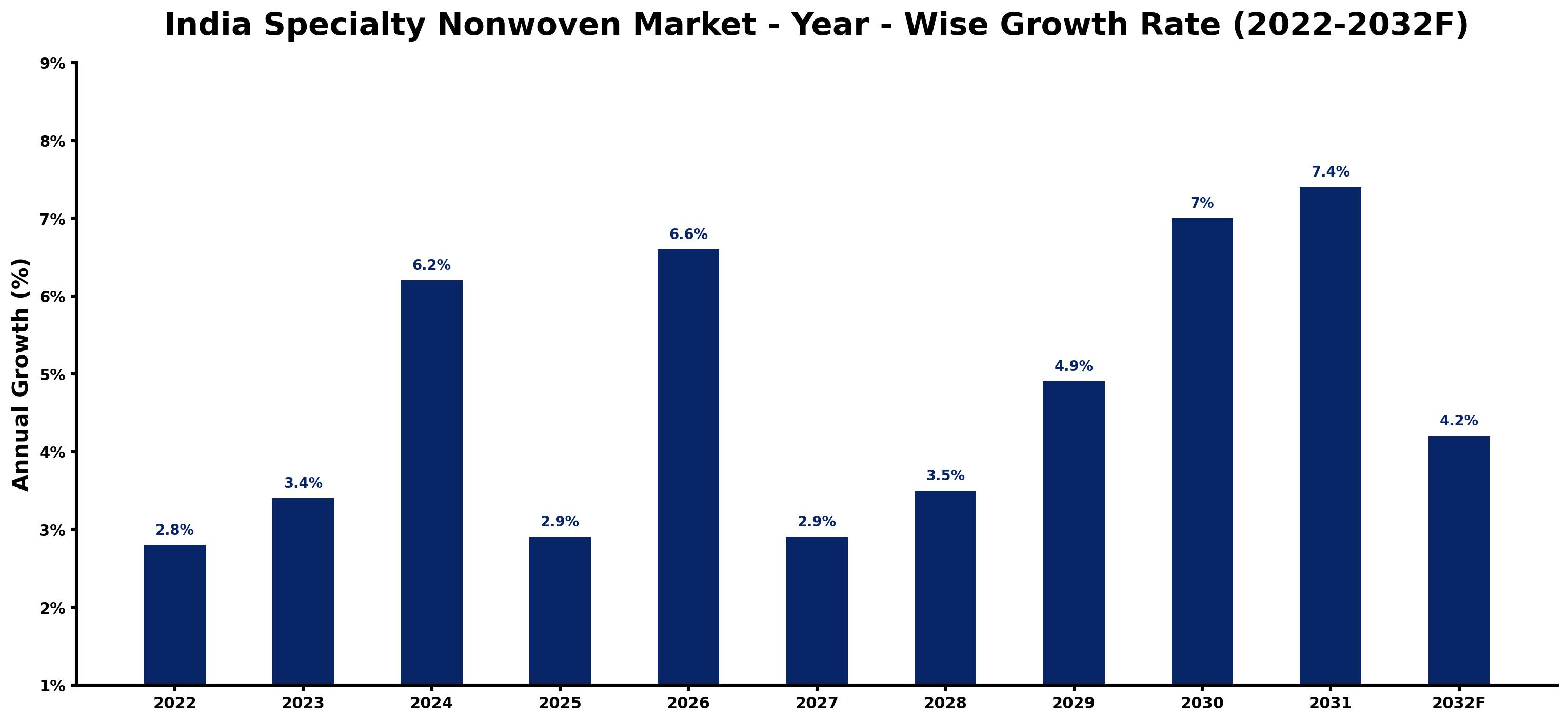
Each row of the following table gives one year's estimated growth and the event or demand shift that explains it.
| Year | Estimated Annual Growth (%) | Market Rationale |
| 2022 | 2.8 | The market experienced steady demand from hygiene and medical sectors, reflecting ongoing consumption patterns. |
| 2023 | 3.4 | Growth accelerated due to increased healthcare needs and the rising production of medical nonwovens. |
| 2024 | 6.2 | The market peaked as demand surged for filtration media and hygiene products amid health concerns. |
| 2025 | 2.9 | Growth slowed as the market adjusted to previous peaks while still benefiting from hygiene product demand. |
| 2026 | 6.6 | A rebound in growth occurred as the automotive sector began utilising more nonwoven materials. |
| 2027 | 2.9 | The market saw another slowdown as production stabilised and demand from medical applications normalised. |
| 2028 | 3.5 | Growth resumed as disposable hygiene products gained traction in response to consumer preferences. |
| 2029 | 4.9 | Increased demand for medical dressings contributed to a rise in market activity and production. |
| 2030 | 7.0 | The market continued to grow as automotive interiors increasingly adopted nonwoven materials. |
| 2031 | 7.4 | A peak in growth was reached, driven by heightened demand in both medical and hygiene sectors. |
| 2032 | 4.2 | Growth slowed as the market began to stabilise after a period of rapid expansion. |
Note: Market size estimations and growth projections presented in this report are based on 6Wresearch's proprietary forecasting methodology, utilizing the latest available industry data, government publications, and primary research inputs.
India Specialty Nonwoven Market Synopsis
The India Specialty Nonwoven Market encompasses engineered textiles made from synthetic fibers, primarily produced through meltblown and spunbond processes. These fabrics are essential for applications in filtration, hygiene products, automotive interiors, and medical uses. The market is expanding due to strong demand from domestic users, particularly in hygiene and medical sectors. With a production volume of approximately 1.5 million tons in 2022, the market is projected to grow, driven by initiatives like the National Textile Policy 2023 and increasing healthcare needs.
Market Dynamics Impact Analysis (2026–2032)
| Factor | Type | Impact | Primary Segment Affected |
| Growing demand for medical nonwovens due to increasing healthcare needs | Driver | High | Medical Dressings |
| Rising automotive production leading to increased use of nonwoven materials | Driver | High | Automotive Interiors |
| Investment in local production facilities for nonwoven fabrics | Opportunity | High | Disposable Hygiene Products |
| Increasing healthcare regulations promoting the use of safe nonwovens | Opportunity | Medium | Medical Dressings |
| Competition from imported nonwoven materials affecting local producers | Restraint | High | Meltblown Nonwoven |
| Fluctuations in raw material prices impacting production costs | Restraint | Medium | Spunbond Nonwoven |
| Challenges in meeting stringent quality standards for medical applications | Challenge | High | Medical Dressings |
| Limited awareness of nonwoven benefits among potential users | Challenge | Medium | Automotive Interiors |
Evaluation of Drivers in India Specialty Nonwoven Market (2026–2032)
The table below links each growth driver to the segment it affects and the evidence for it.
| Drivers | Primary Segment Affected | Why It Matters (Evidence) |
| Increased healthcare spending driving demand for medical nonwovens | Medical Dressings | The medical dressing market is projected to grow significantly due to rising healthcare needs, focusing on quality and safety. |
| Higher automotive production rates leading to greater nonwoven use | Automotive Interiors | The Indian automotive industry is expected to utilise 20% more nonwoven materials by 2025, increasing demand from manufacturers. |
| Supportive government initiatives promoting local manufacturing | Disposable Hygiene Products | The 'Make in India' initiative encourages local production of nonwoven fabrics, reducing dependency on imports. |
| Rising demand for filtration media in healthcare and environmental applications | Filtration Media | Meltblown nonwovens are crucial for producing N95 masks and air filters, driving demand in healthcare settings. |
| Growing consumer awareness of hygiene products and their benefits | Disposable Hygiene Products | The demand for disposable hygiene products is rising as consumers prioritise health and cleanliness. |
Market growth in India for Specialty Nonwoven rests on rising consumer demand from healthcare, automotive, and hygiene sectors. The medical dressing market is projected to grow significantly due to increasing healthcare needs, focusing on quality and safety. The automotive sector will utilise 20% more nonwoven materials by 2025, boosting demand from manufacturers. Consumer awareness of hygiene products is also rising, prompting individuals to prioritise health and cleanliness.
Evaluation of Restraints in India Specialty Nonwoven Market
Below mentioned are some major restraints and their influence on market dynamics.
| Market Restraint | Primary Segment Affected | Why It Matters (Evidence) |
| Competition from imported nonwoven materials affecting local producers | Meltblown Nonwoven | Local producers face challenges from cheaper imports, impacting their market share and pricing strategies. |
| Fluctuations in raw material prices impacting production costs | Spunbond Nonwoven | Rising polypropylene prices can increase production costs by 15%, affecting profitability for manufacturers. |
| Challenges in meeting stringent quality standards for medical applications | Medical Dressings | Producers must invest in quality assurance to comply with regulations, which can increase operational costs. |
| Limited awareness of nonwoven benefits among potential users | Automotive Interiors | Many manufacturers remain unaware of the advantages of nonwovens, hindering market penetration. |
| Dependency on specific suppliers for raw materials | Disposable Hygiene Products | Supply chain disruptions can lead to delays and increased costs for manufacturers reliant on single-source suppliers. |
India Specialty Nonwoven Market Challenges
The India Specialty Nonwoven Market faces several practical issues, the first being cost. Producers encounter elevated raw material prices, particularly for polypropylene, which can inflate production costs by 15% and squeeze profit margins. Importers struggle with a shortage of skills in advanced manufacturing techniques, leading to inefficiencies that delay the supply of essential products like medical dressings. Buyers contend with stiff competition from lower-priced international suppliers, which could result in a 20% decline in market share for local distributors. Lastly, technology adoption among producers is lagging, preventing them from leveraging innovations that could improve product quality and reduce waste.
Trends in the India Specialty Nonwoven Market
Several trends are reshaping the India Specialty Nonwoven Market; the most important are set out below.
- Shift towards Sustainable Nonwoven Materials: The 'Atmanirbhar Bharat' initiative is driving the adoption of sustainable nonwoven materials in India, with a projected increase in eco-friendly options by 30% by 2025.
- Growing Adoption of Nonwovens in Healthcare: Hospitals are increasingly incorporating nonwoven materials for medical applications, with the medical dressing market expected to grow significantly due to rising healthcare needs.
- Expansion of Nonwoven Use in Automotive Interiors: The automotive sector is transitioning towards nonwoven materials for interiors, with a projected demand increase of 20% by 2025, enhancing vehicle comfort and aesthetics.
- Increased Focus on Hygiene Products: The demand for disposable hygiene products is on the rise, with a projected annual market growth of 8%, reflecting evolving consumer preferences towards health and cleanliness.
Investment Opportunities in the India Specialty Nonwoven Market
Investors looking at the India Specialty Nonwoven Market should consider the following areas.
- Diaper Manufacturers Seeking Quality Nonwovens: Diaper manufacturers are increasingly in search of high-quality nonwoven materials, with the market expected to grow due to rising birth rates and consumer demand for hygiene products.
- Timing for Investment in Local Production Facilities: With the Indian textile industry anticipated to attract USD 10 billion in investments by 2025, there exists a prime opportunity for establishing local production facilities to satisfy growing demand.
- Entry through Joint Ventures in Nonwoven Production: Local partnerships can facilitate entry into the nonwoven market, particularly for companies aiming to invest in the expanding hygiene sector and enhance production capabilities.
- Automotive Interiors Demand for Nonwovens: With the automotive industry projected to increase nonwoven usage by 20% by 2025, suppliers can target this expanding segment for new business opportunities.
Government Initiatives in the India Specialty Nonwoven Market
The National Textile Policy 2023 aims to enhance the competitiveness of the textile sector, including nonwovens, through technology upgrades and skill development. This policy builds on previous initiatives by promoting innovation and efficiency in production processes, ensuring that manufacturers can meet evolving market demands. The policy targets a 15% increase in domestic production capacity over the next five years, supporting local producers and strengthening their market position.
The Bureau of Indian Standards (BIS) supervises the implementation of updated standards for nonwoven fabrics, ensuring quality and safety in medical applications. This agency also approves projects aimed at boosting local production capabilities, enabling manufacturers to compete effectively in both domestic and international markets. The Ministry of Health and Family Welfare introduced the 'Healthcare Waste Management Guidelines' in 2021, advocating for the use of safe nonwoven materials in hospitals and ensuring compliance with healthcare regulations.
Future Insight of the India Specialty Nonwoven Market
The India Specialty Nonwoven Market is set to undergo considerable transformations by 2032, primarily driven by advancements in manufacturing processes. The medical dressing segment will expand due to increasing healthcare demands, with a projected annual growth rate of 12%. The automotive sector will increasingly adopt nonwoven materials, creating new opportunities for suppliers. The government's 'Make in India' initiative will stimulate local production, establishing a competitive environment that benefits both buyers and suppliers.
Market Segmentation Analysis
The report offers a comprehensive study of the following market segments and their leading categories in the market.
By Nonwoven Type – Meltblown Nonwoven Dominated and Is Expected to Record the Fastest Growth
According to Summon Dutta, Assistant Manager at 6Wresearch, Meltblown Nonwoven accounted for a 43% market share by nonwoven type in 2025. Meltblown nonwovens dominate the Indian market due to their essential role in producing filtration products and medical supplies, particularly N95 masks. The ongoing demand for personal protective equipment reinforces this segment's leading position, showcasing a strong installed base in healthcare settings. The same category is also set to grow fastest, at a CAGR of 8.0% during 2026–2032. The growth of meltblown nonwovens is propelled by increasing healthcare requirements, especially for medical supplies. As this market expands, the segment's lead will likely widen, driven by the rising necessity for effective filtration solutions. Suppliers should enhance their meltblown production capabilities to effectively meet the rising demand in healthcare and filtration applications.
By Fabric Technology – Polypropylene Dominated, Thermoplastic Polymer Expected to Grow Fastest
Polypropylene took a 37% share of fabric technology in 2025, more than any other category. Polypropylene holds the largest share in the specialty nonwoven market as it is the primary material used in various nonwoven fabric types. Its widespread application across multiple sectors, including hygiene and medical, reinforces its dominant position. Thermoplastic Polymer is set to record the highest CAGR in this split, 6.9% over 2026–2032. Thermoplastic polymers are experiencing rapid growth due to their specific applications in niche markets, particularly in medical and hygiene products. As the demand for advanced materials increases, polypropylene's lead may be challenged but will remain strong due to its versatility. Buyers should consider sourcing polypropylene-based materials for their applications, while suppliers may explore opportunities in thermoplastic polymer innovations.
By Application Area – Disposable Hygiene Products Dominated, Medical Dressings Expected to Grow Fastest
With a 47% revenue share in 2025, Disposable Hygiene Products was the largest application area category. Disposable hygiene products command the largest share as they fulfil the significant demand for items such as diapers and feminine hygiene products in India. This segment benefits from a growing population and a heightened focus on hygiene practices across various demographics. Over 2026–2032, Medical Dressings are expected to post the fastest growth, at a CAGR of 7.8%. Medical dressings are the fastest-growing application area, spurred by escalating healthcare demands and the expansion of healthcare facilities. As hospitals enhance their services, the requirement for advanced medical nonwovens will continue to increase. Suppliers should focus on developing innovative medical dressing solutions to seize opportunities within the expanding healthcare market.
By End User – Diaper Manufacturers Dominated, Hospitals Expected to Grow Fastest
In 2025, Diaper Manufacturers led the end user split with a 34% share. Diaper manufacturers represent the primary end users of specialty nonwovens, reflecting the substantial demand for hygiene products in India. This segment's growth is supported by a rising consumer base and increasing disposable incomes, driving higher consumption of hygiene items. The quickest growth will come from Hospitals, forecast to expand at a CAGR of 7.2% between 2026 and 2032. Hospitals are the fastest-growing end user segment, driven by the surging need for medical nonwovens in healthcare applications. As healthcare infrastructure develops, the demand for nonwoven materials in hospitals is expected to rise considerably. Suppliers must adapt their strategies to meet the changing needs of hospitals, ensuring a reliable supply of high-quality nonwoven materials.
Key Attractiveness of the Report
- 10 Years of Market Numbers
- Historical Data Starting from 2022 to 2025
- Base Year 2025
- Forecast Data until 2032
- Key Performance Indicators Impacting the Market
- Major Upcoming Developments and Projects
Key Highlights of the Report:
- India Specialty Nonwoven Market Outlook
- Market Size of India Specialty Nonwoven Market, 2025
- Forecast of India Specialty Nonwoven Market, 2032
- Historical Data and Forecast of India Specialty Nonwoven Revenues & Volume for the Period 2022 - 2032F
- India Specialty Nonwoven Market Trend Evolution
- India Specialty Nonwoven Market Drivers and Challenges
- India Specialty Nonwoven Price Trends
- India Specialty Nonwoven Porter's Five Forces
- India Specialty Nonwoven Industry Life Cycle
- Historical Data and Forecast of India Specialty Nonwoven Market Revenues & Volume By Nonwoven Type for the Period 2022 - 2032F
- Historical Data and Forecast of India Specialty Nonwoven Market Revenues & Volume By Meltblown Nonwoven for the Period 2022 - 2032F
- Historical Data and Forecast of India Specialty Nonwoven Market Revenues & Volume By Spunbond Nonwoven for the Period 2022 - 2032F
- Historical Data and Forecast of India Specialty Nonwoven Market Revenues & Volume By Needle-Punched for the Period 2022 - 2032F
- Historical Data and Forecast of India Specialty Nonwoven Market Revenues & Volume By Hydroentangled for the Period 2022 - 2032F
- Historical Data and Forecast of India Specialty Nonwoven Market Revenues & Volume By Fabric Technology for the Period 2022 - 2032F
- Historical Data and Forecast of India Specialty Nonwoven Market Revenues & Volume By Polypropylene for the Period 2022 - 2032F
- Historical Data and Forecast of India Specialty Nonwoven Market Revenues & Volume By Thermoplastic Polymer for the Period 2022 - 2032F
- Historical Data and Forecast of India Specialty Nonwoven Market Revenues & Volume By Mechanical Bonding for the Period 2022 - 2032F
- Historical Data and Forecast of India Specialty Nonwoven Market Revenues & Volume By Water Jet Bonded for the Period 2022 - 2032F
- Historical Data and Forecast of India Specialty Nonwoven Market Revenues & Volume By Application Area for the Period 2022 - 2032F
- Historical Data and Forecast of India Specialty Nonwoven Market Revenues & Volume By Filtration Media for the Period 2022 - 2032F
- Historical Data and Forecast of India Specialty Nonwoven Market Revenues & Volume By Disposable Hygiene Products for the Period 2022 - 2032F
- Historical Data and Forecast of India Specialty Nonwoven Market Revenues & Volume By Automotive Interiors for the Period 2022 - 2032F
- Historical Data and Forecast of India Specialty Nonwoven Market Revenues & Volume By Medical Dressings for the Period 2022 - 2032F
- Historical Data and Forecast of India Specialty Nonwoven Market Revenues & Volume By End User for the Period 2022 - 2032F
- Historical Data and Forecast of India Specialty Nonwoven Market Revenues & Volume By Mask & Air Filter Makers for the Period 2022 - 2032F
- Historical Data and Forecast of India Specialty Nonwoven Market Revenues & Volume By Diaper Manufacturers for the Period 2022 - 2032F
- Historical Data and Forecast of India Specialty Nonwoven Market Revenues & Volume By Car Upholstery Suppliers for the Period 2022 - 2032F
- Historical Data and Forecast of India Specialty Nonwoven Market Revenues & Volume By Hospitals for the Period 2022 - 2032F
- India Specialty Nonwoven Import Export Trade Statistics
- Market Opportunity Assessment By Nonwoven Type
- Market Opportunity Assessment By Fabric Technology
- Market Opportunity Assessment By Application Area
- Market Opportunity Assessment By End User
- India Specialty Nonwoven Top Companies Market Share
- India Specialty Nonwoven Competitive Benchmarking By Technical and Operational Parameters
- India Specialty Nonwoven Company Profiles
- India Specialty Nonwoven Key Strategic Recommendations
Market Covered
The report offers an extensive study of the following market segments.
By Nonwoven Type
- Meltblown Nonwoven
- Spunbond Nonwoven
- Needle-Punched
- Hydroentangled
By Fabric Technology
- Polypropylene
- Thermoplastic Polymer
- Mechanical Bonding
- Water Jet Bonded
By Application Area
- Filtration Media
- Disposable Hygiene Products
- Automotive Interiors
- Medical Dressings
By End User
- Mask & Air Filter Makers
- Diaper Manufacturers
- Car Upholstery Suppliers
- Hospitals































