India Species Recognition AI Market Size & Growth Rate
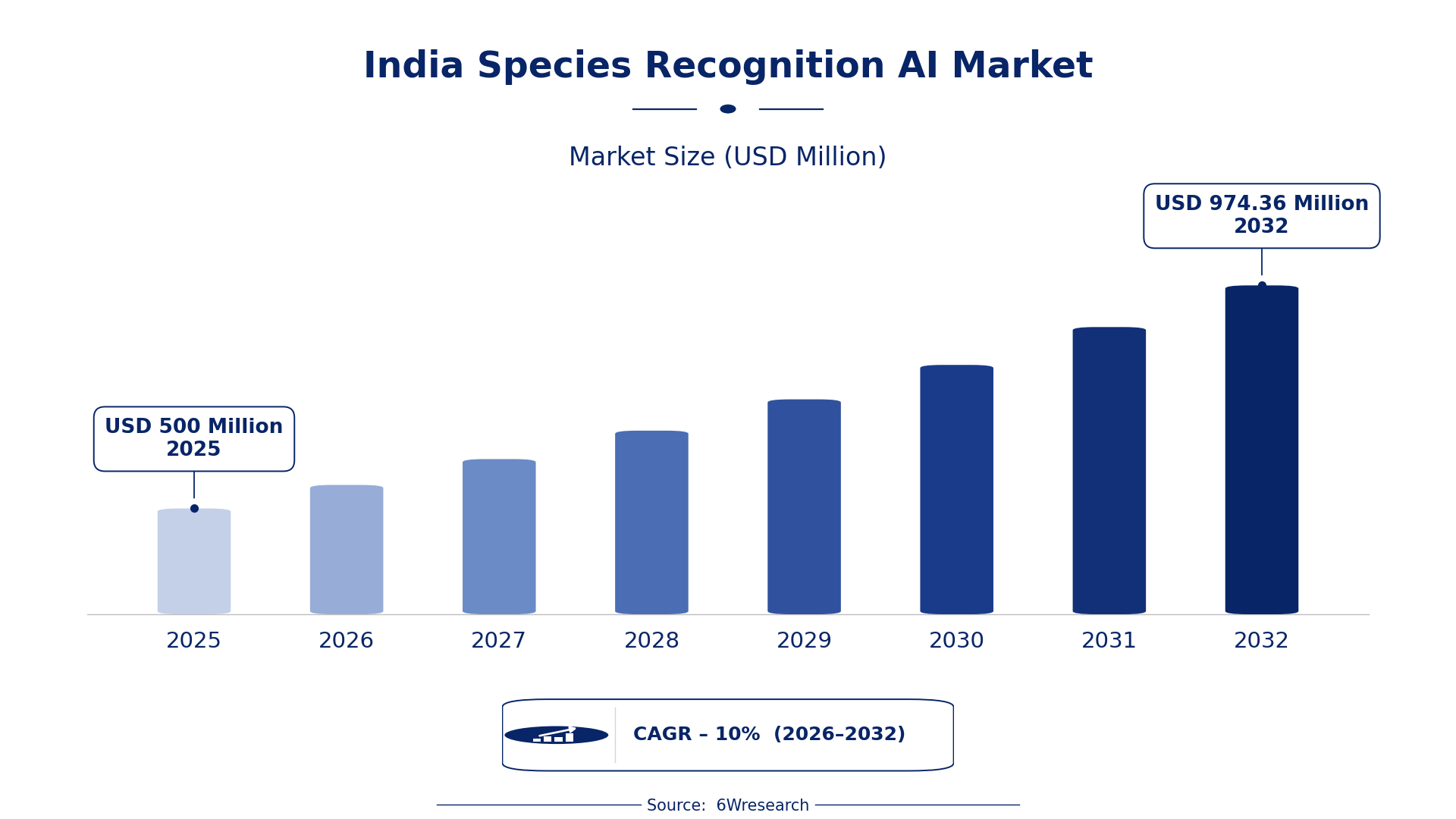
According to 6Wresearch internal database and industry insights, the India Species Recognition AI Market was valued at USD 500.0 million in 2025 and is projected to reach USD 974.36 million by 2032, growing at a CAGR of approximately 10% during 2026–2032.
India Species Recognition AI Market Highlights
| Report Metric | Details |
| Report Name | India Species Recognition AI Market |
| Market Size 2025 | USD 500.0 million |
| Market Size 2032 | USD 974.36 million |
| Absolute Growth 2025–2032 | USD 474.36 million |
| CAGR 2026–2032 | 10% |
| Peak Annual Growth | 12.4% in 2026 |
| Forecast Period | 2026–2032 |
| Historical Data | 2022–2025 |
| Base Year | 2025 |
| Leading AI Model Type, 2025 | Image-Based AI (46% share) |
| Leading Detection Category, 2025 | Wildlife Identification (47% share) |
| Leading Deployment Platform, 2025 | Cloud (35% share) |
| Leading End User, 2025 | Conservation Agencies (43% share) |
| Fastest-Growing AI Model Type | DNA Pattern AI (12.8% CAGR) |
| Fastest-Growing Detection Category | Genetic Classification (11.7% CAGR) |
| Fastest-Growing Deployment Platform | Mobile/Edge Devices (11.3% CAGR) |
| Fastest-Growing End User | Ecological Researchers (12.6% CAGR) |
| Growing Sector | Conservation |
| Key End Users | Conservation Agencies, Ecological Researchers, Environmental Agencies |
India Species Recognition AI Market Year-wise Growth Rate and Key Drivers (2022–2032)
This graph illustrates the annual growth rates of the market from 2022 to 2032, highlighting a steady upward trajectory and projected market expansion over the forecast period.
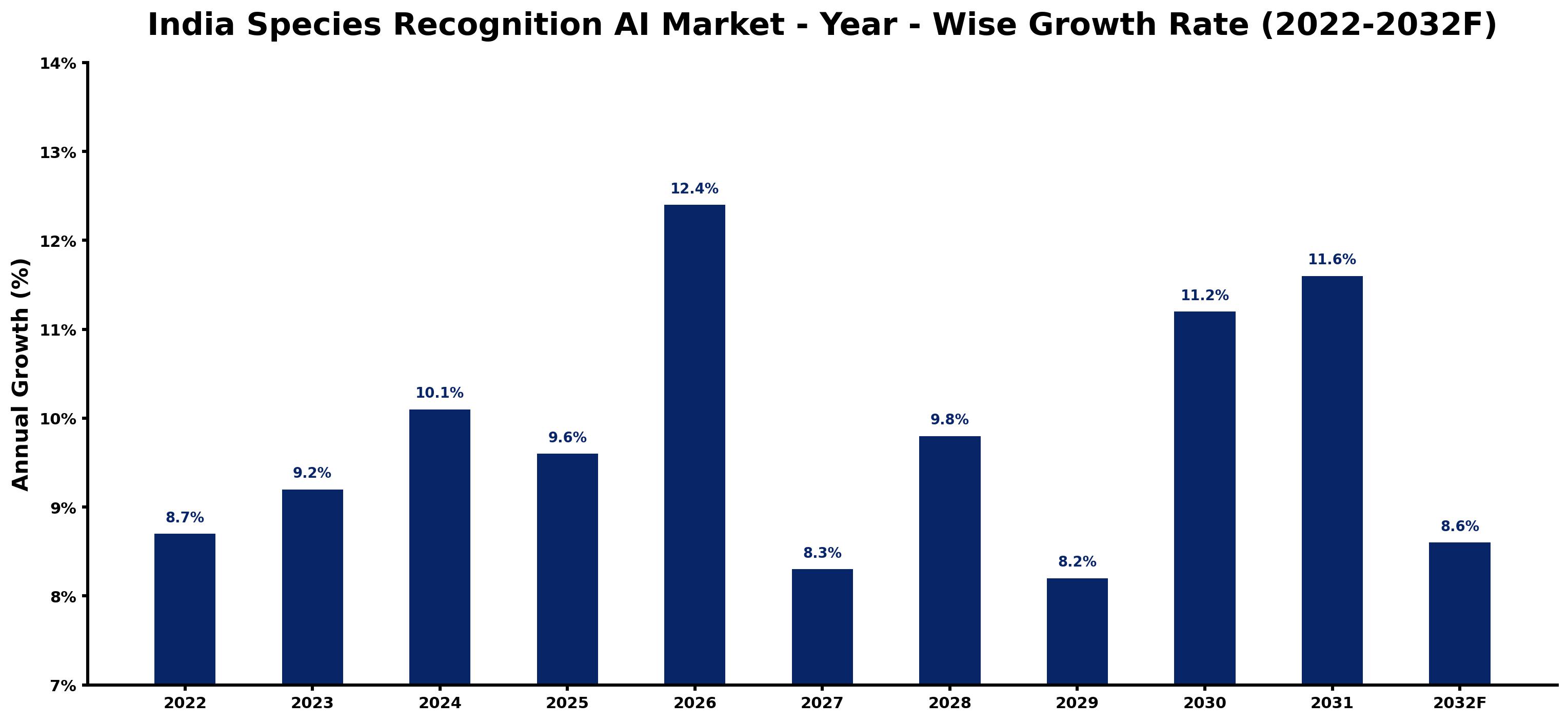
Below, each year's estimated growth is shown next to the factor that most influenced it.
| Year | Estimated Annual Growth (%) | Market Rationale |
| 2022 | 8.7 | The market experienced steady growth as conservation efforts gained momentum. |
| 2023 | 9.2 | Demand rose due to increased research initiatives in biodiversity monitoring. |
| 2024 | 10.1 | The Wildlife Institute of India advanced AI applications, boosting market growth. |
| 2025 | 9.6 | Growth slowed as some conservation projects faced funding challenges. |
| 2026 | 12.4 | The launch of new AI models accelerated growth in species recognition. |
| 2027 | 8.3 | Market expansion slowed as competition among technology providers intensified. |
| 2028 | 9.8 | Research initiatives in states like Uttarakhand increased demand for AI solutions. |
| 2029 | 8.2 | Growth slowed as the market adjusted to technological advancements. |
| 2030 | 11.2 | New ecological research programmes are expected to drive demand further. |
| 2031 | 11.6 | Increased investment in conservation projects supports market growth. |
| 2032 | 8.6 | Growth slows as the market matures and competition stabilises. |
Note: Market size estimations and growth projections presented in this report are based on 6Wresearch's proprietary forecasting methodology, utilizing the latest available industry data, government publications, and primary research inputs.
India Species Recognition AI Market Synopsis
Species Recognition AI Market in India encompasses technologies that identify and classify species using machine learning algorithms. This technology plays a crucial role in wildlife conservation, biodiversity monitoring, and ecological research. The market is expanding due to increased conservation efforts and research initiatives, with over 1,000 bird species identified using AI technologies. The National Biodiversity Action Plan launched in 2021 has further stimulated demand for advanced solutions in biodiversity monitoring, resulting in heightened investments in AI applications.
Market Dynamics Impact Analysis (2026–2032)
| Factor | Type | Impact | Primary Segment Affected |
| Growing conservation efforts drive demand for species identification technologies. | Driver | High | Wildlife Identification |
| Increased funding for biodiversity research enhances the need for AI solutions. | Driver | High | Ecological Researchers |
| The integration of AI in national parks creates opportunities for technology providers. | Opportunity | High | Wildlife Identification |
| Emerging AI applications in genetic classification present new market avenues. | Opportunity | High | Genetic Classification |
| Limited funding for conservation projects can hinder technology adoption. | Restraint | High | Ecological Researchers |
| Competition among technology providers may restrict market growth. | Restraint | Medium | Wildlife Identification |
| The Species Recognition AI Market in India faces practical problems, including funding issues. | Challenge | High | Ecological Researchers |
| Technological integration challenges can delay project implementation. | Challenge | Medium | Wildlife Identification |
Evaluation of Drivers in India Species Recognition AI Market (2026–2032)
The table below links each growth driver to the segment it affects and the evidence for it.
| Drivers | Primary Segment Affected | Why It Matters (Evidence) |
| Increased funding for biodiversity initiatives boosts demand for AI solutions. | Ecological Researchers | The Indian government allocated substantial resources for biodiversity research, increasing AI adoption in studies. |
| Research conducted by the Wildlife Institute of India advances AI technologies for species recognition. | Wildlife Identification | This research supports the development of AI models, increasing demand from conservation agencies. |
| Growing interest in biodiversity conservation among the Indian population boosts demand for AI solutions. | Ecological Researchers | With a population of approximately 1.4 billion, public awareness is driving technology adoption. |
| AI applications in over 50 national parks improve wildlife monitoring capabilities. | Wildlife Identification | This widespread use of AI increases demand from environmental agencies for better tracking solutions. |
| The National Biodiversity Action Plan promotes AI integration in monitoring efforts. | Wildlife Identification | This initiative encourages conservation agencies to adopt advanced technologies for species tracking. |
Growth in the Species Recognition AI market in India comes from increased funding for biodiversity initiatives, which boosts demand for AI solutions. The Indian government allocated substantial resources for biodiversity research, resulting in higher adoption of AI technologies among ecological researchers. Research conducted by the Wildlife Institute of India advances AI technologies for species recognition, which supports model development and drives demand from conservation agencies. The National Biodiversity Action Plan promotes AI integration in monitoring efforts, encouraging technology adoption. Public interest in biodiversity conservation is also contributing to market expansion, with over 1,000 species identified using AI.
Evaluation of Restraints in India Species Recognition AI Market
The table below lists the restraints and the evidence behind each.
| Market Restraint | Primary Segment Affected | Why It Matters (Evidence) |
| Limited funding for conservation projects can hinder technology adoption. | Ecological Researchers | Funding constraints impact research capabilities, delaying the implementation of AI solutions. |
| Competition among technology providers may restrict market growth. | Wildlife Identification | Increased competition can lead to price wars, affecting profitability for suppliers. |
| Technological integration challenges can delay project implementation. | Wildlife Identification | Complexity in integrating AI with existing systems can slow down adoption rates. |
| Lack of awareness about AI benefits limits its adoption in some regions. | Ecological Researchers | In areas with lower awareness, demand for AI technologies remains subdued. |
| Regulatory hurdles may slow down the approval process for new technologies. | Wildlife Identification | Strict regulations can delay the deployment of AI solutions in conservation efforts. |
India Species Recognition AI Market Challenges
The India Species Recognition AI market faces several practical issues, with a notable skills shortage among developers. Many educational institutions do not offer specialised programmes in AI for ecological applications, limiting the pool of qualified professionals available to producers. Supply chain challenges arise, as AI model development requires high-quality datasets that are often difficult to obtain in India, causing delays for conservation areas. Regulatory hurdles exist, with the Ministry of Environment, Forest and Climate Change enforcing strict guidelines that can impede the implementation of new technologies in wildlife monitoring. High integration costs further complicate technology adoption, making it challenging for buyers in conservation to invest in these solutions.
Trends in the India Species Recognition AI Market
Several trends are reshaping the India Species Recognition AI Market; the most important are set out below.
- Shift towards AI-Driven Biodiversity Monitoring: India is increasingly adopting AI technologies for biodiversity monitoring, as evidenced by the National Biodiversity Action Plan 2021, which integrates AI in conservation efforts. This shift is expected to improve species tracking capabilities across various ecosystems.
- Transition from Traditional Methods to AI Solutions: Conservation agencies are moving from traditional species identification methods to AI solutions, with over 10 major conservation areas in India employing AI for wildlife identification. This transition is streamlining monitoring processes and improving accuracy.
- Emergence of Genetic Classification AI: The rise of genetic classification AI is transforming species recognition in India, with research from the Indian Institute of Science leading the way. This trend is expected to advance biodiversity studies.
- Increased Use of Mobile AI Technologies: There is a growing trend towards mobile AI technologies for species recognition, particularly in wildlife monitoring. The adoption of mobile/edge devices is projected to increase, facilitating real-time data collection in the field.
Investment Opportunities in the India Species Recognition AI Market
Investors looking at the India Species Recognition AI Market should consider the following areas.
- Investment in AI for Conservation Agencies: The growing demand for AI solutions presents opportunities for investment in conservation agencies, with over 50 national parks adopting these technologies. Collaborating with local partners can support market entry.
- Development of AI Models in Research Institutions: Research institutions in states like Uttarakhand are developing AI models, creating investment opportunities for technology providers. Establishing joint ventures can facilitate access to this growing market.
- Expansion of AI Applications in National Parks: With 10 major conservation areas employing AI, there is an opportunity for suppliers to provide advanced solutions. Engaging with environmental agencies can lead to fruitful partnerships.
- Enhancing Genetic Classification Technologies: The emergence of genetic classification AI creates opportunities for investment in biotech institutions, with research initiatives driving demand. Collaborating with academic institutions can facilitate technology development.
Government Initiatives in the India Species Recognition AI Market
The National Biodiversity Action Plan 2021 is a key measure that promotes the integration of AI in biodiversity monitoring. This initiative, led by the Ministry of Environment, Forest and Climate Change, aims to improve species tracking and conservation efforts across India. By supporting the adoption of AI technologies, the plan encourages conservation agencies to enhance their monitoring capabilities. The government also emphasises the importance of sustainable development through AI applications in ecological research, ensuring long-term benefits for biodiversity. The plan allocates significant resources to support these initiatives, fostering a collaborative environment for technology integration.
The AI for Earth initiative, launched in 2022 by the Ministry of Science and Technology, promotes AI applications in environmental research. This programme allocates funding to support innovative projects that utilise AI for biodiversity conservation. Additionally, the Digital India Programme encourages the use of AI in various sectors, including conservation, to promote sustainable development. These initiatives aim to improve the integration of technology in ecological research and support decision-making processes for conservation efforts.
Future Insight of the India Species Recognition AI Market
By 2032, buyers and suppliers in the India Species Recognition AI market can expect transformative changes driven by key advancements. The National Biodiversity Action Plan will enhance species monitoring capabilities, facilitating better data collection and analysis. Research initiatives at institutions like the Indian Institute of Science will lead to more accurate AI models for identification. The integration of satellite data from the National Remote Sensing Centre will support habitat mapping, enabling more effective conservation strategies. AI technologies will be employed in over 50 national parks, strengthening biodiversity conservation efforts.
Market Segmentation Analysis
The report offers a comprehensive study of the following market segments and their leading categories in the market.
By AI Model Type – Image-Based AI Dominated, DNA Pattern AI Expected to Grow Fastest
According to Summon Dutta, Assistant Manager at 6Wresearch, the largest ai model type category in 2025 was Image-Based AI, with a 46% share of total revenue. Image-Based AI holds the largest market share due to its widespread application in identifying over 1,000 bird species across India. This method plays a crucial role in wildlife conservation, particularly in major conservation areas where visual data analysis is essential for effective species monitoring. The quickest growth will come from DNA Pattern AI, forecast to expand at a CAGR of 12.8% between 2026 and 2032. DNA Pattern AI is experiencing rapid growth driven by its precise classification capabilities based on genetic information, which are increasingly vital for ecological research. The ongoing research initiatives at the Indian Institute of Science underscore the technology's rising significance in the market. This trend indicates that suppliers must focus on advancing DNA Pattern AI technologies to meet the escalating needs of the research community.
By Detection Category – Wildlife Identification Dominated, Genetic Classification Expected to Grow Fastest
In 2025, Wildlife Identification led the detection category split with a 47% share. Wildlife Identification leads the market share as it directly aids in identifying various wildlife species, essential for conservation strategies across India's national parks. The integration of AI in over 50 national parks highlights its critical role in wildlife monitoring. Genetic Classification is projected to grow fastest, at a CAGR of 11.7% during 2026–2032. Genetic Classification is the fastest-growing segment due to its ability to classify organisms based on genetic makeup, which is vital for ongoing biodiversity research. The support from the Ministry of Environment, Forest and Climate Change further accelerates this growth. Buyers should invest in Genetic Classification technologies to stay ahead in biodiversity research.
By Deployment Platform – Cloud Dominated, Mobile/Edge Devices Expected to Grow Fastest
Cloud accounted for a 35% market share by deployment platform in 2025. Cloud technology leads the market share as it efficiently supports the vast data storage and processing requirements for species recognition initiatives across India. Its integral role in facilitating ecological research makes it indispensable for large-scale conservation projects. Over 2026–2032, Mobile/Edge Devices are expected to post the fastest growth, at a CAGR of 11.3%. Mobile/Edge Devices are experiencing the fastest growth because they allow species recognition on portable platforms, increasing accessibility in remote locations. This surge is fuelled by the pressing need for real-time data collection in conservation efforts. Suppliers must focus on mobile solutions to meet the increasing demand for portable species recognition technologies.
By End User – Conservation Agencies Dominated, Ecological Researchers Expected to Grow Fastest
With a 43% revenue share in 2025, Conservation Agencies was the largest end user category. Conservation Agencies hold the largest market share as they directly utilise species data to support various conservation efforts across India. Their active involvement in initiatives like the National Biodiversity Action Plan underscores their reliance on AI technologies. Ecological Researchers are set to record the highest CAGR in this split, 12.6% over 2026–2032. Ecological Researchers are the fastest-growing segment, as they require advanced tools for studying biodiversity and monitoring ecosystems. The ongoing research initiatives in states like Uttarakhand and Madhya Pradesh highlight the increasing demand for AI in this area. Suppliers should tailor their offerings to meet the specific needs of ecological researchers.
Key Attractiveness of the Report
- 10 Years of Market Numbers
- Historical Data Starting from 2022 to 2025
- Base Year 2025
- Forecast Data until 2032
- Key Performance Indicators Impacting the Market
- Major Upcoming Developments and Projects
Key Highlights of the Report:
- India Species Recognition AI Market Outlook
- Market Size of India Species Recognition AI Market, 2025
- Forecast of India Species Recognition AI Market, 2032
- Historical Data and Forecast of India Species Recognition AI Revenues & Volume for the Period 2022 - 2032F
- India Species Recognition AI Market Trend Evolution
- India Species Recognition AI Market Drivers and Challenges
- India Species Recognition AI Price Trends
- India Species Recognition AI Porter's Five Forces
- India Species Recognition AI Industry Life Cycle
- Historical Data and Forecast of India Species Recognition AI Market Revenues & Volume By AI Model Type for the Period 2022 - 2032F
- Historical Data and Forecast of India Species Recognition AI Market Revenues & Volume By Image-Based AI for the Period 2022 - 2032F
- Historical Data and Forecast of India Species Recognition AI Market Revenues & Volume By Audio Recognition AI for the Period 2022 - 2032F
- Historical Data and Forecast of India Species Recognition AI Market Revenues & Volume By DNA Pattern AI for the Period 2022 - 2032F
- Historical Data and Forecast of India Species Recognition AI Market Revenues & Volume By Multi-Sensor AI for the Period 2022 - 2032F
- Historical Data and Forecast of India Species Recognition AI Market Revenues & Volume By Detection Category for the Period 2022 - 2032F
- Historical Data and Forecast of India Species Recognition AI Market Revenues & Volume By Wildlife Identification for the Period 2022 - 2032F
- Historical Data and Forecast of India Species Recognition AI Market Revenues & Volume By Bird/Marine Species for the Period 2022 - 2032F
- Historical Data and Forecast of India Species Recognition AI Market Revenues & Volume By Genetic Classification for the Period 2022 - 2032F
- Historical Data and Forecast of India Species Recognition AI Market Revenues & Volume By Habitat Mapping for the Period 2022 - 2032F
- Historical Data and Forecast of India Species Recognition AI Market Revenues & Volume By Deployment Platform for the Period 2022 - 2032F
- Historical Data and Forecast of India Species Recognition AI Market Revenues & Volume By Mobile/Edge Devices for the Period 2022 - 2032F
- Historical Data and Forecast of India Species Recognition AI Market Revenues & Volume By Sensor-Enabled Devices for the Period 2022 - 2032F
- Historical Data and Forecast of India Species Recognition AI Market Revenues & Volume By Cloud for the Period 2022 - 2032F
- Historical Data and Forecast of India Species Recognition AI Market Revenues & Volume By Drones for the Period 2022 - 2032F
- Historical Data and Forecast of India Species Recognition AI Market Revenues & Volume By End User for the Period 2022 - 2032F
- Historical Data and Forecast of India Species Recognition AI Market Revenues & Volume By Conservation Agencies for the Period 2022 - 2032F
- Historical Data and Forecast of India Species Recognition AI Market Revenues & Volume By Ecological Researchers for the Period 2022 - 2032F
- Historical Data and Forecast of India Species Recognition AI Market Revenues & Volume By Biotech Institutions for the Period 2022 - 2032F
- Historical Data and Forecast of India Species Recognition AI Market Revenues & Volume By Environmental Agencies for the Period 2022 - 2032F
- India Species Recognition AI Import Export Trade Statistics
- Market Opportunity Assessment By AI Model Type
- Market Opportunity Assessment By Detection Category
- Market Opportunity Assessment By Deployment Platform
- Market Opportunity Assessment By End User
- India Species Recognition AI Top Companies Market Share
- India Species Recognition AI Competitive Benchmarking By Technical and Operational Parameters
- India Species Recognition AI Company Profiles
- India Species Recognition AI Key Strategic Recommendations
Market Covered
Segments analysed in this report are listed below.
By AI Model Type
- Image-Based AI
- Audio Recognition AI
- DNA Pattern AI
- Multi-Sensor AI
By Detection Category
- Wildlife Identification
- Bird/Marine Species
- Genetic Classification
- Habitat Mapping
By Deployment Platform
- Mobile/Edge Devices
- Sensor-Enabled Devices
- Cloud
- Drones
By End User
- Conservation Agencies
- Ecological Researchers
- Biotech Institutions
- Environmental Agencies































