China Species Recognition AI Market Size & Growth Rate
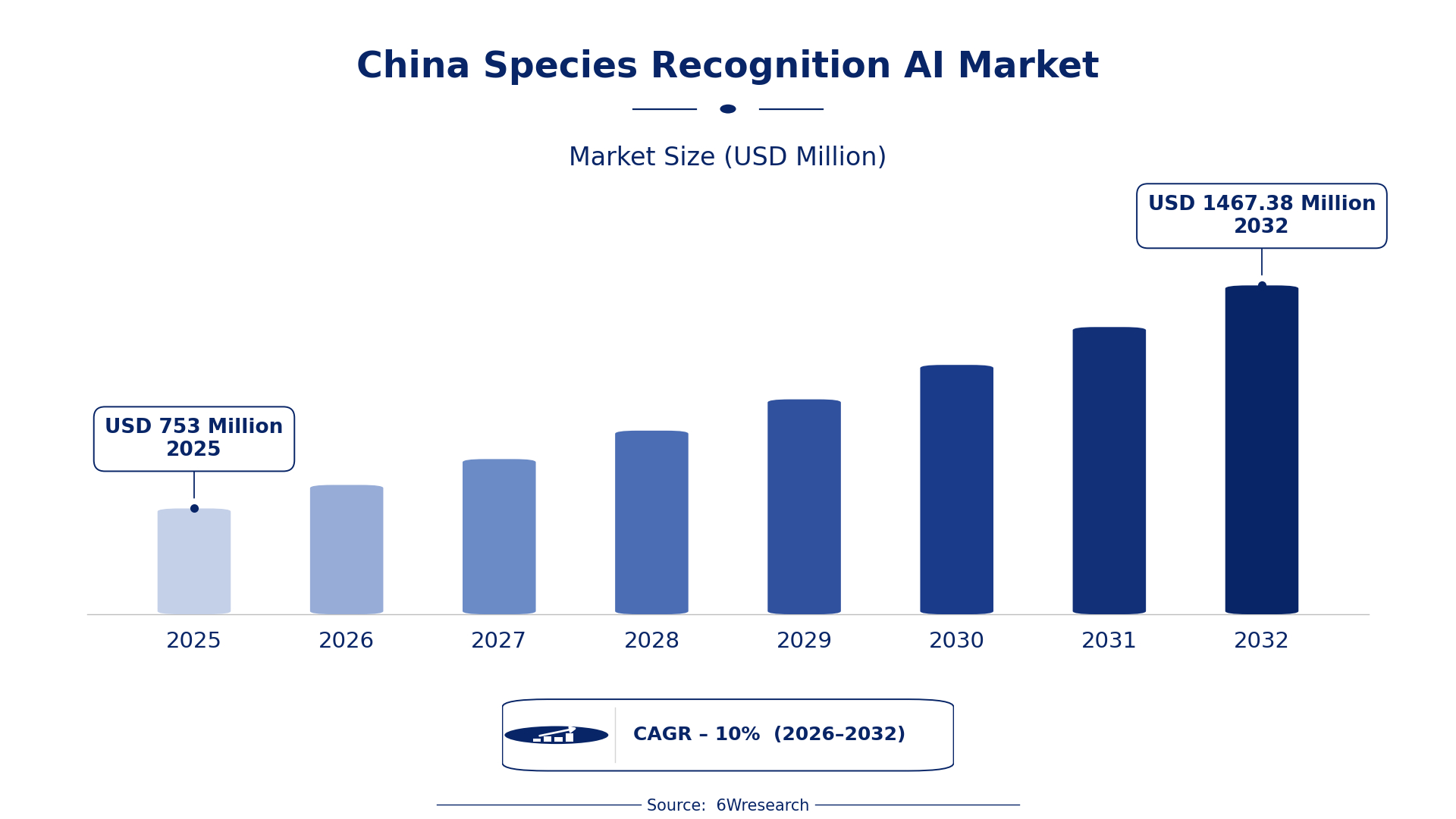
According to 6Wresearch internal database and industry insights, the China Species Recognition AI Market was valued at USD 753.0 million in 2025 and is projected to reach USD 1,467.38 million by 2032, growing at a CAGR of approximately 10% during 2026–2032.
China Species Recognition AI Market Highlights
| Report Metric | Details |
| Report Name | China Species Recognition AI Market |
| Market Size 2025 | USD 753.0 million |
| Market Size 2032 | USD 1,467.38 million |
| Absolute Growth 2025–2032 | USD 714.38 million |
| CAGR 2026–2032 | 10% |
| Peak Annual Growth | 12.5% in 2028 |
| Forecast Period | 2026–2032 |
| Historical Data | 2022–2025 |
| Base Year | 2025 |
| Leading AI Model Type, 2025 | Image-Based AI (40% share) |
| Leading Detection Category, 2025 | Wildlife Identification (44% share) |
| Leading Deployment Platform, 2025 | Cloud (43% share) |
| Leading End User, 2025 | Conservation Agencies (38% share) |
| Fastest-Growing AI Model Type | DNA Pattern AI (12.3% CAGR) |
| Fastest-Growing Detection Category | Genetic Classification (12.7% CAGR) |
| Fastest-Growing Deployment Platform | Drones (12.5% CAGR) |
| Fastest-Growing End User | Ecological Researchers (11.5% CAGR) |
| Growing Sector | Conservation |
| Key End Users | Conservation Agencies, Ecological Researchers, Environmental Agencies |
China Species Recognition AI Market Year-wise Growth Rate and Key Drivers (2022–2032)
This graph illustrates the annual growth rates of the market from 2022 to 2032, highlighting a steady upward trajectory and projected market expansion over the forecast period.
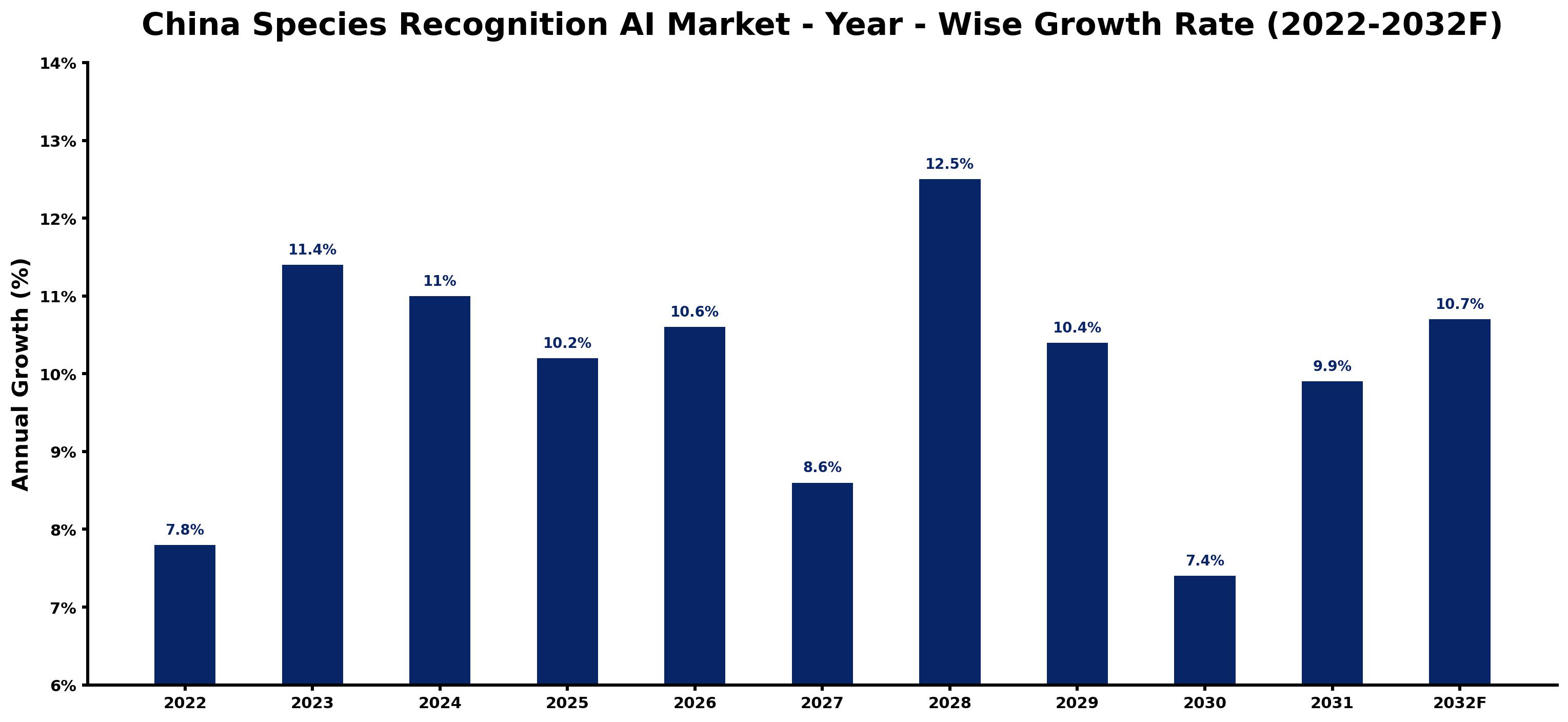
Each row of the following table gives one year's estimated growth and the event or demand shift that explains it.
| Year | Estimated Annual Growth (%) | Market Rationale |
| 2022 | 7.8 | Demand grew as ecological researchers focused on biodiversity monitoring, utilising advanced technologies. |
| 2023 | 11.4 | The update of the National Biodiversity Conservation Strategy spurred interest in AI applications for ecological research. |
| 2024 | 11.0 | The National Standard for Biodiversity Monitoring implementation slightly slowed growth as agencies adapted to new protocols. |
| 2025 | 10.2 | Investment in over 300 ecological research projects continued to drive demand for AI solutions among conservation agencies. |
| 2026 | 10.6 | New AI models are anticipated to enhance capabilities for species identification, boosting interest among researchers. |
| 2027 | 8.6 | A slowdown is expected as smaller players face challenges in competing with larger technology providers. |
| 2028 | 12.5 | The market is projected to peak with advancements in AI capabilities, significantly enhancing biodiversity monitoring. |
| 2029 | 10.4 | Growth is expected to slow as the market stabilises after previous rapid expansions in technology adoption. |
| 2030 | 7.4 | Demand is projected to moderate as the market matures, consolidating among leading technology providers. |
| 2031 | 9.9 | Increased funding for biodiversity projects will stimulate renewed interest in AI technologies among conservation agencies. |
| 2032 | 10.7 | The market is expected to grow as ecological researchers increasingly adopt advanced AI solutions for species monitoring. |
Note: Market size estimations and growth projections presented in this report are based on 6Wresearch's proprietary forecasting methodology, utilizing the latest available industry data, government publications, and primary research inputs.
China Species Recognition AI Market Synopsis
Species Recognition AI in China encompasses technologies that identify and classify species through machine learning algorithms. This approach utilises inputs from images, sounds, and genetic data to support biodiversity monitoring and conservation efforts. The China Species Recognition AI Market is experiencing rapid growth, fuelled by over 300 ecological research projects and a commitment to biodiversity conservation. With approximately 1.4 billion people in China, there is a strong demand as ecological researchers and conservation agencies seek advanced tools for wildlife monitoring and ecosystem protection.
Market Dynamics Impact Analysis (2026–2032)
| Factor | Type | Impact | Primary Segment Affected |
| Increasing investment in ecological research projects drives demand for advanced identification tools. | Driver | High | Wildlife Identification |
| Growing focus on biodiversity conservation creates opportunities for AI technologies. | Driver | High | Ecological Researchers |
| The National Biodiversity Conservation Strategy promotes funding for AI-driven projects. | Opportunity | High | Conservation Agencies |
| The expansion of the National Park System increases the need for monitoring technologies. | Opportunity | High | Ecological Researchers |
| Regulatory hurdles in AI technology approval can delay market entry. | Restraint | Medium | Image-Based AI |
| Limited awareness of AI applications among smaller conservation groups may restrict adoption. | Restraint | Medium | Environmental Agencies |
| High costs associated with AI technology development can hinder smaller players. | Challenge | High | DNA Pattern AI |
| Competition among technology providers may lead to price wars, affecting profitability. | Challenge | Medium | Cloud |
Evaluation of Drivers in China Species Recognition AI Market (2026–2032)
Below mentioned are some major drivers and their influence on market dynamics.
| Drivers | Primary Segment Affected | Why It Matters (Evidence) |
| Increased funding for ecological research projects boosts demand for AI solutions. | Wildlife Identification | Over 300 ecological research projects utilise Species Recognition AI, increasing purchases by conservation agencies. |
| Growing focus on biodiversity conservation drives technology adoption. | Environmental Agencies | Ecological researchers in China have increased by 20% since 2020, leading to more purchases of AI technologies. |
| The expansion of the National Park System increases the need for monitoring technologies. | Conservation Agencies | The National Park System's expansion in 2022 necessitates advanced species monitoring solutions. |
| Technological advancements in AI models improve species identification capabilities. | DNA Pattern AI | AI models are being developed to identify over 500 endangered species, increasing demand from various sectors. |
| The integration of AI in educational programs enhances future workforce capabilities. | Ecological Researchers | The National Environmental Monitoring Center's initiatives have reached over 1,000 students, fostering interest in AI technologies. |
The Species Recognition AI market in China is expanding due to increased funding for ecological research projects, a commitment to biodiversity conservation, and a rise in the number of ecological researchers. The update of the National Biodiversity Conservation Strategy encourages the adoption of AI technologies, motivating researchers to invest in advanced tools for species monitoring. New AI models are being developed to identify over 500 endangered species, which is driving demand across various sectors.
Evaluation of Restraints in China Species Recognition AI Market
The following restraints limit how fast demand can grow.
| Market Restraint | Primary Segment Affected | Why It Matters (Evidence) |
| Regulatory hurdles in AI technology approval can delay market entry. | Image-Based AI | The National Standard for Biodiversity Monitoring requires compliance, which can slow down product launches. |
| Limited awareness of AI applications among smaller conservation groups may restrict adoption. | Environmental Agencies | Many smaller agencies lack the resources to implement advanced AI technologies effectively. |
| High costs associated with AI technology development can hinder smaller players. | DNA Pattern AI | Development costs can exceed budgets for smaller conservation agencies, limiting their participation. |
| Market saturation among technology providers can lead to price competition. | Cloud | Increased competition may drive down prices, affecting profitability for established providers. |
| Insufficient training for end-users may limit effective technology application. | Audio Recognition AI | Without proper training, users may struggle to utilise AI tools effectively for species identification. |
China Species Recognition AI Market Challenges
Ecological researchers in China encounter fierce competition for funding, which limits the number of projects that can effectively implement Species Recognition AI. The rapid growth of the AI sector has resulted in a 20% increase in researchers since 2020, yet funding shortages hinder critical biodiversity monitoring efforts. Skills shortages in machine learning and ecological data analysis impede the deployment of AI technologies, prolonging project timelines for conservation agencies. Regulatory frameworks, such as the revised National Wildlife Protection Law, impose strict compliance requirements that can extend approval processes for new AI applications, complicating efforts for researchers and conservation initiatives.
Trends in the China Species Recognition AI Market
Buyers and suppliers in the China Species Recognition AI Market are adjusting to the following trends.
- Shift in Focus to Advanced AI Models: Conservation agencies are increasingly adopting advanced AI models for species identification, which improves accuracy and efficiency. In 2023, the Ministry of Science and Technology launched the 'AI for Environmental Protection Program', supporting AI applications in conservation efforts.
- Growing Integration of Drones in Biodiversity Monitoring: Drones equipped with AI are becoming crucial for habitat mapping and wildlife monitoring. Over 300 ecological research projects now incorporate drones, enhancing data collection capabilities.
- Increased Collaboration Among Research Institutions: Research institutions are forming partnerships to improve biodiversity monitoring efforts through AI technologies. The National Biodiversity Conservation Strategy encourages collaboration, resulting in more thorough data collection.
- Expansion of Educational Programs on AI Applications: Educational institutions are incorporating AI-based tools into ecological studies, raising awareness and usage among future researchers. The National Environmental Monitoring Center's initiatives have reached over 1,000 students.
Investment Opportunities in the China Species Recognition AI Market
The following opportunities in the China Species Recognition AI Market pair current demand with a clear way in.
- Rising Demand for AI in Conservation: With the National Biodiversity Conservation Strategy updated, there is a growing need for AI solutions in conservation efforts. Conservation agencies are looking to invest in advanced AI technologies to improve monitoring capabilities.
- Expansion of the National Park System: The expansion of the National Park System creates opportunities for technology providers to offer monitoring solutions. Agencies involved in park management are actively seeking partnerships to implement AI technologies.
- Investment in Ecological Research: The increase in ecological research projects presents a timely opportunity for AI developers. Research institutions are looking for practical solutions to support over 300 ongoing projects.
- Funding Initiatives for AI-Driven Projects: The State Forestry and Grassland Administration's $10 million funding initiative for AI-driven biodiversity projects opens avenues for investment. Companies can collaborate with local agencies to develop tailored solutions.
Government Initiatives in the China Species Recognition AI Market
The National Wildlife Protection Law, revised in 2021, establishes stricter guidelines for species protection, promoting conservation efforts. The National Standard for Biodiversity Monitoring, approved in 2021, standardises data collection methods, ensuring consistency across projects. In 2022, the National Biodiversity Strategy and Action Plan was updated to include AI technologies, encouraging their use in conservation. These measures aim to strengthen biodiversity monitoring and protection efforts across China.
In 2023, the Biodiversity Conservation Action Plan was launched, focusing on AI technologies for monitoring species. This initiative allocates $10 million to support AI-driven biodiversity projects. The State Forestry and Grassland Administration oversees the implementation of these projects, ensuring compliance with national standards. Funding initiatives aim to improve research and development in this field, enabling conservation agencies to adopt advanced technologies.
Future Insight of the China Species Recognition AI Market
The Species Recognition AI market in China is set for transformative changes by 2032, driven by advancements in machine learning and increased government support for biodiversity initiatives. The integration of AI tools into educational programs will develop the skills of future ecological professionals, ensuring a steady supply of qualified workers. By 2025, the AI industry is projected to reach $150 billion, offering substantial opportunities for ecological projects. The expansion of the National Park System to include AI monitoring will refine conservation strategies, allowing for more effective biodiversity management.
Market Segmentation Analysis
The analysis below covers each segmentation, its leading category in 2025 and its fastest-growing category through 2032.
By AI Model Type – Image-Based AI Dominated, DNA Pattern AI Expected to Grow Fastest
According to Summon Dutta, Assistant Manager at 6Wresearch, Image-Based AI took a 40% share of ai model type in 2025, more than any other category. Image-Based AI commands the largest market share due to its vital role in visual species identification, extensively utilised by ecological researchers across China. Its proven effectiveness in identifying over 1,000 species makes it the preferred choice for biodiversity monitoring. DNA Pattern AI is projected to grow fastest, at a CAGR of 12.3% during 2026–2032. DNA Pattern AI is experiencing rapid growth as it plays a crucial role in genetic classification, particularly for identifying over 500 endangered species. The increasing focus on conservation efforts is expected to drive demand for this technology, allowing it to close the gap with Image-Based AI. Suppliers should prioritise the development of DNA Pattern AI solutions to align with the rising demand in conservation and ecological research.
By Detection Category – Wildlife Identification Dominated, Genetic Classification Expected to Grow Fastest
The largest detection category category in 2025 was Wildlife Identification, with a 44% share of total revenue. Wildlife Identification holds the largest market share as it is essential for monitoring and protecting wildlife, particularly in significant regions like the Yangtze River basin. Its application in over 300 ecological research projects underscores its importance in biodiversity initiatives. Genetic Classification is set to record the highest CAGR in this split, 12.7% over 2026–2032. Genetic Classification is the fastest-growing segment, propelled by the heightened emphasis on understanding genetic diversity among species. Recent updates to biodiversity strategies in China are expected to further increase demand for this classification method. Buyers should invest in advanced genetic classification tools to enhance their biodiversity conservation efforts.
By Deployment Platform – Cloud Dominated, Drones Expected to Grow Fastest
With a 43% revenue share in 2025, Cloud was the largest deployment platform category. Cloud technology leads the market share as it is crucial for data storage and processing, enabling the management of extensive biodiversity databases. This platform supports the National Environmental Monitoring Center's data analysis, ensuring operational efficiency in ecological research. Over 2026–2032, Drones are expected to post the fastest growth, at a CAGR of 12.5%. Drones are rapidly gaining popularity for their role in data collection, especially in ecological monitoring applications. As more projects integrate AI monitoring, the use of drones is anticipated to expand significantly, improving field data collection capabilities. Suppliers should explore the development of drone-based solutions to improve data collection for ecological research.
By End User – Conservation Agencies Dominated, Ecological Researchers Expected to Grow Fastest
Conservation Agencies held a 38% share of the China Species Recognition AI Market by end user in 2025. Conservation Agencies command the largest market share as primary users for monitoring biodiversity, particularly with the support of the Ministry of Ecology and Environment. Their initiatives align closely with national biodiversity strategies and regulations, ensuring consistent demand for related technologies. The quickest growth will come from Ecological Researchers, forecast to expand at a CAGR of 11.5% between 2026 and 2032. Ecological Researchers represent the fastest-growing segment, driven by a 20% increase in their numbers since 2020. Their need for advanced tools to conduct species studies is propelling this growth, indicating a shift towards more data-driven research methodologies. Suppliers must tailor their offerings to meet the specific requirements of ecological researchers to capture this expanding market.
Key Attractiveness of the Report
- 10 Years of Market Numbers
- Historical Data Starting from 2022 to 2025
- Base Year 2025
- Forecast Data until 2032
- Key Performance Indicators Impacting the Market
- Major Upcoming Developments and Projects
Key Highlights of the Report:
- China Species Recognition AI Market Outlook
- Market Size of China Species Recognition AI Market, 2025
- Forecast of China Species Recognition AI Market, 2032
- Historical Data and Forecast of China Species Recognition AI Revenues & Volume for the Period 2022 - 2032F
- China Species Recognition AI Market Trend Evolution
- China Species Recognition AI Market Drivers and Challenges
- China Species Recognition AI Price Trends
- China Species Recognition AI Porter's Five Forces
- China Species Recognition AI Industry Life Cycle
- Historical Data and Forecast of China Species Recognition AI Market Revenues & Volume By AI Model Type for the Period 2022 - 2032F
- Historical Data and Forecast of China Species Recognition AI Market Revenues & Volume By Image-Based AI for the Period 2022 - 2032F
- Historical Data and Forecast of China Species Recognition AI Market Revenues & Volume By Audio Recognition AI for the Period 2022 - 2032F
- Historical Data and Forecast of China Species Recognition AI Market Revenues & Volume By DNA Pattern AI for the Period 2022 - 2032F
- Historical Data and Forecast of China Species Recognition AI Market Revenues & Volume By Multi-Sensor AI for the Period 2022 - 2032F
- Historical Data and Forecast of China Species Recognition AI Market Revenues & Volume By Detection Category for the Period 2022 - 2032F
- Historical Data and Forecast of China Species Recognition AI Market Revenues & Volume By Wildlife Identification for the Period 2022 - 2032F
- Historical Data and Forecast of China Species Recognition AI Market Revenues & Volume By Bird/Marine Species for the Period 2022 - 2032F
- Historical Data and Forecast of China Species Recognition AI Market Revenues & Volume By Genetic Classification for the Period 2022 - 2032F
- Historical Data and Forecast of China Species Recognition AI Market Revenues & Volume By Habitat Mapping for the Period 2022 - 2032F
- Historical Data and Forecast of China Species Recognition AI Market Revenues & Volume By Deployment Platform for the Period 2022 - 2032F
- Historical Data and Forecast of China Species Recognition AI Market Revenues & Volume By Mobile/Edge Devices for the Period 2022 - 2032F
- Historical Data and Forecast of China Species Recognition AI Market Revenues & Volume By Sensor-Enabled Devices for the Period 2022 - 2032F
- Historical Data and Forecast of China Species Recognition AI Market Revenues & Volume By Cloud for the Period 2022 - 2032F
- Historical Data and Forecast of China Species Recognition AI Market Revenues & Volume By Drones for the Period 2022 - 2032F
- Historical Data and Forecast of China Species Recognition AI Market Revenues & Volume By End User for the Period 2022 - 2032F
- Historical Data and Forecast of China Species Recognition AI Market Revenues & Volume By Conservation Agencies for the Period 2022 - 2032F
- Historical Data and Forecast of China Species Recognition AI Market Revenues & Volume By Ecological Researchers for the Period 2022 - 2032F
- Historical Data and Forecast of China Species Recognition AI Market Revenues & Volume By Biotech Institutions for the Period 2022 - 2032F
- Historical Data and Forecast of China Species Recognition AI Market Revenues & Volume By Environmental Agencies for the Period 2022 - 2032F
- China Species Recognition AI Import Export Trade Statistics
- Market Opportunity Assessment By AI Model Type
- Market Opportunity Assessment By Detection Category
- Market Opportunity Assessment By Deployment Platform
- Market Opportunity Assessment By End User
- China Species Recognition AI Top Companies Market Share
- China Species Recognition AI Competitive Benchmarking By Technical and Operational Parameters
- China Species Recognition AI Company Profiles
- China Species Recognition AI Key Strategic Recommendations
Market Covered
The report offers an extensive study of the following market segments.
By AI Model Type
- Image-Based AI
- Audio Recognition AI
- DNA Pattern AI
- Multi-Sensor AI
By Detection Category
- Wildlife Identification
- Bird/Marine Species
- Genetic Classification
- Habitat Mapping
By Deployment Platform
- Mobile/Edge Devices
- Sensor-Enabled Devices
- Cloud
- Drones
By End User
- Conservation Agencies
- Ecological Researchers
- Biotech Institutions
- Environmental Agencies































