India Spray Adjuvants Market Size & Growth Rate
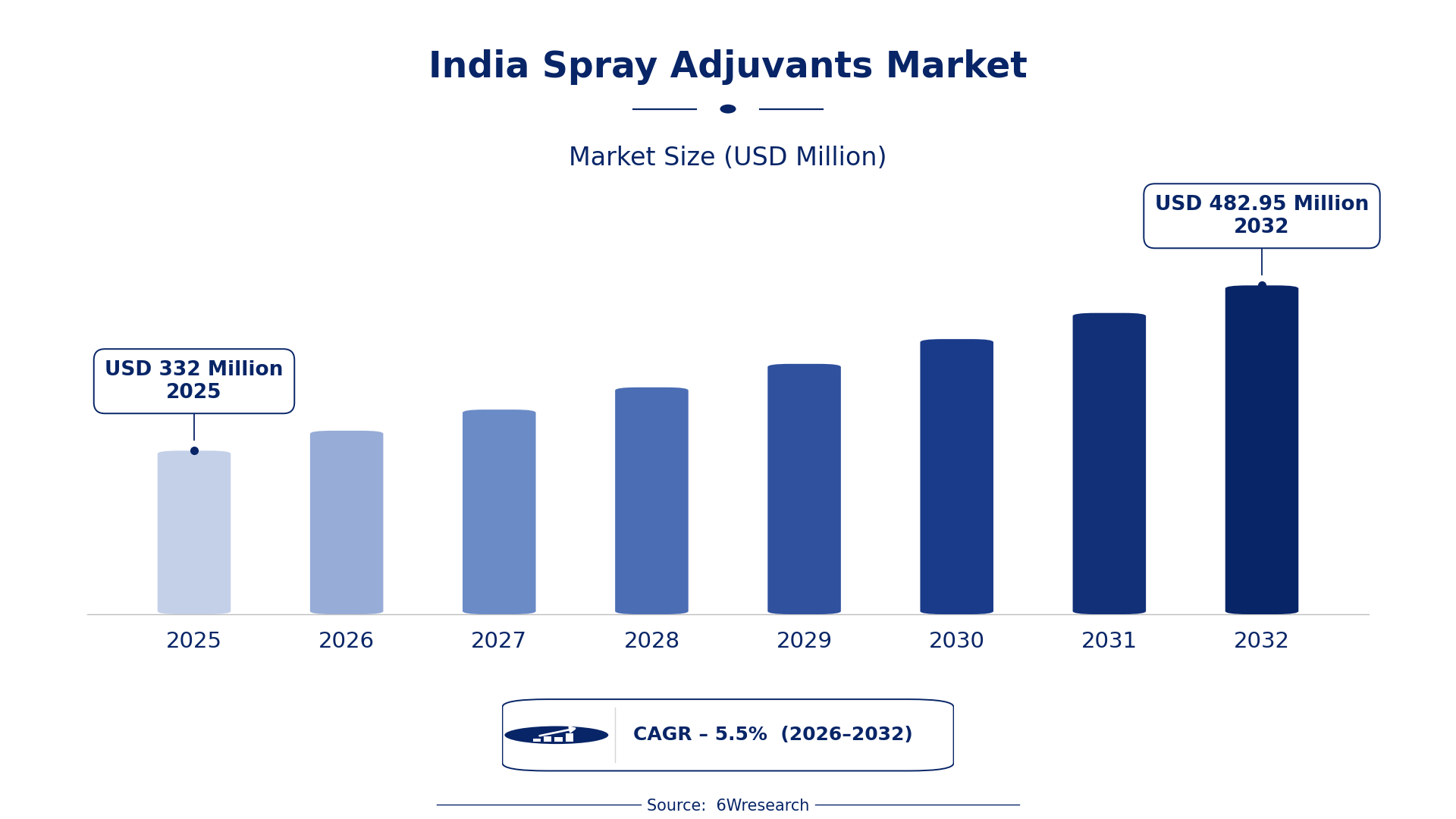
According to 6Wresearch internal database and industry insights, the India Spray Adjuvants Market was valued at USD 332.0 million in 2025 and is projected to reach USD 482.95 million by 2032, growing at a CAGR of approximately 5.5% during 2026–2032.
India Spray Adjuvants Market Highlights
| Report Metric | Details |
| Report Name | India Spray Adjuvants Market |
| Market Size 2025 | USD 332.0 million |
| Market Size 2032 | USD 482.95 million |
| Absolute Growth 2025–2032 | USD 150.95 million |
| CAGR 2026–2032 | 5.5% |
| Peak Annual Growth | 7.4% in 2026 |
| Forecast Period | 2026–2032 |
| Historical Data | 2022–2025 |
| Base Year | 2025 |
| Leading Adjuvant Type, 2025 | Surfactants (39% share) |
| Leading Application Type, 2025 | Herbicide/Fungicide (37% share) |
| Leading Crop Category, 2025 | Fruits & Vegetables (45% share) |
| Leading End User, 2025 | Agrochemical Companies (44% share) |
| Fastest-Growing Adjuvant Type | Drift Control Agents (7.7% CAGR) |
| Fastest-Growing Application Type | Pesticide Mixing (7.2% CAGR) |
| Fastest-Growing End User | Agricultural Input Firms (7.7% CAGR) |
| Growing Sector | Agricultural sector |
| Key End Users | Agrochemical Companies, Contract Farmers, Agricultural Input Firms |
India Spray Adjuvants Market Year-wise Growth Rate and Key Drivers (2022–2032)
This graph illustrates the annual growth rates of the market from 2022 to 2032, highlighting a steady upward trajectory and projected market expansion over the forecast period.
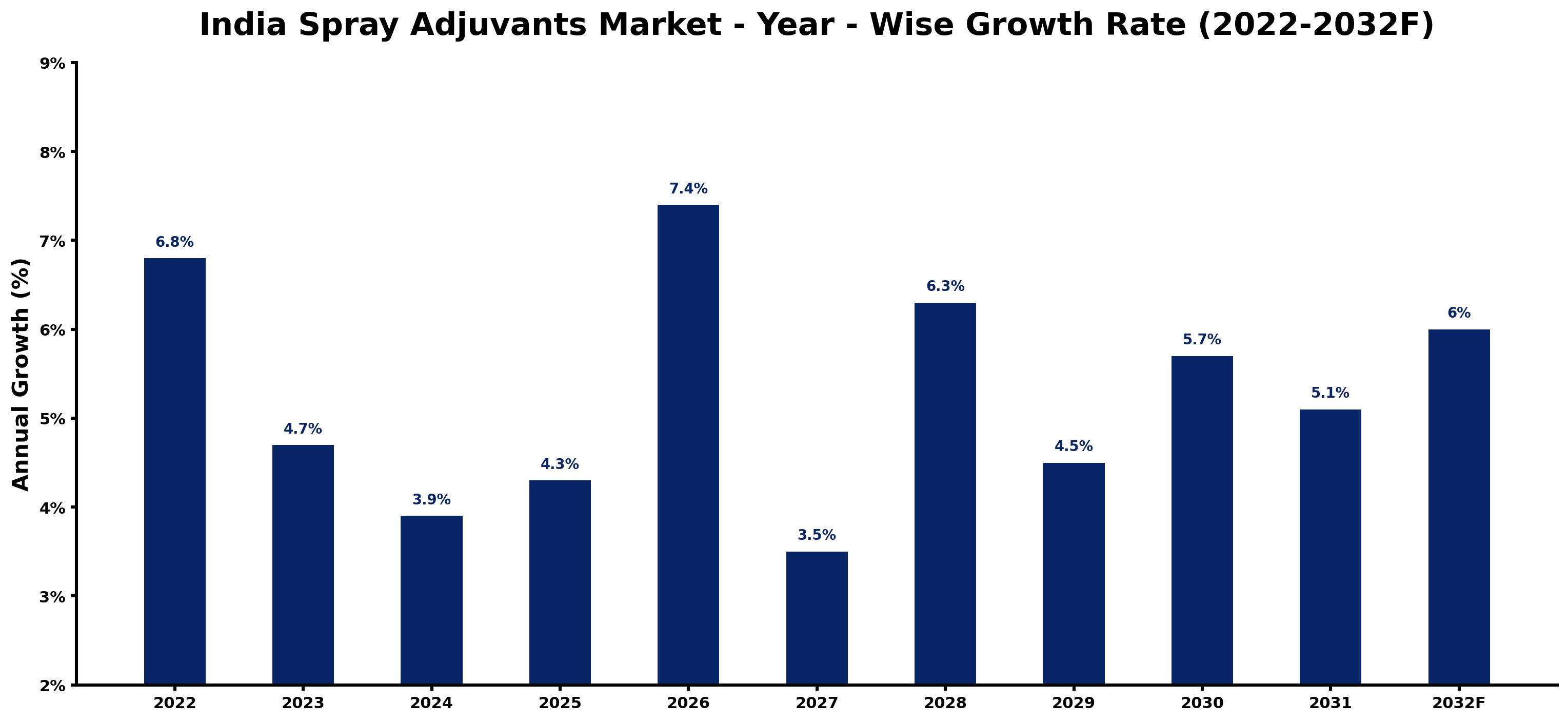
Annual growth estimates for each year appear below with the principal reason behind them, explaining the shifts that set the pace of the market.
| Year | Estimated Annual Growth (%) | Market Rationale |
| 2022 | 6.8 | The market experienced strong demand from agrochemical companies and farmers. |
| 2023 | 4.7 | Growth slowed as farmers adjusted to changing agricultural practices and input costs. |
| 2024 | 3.9 | Demand continued to slow as farmers sought cost-effective pest management solutions. |
| 2025 | 4.3 | Adoption of spray adjuvants increased as farmers recognised their benefits in crop protection. |
| 2026 | 7.4 | A surge in demand is expected due to the National Mission on Sustainable Agriculture promoting efficient input use. |
| 2027 | 3.5 | Growth is projected to slow as market saturation begins to affect new purchases of adjuvants. |
| 2028 | 6.3 | Demand is expected to increase again as agrochemical companies expand their product lines to include adjuvants. |
| 2029 | 4.5 | Growth is projected to slow as farmers face economic pressures impacting their purchasing decisions. |
| 2030 | 5.7 | Adoption rates will improve as awareness of adjuvant benefits spreads among farmers. |
| 2031 | 5.1 | Growth is expected to slow as market maturity leads to stabilisation in adjuvant usage. |
| 2032 | 6.0 | Demand is projected to rise as the agricultural sector continues to grow and innovate. |
Note: Market size estimations and growth projections presented in this report are based on 6Wresearch's proprietary forecasting methodology, utilizing the latest available industry data, government publications, and primary research inputs.
India Spray Adjuvants Market Synopsis
Spray Adjuvants in India are chemical formulations designed to improve the effectiveness of pesticides and herbicides. These products are created by combining surfactants, oils, and other agents to optimise spray application. The India Spray Adjuvants Market is expanding due to strong demand from domestic farmers and agrochemical companies, with the agricultural sector contributing approximately 17% to the country's GDP. In 2022, India produced around 300 million tons of food grains, necessitating effective pest control measures. The National Mission on Sustainable Agriculture promotes efficient input use, driving further market growth.
Market Dynamics Impact Analysis (2026–2032)
| Factor | Type | Impact | Primary Segment Affected |
| Growing adoption of surfactants to improve pesticide performance | Driver | High | Surfactants |
| Increased focus on sustainable agricultural practices | Driver | High | Herbicide/Fungicide |
| Rising demand for effective pest management solutions | Opportunity | High | Agrochemical Companies |
| Expansion of contract farming agreements stipulating adjuvant use | Opportunity | Medium | Contract Farmers |
| Regulatory challenges affecting product registration and compliance | Restraint | High | Compatibility Agents |
| Quality control issues leading to inconsistent product performance | Restraint | Medium | Oil-Based Adjuvants |
| Limited awareness among farmers regarding adjuvant benefits | Challenge | High | Drift Control Agents |
| Economic pressures affecting farmers' purchasing power | Challenge | Medium | Pesticide Mixing |
Evaluation of Drivers in India Spray Adjuvants Market (2026–2032)
The main growth drivers and the segments they affect most are set out below.
| Drivers | Primary Segment Affected | Why It Matters (Evidence) |
| Increased use of surfactants to improve pesticide efficacy | Surfactants | In 2022, the rise in surfactant usage improved pesticide performance, leading to higher demand from agrochemical companies. |
| Focus on sustainable agricultural practices | Herbicide/Fungicide | The National Mission on Sustainable Agriculture promotes efficient input use, driving demand for herbicides and adjuvants. |
| Growing food production necessitating effective pest control | Agrochemical Companies | India's production of around 300 million tons of food grains in 2022 increased the need for effective pest management. |
| Expansion of contract farming agreements | Contract Farmers | Contract farming agreements often require specific adjuvants, which boosts their adoption among farmers. |
| Rising awareness of adjuvant benefits among farmers | Drift Control Agents | As farmers learn about the advantages of adjuvants, demand for drift control agents is expected to rise. |
Growth across the Spray Adjuvants market in India is anchored in rising end-use demand from farmers and agrochemical companies, alongside a responsive supply chain. The agricultural sector's contribution of approximately 17% to India's GDP highlights the importance of effective pest management. In 2022, India produced around 300 million tons of food grains, necessitating improved pest control solutions. The expansion of contract farming agreements is driving demand for specific adjuvants, as farmers increasingly require them for crop protection. The increased use of surfactants has been reported, with agrochemical companies actively integrating these formulations into their products to improve performance.
Evaluation of Restraints in India Spray Adjuvants Market
The table below lists the restraints and the evidence behind each.
| Market Restraint | Primary Segment Affected | Why It Matters (Evidence) |
| Regulatory challenges in product registration and compliance | Compatibility Agents | The Central Insecticides Board oversees registration, causing delays in bringing new products to market. |
| Quality control issues leading to inconsistent product performance | Oil-Based Adjuvants | Inconsistent quality reduces user trust, resulting in lower adoption rates among farmers. |
| Limited awareness among farmers regarding adjuvant benefits | Drift Control Agents | Many farmers remain unfamiliar with the advantages of using adjuvants in pest management strategies. |
| Economic pressures affecting farmers' purchasing power | Pesticide Mixing | Rising input costs reduce spending on additional agricultural inputs like adjuvants. |
| Market saturation limiting new product introductions | Herbicide/Fungicide | As the market matures, fewer new adjuvants are being introduced, which slows growth. |
India Spray Adjuvants Market Challenges
Farmers in the India Spray Adjuvants Market encounter intense competition, as numerous suppliers vie for their attention, which can force prices down and erode profit margins. Suppliers face a skills shortage, with many lacking expertise in creating effective formulations, leading to inconsistent quality that undermines pest control efforts for buyers. Regulatory challenges hinder access to high-quality adjuvants, causing delays in pest management strategies that can last several weeks for farmers. Supply chain disruptions arise from reliance on specific raw materials, resulting in production delays that can increase costs for agrochemical companies and limit availability for farmers.
Trends in the India Spray Adjuvants Market
Buyers and suppliers in the India Spray Adjuvants Market are adjusting to the following trends.
- Shift from Traditional to Sustainable Practices: Since 2021, there has been a noticeable shift towards sustainable agricultural practices in India. The National Mission on Sustainable Agriculture promotes the efficient use of inputs, including adjuvants, with a focus on environmental sustainability.
- Increase in Surfactant Use: The use of surfactants has risen as farmers recognise their effectiveness in improving pesticide performance. In 2022, this trend was clear as agrochemical companies reported higher adoption rates.
- Growing Demand for Compatibility Agents: Agrochemical companies are increasingly focusing on compatibility agents to ensure the effective mixing of various pesticide formulations. This trend is driven by the need for more efficient pest management strategies among farmers.
- Expansion of Contract Farming: Contract farming agreements are expanding, often stipulating the use of specific adjuvants for crop protection. This trend is particularly strong in major agricultural states like Maharashtra and Punjab.
Investment Opportunities in the India Spray Adjuvants Market
Some of the investment opportunities in the India Spray Adjuvants Market are mentioned below.
- Current Demand for Effective Pest Management Solutions: With the agricultural sector producing around 300 million tons of food grains in 2022, there is a pressing need for effective pest management solutions. Agrochemical companies are looking to invest in high-quality adjuvants to meet this demand.
- Growing Interest from Contract Farmers: As contract farming agreements expand, farmers are increasingly required to use specific adjuvants for crop protection. This presents an opportunity for suppliers to partner with agricultural input firms to meet these needs.
- Investment in Sustainable Agricultural Practices: The National Mission on Sustainable Agriculture encourages investments in sustainable practices, including the use of adjuvants. Suppliers can enter this market by collaborating with local agrochemical companies to develop effective solutions.
- Focus on Quality Assurance: There is a growing emphasis on quality assurance in the production of spray adjuvants. Suppliers can benefit by ensuring compliance with ISO 9001 standards to meet market demands and improve product credibility.
Government Initiatives in the India Spray Adjuvants Market
The Fertilizer Control Order, implemented by the Ministry of Chemicals and Fertilizers in 2020, regulates the quality of spray adjuvants to ensure safety and efficacy for farmers. This measure mandates rigorous testing and certification processes, which improve product reliability and consumer confidence. Compliance with this order is essential for manufacturers to maintain market access and credibility, directly impacting their operational strategies. Additionally, the Soil Health Card Scheme, launched in 2020, provides farmers with information on soil health, promoting the use of appropriate adjuvants for improved crop yield, benefiting both producers and buyers.
The Central Insecticides Board oversees the implementation of the National Mission on Sustainable Agriculture, launched in 2021, which aims to improve input efficiency, including adjuvants. This initiative provides funding for research and development projects focused on sustainable practices, benefiting both producers and farmers. The ministry also supports training programs for farmers to educate them on the effective use of adjuvants, further promoting their adoption in agricultural practices.
Future Insight of the India Spray Adjuvants Market
Several forward-looking factors should support the India Spray Adjuvants Market over the coming years. The National Mission on Sustainable Agriculture will promote efficient input use, likely increasing adoption among farmers. By 2032, the Indian Pesticide Industry is projected to grow, with demand for advanced formulations rising to approximately 500 million tons. Research from the Indian Council of Agricultural Research will improve product efficacy, benefiting both buyers and suppliers. State subsidies for effective agricultural inputs will further incentivise the use of spray adjuvants, enhancing crop yields.
Market Segmentation Analysis
Each segment group is reviewed below, with the leader by share and the fastest grower by CAGR.
By Adjuvant Type – Surfactants Dominated, Drift Control Agents Expected to Grow Fastest
According to Summon Dutta, Assistant Manager at 6Wresearch, in 2025, Surfactants led the adjuvant type split with a 39% share. Surfactants hold the largest share in the India Spray Adjuvants Market due to their essential role in improving pesticide spread and adhesion on crops. Their widespread adoption by farmers and agrochemical companies, particularly in states like Maharashtra, underscores their importance in effective pest control. Over 2026–2032, Drift Control Agents are expected to post the fastest growth, at a CAGR of 7.7%. Drift Control Agents are rapidly gaining traction as awareness increases regarding the need to minimise pesticide drift during application. This growth is further supported by regulatory initiatives that promote responsible pesticide use and environmental sustainability. Suppliers should focus on developing drift control agents to meet the rising demand from farmers prioritising environmentally responsible practices.
By Application Type – Herbicide/Fungicide Dominated, Pesticide Mixing Expected to Grow Fastest
Herbicide/Fungicide accounted for a 37% market share by application type in 2025. Herbicide/Fungicide applications dominate the market as they are primarily used for controlling weeds and diseases, which are significant threats to crop yields. Their critical importance in the agricultural sector, particularly for food grain production, reinforces their leading market share. The quickest growth will come from Pesticide Mixing, forecast to expand at a CAGR of 7.2% between 2026 and 2032. Pesticide Mixing is the fastest-growing application type, driven by the need for effective mixing of various pesticide formulations to enhance overall efficacy. The increasing complexity of pest management strategies necessitates tailored solutions, fuelling this rapid growth. Buyers should invest in advanced mixing technologies to optimise pesticide application processes and improve crop protection outcomes.
By Crop Category – Fruits & Vegetables Dominated and Is Expected to Record the Fastest Growth
With a 45% revenue share in 2025, Fruits & Vegetables was the largest crop category category. Fruits & Vegetables account for the largest share in the market as they are high-value crops that require effective protection against pests. The substantial production of these crops in India underscores the critical need for spray adjuvants to ensure quality and yield. Its lead should widen, with a projected CAGR of 6.8% during 2026–2032, the highest in this split. Fruits & Vegetables are also the fastest-growing crop category, driven by rising consumer demand for fresh produce, which necessitates effective pest control solutions. This dual role as both leader and fastest segment indicates a sustained focus on protecting these crops. Suppliers should focus on developing tailored adjuvant solutions specifically for fruits and vegetables to capitalise on this growing market.
By End User – Agrochemical Companies Dominated, Agricultural Input Firms Expected to Grow Fastest
Agrochemical Companies took a 44% share of end user in 2025, more than any other category. Agrochemical Companies command the largest share in the market as they are the primary manufacturers and users of spray adjuvants, crucial for product formulation. Their extensive distribution networks and established relationships with farmers ensure a steady demand for these products. Agricultural Input Firms are set to record the highest CAGR in this split, 7.7% over 2026–2032. Agricultural Input Firms are experiencing the fastest growth as they increasingly rely on spray adjuvants for effective product formulation to meet market demands. This trend reflects a broader shift towards integrated pest management practices among input providers. Suppliers must strengthen partnerships with agricultural input firms to expand their market reach and enhance product offerings.
Key Attractiveness of the Report
- 10 Years of Market Numbers
- Historical Data Starting from 2022 to 2025
- Base Year 2025
- Forecast Data until 2032
- Key Performance Indicators Impacting the Market
- Major Upcoming Developments and Projects
Key Highlights of the Report:
- India Spray Adjuvants Market Outlook
- Market Size of India Spray Adjuvants Market, 2025
- Forecast of India Spray Adjuvants Market, 2032
- Historical Data and Forecast of India Spray Adjuvants Revenues & Volume for the Period 2022 - 2032F
- India Spray Adjuvants Market Trend Evolution
- India Spray Adjuvants Market Drivers and Challenges
- India Spray Adjuvants Price Trends
- India Spray Adjuvants Porter's Five Forces
- India Spray Adjuvants Industry Life Cycle
- Historical Data and Forecast of India Spray Adjuvants Market Revenues & Volume By Adjuvant Type for the Period 2022 - 2032F
- Historical Data and Forecast of India Spray Adjuvants Market Revenues & Volume By Surfactants for the Period 2022 - 2032F
- Historical Data and Forecast of India Spray Adjuvants Market Revenues & Volume By Drift Control Agents for the Period 2022 - 2032F
- Historical Data and Forecast of India Spray Adjuvants Market Revenues & Volume By Oil-Based Adjuvants for the Period 2022 - 2032F
- Historical Data and Forecast of India Spray Adjuvants Market Revenues & Volume By Compatibility Agents for the Period 2022 - 2032F
- Historical Data and Forecast of India Spray Adjuvants Market Revenues & Volume By Application Type for the Period 2022 - 2032F
- Historical Data and Forecast of India Spray Adjuvants Market Revenues & Volume By Herbicide/Fungicide for the Period 2022 - 2032F
- Historical Data and Forecast of India Spray Adjuvants Market Revenues & Volume By Aerial Sprays for the Period 2022 - 2032F
- Historical Data and Forecast of India Spray Adjuvants Market Revenues & Volume By Pesticide Mixing for the Period 2022 - 2032F
- Historical Data and Forecast of India Spray Adjuvants Market Revenues & Volume By Multi-Tank Mixes for the Period 2022 - 2032F
- Historical Data and Forecast of India Spray Adjuvants Market Revenues & Volume By Crop Category for the Period 2022 - 2032F
- Historical Data and Forecast of India Spray Adjuvants Market Revenues & Volume By Row Crops for the Period 2022 - 2032F
- Historical Data and Forecast of India Spray Adjuvants Market Revenues & Volume By Fruits & Vegetables for the Period 2022 - 2032F
- Historical Data and Forecast of India Spray Adjuvants Market Revenues & Volume By Cereal Crops for the Period 2022 - 2032F
- Historical Data and Forecast of India Spray Adjuvants Market Revenues & Volume By Plantation Crops for the Period 2022 - 2032F
- Historical Data and Forecast of India Spray Adjuvants Market Revenues & Volume By End User for the Period 2022 - 2032F
- Historical Data and Forecast of India Spray Adjuvants Market Revenues & Volume By Agricultural Input Firms for the Period 2022 - 2032F
- Historical Data and Forecast of India Spray Adjuvants Market Revenues & Volume By Agrochemical Companies for the Period 2022 - 2032F
- Historical Data and Forecast of India Spray Adjuvants Market Revenues & Volume By Contract Farmers for the Period 2022 - 2032F
- Historical Data and Forecast of India Spray Adjuvants Market Revenues & Volume By Agronomy Consultants for the Period 2022 - 2032F
- India Spray Adjuvants Import Export Trade Statistics
- Market Opportunity Assessment By Adjuvant Type
- Market Opportunity Assessment By Application Type
- Market Opportunity Assessment By Crop Category
- Market Opportunity Assessment By End User
- India Spray Adjuvants Top Companies Market Share
- India Spray Adjuvants Competitive Benchmarking By Technical and Operational Parameters
- India Spray Adjuvants Company Profiles
- India Spray Adjuvants Key Strategic Recommendations
Market Covered
This report examines the market across the segments below.
By Adjuvant Type
- Surfactants
- Drift Control Agents
- Oil-Based Adjuvants
- Compatibility Agents
By Application Type
- Herbicide/Fungicide
- Aerial Sprays
- Pesticide Mixing
- Multi-Tank Mixes
By Crop Category
- Row Crops
- Fruits & Vegetables
- Cereal Crops
- Plantation Crops
By End User
- Agricultural Input Firms
- Agrochemical Companies
- Contract Farmers
- Agronomy Consultants































