India Starch Processing Enzymes Market Size & Growth Rate
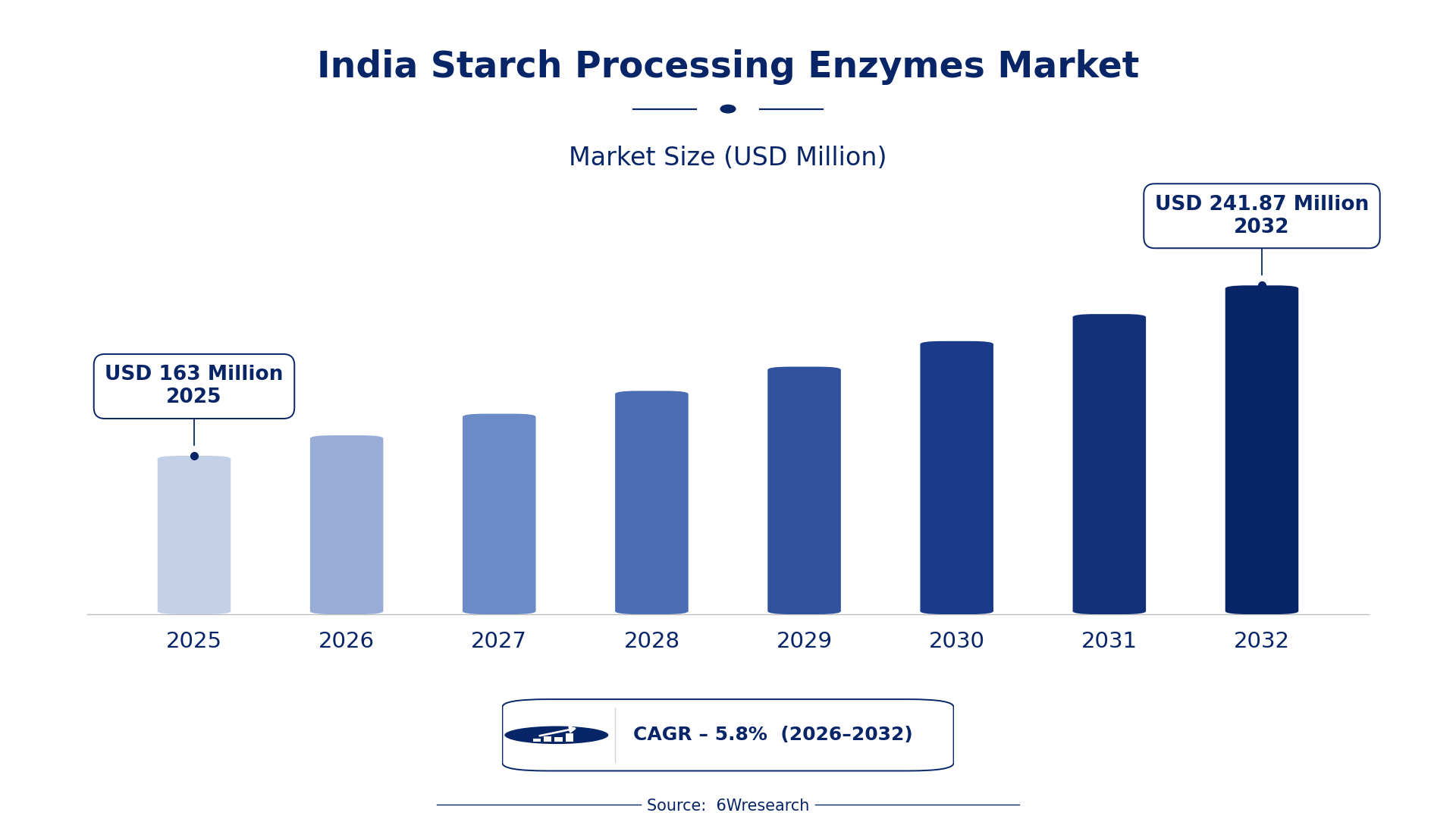
According to 6Wresearch internal database and industry insights, the India Starch Processing Enzymes Market was valued at USD 163.0 million in 2025 and is projected to reach USD 241.87 million by 2032, growing at a CAGR of approximately 5.8% during 2026–2032.
India Starch Processing Enzymes Market Highlights
| Report Metric | Details |
| Report Name | India Starch Processing Enzymes Market |
| Market Size 2025 | USD 163.0 million |
| Market Size 2032 | USD 241.87 million |
| Absolute Growth 2025–2032 | USD 78.87 million |
| CAGR 2026–2032 | 5.8% |
| Peak Annual Growth | 8.3% in 2027 |
| Forecast Period | 2026–2032 |
| Historical Data | 2022–2025 |
| Base Year | 2025 |
| Leading Enzyme Type, 2025 | Amylase (40% share) |
| Leading Function, 2025 | Starch Breakdown (43% share) |
| Leading Source, 2025 | Bacterial/Fungal (46% share) |
| Leading End User, 2025 | Food Processing Units (42% share) |
| Fastest-Growing Enzyme Type | Glucoamylase (8.4% CAGR) |
| Fastest-Growing Function | Glucose Conversion (7.6% CAGR) |
| Fastest-Growing Source | Microbial (8.1% CAGR) |
| Fastest-Growing End User | Bioethanol Plants (7.9% CAGR) |
| Growing Sector | Food Processing |
| Key End Users | Food Processing Units, Bioethanol Plants, Sweetener Producers |
India Starch Processing Enzymes Market Year-wise Growth Rate and Key Drivers (2022–2032)
This graph illustrates the annual growth rates of the market from 2022 to 2032, highlighting a steady upward trajectory and projected market expansion over the forecast period.
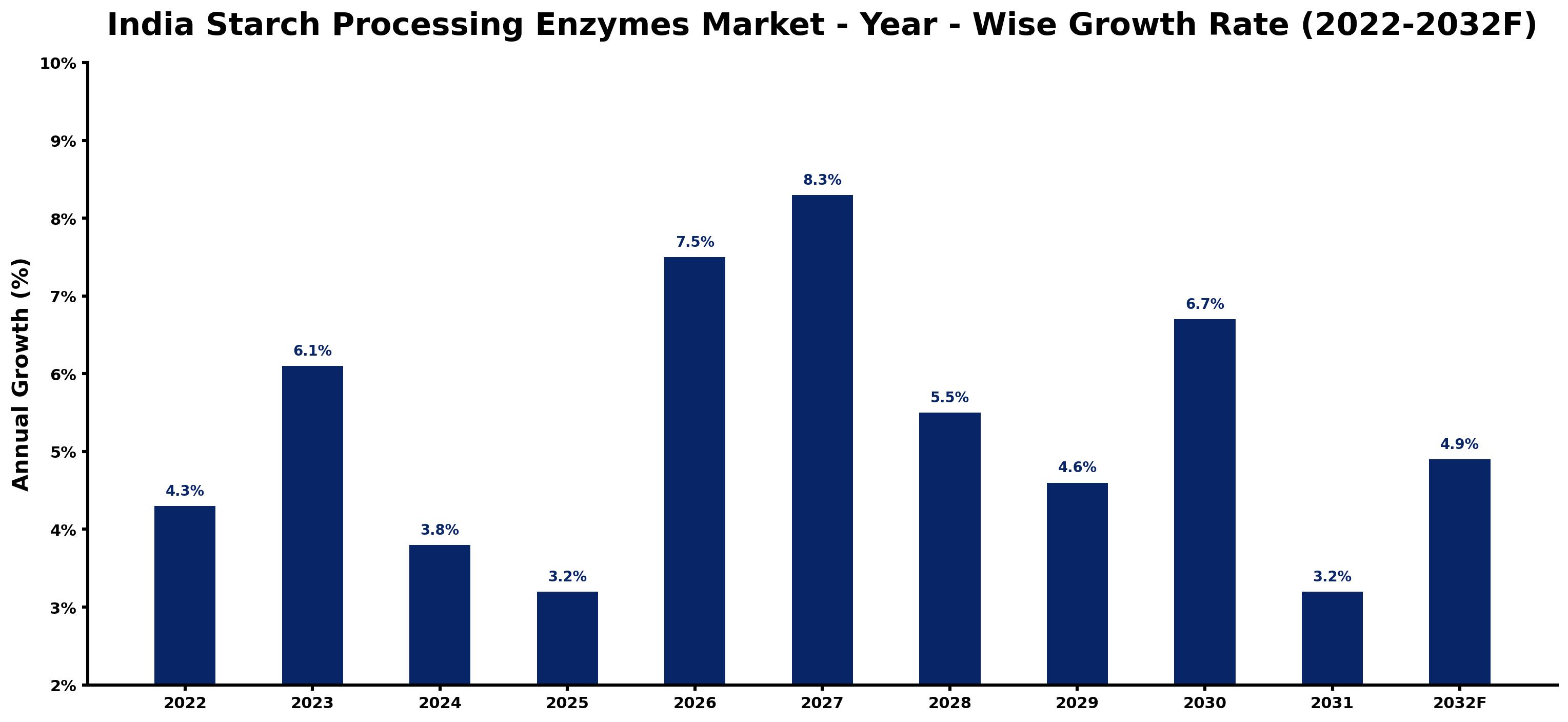
Year by year, the estimates below pair each growth rate with the development that shaped it.
| Year | Estimated Annual Growth (%) | Market Rationale |
| 2022 | 4.3 | The market showed steady demand from food processing units, reflecting ongoing production needs. |
| 2023 | 6.1 | Accelerated growth stemmed from increased activity in the bioethanol sector, boosting enzyme usage. |
| 2024 | 3.8 | A slowdown occurred as food processing units adjusted to demand patterns following previous growth. |
| 2025 | 3.2 | Demand continued to decelerate as production stabilised, yet growth remained positive overall due to ongoing needs. |
| 2026 | 7.5 | The market is expected to rebound with rising investments in bioethanol plants, driving enzyme requirements. |
| 2027 | 8.3 | Peak growth is projected as food processing units expand production capabilities, leading to increased enzyme demand. |
| 2028 | 5.5 | A slowdown is expected as growth rates normalise after the previous peak in demand. |
| 2029 | 4.6 | The market will continue to grow, albeit at a slower pace due to evolving buyer preferences. |
| 2030 | 6.7 | Growth is anticipated to accelerate again as the sweetener production sector increases its enzyme usage. |
| 2031 | 3.2 | A slowdown is expected as the market stabilises after a period of rapid growth. |
| 2032 | 4.9 | Growth is projected to pick up again, supported by ongoing investments in food processing technologies. |
Note: Market size estimations and growth projections presented in this report are based on 6Wresearch's proprietary forecasting methodology, utilizing the latest available industry data, government publications, and primary research inputs.
India Starch Processing Enzymes Market Synopsis
Starch Processing Enzymes in India are biological catalysts that break down starch into simpler sugars, produced through fermentation with microorganisms. These enzymes find primary applications in food processing, bioethanol production, and sweetener manufacturing. The India Starch Processing Enzymes Market is expanding due to robust demand from food processing units, which represent over 60% of the market. The bioethanol industry is also on the rise, with more than 200 operational plants as of 2023, further increasing enzyme utilisation. The National Biofuel Policy aims to elevate ethanol blending to 20% by 2025, driving the overall demand for starch processing enzymes.
Market Dynamics Impact Analysis (2026–2032)
| Factor | Type | Impact | Primary Segment Affected |
| Strong demand from food processing units due to increased production needs. | Driver | High | Food Processing Units |
| Expansion of bioethanol plants leading to higher enzyme consumption. | Driver | High | Bioethanol Plants |
| Growing bioethanol production capacity creates investment opportunities. | Opportunity | High | Bioethanol Plants |
| Increasing sweetener consumption opens new markets for enzyme suppliers. | Opportunity | Medium | Sweetener Producers |
| Regulatory compliance costs for enzyme production can constrain growth. | Restraint | High | Amylase |
| Limited awareness among smaller producers may hinder market penetration. | Restraint | Medium | Food Processing Units |
| Supply chain disruptions can delay enzyme availability for producers. | Challenge | High | Amylase |
| Competition from alternative sweetening agents may impact enzyme demand. | Challenge | Medium | Sweetener Producers |
Evaluation of Drivers in India Starch Processing Enzymes Market (2026–2032)
The main growth drivers and the segments they affect most are set out below.
| Drivers | Primary Segment Affected | Why It Matters (Evidence) |
| Increased food production drives demand for starch processing enzymes. | Food Processing Units | Food processing units account for over 60% of enzyme demand, leading to higher purchases. |
| Rising bioethanol production requires more enzymes for efficient processing. | Bioethanol Plants | With over 200 bioethanol plants operational, enzyme usage is significantly increasing. |
| Growing sweetener consumption boosts enzyme requirements for production. | Sweetener Producers | The average sweetener consumption in India is around 20 kg per person per year. |
| Technological advancements in enzyme production enhance efficiency. | Amylase | ISO 9001 certification is sought by producers, ensuring quality and efficiency. |
| Government incentives for biofuel production stimulate enzyme demand. | Bioethanol Plants | In 2023, INR 10 billion was allocated for biofuel production incentives. |
Growth across the Starch Processing Enzymes market in India is anchored in rising demand from food processing units and bioethanol plants. Food processing units account for over 60% of the demand, propelling enzyme purchases. The average sweetener consumption in India is around 20 kg per person per year, further boosting enzyme requirements. Technological improvements in production processes are increasing efficiency, supporting market expansion.
Evaluation of Restraints in India Starch Processing Enzymes Market
The key brakes on demand, and where they bite hardest, are shown below.
| Market Restraint | Primary Segment Affected | Why It Matters (Evidence) |
| High regulatory compliance costs for enzyme production. | Amylase | Producers face high costs to meet regulatory standards, impacting profitability and pricing strategies. |
| Limited awareness among smaller food processors about enzyme benefits. | Food Processing Units | Smaller units may not fully utilise enzymes, which restricts overall market growth potential. |
| Supply chain disruptions affecting enzyme availability. | Amylase | Disruptions can delay deliveries, impacting production schedules and increasing operational costs. |
| Competition from alternative sweeteners reduces enzyme demand. | Sweetener Producers | As consumers shift to alternatives, enzyme usage in sweetener production may decline, affecting sales. |
| Market entry barriers for new enzyme producers due to established players. | Amylase | New entrants may struggle against established firms with strong market presence, limiting competition. |
India Starch Processing Enzymes Market Challenges
In the India starch processing enzymes market, intense competition emerges as food processing units drive over 60% of demand. This concentration results in price wars that compel producers to lower prices, thereby eroding their profit margins. Supply chain disruptions frequently impact the bioethanol sector, where over 200 operational plants rely on consistent enzyme delivery, risking production delays. A shortage of skilled workers in enzyme production hampers efficiency, leading to longer lead times for buyers and disrupting their production schedules. Demand fluctuations from sweetener manufacturers complicate inventory management, as they consume an average of 20 kg per person per year, creating uncertainty for producers.
Trends in the India Starch Processing Enzymes Market
Several trends are reshaping the India Starch Processing Enzymes Market; the most important are set out below.
- Shift Towards Sustainable Bioethanol Production: India is focusing on sustainable bioethanol production, with over 200 plants operational. The National Biofuel Policy aims for 20% blending by 2025, encouraging enzyme use in bioethanol processes.
- Growing Demand for Quality Assurance in Enzyme Production: The push for quality assurance among enzyme producers is rising. This focus on quality management systems is critical for food safety and regulatory compliance.
- Increased Focus on Sweetener Production Efficiency: Sweetener producers are adopting advanced enzyme technologies to improve production efficiency. The average consumption of sweeteners in India is around 20 kg per person per year.
- Expansion of Food Processing Units in Maharashtra: Maharashtra is emerging as a significant hub for food processing, hosting numerous units. This growth is driving enzyme demand as production capabilities expand.
Investment Opportunities in the India Starch Processing Enzymes Market
Below are the investment opportunities with the strongest case in the India Starch Processing Enzymes Market.
- Investment in Bioethanol Production Facilities: With over 200 bioethanol plants operational, there is a gap in enzyme supply. Investing in enzyme production for these facilities can yield high returns as demand rises.
- Collaborations with Food Processing Units: Partnering with food processing units in Maharashtra can facilitate market entry. The region hosts numerous units, creating opportunities for local partnerships and growth.
- Focus on Quality Enzyme Production: Investing in certified production facilities can meet the increasing demand for quality assurance. This is essential for food safety and regulatory compliance, ensuring market competitiveness.
- Expansion into Sweetener Production: As sweetener consumption rises, there is a gap in enzyme supply for production. Targeting sweetener producers can be lucrative, given the average consumption of 20 kg per person.
Government Initiatives in the India Starch Processing Enzymes Market
The National Biofuel Policy, launched in 2021, aims for 20% ethanol blending by 2025. This policy increases enzyme demand as bioethanol production rises, requiring more starch processing enzymes. The Food Safety and Standards Authority of India updated the Food Safety and Standards Act in 2020 to include regulations on enzyme usage in food applications, ensuring safety and quality in food processing practices.
The Pradhan Mantri Kisan Sampada Yojana, initiated in 2020, promotes food processing. This scheme provides funding and support for food processing units, indirectly increasing enzyme demand as these units expand. The Biotechnology Industry Research Assistance Council, launched in 2021, supports enzyme research and development, promoting innovation in enzyme applications.
Future Insight of the India Starch Processing Enzymes Market
By 2032, buyers and suppliers in the India starch processing enzymes market can expect substantial changes driven by regulatory and technological shifts. The National Biofuel Policy aims to boost ethanol production, significantly increasing enzyme demand and opening new avenues for suppliers. The Indian government's allocation of INR 10 billion for biofuel production incentives will positively influence market conditions. Enhanced research initiatives from the Indian Council of Agricultural Research will promote advanced enzyme applications, enabling producers to meet the specific needs of food processing and bioethanol industries.
Market Segmentation Analysis
The report offers a comprehensive study of the following market segments and their leading categories in the market.
By Enzyme Type – Amylase Dominated, Glucoamylase Expected to Grow Fastest
According to Summon Dutta, Assistant Manager at 6Wresearch, Amylase held a 40% share of the India Starch Processing Enzymes Market by enzyme type in 2025. Amylase holds the largest market share in India due to its widespread application in food processing, particularly in baking and brewing. This enzyme's extensive use across numerous food processing units solidifies its position as the preferred choice for starch breakdown. The quickest growth will come from Glucoamylase, forecast to expand at a CAGR of 8.4% between 2026 and 2032. Glucoamylase is experiencing rapid growth as it is essential for converting starch into glucose, a critical process in sweetener manufacturing. The rising demand for glucose in food products is significantly driving its market expansion. Suppliers should enhance their glucoamylase offerings to capitalise on the growing demand in the sweetener sector.
By Function – Starch Breakdown Dominated, Glucose Conversion Expected to Grow Fastest
Starch Breakdown accounted for a 43% market share by function in 2025. Starch Breakdown leads the market, accounting for a substantial share due to its fundamental role in starch processing across various applications. This function is vital for food processing units, which form the backbone of the enzyme market. Over 2026–2032, Glucose Conversion is expected to post the fastest growth, at a CAGR of 7.6%. Glucose Conversion is the fastest-growing function, propelled by the increasing need for glucose in food products and sweeteners. The heightened focus on producing higher glucose levels is likely to accelerate its growth further. Buyers should invest in glucose conversion solutions to meet the surging demand for sweeteners.
By Source – Bacterial/Fungal Dominated, Microbial Expected to Grow Fastest
Bacterial/Fungal took a 46% share of source in 2025, more than any other category. Bacterial/Fungal sources dominate the market, providing the primary enzymes necessary for starch processing. Their established role in enzyme production ensures a consistent supply for food processing units, solidifying their market position. Microbial is set to record the highest CAGR in this split, 8.1% over 2026–2032. Microbial sources are rapidly gaining traction, driven by advancements in technology that improve enzyme production efficiency. This shift is expected to cater to the growing demand for sustainable enzyme solutions in the market. Suppliers should explore microbial sources to align with the market's trend towards sustainability.
By End User – Food Processing Units Dominated, Bioethanol Plants Expected to Grow Fastest
In 2025, Food Processing Units led the end user split with a 42% share. Food Processing Units represent the largest share of the market as they are the primary consumers of starch processing enzymes for various applications. Their significant presence in the industry ensures sustained demand for these enzymes. Bioethanol Plants are projected to grow fastest, at a CAGR of 7.9% during 2026–2032. Bioethanol Plants are the fastest-growing end user segment, stimulated by government initiatives aimed at increasing ethanol production to 20% blending by 2025. This policy shift is expected to significantly boost enzyme usage in bioethanol production. Suppliers should strategically target bioethanol plants to tap into this expanding market segment.
Key Attractiveness of the Report
- 10 Years of Market Numbers
- Historical Data Starting from 2022 to 2025
- Base Year 2025
- Forecast Data until 2032
- Key Performance Indicators Impacting the Market
- Major Upcoming Developments and Projects
Key Highlights of the Report:
- India Starch Processing Enzymes Market Outlook
- Market Size of India Starch Processing Enzymes Market, 2025
- Forecast of India Starch Processing Enzymes Market, 2032
- Historical Data and Forecast of India Starch Processing Enzymes Revenues & Volume for the Period 2022 - 2032F
- India Starch Processing Enzymes Market Trend Evolution
- India Starch Processing Enzymes Market Drivers and Challenges
- India Starch Processing Enzymes Price Trends
- India Starch Processing Enzymes Porter's Five Forces
- India Starch Processing Enzymes Industry Life Cycle
- Historical Data and Forecast of India Starch Processing Enzymes Market Revenues & Volume By Enzyme Type for the Period 2022 - 2032F
- Historical Data and Forecast of India Starch Processing Enzymes Market Revenues & Volume By Amylase for the Period 2022 - 2032F
- Historical Data and Forecast of India Starch Processing Enzymes Market Revenues & Volume By Glucoamylase for the Period 2022 - 2032F
- Historical Data and Forecast of India Starch Processing Enzymes Market Revenues & Volume By Pullulanase for the Period 2022 - 2032F
- Historical Data and Forecast of India Starch Processing Enzymes Market Revenues & Volume By Alpha-glucosidase for the Period 2022 - 2032F
- Historical Data and Forecast of India Starch Processing Enzymes Market Revenues & Volume By Function for the Period 2022 - 2032F
- Historical Data and Forecast of India Starch Processing Enzymes Market Revenues & Volume By Starch Breakdown for the Period 2022 - 2032F
- Historical Data and Forecast of India Starch Processing Enzymes Market Revenues & Volume By Glucose Conversion for the Period 2022 - 2032F
- Historical Data and Forecast of India Starch Processing Enzymes Market Revenues & Volume By Debranching for the Period 2022 - 2032F
- Historical Data and Forecast of India Starch Processing Enzymes Market Revenues & Volume By Maltose Conversion for the Period 2022 - 2032F
- Historical Data and Forecast of India Starch Processing Enzymes Market Revenues & Volume By Source for the Period 2022 - 2032F
- Historical Data and Forecast of India Starch Processing Enzymes Market Revenues & Volume By Bacterial/Fungal for the Period 2022 - 2032F
- Historical Data and Forecast of India Starch Processing Enzymes Market Revenues & Volume By Microbial for the Period 2022 - 2032F
- Historical Data and Forecast of India Starch Processing Enzymes Market Revenues & Volume By Fungal/Yeast for the Period 2022 - 2032F
- Historical Data and Forecast of India Starch Processing Enzymes Market Revenues & Volume By Fermentation for the Period 2022 - 2032F
- Historical Data and Forecast of India Starch Processing Enzymes Market Revenues & Volume By End User for the Period 2022 - 2032F
- Historical Data and Forecast of India Starch Processing Enzymes Market Revenues & Volume By Food Processing Units for the Period 2022 - 2032F
- Historical Data and Forecast of India Starch Processing Enzymes Market Revenues & Volume By Bioethanol Plants for the Period 2022 - 2032F
- Historical Data and Forecast of India Starch Processing Enzymes Market Revenues & Volume By Beverage Manufacturers for the Period 2022 - 2032F
- Historical Data and Forecast of India Starch Processing Enzymes Market Revenues & Volume By Sweetener Producers for the Period 2022 - 2032F
- India Starch Processing Enzymes Import Export Trade Statistics
- Market Opportunity Assessment By Enzyme Type
- Market Opportunity Assessment By Function
- Market Opportunity Assessment By Source
- Market Opportunity Assessment By End User
- India Starch Processing Enzymes Top Companies Market Share
- India Starch Processing Enzymes Competitive Benchmarking By Technical and Operational Parameters
- India Starch Processing Enzymes Company Profiles
- India Starch Processing Enzymes Key Strategic Recommendations
Market Covered
This report examines the market across the segments below.
By Enzyme Type
- Amylase
- Glucoamylase
- Pullulanase
- Alpha-glucosidase
By Function
- Starch Breakdown
- Glucose Conversion
- Debranching
- Maltose Conversion
By Source
- Bacterial/Fungal
- Microbial
- Fungal/Yeast
- Fermentation
By End User
- Food Processing Units
- Bioethanol Plants
- Beverage Manufacturers
- Sweetener Producers































