India String Instruments Market Size & Growth Rate
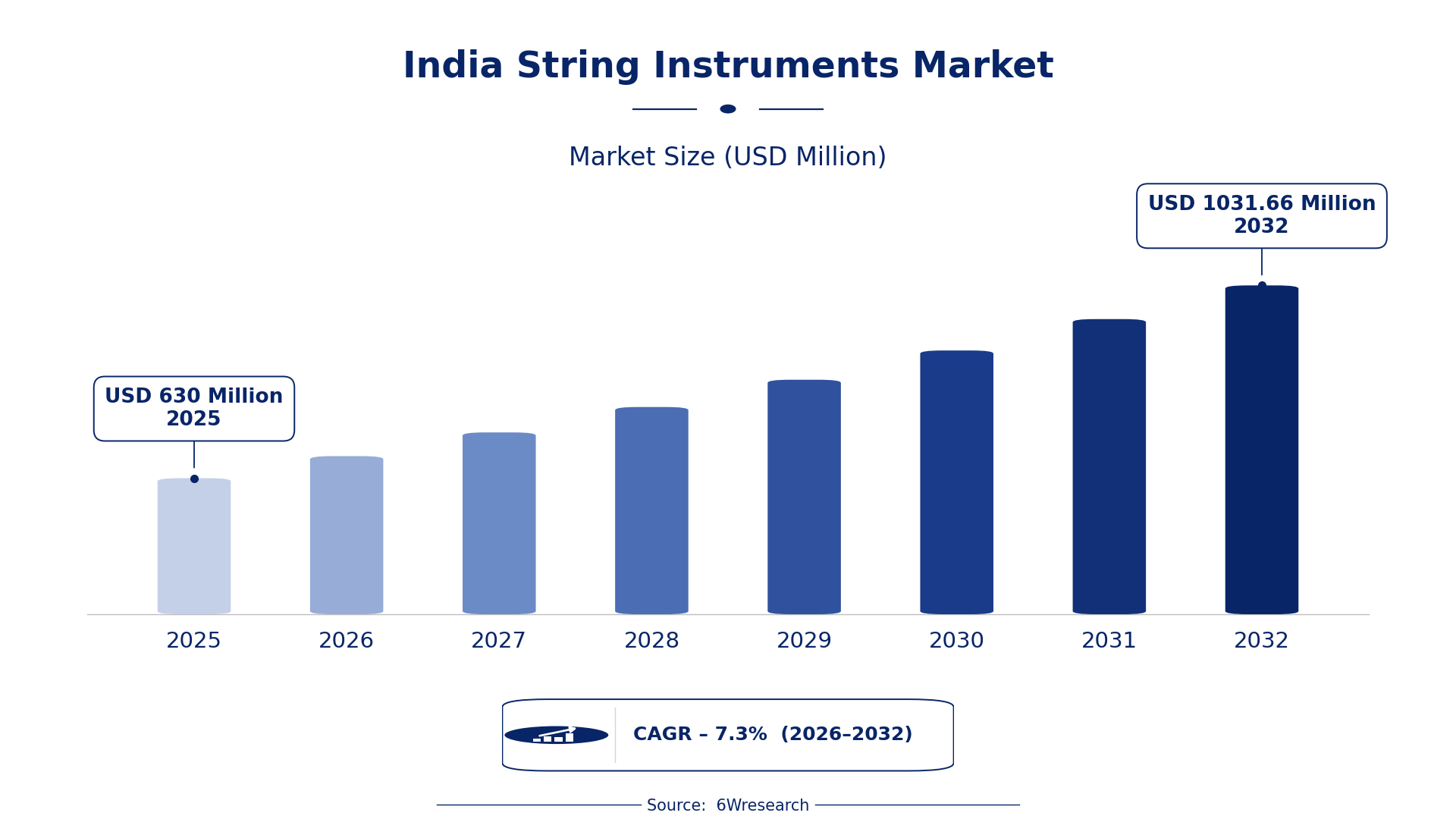
According to 6Wresearch internal database and industry insights, the India String Instruments Market was valued at USD 630.0 million in 2025 and is projected to reach USD 1,031.66 million by 2032, growing at a CAGR of approximately 7.3% during 2026–2032.
India String Instruments Market Highlights
| Report Metric | Details |
| Report Name | India String Instruments Market |
| Market Size 2025 | USD 630.0 million |
| Market Size 2032 | USD 1,031.66 million |
| Absolute Growth 2025–2032 | USD 401.66 million |
| CAGR 2026–2032 | 7.3% |
| Peak Annual Growth | 8.9% in 2029 |
| Forecast Period | 2026–2032 |
| Historical Data | 2022–2025 |
| Base Year | 2025 |
| Leading Instrument Type, 2025 | Guitars (50% share) |
| Leading Material Type, 2025 | Mahogany/Rosewood (40% share) |
| Leading Distribution Channel, 2025 | Music Stores (46% share) |
| Leading End User, 2025 | Music Students (40% share) |
| Fastest-Growing Instrument Type | Ukuleles (9.9% CAGR) |
| Fastest-Growing Material Type | Bamboo/Plastic (10.1% CAGR) |
| Fastest-Growing Distribution Channel | Online Retailers (9.7% CAGR) |
| Fastest-Growing End User | Hobbyists (8.7% CAGR) |
| Growing Sector | Hobbyists |
| Key End Users | Music Students, Amateur Musicians, Hobbyists, Orchestras |
India String Instruments Market Year-wise Growth Rate and Key Drivers (2022–2032)
This graph illustrates the annual growth rates of the market from 2022 to 2032, highlighting a steady upward trajectory and projected market expansion over the forecast period.
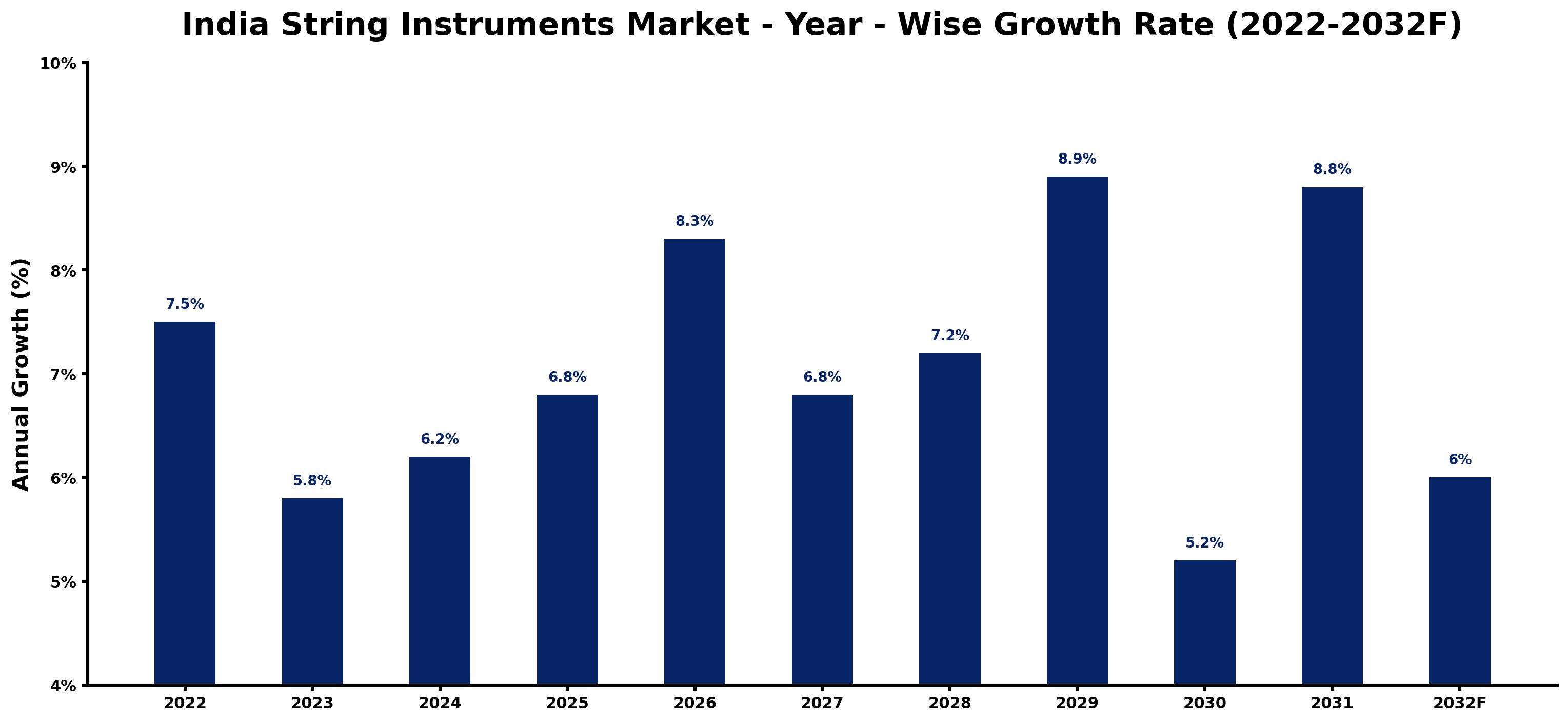
Each row of the following table gives one year's estimated growth and the event or demand shift that explains it.
| Year | Estimated Annual Growth (%) | Market Rationale |
| 2022 | 7.5 | The market experienced strong activity, driven by high interest in music education. |
| 2023 | 5.8 | Growth slowed as demand stabilised after a peak in music school enrolments. |
| 2024 | 6.2 | An increase in music festivals boosted interest in string instruments. |
| 2025 | 6.8 | Sales rose due to the popularity of guitars among amateur musicians. |
| 2026 | 8.3 | The introduction of new training programs is expected to improve craftsmanship skills. |
| 2027 | 6.8 | Growth is projected to slow as market adjustments take place following rapid expansion. |
| 2028 | 7.2 | Increased disposable incomes will lead to higher purchases of string instruments. |
| 2029 | 8.9 | The market is expected to peak as orchestras significantly expand their string sections. |
| 2030 | 5.2 | Growth is projected to slow as buyers become more selective in their instrument choices. |
| 2031 | 8.8 | Sales are expected to surge again due to rising interest in traditional music forms. |
| 2032 | 6.0 | The market is projected to stabilise as online sales continue to gain traction. |
Note: Market size estimations and growth projections presented in this report are based on 6Wresearch's proprietary forecasting methodology, utilizing the latest available industry data, government publications, and primary research inputs.
India String Instruments Market Synopsis
String Instruments in India encompass a variety of musical instruments that produce sound through vibrating strings. These instruments, including violins, guitars, and cellos, are crafted using traditional techniques and serve important roles in orchestras, music education, and solo performances. The India String Instruments Market is expanding due to rising disposable incomes, increasing enrolment in music schools, and a vibrant community of amateur musicians. With over 1,000 music schools and a thriving population of 1.5 million musicians, demand is expected to rise further, particularly for guitars and ukuleles.
Market Dynamics Impact Analysis (2026–2032)
| Factor | Type | Impact | Primary Segment Affected |
| Growing interest in music education and performance opportunities | Driver | High | Music Students |
| Rising disposable incomes leading to higher spending on musical instruments | Driver | High | Amateur Musicians |
| Increased demand for online sales channels for convenience | Opportunity | High | E-commerce |
| Expansion of music festivals and cultural events fostering instrument sales | Opportunity | High | Orchestras |
| High competition among retailers affecting pricing strategies | Restraint | Medium | Music Stores |
| Limited awareness of traditional craftsmanship among new musicians | Restraint | Medium | Specialty Shops |
| Supply chain disruptions affecting instrument availability | Challenge | High | Guitars |
| Skilled labour shortages in traditional instrument craftsmanship | Challenge | Medium | Mahogany/Rosewood |
Evaluation of Drivers in India String Instruments Market (2026–2032)
The table below links each growth driver to the segment it affects and the evidence for it.
| Drivers | Primary Segment Affected | Why It Matters (Evidence) |
| Growing enrolment in music schools | Music Students | With over 1,000 music schools, demand for string instruments has surged, particularly for violins and cellos. |
| Increased sales of guitars among amateur musicians | Guitars | Guitar sales in India have increased by 25% in the last five years, driven by a growing interest in personal music creation. |
| Rising online sales of string instruments | E-commerce | Online sales have grown by 40% since 2020, making it easier for buyers to access a variety of instruments. |
| Support from cultural programs promoting traditional music | Orchestras | The Indian government supports traditional music through various cultural programs, encouraging orchestras to expand their string sections. |
| Integration of string instruments in educational curricula | Music Students | The National School of Drama includes string instruments in its curriculum, boosting demand among students. |
Market growth for String Instruments in India is underpinned by rising enrolment in music schools, which has led to increased demand for violins and cellos. The Indian music industry, valued at approximately $1.5 billion, is experiencing a surge in guitar sales, which have risen by 25% in the last five years. Online sales channels have also gained traction, with a 40% increase since 2020, allowing more buyers access to a variety of instruments. The integration of string instruments into educational curricula has also contributed to this growth, as seen in the National School of Drama's inclusion of these instruments.
Evaluation of Restraints in India String Instruments Market
The table below lists the restraints and the evidence behind each.
| Market Restraint | Primary Segment Affected | Why It Matters (Evidence) |
| Challenges in meeting ISO 9001 standards | Guitars | String instrument manufacturers often struggle to meet ISO 9001 standards, leading to delays in production and increased costs. |
| Rising material costs for instrument production | Violins | Rising material costs, particularly for maple and spruce used in violins, have surged by 20% over the past three years. |
| Shortage of skilled luthiers | Guitars | A shortage of skilled luthiers hampers production capacity, forcing music schools to wait longer for instrument deliveries. |
| Competition from imported instruments | Guitars | Competition from imported instruments, which can be 30% cheaper, pressures local makers to lower prices. |
| Limited access to financing for small producers | Guitars | Many small-scale producers face challenges in securing financing, limiting their ability to invest in production capabilities. |
India String Instruments Market Challenges
The India String Instruments Market faces practical problems that impact producers and buyers alike, starting with regulatory compliance. String instrument manufacturers often struggle to meet ISO 9001 standards, which can lead to production delays and increase costs, raising prices for music schools by up to 15%. Rising material costs, particularly for maple and spruce used in violins, have surged by 20% over the past three years, squeezing margins for producers. A shortage of skilled luthiers hampers production capacity, forcing music schools to wait longer for instrument deliveries, delaying their educational programs. Competition from imported instruments, which can be 30% cheaper, pressures local makers to lower prices, impacting their profitability.
Trends in the India String Instruments Market
Several trends are reshaping the India String Instruments Market; the most important are set out below.
- Shift towards Online Retailing: The retail environment is shifting towards online platforms, with online sales of string instruments growing by 40% since 2020. This trend reflects a broader consumer preference for the convenience of e-commerce for purchasing instruments.
- Growing Interest in Ukuleles: The ukulele is gaining popularity among beginners and hobbyists, with a projected CAGR of 9.9% from 2026 to 2032. This trend is particularly noticeable in urban areas where music schools are incorporating ukulele classes.
- Increased Focus on Traditional Music: There is a renewed interest in traditional music forms, supported by cultural programs from the government. This trend is likely to increase the visibility of traditional string instruments.
- Integration of String Instruments in Education: The inclusion of string instruments in educational curricula, such as the National School of Drama's program, is becoming more common. This integration is expected to cultivate a new generation of musicians.
Investment Opportunities in the India String Instruments Market
Below are the investment opportunities with the strongest case in the India String Instruments Market.
- Music Schools Seeking Quality Instruments: Music schools across India are in need of quality string instruments to meet rising student enrolments. With over 1,000 music schools, suppliers can enter this market through partnerships with local educational institutions.
- E-commerce Platforms for Wider Reach: The growing trend of online shopping presents opportunities for suppliers to expand their reach. Collaborating with e-commerce platforms can help manufacturers tap into the increasing demand for string instruments.
- Support for Traditional Craftsmanship: Investment in traditional craftsmanship is a growing opportunity, particularly in regions like Kerala, known for its rich heritage in string instrument making. This aligns with government initiatives supporting cultural preservation.
- Rural Development Programs Promoting Instruments: Rural development programs are promoting bamboo instruments, creating a niche market for affordable options. Suppliers can engage with local communities to develop and distribute these instruments.
Government Initiatives in the India String Instruments Market
The Cultural Heritage Fund, established by the Ministry of Culture in 2022, allocates funds for preserving traditional string instrument making. This measure builds on the National Policy on Music Education from 2021, which aims to integrate music education into the school curriculum nationwide. Together, these initiatives support local craftsmanship and promote the cultural significance of string instruments in India.
The Skill India Initiative, run by the Ministry of Skill Development, funds training programs for string instrument craftsmanship. This initiative empowers local artisans and supports the growth of the string instrument market. Additionally, the All India Music Conference promotes string instrument education, ensuring that buyers can access quality instruments produced by skilled craftsmen.
Future Insight of the India String Instruments Market
The India String Instruments Market will evolve by 2032, driven by rising disposable incomes and a growing interest in music education. Increased government support for traditional music through cultural programs will raise visibility for local craftsmanship. The expansion of online sales, which have already surged by 40% since 2020, will improve access for buyers. The integration of string instruments into mainstream education, as seen in the National School of Drama, will cultivate a new generation of musicians, boosting demand for locally crafted instruments.
Market Segmentation Analysis
The report offers a comprehensive study of the following market segments and their leading categories in the market.
By Instrument Type – Guitars Dominated, Ukuleles Expected to Grow Fastest
According to Summon Dutta, Assistant Manager at 6Wresearch, Guitars held a 50% share of the India String Instruments Market by instrument type in 2025. Guitars hold the largest market share due to their widespread appeal among amateur musicians and hobbyists. With over 1,000 music schools in India, guitars are a staple instrument for many students. Over 2026–2032, Ukuleles are expected to post the fastest growth, at a CAGR of 9.9%. Ukuleles are experiencing rapid growth as they gain popularity among beginners and hobbyists, making them an attractive option for new learners. Their affordability and ease of play contribute to this surge in interest. Suppliers should focus on expanding their guitar and ukulele offerings to cater to the growing demand in the Indian market.
By Material Type – Mahogany/Rosewood Dominated, Bamboo/Plastic Expected to Grow Fastest
With a 40% revenue share in 2025, Mahogany/Rosewood was the largest material type category. Mahogany and rosewood command the largest share due to their widespread use in crafting high-quality string instruments, particularly in prestigious music schools. Their warm tonal qualities make them the preferred choice among professional musicians and educators across India. Bamboo/Plastic is projected to grow fastest, at a CAGR of 10.1% during 2026–2032. Bamboo and plastic are rapidly gaining traction as they cater to budget-conscious consumers looking for affordable instruments, especially in educational settings. This growth is driven by an increasing number of music schools incorporating these materials into their teaching programs for beginners. Suppliers should consider expanding their product lines to include bamboo and plastic instruments to cater to the growing demand from cost-sensitive consumers.
By Distribution Channel – Music Stores Dominated, Online Retailers Expected to Grow Fastest
Music Stores took a 46% share of distribution channel in 2025, more than any other category. Music stores hold the largest market share as they offer a hands-on shopping experience, allowing customers to try instruments before making a purchase. Their established presence in local communities builds trust and loyalty among musicians and students alike. The quickest growth will come from Online Retailers, forecast to expand at a CAGR of 9.7% between 2026 and 2032. Online retailers are experiencing significant growth, propelled by the convenience of shopping from home and the expanding range of products available. This trend is particularly evident as more consumers opt to purchase string instruments online, especially in recent years. Retailers must enhance their online platforms to take advantage of the increasing trend towards online shopping for string instruments.
By End User – Music Students Dominated, Hobbyists Expected to Grow Fastest
In 2025, Music Students led the end user split with a 40% share. Music students represent the largest share of end users, driven by the extensive network of over 1,000 music schools across India that focus on string instrument education. Their consistent demand for quality instruments ensures a stable market for suppliers. Hobbyists are set to record the highest CAGR in this split, 8.7% over 2026–2032. Hobbyists are the fastest-growing segment, reflecting a surge in interest in music as a leisure activity among the general population. This shift indicates a broader market potential as more individuals seek to engage with string instruments for personal enjoyment. Suppliers should adapt their marketing strategies to effectively target both music students and hobbyists to maximise their market reach.
Key Attractiveness of the Report
- 10 Years of Market Numbers
- Historical Data Starting from 2022 to 2025
- Base Year 2025
- Forecast Data until 2032
- Key Performance Indicators Impacting the Market
- Major Upcoming Developments and Projects
Key Highlights of the Report:
- India String Instruments Market Outlook
- Market Size of India String Instruments Market, 2025
- Forecast of India String Instruments Market, 2032
- Historical Data and Forecast of India String Instruments Revenues & Volume for the Period 2022 - 2032F
- India String Instruments Market Trend Evolution
- India String Instruments Market Drivers and Challenges
- India String Instruments Price Trends
- India String Instruments Porter's Five Forces
- India String Instruments Industry Life Cycle
- Historical Data and Forecast of India String Instruments Market Revenues & Volume By Instrument Type for the Period 2022 - 2032F
- Historical Data and Forecast of India String Instruments Market Revenues & Volume By Violins for the Period 2022 - 2032F
- Historical Data and Forecast of India String Instruments Market Revenues & Volume By Guitars for the Period 2022 - 2032F
- Historical Data and Forecast of India String Instruments Market Revenues & Volume By Cellos for the Period 2022 - 2032F
- Historical Data and Forecast of India String Instruments Market Revenues & Volume By Ukuleles for the Period 2022 - 2032F
- Historical Data and Forecast of India String Instruments Market Revenues & Volume By Material Type for the Period 2022 - 2032F
- Historical Data and Forecast of India String Instruments Market Revenues & Volume By Maple/Spruce for the Period 2022 - 2032F
- Historical Data and Forecast of India String Instruments Market Revenues & Volume By Mahogany/Rosewood for the Period 2022 - 2032F
- Historical Data and Forecast of India String Instruments Market Revenues & Volume By Ebony/Fiberglass for the Period 2022 - 2032F
- Historical Data and Forecast of India String Instruments Market Revenues & Volume By Bamboo/Plastic for the Period 2022 - 2032F
- Historical Data and Forecast of India String Instruments Market Revenues & Volume By Distribution Channel for the Period 2022 - 2032F
- Historical Data and Forecast of India String Instruments Market Revenues & Volume By Music Stores for the Period 2022 - 2032F
- Historical Data and Forecast of India String Instruments Market Revenues & Volume By Online Retailers for the Period 2022 - 2032F
- Historical Data and Forecast of India String Instruments Market Revenues & Volume By Specialty Shops for the Period 2022 - 2032F
- Historical Data and Forecast of India String Instruments Market Revenues & Volume By E-commerce for the Period 2022 - 2032F
- Historical Data and Forecast of India String Instruments Market Revenues & Volume By End User for the Period 2022 - 2032F
- Historical Data and Forecast of India String Instruments Market Revenues & Volume By Music Students for the Period 2022 - 2032F
- Historical Data and Forecast of India String Instruments Market Revenues & Volume By Amateur Musicians for the Period 2022 - 2032F
- Historical Data and Forecast of India String Instruments Market Revenues & Volume By Orchestras for the Period 2022 - 2032F
- Historical Data and Forecast of India String Instruments Market Revenues & Volume By Hobbyists for the Period 2022 - 2032F
- India String Instruments Import Export Trade Statistics
- Market Opportunity Assessment By Instrument Type
- Market Opportunity Assessment By Material Type
- Market Opportunity Assessment By Distribution Channel
- Market Opportunity Assessment By End User
- India String Instruments Top Companies Market Share
- India String Instruments Competitive Benchmarking By Technical and Operational Parameters
- India String Instruments Company Profiles
- India String Instruments Key Strategic Recommendations
Market Covered
The report offers an extensive study of the following market segments.
By Instrument Type
- Violins
- Guitars
- Cellos
- Ukuleles
By Material Type
- Maple/Spruce
- Mahogany/Rosewood
- Ebony/Fiberglass
- Bamboo/Plastic
By Distribution Channel
- Music Stores
- Online Retailers
- Specialty Shops
- E-commerce
By End User
- Music Students
- Amateur Musicians
- Orchestras
- Hobbyists































