China String Instruments Market Size & Growth Rate
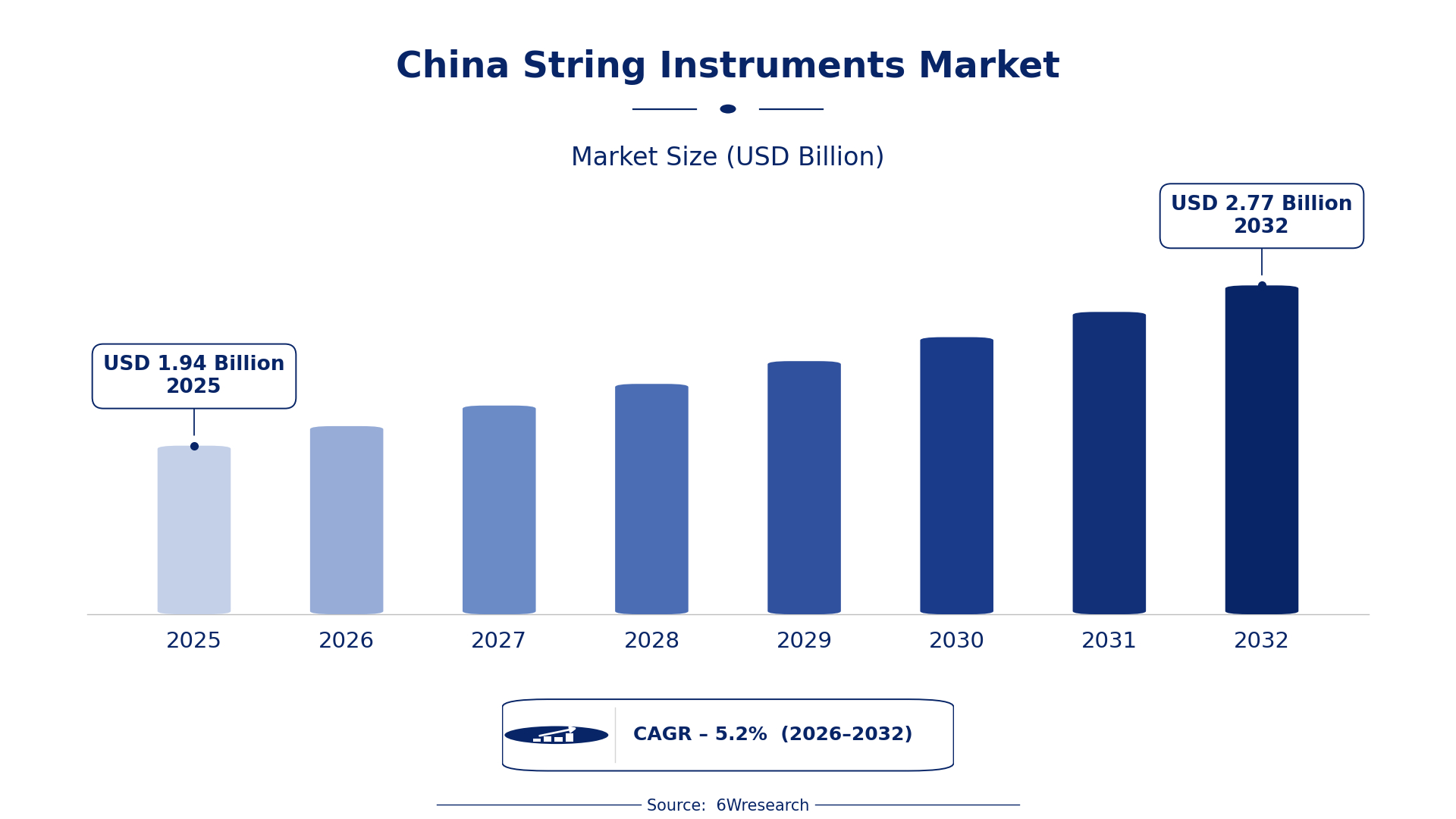
According to 6Wresearch internal database and industry insights, the China String Instruments Market was valued at USD 1.94 billion in 2025 and is projected to reach USD 2.77 billion by 2032, growing at a CAGR of approximately 5.2% during 2026–2032.
China String Instruments Market Highlights
| Report Metric | Details |
| Report Name | China String Instruments Market |
| Market Size 2025 | USD 1.94 billion |
| Market Size 2032 | USD 2.77 billion |
| Absolute Growth 2025–2032 | USD 0.83 billion |
| CAGR 2026–2032 | 5.2% |
| Peak Annual Growth | 7.4% in 2026 |
| Forecast Period | 2026–2032 |
| Historical Data | 2022–2025 |
| Base Year | 2025 |
| Leading Instrument Type, 2025 | Guitars (39% share) |
| Leading Material Type, 2025 | Maple/Spruce (38% share) |
| Leading Distribution Channel, 2025 | Music Stores (52% share) |
| Leading End User, 2025 | Music Students (43% share) |
| Fastest-Growing Instrument Type | Ukuleles (6.2% CAGR) |
| Fastest-Growing Material Type | Bamboo/Plastic (7.4% CAGR) |
| Fastest-Growing Distribution Channel | E-commerce (7.8% CAGR) |
| Fastest-Growing End User | Hobbyists (7.5% CAGR) |
| Growing Sector | Music Education |
| Key End Users | Music Students, Amateur Musicians, Cultural Institutions |
China String Instruments Market Year-wise Growth Rate and Key Drivers (2022–2032)
This graph illustrates the annual growth rates of the market from 2022 to 2032, highlighting a steady upward trajectory and projected market expansion over the forecast period.
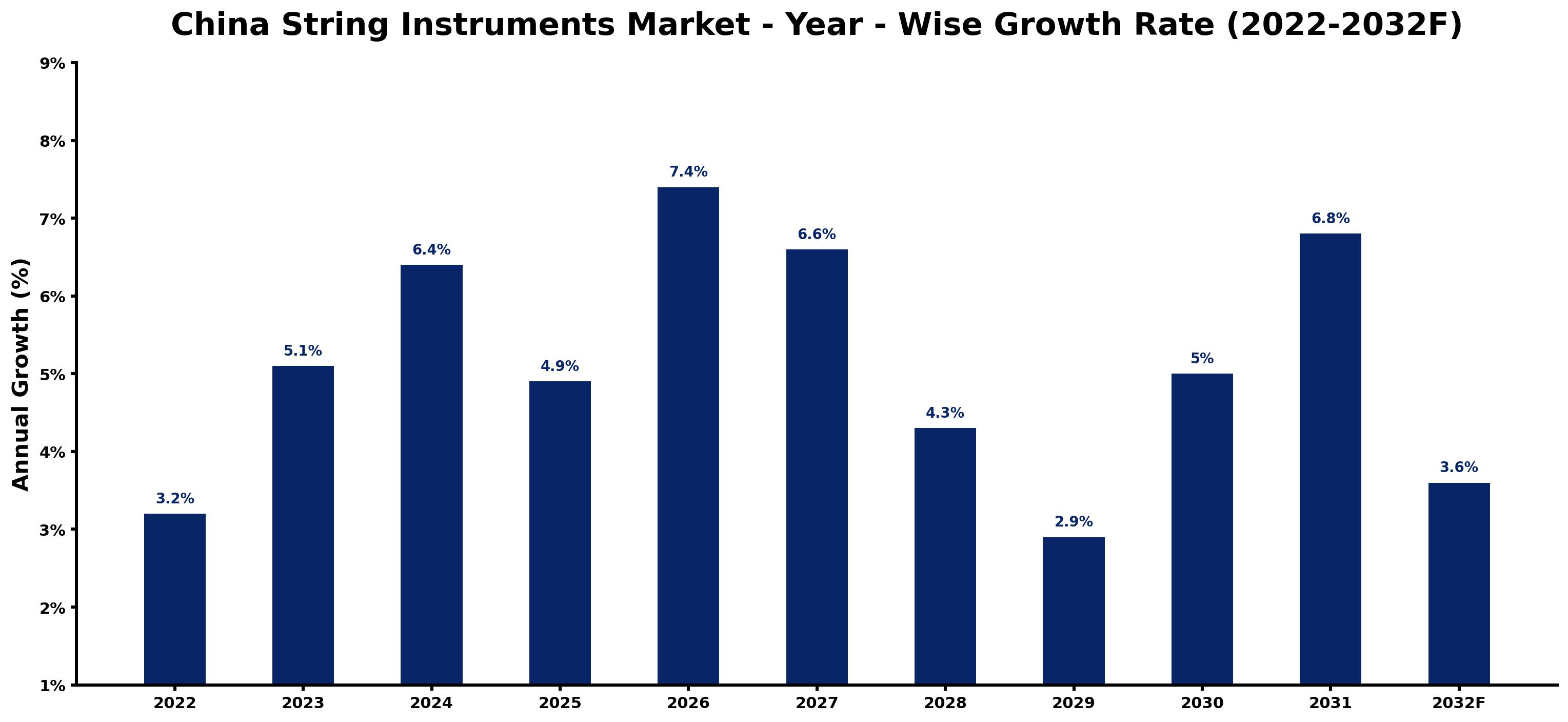
The following table presents the estimated annual growth rate for each year together with the principal factor influencing market performance.
| Year | Estimated Annual Growth (%) | Market Rationale |
| 2022 | 3.2 | The market experienced moderate growth, driven by increased interest in music education. |
| 2023 | 5.1 | More students enrolled in music schools across urban areas, accelerating growth. |
| 2024 | 6.4 | Demand surged as violins gained popularity among students in orchestras. |
| 2025 | 4.9 | Online sales began to stabilise after rapid increases, leading to slower growth. |
| 2026 | 7.4 | Heightened interest in string instruments during music festivals is expected to peak growth. |
| 2027 | 6.6 | The market adjusts to previous peaks in demand, leading to slower growth projections. |
| 2028 | 4.3 | Continued interest in music education is expected to maintain steady growth despite a slight slowdown. |
| 2029 | 2.9 | Market saturation is anticipated to slow growth further as competition increases. |
| 2030 | 5.0 | An increase in hobbyist musicians will contribute to a resurgence in demand for instruments. |
| 2031 | 6.8 | Cultural events are expected to spark renewed interest in string instruments, boosting growth. |
| 2032 | 3.6 | The market is projected to stabilise after years of expansion, resulting in slower growth. |
Note: Market size estimations and growth projections presented in this report are based on 6Wresearch's proprietary forecasting methodology, utilizing the latest available industry data, government publications, and primary research inputs.
China String Instruments Market Synopsis
String Instruments in China encompass a variety of musical instruments that produce sound through vibrating strings, commonly made from wood and metal. These instruments are essential for education, performance, and recreational music-making. The China String Instruments Market is experiencing growth due to rising student enrolment in music schools, with over 1,000 institutions educating more than 500,000 students. Government initiatives supporting traditional music education are increasing demand for these instruments, particularly violins and guitars, as cultural institutions seek to enrich their offerings.
Market Dynamics Impact Analysis (2026–2032)
| Factor | Type | Impact | Primary Segment Affected |
| Increased enrolment in music schools drives demand for string instruments among students. | Driver | High | Music Students |
| Growing interest in traditional music education creates opportunities for instrument production. | Opportunity | High | Guitars |
| Rising online sales channels enhance accessibility for buyers. | Driver | Medium | E-commerce |
| The growing popularity of hobbyist musicians opens new markets for instrument sales. | Opportunity | Medium | Hobbyists |
| High production costs for quality instruments limit affordability for some buyers. | Restraint | High | Violins |
| Supply chain disruptions can delay instrument availability for retailers. | Restraint | Medium | Guitars |
| Competition from alternative music instruments can divert potential buyers. | Challenge | High | Cellos |
| Regulatory approvals for new instrument designs can slow market entry. | Challenge | Medium | Ukuleles |
Evaluation of Drivers in China String Instruments Market (2026–2032)
Below mentioned are some major drivers and their influence on market dynamics.
| Drivers | Primary Segment Affected | Why It Matters (Evidence) |
| Increased enrolment in music schools boosts demand for string instruments. | Music Students | Over 500,000 students are enrolled in more than 1,000 music schools, leading to higher instrument purchases. |
| Rising online sales provide convenient access to string instruments. | E-commerce | Online sales grew by 30% in 2022, encouraging more buyers to purchase instruments online. |
| Cultural events promote string instrument usage among amateur musicians. | Hobbyists | The annual China Music Education Conference attracts over 10,000 participants, increasing interest in string instruments. |
| Government programs support traditional music education, increasing demand for instruments. | Violins | The Ministry of Culture promotes traditional music education through various programs, increasing instrument sales. |
| The popularity of violins among students drives sales growth. | Violins | Violins are the most popular string instrument among students in urban areas, boosting demand. |
Market growth in China for String Instruments is fuelled by rising enrolment in music schools, cultural events, and online sales. With over 500,000 students currently enrolled in more than 1,000 music schools, there is a notable increase in purchases of violins and guitars. The annual China Music Education Conference draws over 10,000 participants, generating heightened interest in string instruments.
Evaluation of Restraints in China String Instruments Market
The main factors holding the market back are set out below.
| Market Restraint | Primary Segment Affected | Why It Matters (Evidence) |
| High production costs limit the affordability of quality string instruments. | Violins | Production costs for violins can exceed 1,000 RMB, making them less accessible to students. |
| Supply chain disruptions can lead to delays in instrument availability. | Guitars | Manufacturers in Guangdong province face challenges in sourcing materials, affecting supply. |
| Competition from alternative instruments can divert potential buyers from string instruments. | Cellos | The rise of digital music tools offers cheaper alternatives for music creation. |
| Regulatory approvals for new designs can slow market entry for innovative instruments. | Ukuleles | Approval processes can take several months, delaying product launches. |
| Limited awareness of string instruments in rural areas restricts market growth. | Hobbyists | Many rural areas lack access to music education, reducing instrument purchases. |
China String Instruments Market Challenges
Supply chain disruptions are currently affecting the China String Instruments Market, with certain wood types experiencing price increases of up to 15% this year, placing a strain on local artisans. Domestic producers encounter intense competition from imported instruments, as lower-priced options can result in a 20% decline in sales for some manufacturers. Compliance with ISO 9001 standards raises operational costs, compelling smaller producers to allocate up to 10% of their budgets for certification. A shortage of skilled craftsmen in the industry is causing delays in production timelines, impacting supply to music schools and students who depend on timely access to instruments.
Trends in the China String Instruments Market
Buyers and suppliers in the China String Instruments Market are adjusting to the following trends.
- Expansion of E-commerce for String Instruments: The growth of online retailing is reshaping the sale of string instruments in China. E-commerce platforms have recorded a 30% increase in sales, making instruments more accessible to a broader audience.
- Increased Focus on Traditional Music Education: The 'Traditional Music Revitalization Plan' launched in 2021 is enhancing the quality of string instrument education. This initiative seeks to integrate traditional music into school curriculums, benefiting over 500,000 students.
- Growing Popularity of Ukuleles Among Beginners: The ukulele is becoming increasingly popular as a beginner-friendly instrument in China. With a projected CAGR of 6.2% from 2026 to 2032, it appeals to a younger audience eager for accessible music-making options.
- Rise of Music Festivals Promoting String Instruments: The Shanghai International Music Festival prominently features string instruments, drawing thousands of attendees. This event underscores the cultural importance of string instruments, enhancing their popularity.
Investment Opportunities in the China String Instruments Market
Below are the investment opportunities with the strongest case in the China String Instruments Market.
- Investment in High-Quality String Instruments: The market is projected to reach USD 2.77 billion by 2032, creating an opportunity to invest in high-quality instrument production. Music schools represent key buyers in need of reliable instruments.
- Partnerships with Local Artisans for Craftsmanship: The government's 'Creative Arts Initiative' supports local artisans, offering opportunities for partnerships. Collaborating with artisans can enhance product quality and appeal to cultural institutions.
- Development of Affordable Beginner Instruments: With a rising number of music students, there is a growing demand for affordable beginner instruments. Targeting music schools can facilitate entry into this expanding market segment.
- Expansion of Online Sales Channels: E-commerce is expected to experience substantial growth. Establishing an online presence can enable suppliers to reach a wider audience of music enthusiasts.
Government Initiatives in the China String Instruments Market
In 2023, the 'Creative Arts Initiative' was launched to promote innovation in traditional music, including string instruments. This initiative builds on the 'Traditional Music Revitalization Plan' from 2021, which promotes craftsmanship and education in string instrument production. These measures collectively improve the quality and accessibility of string instruments in China, benefiting both producers and buyers.
The National Cultural Heritage Administration oversees the 'Cultural Industry Support Program', which allocates a budget of 50 million RMB for music-related projects. This program funds initiatives that improve public access to string instrument education and performances, supporting local artisans and music schools in their efforts to promote traditional music.
Future Insight of the China String Instruments Market
The China String Instruments Market is anticipated to grow positively by 2032, driven by several key factors. Government support for local artisans is likely to enhance production capabilities, contributing to a 25% increase in output. The promotion of traditional music education will stimulate demand from music schools, nurturing a new generation of musicians. Technological advancements in manufacturing processes will boost efficiency, while the increasing popularity of online sales channels will broaden market reach, providing buyers with greater access to a variety of string instruments.
Market Segmentation Analysis
The analysis below covers each segmentation, its leading category in 2025 and its fastest-growing category through 2032.
By Instrument Type – Guitars Dominated, Ukuleles Expected to Grow Fastest
According to Summon Dutta, Assistant Manager at 6Wresearch, with a 39% revenue share in 2025, Guitars was the largest instrument type category. Guitars hold the largest share in the China String Instruments Market due to their popularity among amateur musicians and hobbyists. This segment benefits from the extensive network of music schools, where guitars are a staple in teaching and practice. Ukuleles are projected to grow fastest, at a CAGR of 6.2% during 2026–2032. The ukulele is experiencing rapid growth as it becomes increasingly popular among beginners and hobbyists. Its appeal lies in its affordability and ease of learning, which attracts new players to the string instrument market. Suppliers should focus on expanding their guitar offerings while also catering to the rising demand for ukuleles to capture a broader market share.
By Material Type – Maple/Spruce Dominated, Bamboo/Plastic Expected to Grow Fastest
In 2025, Maple/Spruce led the material type split with a 38% share. Maple and spruce are the leading materials in the China String Instruments Market, primarily used for high-quality instruments. Their acoustic properties make them the preferred choice among music schools and professional musicians alike. The quickest growth will come from Bamboo/Plastic, forecast to expand at a CAGR of 7.4% between 2026 and 2032. Bamboo and plastic are gaining traction as the fastest-growing materials, especially for low-cost or beginner instruments. This shift is driven by the increasing demand for affordable options among new players entering the market. Manufacturers should consider diversifying their product lines to include bamboo and plastic instruments to attract budget-conscious consumers.
By Distribution Channel – Music Stores Dominated, E-commerce Expected to Grow Fastest
Music Stores held a 52% share of the China String Instruments Market by distribution channel in 2025. Music stores dominate the China String Instruments Market as they serve as the primary sales channel, allowing customers to physically interact with instruments before purchase. This tactile experience is essential for buyers, particularly in a market where quality and sound are paramount. Over 2026–2032, E-commerce is expected to post the fastest growth, at a CAGR of 7.8%. E-commerce is rapidly expanding as more consumers choose online platforms for purchasing string instruments, evidenced by a 30% increase in online sales in 2022. This trend indicates a shift in consumer behaviour towards convenience and accessibility, suggesting that suppliers must adapt their strategies accordingly. Suppliers should enhance their online presence to capture the growing segment of consumers preferring e-commerce for string instrument purchases.
By End User – Music Students Dominated, Hobbyists Expected to Grow Fastest
Music Students took a 43% share of end user in 2025, more than any other category. Music students represent the largest segment in the China String Instruments Market, supported by a robust network of over 1,000 music schools and a student population exceeding 500,000. This group is crucial for sustaining demand, as their educational needs drive significant market share. Hobbyists are set to record the highest CAGR in this split, 7.5% over 2026–2032. Hobbyists are the fastest-growing user segment, reflecting a cultural shift towards recreational music-making among individuals. This increasing interest in personal music pursuits presents a valuable opportunity for suppliers to tap into a new customer base. To optimise market share, suppliers should tailor their offerings and marketing efforts to appeal to both music students and the expanding hobbyist segment.
Key Attractiveness of the Report
- 10 Years of Market Numbers
- Historical Data Starting from 2022 to 2025
- Base Year 2025
- Forecast Data until 2032
- Key Performance Indicators Impacting the Market
- Major Upcoming Developments and Projects
Key Highlights of the Report:
- China String Instruments Market Outlook
- Market Size of China String Instruments Market, 2025
- Forecast of China String Instruments Market, 2032
- Historical Data and Forecast of China String Instruments Revenues & Volume for the Period 2022 - 2032F
- China String Instruments Market Trend Evolution
- China String Instruments Market Drivers and Challenges
- China String Instruments Price Trends
- China String Instruments Porter's Five Forces
- China String Instruments Industry Life Cycle
- Historical Data and Forecast of China String Instruments Market Revenues & Volume By Instrument Type for the Period 2022 - 2032F
- Historical Data and Forecast of China String Instruments Market Revenues & Volume By Violins for the Period 2022 - 2032F
- Historical Data and Forecast of China String Instruments Market Revenues & Volume By Guitars for the Period 2022 - 2032F
- Historical Data and Forecast of China String Instruments Market Revenues & Volume By Cellos for the Period 2022 - 2032F
- Historical Data and Forecast of China String Instruments Market Revenues & Volume By Ukuleles for the Period 2022 - 2032F
- Historical Data and Forecast of China String Instruments Market Revenues & Volume By Material Type for the Period 2022 - 2032F
- Historical Data and Forecast of China String Instruments Market Revenues & Volume By Maple/Spruce for the Period 2022 - 2032F
- Historical Data and Forecast of China String Instruments Market Revenues & Volume By Mahogany/Rosewood for the Period 2022 - 2032F
- Historical Data and Forecast of China String Instruments Market Revenues & Volume By Ebony/Fiberglass for the Period 2022 - 2032F
- Historical Data and Forecast of China String Instruments Market Revenues & Volume By Bamboo/Plastic for the Period 2022 - 2032F
- Historical Data and Forecast of China String Instruments Market Revenues & Volume By Distribution Channel for the Period 2022 - 2032F
- Historical Data and Forecast of China String Instruments Market Revenues & Volume By Music Stores for the Period 2022 - 2032F
- Historical Data and Forecast of China String Instruments Market Revenues & Volume By Online Retailers for the Period 2022 - 2032F
- Historical Data and Forecast of China String Instruments Market Revenues & Volume By Specialty Shops for the Period 2022 - 2032F
- Historical Data and Forecast of China String Instruments Market Revenues & Volume By E-commerce for the Period 2022 - 2032F
- Historical Data and Forecast of China String Instruments Market Revenues & Volume By End User for the Period 2022 - 2032F
- Historical Data and Forecast of China String Instruments Market Revenues & Volume By Music Students for the Period 2022 - 2032F
- Historical Data and Forecast of China String Instruments Market Revenues & Volume By Amateur Musicians for the Period 2022 - 2032F
- Historical Data and Forecast of China String Instruments Market Revenues & Volume By Orchestras for the Period 2022 - 2032F
- Historical Data and Forecast of China String Instruments Market Revenues & Volume By Hobbyists for the Period 2022 - 2032F
- China String Instruments Import Export Trade Statistics
- Market Opportunity Assessment By Instrument Type
- Market Opportunity Assessment By Material Type
- Market Opportunity Assessment By Distribution Channel
- Market Opportunity Assessment By End User
- China String Instruments Top Companies Market Share
- China String Instruments Competitive Benchmarking By Technical and Operational Parameters
- China String Instruments Company Profiles
- China String Instruments Key Strategic Recommendations
Market Covered
Segments analysed in this report are listed below.
By Instrument Type
- Violins
- Guitars
- Cellos
- Ukuleles
By Material Type
- Maple/Spruce
- Mahogany/Rosewood
- Ebony/Fiberglass
- Bamboo/Plastic
By Distribution Channel
- Music Stores
- Online Retailers
- Specialty Shops
- E-commerce
By End User
- Music Students
- Amateur Musicians
- Orchestras
- Hobbyists































