India Structural Health Sensor Market Size & Growth Rate
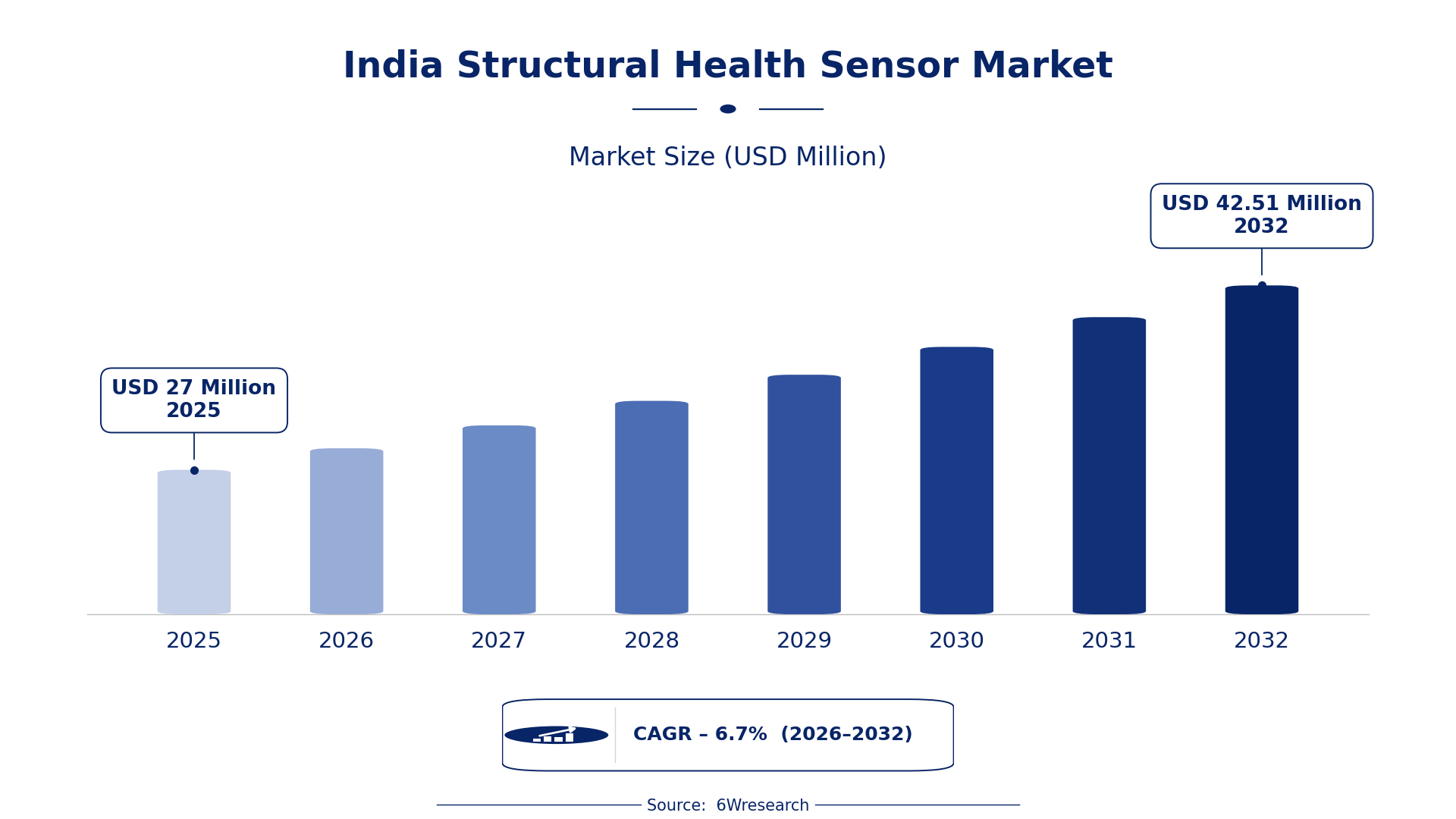
According to 6Wresearch internal database and industry insights, the India Structural Health Sensor Market was valued at USD 27.0 million in 2025 and is projected to reach USD 42.51 million by 2032, growing at a CAGR of approximately 6.7% during 2026–2032.
India Structural Health Sensor Market Highlights
| Report Metric | Details |
| Report Name | India Structural Health Sensor Market |
| Market Size 2025 | USD 27.0 million |
| Market Size 2032 | USD 42.51 million |
| Absolute Growth 2025–2032 | USD 15.51 million |
| CAGR 2026–2032 | 6.7% |
| Peak Annual Growth | 8.5% in 2031 |
| Forecast Period | 2026–2032 |
| Historical Data | 2022–2025 |
| Base Year | 2025 |
| Leading Sensor Type, 2025 | Strain Gauges (35% share) |
| Leading Measurement Focus, 2025 | Structural Stress (48% share) |
| Leading Integration Method, 2025 | Wired (40% share) |
| Leading End User, 2025 | Dam Monitoring Agencies (45% share) |
| Fastest-Growing Sensor Type | Fiber Optic Sensors (7.8% CAGR) |
| Fastest-Growing Measurement Focus | Crack Detection (8.2% CAGR) |
| Fastest-Growing Integration Method | Wireless (8.5% CAGR) |
| Fastest-Growing End User | Bridge Maintenance Units (9.5% CAGR) |
| Growing Sector | infrastructure monitoring |
| Key End Users | government agencies, construction firms, infrastructure management firms, urban planners |
India Structural Health Sensor Market Year-wise Growth Rate and Key Drivers (2022–2032)
This graph illustrates the annual growth rates of the market from 2022 to 2032, highlighting a steady upward trajectory and projected market expansion over the forecast period.
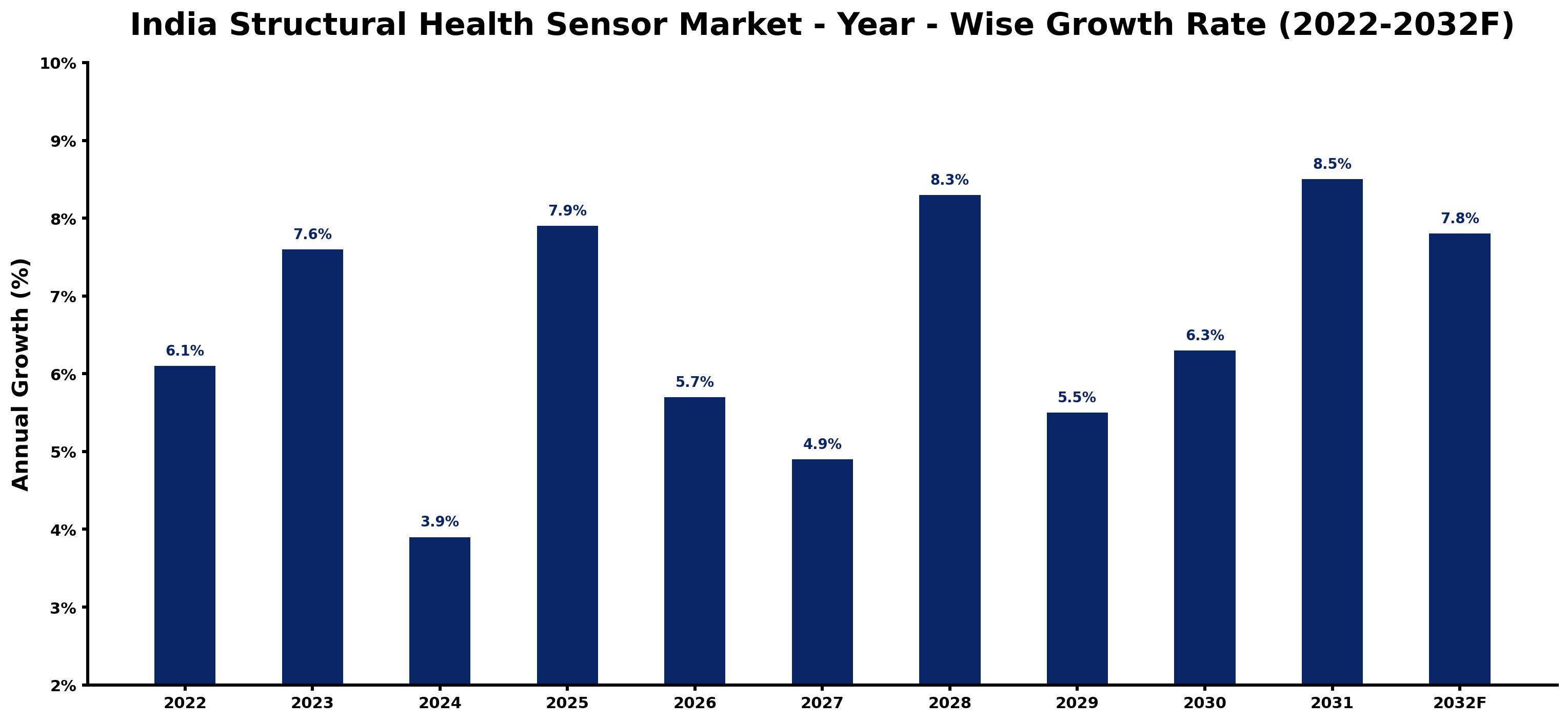
The table below sets out the estimated growth rate for each year and the main factor behind it.
| Year | Estimated Annual Growth (%) | Market Rationale |
| 2022 | 6.1 | The market experienced steady growth due to ongoing infrastructure projects across India. |
| 2023 | 7.6 | Demand increased as the National Highways Authority of India employed sensors for bridge safety assessments. |
| 2024 | 3.9 | Growth slowed as projects faced delays in implementation and funding allocation. |
| 2025 | 7.9 | The market rebounded with faster growth driven by infrastructure upgrades and monitoring needs. |
| 2026 | 5.7 | A slowdown occurred as manufacturers faced challenges in sourcing materials for sensor production. |
| 2027 | 4.9 | Continued growth was supported by rising demand for structural integrity assessments in infrastructure. |
| 2028 | 8.3 | Growth accelerated as the Smart Cities Mission promoted advanced monitoring technologies. |
| 2029 | 5.5 | A slowdown was observed as the market adjusted to the integration of new technologies. |
| 2030 | 6.3 | Growth resumed as urban infrastructure projects gained momentum across major cities. |
| 2031 | 8.5 | The market peaked due to heightened investments in structural health monitoring systems. |
| 2032 | 7.8 | A slight slowdown was noted as the market stabilised after rapid expansion. |
Note: Market size estimations and growth projections presented in this report are based on 6Wresearch's proprietary forecasting methodology, utilizing the latest available industry data, government publications, and primary research inputs.
India Structural Health Sensor Market Synopsis
The Structural Health Sensor Market in India includes devices that monitor the condition of critical infrastructure such as bridges and dams. These sensors employ technologies like strain gauges and fibre optics to evaluate structural integrity and identify potential issues. The market is expanding due to rising infrastructure demand, driven by initiatives like the National Infrastructure Pipeline, which plans to invest over INR 100 trillion in projects, including health monitoring systems. As urbanisation accelerates, the need for sophisticated monitoring solutions intensifies, attracting various buyer groups.
Market Dynamics Impact Analysis (2026–2032)
| Factor | Type | Impact | Primary Segment Affected |
| Increased infrastructure investment through the National Infrastructure Pipeline | Driver | High | Structural Stress |
| Growing adoption of smart technologies in urban areas | Driver | High | Crack Detection |
| Rising demand for monitoring solutions among Dam Monitoring Agencies | Opportunity | High | Dam Monitoring Agencies |
| Need for retrofit solutions in aging infrastructure | Opportunity | Medium | Retrofit Solutions |
| Challenges in sourcing materials for sensor production | Restraint | High | Fiber Optic Sensors |
| Limited awareness of advanced monitoring technologies among smaller firms | Restraint | Medium | Accelerometers |
| High initial investment costs for advanced monitoring systems | Challenge | High | Strain Gauges |
| Regulatory compliance requirements can delay project timelines | Challenge | Medium | Wired |
Evaluation of Drivers in India Structural Health Sensor Market (2026–2032)
The factors lifting demand, and the evidence behind each, are summarised below.
| Drivers | Primary Segment Affected | Why It Matters (Evidence) |
| Increased infrastructure investment through the National Infrastructure Pipeline | Structural Stress | This initiative aims to invest over INR 100 trillion in infrastructure projects, creating demand for monitoring solutions. |
| Growing adoption of smart technologies in urban areas | Crack Detection | The Smart Cities Mission encourages integrating advanced monitoring systems, resulting in higher sensor deployment rates. |
| Rising demand for monitoring solutions among Dam Monitoring Agencies | Dam Monitoring Agencies | With over 1,500 large dams in India, regular monitoring is essential for safety and compliance. |
| Need for retrofit solutions in aging infrastructure | Retrofit Solutions | Many existing structures require upgrades, increasing the demand for modern monitoring technologies. |
| Increasing focus on disaster risk reduction by the National Disaster Management Authority | Strain Gauges | The emphasis on technology for disaster resilience promotes the adoption of health monitoring systems. |
Market growth for Structural Health Sensor in India is underpinned by increased infrastructure investment through the National Infrastructure Pipeline and the growing adoption of smart technologies in urban areas. The Smart Cities Mission encourages integrating advanced monitoring systems, resulting in higher sensor deployment rates. With over 1,500 large dams in India, regular monitoring is essential for safety and compliance. Many existing structures require upgrades, increasing the demand for modern monitoring technologies. The focus on disaster resilience promotes the adoption of health monitoring systems, improving overall infrastructure safety.
Evaluation of Restraints in India Structural Health Sensor Market
The table below lists the restraints and the evidence behind each.
| Market Restraint | Primary Segment Affected | Why It Matters (Evidence) |
| Challenges in sourcing materials for sensor production | Fiber Optic Sensors | Manufacturers face difficulties in obtaining essential components, affecting production timelines. |
| Limited awareness of advanced monitoring technologies among smaller firms | Accelerometers | Smaller firms may not invest in new technologies due to lack of knowledge, hindering market growth. |
| High initial investment costs for advanced monitoring systems | Strain Gauges | Upfront costs deter potential buyers from adopting new technologies, impacting overall market penetration. |
| Regulatory compliance requirements can delay project timelines | Wired | Complex regulations may slow down the implementation of monitoring systems in infrastructure projects. |
| Competition from alternative monitoring solutions | Crack Detection | Other technologies may offer lower costs or perceived benefits, affecting sensor adoption rates. |
India Structural Health Sensor Market Challenges
The India Structural Health Sensor Market faces several practical issues, with supply chain disruptions being a primary concern. Many producers depend on imported components, which can delay production and raise costs by up to 15% for manufacturers. Skills shortages in advanced sensor technology are common, as the workforce lacks training in the latest monitoring techniques, leading to project delays for contractors. Outdated technology reduces efficiency, with many existing devices failing to meet modern standards, resulting in increased maintenance costs for infrastructure owners. Budget constraints also pose challenges for buyers, as infrastructure projects often exceed initial estimates by 20%, limiting the adoption of necessary monitoring technologies.
Trends in the India Structural Health Sensor Market
The trends below show where the India Structural Health Sensor Market is heading.
- Shift towards Smart Monitoring Solutions in Urban Areas: India is increasingly integrating smart technologies into urban infrastructure, as seen in the Smart Cities Mission, which promotes advanced monitoring solutions. In 2023, the government allocated INR 1 trillion for infrastructure upgrades, supporting sensor technologies.
- Growing Use of Fiber Optic Sensors for Seismic Monitoring: Fiber optic sensors are being increasingly utilized for seismic monitoring across India, improving safety measures. This trend is supported by research from the Indian Institute of Technology on advanced sensor technologies.
- Rising Demand for Retrofit Solutions in Aging Infrastructure: Many existing structures are being upgraded with modern monitoring technologies, driven by the need for safety. The National Disaster Management Authority promotes the use of sensors for disaster risk reduction, further supporting this trend.
- Increased Focus on Structural Integrity Assessments: There is a heightened emphasis on assessing structural integrity in infrastructure projects, particularly for bridges and dams. The National Highways Authority of India employs sensors for bridge safety assessments, reflecting this growing focus.
Investment Opportunities in the India Structural Health Sensor Market
The following opportunities in the India Structural Health Sensor Market pair current demand with a clear way in.
- INR 100 trillion Investment Gap in Infrastructure: With the National Infrastructure Pipeline aiming to invest over INR 100 trillion, there is a considerable opportunity for suppliers of structural health sensors to meet rising demand from government projects.
- Supply of Advanced Monitoring Solutions for Smart Cities: The Smart Cities Mission offers an opportunity to provide advanced monitoring solutions. The government allocated INR 1 trillion for urban infrastructure upgrades, creating demand for modern technologies.
- Growing Need for Dam Safety Monitoring Solutions: With over 1,500 large dams requiring regular monitoring, there is a substantial opportunity for suppliers of health sensors. The Central Water Commission oversees dam safety regulations, ensuring consistent demand.
- Investment in Retrofit Solutions for Aging Infrastructure: As many existing structures require upgrades, there is a demand for retrofit solutions. The focus on safety and compliance creates opportunities among infrastructure managers.
Government Initiatives in the India Structural Health Sensor Market
The Bureau of Indian Standards is developing new standards for structural health monitoring systems to improve safety and reliability. This initiative affects producers by ensuring they meet required safety benchmarks, enhancing product quality. The focus on compliance encourages manufacturers to adapt and align with evolving industry standards.
In 2023, the Ministry of Housing and Urban Affairs allocated INR 1 trillion for smart city projects, which includes funding for sensor technologies. This financial support enables buyers to access modern monitoring solutions, improving urban safety and efficiency. The National Disaster Management Authority also promotes the use of sensors for disaster risk reduction, ensuring that infrastructure projects incorporate advanced monitoring technologies.
Future Insight of the India Structural Health Sensor Market
By 2032, buyers and suppliers in the India Structural Health Sensor Market can anticipate substantial advancements driven by government initiatives and technological progress. The Smart Cities Mission will modernise urban infrastructure with integrated monitoring solutions, while the Ministry of Road Transport and Highways' smart bridge programme will enhance real-time data collection. Research from the Indian Institute of Technology will encourage the development of new monitoring technologies, improving reliability and performance. With over 1,500 large dams requiring regular monitoring, the demand for advanced solutions will increase, creating fresh opportunities for producers.
Market Segmentation Analysis
The analysis below covers each segmentation, its leading category in 2025 and its fastest-growing category through 2032.
By Sensor Type – Strain Gauges Dominated, Fiber Optic Sensors Expected to Grow Fastest
According to Summon Dutta, Assistant Manager at 6Wresearch, in 2025, Strain Gauges led the sensor type split with a 35% share. Strain gauges lead the India Structural Health Sensor Market due to their critical function in measuring strain across various structures. Their widespread use in significant projects, such as those monitored by dam safety agencies, reinforces their importance and market share. Fiber Optic Sensors are projected to grow fastest, at a CAGR of 7.8% during 2026–2032. Fiber optic sensors are experiencing rapid growth, particularly in seismic monitoring applications where long-term data collection is essential. Their integration into national initiatives like the Smart Cities Mission underscores their rising significance in modern infrastructure projects. Suppliers must focus on enhancing fiber optic sensor technologies to meet the growing demand for advanced structural monitoring solutions.
By Measurement Focus – Structural Stress Dominated, Crack Detection Expected to Grow Fastest
Structural Stress held a 48% share of the India Structural Health Sensor Market by measurement focus in 2025. Structural stress measurement commands the largest share as it is crucial for evaluating how loads impact the safety of structures. This focus is especially relevant for agencies overseeing large infrastructure, ensuring compliance with safety regulations. The quickest growth will come from Crack Detection, forecast to expand at a CAGR of 8.2% between 2026 and 2032. Crack detection is the fastest-growing measurement focus, driven by the urgent need to maintain safety in aging infrastructure. Increased investments in infrastructure upgrades are propelling the demand for effective crack monitoring solutions. Buyers should prioritise investments in advanced crack detection technologies to safeguard the integrity and longevity of their infrastructure.
By Integration Method – Wired Dominated, Wireless Expected to Grow Fastest
Wired took a 40% share of integration method in 2025, more than any other category. Wired integration methods dominate the market due to their reliability in data transmission, making them the preferred choice for critical monitoring applications. Many established projects, such as dam safety monitoring, rely on wired systems for consistent performance. Wireless is set to record the highest CAGR in this split, 8.5% over 2026–2032. Wireless integration methods are gaining traction as they provide flexibility in sensor placement and data collection, which is essential for modern infrastructure projects. As urban areas expand, the need for adaptable monitoring solutions is driving this growth. Suppliers must invest in wireless technologies to cater to the evolving needs of infrastructure monitoring.
By End User – Dam Monitoring Agencies Dominated, Bridge Maintenance Units Expected to Grow Fastest
Dam Monitoring Agencies accounted for a 45% market share by end user in 2025. Dam monitoring agencies represent the largest share of end users, tasked with ensuring the safety and integrity of over 1,500 large dams in India. Their crucial role in maintaining infrastructure safety guarantees a consistent demand for structural health sensors. Over 2026–2032, Bridge Maintenance Units are expected to post the fastest growth, at a CAGR of 9.5%. Bridge maintenance units are the fastest-growing segment, reflecting a heightened focus on bridge safety amid increasing infrastructure investments. Government initiatives aimed at infrastructure enhancement further drive this growth in demand. Buyers in the bridge maintenance sector should seek advanced sensor solutions to bolster their monitoring and maintenance efforts.
Key Attractiveness of the Report
- 10 Years of Market Numbers
- Historical Data Starting from 2022 to 2025
- Base Year 2025
- Forecast Data until 2032
- Key Performance Indicators Impacting the Market
- Major Upcoming Developments and Projects
Key Highlights of the Report:
- India Structural Health Sensor Market Outlook
- Market Size of India Structural Health Sensor Market, 2025
- Forecast of India Structural Health Sensor Market, 2032
- Historical Data and Forecast of India Structural Health Sensor Revenues & Volume for the Period 2022 - 2032F
- India Structural Health Sensor Market Trend Evolution
- India Structural Health Sensor Market Drivers and Challenges
- India Structural Health Sensor Price Trends
- India Structural Health Sensor Porter's Five Forces
- India Structural Health Sensor Industry Life Cycle
- Historical Data and Forecast of India Structural Health Sensor Market Revenues & Volume By Sensor Type for the Period 2022 - 2032F
- Historical Data and Forecast of India Structural Health Sensor Market Revenues & Volume By Strain Gauges for the Period 2022 - 2032F
- Historical Data and Forecast of India Structural Health Sensor Market Revenues & Volume By Acoustic Emission Sensors for the Period 2022 - 2032F
- Historical Data and Forecast of India Structural Health Sensor Market Revenues & Volume By Fiber Optic Sensors for the Period 2022 - 2032F
- Historical Data and Forecast of India Structural Health Sensor Market Revenues & Volume By Accelerometers for the Period 2022 - 2032F
- Historical Data and Forecast of India Structural Health Sensor Market Revenues & Volume By Measurement Focus for the Period 2022 - 2032F
- Historical Data and Forecast of India Structural Health Sensor Market Revenues & Volume By Structural Stress for the Period 2022 - 2032F
- Historical Data and Forecast of India Structural Health Sensor Market Revenues & Volume By Crack Detection for the Period 2022 - 2032F
- Historical Data and Forecast of India Structural Health Sensor Market Revenues & Volume By Vibration/Temp for the Period 2022 - 2032F
- Historical Data and Forecast of India Structural Health Sensor Market Revenues & Volume By Dynamic Load for the Period 2022 - 2032F
- Historical Data and Forecast of India Structural Health Sensor Market Revenues & Volume By Integration Method for the Period 2022 - 2032F
- Historical Data and Forecast of India Structural Health Sensor Market Revenues & Volume By Wired for the Period 2022 - 2032F
- Historical Data and Forecast of India Structural Health Sensor Market Revenues & Volume By Embedded for the Period 2022 - 2032F
- Historical Data and Forecast of India Structural Health Sensor Market Revenues & Volume By Wireless for the Period 2022 - 2032F
- Historical Data and Forecast of India Structural Health Sensor Market Revenues & Volume By Retrofit Solutions for the Period 2022 - 2032F
- Historical Data and Forecast of India Structural Health Sensor Market Revenues & Volume By End User for the Period 2022 - 2032F
- Historical Data and Forecast of India Structural Health Sensor Market Revenues & Volume By Dam Monitoring Agencies for the Period 2022 - 2032F
- Historical Data and Forecast of India Structural Health Sensor Market Revenues & Volume By Bridge Maintenance Units for the Period 2022 - 2032F
- Historical Data and Forecast of India Structural Health Sensor Market Revenues & Volume By Power Grid Managers for the Period 2022 - 2032F
- Historical Data and Forecast of India Structural Health Sensor Market Revenues & Volume By Oil & Gas Infrastructure for the Period 2022 - 2032F
- India Structural Health Sensor Import Export Trade Statistics
- Market Opportunity Assessment By Sensor Type
- Market Opportunity Assessment By Measurement Focus
- Market Opportunity Assessment By Integration Method
- Market Opportunity Assessment By End User
- India Structural Health Sensor Top Companies Market Share
- India Structural Health Sensor Competitive Benchmarking By Technical and Operational Parameters
- India Structural Health Sensor Company Profiles
- India Structural Health Sensor Key Strategic Recommendations
Market Covered
Segments analysed in this report are listed below.
By Sensor Type
- Strain Gauges
- Acoustic Emission Sensors
- Fiber Optic Sensors
- Accelerometers
By Measurement Focus
- Structural Stress
- Crack Detection
- Vibration/Temp
- Dynamic Load
By Integration Method
- Wired
- Embedded
- Wireless
- Retrofit Solutions
By End User
- Dam Monitoring Agencies
- Bridge Maintenance Units
- Power Grid Managers
- Oil & Gas Infrastructure































