China Structural Health Sensor Market Size & Growth Rate
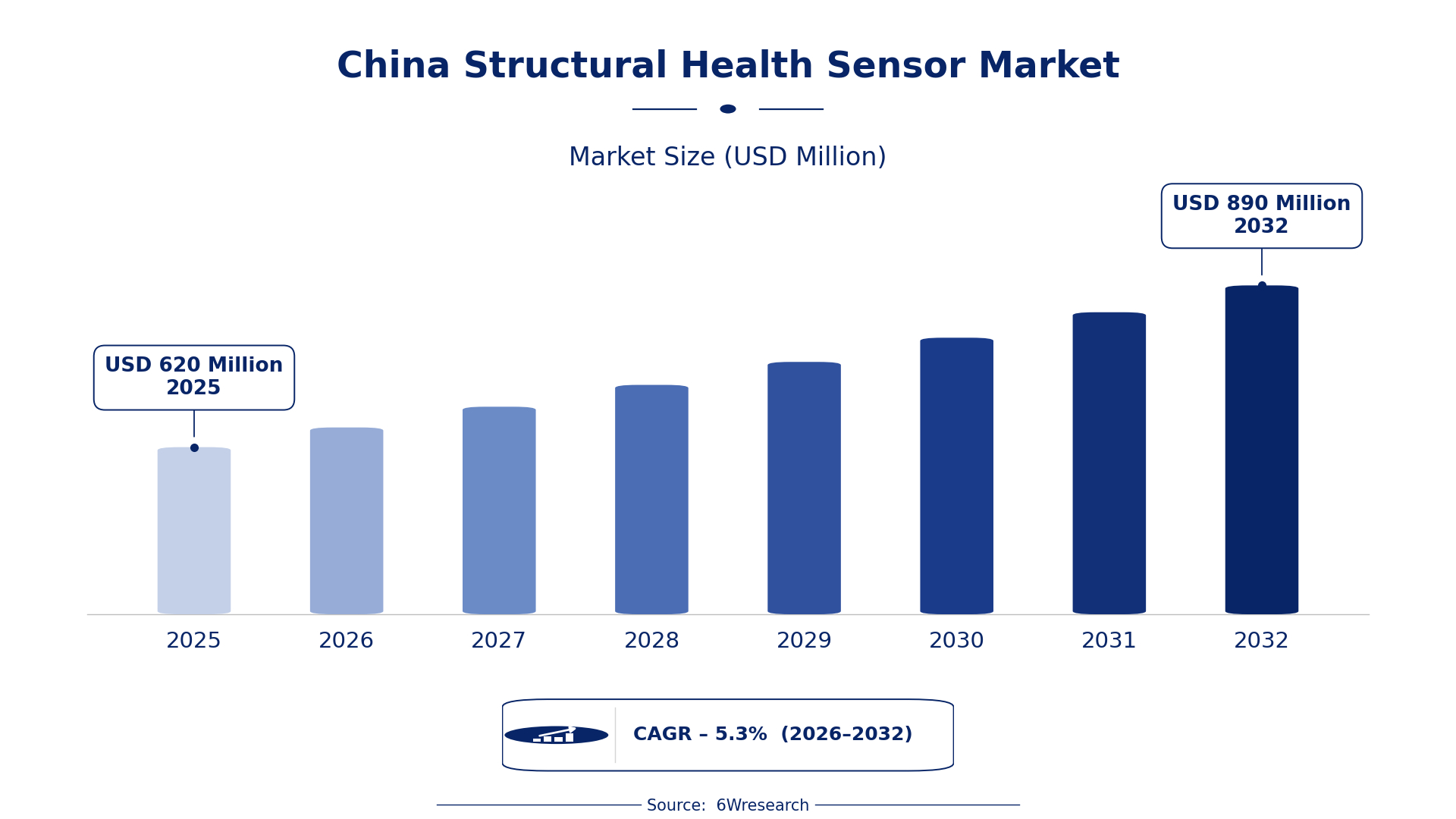
According to 6Wresearch internal database and industry insights, the China Structural Health Sensor Market was valued at USD 620.0 million in 2025 and is projected to reach USD 890 million by 2032, growing at a CAGR of approximately 5.3% during 2026–2032.
China Structural Health Sensor Market Highlights
| Report Metric | Details |
| Report Name | China Structural Health Sensor Market |
| Market Size 2025 | USD 620.0 million |
| Market Size 2032 | USD 890 million |
| Absolute Growth 2025–2032 | USD 270 million |
| CAGR 2026–2032 | 5.3% |
| Peak Annual Growth | 7.4% in 2030 |
| Forecast Period | 2026–2032 |
| Historical Data | 2022–2025 |
| Base Year | 2025 |
| Leading Sensor Type, 2025 | Strain Gauges (41% share) |
| Leading Measurement Focus, 2025 | Structural Stress (53% share) |
| Leading Integration Method, 2025 | Wired (40% share) |
| Leading End User, 2025 | Dam Monitoring Agencies (43% share) |
| Fastest-Growing Sensor Type | Fiber Optic Sensors (7.4% CAGR) |
| Fastest-Growing Measurement Focus | Crack Detection (6.3% CAGR) |
| Fastest-Growing Integration Method | Wireless (7.3% CAGR) |
| Fastest-Growing End User | Bridge Maintenance Units (7.8% CAGR) |
| Growing Sector | Bridge Maintenance Units |
| Key End Users | Dam Monitoring Agencies, Bridge Maintenance Units, Power Grid Managers, Oil & Gas Infrastructure |
China Structural Health Sensor Market Year-wise Growth Rate and Key Drivers (2022–2032)
This graph illustrates the annual growth rates of the market from 2022 to 2032, highlighting a steady upward trajectory and projected market expansion over the forecast period.
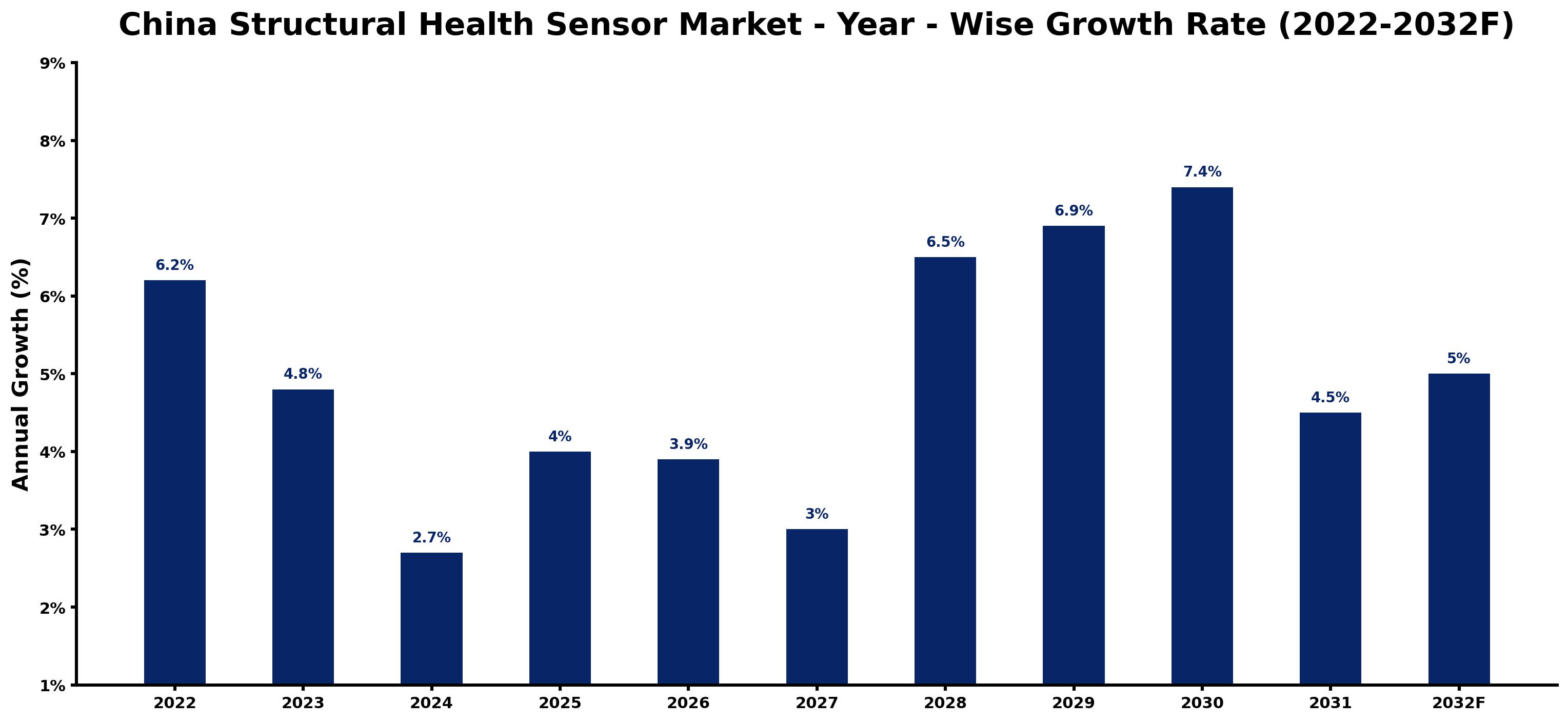
Annual growth estimates for each year appear below with the principal reason behind them, explaining the shifts that set the pace of the market.
| Year | Estimated Annual Growth (%) | Market Rationale |
| 2022 | 6.2 | The market experienced strong demand due to increased infrastructure projects across the country. |
| 2023 | 4.8 | Growth slowed as some infrastructure projects faced delays in funding and implementation. |
| 2024 | 2.7 | Demand continued to slow as the market adjusted to previous high growth rates. |
| 2025 | 4.0 | New investments in infrastructure safety emerged, accelerating growth again. |
| 2026 | 3.9 | A slowdown is expected as competition intensifies among sensor manufacturers. |
| 2027 | 3.0 | Growth will continue to decelerate as buyers become more selective in purchasing. |
| 2028 | 6.5 | A resurgence in demand is anticipated as new technologies are integrated into monitoring systems. |
| 2029 | 6.9 | Demand will increase as infrastructure safety becomes a national priority following recent incidents. |
| 2030 | 7.4 | The market is projected to peak with heightened investments in smart infrastructure technologies. |
| 2031 | 4.5 | Growth will slow as the market begins to stabilise after rapid expansion. |
| 2032 | 5.0 | New regulations mandating sensor usage are expected to drive demand again. |
Note: Market size estimations and growth projections presented in this report are based on 6Wresearch's proprietary forecasting methodology, utilizing the latest available industry data, government publications, and primary research inputs.
China Structural Health Sensor Market Synopsis
The China Structural Health Sensor Market includes devices that monitor the condition of structures such as bridges and dams. These sensors gather real-time data on structural integrity, assessing stress, detecting cracks, and monitoring vibrations. The market is expanding due to investments in infrastructure projects, especially in the Yangtze River Delta, a key area for such initiatives. In 2022, the market was valued at approximately 1.5 billion CNY, reflecting the growing importance of safety and maintenance in construction.
Market Dynamics Impact Analysis (2026–2032)
| Factor | Type | Impact | Primary Segment Affected |
| Growing investments in infrastructure safety initiatives | Driver | High | Structural Stress |
| Increased adoption of IoT technologies in monitoring systems | Driver | High | Crack Detection |
| Rising demand for advanced monitoring solutions in urban areas | Opportunity | High | Fiber Optic Sensors |
| Need for compliance with new safety regulations | Opportunity | High | Dam Monitoring Agencies |
| High initial costs of sensor installation | Restraint | Medium | Accelerometers |
| Limited awareness of sensor benefits among smaller agencies | Restraint | Medium | Bridge Maintenance Units |
| Supply chain disruptions affecting sensor availability | Challenge | High | Wired |
| Technological challenges in integrating new systems | Challenge | Medium | Wireless |
Evaluation of Drivers in China Structural Health Sensor Market (2026–2032)
The table below links each growth driver to the segment it affects and the evidence for it.
| Drivers | Primary Segment Affected | Why It Matters (Evidence) |
| Increased government funding for infrastructure safety improvements | Structural Stress | In 2023, 200 million CNY was allocated for infrastructure safety improvements, boosting sensor purchases. |
| Growing urbanisation leading to more infrastructure projects | Crack Detection | The Yangtze River Delta region is a hub for infrastructure projects requiring health monitoring. |
| Rising demand for smart city solutions | Fiber Optic Sensors | Integration of IoT technologies is driving demand for monitoring systems, with a projected 30% increase in installations. |
| Implementation of new safety regulations for construction | Accelerometers | 2023 guidelines mandate sensor use in all new bridge constructions, ensuring compliance with safety standards. |
| Focus on preventive maintenance in infrastructure management | Vibration/Temp | With over 30,000 dams, regular monitoring using health sensors is essential for safety. |
The Structural Health Sensor market in China is growing on the back of increased funding for infrastructure safety, urbanisation, and the push for smart city solutions. In 2023, 200 million CNY was allocated for infrastructure safety improvements, boosting sensor purchases. As urbanisation accelerates, demand for advanced monitoring systems rises, particularly in regions with extensive infrastructure projects. The focus on preventive maintenance is vital, especially with numerous dams requiring regular monitoring to ensure safety and integrity.
Evaluation of Restraints in China Structural Health Sensor Market
The key brakes on demand, and where they bite hardest, are shown below.
| Market Restraint | Primary Segment Affected | Why It Matters (Evidence) |
| Skills shortage in advanced data analysis | Structural Stress | This shortage delays project timelines and increases costs for contractors by up to 15%. |
| Intense competition among local manufacturers | Crack Detection | This competition drives down prices, making it difficult for suppliers to maintain profit margins. |
| Complexity of regulatory compliance | Fiber Optic Sensors | Buyers struggle with standards like GB/T 50570-2010, causing project delays that can extend timelines by several months. |
| Rapid pace of technological change | Accelerometers | Manufacturers must adapt to new regulations, diverting resources and increasing costs. |
| Limited awareness of sensor benefits | Vibration/Temp | This limits adoption rates, particularly among smaller infrastructure projects. |
China Structural Health Sensor Market Challenges
In China, the structural health sensor market encounters a skills shortage in data analysis, delaying project timelines and increasing costs for contractors by up to 15%. Intense competition among local manufacturers drives prices down, which can lead to reduced investment in research and development and ultimately impact product innovation. Buyers face challenges with regulatory compliance, particularly with standards like GB/T 50570-2010, causing project delays that can extend timelines by several months. Additionally, the rapid pace of technological change creates uncertainty for manufacturers, forcing them to continuously adapt to new regulations, which diverts resources and raises operational costs.
Trends in the China Structural Health Sensor Market
Buyers and suppliers in the China Structural Health Sensor Market are adjusting to the following trends.
- Integration of IoT Technologies in Monitoring Systems: The Ministry of Housing and Urban-Rural Development's "Smart Infrastructure" initiative promotes IoT integration in monitoring systems, improving data accuracy and efficiency. In 2023, this initiative is expected to lead to a 30% increase in sensor installations.
- Shift Towards Preventive Maintenance: With over 30,000 dams requiring regular monitoring, there is a shift towards preventive maintenance strategies. This trend is evident in the Guangdong province, where sensor installations have surged by 25% in recent years.
- Growing Demand for Wireless Sensors: The market is experiencing a shift towards wireless sensors due to their ease of installation. In 2023, the adoption of wireless solutions is projected to increase by 40% in urban infrastructure projects.
- Focus on Smart City Initiatives: The push for smart city solutions is driving demand for advanced monitoring technologies. By 2025, urban areas are expected to see a 50% increase in the deployment of structural health sensors.
Investment Opportunities in the China Structural Health Sensor Market
Some of the investment opportunities in the China Structural Health Sensor Market are mentioned below.
- Investment in Smart Infrastructure: With 200 million CNY allocated for infrastructure safety improvements in 2023, there is a strong investment opportunity in smart infrastructure technologies. Collaborating with local government agencies can facilitate entry into this growing market.
- Expansion in the Yangtze River Delta: The Yangtze River Delta is experiencing rapid urbanisation, creating a demand for structural health sensors. Companies can enter this market by forming joint ventures with local firms to utilise existing networks.
- Focus on Preventive Maintenance Solutions: The increasing emphasis on preventive maintenance presents an opportunity for suppliers of advanced monitoring systems. Targeting dam monitoring agencies can yield substantial contracts, especially with over 30,000 dams requiring regular assessments.
- Development of Wireless Sensor Technologies: The shift towards wireless sensors opens avenues for innovation and development. Investing in R&D for wireless solutions can attract buyers in urban infrastructure projects, particularly in metropolitan areas.
Government Initiatives in the China Structural Health Sensor Market
The "Smart Infrastructure" initiative by the Ministry of Housing and Urban-Rural Development, launched in 2021, aims to improve safety through advanced monitoring technologies. This initiative has led to increased investment in structural health sensors, with 500 million CNY allocated for the development of smart monitoring systems under the "Infrastructure Modernization Plan" approved in 2022. These measures ensure that infrastructure projects meet safety standards and incorporate modern technologies. The Ministry of Science and Technology's "National Key R&D Program" includes funding for research on advanced structural health monitoring technologies, promoting innovation in this field.
The Ministry of Transport's 2023 guidelines mandate the use of structural health sensors in all new bridge constructions, ensuring compliance with safety regulations. Additionally, the National Energy Administration's "Energy Innovation Plan" promotes the adoption of structural health sensors in power grid management, enhancing operational safety. These policies are expected to drive demand for sensors across various infrastructure sectors, with funding allocated to support their implementation.
Future Insight of the China Structural Health Sensor Market
The structural health sensor market in China is set for significant changes by 2032, driven by the "Smart Infrastructure" initiative that promotes advanced sensor technologies. The government’s allocation of 200 million CNY for infrastructure safety improvements will support broader sensor deployment across critical structures. Ongoing efforts towards ISO 9001 certification will improve product quality and standardisation among manufacturers. The integration of IoT technologies with structural health monitoring systems will transform data collection and analysis, providing real-time insights that enhance infrastructure management.
Market Segmentation Analysis
The report offers a comprehensive study of the following market segments and their leading categories in the market.
By Sensor Type – Strain Gauges Dominated, Fiber Optic Sensors Expected to Grow Fastest
According to Summon Dutta, Assistant Manager at 6Wresearch, Strain Gauges took a 41% share of sensor type in 2025, more than any other category. Strain gauges command the largest market share in China due to their crucial role in measuring structural stress across various infrastructure projects. Their extensive use in the Yangtze River Delta region underscores the importance of reliable monitoring for maintaining safety standards. Fiber Optic Sensors are set to record the highest CAGR in this split, 7.4% over 2026–2032. The swift growth of fiber optic sensors is fuelled by their importance in long-term monitoring of structures, particularly as infrastructure projects expand. The recent initiative to integrate IoT technologies with monitoring systems is likely to further boost demand for these sophisticated sensors. Suppliers should concentrate on enhancing their fiber optic sensor offerings to cater to the rising demand for advanced monitoring solutions.
By Measurement Focus – Structural Stress Dominated, Crack Detection Expected to Grow Fastest
Structural Stress held a 53% share of the China Structural Health Sensor Market by measurement focus in 2025. Structural stress measurement leads the market share as it is essential for ensuring the safety and integrity of numerous structures throughout China. This focus is particularly critical in densely populated infrastructure regions like Beijing-Tianjin-Hebei, where continuous safety evaluations are vital. Crack Detection is projected to grow fastest, at a CAGR of 6.3% during 2026–2032. Crack detection is experiencing rapid growth, driven by its key role in preventive maintenance and safety measures. The increase in infrastructure projects creates a pressing need for effective monitoring solutions to identify potential structural issues early and mitigate risks. Buyers should emphasise crack detection technologies to enhance safety protocols and lower long-term maintenance expenses.
By Integration Method – Wired Dominated, Wireless Expected to Grow Fastest
The largest integration method category in 2025 was Wired, with a 40% share of total revenue. Wired integration methods dominate the market due to their reliability and established use in critical infrastructure projects. This approach is particularly favoured in regions with stringent safety standards, ensuring consistent performance. Over 2026–2032, Wireless is expected to post the fastest growth, at a CAGR of 7.3%. Wireless integration methods are gaining traction as they offer ease of installation and flexibility, appealing to modern infrastructure projects. The shift towards smart infrastructure initiatives is propelling the demand for wireless solutions. Suppliers should invest in wireless technologies to meet the growing preference for flexible and efficient monitoring systems.
By End User – Dam Monitoring Agencies Dominated, Bridge Maintenance Units Expected to Grow Fastest
In 2025, Dam Monitoring Agencies led the end user split with a 43% share. Dam monitoring agencies represent the largest market share as they are the primary users of structural health sensors, ensuring safety and compliance across China's vast network of dams. With over 30,000 dams needing regular monitoring, the demand for these sensors remains strong and essential. The quickest growth will come from Bridge Maintenance Units, forecast to expand at a CAGR of 7.8% between 2026 and 2032. Bridge maintenance units are the fastest-growing segment, reflecting their vital role in ongoing infrastructure assessments and safety inspections. The increased emphasis on bridge safety, particularly in urban settings, is driving this segment's rapid growth and demand for effective monitoring solutions. Suppliers should customise their products to meet the specific needs of bridge maintenance units to effectively capture this expanding market.
Key Attractiveness of the Report
- 10 Years of Market Numbers
- Historical Data Starting from 2022 to 2025
- Base Year 2025
- Forecast Data until 2032
- Key Performance Indicators Impacting the Market
- Major Upcoming Developments and Projects
Key Highlights of the Report:
- China Structural Health Sensor Market Outlook
- Market Size of China Structural Health Sensor Market, 2025
- Forecast of China Structural Health Sensor Market, 2032
- Historical Data and Forecast of China Structural Health Sensor Revenues & Volume for the Period 2022 - 2032F
- China Structural Health Sensor Market Trend Evolution
- China Structural Health Sensor Market Drivers and Challenges
- China Structural Health Sensor Price Trends
- China Structural Health Sensor Porter's Five Forces
- China Structural Health Sensor Industry Life Cycle
- Historical Data and Forecast of China Structural Health Sensor Market Revenues & Volume By Sensor Type for the Period 2022 - 2032F
- Historical Data and Forecast of China Structural Health Sensor Market Revenues & Volume By Strain Gauges for the Period 2022 - 2032F
- Historical Data and Forecast of China Structural Health Sensor Market Revenues & Volume By Acoustic Emission Sensors for the Period 2022 - 2032F
- Historical Data and Forecast of China Structural Health Sensor Market Revenues & Volume By Fiber Optic Sensors for the Period 2022 - 2032F
- Historical Data and Forecast of China Structural Health Sensor Market Revenues & Volume By Accelerometers for the Period 2022 - 2032F
- Historical Data and Forecast of China Structural Health Sensor Market Revenues & Volume By Measurement Focus for the Period 2022 - 2032F
- Historical Data and Forecast of China Structural Health Sensor Market Revenues & Volume By Structural Stress for the Period 2022 - 2032F
- Historical Data and Forecast of China Structural Health Sensor Market Revenues & Volume By Crack Detection for the Period 2022 - 2032F
- Historical Data and Forecast of China Structural Health Sensor Market Revenues & Volume By Vibration/Temp for the Period 2022 - 2032F
- Historical Data and Forecast of China Structural Health Sensor Market Revenues & Volume By Dynamic Load for the Period 2022 - 2032F
- Historical Data and Forecast of China Structural Health Sensor Market Revenues & Volume By Integration Method for the Period 2022 - 2032F
- Historical Data and Forecast of China Structural Health Sensor Market Revenues & Volume By Wired for the Period 2022 - 2032F
- Historical Data and Forecast of China Structural Health Sensor Market Revenues & Volume By Embedded for the Period 2022 - 2032F
- Historical Data and Forecast of China Structural Health Sensor Market Revenues & Volume By Wireless for the Period 2022 - 2032F
- Historical Data and Forecast of China Structural Health Sensor Market Revenues & Volume By Retrofit Solutions for the Period 2022 - 2032F
- Historical Data and Forecast of China Structural Health Sensor Market Revenues & Volume By End User for the Period 2022 - 2032F
- Historical Data and Forecast of China Structural Health Sensor Market Revenues & Volume By Dam Monitoring Agencies for the Period 2022 - 2032F
- Historical Data and Forecast of China Structural Health Sensor Market Revenues & Volume By Bridge Maintenance Units for the Period 2022 - 2032F
- Historical Data and Forecast of China Structural Health Sensor Market Revenues & Volume By Power Grid Managers for the Period 2022 - 2032F
- Historical Data and Forecast of China Structural Health Sensor Market Revenues & Volume By Oil & Gas Infrastructure for the Period 2022 - 2032F
- China Structural Health Sensor Import Export Trade Statistics
- Market Opportunity Assessment By Sensor Type
- Market Opportunity Assessment By Measurement Focus
- Market Opportunity Assessment By Integration Method
- Market Opportunity Assessment By End User
- China Structural Health Sensor Top Companies Market Share
- China Structural Health Sensor Competitive Benchmarking By Technical and Operational Parameters
- China Structural Health Sensor Company Profiles
- China Structural Health Sensor Key Strategic Recommendations
Market Covered
This report examines the market across the segments below.
By Sensor Type
- Strain Gauges
- Acoustic Emission Sensors
- Fiber Optic Sensors
- Accelerometers
By Measurement Focus
- Structural Stress
- Crack Detection
- Vibration/Temp
- Dynamic Load
By Integration Method
- Wired
- Embedded
- Wireless
- Retrofit Solutions
By End User
- Dam Monitoring Agencies
- Bridge Maintenance Units
- Power Grid Managers
- Oil & Gas Infrastructure































