India Sugarcane-Based Fuel Market Size & Growth Rate
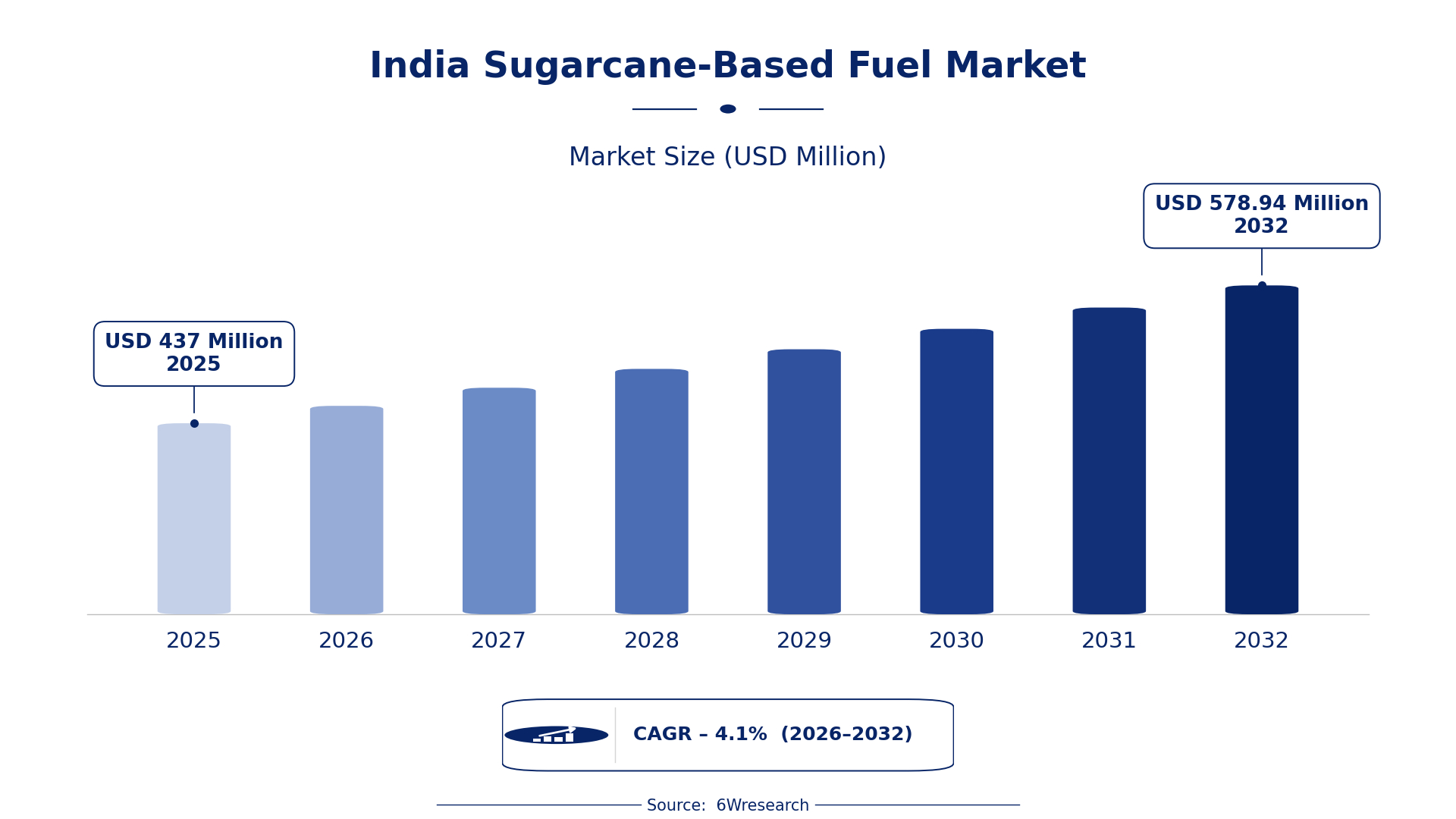
According to 6Wresearch internal database and industry insights, the India Sugarcane-Based Fuel Market was valued at USD 437.0 million in 2025 and is projected to reach USD 578.94 million by 2032, growing at a CAGR of approximately 4.1% during 2026–2032.
India Sugarcane-Based Fuel Market Highlights
| Report Metric | Details |
| Report Name | India Sugarcane-Based Fuel Market |
| Market Size 2025 | USD 437.0 million |
| Market Size 2032 | USD 578.94 million |
| Absolute Growth 2025–2032 | USD 141.94 million |
| CAGR 2026–2032 | 4.1% |
| Peak Annual Growth | 6.2% in 2026 |
| Forecast Period | 2026–2032 |
| Historical Data | 2022–2025 |
| Base Year | 2025 |
| Leading Fuel Type, 2025 | Anhydrous Ethanol (38% share) |
| Leading Feedstock Used, 2025 | Sugarcane Juice (46% share) |
| Leading Blending Ratio, 2025 | E10/E20 (43% share) |
| Leading End User, 2025 | Oil Marketing Companies (50% share) |
| Fastest-Growing Fuel Type | Bio-CNG (6.0% CAGR) |
| Fastest-Growing Feedstock Used | Bagasse + Organic Waste (5.7% CAGR) |
| Fastest-Growing End User | Flex Fuel Vehicle Owners (6.3% CAGR) |
| Growing Sector | Biofuels for Transportation |
| Key End Users | Oil Marketing Companies, Flex Fuel Vehicle Owners, Commercial Fleet Operators |
India Sugarcane-Based Fuel Market Year-wise Growth Rate and Key Drivers (2022–2032)
This graph illustrates the annual growth rates of the market from 2022 to 2032, highlighting a steady upward trajectory and projected market expansion over the forecast period.
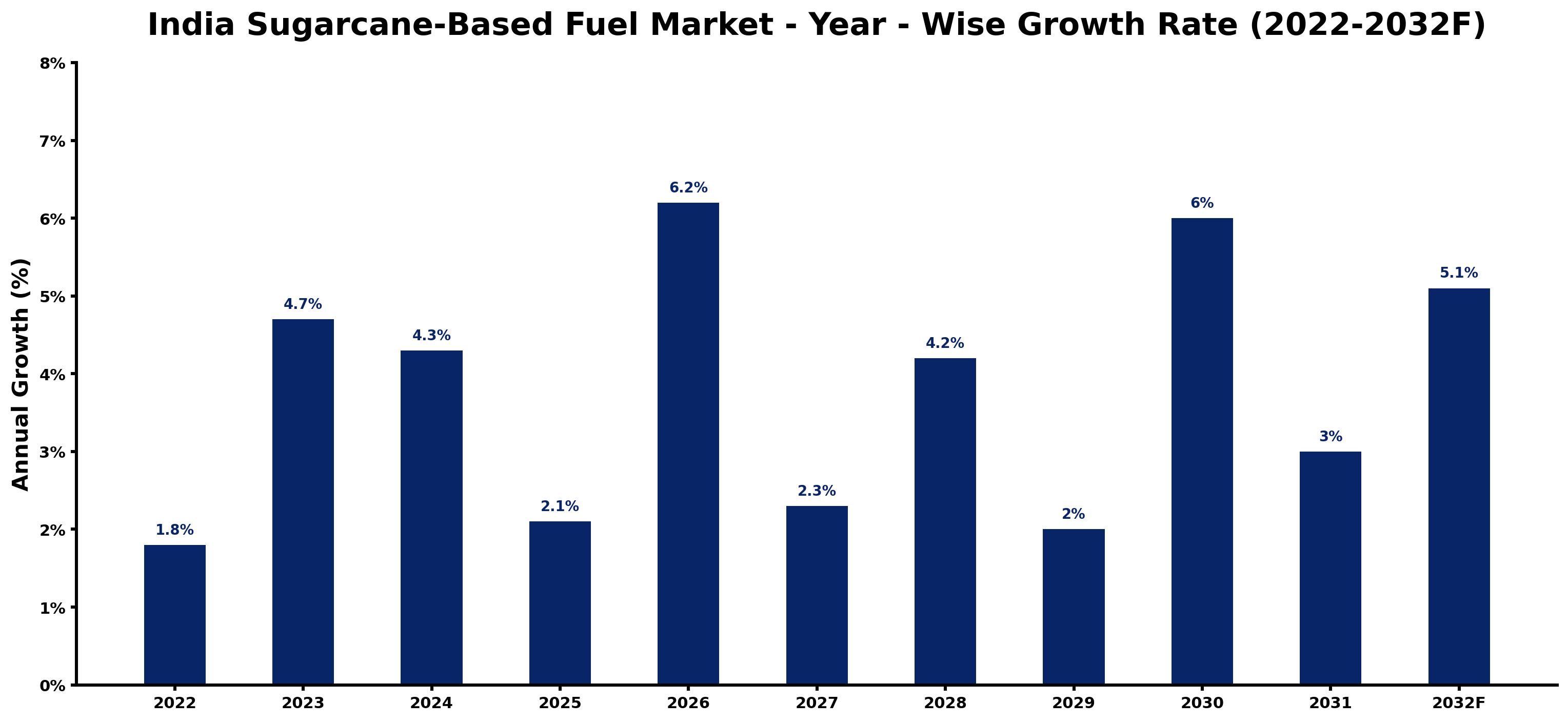
The following table presents the estimated annual growth rate for each year together with the principal factor influencing market performance.
| Year | Estimated Annual Growth (%) | Market Rationale |
| 2022 | 1.8 | The market experienced steady activity with established biofuel production methods. |
| 2023 | 4.7 | Growth accelerated due to increased government initiatives promoting ethanol blending under the Ethanol Blending Roadmap 2022. |
| 2024 | 4.3 | Demand growth slowed as the market adjusted to previous high levels of production and consumer expectations. |
| 2025 | 2.1 | The market continued to grow, but at a reduced rate due to regulatory changes affecting production timelines. |
| 2026 | 6.2 | A surge in investment and production capacity is expected to lead to growth in biofuels. |
| 2027 | 2.3 | Growth will slow as producers face challenges in scaling up operations effectively amidst rising costs. |
| 2028 | 4.2 | Increased consumer acceptance of biofuels is expected to spur demand, driving growth again. |
| 2029 | 2.0 | The market will see a slowdown as competition from fossil fuels intensifies, affecting pricing strategies. |
| 2030 | 6.0 | Renewed interest in sustainable fuels will lead to a rebound in growth rates as infrastructure develops. |
| 2031 | 3.0 | Growth will moderate as the National Biofuel Policy continues to shape market dynamics and production levels. |
| 2032 | 5.1 | The market is expected to grow as new government policies support biofuel adoption and investment. |
Note: Market size estimations and growth projections presented in this report are based on 6Wresearch's proprietary forecasting methodology, utilizing the latest available industry data, government publications, and primary research inputs.
India Sugarcane-Based Fuel Market Synopsis
Sugarcane-Based Fuel in India is a renewable energy source derived from sugarcane through fermentation and distillation processes. This biofuel is primarily used for transportation and energy generation, contributing to reduced reliance on fossil fuels. The India Sugarcane-Based Fuel Market is expanding due to strong domestic demand and government mandates encouraging biofuel usage. In 2022, India produced approximately 4.5 billion liters of ethanol, with a target of 20% ethanol blending in petrol by 2025 under the National Biofuel Policy. The increasing cultivation of sugarcane across major states like Maharashtra and Uttar Pradesh is further driving market growth.
Market Dynamics Impact Analysis (2026–2032)
| Factor | Type | Impact | Primary Segment Affected |
| Growing domestic production of ethanol | Driver | High | Anhydrous Ethanol |
| Government mandates for biofuel usage | Driver | High | E10/E20 |
| Emerging demand from commercial fleet operators | Opportunity | High | Bio-Diesel |
| Rising interest in sustainable energy solutions | Opportunity | High | Bio-CNG |
| Challenges in scaling up production capacity | Restraint | High | Hydrous Ethanol |
| Competition from fossil fuels affecting market share | Restraint | Medium | Bio-Diesel |
| High initial investment costs for biofuel plants | Challenge | High | Bio-CNG |
| Delays in regulatory approvals for new projects | Challenge | Medium | Anhydrous Ethanol |
Evaluation of Drivers in India Sugarcane-Based Fuel Market (2026–2032)
The table below links each growth driver to the segment it affects and the evidence for it.
| Drivers | Primary Segment Affected | Why It Matters (Evidence) |
| Increased investment in biofuel production facilities | Bio-CNG | The government allocated ₹10,000 crores for biofuel projects under the National Biofuel Policy, boosting production capabilities. |
| Rising consumer acceptance of biofuels | Flex Fuel Vehicle Owners | The installed base of flex-fuel vehicles in India is expected to reach 1 million by 2025, increasing demand for compatible fuels. |
| Government initiatives promoting ethanol blending | E10/E20 | The Ethanol Blending Roadmap 2022 aims for 20% ethanol blending by 2025, driving demand for blended fuels. |
| Growing biofuel mandates from the government | Hydrous Ethanol | The National Biofuel Policy 2018 encourages biofuel production, creating a stable demand environment. |
| Expansion of sugarcane cultivation areas | Sugarcane Juice | India's sugarcane area under cultivation is approximately 5 million hectares, supporting raw material availability. |
The Sugarcane-Based Fuel market in India is growing on the back of increased investment in biofuel production facilities, driven by a budget allocation of ₹10,000 crores for biofuel projects. Rising consumer acceptance of biofuels is reflected in the expected installed base of flex-fuel vehicles reaching 1 million by 2025, which will increase demand for compatible fuels. The expansion of sugarcane cultivation areas, with approximately 5 million hectares under cultivation, supports the availability of raw materials for production.
Evaluation of Restraints in India Sugarcane-Based Fuel Market
The key brakes on demand, and where they bite hardest, are shown below.
| Market Restraint | Primary Segment Affected | Why It Matters (Evidence) |
| High initial investment costs for biofuel plants | Bio-CNG | Establishing biofuel production facilities requires substantial capital, limiting market entry for new players. |
| Competition from fossil fuels affecting market share | Bio-Diesel | The lower price of fossil fuels makes it challenging for biofuels to compete effectively in the market. |
| Regulatory hurdles for new biofuel projects | Hydrous Ethanol | Delays in obtaining necessary approvals can slow down project timelines and increase costs. |
| Supply chain inefficiencies in raw material sourcing | Sugarcane Juice | Inconsistent supply of sugarcane can disrupt production schedules and affect availability. |
| Limited consumer awareness about biofuels | E10/E20 | Low awareness among consumers about the benefits of biofuels can hinder market growth. |
India Sugarcane-Based Fuel Market Challenges
In the India sugarcane-based fuel market, buyers face supply chain disruptions due to unpredictable sugarcane yields, particularly in Maharashtra and Uttar Pradesh, which can delay fuel availability. This inconsistency raises costs for domestic users, who may need to seek alternative fuels, increasing their expenses by up to 15%. Suppliers struggle with rising production costs as government mandates for higher ethanol blending necessitate more investment in processing technologies, impacting their profit margins. Technological inefficiencies in fermentation and distillation processes limit production capacity, causing delays that hinder suppliers' ability to meet the growing demand for biofuels.
Trends in the India Sugarcane-Based Fuel Market
Four trends stand out in the India Sugarcane-Based Fuel Market.
- Shift from Conventional Fuels to Biofuels: In 2023, the Indian government launched the 'Ethanol Blending Program' to promote domestic ethanol production, targeting 20% blending by 2025. This initiative is expected to increase biofuel adoption, with production anticipated to reach 4.5 billion liters.
- Transition to Flex-Fuel Vehicles: Maharashtra is leading the shift towards flex-fuel vehicles, with the installed base projected to reach 1 million by 2025. This transition is driving demand for compatible biofuels, particularly E10/E20 blends.
- Emergence of Bio-CNG as a Preferred Alternative: The increasing focus on renewable energy has led to the rise of Bio-CNG, with a projected CAGR of 6.0% from 2026 to 2032. This trend is supported by government initiatives promoting sustainable energy solutions.
- Prioritisation of Sustainable Energy Policies: The National Biofuel Policy 2018 has set ambitious targets for ethanol blending, encouraging investment in biofuel technologies. This policy framework is expected to shape the market by 2025.
Investment Opportunities in the India Sugarcane-Based Fuel Market
The following opportunities in the India Sugarcane-Based Fuel Market pair current demand with a clear way in.
- Oil Marketing Companies Seeking Sustainable Fuels: Oil Marketing Companies are increasingly looking for sustainable fuel options to meet government mandates. The market is projected to reach ₹437.0 million by 2025, creating strong opportunities for suppliers.
- Expansion of Bio-Diesel Production Facilities: The Bio-Diesel sector is set for growth as demand rises from commercial fleet operators. Investing in production facilities can tap into this growing market, particularly in states with high vehicle usage.
- Investment in Bio-CNG Production Plants: Bio-CNG production is gaining traction due to its environmental benefits. Establishing production plants in regions like Maharashtra can cater to local demand, supported by government incentives.
- Collaboration with Flex Fuel Vehicle Owners: Flex Fuel Vehicle Owners represent a growing market segment. Partnering with local distributors to supply compatible biofuels can improve market reach and profitability.
Government Initiatives in the India Sugarcane-Based Fuel Market
The National Biofuel Policy 2018, implemented by the Ministry of Petroleum and Natural Gas, promotes biofuel production with a target of 20% ethanol blending by 2025. This policy has spurred increased investments in biofuel production facilities and established clear guidelines for producers. The Ethanol Blending Roadmap 2022 aims for 10% ethanol blending in petrol by 2022, further encouraging biofuel use in the transportation sector. The government allocated ₹10,000 crores for biofuel projects, facilitating infrastructure development and enhancing production capabilities.
The National Biofuel Coordination Committee supervises the implementation of biofuel initiatives across various ministries. Under the Pradhan Mantri JI-VAN Yojana, financial assistance is available for establishing biofuel production plants, with a budget of ₹1,000 crores. This scheme supports producers in setting up facilities that meet the rising demand for biofuels. Furthermore, the Bureau of Indian Standards has established specifications for biofuels under IS 15464:2004, ensuring quality and safety for consumers.
Future Insight of the India Sugarcane-Based Fuel Market
By 2032, buyers and suppliers in the India sugarcane-based fuel market can expect notable advancements driven by government initiatives and technological improvements. The Ethanol Blending Program will boost domestic ethanol production, aligning with the National Biofuel Policy's goal of 20% ethanol blending in petrol. The installed base of flex-fuel vehicles is projected to reach 1 million by 2025, broadening market access for sugarcane-based fuels. Additionally, the government’s allocation of ₹10,000 crores for biofuel projects will encourage investment in production facilities, strengthening the supply chain.
Market Segmentation Analysis
The analysis below covers each segmentation, its leading category in 2025 and its fastest-growing category through 2032.
By Fuel Type – Anhydrous Ethanol Dominated, Bio-CNG Expected to Grow Fastest
According to Sumit Sagar, AM at 6Wresearch, the largest fuel type category in 2025 was Anhydrous Ethanol, with a 38% share of total revenue. Anhydrous Ethanol holds the largest share in the India Sugarcane-Based Fuel Market due to its direct application as a vehicle fuel. The government's target of 20% ethanol blending in petrol by 2025 significantly boosts demand from both consumers and fuel producers. Over 2026–2032, Bio-CNG is expected to post the fastest growth, at a CAGR of 6.0%. Bio-CNG is experiencing the fastest growth as it utilises organic waste, aligning with the rising focus on sustainable energy solutions. The recent launch of the Ethanol Blending Program in 2023 is expected to spur further interest in alternative fuels such as Bio-CNG. This means suppliers need to enhance production capabilities and explore new innovations to meet the increasing demand for Anhydrous Ethanol and Bio-CNG.
By Feedstock Used – Sugarcane Juice Dominated, Bagasse + Organic Waste Expected to Grow Fastest
In 2025, Sugarcane Juice led the feedstock used split with a 46% share. Sugarcane Juice leads the market share as it is a key feedstock used in limited direct fuel applications, primarily for ethanol production. The extensive sugarcane cultivation in India, covering approximately 5 million hectares, ensures a steady supply of this feedstock. The quickest growth will come from Bagasse + Organic Waste, forecast to expand at a CAGR of 5.7% between 2026 and 2032. Bagasse + Organic Waste is growing rapidly as it utilises by-products and waste for biofuel production, reflecting a shift towards more sustainable practices. The government's allocation of ₹10,000 crores for biofuel projects underlines the importance of utilising waste materials in energy generation. Buyers should consider sourcing biofuels from suppliers who effectively utilise Bagasse and Organic Waste to ensure sustainability.
By Blending Ratio – E10/E20 Dominated and Is Expected to Record the Fastest Growth
E10/E20 took a 43% share of blending ratio in 2025, more than any other category. E10/E20 dominates the market as it is the primary blended fuel for vehicles, driven by government mandates promoting ethanol blending. The increasing number of flex-fuel vehicles expected to reach 1 million by 2025 further reinforces its market share. The same category is also set to grow fastest, at a CAGR of 6.5% during 2026–2032. E10/E20 is also the fastest-growing segment, as its adoption is supported by the rising demand for blended fuels among consumers. The synergy between government policies and consumer preferences will likely widen the lead of this blending ratio. Suppliers must align their offerings with the growing preference for E10/E20 to capture market share effectively.
By End User – Oil Marketing Companies Dominated, Flex Fuel Vehicle Owners Expected to Grow Fastest
With a 50% revenue share in 2025, Oil Marketing Companies was the largest end user category. Oil Marketing Companies represent the largest share in the market as they are the primary distributors of biofuels, ensuring widespread availability. Their established infrastructure and distribution networks facilitate the efficient delivery of sugarcane-based fuels. Flex Fuel Vehicle Owners are set to record the highest CAGR in this split, 6.3% over 2026–2032. Flex Fuel Vehicle Owners are the fastest-growing segment, driven by the increasing adoption of vehicles compatible with biofuels. As the installed base of flex-fuel vehicles is projected to reach 1 million by 2025, this segment's growth will likely continue to accelerate. Suppliers should target their marketing strategies towards Flex Fuel Vehicle Owners to capitalise on this growing user base.
Key Attractiveness of the Report
- 10 Years of Market Numbers
- Historical Data Starting from 2022 to 2025
- Base Year 2025
- Forecast Data until 2032
- Key Performance Indicators Impacting the Market
- Major Upcoming Developments and Projects
Key Highlights of the Report:
- India Sugarcane-Based Fuel Market Outlook
- Market Size of India Sugarcane-Based Fuel Market, 2025
- Forecast of India Sugarcane-Based Fuel Market, 2032
- Historical Data and Forecast of India Sugarcane-Based Fuel Revenues & Volume for the Period 2022 - 2032F
- India Sugarcane-Based Fuel Market Trend Evolution
- India Sugarcane-Based Fuel Market Drivers and Challenges
- India Sugarcane-Based Fuel Price Trends
- India Sugarcane-Based Fuel Porter's Five Forces
- India Sugarcane-Based Fuel Industry Life Cycle
- Historical Data and Forecast of India Sugarcane-Based Fuel Market Revenues & Volume By Fuel Type for the Period 2022 - 2032F
- Historical Data and Forecast of India Sugarcane-Based Fuel Market Revenues & Volume By Anhydrous Ethanol for the Period 2022 - 2032F
- Historical Data and Forecast of India Sugarcane-Based Fuel Market Revenues & Volume By Hydrous Ethanol for the Period 2022 - 2032F
- Historical Data and Forecast of India Sugarcane-Based Fuel Market Revenues & Volume By Bio-CNG for the Period 2022 - 2032F
- Historical Data and Forecast of India Sugarcane-Based Fuel Market Revenues & Volume By Bio-Diesel for the Period 2022 - 2032F
- Historical Data and Forecast of India Sugarcane-Based Fuel Market Revenues & Volume By Feedstock Used for the Period 2022 - 2032F
- Historical Data and Forecast of India Sugarcane-Based Fuel Market Revenues & Volume By Sugarcane Juice for the Period 2022 - 2032F
- Historical Data and Forecast of India Sugarcane-Based Fuel Market Revenues & Volume By Molasses for the Period 2022 - 2032F
- Historical Data and Forecast of India Sugarcane-Based Fuel Market Revenues & Volume By Bagasse + Organic Waste for the Period 2022 - 2032F
- Historical Data and Forecast of India Sugarcane-Based Fuel Market Revenues & Volume By Residue Oils for the Period 2022 - 2032F
- Historical Data and Forecast of India Sugarcane-Based Fuel Market Revenues & Volume By Blending Ratio for the Period 2022 - 2032F
- Historical Data and Forecast of India Sugarcane-Based Fuel Market Revenues & Volume By E10/E20 for the Period 2022 - 2032F
- Historical Data and Forecast of India Sugarcane-Based Fuel Market Revenues & Volume By Direct Use for the Period 2022 - 2032F
- Historical Data and Forecast of India Sugarcane-Based Fuel Market Revenues & Volume By Natural Gas Alternative for the Period 2022 - 2032F
- Historical Data and Forecast of India Sugarcane-Based Fuel Market Revenues & Volume By Diesel Replacement for the Period 2022 - 2032F
- Historical Data and Forecast of India Sugarcane-Based Fuel Market Revenues & Volume By End User for the Period 2022 - 2032F
- Historical Data and Forecast of India Sugarcane-Based Fuel Market Revenues & Volume By Oil Marketing Companies for the Period 2022 - 2032F
- Historical Data and Forecast of India Sugarcane-Based Fuel Market Revenues & Volume By Flex Fuel Vehicle Owners for the Period 2022 - 2032F
- Historical Data and Forecast of India Sugarcane-Based Fuel Market Revenues & Volume By City Gas Providers for the Period 2022 - 2032F
- Historical Data and Forecast of India Sugarcane-Based Fuel Market Revenues & Volume By Commercial Fleet Operators for the Period 2022 - 2032F
- India Sugarcane-Based Fuel Import Export Trade Statistics
- Market Opportunity Assessment By Fuel Type
- Market Opportunity Assessment By Feedstock Used
- Market Opportunity Assessment By Blending Ratio
- Market Opportunity Assessment By End User
- India Sugarcane-Based Fuel Top Companies Market Share
- India Sugarcane-Based Fuel Competitive Benchmarking By Technical and Operational Parameters
- India Sugarcane-Based Fuel Company Profiles
- India Sugarcane-Based Fuel Key Strategic Recommendations
Market Covered
The report offers an extensive study of the following market segments.
By Fuel Type
- Anhydrous Ethanol
- Hydrous Ethanol
- Bio-CNG
- Bio-Diesel
By Feedstock Used
- Sugarcane Juice
- Molasses
- Bagasse + Organic Waste
- Residue Oils
By Blending Ratio
- E10/E20
- Direct Use
- Natural Gas Alternative
- Diesel Replacement
By End User
- Oil Marketing Companies
- Flex Fuel Vehicle Owners
- City Gas Providers
- Commercial Fleet Operators































