China Sugarcane-Based Fuel Market Size & Growth Rate
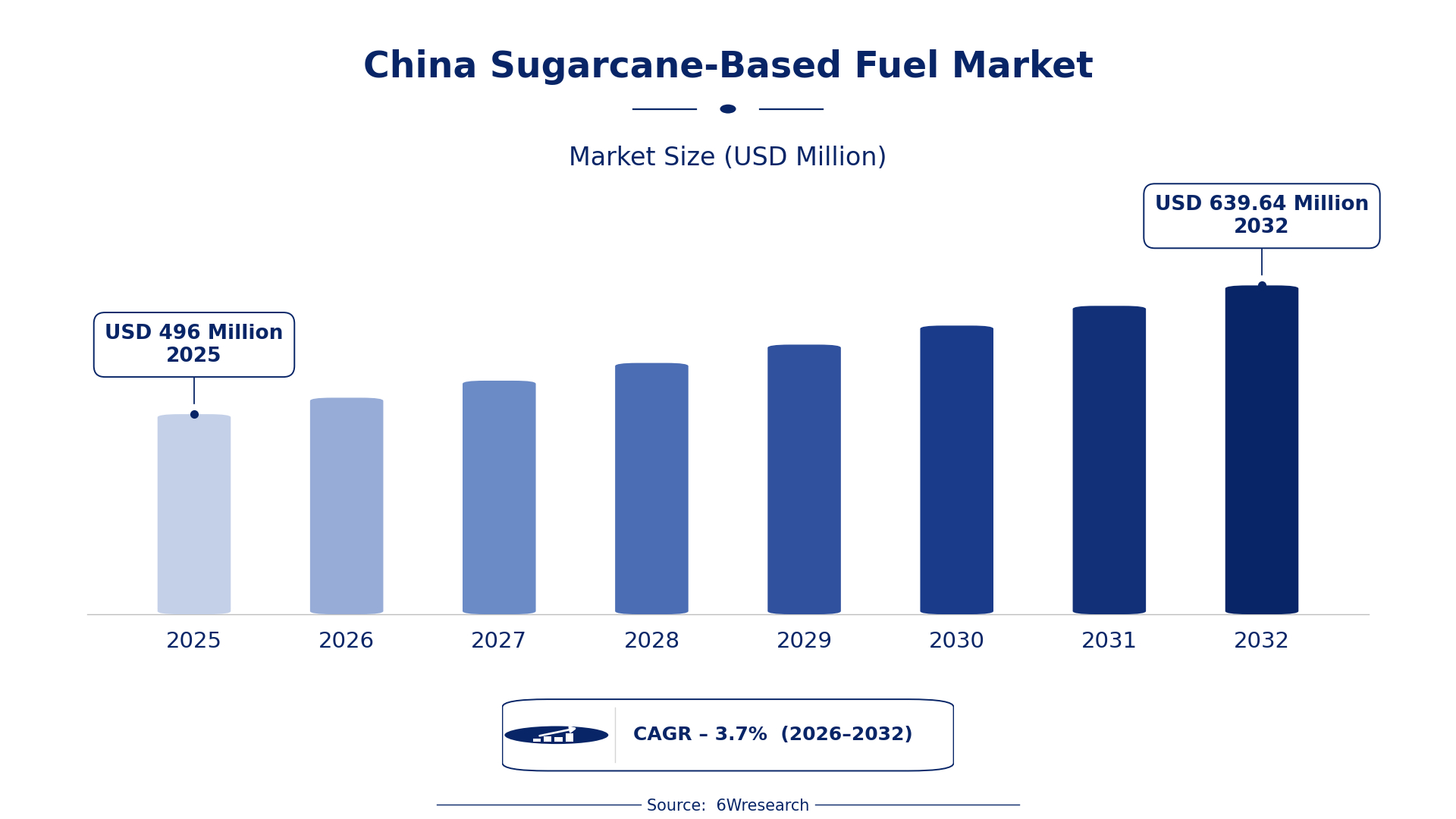
According to 6Wresearch internal database and industry insights, the China Sugarcane-Based Fuel Market was valued at USD 496.0 million in 2025 and is projected to reach USD 639.64 million by 2032, growing at a CAGR of approximately 3.7% during 2026–2032.
China Sugarcane-Based Fuel Market Highlights
| Report Metric | Details |
| Report Name | China Sugarcane-Based Fuel Market |
| Market Size 2025 | USD 496.0 million |
| Market Size 2032 | USD 639.64 million |
| Absolute Growth 2025–2032 | USD 143.64 million |
| CAGR 2026–2032 | 3.7% |
| Peak Annual Growth | 6.0% in 2032 |
| Forecast Period | 2026–2032 |
| Historical Data | 2022–2025 |
| Base Year | 2025 |
| Leading Fuel Type, 2025 | Anhydrous Ethanol (36% share) |
| Leading Feedstock Used, 2025 | Sugarcane Juice (45% share) |
| Leading Blending Ratio, 2025 | E10/E20 (35% share) |
| Leading End User, 2025 | Oil Marketing Companies (47% share) |
| Fastest-Growing Fuel Type | Hydrous Ethanol (6.2% CAGR) |
| Fastest-Growing Feedstock Used | Molasses (6.2% CAGR) |
| Fastest-Growing Blending Ratio | Direct Use (5.0% CAGR) |
| Fastest-Growing End User | Flex Fuel Vehicle Owners (5.7% CAGR) |
| Growing Sector | Transportation |
| Key End Users | Oil Marketing Companies, Flex Fuel Vehicle Owners, Commercial Fleet Operators |
China Sugarcane-Based Fuel Market Year-wise Growth Rate and Key Drivers (2022–2032)
This graph illustrates the annual growth rates of the market from 2022 to 2032, highlighting a steady upward trajectory and projected market expansion over the forecast period.
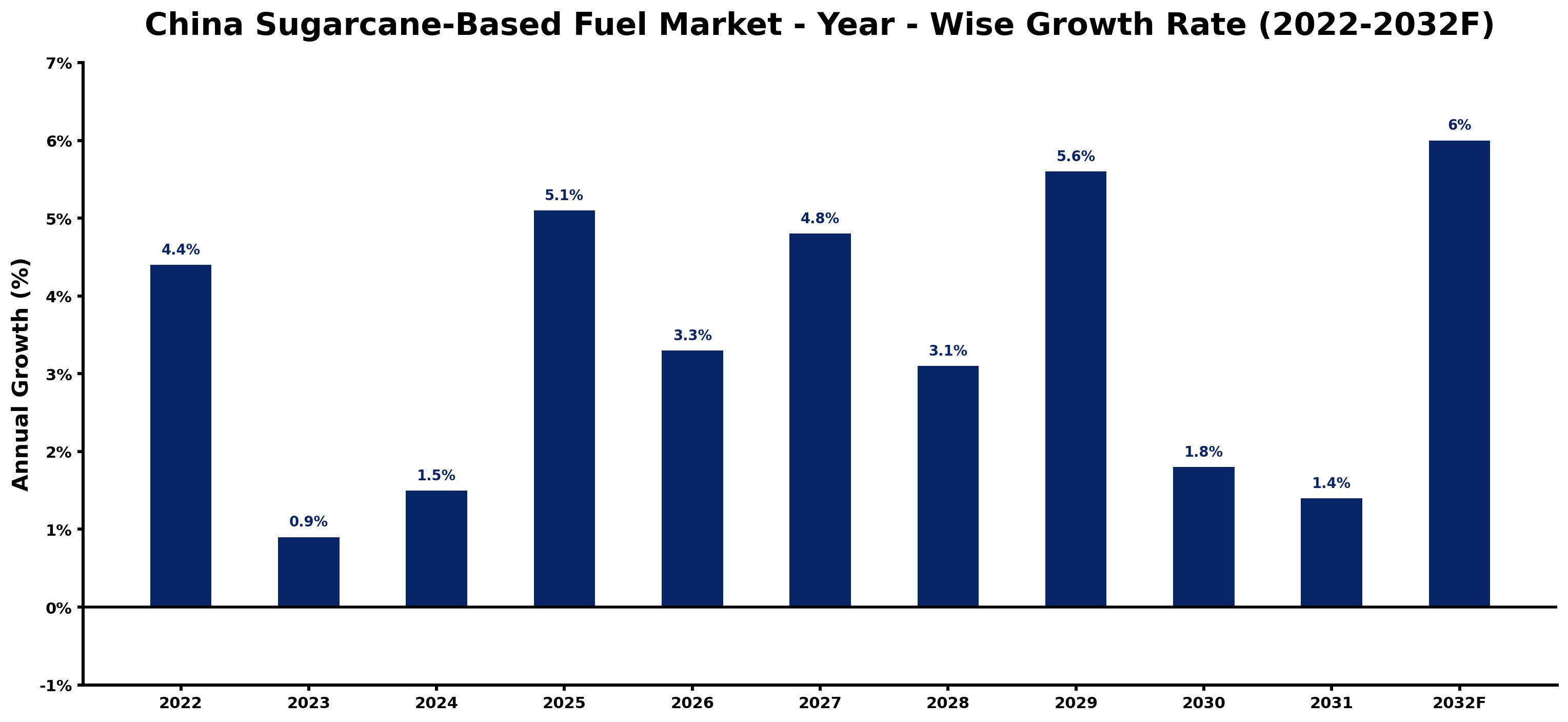
Annual growth estimates for each year appear below with the principal reason behind them, explaining the shifts that set the pace of the market.
| Year | Estimated Annual Growth (%) | Market Rationale |
| 2022 | 4.4 | The market experienced steady growth supported by increasing domestic sugarcane production from the Guangxi region. |
| 2023 | 0.9 | Growth slowed as the market faced challenges in biofuel adoption rates due to limited infrastructure. |
| 2024 | 1.5 | Demand picked up due to rising biofuel blending requirements from the National Energy Administration's initiatives. |
| 2025 | 5.1 | The market peaked with investments in biofuel infrastructure and technology under the 14th Five-Year Plan. |
| 2026 | 3.3 | Growth slowed as investments began to stabilise and production capacities adjusted to meet blending targets. |
| 2027 | 4.8 | Demand increased again due to a rise in flex fuel vehicle ownership projected to grow by 30% by 2025. |
| 2028 | 3.1 | Growth slowed as market conditions normalised after rapid expansion in urban areas adopting biofuels. |
| 2029 | 5.6 | Demand surged as urban areas increasingly adopted biofuels to meet environmental standards set by the government. |
| 2030 | 1.8 | Growth slowed as the market adjusted to the previous year's rapid expansion in production capacity. |
| 2031 | 1.4 | A further slowdown occurred as the market stabilised after peak growth in biofuel production. |
| 2032 | 6.0 | The market is expected to peak again as biofuel blending targets are achieved under the National Biofuel Development Program. |
Note: Market size estimations and growth projections presented in this report are based on 6Wresearch's proprietary forecasting methodology, utilizing the latest available industry data, government publications, and primary research inputs.
China Sugarcane-Based Fuel Market Synopsis
The China Sugarcane-Based Fuel Market encompasses renewable energy derived from sugarcane, produced through fermentation and distillation processes. This biofuel is primarily used for transportation and energy generation. The market is expanding due to increasing domestic sugarcane production and government mandates for biofuel blending. With a target of 10% blending by 2025, demand is driven by the transportation sector and energy production, supported by infrastructure investments and technology advancements.
Market Dynamics Impact Analysis (2026–2032)
| Factor | Type | Impact | Primary Segment Affected |
| Increasing domestic sugarcane production driven by government subsidies. | Driver | High | Sugarcane Juice |
| Rising adoption of flex fuel vehicles as a cleaner fuel option. | Driver | High | Flex Fuel Vehicle Owners |
| Investment in biofuel infrastructure expected to reach 50 billion yuan by 2025. | Opportunity | High | Bio-CNG |
| Growing urban demand for cleaner fuels as cities adopt biofuel standards. | Opportunity | Medium | Oil Marketing Companies |
| Slow adoption rates of biofuels in certain regions due to infrastructure gaps. | Restraint | High | Bio-Diesel |
| Competition from fossil fuels which remain cheaper in some markets. | Restraint | Medium | Hydrous Ethanol |
| The Sugarcane-Based Fuel market in China faces regulatory hurdles that complicate production. | Challenge | High | Bio-CNG |
| Limited consumer awareness about the benefits of sugarcane-based fuels hampers demand. | Challenge | Medium | Flex Fuel Vehicle Owners |
Evaluation of Drivers in China Sugarcane-Based Fuel Market (2026–2032)
The main growth drivers and the segments they affect most are set out below.
| Drivers | Primary Segment Affected | Why It Matters (Evidence) |
| Government subsidies for sugarcane cultivation boost production capacity. | Sugarcane Juice | In 2022, China's sugarcane production reached 12 million tons, increasing supply for biofuels. |
| The rise in flex fuel vehicle ownership increases demand for biofuels. | Flex Fuel Vehicle Owners | The installed base of flex fuel vehicles in China is approximately 1 million units. |
| Investment in biofuel infrastructure supports production and distribution. | Bio-CNG | Investment in biofuel infrastructure is projected to reach 50 billion yuan by 2025. |
| Urban areas are increasingly adopting biofuels to meet environmental standards. | Oil Marketing Companies | The biofuel market is expected to see growth in urban areas by 2025. |
| Government mandates for biofuel blending drive market growth. | Hydrous Ethanol | China aims to increase biofuel blending to 10% by 2025. |
The Sugarcane-Based Fuel market in China is expanding as investment in biofuel infrastructure and rising flex fuel vehicle ownership drive demand. In 2022, China's sugarcane production reached 12 million tons, increasing supply for biofuels. Investment in biofuel infrastructure will reach 50 billion yuan by 2025, supporting production and distribution capabilities. Urban areas are increasingly adopting biofuels to meet environmental standards, with growth anticipated in cities by 2025. The installed base of flex fuel vehicles in China is approximately 1 million units, further boosting demand for sugarcane-based fuels.
Evaluation of Restraints in China Sugarcane-Based Fuel Market
Below mentioned are some major restraints and their influence on market dynamics.
| Market Restraint | Primary Segment Affected | Why It Matters (Evidence) |
| Infrastructure gaps hinder the widespread adoption of biofuels. | Bio-Diesel | Limited infrastructure affects the availability of biofuels in remote areas, impacting access for consumers. |
| Fossil fuel prices remain competitive against biofuels. | Hydrous Ethanol | Lower fossil fuel prices discourage consumers from switching to biofuels, affecting demand. |
| Regulatory hurdles complicate production processes for biofuels. | Bio-CNG | Complex regulations slow down the approval and production of biofuels, delaying market entry. |
| Limited consumer awareness about sugarcane-based fuels impacts demand. | Flex Fuel Vehicle Owners | Many consumers are unaware of the benefits of using biofuels, limiting market growth. |
| Market fluctuations in sugarcane prices can affect biofuel production costs. | Sugarcane Juice | Rising sugarcane prices may increase production costs for biofuels, impacting profitability. |
China Sugarcane-Based Fuel Market Challenges
The China Sugarcane-Based Fuel Market encounters significant competition from alternative renewable energy sources, which pressures pricing and market share for producers. This competition arises from the rapid advancements in solar and wind technologies, prompting buyers to prefer these alternatives and potentially limiting sugarcane fuel's market share. Buyers face fluctuating prices due to inconsistent sugarcane yields, with production reaching only 12 million tons in 2022, resulting in supply uncertainty and higher costs for fuel. Regulatory changes, such as updated biofuel standards, impose compliance challenges for producers, delaying product launches and increasing operational costs by 15%.
Trends in the China Sugarcane-Based Fuel Market
Four trends stand out in the China Sugarcane-Based Fuel Market.
- Shift from Traditional Fuels to Biofuels: Since 2021, urban areas in China have increasingly adopted biofuels as part of their energy strategy, with a target of 10% blending by 2025. This shift is expected to grow the market for biofuels, particularly in cities.
- Emergence of Flex Fuel Vehicles: The rise of flex fuel vehicle ownership has been notable, with projections indicating a 30% growth by 2025. This trend is driving demand for sugarcane-based fuels, especially in urban regions.
- Increased Investment in Biofuel Infrastructure: Investment in biofuel infrastructure is expected to reach 50 billion yuan by 2025, supporting the production and distribution of sugarcane-based fuels. This investment is vital for meeting growing urban demand.
- Adoption of Biofuel Quality Standards: In 2023, the National Standard for Biofuels was updated to improve quality, ensuring safety and compliance in production. This standardisation is important for boosting consumer confidence in biofuels.
Investment Opportunities in the China Sugarcane-Based Fuel Market
Below are the investment opportunities with the strongest case in the China Sugarcane-Based Fuel Market.
- Investment in Biofuel Infrastructure: With an expected investment of 50 billion yuan by 2025, there is an opportunity to develop biofuel infrastructure. Oil Marketing Companies can play a key role in this expansion.
- Expansion of Flex Fuel Vehicle Market: The total population of flex fuel vehicle owners is projected to grow by 30% by 2025, indicating a strong market for sugarcane-based fuels. Collaborating with local dealerships can facilitate market entry.
- Urban Demand for Cleaner Fuels: Urban areas are increasingly adopting biofuels, with growth expected by 2025. Targeting city gas providers can help suppliers meet this rising demand effectively.
- Support for Sugarcane Cultivation: The Sugarcane Cultivation Support Program provides subsidies to farmers, enhancing sugarcane yield. Suppliers can engage with farmers to ensure quality and consistency in production.
Government Initiatives in the China Sugarcane-Based Fuel Market
The National Energy Administration oversees the biofuel market, promoting sustainable biofuel production and usage through initiatives like the 'Biofuel Development Action Plan' launched in 2021. This plan targets a 10% blending rate by 2025, directly impacting the Sugarcane-Based Fuel market. The Ministry of Agriculture initiated the 'Sugarcane Cultivation Support Program' in 2022, providing subsidies to farmers to enhance sugarcane yield and quality, which is vital for biofuel production. Additionally, the Renewable Energy Law was updated in 2023 to facilitate investments in biofuel infrastructure and technology, ensuring compliance and safety in production.
The National Development and Reform Commission regulates the biofuel market, approving projects and funding initiatives that support biofuel production. Their efforts are essential in aligning biofuel production with national energy goals. The Ministry of Ecology and Environment also plays a role in regulating biofuels, ensuring compliance with environmental standards. Their approval of the 'Biofuel Quality Standards' in 2022 is important for maintaining safety in production and boosting consumer confidence.
Future Insight of the China Sugarcane-Based Fuel Market
The China Sugarcane-Based Fuel Market is set to evolve significantly by 2032, driven by government initiatives and blending requirements. The country aims to produce 20 million tons of biofuel by 2025, with infrastructure investments expected to reach 50 billion yuan. The rise of flex fuel vehicles, with ownership projected to grow by 30% by 2025, will expand the consumer base for sugarcane-based fuel. The National Biofuel Development Program will promote production efficiency, creating a more sustainable and competitive environment for suppliers.
Market Segmentation Analysis
Each segment group is reviewed below, with the leader by share and the fastest grower by CAGR.
By Fuel Type – Anhydrous Ethanol Dominated, Hydrous Ethanol Expected to Grow Fastest
According to Sumit Sagar, AM at 6Wresearch, Anhydrous Ethanol took a 36% share of fuel type in 2025, more than any other category. Anhydrous Ethanol holds the largest market share in China due to its direct application as fuel for flex fuel vehicles, which are becoming increasingly popular. With approximately 1 million flex fuel vehicles already in use, the demand for this fuel type continues to rise. Hydrous Ethanol is set to record the highest CAGR in this split, 6.2% over 2026–2032. Hydrous Ethanol is experiencing rapid growth as it serves as a blend with gasoline, appealing to a broader range of vehicle owners. The increasing adoption of E10 blending ratios across major cities is a key driver for this segment. Suppliers should focus on enhancing production capabilities for Hydrous Ethanol to meet the growing blending demand.
By Feedstock Used – Sugarcane Juice Dominated, Molasses Expected to Grow Fastest
Sugarcane Juice accounted for a 45% market share by feedstock used in 2025. Sugarcane Juice dominates the market share as it is primarily used in the food and beverage industries, creating a robust supply chain that supports its use in biofuel production. The established infrastructure for sugarcane cultivation in regions like Guangxi further strengthens this segment. The quickest growth will come from Molasses, forecast to expand at a CAGR of 6.2% between 2026 and 2032. Molasses is the fastest-growing feedstock due to its application in fermentation processes, which are gaining traction in biofuel production. The increasing focus on utilising all parts of the sugarcane plant is propelling demand for this by-product. Buyers should consider diversifying their feedstock sources to include Molasses, capitalising on its rising popularity.
By Blending Ratio – E10/E20 Dominated, Direct Use Expected to Grow Fastest
In 2025, E10/E20 led the blending ratio split with a 35% share. E10/E20 is the leading blending ratio in China, widely adopted for gasoline in vehicles, which enhances the market share of sugarcane-based fuels. This common practice among oil marketing companies ensures a steady demand for these blends. Direct Use is projected to grow fastest, at a CAGR of 5.0% during 2026–2032. Direct Use is the fastest-growing ratio as it allows sugarcane-based fuels to be used directly in specific engines, catering to niche markets. The increasing number of flex fuel vehicles is likely to further boost this segment's growth. Suppliers should invest in educating consumers about the benefits of Direct Use to tap into this emerging market.
By End User – Oil Marketing Companies Dominated, Flex Fuel Vehicle Owners Expected to Grow Fastest
With a 47% revenue share in 2025, Oil Marketing Companies was the largest end user category. Oil Marketing Companies represent the largest share of the market as they are the primary distributors of biofuels, ensuring widespread availability and accessibility. Their established networks facilitate the distribution of sugarcane-based fuels across various regions. Over 2026–2032, Flex Fuel Vehicle Owners are expected to post the fastest growth, at a CAGR of 5.7%. Flex Fuel Vehicle Owners are the fastest-growing end user group, driven by the increasing number of flex fuel vehicles projected to grow by 30% by 2025. This growth reflects a shift towards more sustainable transportation options, encouraging further investment in biofuels. Suppliers should engage directly with Flex Fuel Vehicle Owners to understand their needs and enhance product offerings.
Key Attractiveness of the Report
- 10 Years of Market Numbers
- Historical Data Starting from 2022 to 2025
- Base Year 2025
- Forecast Data until 2032
- Key Performance Indicators Impacting the Market
- Major Upcoming Developments and Projects
Key Highlights of the Report:
- China Sugarcane-Based Fuel Market Outlook
- Market Size of China Sugarcane-Based Fuel Market, 2025
- Forecast of China Sugarcane-Based Fuel Market, 2032
- Historical Data and Forecast of China Sugarcane-Based Fuel Revenues & Volume for the Period 2022 - 2032F
- China Sugarcane-Based Fuel Market Trend Evolution
- China Sugarcane-Based Fuel Market Drivers and Challenges
- China Sugarcane-Based Fuel Price Trends
- China Sugarcane-Based Fuel Porter's Five Forces
- China Sugarcane-Based Fuel Industry Life Cycle
- Historical Data and Forecast of China Sugarcane-Based Fuel Market Revenues & Volume By Fuel Type for the Period 2022 - 2032F
- Historical Data and Forecast of China Sugarcane-Based Fuel Market Revenues & Volume By Anhydrous Ethanol for the Period 2022 - 2032F
- Historical Data and Forecast of China Sugarcane-Based Fuel Market Revenues & Volume By Hydrous Ethanol for the Period 2022 - 2032F
- Historical Data and Forecast of China Sugarcane-Based Fuel Market Revenues & Volume By Bio-CNG for the Period 2022 - 2032F
- Historical Data and Forecast of China Sugarcane-Based Fuel Market Revenues & Volume By Bio-Diesel for the Period 2022 - 2032F
- Historical Data and Forecast of China Sugarcane-Based Fuel Market Revenues & Volume By Feedstock Used for the Period 2022 - 2032F
- Historical Data and Forecast of China Sugarcane-Based Fuel Market Revenues & Volume By Sugarcane Juice for the Period 2022 - 2032F
- Historical Data and Forecast of China Sugarcane-Based Fuel Market Revenues & Volume By Molasses for the Period 2022 - 2032F
- Historical Data and Forecast of China Sugarcane-Based Fuel Market Revenues & Volume By Bagasse + Organic Waste for the Period 2022 - 2032F
- Historical Data and Forecast of China Sugarcane-Based Fuel Market Revenues & Volume By Residue Oils for the Period 2022 - 2032F
- Historical Data and Forecast of China Sugarcane-Based Fuel Market Revenues & Volume By Blending Ratio for the Period 2022 - 2032F
- Historical Data and Forecast of China Sugarcane-Based Fuel Market Revenues & Volume By E10/E20 for the Period 2022 - 2032F
- Historical Data and Forecast of China Sugarcane-Based Fuel Market Revenues & Volume By Direct Use for the Period 2022 - 2032F
- Historical Data and Forecast of China Sugarcane-Based Fuel Market Revenues & Volume By Natural Gas Alternative for the Period 2022 - 2032F
- Historical Data and Forecast of China Sugarcane-Based Fuel Market Revenues & Volume By Diesel Replacement for the Period 2022 - 2032F
- Historical Data and Forecast of China Sugarcane-Based Fuel Market Revenues & Volume By End User for the Period 2022 - 2032F
- Historical Data and Forecast of China Sugarcane-Based Fuel Market Revenues & Volume By Oil Marketing Companies for the Period 2022 - 2032F
- Historical Data and Forecast of China Sugarcane-Based Fuel Market Revenues & Volume By Flex Fuel Vehicle Owners for the Period 2022 - 2032F
- Historical Data and Forecast of China Sugarcane-Based Fuel Market Revenues & Volume By City Gas Providers for the Period 2022 - 2032F
- Historical Data and Forecast of China Sugarcane-Based Fuel Market Revenues & Volume By Commercial Fleet Operators for the Period 2022 - 2032F
- China Sugarcane-Based Fuel Import Export Trade Statistics
- Market Opportunity Assessment By Fuel Type
- Market Opportunity Assessment By Feedstock Used
- Market Opportunity Assessment By Blending Ratio
- Market Opportunity Assessment By End User
- China Sugarcane-Based Fuel Top Companies Market Share
- China Sugarcane-Based Fuel Competitive Benchmarking By Technical and Operational Parameters
- China Sugarcane-Based Fuel Company Profiles
- China Sugarcane-Based Fuel Key Strategic Recommendations
Market Covered
This report examines the market across the segments below.
By Fuel Type
- Anhydrous Ethanol
- Hydrous Ethanol
- Bio-CNG
- Bio-Diesel
By Feedstock Used
- Sugarcane Juice
- Molasses
- Bagasse + Organic Waste
- Residue Oils
By Blending Ratio
- E10/E20
- Direct Use
- Natural Gas Alternative
- Diesel Replacement
By End User
- Oil Marketing Companies
- Flex Fuel Vehicle Owners
- City Gas Providers
- Commercial Fleet Operators































