India Sulfide Reagent Market Size & Growth Rate
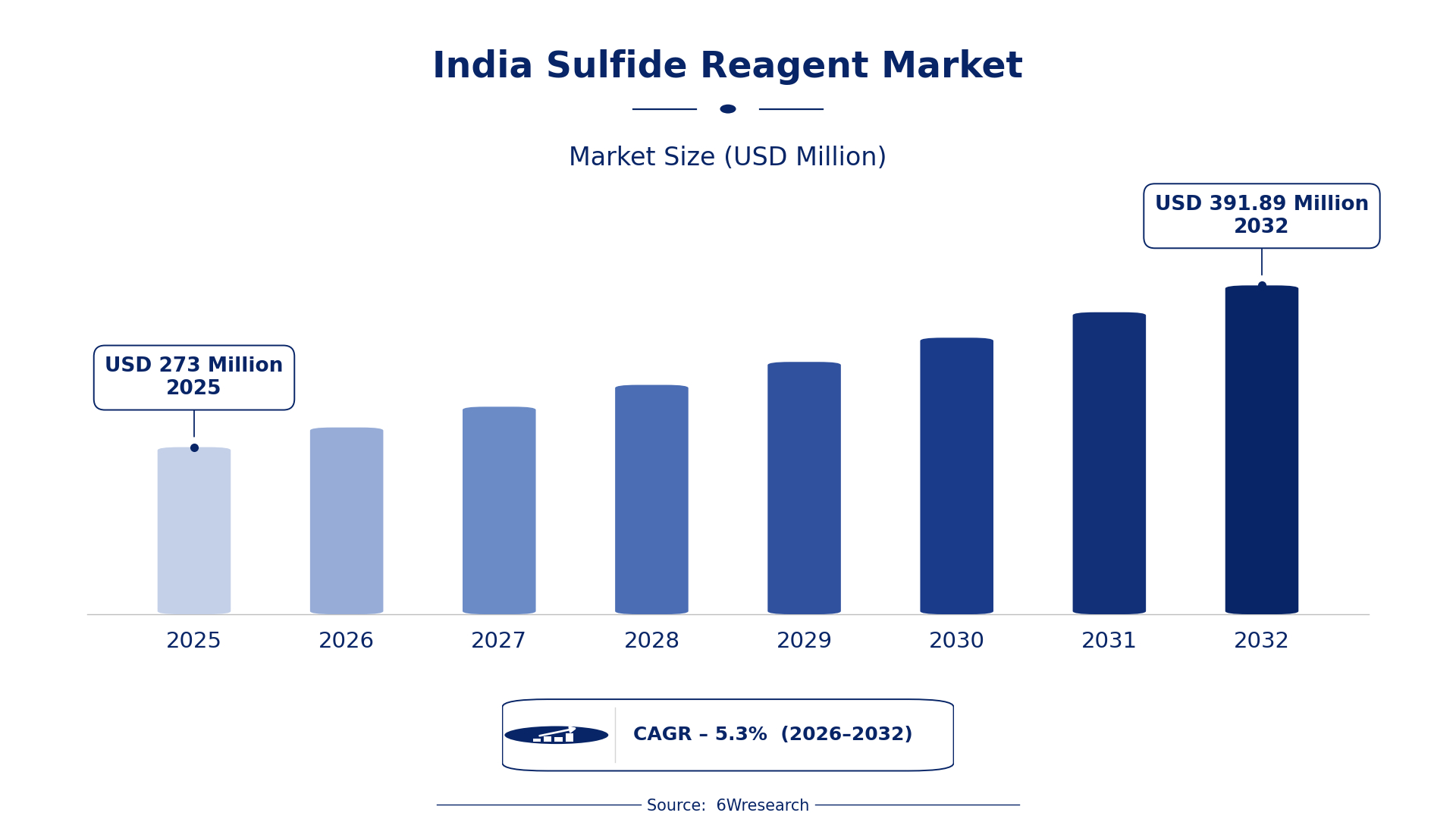
According to 6Wresearch internal database and industry insights, the India Sulfide Reagent Market was valued at USD 273.0 million in 2025 and is projected to reach USD 391.89 million by 2032, growing at a CAGR of approximately 5.3% during 2026–2032.
India Sulfide Reagent Market Highlights
| Report Metric | Details |
| Report Name | India Sulfide Reagent Market |
| Market Size 2025 | USD 273.0 million |
| Market Size 2032 | USD 391.89 million |
| Absolute Growth 2025–2032 | USD 118.89 million |
| CAGR 2026–2032 | 5.3% |
| Peak Annual Growth | 7.9% in 2032 |
| Forecast Period | 2026–2032 |
| Historical Data | 2022–2025 |
| Base Year | 2025 |
| Leading Reagent Type, 2025 | Sodium Sulfide (43% share) |
| Leading Composition, 2025 | Inorganic Compound (41% share) |
| Leading Application Area, 2025 | Ore Flotation (39% share) |
| Leading End User, 2025 | Mining Industry (42% share) |
| Fastest-Growing Reagent Type | Potassium Sulfide (7.1% CAGR) |
| Fastest-Growing Composition | Alkali Sulfide (7.9% CAGR) |
| Fastest-Growing Application Area | Leather Processing (6.8% CAGR) |
| Fastest-Growing End User | Tannery Units (6.5% CAGR) |
| Growing Sector | Mining Industry |
| Key End Users | Mining Industry, Tannery Units, Specialty Chemical Firms, Electronics Manufacturers |
India Sulfide Reagent Market Year-wise Growth Rate and Key Drivers (2022–2032)
This graph illustrates the annual growth rates of the market from 2022 to 2032, highlighting a steady upward trajectory and projected market expansion over the forecast period.
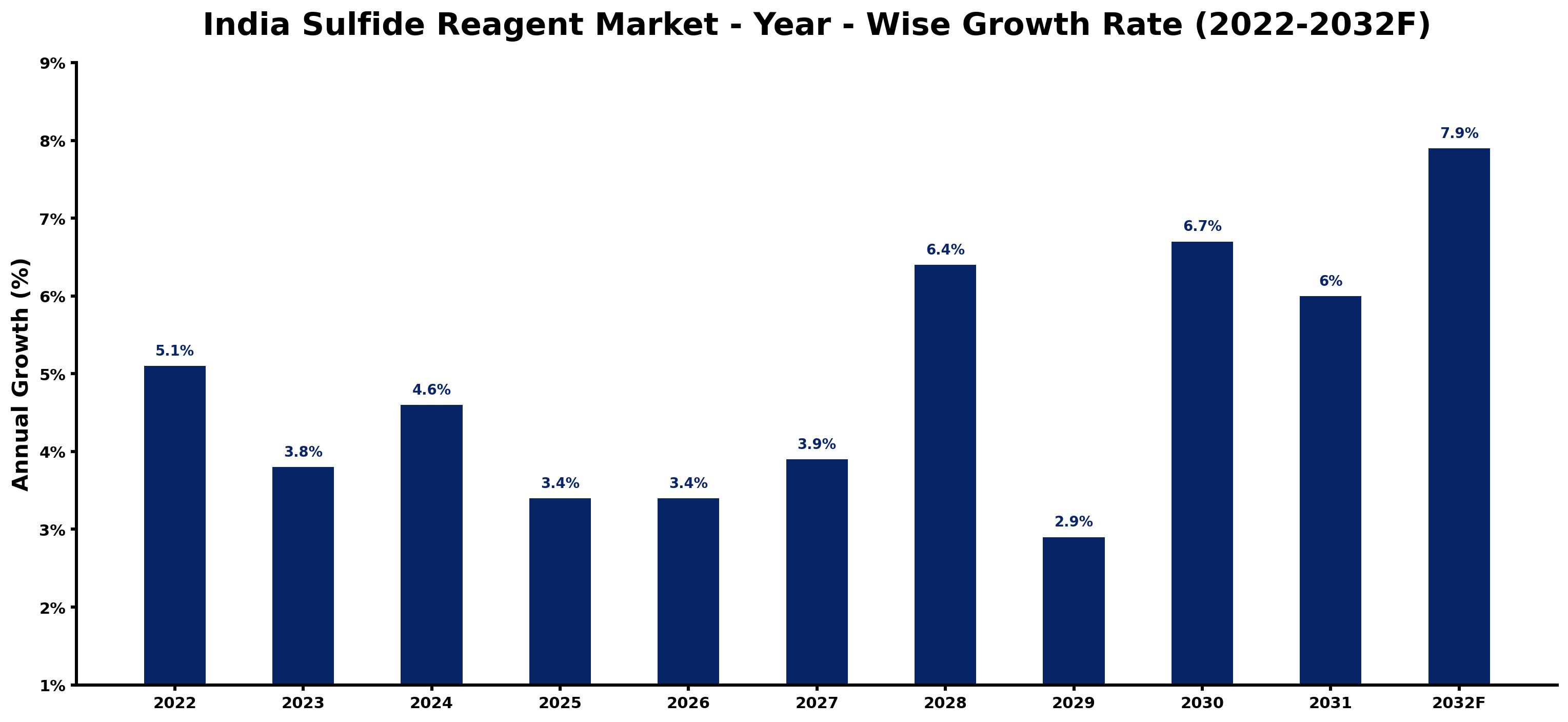
The table below sets out the estimated growth rate for each year and the main factor behind it.
| Year | Estimated Annual Growth (%) | Market Rationale |
| 2022 | 5.1 | The mining sector showed strong activity, driving demand for sulfide reagents. |
| 2023 | 3.8 | Demand growth slowed due to fluctuations in mining output and leather production in Tamil Nadu. |
| 2024 | 4.6 | Increased ore flotation activities boosted demand for sodium sulfide in Jharkhand and Chhattisgarh. |
| 2025 | 3.4 | Demand growth slowed as the leather industry faced temporary production challenges in Tamil Nadu. |
| 2026 | 3.4 | The mining sector is expected to stabilise, maintaining demand for sulfide reagents in ore flotation. |
| 2027 | 3.9 | Increased mining employment will lead to higher demand for sulfide reagents in Jharkhand. |
| 2028 | 6.4 | The leather processing sector is projected to expand, increasing the need for sulfide reagents in Tamil Nadu. |
| 2029 | 2.9 | Growth is expected to slow as mining activities face regulatory adjustments and compliance checks in the sector. |
| 2030 | 6.7 | Demand will surge due to the implementation of new mining policies that improve exploration in Jharkhand. |
| 2031 | 6.0 | The leather industry will maintain steady growth, sustaining demand for sulfide reagents in tanneries. |
| 2032 | 7.9 | The market is projected to peak as mining and leather sectors experience substantial growth. |
Note: Market size estimations and growth projections presented in this report are based on 6Wresearch's proprietary forecasting methodology, utilizing the latest available industry data, government publications, and primary research inputs.
India Sulfide Reagent Market Synopsis
Sulfide Reagents in India are chemical compounds primarily used in mining and leather processing. These reagents are produced through various chemical processes, mainly for ore flotation and leather tanning. The India Sulfide Reagent Market is expanding due to strong domestic demand, particularly from the mining sector, which contributes approximately 2.5% to the national GDP. The 'National Mineral Policy' launched in 2022 has further stimulated demand for sodium sulfide, essential for both ore flotation and leather processing.
Market Dynamics Impact Analysis (2026–2032)
| Factor | Type | Impact | Primary Segment Affected |
| Strong domestic demand from the mining industry drives the need for sulfide reagents. | Driver | High | Ore Flotation |
| The leather industry in Tamil Nadu significantly boosts the need for sulfide reagents. | Driver | High | Leather Processing |
| The 'National Mineral Policy' aims to enhance mineral exploration, creating opportunities for suppliers. | Opportunity | High | Mining Industry |
| Growing leather production in Tamil Nadu presents a chance for increased reagent supply. | Opportunity | High | Tannery Units |
| Regulatory compliance costs can impact the pricing of sulfide reagents. | Restraint | Medium | Sodium Sulfide |
| Quality assurance requirements set by the Bureau of Indian Standards may limit production capacity. | Restraint | Medium | Sodium Sulfide |
| Supply chain disruptions can delay the availability of raw materials for production. | Challenge | High | Sodium Sulfide |
| The need for continuous quality compliance can slow down production processes. | Challenge | Medium | Sodium Sulfide |
Evaluation of Drivers in India Sulfide Reagent Market (2026–2032)
The factors lifting demand, and the evidence behind each, are summarised below.
| Drivers | Primary Segment Affected | Why It Matters (Evidence) |
| Increased mining activities in Jharkhand and Chhattisgarh drive demand for sodium sulfide. | Sodium Sulfide | In 2022, the mining sector contributed approximately 2.5% to India's GDP. |
| The leather industry in Tamil Nadu is a major consumer of sulfide reagents. | Leather Processing | Over 30% of India's leather production occurs in Tamil Nadu, necessitating sulfide reagents. |
| The 'Make in India' initiative supports local production of chemicals, including sulfide reagents. | Sodium Sulfide | This initiative encourages investments in the chemical sector, boosting domestic supply. |
| The National Chemical Policy aims to promote the specialty chemicals sector, indirectly increasing demand. | Sodium Sulfide | This policy supports growth in sectors that use sulfide reagents. |
| The installed base of tanneries, over 1,000, relies heavily on sulfide reagents for processing. | Tannery Units | These facilities are essential for leather production, driving reagent demand. |
In 2022, the mining sector contributed approximately 2.5% to India's GDP, which boosted the need for sodium sulfide. The leather industry, accounting for over 30% of national production, also necessitates these reagents. The installed base of over 1,000 tanneries relies on sulfide reagents for processing, ensuring sustained demand.
Evaluation of Restraints in India Sulfide Reagent Market
The table below lists the restraints and the evidence behind each.
| Market Restraint | Primary Segment Affected | Why It Matters (Evidence) |
| Regulatory compliance costs can increase production expenses for manufacturers. | Sodium Sulfide | Compliance with BIS standards requires investment in quality assurance measures, impacting overall costs. |
| Quality assurance requirements may limit production capacity of sulfide reagents. | Sodium Sulfide | Producers must adhere to updated standards set by the Bureau of Indian Standards, which can slow output. |
| Supply chain disruptions can affect the availability of raw materials. | Sodium Sulfide | Global supply chain issues have led to delays in sourcing essential chemicals, impacting production timelines. |
| Market fluctuations in raw material prices can impact profitability for producers. | Sodium Sulfide | Volatility in chemical prices affects production costs and pricing strategies, squeezing margins. |
| Limited awareness of sulfide reagent applications may hinder market expansion. | Sodium Sulfide | Some potential users in niche markets may not fully understand the benefits, restricting adoption. |
India Sulfide Reagent Market Challenges
The India Sulfide Reagent Market faces regulatory challenges that slow down product approvals, causing delays for suppliers. These compliance issues can extend lead times by six months, affecting producers in the mining and leather sectors who depend on timely access to sulfide reagents. Buyers encounter rising costs as prices for these chemicals can spike by 15% during peak demand, straining budgets for manufacturers. Local producers also face intense competition from imports, which pressures them to reduce prices, potentially compromising quality and reliability for buyers in the long term.
Trends in the India Sulfide Reagent Market
Below mentioned are some of the trends shaping the India Sulfide Reagent Market growth.
- Shift towards Sustainable Practices in Mining: The 'National Mineral Exploration Policy' initiated in 2021 promotes sustainable mining practices, increasing the demand for eco-friendly sulfide reagents. This shift is expected to boost compliance with environmental standards, leading to a 10% increase in market growth.
- Growth in Leather Processing Capacity: Tamil Nadu is expanding its leather processing capacity, with over 30% of India's production concentrated here. This growth is projected to increase sulfide reagent consumption by 15%, benefiting local suppliers.
- Rise in Local Chemical Production: The 'Make in India' initiative has led to a 15% increase in local chemical production, including sulfide reagents, promoting self-sufficiency in the market and reducing dependence on imports.
- Increased Employment in Mining Sector: The mining industry employs over 1 million people, driving demand for sulfide reagents as production scales up to meet national needs, particularly in ore flotation, which is expected to rise by 12%.
Investment Opportunities in the India Sulfide Reagent Market
Below are the investment opportunities with the strongest case in the India Sulfide Reagent Market.
- Expansion of Mining Operations in Jharkhand: Jharkhand is experiencing a surge in mining operations, creating a demand gap for sulfide reagents. This presents an opportunity for suppliers to establish partnerships with local mining firms to meet growing needs, projected to increase by 20%.
- Growing Leather Industry in Tamil Nadu: With over 30% of India's leather production, Tamil Nadu offers opportunities for sulfide reagent suppliers to cater to increasing requirements from tanneries, enhancing local supply chains and expected to grow by 15%.
- Investment in Specialty Chemicals: The National Chemical Policy aims to boost the specialty chemicals sector, presenting a 20% growth opportunity for sulfide reagent suppliers in this area, encouraging new entrants to the market.
- Emerging Markets in Ore Flotation: The demand for ore flotation chemicals is rising, particularly in new mining projects, creating opportunities for suppliers to enter emerging markets and expand their reach, with growth expected at 18%.
Government Initiatives in the India Sulfide Reagent Market
The 'Leather Industry Development Programme' initiated by the Ministry of Textiles in 2020 focuses on boosting leather production, which directly increases the need for sulfide reagents. This programme provides funding for modernising tanneries and improving production capacity, ensuring compliance with international standards. Additionally, the updated 'Skill India Mission' aims to train workers in the leather sector, improving workforce skills and productivity in industries that rely on sulfide reagents. These initiatives support the growth of the sulfide reagent market.
The 'National Mineral Exploration Policy' launched by the Ministry of Mines in 2021 enhances exploration activities, impacting demand for sulfide reagents in mining. This policy aims to increase investment in mineral exploration, which is expected to grow by 25% in the coming years. The Bureau of Indian Standards (BIS) also plays a crucial role in setting quality standards, ensuring compliance in industrial applications, which benefits producers by maintaining quality assurance.
Future Insight of the India Sulfide Reagent Market
The India Sulfide Reagent Market is set to evolve by 2032, driven by the National Mineral Policy, which aims to boost mineral exploration and increase demand for sulfide reagents. The mining sector will see heightened usage in ore flotation, while the leather industry is expected to expand its production capacity, with over 30% of India's leather output relying on these reagents. The National Chemical Policy will promote local production, improving the supply chain for both buyers and suppliers.
Market Segmentation Analysis
The analysis below covers each segmentation, its leading category in 2025 and its fastest-growing category through 2032.
By Reagent Type – Sodium Sulfide Dominated, Potassium Sulfide Expected to Grow Fastest
According to Sumit Sagar, AM at 6Wresearch, the largest reagent type category in 2025 was Sodium Sulfide, with a 43% share of total revenue. Sodium sulfide commands the largest share due to its essential function in ore flotation, particularly in the mineral-rich regions of Jharkhand and Chhattisgarh. Its widespread use in leather tanning further solidifies its position as the leading sulfide reagent in India. Potassium Sulfide is projected to grow fastest, at a CAGR of 7.1% during 2026–2032. Potassium sulfide is experiencing rapid growth as its applications in specialty chemicals gain traction across various industrial sectors. This upward trend indicates that potassium sulfide's relevance will continue to expand as industries seek versatile chemical solutions. Suppliers should focus on enhancing sodium sulfide production while exploring potassium sulfide opportunities to align with the growing market demands.
By Composition – Inorganic Compound Dominated, Alkali Sulfide Expected to Grow Fastest
Inorganic Compound accounted for a 41% market share by composition in 2025. Inorganic compounds hold the largest market share as they are fundamental components in numerous applications, including ore flotation and leather processing. Their critical role in chemical processes makes them vital for industries relying on sulfide reagents. The quickest growth will come from Alkali Sulfide, forecast to expand at a CAGR of 7.9% between 2026 and 2032. Alkali sulfides are witnessing the fastest growth due to their specific utility in ore flotation, which is crucial for efficient mineral extraction. As mining activities increase, the demand for alkali sulfides is projected to rise significantly. Buyers should ensure they have reliable sources of inorganic compounds to maintain a consistent supply for their operational requirements.
By Application Area – Ore Flotation Dominated, Leather Processing Expected to Grow Fastest
With a 39% revenue share in 2025, Ore Flotation was the largest application area category. Ore flotation represents the largest share of the market as it is the primary application for sulfide reagents in the mining sector. The importance of sodium sulfide in this process underscores its significance for mineral extraction in India. Leather Processing is set to record the highest CAGR in this split, 6.8% over 2026–2032. Leather processing is rapidly growing as the leather industry in Tamil Nadu, responsible for over 30% of India's leather production, increasingly depends on sulfide reagents for tanning. This growth mirrors the rising demand for high-quality leather products. Suppliers must adapt to the increasing demand in leather processing while ensuring quality standards to seize market opportunities.
By End User – Mining Industry Dominated, Tannery Units Expected to Grow Fastest
In 2025, Mining Industry led the end user split with a 42% share. The mining industry is the largest consumer of sulfide reagents, accounting for a substantial share of the market due to its extensive use in mineral extraction processes. The sector's contribution of approximately 2.5% to India's GDP highlights its significance. Over 2026–2032, Tannery Units are expected to post the fastest growth, at a CAGR of 6.5%. Tannery units are rapidly increasing their use of sulfide reagents, driven by the booming leather production in Tamil Nadu. This trend indicates a shift towards higher consumption of sulfide reagents in leather processing. Suppliers should target tannery units to capitalise on the growing demand while ensuring compliance with industry standards.
Key Attractiveness of the Report
- 10 Years of Market Numbers
- Historical Data Starting from 2022 to 2025
- Base Year 2025
- Forecast Data until 2032
- Key Performance Indicators Impacting the Market
- Major Upcoming Developments and Projects
Key Highlights of the Report:
- India Sulfide Reagent Market Outlook
- Market Size of India Sulfide Reagent Market, 2025
- Forecast of India Sulfide Reagent Market, 2032
- Historical Data and Forecast of India Sulfide Reagent Revenues & Volume for the Period 2022 - 2032F
- India Sulfide Reagent Market Trend Evolution
- India Sulfide Reagent Market Drivers and Challenges
- India Sulfide Reagent Price Trends
- India Sulfide Reagent Porter's Five Forces
- India Sulfide Reagent Industry Life Cycle
- Historical Data and Forecast of India Sulfide Reagent Market Revenues & Volume By Reagent Type for the Period 2022 - 2032F
- Historical Data and Forecast of India Sulfide Reagent Market Revenues & Volume By Sodium Sulfide for the Period 2022 - 2032F
- Historical Data and Forecast of India Sulfide Reagent Market Revenues & Volume By Potassium Sulfide for the Period 2022 - 2032F
- Historical Data and Forecast of India Sulfide Reagent Market Revenues & Volume By Iron Sulfide for the Period 2022 - 2032F
- Historical Data and Forecast of India Sulfide Reagent Market Revenues & Volume By Ammonium Sulfide for the Period 2022 - 2032F
- Historical Data and Forecast of India Sulfide Reagent Market Revenues & Volume By Composition for the Period 2022 - 2032F
- Historical Data and Forecast of India Sulfide Reagent Market Revenues & Volume By Inorganic Compound for the Period 2022 - 2032F
- Historical Data and Forecast of India Sulfide Reagent Market Revenues & Volume By Alkali Sulfide for the Period 2022 - 2032F
- Historical Data and Forecast of India Sulfide Reagent Market Revenues & Volume By Metal Sulfide for the Period 2022 - 2032F
- Historical Data and Forecast of India Sulfide Reagent Market Revenues & Volume By Aqueous Solution for the Period 2022 - 2032F
- Historical Data and Forecast of India Sulfide Reagent Market Revenues & Volume By Application Area for the Period 2022 - 2032F
- Historical Data and Forecast of India Sulfide Reagent Market Revenues & Volume By Ore Flotation for the Period 2022 - 2032F
- Historical Data and Forecast of India Sulfide Reagent Market Revenues & Volume By Leather Processing for the Period 2022 - 2032F
- Historical Data and Forecast of India Sulfide Reagent Market Revenues & Volume By Lubricant Additives for the Period 2022 - 2032F
- Historical Data and Forecast of India Sulfide Reagent Market Revenues & Volume By Semiconductor Cleaning for the Period 2022 - 2032F
- Historical Data and Forecast of India Sulfide Reagent Market Revenues & Volume By End User for the Period 2022 - 2032F
- Historical Data and Forecast of India Sulfide Reagent Market Revenues & Volume By Mining Industry for the Period 2022 - 2032F
- Historical Data and Forecast of India Sulfide Reagent Market Revenues & Volume By Tannery Units for the Period 2022 - 2032F
- Historical Data and Forecast of India Sulfide Reagent Market Revenues & Volume By Specialty Chemical Firms for the Period 2022 - 2032F
- Historical Data and Forecast of India Sulfide Reagent Market Revenues & Volume By Electronics Manufacturers for the Period 2022 - 2032F
- India Sulfide Reagent Import Export Trade Statistics
- Market Opportunity Assessment By Reagent Type
- Market Opportunity Assessment By Composition
- Market Opportunity Assessment By Application Area
- Market Opportunity Assessment By End User
- India Sulfide Reagent Top Companies Market Share
- India Sulfide Reagent Competitive Benchmarking By Technical and Operational Parameters
- India Sulfide Reagent Company Profiles
- India Sulfide Reagent Key Strategic Recommendations
Market Covered
This report examines the market across the segments below.
By Reagent Type
- Sodium Sulfide
- Potassium Sulfide
- Iron Sulfide
- Ammonium Sulfide
By Composition
- Inorganic Compound
- Alkali Sulfide
- Metal Sulfide
- Aqueous Solution
By Application Area
- Ore Flotation
- Leather Processing
- Lubricant Additives
- Semiconductor Cleaning
By End User
- Mining Industry
- Tannery Units
- Specialty Chemical Firms
- Electronics Manufacturers































