India supervisory control systems Market Size & Growth Rate
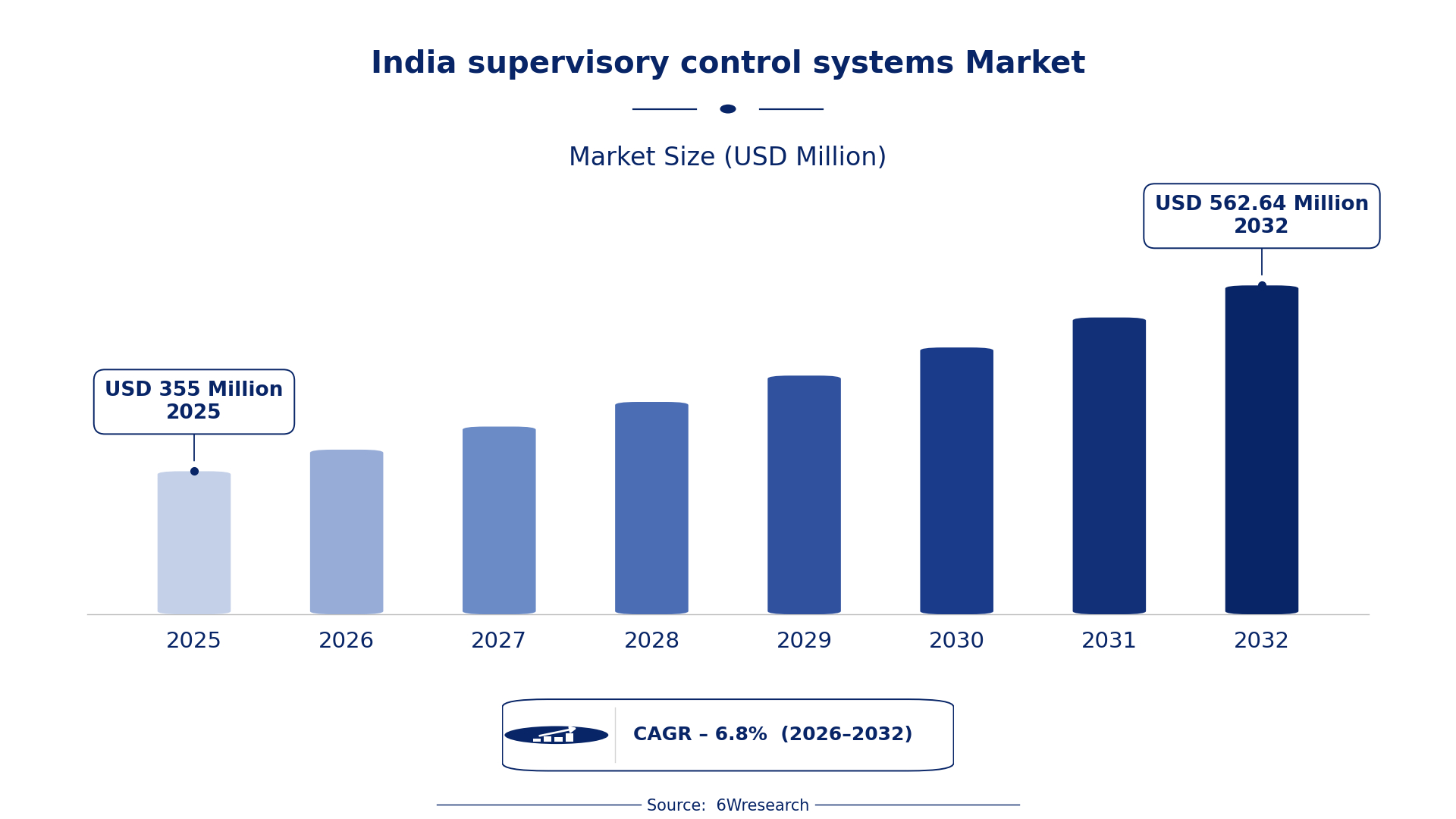
According to 6Wresearch internal database and industry insights, the India supervisory control systems Market was valued at USD 355.0 million in 2025 and is projected to reach USD 562.64 million by 2032, growing at a CAGR of approximately 6.8% during 2026–2032.
India supervisory control systems Market Highlights
| Report Metric | Details |
| Report Name | India supervisory control systems Market |
| Market Size 2025 | USD 355.0 million |
| Market Size 2032 | USD 562.64 million |
| Absolute Growth 2025–2032 | USD 207.64 million |
| CAGR 2026–2032 | 6.8% |
| Peak Annual Growth | 9.4% in 2027 |
| Forecast Period | 2026–2032 |
| Historical Data | 2022–2025 |
| Base Year | 2025 |
| Leading System Type, 2025 | SCADA Systems (47% share) |
| Leading Architecture Type, 2025 | Centralized (34% share) |
| Leading Control Level, 2025 | Plant-Level Monitoring (48% share) |
| Leading End User, 2025 | Power Generation Units (48% share) |
| Fastest-Growing System Type | HMI-Based Systems (9.3% CAGR) |
| Fastest-Growing Architecture Type | Modular (8.7% CAGR) |
| Fastest-Growing Control Level | Process Control (8.1% CAGR) |
| Fastest-Growing End User | Industrial Automation Firms (9.2% CAGR) |
| Growing Sector | Industrial Automation Firms |
| Key End Users | Power Generation Units, Oil Refining Plants, Industrial Automation Firms, Utility Operators |
India supervisory control systems Market Year-wise Growth Rate and Key Drivers (2022–2032)
This graph illustrates the annual growth rates of the market from 2022 to 2032, highlighting a steady upward trajectory and projected market expansion over the forecast period.
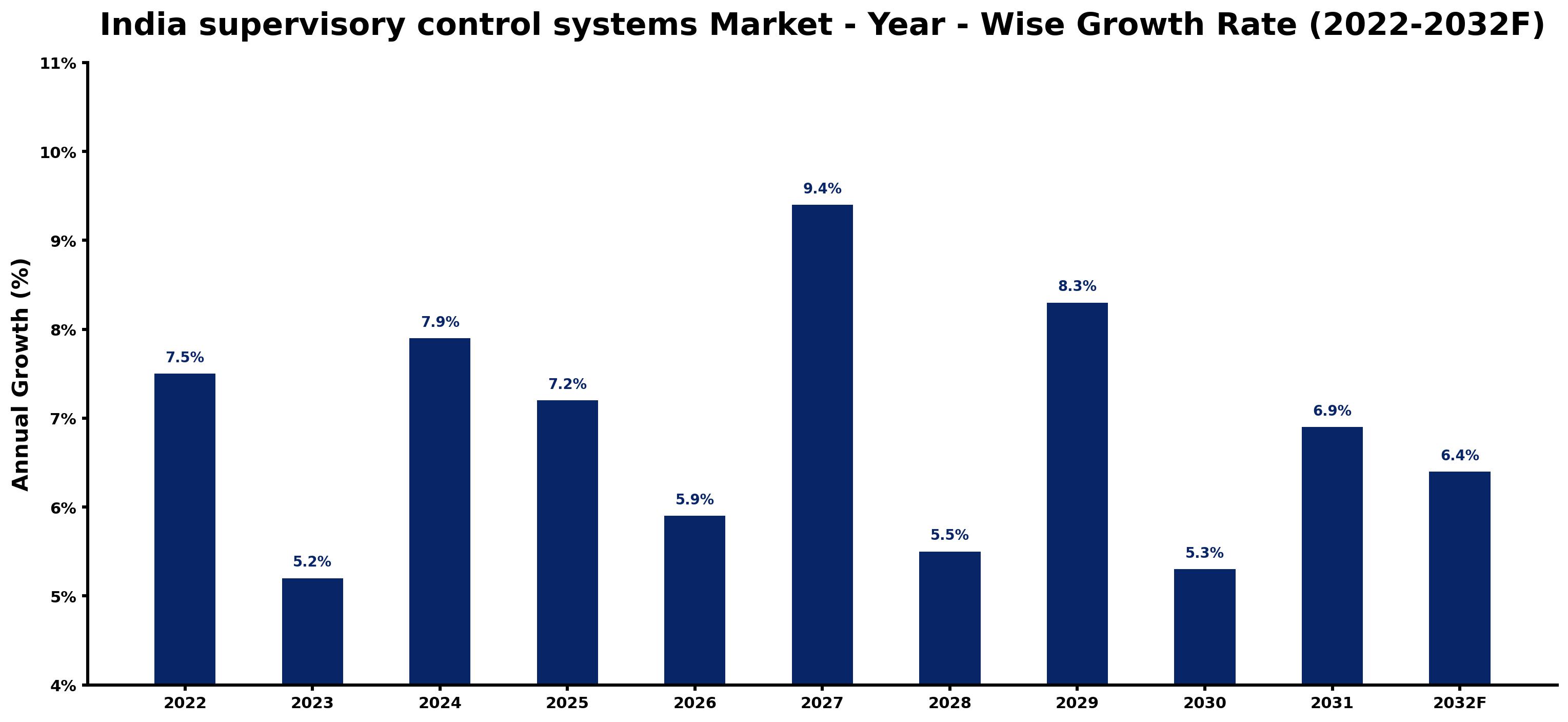
Below, each year's estimated growth is shown next to the factor that most influenced it.
| Year | Estimated Annual Growth (%) | Market Rationale |
| 2022 | 7.5 | The market experienced solid growth driven by increased automation in various sectors. |
| 2023 | 5.2 | Growth slowed due to market adjustments and a focus on efficiency improvements. |
| 2024 | 7.9 | Demand surged as industries ramped up investments in automation technologies. |
| 2025 | 7.2 | The market continued to grow, albeit at a slower pace as projects matured. |
| 2026 | 5.9 | Growth decelerated as companies evaluated their automation strategies and investments. |
| 2027 | 9.4 | A significant rise in demand occurred, driven by new industrial projects and upgrades. |
| 2028 | 5.5 | Growth slowed again as companies focused on optimising existing systems. |
| 2029 | 8.3 | Demand increased as industrial automation firms expanded their capabilities. |
| 2030 | 5.3 | The market experienced another slowdown as investments stabilised across sectors. |
| 2031 | 6.9 | Growth accelerated again as new technologies and systems were adopted. |
| 2032 | 6.4 | The market slowed slightly as it reached a more mature phase of development. |
Note: Market size estimations and growth projections presented in this report are based on 6Wresearch's proprietary forecasting methodology, utilizing the latest available industry data, government publications, and primary research inputs.
India supervisory control systems Market Synopsis
Supervisory control systems in India include SCADA and DCS technologies that monitor industrial processes. These systems facilitate real-time data acquisition, process automation, and improved operational efficiency in sectors such as power generation and oil refining. The India supervisory control systems Market is growing due to increasing automation demands across industries and substantial investments in infrastructure. The power generation sector plans to install over 200 SCADA systems by 2025, highlighting the rising need for sophisticated monitoring solutions. Furthermore, the Smart Cities Mission incorporates these systems into urban infrastructure projects, propelling market expansion.
Market Dynamics Impact Analysis (2026–2032)
| Factor | Type | Impact | Primary Segment Affected |
| Increased demand for automation in industrial processes | Driver | High | SCADA Systems |
| Ongoing investments in power generation and oil refining sectors | Driver | High | Distributed Control Systems |
| Growing urbanisation and infrastructure projects in cities | Opportunity | High | HMI-Based Systems |
| Rising need for operational efficiency in manufacturing | Opportunity | Medium | PLC-Integrated Systems |
| Challenges in integrating new technologies with legacy systems | Restraint | High | Centralized |
| Limited awareness of advanced supervisory control systems | Restraint | Medium | Hierarchical |
| High initial investment costs for advanced systems | Challenge | High | Plant-Level Monitoring |
| Shortage of skilled professionals in automation technologies | Challenge | Medium | Process Control |
Evaluation of Drivers in India supervisory control systems Market (2026–2032)
Key forces behind demand, with the segment each one moves most, are listed below.
| Drivers | Primary Segment Affected | Why It Matters (Evidence) |
| Growing investments in automation technologies | SCADA Systems | This trend is driven by the need for real-time monitoring in sectors like power generation, with over 200 systems expected by 2025. |
| Increased focus on operational efficiency | Distributed Control Systems | The oil and gas sector relies on these systems for refining processes, boosting demand for advanced control solutions. |
| Government initiatives promoting smart city projects | PLC-Integrated Systems | These firms are adopting more PLC-integrated systems to automate machinery, with an installed base projected to reach 150,000 units by 2025. |
| Enhanced regulatory standards for industrial processes | Centralized | ISO 9001 standards are being adopted, driving the need for compliant supervisory control systems. |
| Rising demand from industrial automation firms | HMI-Based Systems | Over 70% of industrial automation firms in India utilise HMI-based systems for operational efficiency. |
Growth across the supervisory control systems market in India is anchored in rising investments in automation technologies, particularly in sectors like power generation and oil refining. The power generation sector is expected to install over 200 SCADA systems by 2025, reflecting increased demand for advanced monitoring solutions. The oil and gas sector relies on distributed control systems for refining processes, further boosting demand. As industrial automation firms expand their capabilities, the installed base of PLC-integrated systems is projected to reach 150,000 units by 2025, indicating strong growth potential in this segment.
Evaluation of Restraints in India supervisory control systems Market
The key brakes on demand, and where they bite hardest, are shown below.
| Market Restraint | Primary Segment Affected | Why It Matters (Evidence) |
| Integration challenges with existing legacy systems | Centralized | Many firms face difficulties in upgrading to new systems, which can delay implementation and increase costs. |
| Limited understanding of advanced supervisory control systems | Hierarchical | This lack of awareness hinders adoption rates, particularly in smaller firms looking to modernise. |
| High initial investment costs for advanced systems | Plant-Level Monitoring | The upfront costs can deter companies from investing in new technologies, impacting project timelines. |
| Shortage of skilled professionals in automation | Process Control | The lack of qualified personnel can lead to delays in project execution and operational inefficiencies. |
| Regulatory compliance requirements may slow down adoption | Operator Control | Firms must navigate complex regulations, which can prolong the implementation of new systems. |
India supervisory control systems Market Challenges
India's supervisory control systems market still has to solve a few problems, and the first is cost. High development expenses for software and hardware integration can inflate project budgets by up to 30%, making it challenging for smaller manufacturers to adopt these systems. Competition presents another issue, as local suppliers struggle against international players offering lower-priced solutions, which can lead to quality compromises. Supply chain disruptions, particularly in hardware components, can delay project timelines by as much as six months for end users, negatively impacting operational efficiency. Regulatory compliance with ISO 9001 standards complicates matters, requiring firms to allocate extra resources for certification processes, which can extend project durations by up to 20% for buyers.
Trends in the India supervisory control systems Market
Buyers and suppliers in the India supervisory control systems Market are adjusting to the following trends.
- Shift towards Integrated Control Systems: India is transitioning towards integrated supervisory control systems that streamline operations across various sectors. The Smart Cities Mission supports this integration, with funding allocated for 100 cities to improve urban infrastructure.
- Increased Adoption of HMI-Based Systems: The demand for HMI-based systems is on the rise as industries seek better operator interaction and system visualisation. Over 70% of industrial automation firms in India employ these systems to boost operational efficiency.
- Growing Focus on Digital Transformation: A national strategy for digital transformation in the energy sector was launched in 2023, aiming to modernise control systems. This initiative will improve operational capabilities across power generation units.
- Expansion of SCADA Systems in Power Generation: The power generation sector is increasingly adopting SCADA systems for real-time monitoring and control. It is projected to install over 200 SCADA systems by 2025, reflecting the growing need for advanced monitoring solutions.
Investment Opportunities in the India supervisory control systems Market
Investors looking at the India supervisory control systems Market should consider the following areas.
- Supply of Advanced SCADA Systems: There is a strong opportunity to supply advanced SCADA systems, driven by the anticipated installation of over 200 systems in the power generation sector by 2025. Collaborating with utility operators can ease market entry.
- Investment in HMI-Based Solutions: Industrial automation firms are pursuing HMI-based solutions for improved operational efficiency. With over 70% of firms using these systems, suppliers can enter the market through partnerships with these companies.
- Development of Modular Control Systems: The demand for modular control systems is rising as industries seek flexibility in their operations. Suppliers can target manufacturing firms aiming to enhance automation capabilities through local partnerships.
- Enhancing Automation in Smart Cities: The Smart Cities Mission offers opportunities for suppliers to boost automation in urban infrastructure projects. With funding allocated for 100 cities, local partnerships can facilitate entry into this market.
Government Initiatives in the India supervisory control systems Market
The National Smart Grid Mission, launched by the Ministry of Power in 2020, aims to improve grid reliability and efficiency through advanced supervisory control systems. This initiative encourages the adoption of modern monitoring technologies in power generation and utility sectors, ensuring better service delivery and operational performance. The program has allocated funds to support the integration of these systems in various projects, benefiting both producers and buyers in the market.
The Digital India initiative, initiated in 2021, includes provisions for upgrading control systems in public utilities to enhance service delivery. The Ministry of Electronics and Information Technology oversees this program, which funds projects aimed at modernising infrastructure and improving operational capabilities across sectors. This initiative is expected to boost the adoption of advanced supervisory control systems in urban areas.
Future Insight of the India supervisory control systems Market
The supervisory control systems market in India is projected to grow substantially by 2032, driven by several key factors. The Ministry of Power's initiative to enhance monitoring systems in 50 power plants by 2024 will stimulate further investments in automation. The Smart Cities Mission seeks to integrate these systems into urban infrastructure, improving efficiency and real-time data management. By 2025, the installed base of supervisory control systems in manufacturing is expected to reach 150,000 units, indicating a clear shift towards automation in key sectors. The national strategy for digital transformation in the energy sector will further promote the adoption of advanced supervisory control systems.
Market Segmentation Analysis
The analysis below covers each segmentation, its leading category in 2025 and its fastest-growing category through 2032.
By System Type – SCADA Systems Dominated, HMI-Based Systems Expected to Grow Fastest
According to Sumit Sagar, AM at 6Wresearch, in 2025, SCADA Systems led the system type split with a 47% share. SCADA systems hold the largest share in India's supervisory control systems market due to their extensive application in real-time monitoring and control across diverse sectors. Their significance is underscored by the projected installation of over 200 SCADA systems in the power generation sector by 2025, showcasing their critical role in enhancing operational efficiency. HMI-Based Systems are set to record the highest CAGR in this split, 9.3% over 2026–2032. HMI-based systems are rapidly gaining traction as they are essential for operator interaction and system visualisation, especially in industries prioritising operational efficiency. The fact that over 70% of industrial automation firms in India utilise these systems indicates a strong growth trajectory for this sub-segment. Suppliers should enhance HMI capabilities to cater to the increasing demand from industrial automation firms seeking improved operational efficiency.
By Architecture Type – Centralized Dominated, Modular Expected to Grow Fastest
With a 34% revenue share in 2025, Centralized was the largest architecture type category. Centralized systems dominate the market as they are essential for managing large-scale operations effectively. Their critical role is highlighted by substantial investments in upgrading supervisory control systems across various sectors in India, ensuring streamlined processes and oversight. The quickest growth will come from Modular, forecast to expand at a CAGR of 8.7% between 2026 and 2032. Modular systems are witnessing rapid growth as they offer flexibility and scalability, particularly in projects requiring customisation. This trend aligns with ongoing initiatives to enhance urban infrastructure under the Smart Cities Mission, driving demand for adaptable solutions. Buyers may find value in considering modular solutions to effectively respond to evolving operational needs in their projects.
By Control Level – Plant-Level Monitoring Dominated, Process Control Expected to Grow Fastest
Plant-Level Monitoring took a 48% share of control level in 2025, more than any other category. Plant-level monitoring systems are crucial for overseeing entire plant operations, ensuring both efficiency and reliability in production processes. Their importance is particularly evident in sectors like power generation, where effective monitoring is essential for optimal performance. Process Control is projected to grow fastest, at a CAGR of 8.1% during 2026–2032. Process control systems are increasingly sought after as they are key to maintaining production standards and operational efficiency. This growth is propelled by the rising emphasis on optimising processes within various industrial environments. Suppliers should focus on developing process control solutions to meet the growing demand for enhanced efficiency in production settings.
By End User – Power Generation Units Dominated, Industrial Automation Firms Expected to Grow Fastest
Power Generation Units accounted for a 48% market share by end user in 2025. Power generation units are the primary users of supervisory control systems, leveraging these technologies for improved efficiency and reliability in their operations. Initiatives by the Ministry of Power further highlight the critical importance of these systems in the sector. Over 2026–2032, Industrial Automation Firms are expected to post the fastest growth, at a CAGR of 9.2%. Industrial automation firms are experiencing the most rapid growth as they strive to enhance their automation capabilities, reflecting a broader trend towards increased efficiency in manufacturing. Their proactive adoption of advanced supervisory control systems is driving this segment forward. Suppliers must tailor their offerings to meet the specific requirements of industrial automation firms as they expand their automation initiatives.
Key Attractiveness of the Report
- 10 Years of Market Numbers
- Historical Data Starting from 2022 to 2025
- Base Year 2025
- Forecast Data until 2032
- Key Performance Indicators Impacting the Market
- Major Upcoming Developments and Projects
Key Highlights of the Report:
- India supervisory control systems Market Outlook
- Market Size of India supervisory control systems Market, 2025
- Forecast of India supervisory control systems Market, 2032
- Historical Data and Forecast of India supervisory control systems Revenues & Volume for the Period 2022 - 2032F
- India supervisory control systems Market Trend Evolution
- India supervisory control systems Market Drivers and Challenges
- India supervisory control systems Price Trends
- India supervisory control systems Porter's Five Forces
- India supervisory control systems Industry Life Cycle
- Historical Data and Forecast of India supervisory control systems Market Revenues & Volume By System Type for the Period 2022 - 2032F
- Historical Data and Forecast of India supervisory control systems Market Revenues & Volume By SCADA Systems for the Period 2022 - 2032F
- Historical Data and Forecast of India supervisory control systems Market Revenues & Volume By Distributed Control Systems for the Period 2022 - 2032F
- Historical Data and Forecast of India supervisory control systems Market Revenues & Volume By HMI-Based Systems for the Period 2022 - 2032F
- Historical Data and Forecast of India supervisory control systems Market Revenues & Volume By PLC-Integrated Systems for the Period 2022 - 2032F
- Historical Data and Forecast of India supervisory control systems Market Revenues & Volume By Architecture Type for the Period 2022 - 2032F
- Historical Data and Forecast of India supervisory control systems Market Revenues & Volume By Centralized for the Period 2022 - 2032F
- Historical Data and Forecast of India supervisory control systems Market Revenues & Volume By Hierarchical for the Period 2022 - 2032F
- Historical Data and Forecast of India supervisory control systems Market Revenues & Volume By Visual Interface for the Period 2022 - 2032F
- Historical Data and Forecast of India supervisory control systems Market Revenues & Volume By Modular for the Period 2022 - 2032F
- Historical Data and Forecast of India supervisory control systems Market Revenues & Volume By Control Level for the Period 2022 - 2032F
- Historical Data and Forecast of India supervisory control systems Market Revenues & Volume By Plant-Level Monitoring for the Period 2022 - 2032F
- Historical Data and Forecast of India supervisory control systems Market Revenues & Volume By Process Control for the Period 2022 - 2032F
- Historical Data and Forecast of India supervisory control systems Market Revenues & Volume By Operator Control for the Period 2022 - 2032F
- Historical Data and Forecast of India supervisory control systems Market Revenues & Volume By Equipment-Level Management for the Period 2022 - 2032F
- Historical Data and Forecast of India supervisory control systems Market Revenues & Volume By End User for the Period 2022 - 2032F
- Historical Data and Forecast of India supervisory control systems Market Revenues & Volume By Power Generation Units for the Period 2022 - 2032F
- Historical Data and Forecast of India supervisory control systems Market Revenues & Volume By Oil Refining Plants for the Period 2022 - 2032F
- Historical Data and Forecast of India supervisory control systems Market Revenues & Volume By Industrial Automation Firms for the Period 2022 - 2032F
- Historical Data and Forecast of India supervisory control systems Market Revenues & Volume By Utility Operators for the Period 2022 - 2032F
- India supervisory control systems Import Export Trade Statistics
- Market Opportunity Assessment By System Type
- Market Opportunity Assessment By Architecture Type
- Market Opportunity Assessment By Control Level
- Market Opportunity Assessment By End User
- India supervisory control systems Top Companies Market Share
- India supervisory control systems Competitive Benchmarking By Technical and Operational Parameters
- India supervisory control systems Company Profiles
- India supervisory control systems Key Strategic Recommendations
Market Covered
Segments analysed in this report are listed below.
By System Type
- SCADA Systems
- Distributed Control Systems
- HMI-Based Systems
- PLC-Integrated Systems
By Architecture Type
- Centralized
- Hierarchical
- Visual Interface
- Modular
By Control Level
- Plant-Level Monitoring
- Process Control
- Operator Control
- Equipment-Level Management
By End User
- Power Generation Units
- Oil Refining Plants
- Industrial Automation Firms
- Utility Operators































