China supervisory control systems Market Size & Growth Rate
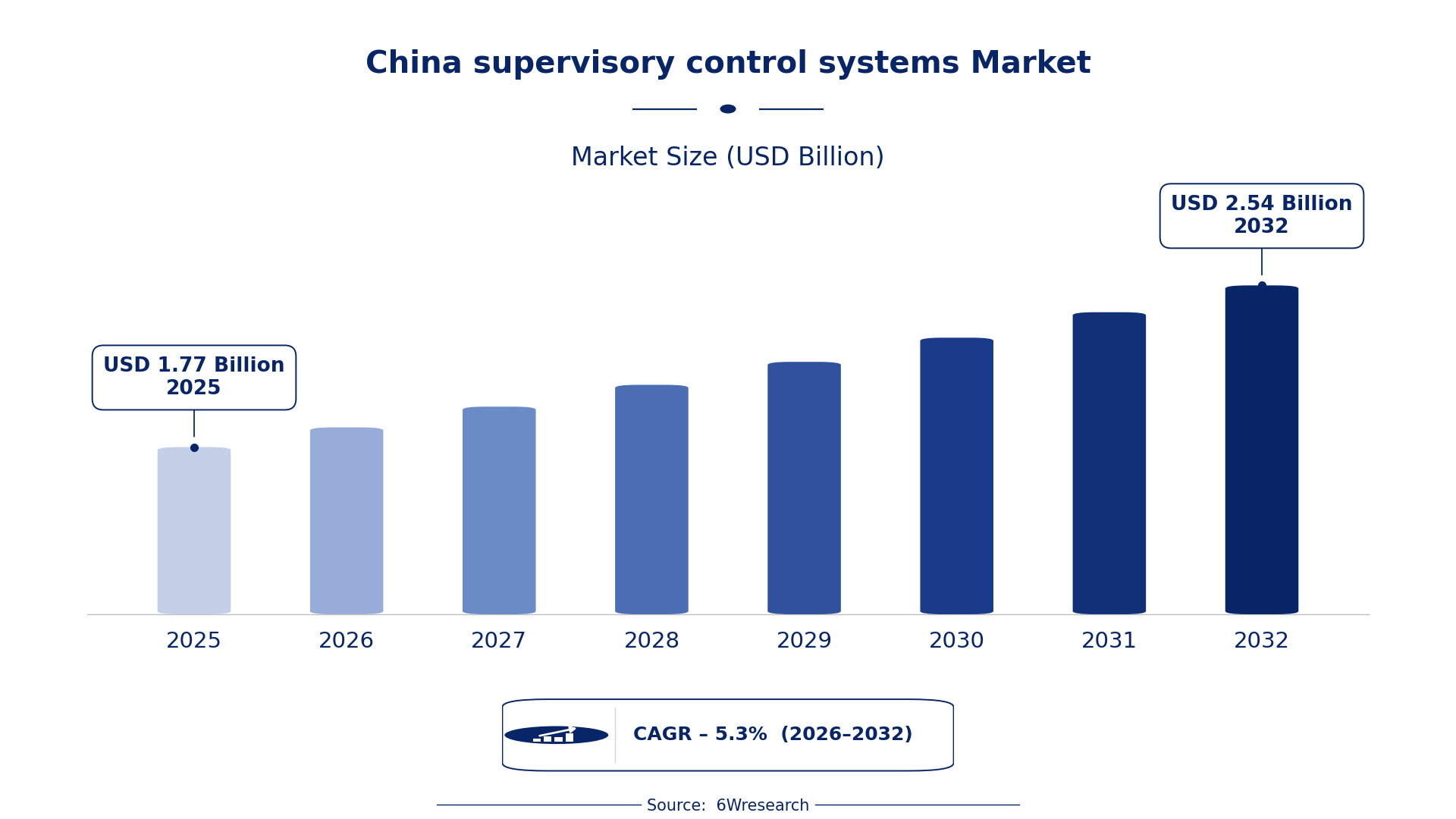
According to 6Wresearch internal database and industry insights, the China supervisory control systems Market was valued at USD 1.77 billion in 2025 and is projected to reach USD 2.54 billion by 2032, growing at a CAGR of approximately 5.3% during 2026–2032.
China supervisory control systems Market Highlights
| Report Metric | Details |
| Report Name | China supervisory control systems Market |
| Market Size 2025 | USD 1.77 billion |
| Market Size 2032 | USD 2.54 billion |
| Absolute Growth 2025–2032 | USD 0.77 billion |
| CAGR 2026–2032 | 5.3% |
| Peak Annual Growth | 7.7% in 2030 |
| Forecast Period | 2026–2032 |
| Historical Data | 2022–2025 |
| Base Year | 2025 |
| Leading System Type, 2025 | SCADA Systems (42% share) |
| Leading Architecture Type, 2025 | Centralized (43% share) |
| Leading Control Level, 2025 | Plant-Level Monitoring (41% share) |
| Leading End User, 2025 | Power Generation Units (34% share) |
| Fastest-Growing System Type | Distributed Control Systems (7.6% CAGR) |
| Fastest-Growing Architecture Type | Hierarchical (7.5% CAGR) |
| Fastest-Growing Control Level | Process Control (7.2% CAGR) |
| Fastest-Growing End User | Oil Refining Plants (7.0% CAGR) |
| Growing Sector | Oil Refining Plants |
| Key End Users | Power Generation Units, Oil Refining Plants, Industrial Automation Firms, Utility Operators |
China supervisory control systems Market Year-wise Growth Rate and Key Drivers (2022–2032)
This graph illustrates the annual growth rates of the market from 2022 to 2032, highlighting a steady upward trajectory and projected market expansion over the forecast period.
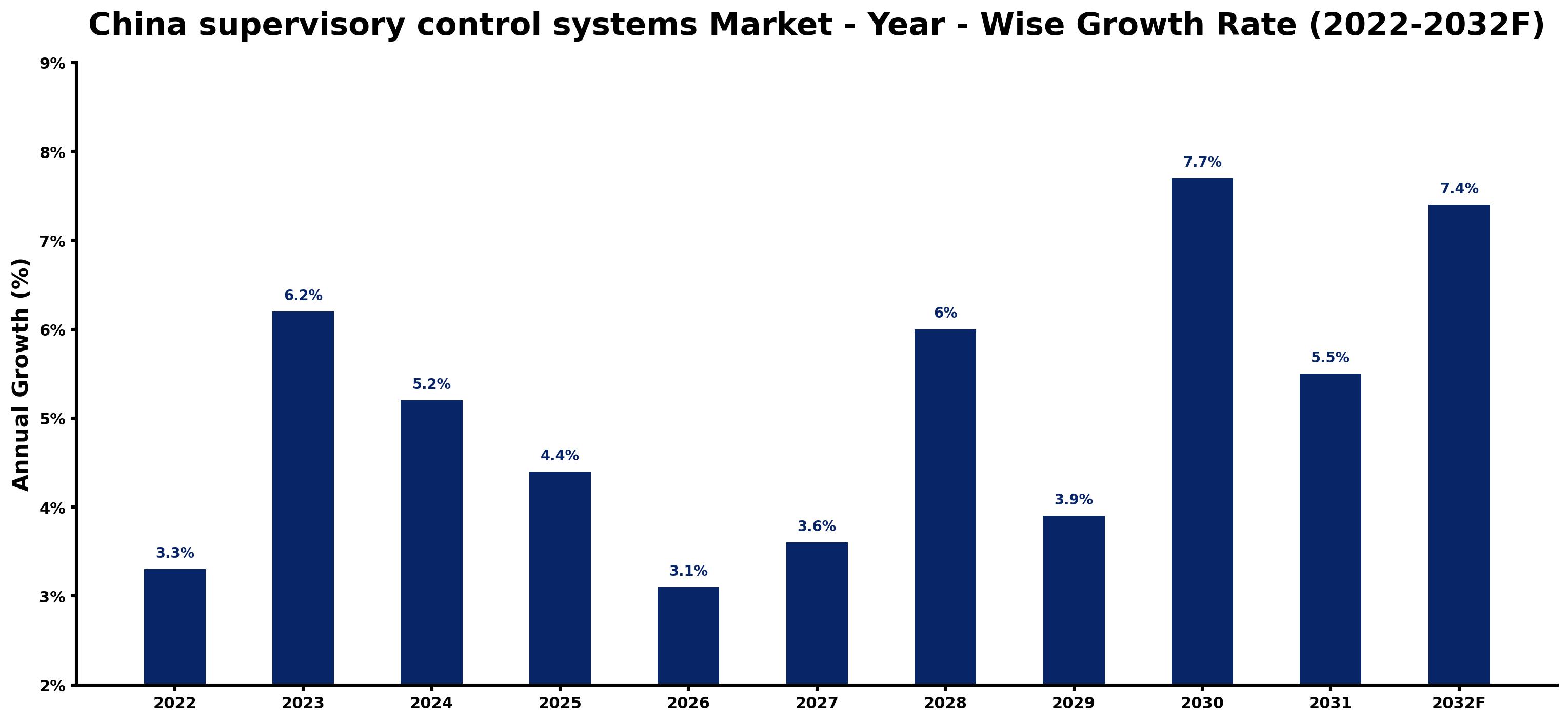
Each row of the following table gives one year's estimated growth and the event or demand shift that explains it.
| Year | Estimated Annual Growth (%) | Market Rationale |
| 2022 | 3.3 | The market showed steady activity with established demand from industrial users. |
| 2023 | 6.2 | Growth accelerated due to increased investments in energy efficiency initiatives launched by the National Energy Administration. |
| 2024 | 5.2 | The market experienced a slowdown as investments stabilised after a surge in energy efficiency projects. |
| 2025 | 4.4 | Demand continued to slow as the market adjusted to previous growth rates and energy initiatives matured. |
| 2026 | 3.1 | Growth is expected to decelerate as the market faces increased competition and saturation in the automation sector. |
| 2027 | 3.6 | An uptick in demand is projected as automation technologies gain traction in various industries. |
| 2028 | 6.0 | Growth is expected to rebound as investments in industrial automation increase, particularly in the Yangtze River Delta region. |
| 2029 | 3.9 | A slowdown is projected as market conditions normalise after rapid growth in energy efficiency initiatives. |
| 2030 | 7.7 | The market is expected to peak due to heightened investments in smart manufacturing technologies under the 'Made in China 2025' initiative. |
| 2031 | 5.5 | Growth is projected to slow as the market stabilises after reaching peak levels in automation investments. |
| 2032 | 7.4 | Demand is expected to surge again as new energy efficiency targets are introduced by the National Development and Reform Commission. |
Note: Market size estimations and growth projections presented in this report are based on 6Wresearch's proprietary forecasting methodology, utilizing the latest available industry data, government publications, and primary research inputs.
China supervisory control systems Market Synopsis
The China supervisory control systems market encompasses advanced technology solutions used for monitoring and controlling industrial processes. These systems integrate software and hardware components with various sensors, enabling real-time data acquisition and process automation. The market is expanding due to strong demand from over 1,300 power generation units and ongoing investments in industrial automation technologies. Initiatives from the National Energy Administration to promote energy efficiency further drive this growth, alongside support from the Ministry of Industry and Information Technology for smart manufacturing strategies.
Market Dynamics Impact Analysis (2026–2032)
| Factor | Type | Impact | Primary Segment Affected |
| High demand from power generation units is driving the need for reliable supervisory control systems. | Driver | High | Power Generation Units |
| The increasing focus on energy efficiency and automation technologies is creating opportunities for system upgrades. | Opportunity | High | Industrial Automation Firms |
| The rising number of oil refining plants necessitates advanced monitoring systems for operational safety. | Driver | High | Oil Refining Plants |
| The growing automotive manufacturing sector is driving demand for PLC-integrated systems. | Driver | Medium | Industrial Automation Firms |
| The complexity of integrating advanced systems can hinder adoption rates in smaller facilities. | Restraint | Medium | HMI-Based Systems |
| High initial investment costs for advanced supervisory control systems can deter potential buyers. | Restraint | High | Distributed Control Systems |
| Limited availability of skilled workers in automation technologies poses a challenge for implementation. | Challenge | High | SCADA Systems |
| The rapid pace of technological change can lead to obsolescence of existing systems. | Challenge | Medium | SCADA Systems |
Evaluation of Drivers in China supervisory control systems Market (2026–2032)
Below mentioned are some major drivers and their influence on market dynamics.
| Drivers | Primary Segment Affected | Why It Matters (Evidence) |
| Increased investments in energy efficiency initiatives drive demand for supervisory control systems. | Power Generation Units | China's National Energy Administration has launched initiatives to promote energy efficiency in power generation. |
| The growing number of oil refining plants necessitates advanced monitoring systems for operational safety. | Oil Refining Plants | Over 500 oil refining plants in China widely use HMI-based systems for critical monitoring. |
| The automotive manufacturing sector is increasingly adopting PLC-integrated systems for automation tasks. | Industrial Automation Firms | The demand for PLC-integrated systems is growing in the automotive sector. |
| The rise of smart manufacturing strategies is boosting the adoption of supervisory control systems. | SCADA Systems | The Ministry of Industry and Information Technology supports the development of smart manufacturing strategies. |
| The expansion of the industrial automation sector is driving demand for supervisory control systems. | SCADA Systems | The industrial automation sector in China employs over 1 million workers, highlighting its significance. |
In 2023, China invested 5 billion CNY in upgrading industrial automation technologies, driving further demand. The automotive manufacturing sector is increasingly adopting PLC-integrated systems for automation tasks, which boosts overall market growth. The industrial automation sector employs over 1 million workers, underscoring its importance in driving the market forward.
Evaluation of Restraints in China supervisory control systems Market
The following restraints limit how fast demand can grow.
| Market Restraint | Primary Segment Affected | Why It Matters (Evidence) |
| The complexity of integrating advanced systems can hinder adoption rates in smaller facilities. | HMI-Based Systems | Many smaller facilities struggle with the integration of complex supervisory control systems. |
| High initial investment costs for advanced supervisory control systems can deter potential buyers. | Distributed Control Systems | The cost of implementing advanced systems can be prohibitive for some industrial users. |
| Limited availability of skilled workers in automation technologies poses a challenge for implementation. | SCADA Systems | A shortage of skilled workers can delay the deployment of advanced supervisory control systems. |
| Rapid technological advancements may lead to obsolescence of existing systems. | SCADA Systems | The fast pace of innovation can make current systems outdated quickly. |
| Regulatory compliance can add additional costs and complexity to system implementation. | SCADA Systems | Compliance with safety and operational standards can complicate system upgrades. |
China supervisory control systems Market Challenges
The China supervisory control systems market faces a few practical problems, and the first is a skills shortage among producers. This gap exists because the rapid advancement of technology outpaces the training of workers, resulting in project delays that can extend timelines by up to 20%. Buyers encounter high costs due to fluctuating prices of raw materials, which can increase project budgets by 15%. Regulatory compliance presents another challenge, as updated standards from the State Administration for Market Regulation require significant adjustments, delaying product launches for distributors by several months. Technology integration issues also arise in older facilities, leading to inefficiencies that can reduce operational effectiveness for buyers by 10%.
Trends in the China supervisory control systems Market
Several trends are reshaping the China supervisory control systems Market; the most important are set out below.
- Shift towards Smart Manufacturing: Power generation units are increasingly adopting smart manufacturing practices, with 1,300 units implementing advanced supervisory control systems. This shift is driven by the need for improved efficiency and data-driven decision-making.
- Transition to Energy Efficiency: Since 2021, the National Energy Administration has promoted energy efficiency in power generation. In 2023, investments in this area reached 5 billion CNY, highlighting the growing focus on sustainable practices.
- Emergence of Advanced Monitoring Systems: The Yangtze River Delta region is becoming a hub for advanced monitoring systems, with over 20,000 SCADA units installed by 2022. This trend reflects the increasing demand for real-time data in industrial processes.
- Prioritisation of Automation Technologies: The Chinese government has launched the 'Made in China 2025' initiative, which aims to boost industrial automation. This initiative is expected to drive investments in automation technologies.
Investment Opportunities in the China supervisory control systems Market
The following opportunities in the China supervisory control systems Market pair current demand with a clear way in.
- Timing for Investment in Automation: With the government's push for smart manufacturing, now is an ideal time to invest in supervisory control systems. The Ministry of Industry and Information Technology's support for automation technologies highlights this opportunity.
- Supply of Advanced Monitoring Systems: There is a growing need for advanced monitoring systems in oil refining plants, which require reliable solutions. Suppliers can enter this market by partnering with local industrial automation firms.
- Focus on Energy Efficiency Solutions: The emphasis on energy efficiency presents an opportunity for suppliers of supervisory control systems. Collaborating with power generation units can lead to significant market penetration.
- Entry through Joint Ventures: Establishing joint ventures with local firms can facilitate entry into the supervisory control systems market. The Guangdong province's industrial base offers a strategic location for such partnerships.
Government Initiatives in the China supervisory control systems Market
The National Energy Administration launched the 'Energy Efficiency Improvement Program' in 2021 to promote advanced control systems in energy sectors. This initiative encourages the adoption of supervisory control systems to enhance operational efficiency in power generation. In 2022, the Ministry of Industry and Information Technology approved the 'Smart Manufacturing Development Plan' aimed at enhancing automation technologies. This plan supports the integration of advanced supervisory control systems across various industries, ensuring compliance with safety standards. The State Administration for Market Regulation introduced the 'Industrial Control Systems Safety Standards' in 2023 to ensure system reliability and safety for users.
The Ministry of Ecology and Environment initiated the 'Green Manufacturing Program' in 2020, promoting the use of efficient control systems in manufacturing. This program encourages manufacturers to adopt advanced supervisory control systems that meet environmental standards. The National Development and Reform Commission has outlined plans for digital transformation in manufacturing, which includes funding for automation projects. These initiatives aim to modernise production processes and improve energy efficiency. The support from these agencies ensures that buyers have access to the latest technologies and standards in supervisory control systems.
Future Insight of the China supervisory control systems Market
Several forward-looking factors should support the China supervisory control systems market over the coming years. The government's 'Made in China 2025' initiative will drive investment in automation technologies, boosting operational efficiency across sectors. By 2025, the target to reduce energy consumption per unit of GDP by 13.5% will accelerate the adoption of advanced control systems. The National Development and Reform Commission's digital transformation plans will modernise manufacturing processes, creating new opportunities for suppliers and improving competitiveness in the market.
Market Segmentation Analysis
The analysis below covers each segmentation, its leading category in 2025 and its fastest-growing category through 2032.
By System Type – SCADA Systems Dominated, Distributed Control Systems Expected to Grow Fastest
According to Sumit Sagar, AM at 6Wresearch, SCADA Systems held a 42% share of the China supervisory control systems Market by system type in 2025. SCADA systems dominate the market due to their extensive use for real-time monitoring and control, particularly in power generation, where over 1,300 units are operational. The installed base of approximately 20,000 units highlights their critical importance in maintaining operational efficiency across various sectors. The quickest growth will come from Distributed Control Systems, forecast to expand at a CAGR of 7.6% between 2026 and 2032. The growth of distributed control systems is propelled by their necessity in large-scale industrial operations that demand decentralised control. This trend is particularly evident in the energy sector, where the installed base reached 15,000 units in 2023, indicating a robust demand for these systems. Suppliers should focus on enhancing SCADA systems while also addressing the increasing demand for distributed control solutions.
By Architecture Type – Centralized Dominated, Hierarchical Expected to Grow Fastest
The largest architecture type category in 2025 was Centralized, with a 43% share of total revenue. Centralised architecture leads the market as it effectively supports facilities that require unified monitoring and control across operations. This is particularly advantageous in large manufacturing plants, where streamlined oversight is essential for productivity and operational efficiency. Hierarchical is set to record the highest CAGR in this split, 7.5% over 2026–2032. Hierarchical architecture is growing swiftly because it enables structured control across multiple operational levels, improving coordination and efficiency. This growth is especially relevant in complex industrial settings where layered management is vital for optimal performance. Suppliers must consider expanding their product lines to include hierarchical systems to meet the rising demand for structured control solutions.
By Control Level – Plant-Level Monitoring Dominated, Process Control Expected to Grow Fastest
Plant-Level Monitoring took a 41% share of control level in 2025, more than any other category. Plant-level monitoring is the leading segment, crucial for overseeing entire plant operations and ensuring optimal performance across all processes. This comprehensive approach is particularly important in industries like power generation, where efficiency and reliability are critical. Process Control is projected to grow fastest, at a CAGR of 7.2% during 2026–2032. Process control is rapidly expanding as it is essential for maintaining optimal conditions and efficiency in industrial processes. The increasing emphasis on operational excellence drives the demand for advanced process control systems, marking them as a key investment area. This indicates that suppliers should enhance their process control offerings to align with the growing expectations for operational efficiency across various industries.
By End User – Power Generation Units Dominated, Oil Refining Plants Expected to Grow Fastest
In 2025, Power Generation Units led the end user split with a 34% share. Power generation units represent the largest end-user group, necessitating reliable monitoring and control systems to manage their extensive operations effectively. The substantial number of power generation units in China underscores their ongoing demand for supervisory control systems. Over 2026–2032, Oil Refining Plants are expected to post the fastest growth, at a CAGR of 7.0%. Oil refining plants are experiencing the fastest growth as they increasingly implement supervisory control systems to ensure operational safety and efficiency. This trend is driven by the need for stringent monitoring in refining processes, which is essential for maintaining safety standards. This highlights the necessity for suppliers to tailor their solutions to meet the specific requirements of oil refining plants, ensuring both safety and efficiency.
Key Attractiveness of the Report
- 10 Years of Market Numbers
- Historical Data Starting from 2022 to 2025
- Base Year 2025
- Forecast Data until 2032
- Key Performance Indicators Impacting the Market
- Major Upcoming Developments and Projects
Key Highlights of the Report:
- China supervisory control systems Market Outlook
- Market Size of China supervisory control systems Market, 2025
- Forecast of China supervisory control systems Market, 2032
- Historical Data and Forecast of China supervisory control systems Revenues & Volume for the Period 2022 - 2032F
- China supervisory control systems Market Trend Evolution
- China supervisory control systems Market Drivers and Challenges
- China supervisory control systems Price Trends
- China supervisory control systems Porter's Five Forces
- China supervisory control systems Industry Life Cycle
- Historical Data and Forecast of China supervisory control systems Market Revenues & Volume By System Type for the Period 2022 - 2032F
- Historical Data and Forecast of China supervisory control systems Market Revenues & Volume By SCADA Systems for the Period 2022 - 2032F
- Historical Data and Forecast of China supervisory control systems Market Revenues & Volume By Distributed Control Systems for the Period 2022 - 2032F
- Historical Data and Forecast of China supervisory control systems Market Revenues & Volume By HMI-Based Systems for the Period 2022 - 2032F
- Historical Data and Forecast of China supervisory control systems Market Revenues & Volume By PLC-Integrated Systems for the Period 2022 - 2032F
- Historical Data and Forecast of China supervisory control systems Market Revenues & Volume By Architecture Type for the Period 2022 - 2032F
- Historical Data and Forecast of China supervisory control systems Market Revenues & Volume By Centralized for the Period 2022 - 2032F
- Historical Data and Forecast of China supervisory control systems Market Revenues & Volume By Hierarchical for the Period 2022 - 2032F
- Historical Data and Forecast of China supervisory control systems Market Revenues & Volume By Visual Interface for the Period 2022 - 2032F
- Historical Data and Forecast of China supervisory control systems Market Revenues & Volume By Modular for the Period 2022 - 2032F
- Historical Data and Forecast of China supervisory control systems Market Revenues & Volume By Control Level for the Period 2022 - 2032F
- Historical Data and Forecast of China supervisory control systems Market Revenues & Volume By Plant-Level Monitoring for the Period 2022 - 2032F
- Historical Data and Forecast of China supervisory control systems Market Revenues & Volume By Process Control for the Period 2022 - 2032F
- Historical Data and Forecast of China supervisory control systems Market Revenues & Volume By Operator Control for the Period 2022 - 2032F
- Historical Data and Forecast of China supervisory control systems Market Revenues & Volume By Equipment-Level Management for the Period 2022 - 2032F
- Historical Data and Forecast of China supervisory control systems Market Revenues & Volume By End User for the Period 2022 - 2032F
- Historical Data and Forecast of China supervisory control systems Market Revenues & Volume By Power Generation Units for the Period 2022 - 2032F
- Historical Data and Forecast of China supervisory control systems Market Revenues & Volume By Oil Refining Plants for the Period 2022 - 2032F
- Historical Data and Forecast of China supervisory control systems Market Revenues & Volume By Industrial Automation Firms for the Period 2022 - 2032F
- Historical Data and Forecast of China supervisory control systems Market Revenues & Volume By Utility Operators for the Period 2022 - 2032F
- China supervisory control systems Import Export Trade Statistics
- Market Opportunity Assessment By System Type
- Market Opportunity Assessment By Architecture Type
- Market Opportunity Assessment By Control Level
- Market Opportunity Assessment By End User
- China supervisory control systems Top Companies Market Share
- China supervisory control systems Competitive Benchmarking By Technical and Operational Parameters
- China supervisory control systems Company Profiles
- China supervisory control systems Key Strategic Recommendations
Market Covered
The report offers an extensive study of the following market segments.
By System Type
- SCADA Systems
- Distributed Control Systems
- HMI-Based Systems
- PLC-Integrated Systems
By Architecture Type
- Centralized
- Hierarchical
- Visual Interface
- Modular
By Control Level
- Plant-Level Monitoring
- Process Control
- Operator Control
- Equipment-Level Management
By End User
- Power Generation Units
- Oil Refining Plants
- Industrial Automation Firms
- Utility Operators































