India Supply chain e-solutions Market Size & Growth Rate
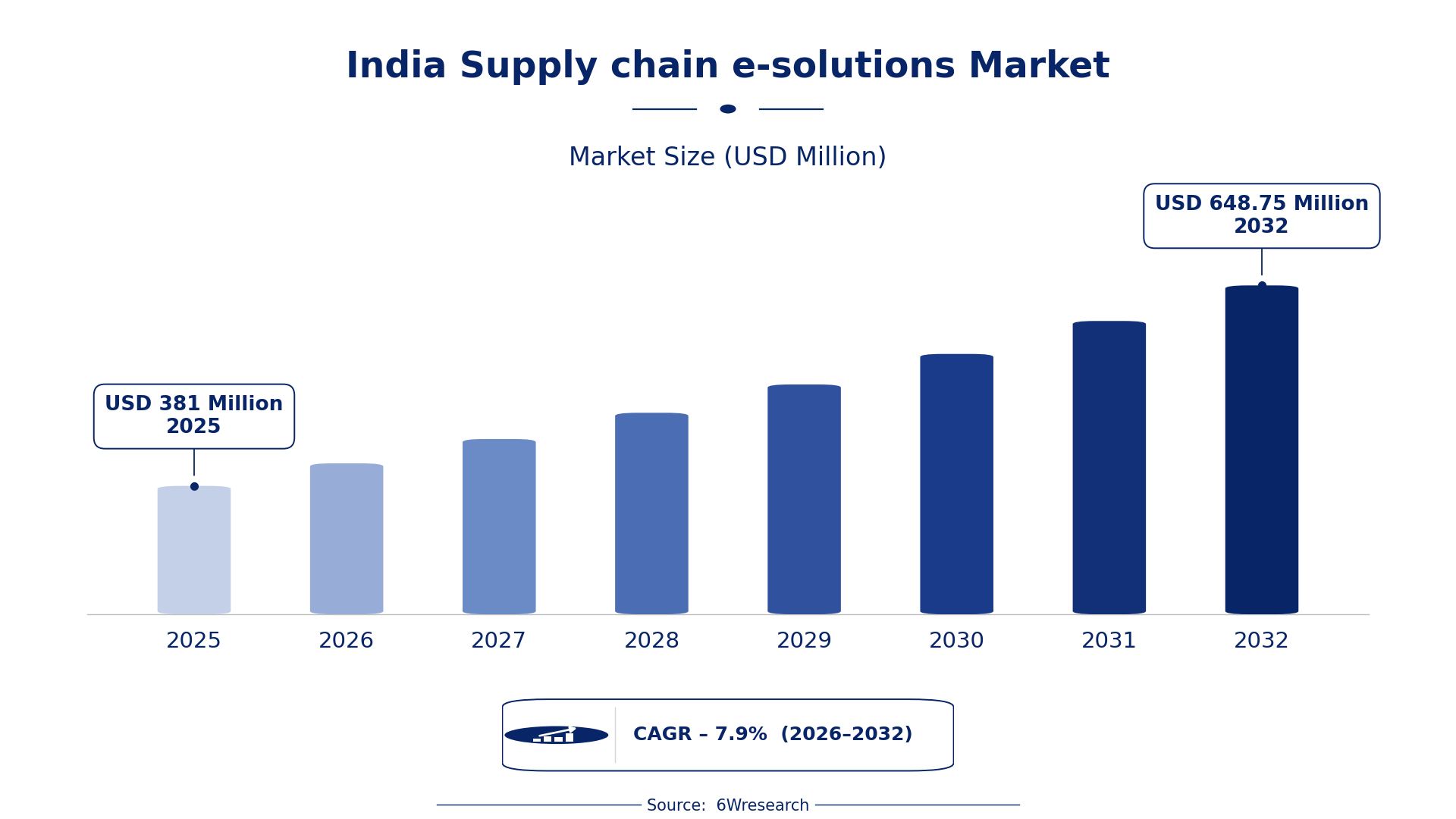
According to 6Wresearch internal database and industry insights, the India Supply chain e-solutions Market was valued at USD 381.0 million in 2025 and is projected to reach USD 648.75 million by 2032, growing at a CAGR of approximately 7.9% during 2026–2032.
India Supply chain e-solutions Market Highlights
| Report Metric | Details |
| Report Name | India Supply chain e-solutions Market |
| Market Size 2025 | USD 381.0 million |
| Market Size 2032 | USD 648.75 million |
| Absolute Growth 2025–2032 | USD 267.75 million |
| CAGR 2026–2032 | 7.9% |
| Peak Annual Growth | 10.0% in 2029 |
| Forecast Period | 2026–2032 |
| Historical Data | 2022–2025 |
| Base Year | 2025 |
| Leading Solution Type, 2025 | Demand Forecasting (33% share) |
| Leading Delivery Mode, 2025 | SaaS (52% share) |
| Leading Integration Scope, 2025 | Real-Time Tracking (47% share) |
| Leading End User, 2025 | Retailers (53% share) |
| Fastest-Growing Delivery Mode | AI-Driven (9.3% CAGR) |
| Fastest-Growing Integration Scope | End-to-End Planning (9.1% CAGR) |
| Fastest-Growing End User | FMCG Companies (9.2% CAGR) |
| Growing Sector | Retail |
| Key End Users | Retailers, FMCG Companies, 3PL Providers, Manufacturing Firms |
India Supply chain e-solutions Market Year-wise Growth Rate and Key Drivers (2022–2032)
This graph illustrates the annual growth rates of the market from 2022 to 2032, highlighting a steady upward trajectory and projected market expansion over the forecast period.
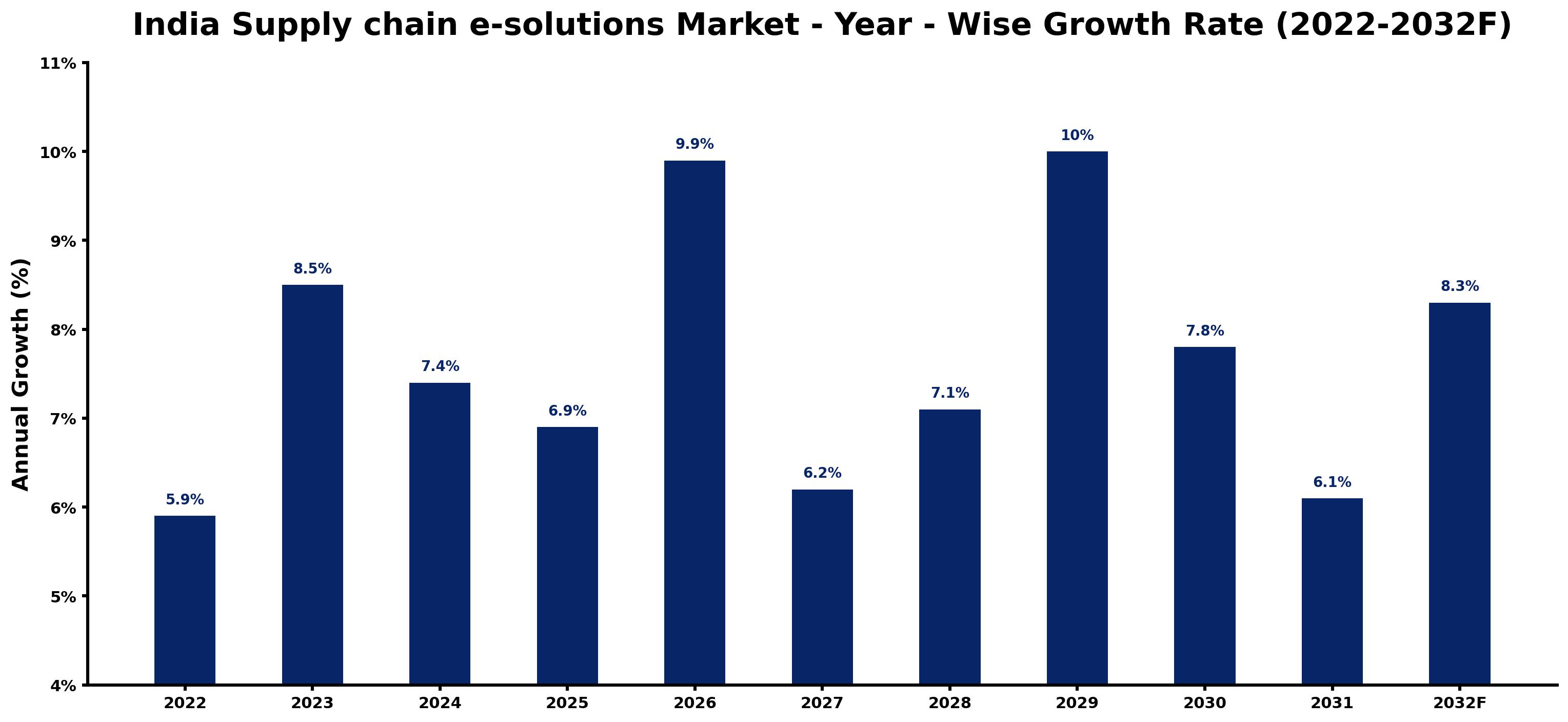
Year by year, the estimates below pair each growth rate with the development that shaped it.
| Year | Estimated Annual Growth (%) | Market Rationale |
| 2022 | 5.9 | The market experienced steady growth, driven by increasing technology adoption across sectors. |
| 2023 | 8.5 | Demand surged as the retail market expanded, reaching a projected size of $1.3 trillion by 2025. |
| 2024 | 7.4 | Growth slowed as companies adjusted to new digital supply chain technologies and their implementation. |
| 2025 | 6.9 | Continued investment in supply chain e-solutions supported ongoing growth despite a slight slowdown. |
| 2026 | 9.9 | A rise in technology adoption in logistics propelled growth as more firms sought efficiency. |
| 2027 | 6.2 | Growth decelerated as companies faced challenges in integrating advanced solutions into existing systems. |
| 2028 | 7.1 | Demand increased as firms recognised the value of real-time tracking for logistics management. |
| 2029 | 10.0 | The market peaked due to heightened investments in AI-driven solutions across various sectors. |
| 2030 | 7.8 | Growth moderated as firms focused on optimising existing technology rather than new investments. |
| 2031 | 6.1 | The market continued to grow as manufacturers increasingly adopted supply chain e-solutions. |
| 2032 | 8.3 | Demand is expected to rise as the FMCG sector expands, driving further investments in supply chain technologies. |
Note: Market size estimations and growth projections presented in this report are based on 6Wresearch's proprietary forecasting methodology, utilizing the latest available industry data, government publications, and primary research inputs.
India Supply chain e-solutions Market Synopsis
Supply chain e-solutions in India encompass software and technology that optimise logistics, inventory management, and procurement processes. These solutions leverage cloud computing and AI to improve operational efficiency and reduce costs. The India Supply Chain E-solutions Market is expanding due to rising domestic demand from sectors like retail and manufacturing, alongside increased investments in digital technologies. The retail market's anticipated growth to $1.3 trillion by 2025 further stimulates this demand. Additionally, over 90% of Indian FMCG companies are investing in these technologies, highlighting strong market potential.
Market Dynamics Impact Analysis (2026–2032)
| Factor | Type | Impact | Primary Segment Affected |
| Increasing investment in digital technologies | Driver | High | SaaS |
| Growing demand for real-time tracking solutions | Driver | High | Real-Time Tracking |
| Rising need for efficient inventory management | Opportunity | High | Inventory Management |
| Expanding retail market driving technology adoption | Opportunity | High | Retailers |
| High logistics costs limiting profitability | Restraint | High | Transportation Software |
| Challenges in technology integration slowing adoption | Restraint | Medium | Procurement Solutions |
| Supply chain e-solutions market in India faces integration challenges | Challenge | High | AI-Driven |
| Limited skilled workforce hindering technology implementation | Challenge | Medium | Cloud-Based |
Evaluation of Drivers in India Supply chain e-solutions Market (2026–2032)
The factors lifting demand, and the evidence behind each, are summarised below.
| Drivers | Primary Segment Affected | Why It Matters (Evidence) |
| Investment in digital supply chain technologies | SaaS | Over 90% of Indian FMCG companies are investing in digital supply chain technologies, increasing demand for flexible solutions. |
| Demand for real-time tracking solutions | Real-Time Tracking | Logistics costs in India are approximately 13-15% of GDP, prompting firms to seek visibility and accountability. |
| Growth in the retail sector | Transportation Software | The retail market is expected to grow to $1.3 trillion by 2025, driving demand for efficient logistics solutions. |
| Need for streamlined logistics processes | AI-Driven | The National Logistics Policy aims to improve logistics efficiency, encouraging firms to adopt advanced technologies. |
| Adoption of end-to-end planning solutions | Procurement Solutions | Approximately 70% of Indian manufacturers are using some form of supply chain e-solutions, improving operational efficiency. |
Expansion of the Supply chain e-solutions market in India is backed by significant investments in digital technologies and a growing retail sector. The retail market is expected to grow to $1.3 trillion by 2025, driving demand for efficient logistics solutions. As logistics costs account for approximately 13-15% of GDP, firms are increasingly adopting real-time tracking solutions to improve visibility. Over 90% of FMCG companies are investing in digital supply chain technologies, which boosts the need for SaaS and AI-driven solutions. This trend will continue as many manufacturers adopt these technologies to improve their operational capabilities.
Evaluation of Restraints in India Supply chain e-solutions Market
The main factors holding the market back are set out below.
| Market Restraint | Primary Segment Affected | Why It Matters (Evidence) |
| High logistics costs impacting profitability | Transportation Software | Logistics costs in India are approximately 13-15% of GDP, limiting the ability of firms to invest in new technologies. |
| Integration challenges with existing systems | AI-Driven | Many firms struggle to integrate AI-driven solutions into their existing supply chain processes, delaying adoption. |
| Limited skilled workforce for technology implementation | Cloud-Based | A shortage of skilled professionals in supply chain management hampers the effective use of advanced technologies. |
| Regulatory complexities slowing adoption | Procurement Solutions | Navigating regulations can be challenging for firms, which may hinder the swift implementation of new solutions. |
| Resistance to change within organisations | SaaS | Some companies are hesitant to transition to digital solutions, preferring traditional methods that may be less efficient. |
India Supply chain e-solutions Market Challenges
The India Supply chain e-solutions market faces a considerable challenge with supply chain fragmentation, as over 70% of manufacturers struggle to integrate diverse technologies, leading to inefficiencies for producers. Regulatory hurdles complicate the swift adoption of digital solutions, with compliance to standards like ISO 28000 causing delays of several months for suppliers. High logistics costs, which represent approximately 13-15% of GDP, impose financial burdens on buyers, limiting their investments in advanced supply chain technologies. A shortage of digital skills restricts the growth potential of e-solutions, hindering smaller firms from leveraging these innovations effectively.
Trends in the India Supply chain e-solutions Market
The trends below show where the India Supply chain e-solutions Market is heading.
- Shift from Traditional to Digital Supply Chain Solutions: Since 2020, many retailers have moved towards digital supply chain solutions to improve efficiency. Over 90% of Indian FMCG companies are investing in these technologies, reflecting a notable industry shift.
- Emergence of AI-Driven Logistics: In 2023, AI-driven solutions gained traction among logistics providers, with many firms adopting these technologies. Approximately 70% of manufacturers are now using AI for predictive analytics, improving operational efficiency.
- Focus on Real-Time Tracking: Retailers are increasingly adopting real-time tracking solutions to improve supply chain visibility. This trend is evidenced by the 47% market share held by real-time tracking solutions in 2025.
- Growth of End-to-End Planning Solutions: The demand for end-to-end planning solutions has surged, particularly among FMCG companies. This segment is expected to grow at a CAGR of 9.1% from 2026 to 2032, indicating strong market potential.
Investment Opportunities in the India Supply chain e-solutions Market
Below are the investment opportunities with the strongest case in the India Supply chain e-solutions Market.
- FMCG Companies Seeking Efficient Solutions: FMCG companies are increasingly looking for efficient supply chain solutions to manage fast-moving products. With over 90% investing in digital technologies, this presents a strong opportunity for suppliers.
- Retailers Expanding Technology Adoption: Retailers are focusing on adopting advanced supply chain technologies to optimise inventory management. The projected growth of the retail market to $1.3 trillion by 2025 creates a ripe opportunity for investment.
- Demand for AI-Driven Solutions: The growing demand for AI-driven solutions in logistics presents an opportunity for suppliers. With the Ministry of Electronics and Information Technology promoting these technologies, firms can benefit from local partnerships.
- Need for Improved Real-Time Tracking Capabilities: The need for improved real-time tracking solutions is rising among logistics providers. Investing in innovative tracking technologies can help companies meet increasing customer expectations.
Government Initiatives in the India Supply chain e-solutions Market
The 'National Logistics Policy' launched in 2021 aims to improve logistics efficiency and reduce costs across the supply chain. This policy encourages firms to adopt advanced technologies and streamline processes, benefiting buyers by improving service delivery. Additionally, the updated 'Digital India Programme' in 2022 allocated ₹1,500 crores to support digitalisation in supply chains, enabling companies to access funding for technology adoption. These measures aim to boost the overall efficiency of supply chain operations in India.
The Ministry of Commerce and Industry oversees the implementation of the 'National Logistics Policy', which funds projects aimed at improving logistics infrastructure. The 'Atmanirbhar Bharat' initiative supports local manufacturing and supply chain resilience, providing resources for firms to enhance their operational capabilities. Furthermore, the Ministry of Electronics and Information Technology promotes AI-driven solutions in logistics, facilitating approvals for technology integration in supply chains. These initiatives empower buyers to adopt advanced solutions and improve their supply chain management.
Future Insight of the India Supply chain e-solutions Market
The India Supply chain e-solutions market is set for substantial evolution by 2032, driven by the government's Digital India initiative, which promotes technology adoption across sectors. Improved logistics frameworks from the National Logistics Policy will facilitate smoother operations, positively impacting both buyers and suppliers. As more firms invest in digital technologies, this will elevate the market's operational capabilities and enhance overall competitiveness.
Market Segmentation Analysis
Each segment group is reviewed below, with the leader by share and the fastest grower by CAGR.
By Solution Type – Demand Forecasting Dominated and Is Expected to Record the Fastest Growth
According to Sumit Sagar, AM at 6Wresearch, Demand Forecasting accounted for a 33% market share by solution type in 2025. Demand forecasting leads the Indian supply chain e-solutions market due to its essential role in accurately predicting customer needs and managing supply effectively. This is vital as the retail market is projected to reach $1.3 trillion by 2025, creating a significant demand for precise forecasting tools. The same category is also set to grow fastest, at a CAGR of 9.5% during 2026–2032. The rapid growth of demand forecasting is driven by the increasing investment in digital supply chain technologies, with over 90% of Indian FMCG companies committing to these solutions as of 2023. This trend indicates that the segment's lead will continue to expand as firms seek enhanced operational efficiency. Suppliers should focus on developing advanced demand forecasting tools to meet the rising needs of businesses in India.
By Delivery Mode – SaaS Dominated, AI-Driven Expected to Grow Fastest
The largest delivery mode category in 2025 was SaaS, with a 52% share of total revenue. SaaS holds the largest market share due to its flexibility and cost-effectiveness, making it a preferred choice for many companies in India. Its widespread adoption aligns with the growing demand for scalable supply chain e-solutions across various sectors, ensuring accessibility for businesses of all sizes. AI-Driven is set to record the highest CAGR in this split, 9.3% over 2026–2032. AI-driven solutions are experiencing the fastest growth as they offer predictive analytics and automation capabilities that significantly enhance operational efficiency. As businesses increasingly recognise the benefits of these advanced technologies, the gap between SaaS and AI-driven solutions is expected to narrow further. Buyers should consider integrating AI-driven solutions to leverage predictive capabilities and improve supply chain performance.
By Integration Scope – Real-Time Tracking Dominated, End-to-End Planning Expected to Grow Fastest
Real-Time Tracking held a 47% share of the India Supply chain e-solutions Market by integration scope in 2025. Real-time tracking captures the largest market share, as it is crucial for visibility and accountability in logistics operations. This capability is essential for companies aiming to optimise their supply chain processes, especially given that logistics costs in India account for approximately 13-15% of GDP. The quickest growth will come from End-to-End Planning, forecast to expand at a CAGR of 9.1% between 2026 and 2032. End-to-end planning is the fastest-growing segment, driven by the need for comprehensive management of supply chains. As businesses increasingly seek to streamline operations and boost efficiency, the demand for integrated planning solutions is expected to rise significantly. Suppliers must prioritise the development of end-to-end planning solutions to meet the changing requirements of supply chain management.
By End User – Retailers Dominated, FMCG Companies Expected to Grow Fastest
In 2025, Retailers led the end user split with a 53% share. Retailers dominate the market share as the primary users of supply chain solutions, particularly for inventory and logistics management. Their substantial presence in the Indian market, supported by the anticipated growth of the retail sector, underscores the critical role of these solutions in their operations. Over 2026–2032, FMCG Companies are expected to post the fastest growth, at a CAGR of 9.2%. FMCG companies are witnessing the fastest growth in the adoption of supply chain e-solutions, as they heavily rely on efficient supply chains for their fast-moving products. This trend highlights the urgent need for these companies to invest in advanced supply chain technologies to remain competitive. Suppliers should tailor their offerings to meet the specific needs of FMCG companies, ensuring they remain competitive in the market.
Key Attractiveness of the Report
- 10 Years of Market Numbers
- Historical Data Starting from 2022 to 2025
- Base Year 2025
- Forecast Data until 2032
- Key Performance Indicators Impacting the Market
- Major Upcoming Developments and Projects
Key Highlights of the Report:
- India Supply chain e-solutions Market Outlook
- Market Size of India Supply chain e-solutions Market, 2025
- Forecast of India Supply chain e-solutions Market, 2032
- Historical Data and Forecast of India Supply chain e-solutions Revenues & Volume for the Period 2022 - 2032F
- India Supply chain e-solutions Market Trend Evolution
- India Supply chain e-solutions Market Drivers and Challenges
- India Supply chain e-solutions Price Trends
- India Supply chain e-solutions Porter's Five Forces
- India Supply chain e-solutions Industry Life Cycle
- Historical Data and Forecast of India Supply chain e-solutions Market Revenues & Volume By Solution Type for the Period 2022 - 2032F
- Historical Data and Forecast of India Supply chain e-solutions Market Revenues & Volume By Inventory Management for the Period 2022 - 2032F
- Historical Data and Forecast of India Supply chain e-solutions Market Revenues & Volume By Demand Forecasting for the Period 2022 - 2032F
- Historical Data and Forecast of India Supply chain e-solutions Market Revenues & Volume By Transportation Software for the Period 2022 - 2032F
- Historical Data and Forecast of India Supply chain e-solutions Market Revenues & Volume By Procurement Solutions for the Period 2022 - 2032F
- Historical Data and Forecast of India Supply chain e-solutions Market Revenues & Volume By Delivery Mode for the Period 2022 - 2032F
- Historical Data and Forecast of India Supply chain e-solutions Market Revenues & Volume By SaaS for the Period 2022 - 2032F
- Historical Data and Forecast of India Supply chain e-solutions Market Revenues & Volume By AI-Driven for the Period 2022 - 2032F
- Historical Data and Forecast of India Supply chain e-solutions Market Revenues & Volume By Cloud-Based for the Period 2022 - 2032F
- Historical Data and Forecast of India Supply chain e-solutions Market Revenues & Volume By Web Platform for the Period 2022 - 2032F
- Historical Data and Forecast of India Supply chain e-solutions Market Revenues & Volume By Integration Scope for the Period 2022 - 2032F
- Historical Data and Forecast of India Supply chain e-solutions Market Revenues & Volume By Real-Time Tracking for the Period 2022 - 2032F
- Historical Data and Forecast of India Supply chain e-solutions Market Revenues & Volume By End-to-End Planning for the Period 2022 - 2032F
- Historical Data and Forecast of India Supply chain e-solutions Market Revenues & Volume By Logistics Integration for the Period 2022 - 2032F
- Historical Data and Forecast of India Supply chain e-solutions Market Revenues & Volume By Supplier Coordination for the Period 2022 - 2032F
- Historical Data and Forecast of India Supply chain e-solutions Market Revenues & Volume By End User for the Period 2022 - 2032F
- Historical Data and Forecast of India Supply chain e-solutions Market Revenues & Volume By Retailers for the Period 2022 - 2032F
- Historical Data and Forecast of India Supply chain e-solutions Market Revenues & Volume By FMCG Companies for the Period 2022 - 2032F
- Historical Data and Forecast of India Supply chain e-solutions Market Revenues & Volume By 3PL Providers for the Period 2022 - 2032F
- Historical Data and Forecast of India Supply chain e-solutions Market Revenues & Volume By Manufacturing Firms for the Period 2022 - 2032F
- India Supply chain e-solutions Import Export Trade Statistics
- Market Opportunity Assessment By Solution Type
- Market Opportunity Assessment By Delivery Mode
- Market Opportunity Assessment By Integration Scope
- Market Opportunity Assessment By End User
- India Supply chain e-solutions Top Companies Market Share
- India Supply chain e-solutions Competitive Benchmarking By Technical and Operational Parameters
- India Supply chain e-solutions Company Profiles
- India Supply chain e-solutions Key Strategic Recommendations
Market Covered
The report offers an extensive study of the following market segments.
By Solution Type
- Inventory Management
- Demand Forecasting
- Transportation Software
- Procurement Solutions
By Delivery Mode
- SaaS
- AI-Driven
- Cloud-Based
- Web Platform
By Integration Scope
- Real-Time Tracking
- End-to-End Planning
- Logistics Integration
- Supplier Coordination
By End User
- Retailers
- FMCG Companies
- 3PL Providers
- Manufacturing Firms































