China Supply chain e-solutions Market Size & Growth Rate
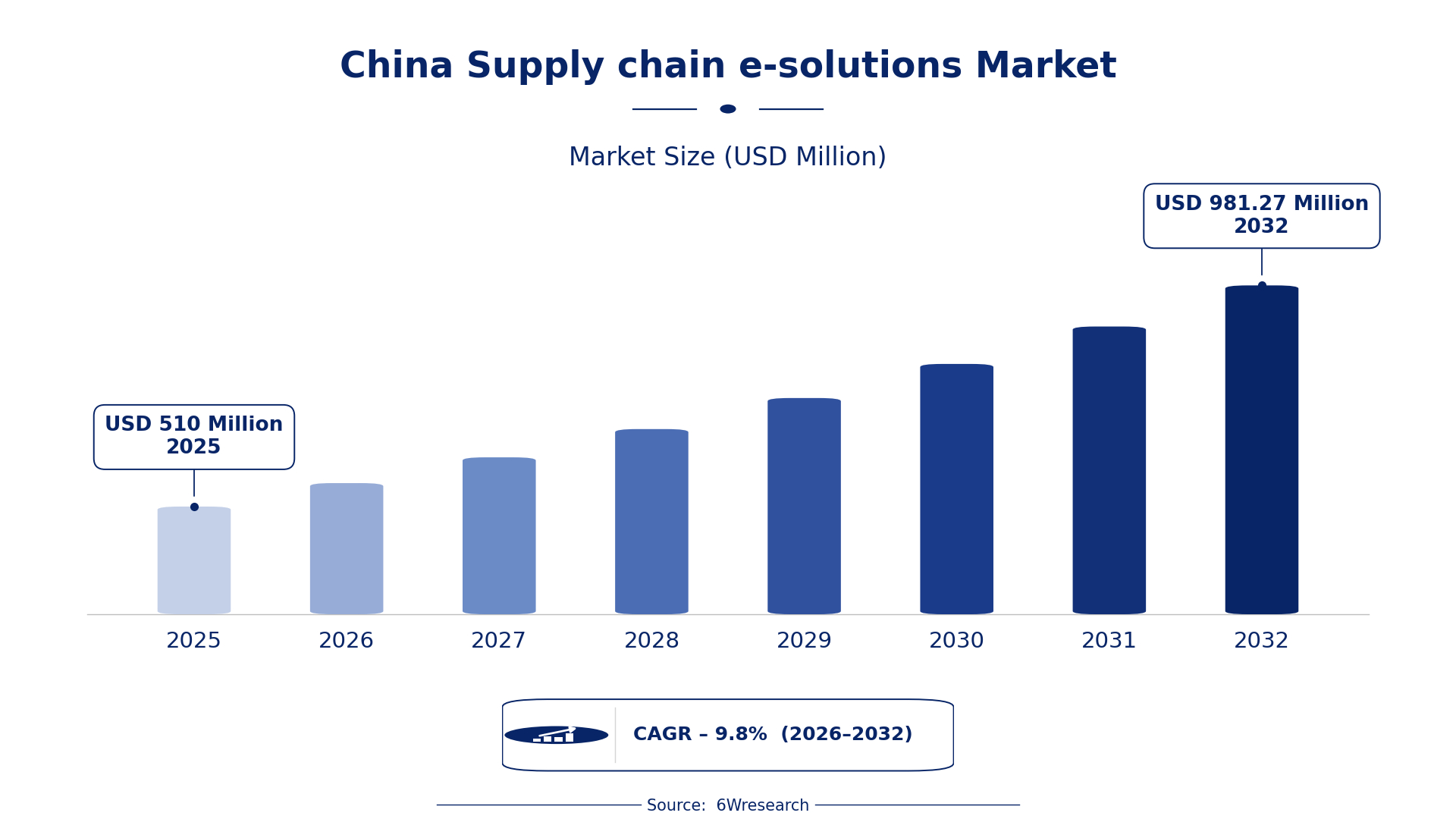
According to 6Wresearch internal database and industry insights, the China Supply chain e-solutions Market was valued at USD 510.0 million in 2025 and is projected to reach USD 981.27 million by 2032, growing at a CAGR of approximately 9.8% during 2026–2032.
China Supply chain e-solutions Market Highlights
| Report Metric | Details |
| Report Name | China Supply chain e-solutions Market |
| Market Size 2025 | USD 510.0 million |
| Market Size 2032 | USD 981.27 million |
| Absolute Growth 2025–2032 | USD 471.27 million |
| CAGR 2026–2032 | 9.8% |
| Peak Annual Growth | 11.9% in 2030 |
| Forecast Period | 2026–2032 |
| Historical Data | 2022–2025 |
| Base Year | 2025 |
| Leading Solution Type, 2025 | Inventory Management (46% share) |
| Leading Delivery Mode, 2025 | SaaS (41% share) |
| Leading Integration Scope, 2025 | Real-Time Tracking (42% share) |
| Leading End User, 2025 | Retailers (46% share) |
| Fastest-Growing Solution Type | Demand Forecasting (12.0% CAGR) |
| Fastest-Growing Delivery Mode | AI-Driven (11.7% CAGR) |
| Fastest-Growing Integration Scope | End-to-End Planning (11.5% CAGR) |
| Fastest-Growing End User | FMCG Companies (12.1% CAGR) |
| Growing Sector | E-commerce |
| Key End Users | Retailers, FMCG Companies, 3PL Providers, Manufacturing Firms |
China Supply chain e-solutions Market Year-wise Growth Rate and Key Drivers (2022–2032)
This graph illustrates the annual growth rates of the market from 2022 to 2032, highlighting a steady upward trajectory and projected market expansion over the forecast period.
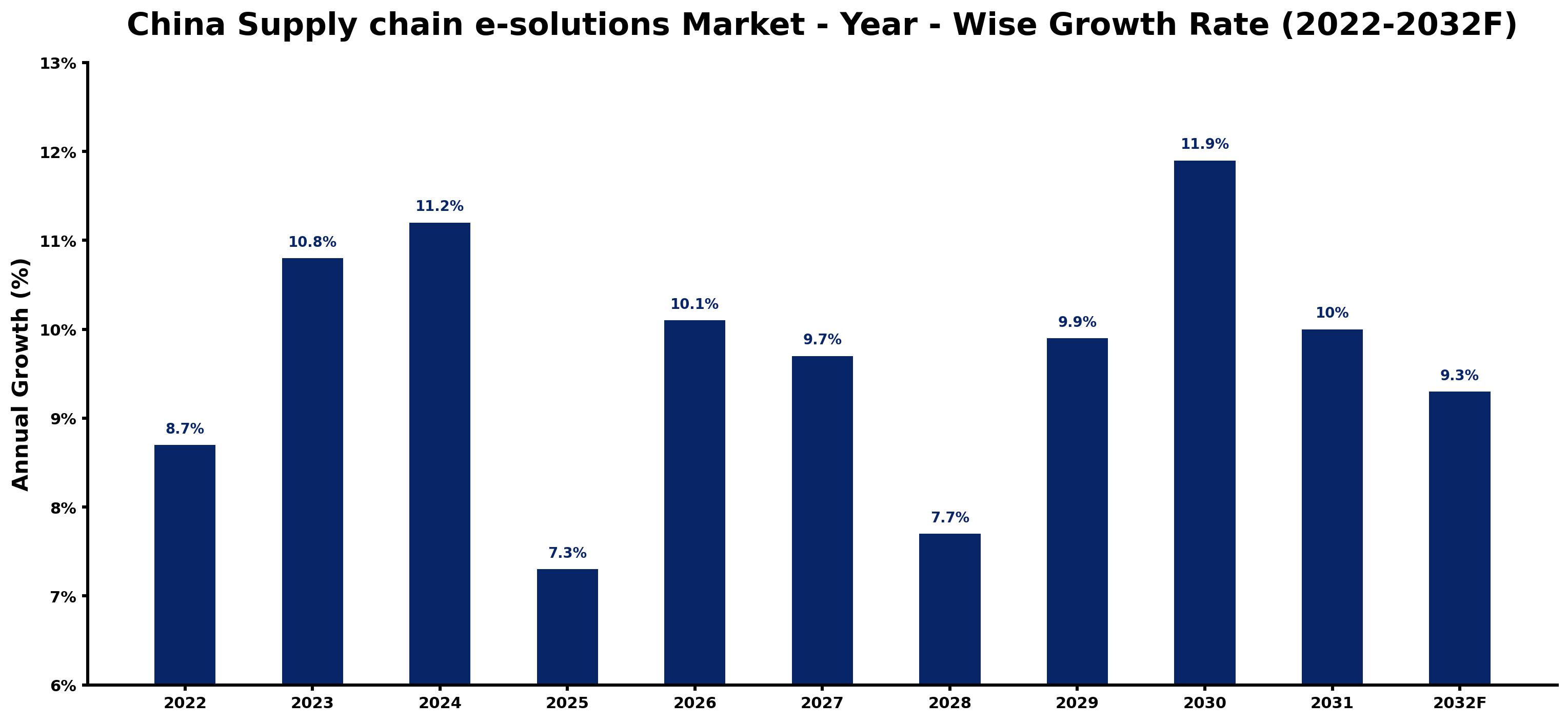
The following table presents the estimated annual growth rate for each year together with the principal factor influencing market performance.
| Year | Estimated Annual Growth (%) | Market Rationale |
| 2022 | 8.7 | The market showed strong growth due to increased e-commerce activities. |
| 2023 | 10.8 | Demand surged as more retailers adopted advanced supply chain solutions. |
| 2024 | 11.2 | Growth accelerated with the implementation of the 'Digital Supply Chain Development Plan'. |
| 2025 | 7.3 | A slight slowdown occurred as the market adjusted to new technologies. |
| 2026 | 10.1 | Demand increased again as logistics efficiency became a priority. |
| 2027 | 9.7 | Growth slowed as the market began to stabilise after rapid expansion. |
| 2028 | 7.7 | Continued demand for digital solutions contributed to a further slowdown. |
| 2029 | 9.9 | Growth picked up as more companies integrated AI-driven solutions. |
| 2030 | 11.9 | The market peaked with heightened investments in supply chain technologies. |
| 2031 | 10.0 | A slowdown occurred as the market began to mature and stabilise. |
| 2032 | 9.3 | Growth continued at a reduced rate as digital infrastructure improved. |
Note: Market size estimations and growth projections presented in this report are based on 6Wresearch's proprietary forecasting methodology, utilizing the latest available industry data, government publications, and primary research inputs.
China Supply chain e-solutions Market Synopsis
Supply chain e-solutions in China include software and technology that optimise logistics operations. These solutions play a crucial role in inventory management, demand forecasting, and transportation logistics. The China Supply chain e-solutions Market is experiencing rapid growth, fuelled by the booming e-commerce sector, which reached $2.3 trillion in 2022. Retailers are increasingly adopting these solutions to improve operational efficiency. The ongoing digital transformation and supportive government initiatives further drive this growth, creating a vibrant market environment.
Market Dynamics Impact Analysis (2026–2032)
| Factor | Type | Impact | Primary Segment Affected |
| Increased e-commerce activities drive demand for efficient logistics solutions. | Driver | High | Inventory Management |
| The rise of AI-driven technologies enhances predictive capabilities in supply chains. | Driver | High | Demand Forecasting |
| The e-logistics market is projected to reach $200 billion by 2025, creating opportunities for integrated solutions. | Opportunity | High | Transportation Software |
| Retailers are increasingly investing in inventory management solutions to optimise stock levels. | Opportunity | High | Procurement Solutions |
| High costs of implementing advanced technologies can deter smaller firms from adopting e-solutions. | Restraint | Medium | SaaS |
| The complexity of integrating various supply chain functions can slow down adoption rates. | Restraint | Medium | Logistics Integration |
| Limited access to skilled professionals in AI and logistics technology hampers growth. | Challenge | High | AI-Driven |
| Regulatory hurdles in data security and privacy can delay implementation of new solutions. | Challenge | Medium | Cloud-Based |
Evaluation of Drivers in China Supply chain e-solutions Market (2026–2032)
The main growth drivers and the segments they affect most are set out below.
| Drivers | Primary Segment Affected | Why It Matters (Evidence) |
| Growth in e-commerce increases the need for efficient inventory management solutions. | Inventory Management | China's e-commerce market reached $2.3 trillion in 2022, prompting retailers to adopt better inventory systems. |
| AI-driven technologies improve demand forecasting accuracy for supply chains. | Demand Forecasting | 60% of FMCG companies are implementing AI solutions for demand forecasting in 2023. |
| The logistics sector's growth fuels demand for transportation software. | Transportation Software | The logistics sector in China is projected to grow to $1 trillion by 2025, increasing software needs. |
| Retailers' adoption of e-solutions boosts procurement efficiency. | Procurement Solutions | Over 80% of retailers in China are adopting inventory management solutions to optimise stock levels. |
| Integration of real-time tracking improves supply chain visibility. | Real-Time Tracking | 42% of the market share in 2025 is held by real-time tracking solutions, enhancing operational efficiency. |
The Supply chain e-solutions market in China is growing on the back of rising e-commerce demand, technological advancements, and increased logistics efficiency. China's e-commerce market reached $2.3 trillion in 2022, prompting retailers to adopt better inventory systems. Approximately 60% of FMCG companies are implementing AI solutions for demand forecasting, which improves operational capabilities. The logistics sector is anticipated to grow to $1 trillion by 2025, increasing the need for transportation software. Real-time tracking solutions are expected to capture a substantial market share in 2025, improving supply chain visibility and coordination.
Evaluation of Restraints in China Supply chain e-solutions Market
The table below lists the restraints and the evidence behind each.
| Market Restraint | Primary Segment Affected | Why It Matters (Evidence) |
| High implementation costs deter small firms from adopting advanced solutions. | SaaS | Many small retailers find the costs of advanced SaaS solutions prohibitive, limiting their market participation. |
| Complex integration processes slow down the adoption of logistics solutions. | Logistics Integration | The need for integration among various supply chain functions can delay implementation. |
| Limited access to skilled professionals hampers technology adoption. | AI-Driven | The shortage of skilled workers in AI and logistics technology restricts growth in this segment. |
| Regulatory compliance can delay the rollout of new solutions. | Cloud-Based | Data security regulations create hurdles for companies looking to implement cloud-based solutions. |
| Resistance to change among traditional firms slows market growth. | Transportation Software | Many traditional companies are hesitant to adopt new technologies, affecting overall market progress. |
China Supply chain e-solutions Market Challenges
The China Supply chain e-solutions market struggles with a skills shortage that costs producers approximately 20% in lost productivity, as many workers lack the necessary training in logistics technology. This issue arises from the rapid growth of the industry, which has outpaced educational initiatives, causing delays in the adoption of critical systems for producers. Regulatory compliance, particularly with ISO 28000 standards, can take up to six months, which affects buyers needing timely solutions to stay competitive. Intense competition among providers leads to price wars, compelling suppliers to reduce service quality, ultimately impacting buyers' satisfaction.
Trends in the China Supply chain e-solutions Market
Buyers and suppliers in the China Supply chain e-solutions Market are adjusting to the following trends.
- Shift Towards AI-Driven Solutions: In 2023, 60% of FMCG companies in China are adopting AI-driven solutions for demand forecasting. This trend underscores the growing dependence on technology for efficiency, prompting suppliers to adjust their offerings accordingly.
- Growing Adoption of Real-Time Tracking: The demand for real-time tracking solutions is increasing, with a 42% market share anticipated in 2025. This shift is driven by the need for enhanced supply chain visibility, leading to investments in tracking technologies.
- Transition to Cloud-Based Solutions: Cloud-based supply chain solutions are gaining priority as companies seek flexibility and remote access. This trend is particularly evident in the logistics sector, projected to grow to $1 trillion by 2025.
- Increased Focus on Sustainability: The 'Green Supply Chain Development Strategy' launched in 2023 promotes sustainable practices in logistics. This initiative encourages companies to adopt eco-friendly solutions, aligning with consumer preferences.
Investment Opportunities in the China Supply chain e-solutions Market
Some of the investment opportunities in the China Supply chain e-solutions Market are mentioned below.
- Investment in AI-Driven Technologies: With 60% of FMCG companies implementing AI for demand forecasting, there is an opportunity for technology providers to invest in AI-driven solutions. This trend is especially strong in urban centres like Shanghai.
- Expansion of E-Logistics Services: The e-logistics market is expected to grow substantially, highlighting the need for integrated solutions. Companies should explore partnerships with logistics hubs in major cities to tap into this expanding market.
- Development of Digital Infrastructure: The '14th Five-Year Plan' includes strategies for enhancing digital infrastructure in logistics. This presents opportunities for tech firms to collaborate with government initiatives and improve supply chain capabilities.
- Focus on Inventory Management Solutions: Over 80% of retailers are embracing inventory management solutions, creating a demand for innovative software. Suppliers can penetrate this market by partnering with retail associations to enhance their offerings.
Government Initiatives in the China Supply chain e-solutions Market
The 'Digital Economy Development Plan' launched in 2022 by the Ministry of Industry and Information Technology aims to improve digital logistics capabilities. This plan focuses on optimising supply chain operations through advanced technologies. Additionally, the 'National Logistics Hub Development Plan' from 2021 targets the establishment of 10 major logistics hubs by 2025, enhancing overall supply chain efficiency. These initiatives are designed to support the growth of the supply chain e-solutions market in China, enabling better integration of logistics functions.
The 'E-commerce Logistics Development Action Plan' introduced in 2021 by the Ministry of Commerce aims to enhance logistics efficiency in e-commerce by 20% by 2025. The plan focuses on improving delivery services and infrastructure, which will benefit supply chain e-solutions providers. Furthermore, the 'Green Supply Chain Development Strategy' approved in 2023 promotes sustainable practices in logistics, encouraging companies to adopt eco-friendly solutions.
Future Insight of the China Supply chain e-solutions Market
By 2032, the China Supply chain e-solutions market is poised for transformation, driven by the 'Digital Supply Chain Development Plan' and the '14th Five-Year Plan' focusing on digital infrastructure. As over 300 million active online shoppers continue to shape market dynamics, suppliers will increasingly leverage advanced technologies to improve operational efficiency. Buyers can anticipate enhanced logistics capabilities, resulting in quicker response times and more reliable service.
Market Segmentation Analysis
The analysis below covers each segmentation, its leading category in 2025 and its fastest-growing category through 2032.
By Solution Type – Inventory Management Dominated, Demand Forecasting Expected to Grow Fastest
According to Sumit Sagar, AM at 6Wresearch, the largest solution type category in 2025 was Inventory Management, with a 46% share of total revenue. Inventory management secures the largest market share as it is essential for retailers to effectively track stock levels and optimise storage. With over 80% of retailers in China adopting these solutions, the demand remains robust and consistent. The quickest growth will come from Demand Forecasting, forecast to expand at a CAGR of 12.0% between 2026 and 2032. Demand forecasting is rapidly gaining traction because it enables companies to accurately predict future product demand, with 60% of FMCG companies utilising advanced methods. This trend signals a shift towards more analytical approaches in supply chain management. Suppliers should focus on enhancing demand forecasting capabilities to meet the increasing requirements of FMCG companies.
By Delivery Mode – SaaS Dominated, AI-Driven Expected to Grow Fastest
With a 41% revenue share in 2025, SaaS was the largest delivery mode category. SaaS dominates the market share due to its extensive adoption, offering scalability and accessibility that many businesses appreciate. This model allows companies to manage supply chain operations efficiently without substantial initial investments. AI-Driven is projected to grow fastest, at a CAGR of 11.7% during 2026–2032. AI-driven solutions are experiencing swift growth as they improve predictive capabilities and streamline operations, reflecting a trend towards advanced technological integration in supply chain processes. This shift indicates a strong demand for enhanced operational efficiency. Buyers should consider implementing SaaS and AI-driven solutions to elevate their supply chain efficiency and responsiveness.
By Integration Scope – Real-Time Tracking Dominated, End-to-End Planning Expected to Grow Fastest
In 2025, Real-Time Tracking led the integration scope split with a 42% share. Real-time tracking holds the largest market share as it is crucial for monitoring shipments and inventory in transit, which is vital for smooth business operations. This functionality is key to ensuring customer satisfaction and operational effectiveness. Over 2026–2032, End-to-End Planning is expected to post the fastest growth, at a CAGR of 11.5%. End-to-end planning is rapidly expanding as it provides comprehensive visibility and coordination across the supply chain, increasingly necessary in today's complex logistics environment. Companies are recognising the value of integrated solutions that streamline their entire supply chain processes. Suppliers must enhance end-to-end planning features to cater to businesses seeking holistic supply chain solutions.
By End User – Retailers Dominated, FMCG Companies Expected to Grow Fastest
Retailers accounted for a 46% market share by end user in 2025. Retailers command the largest share of the market as they are major users of e-solutions for inventory and sales management, driven by the booming e-commerce sector. Their substantial presence ensures a steady demand for supply chain technologies. FMCG Companies are set to record the highest CAGR in this split, 12.1% over 2026–2032. FMCG companies are the fastest-growing segment as they increasingly rely on e-solutions for efficient supply chain operations, particularly in response to the growing e-commerce market. Their focus on optimising supply chains is propelling this segment's growth. Suppliers should tailor their offerings to meet the specific needs of FMCG companies to capture this growing market segment.
Key Attractiveness of the Report
- 10 Years of Market Numbers
- Historical Data Starting from 2022 to 2025
- Base Year 2025
- Forecast Data until 2032
- Key Performance Indicators Impacting the Market
- Major Upcoming Developments and Projects
Key Highlights of the Report:
- China Supply chain e-solutions Market Outlook
- Market Size of China Supply chain e-solutions Market, 2025
- Forecast of China Supply chain e-solutions Market, 2032
- Historical Data and Forecast of China Supply chain e-solutions Revenues & Volume for the Period 2022 - 2032F
- China Supply chain e-solutions Market Trend Evolution
- China Supply chain e-solutions Market Drivers and Challenges
- China Supply chain e-solutions Price Trends
- China Supply chain e-solutions Porter's Five Forces
- China Supply chain e-solutions Industry Life Cycle
- Historical Data and Forecast of China Supply chain e-solutions Market Revenues & Volume By Solution Type for the Period 2022 - 2032F
- Historical Data and Forecast of China Supply chain e-solutions Market Revenues & Volume By Inventory Management for the Period 2022 - 2032F
- Historical Data and Forecast of China Supply chain e-solutions Market Revenues & Volume By Demand Forecasting for the Period 2022 - 2032F
- Historical Data and Forecast of China Supply chain e-solutions Market Revenues & Volume By Transportation Software for the Period 2022 - 2032F
- Historical Data and Forecast of China Supply chain e-solutions Market Revenues & Volume By Procurement Solutions for the Period 2022 - 2032F
- Historical Data and Forecast of China Supply chain e-solutions Market Revenues & Volume By Delivery Mode for the Period 2022 - 2032F
- Historical Data and Forecast of China Supply chain e-solutions Market Revenues & Volume By SaaS for the Period 2022 - 2032F
- Historical Data and Forecast of China Supply chain e-solutions Market Revenues & Volume By AI-Driven for the Period 2022 - 2032F
- Historical Data and Forecast of China Supply chain e-solutions Market Revenues & Volume By Cloud-Based for the Period 2022 - 2032F
- Historical Data and Forecast of China Supply chain e-solutions Market Revenues & Volume By Web Platform for the Period 2022 - 2032F
- Historical Data and Forecast of China Supply chain e-solutions Market Revenues & Volume By Integration Scope for the Period 2022 - 2032F
- Historical Data and Forecast of China Supply chain e-solutions Market Revenues & Volume By Real-Time Tracking for the Period 2022 - 2032F
- Historical Data and Forecast of China Supply chain e-solutions Market Revenues & Volume By End-to-End Planning for the Period 2022 - 2032F
- Historical Data and Forecast of China Supply chain e-solutions Market Revenues & Volume By Logistics Integration for the Period 2022 - 2032F
- Historical Data and Forecast of China Supply chain e-solutions Market Revenues & Volume By Supplier Coordination for the Period 2022 - 2032F
- Historical Data and Forecast of China Supply chain e-solutions Market Revenues & Volume By End User for the Period 2022 - 2032F
- Historical Data and Forecast of China Supply chain e-solutions Market Revenues & Volume By Retailers for the Period 2022 - 2032F
- Historical Data and Forecast of China Supply chain e-solutions Market Revenues & Volume By FMCG Companies for the Period 2022 - 2032F
- Historical Data and Forecast of China Supply chain e-solutions Market Revenues & Volume By 3PL Providers for the Period 2022 - 2032F
- Historical Data and Forecast of China Supply chain e-solutions Market Revenues & Volume By Manufacturing Firms for the Period 2022 - 2032F
- China Supply chain e-solutions Import Export Trade Statistics
- Market Opportunity Assessment By Solution Type
- Market Opportunity Assessment By Delivery Mode
- Market Opportunity Assessment By Integration Scope
- Market Opportunity Assessment By End User
- China Supply chain e-solutions Top Companies Market Share
- China Supply chain e-solutions Competitive Benchmarking By Technical and Operational Parameters
- China Supply chain e-solutions Company Profiles
- China Supply chain e-solutions Key Strategic Recommendations
Market Covered
The report offers an extensive study of the following market segments.
By Solution Type
- Inventory Management
- Demand Forecasting
- Transportation Software
- Procurement Solutions
By Delivery Mode
- SaaS
- AI-Driven
- Cloud-Based
- Web Platform
By Integration Scope
- Real-Time Tracking
- End-to-End Planning
- Logistics Integration
- Supplier Coordination
By End User
- Retailers
- FMCG Companies
- 3PL Providers
- Manufacturing Firms































