India Supply Chain Forwarding Market Size & Growth Rate
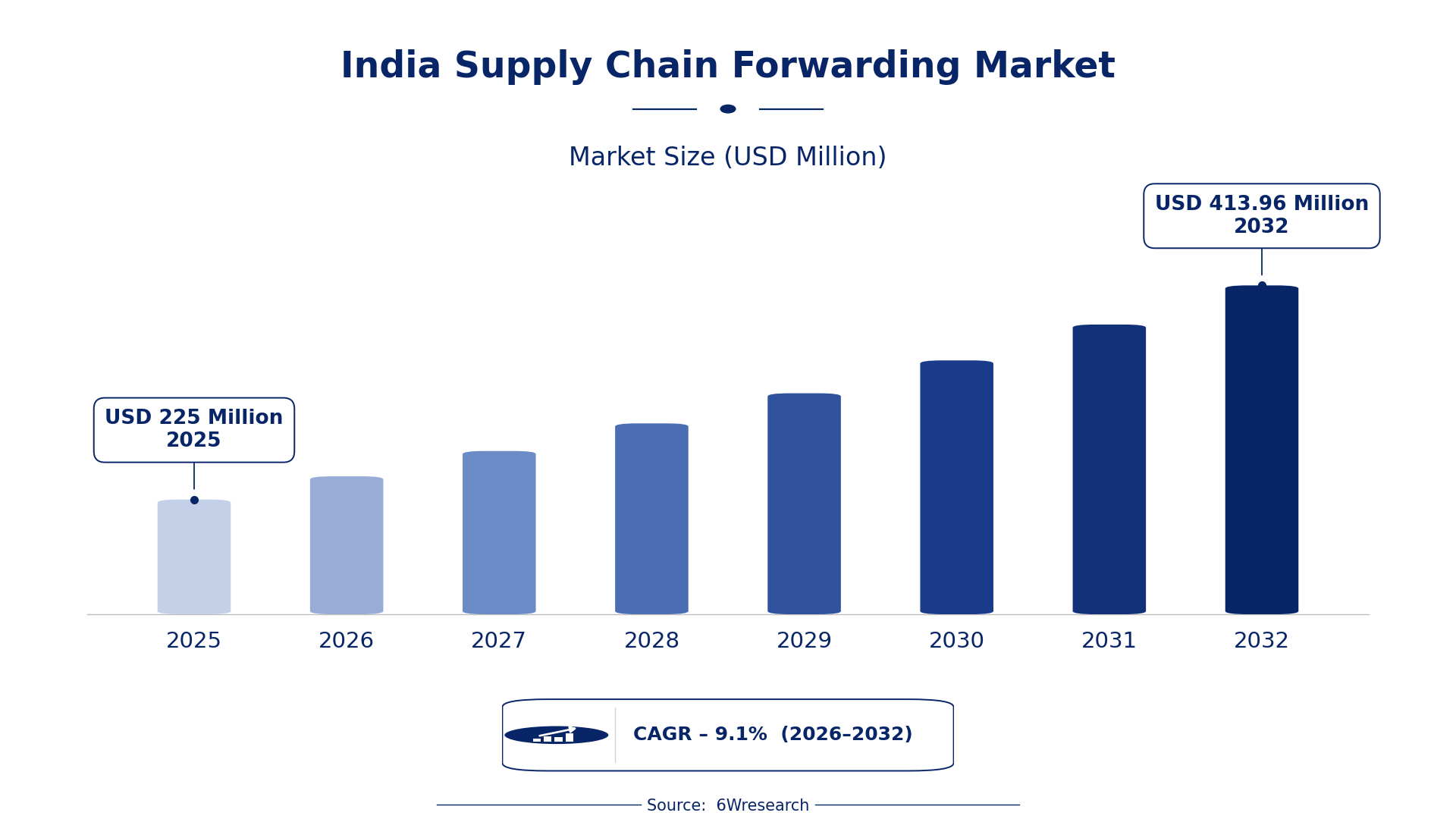
According to 6Wresearch internal database and industry insights, the India Supply Chain Forwarding Market was valued at USD 225.0 million in 2025 and is projected to reach USD 413.96 million by 2032, growing at a CAGR of approximately 9.1% during 2026–2032.
India Supply Chain Forwarding Market Highlights
| Report Metric | Details |
| Report Name | India Supply Chain Forwarding Market |
| Market Size 2025 | USD 225.0 million |
| Market Size 2032 | USD 413.96 million |
| Absolute Growth 2025–2032 | USD 188.96 million |
| CAGR 2026–2032 | 9.1% |
| Peak Annual Growth | 11.6% in 2031 |
| Forecast Period | 2026–2032 |
| Historical Data | 2022–2025 |
| Base Year | 2025 |
| Leading Forwarding Type, 2025 | Sea Freight Forwarding (47% share) |
| Leading Transport Mode, 2025 | Road/Rail (43% share) |
| Leading Service Model, 2025 | Full Container Load (FCL) (45% share) |
| Leading End User, 2025 | E-commerce Firms (35% share) |
| Fastest-Growing Forwarding Type | Multimodal Forwarding (10.3% CAGR) |
| Fastest-Growing Transport Mode | Hybrid (11.5% CAGR) |
| Fastest-Growing Service Model | Express Logistics (11.7% CAGR) |
| Growing Sector | E-commerce logistics |
| Key End Users | E-commerce Firms, Global Exporters, Logistics Providers |
India Supply Chain Forwarding Market Year-wise Growth Rate and Key Drivers (2022–2032)
This graph illustrates the annual growth rates of the market from 2022 to 2032, highlighting a steady upward trajectory and projected market expansion over the forecast period.
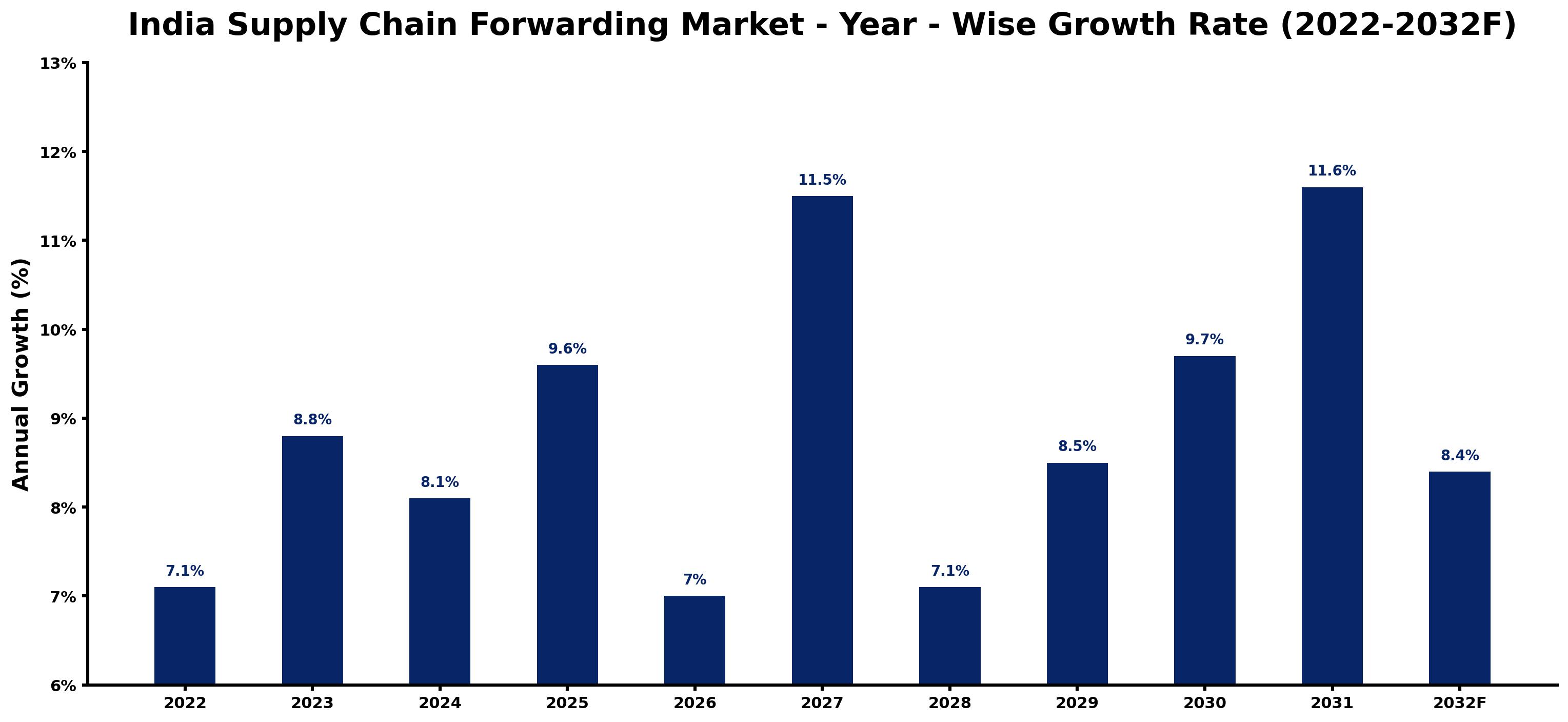
Annual growth estimates for each year appear below with the principal reason behind them, explaining the shifts that set the pace of the market.
| Year | Estimated Annual Growth (%) | Market Rationale |
| 2022 | 7.1 | The logistics sector employed around 22 million people, indicating strong demand. |
| 2023 | 8.8 | E-commerce logistics accounted for 25% of the total logistics market, driving growth. |
| 2024 | 8.1 | Growth slowed as the market adjusted to increasing operational costs. |
| 2025 | 9.6 | The 'Sagarmala Programme' enhanced port connectivity, boosting logistics efficiency. |
| 2026 | 7.0 | The National Logistics Policy streamlined operations, leading to a slowdown in growth. |
| 2027 | 11.5 | E-commerce firms expanded logistics capabilities, driving demand higher. |
| 2028 | 7.1 | Growth slowed as market dynamics stabilised after rapid expansion. |
| 2029 | 8.5 | Increased demand from global exporters accelerated logistics services uptake. |
| 2030 | 9.7 | Road and rail networks improved, facilitating higher logistics throughput. |
| 2031 | 11.6 | The logistics sector's expansion peaked due to rising e-commerce activities. |
| 2032 | 8.4 | Growth slowed as the market matured, yet demand remains strong. |
Note: Market size estimations and growth projections presented in this report are based on 6Wresearch's proprietary forecasting methodology, utilizing the latest available industry data, government publications, and primary research inputs.
India Supply Chain Forwarding Market Synopsis
Supply Chain Forwarding in India involves managing the logistics and transportation of goods from manufacturers to consumers. This sector encompasses various transport modes and service models, which are crucial for e-commerce and global exports. The India Supply Chain Forwarding Market is growing due to robust demand from e-commerce companies and an expanding logistics infrastructure. With a population of approximately 1.4 billion, consumption is on the rise, while government initiatives like the National Logistics Policy improve operational efficiency. The presence of over 1,000 logistics parks across the country positions the market for sustained growth.
Market Dynamics Impact Analysis (2026–2032)
| Factor | Type | Impact | Primary Segment Affected |
| Strong demand from e-commerce firms is driving logistics services expansion. | Driver | High | E-commerce Firms |
| The growing number of logistics parks facilitates better distribution networks. | Driver | High | Sea Freight Forwarding |
| Investment in logistics infrastructure is increasing, creating opportunities for suppliers. | Opportunity | High | Sea Freight Forwarding |
| The need for efficient supply chain solutions is rising among global exporters. | Opportunity | High | Global Exporters |
| Operational costs are increasing, impacting profit margins for logistics providers. | Restraint | High | Sea Freight Forwarding |
| Regulatory compliance can be burdensome for smaller logistics firms. | Restraint | Medium | Sea Freight Forwarding |
| Supply chain disruptions can delay shipments and affect service quality. | Challenge | High | Sea Freight Forwarding |
| Competition among logistics providers can lead to price wars, impacting profitability. | Challenge | Medium | Sea Freight Forwarding |
Evaluation of Drivers in India Supply Chain Forwarding Market (2026–2032)
The main growth drivers and the segments they affect most are set out below.
| Drivers | Primary Segment Affected | Why It Matters (Evidence) |
| Growing e-commerce demand drives logistics services expansion. | E-commerce Firms | E-commerce logistics accounts for 25% of the total logistics market in India. |
| Investment in logistics parks improves distribution efficiency. | Sea Freight Forwarding | India has over 1,000 logistics parks and hubs across various states. |
| Government initiatives improve operational efficiency in logistics. | Sea Freight Forwarding | The National Logistics Policy was introduced in 2022 to streamline logistics operations. |
| Increased global trade boosts demand for forwarding services. | Global Exporters | India's population of approximately 1.4 billion drives consumption and exports. |
| Technological advancements enhance logistics operations. | Sea Freight Forwarding | The Digital India Programme supports the digitization of logistics operations. |
The Supply Chain Forwarding market in India is growing as e-commerce companies, logistics parks and government initiatives stimulate demand. E-commerce logistics represents 25% of the total logistics market, leading to increased service requirements. A considerable number of logistics parks are enhancing distribution efficiency, which drives higher demand for forwarding services. The National Logistics Policy introduced in 2022 has streamlined operations, further propelling growth. Technological advancements supported by the Digital India Programme are improving logistics operations, attracting more investments in the sector.
Evaluation of Restraints in India Supply Chain Forwarding Market
The following restraints limit how fast demand can grow.
| Market Restraint | Primary Segment Affected | Why It Matters (Evidence) |
| Increasing operational costs impact profit margins for logistics providers. | Sea Freight Forwarding | Operational costs have risen, affecting the financial viability of many logistics firms. |
| Regulatory compliance can be burdensome for smaller logistics firms. | Sea Freight Forwarding | Smaller firms struggle to meet compliance requirements, limiting their competitiveness. |
| Supply chain disruptions can delay shipments and affect service quality. | Sea Freight Forwarding | Disruptions from external factors like weather or geopolitical issues hinder timely deliveries. |
| Intense competition among logistics providers can lead to price wars. | Sea Freight Forwarding | Price pressures reduce profitability for many logistics firms. |
| Limited infrastructure in certain regions hampers logistics efficiency. | Sea Freight Forwarding | Some areas lack adequate transport facilities, affecting service delivery and costs. |
India Supply Chain Forwarding Market Challenges
In the India Supply Chain Forwarding market, intense competition among logistics providers results in service quality issues and longer delivery times. This challenge stems from the rapid expansion of e-commerce, which accounts for 25% of the logistics market, causing delays that frustrate consumers. Regulatory complexities under the National Logistics Policy, introduced in 2022, place a burden on logistics firms, raising operational costs and ultimately increasing prices for customers. Additionally, rising transportation costs associated with the extensive 6.2 million-kilometre road network exert financial pressure on businesses, squeezing profit margins and limiting investment in service improvements.
Trends in the India Supply Chain Forwarding Market
Four trends stand out in the India Supply Chain Forwarding Market.
- E-commerce Firms Expanding Logistics Capabilities: E-commerce firms are investing in logistics capabilities to meet rising demand. In 2023, e-commerce logistics accounted for 25% of the total logistics market. This trend is reshaping supply chain strategies and service offerings.
- Shift Towards Digitization in Logistics Operations: The logistics sector is embracing digital solutions to improve efficiency and transparency. The Digital India Programme, launched in 2020, supports this shift, with many logistics firms adopting new technologies to streamline operations.
- Increased Focus on Multimodal Forwarding: Multimodal forwarding is gaining traction as businesses seek efficient transport solutions. This approach combines various transport modes, with a projected CAGR of 10.3% from 2026 to 2032, improving logistics efficiency.
- Growth in Logistics Parks Across India: The establishment of logistics parks is transforming supply chains. With over 1,000 logistics parks in India, this infrastructure supports efficient distribution and is set to drive further investment in the coming years.
Investment Opportunities in the India Supply Chain Forwarding Market
Several openings in the India Supply Chain Forwarding Market merit attention from investors.
- Investment in Logistics Infrastructure: The demand for improved logistics infrastructure is pressing, with government initiatives promoting connectivity. With over 1,000 logistics parks, there is a substantial opportunity for investment in this sector.
- Expansion of E-commerce Logistics: E-commerce firms are rapidly broadening their logistics capabilities, generating demand for advanced logistics solutions. With a significant portion of the logistics market driven by e-commerce, suppliers can capitalise on this expanding segment.
- Development of Green Logistics Solutions: There is a growing demand for sustainable logistics practices, creating opportunities for green logistics solutions. The logistics sector is increasingly focusing on eco-friendly practices to meet regulatory standards and consumer expectations.
- Enhancement of Port Facilities: The Sagarmala Programme aims to modernise ports, creating opportunities for investment in port infrastructure. This initiative is expected to improve coastal shipping efficiency, benefiting logistics providers.
Government Initiatives in the India Supply Chain Forwarding Market
The National Logistics Policy, launched by the Ministry of Commerce in 2022, improves logistics efficiency and reduces costs. This policy streamlines operations and establishes standards for logistics providers, facilitating regulatory compliance. It builds upon previous measures like the Sagarmala Programme, initiated in 2015, which focused on modernising ports and enhancing coastal shipping.
The Ministry of Shipping oversees the implementation of the Sagarmala Programme, which funds port modernisation projects. Additionally, the Ministry of Commerce approves initiatives under the National Logistics Policy, ensuring that logistics providers meet efficiency standards. These agencies improve logistics infrastructure across India, benefiting both producers and consumers.
Future Insight of the India Supply Chain Forwarding Market
By 2032, the India Supply Chain Forwarding market will undergo significant evolution, driven by initiatives like the Sagarmala Programme that enhance port connectivity. The implementation of ISO 9001 standards will improve service reliability, benefiting logistics providers and their clients. The Atmanirbhar Bharat initiative will strengthen local supply chains, promoting self-sufficiency and reducing reliance on foreign logistics. With a population of around 1.4 billion, the demand for efficient logistics services will increase, presenting new opportunities for suppliers to expand their operations.
Market Segmentation Analysis
The report offers a comprehensive study of the following market segments and their leading categories in the market.
By Forwarding Type – Sea Freight Forwarding Dominated, Multimodal Forwarding Expected to Grow Fastest
According to Sumit Sagar, AM at 6Wresearch, Sea Freight Forwarding held a 47% share of the India Supply Chain Forwarding Market by forwarding type in 2025. Sea Freight Forwarding commands the largest share in India due to its critical role in transporting bulk goods, especially for international trade. The extensive volume of cargo handled at major ports, driven by the Sagarmala Programme, solidifies its position in the logistics market. Multimodal Forwarding is set to record the highest CAGR in this split, 10.3% over 2026–2032. Multimodal Forwarding is experiencing significant growth as companies aim to optimise logistics by integrating various transport methods, responding to the complexities of modern supply chains. This flexibility allows for more efficient and adaptable logistics solutions, ensuring its competitive advantage. Suppliers should focus on enhancing multimodal capabilities to meet the growing demands of logistics customers effectively.
By Transport Mode – Road/Rail Dominated, Hybrid Expected to Grow Fastest
Road/Rail accounted for a 43% market share by transport mode in 2025. Road/Rail holds the largest market share as it is essential for domestic distribution, leveraging India's extensive road network of over 6.2 million kilometres. This mode is crucial for connecting manufacturers with consumers efficiently across the country. Hybrid is projected to grow fastest, at a CAGR of 11.5% during 2026–2032. Hybrid transport modes are rapidly gaining traction as they offer flexibility in logistics operations, catering to businesses that need to adapt to evolving delivery demands. This adaptability optimises costs and delivery times, making hybrid solutions increasingly appealing. Investing in hybrid transport solutions will enable suppliers to effectively address the rising demand for flexible logistics options.
By Service Model – Full Container Load (FCL) Dominated, Express Logistics Expected to Grow Fastest
Full Container Load (FCL) took a 45% share of service model in 2025, more than any other category. Full Container Load (FCL) dominates the market share as it is the preferred choice for large shipments, providing cost efficiency and reliability for businesses. Its widespread adoption among logistics providers underscores its vital role in the supply chain. Over 2026–2032, Express Logistics is expected to post the fastest growth, at a CAGR of 11.7%. Express Logistics is the fastest-growing service model, driven by the urgent delivery needs of e-commerce firms that require rapid fulfilment. The increasing consumer expectation for quick delivery times significantly propels this segment's growth. Suppliers must enhance their express logistics offerings to remain competitive in a market increasingly prioritising speed and efficiency.
By End User – E-commerce Firms Dominated and Is Expected to Record the Fastest Growth
In 2025, E-commerce Firms led the end user split with a 35% share. E-commerce Firms lead the market share as they are the primary users of logistics services, largely due to the rapid growth of online shopping in India. Their substantial demand for efficient logistics solutions significantly impacts the overall supply chain environment. E-commerce Firms are also forecast to expand faster than any other category, at a CAGR of 11.3% over 2026–2032. E-commerce Firms are also the fastest-growing segment, propelled by the surge in online shopping and the need for rapid delivery services. Their continuous expansion and investment in logistics capabilities will likely sustain this growth trajectory. This trend indicates that suppliers should prioritise partnerships with e-commerce firms to align with their logistics needs and growth strategies.
Key Attractiveness of the Report
- 10 Years of Market Numbers
- Historical Data Starting from 2022 to 2025
- Base Year 2025
- Forecast Data until 2032
- Key Performance Indicators Impacting the Market
- Major Upcoming Developments and Projects
Key Highlights of the Report:
- India Supply Chain Forwarding Market Outlook
- Market Size of India Supply Chain Forwarding Market, 2025
- Forecast of India Supply Chain Forwarding Market, 2032
- Historical Data and Forecast of India Supply Chain Forwarding Revenues & Volume for the Period 2022 - 2032F
- India Supply Chain Forwarding Market Trend Evolution
- India Supply Chain Forwarding Market Drivers and Challenges
- India Supply Chain Forwarding Price Trends
- India Supply Chain Forwarding Porter's Five Forces
- India Supply Chain Forwarding Industry Life Cycle
- Historical Data and Forecast of India Supply Chain Forwarding Market Revenues & Volume By Forwarding Type for the Period 2022 - 2032F
- Historical Data and Forecast of India Supply Chain Forwarding Market Revenues & Volume By Air Freight Forwarding for the Period 2022 - 2032F
- Historical Data and Forecast of India Supply Chain Forwarding Market Revenues & Volume By Sea Freight Forwarding for the Period 2022 - 2032F
- Historical Data and Forecast of India Supply Chain Forwarding Market Revenues & Volume By Land Freight Forwarding for the Period 2022 - 2032F
- Historical Data and Forecast of India Supply Chain Forwarding Market Revenues & Volume By Multimodal Forwarding for the Period 2022 - 2032F
- Historical Data and Forecast of India Supply Chain Forwarding Market Revenues & Volume By Transport Mode for the Period 2022 - 2032F
- Historical Data and Forecast of India Supply Chain Forwarding Market Revenues & Volume By Air for the Period 2022 - 2032F
- Historical Data and Forecast of India Supply Chain Forwarding Market Revenues & Volume By Ocean for the Period 2022 - 2032F
- Historical Data and Forecast of India Supply Chain Forwarding Market Revenues & Volume By Road/Rail for the Period 2022 - 2032F
- Historical Data and Forecast of India Supply Chain Forwarding Market Revenues & Volume By Hybrid for the Period 2022 - 2032F
- Historical Data and Forecast of India Supply Chain Forwarding Market Revenues & Volume By Service Model for the Period 2022 - 2032F
- Historical Data and Forecast of India Supply Chain Forwarding Market Revenues & Volume By Express Logistics for the Period 2022 - 2032F
- Historical Data and Forecast of India Supply Chain Forwarding Market Revenues & Volume By Full Container Load (FCL) for the Period 2022 - 2032F
- Historical Data and Forecast of India Supply Chain Forwarding Market Revenues & Volume By Hub-and-Spoke for the Period 2022 - 2032F
- Historical Data and Forecast of India Supply Chain Forwarding Market Revenues & Volume By End-to-End for the Period 2022 - 2032F
- Historical Data and Forecast of India Supply Chain Forwarding Market Revenues & Volume By End User for the Period 2022 - 2032F
- Historical Data and Forecast of India Supply Chain Forwarding Market Revenues & Volume By E-commerce Firms for the Period 2022 - 2032F
- Historical Data and Forecast of India Supply Chain Forwarding Market Revenues & Volume By Global Exporters for the Period 2022 - 2032F
- Historical Data and Forecast of India Supply Chain Forwarding Market Revenues & Volume By Retail Supply Chains for the Period 2022 - 2032F
- Historical Data and Forecast of India Supply Chain Forwarding Market Revenues & Volume By Logistics Aggregators for the Period 2022 - 2032F
- India Supply Chain Forwarding Import Export Trade Statistics
- Market Opportunity Assessment By Forwarding Type
- Market Opportunity Assessment By Transport Mode
- Market Opportunity Assessment By Service Model
- Market Opportunity Assessment By End User
- India Supply Chain Forwarding Top Companies Market Share
- India Supply Chain Forwarding Competitive Benchmarking By Technical and Operational Parameters
- India Supply Chain Forwarding Company Profiles
- India Supply Chain Forwarding Key Strategic Recommendations
Market Covered
Segments analysed in this report are listed below.
By Forwarding Type
- Air Freight Forwarding
- Sea Freight Forwarding
- Land Freight Forwarding
- Multimodal Forwarding
By Transport Mode
- Air
- Ocean
- Road/Rail
- Hybrid
By Service Model
- Express Logistics
- Full Container Load (FCL)
- Hub-and-Spoke
- End-to-End
By End User
- E-commerce Firms
- Global Exporters
- Retail Supply Chains
- Logistics Aggregators































