China Supply Chain Forwarding Market Size & Growth Rate
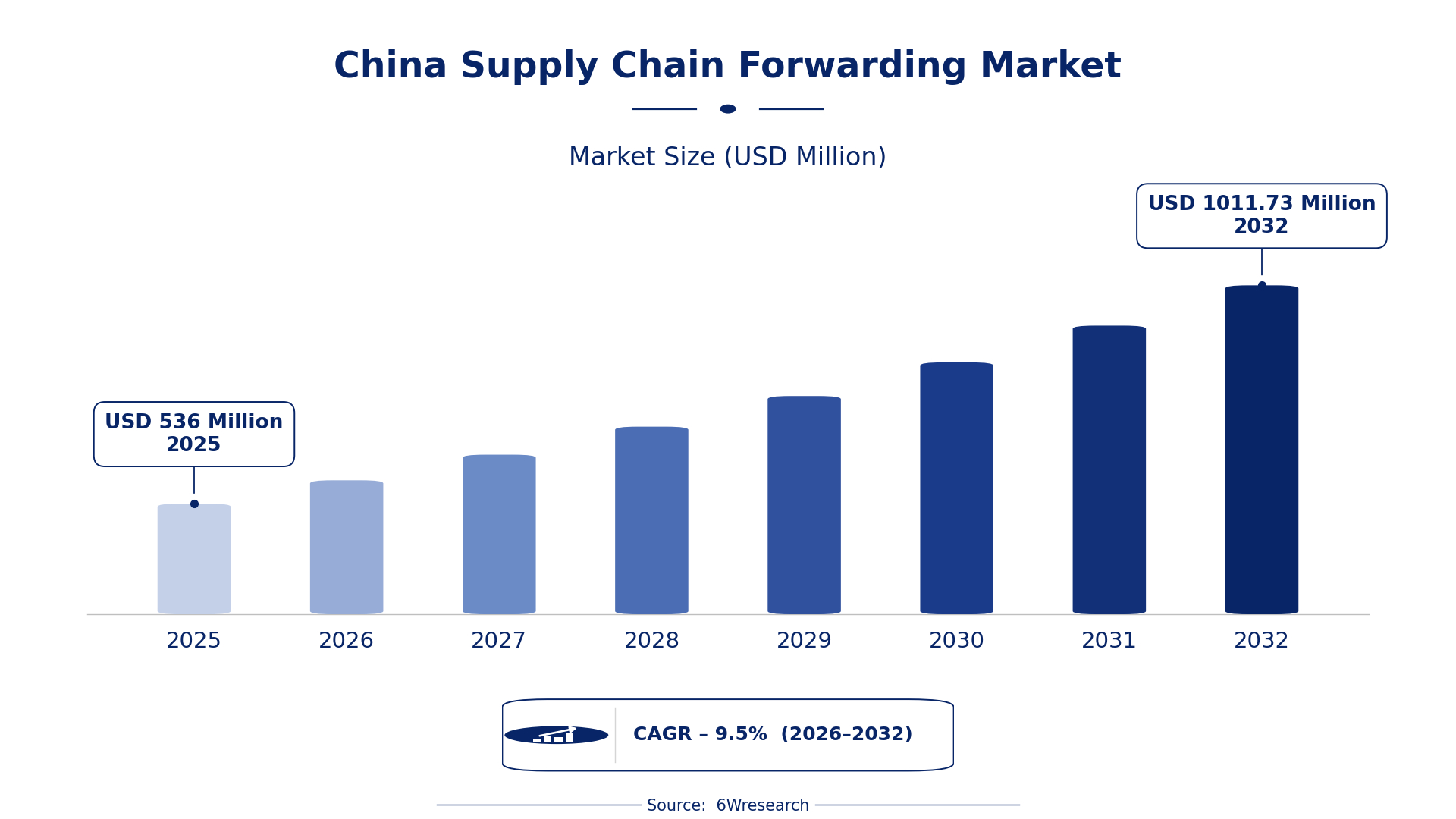
According to 6Wresearch internal database and industry insights, the China Supply Chain Forwarding Market was valued at USD 536.0 million in 2025 and is projected to reach USD 1,011.73 million by 2032, growing at a CAGR of approximately 9.5% during 2026–2032.
China Supply Chain Forwarding Market Highlights
| Report Metric | Details |
| Report Name | China Supply Chain Forwarding Market |
| Market Size 2025 | USD 536.0 million |
| Market Size 2032 | USD 1,011.73 million |
| Absolute Growth 2025–2032 | USD 475.73 million |
| CAGR 2026–2032 | 9.5% |
| Peak Annual Growth | 11.8% in 2028 |
| Forecast Period | 2026–2032 |
| Historical Data | 2022–2025 |
| Base Year | 2025 |
| Leading Forwarding Type, 2025 | Sea Freight Forwarding (41% share) |
| Leading Transport Mode, 2025 | Ocean (42% share) |
| Leading Service Model, 2025 | Express Logistics (36% share) |
| Leading End User, 2025 | E-commerce Firms (39% share) |
| Fastest-Growing Forwarding Type | Multimodal Forwarding (11.6% CAGR) |
| Fastest-Growing Transport Mode | Hybrid (11.0% CAGR) |
| Fastest-Growing End User | Global Exporters (10.7% CAGR) |
| Growing Sector | Global Exporters |
| Key End Users | E-commerce Firms, Global Exporters, Retail Supply Chains, Logistics Aggregators |
China Supply Chain Forwarding Market Year-wise Growth Rate and Key Drivers (2022–2032)
This graph illustrates the annual growth rates of the market from 2022 to 2032, highlighting a steady upward trajectory and projected market expansion over the forecast period.
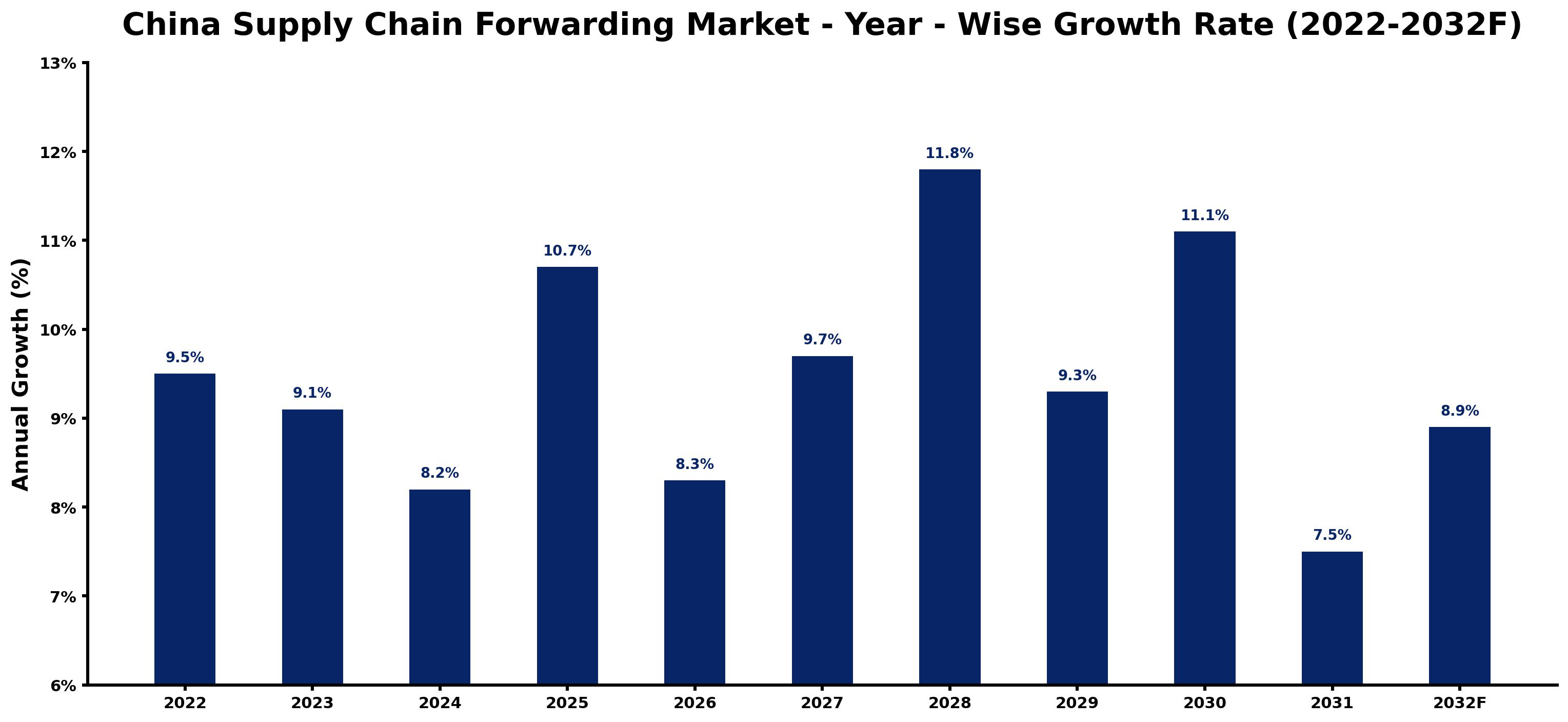
The following table presents the estimated annual growth rate for each year together with the principal factor influencing market performance.
| Year | Estimated Annual Growth (%) | Market Rationale |
| 2022 | 9.5 | The market experienced solid growth, driven by increased logistics demand from domestic users and international trade activities. |
| 2023 | 9.1 | Growth slowed due to ongoing supply chain disruptions affecting logistics efficiency across various sectors. |
| 2024 | 8.2 | The market continued to grow, albeit at a slower pace, influenced by the evolving e-commerce sector and domestic distribution needs. |
| 2025 | 10.7 | A surge in logistics demand was observed, attributed to the booming e-commerce sector and increased trade volume. |
| 2026 | 8.3 | Growth slowed as logistics companies faced challenges in adapting to changing consumer behaviours and operational hurdles. |
| 2027 | 9.7 | An uptick in demand for logistics services was noted, driven by the expansion of e-commerce and global export activities. |
| 2028 | 11.8 | The market peaked with notable growth, supported by the 'Digital Logistics Development Strategy' integrating AI into operations. |
| 2029 | 9.3 | Growth slowed slightly as the market began to stabilise after a period of rapid expansion and increased competition. |
| 2030 | 11.1 | Demand rose again, driven by ongoing investments in logistics infrastructure and the integration of digital technologies. |
| 2031 | 7.5 | Growth slowed as the market adjusted to new operational standards and evolving buyer expectations. |
| 2032 | 8.9 | The market is expected to grow steadily, supported by the continued expansion of e-commerce and logistics efficiency initiatives. |
Note: Market size estimations and growth projections presented in this report are based on 6Wresearch's proprietary forecasting methodology, utilizing the latest available industry data, government publications, and primary research inputs.
China Supply Chain Forwarding Market Synopsis
Supply Chain Forwarding in China involves the coordination and management of logistics services to ensure efficient goods delivery. This sector depends on a network of logistics providers and technology platforms, enabling effective tracking and management of shipments. The China Supply Chain Forwarding Market is growing due to increasing demand from domestic users and global trade activities. The e-commerce sector is expected to surpass $2 trillion by 2025, driving logistics requirements. Major logistics hubs such as Shanghai and Shenzhen are enhancing their infrastructure to meet this demand.
Market Dynamics Impact Analysis (2026–2032)
| Factor | Type | Impact | Primary Segment Affected |
| Rising e-commerce demand for logistics services | Driver | High | E-commerce Firms |
| Increased trade volume driving logistics activities | Driver | High | Global Exporters |
| Growing demand for efficient logistics solutions | Opportunity | High | Retail Supply Chains |
| Investment in logistics technology and infrastructure | Opportunity | Medium | Logistics Aggregators |
| Challenges in adapting to supply chain disruptions | Restraint | High | Air Freight Forwarding |
| Regulatory compliance costs impacting operations | Restraint | Medium | Sea Freight Forwarding |
| Supply Chain Forwarding in China faces challenges from inefficiencies | Challenge | High | Land Freight Forwarding |
| Competition among logistics providers is intensifying | Challenge | Medium | Multimodal Forwarding |
Evaluation of Drivers in China Supply Chain Forwarding Market (2026–2032)
Below mentioned are some major drivers and their influence on market dynamics.
| Drivers | Primary Segment Affected | Why It Matters (Evidence) |
| Increased e-commerce sales driving logistics demand | E-commerce Firms | The e-commerce sector in China is expected to exceed $2 trillion by 2025, leading to higher logistics service requirements. |
| Rising trade volume necessitating efficient forwarding services | Global Exporters | China's trade volume surpassed $2.5 trillion in 2022, boosting demand for forwarding services. |
| Investment in logistics technology improving operational efficiency | Logistics Aggregators | The integration of AI and big data into logistics operations is transforming service delivery and efficiency. |
| Development of logistics hubs improving service quality | Retail Supply Chains | Key logistics hubs like Shanghai and Shenzhen are upgrading infrastructure, facilitating better supply chain management. |
| Government initiatives promoting logistics sector growth | Air Freight Forwarding | The 'Logistics Industry Development Plan' aims to increase logistics efficiency by 15% by 2025, driving service demand. |
Market growth for Supply Chain Forwarding in China is underpinned by rising e-commerce demand, increased trade volume, and investments in logistics technology. The e-commerce sector is projected to exceed $2 trillion by 2025, boosting logistics service requirements. China's trade volume surpassed $2.5 trillion in 2022, creating a heightened need for efficient forwarding services. Key logistics hubs like Shanghai and Shenzhen are upgrading infrastructure, which improves service quality and operational efficiency.
Evaluation of Restraints in China Supply Chain Forwarding Market
The table below lists the restraints and the evidence behind each.
| Market Restraint | Primary Segment Affected | Why It Matters (Evidence) |
| Inefficiencies in supply chain operations | Air Freight Forwarding | China's logistics performance index ranked 28th globally in 2022, indicating room for improvement in operations. |
| High regulatory compliance costs for logistics providers | Sea Freight Forwarding | Producers must adhere to national standards for freight forwarding services, increasing operational costs. |
| Challenges in adapting to evolving consumer behaviours | Land Freight Forwarding | Logistics companies face difficulties in meeting changing demands from consumers, affecting service delivery. |
| Intensifying competition among logistics providers | Multimodal Forwarding | The growing number of logistics firms increases competition, pressuring margins and service quality. |
| Supply chain disruptions impacting logistics efficiency | E-commerce Firms | Ongoing global supply chain disruptions have created challenges for logistics efficiency and service delivery. |
China Supply Chain Forwarding Market Challenges
The China Supply Chain Forwarding market encounters regulatory challenges, as compliance measures from the Ministry of Transport can delay shipments by up to 15%, raising costs for freight forwarders. Intense competition among logistics firms leads to price wars that erode profit margins and compel suppliers to compromise on service quality. A shortage of skilled workers complicates operations, resulting in increased training costs and service delays for logistics companies. Trade tensions can disrupt supply chains, causing unpredictable fluctuations in freight costs that complicate budgeting for buyers, with potential increases of up to 20%.
Trends in the China Supply Chain Forwarding Market
Below mentioned are some of the trends shaping the China Supply Chain Forwarding Market growth.
- Shift towards Hybrid Transport Solutions: In 2022, the demand for Hybrid transport solutions began to rise, reflecting a need for flexibility in logistics. This shift is driven by the integration of various transport modes, with a projected CAGR of 11.0% for Hybrid forwarding.
- Increased Focus on Green Logistics: The 'Green Logistics Development Action Plan' initiated in 2020 promotes sustainable practices in logistics, aiming for a 30% reduction in carbon emissions by 2030. This trend is reshaping logistics operations across China.
- Expansion of Last-Mile Delivery Services: The 'E-commerce Logistics Development Plan' launched in 2021 aims to improve last-mile delivery services across urban areas by 2025. This initiative is essential for enhancing customer satisfaction and service efficiency.
- Integration of Digital Technologies in Logistics: The 'Digital Logistics Development Strategy' launched in 2022 focuses on integrating AI and big data into logistics operations. This trend is projected to improve operational efficiency and service quality.
Investment Opportunities in the China Supply Chain Forwarding Market
Some of the investment opportunities in the China Supply Chain Forwarding Market are mentioned below.
- E-commerce Firms seeking logistics solutions: With the e-commerce sector expected to exceed $2 trillion by 2025, there is an opportunity to supply logistics services. Collaborating with e-commerce platforms can improve service offerings.
- Investment in logistics technology is essential now: As the logistics industry in China is projected to reach $1 trillion by 2025, investing in advanced logistics technology is vital. Partnering with logistics aggregators can facilitate market entry.
- Supply Chain Forwarding services for Global Exporters: The growing trade volume presents an opportunity to provide forwarding services to global exporters. Establishing partnerships with exporters can improve service delivery.
- Development of logistics hubs in key regions: With Shanghai and Shenzhen as key logistics hubs, investing in infrastructure development in these areas is essential. Collaborating with local authorities can streamline operations.
Government Initiatives in the China Supply Chain Forwarding Market
In 2021, the National Development and Reform Commission launched the 'Logistics Industry Development Plan', aiming to increase logistics efficiency by 15% by 2025. This measure complements existing regulations, improving the overall operational framework for providers. It mandates improvements in service quality and efficiency across the sector, benefiting both producers and consumers.
In 2022, the Ministry of Transport's 'National Logistics Hub Construction Plan' targeted the establishment of 100 logistics hubs by 2025. This initiative aims to improve supply chain efficiency and enhance connectivity. The plan provides funding for infrastructure projects, facilitating better logistics operations and supporting economic growth.
Future Insight of the China Supply Chain Forwarding Market
The China Supply Chain Forwarding market is set for transformation by 2032, driven by the 'Belt and Road Initiative' which will improve logistics connectivity across Asia and Europe. The logistics industry is projected to reach $1 trillion by 2025, creating ample opportunities for suppliers. The 'Green Logistics Development Action Plan' will promote sustainable practices, appealing to environmentally conscious buyers. Advancements in logistics technology will streamline operations and improve tracking capabilities, resulting in better service quality for all stakeholders.
Market Segmentation Analysis
Each segment group is reviewed below, with the leader by share and the fastest grower by CAGR.
By Forwarding Type – Sea Freight Forwarding Dominated, Multimodal Forwarding Expected to Grow Fastest
According to Sumit Sagar, AM at 6Wresearch, Sea Freight Forwarding held a 41% share of the China Supply Chain Forwarding Market by forwarding type in 2025. Sea Freight Forwarding holds the largest market share as it serves as the dominant mode for transporting bulk goods, crucial for China's extensive export activities. With a trade volume exceeding $2.5 trillion in 2022, this segment plays a vital role in the overall supply chain. Multimodal Forwarding is set to record the highest CAGR in this split, 11.6% over 2026–2032. Multimodal Forwarding is experiencing the fastest growth due to its capacity to integrate various transport modes, thereby enhancing logistics efficiency. The surge in e-commerce, projected to exceed $2 trillion by 2025, significantly fuels the demand for this adaptable supply chain solution. Suppliers should focus on developing multimodal forwarding solutions to meet the rising demand for efficient logistics in a rapidly changing market.
By Transport Mode – Ocean Dominated, Hybrid Expected to Grow Fastest
Ocean took a 42% share of transport mode in 2025, more than any other category. Ocean transport leads the market as the primary method for international shipping, essential for handling large volumes of goods. With China being the largest global exporter, this mode is vital for maintaining trade flows. Hybrid is projected to grow fastest, at a CAGR of 11.0% during 2026–2032. Hybrid transport is gaining traction as it offers combined transport solutions that cater to the diverse needs of logistics operations. This growth is driven by the need for flexibility and efficiency in supply chain management. Buyers should consider hybrid transport options to optimise their logistics strategies and reduce delivery times.
By Service Model – Express Logistics Dominated and Is Expected to Record the Fastest Growth
The largest service model category in 2025 was Express Logistics, with a 36% share of total revenue. Express Logistics dominates the market as it is essential for meeting urgent delivery needs, catering to the fast-paced requirements of various industries. This model is particularly significant in the thriving e-commerce sector, where timely deliveries directly impact customer satisfaction. The same category is also set to grow fastest, at a CAGR of 12.1% during 2026–2032. Express Logistics is also the fastest-growing segment, driven by the rapid expansion of online shopping that demands swift delivery options. The continuous growth of the e-commerce sector ensures ongoing demand for express logistics services, solidifying its market position. Suppliers must enhance their express logistics capabilities to effectively capitalise on the expanding e-commerce market.
By End User – E-commerce Firms Dominated, Global Exporters Expected to Grow Fastest
With a 39% revenue share in 2025, E-commerce Firms was the largest end user category. E-commerce Firms represent the largest share of end users, as they heavily rely on logistics services to fulfil customer orders efficiently. The projected growth of the e-commerce sector to over $2 trillion by 2025 underscores the importance of this user group. Over 2026–2032, Global Exporters are expected to post the fastest growth, at a CAGR of 10.7%. Global Exporters are the fastest-growing segment, driven by the increasing need for forwarding services to facilitate international trade. As China’s export activities expand, this group will see heightened demand for logistics solutions. Suppliers should tailor their services to meet the specific needs of global exporters to capture this growing market segment.
Key Attractiveness of the Report
- 10 Years of Market Numbers
- Historical Data Starting from 2022 to 2025
- Base Year 2025
- Forecast Data until 2032
- Key Performance Indicators Impacting the Market
- Major Upcoming Developments and Projects
Key Highlights of the Report:
- China Supply Chain Forwarding Market Outlook
- Market Size of China Supply Chain Forwarding Market, 2025
- Forecast of China Supply Chain Forwarding Market, 2032
- Historical Data and Forecast of China Supply Chain Forwarding Revenues & Volume for the Period 2022 - 2032F
- China Supply Chain Forwarding Market Trend Evolution
- China Supply Chain Forwarding Market Drivers and Challenges
- China Supply Chain Forwarding Price Trends
- China Supply Chain Forwarding Porter's Five Forces
- China Supply Chain Forwarding Industry Life Cycle
- Historical Data and Forecast of China Supply Chain Forwarding Market Revenues & Volume By Forwarding Type for the Period 2022 - 2032F
- Historical Data and Forecast of China Supply Chain Forwarding Market Revenues & Volume By Air Freight Forwarding for the Period 2022 - 2032F
- Historical Data and Forecast of China Supply Chain Forwarding Market Revenues & Volume By Sea Freight Forwarding for the Period 2022 - 2032F
- Historical Data and Forecast of China Supply Chain Forwarding Market Revenues & Volume By Land Freight Forwarding for the Period 2022 - 2032F
- Historical Data and Forecast of China Supply Chain Forwarding Market Revenues & Volume By Multimodal Forwarding for the Period 2022 - 2032F
- Historical Data and Forecast of China Supply Chain Forwarding Market Revenues & Volume By Transport Mode for the Period 2022 - 2032F
- Historical Data and Forecast of China Supply Chain Forwarding Market Revenues & Volume By Air for the Period 2022 - 2032F
- Historical Data and Forecast of China Supply Chain Forwarding Market Revenues & Volume By Ocean for the Period 2022 - 2032F
- Historical Data and Forecast of China Supply Chain Forwarding Market Revenues & Volume By Road/Rail for the Period 2022 - 2032F
- Historical Data and Forecast of China Supply Chain Forwarding Market Revenues & Volume By Hybrid for the Period 2022 - 2032F
- Historical Data and Forecast of China Supply Chain Forwarding Market Revenues & Volume By Service Model for the Period 2022 - 2032F
- Historical Data and Forecast of China Supply Chain Forwarding Market Revenues & Volume By Express Logistics for the Period 2022 - 2032F
- Historical Data and Forecast of China Supply Chain Forwarding Market Revenues & Volume By Full Container Load (FCL) for the Period 2022 - 2032F
- Historical Data and Forecast of China Supply Chain Forwarding Market Revenues & Volume By Hub-and-Spoke for the Period 2022 - 2032F
- Historical Data and Forecast of China Supply Chain Forwarding Market Revenues & Volume By End-to-End for the Period 2022 - 2032F
- Historical Data and Forecast of China Supply Chain Forwarding Market Revenues & Volume By End User for the Period 2022 - 2032F
- Historical Data and Forecast of China Supply Chain Forwarding Market Revenues & Volume By E-commerce Firms for the Period 2022 - 2032F
- Historical Data and Forecast of China Supply Chain Forwarding Market Revenues & Volume By Global Exporters for the Period 2022 - 2032F
- Historical Data and Forecast of China Supply Chain Forwarding Market Revenues & Volume By Retail Supply Chains for the Period 2022 - 2032F
- Historical Data and Forecast of China Supply Chain Forwarding Market Revenues & Volume By Logistics Aggregators for the Period 2022 - 2032F
- China Supply Chain Forwarding Import Export Trade Statistics
- Market Opportunity Assessment By Forwarding Type
- Market Opportunity Assessment By Transport Mode
- Market Opportunity Assessment By Service Model
- Market Opportunity Assessment By End User
- China Supply Chain Forwarding Top Companies Market Share
- China Supply Chain Forwarding Competitive Benchmarking By Technical and Operational Parameters
- China Supply Chain Forwarding Company Profiles
- China Supply Chain Forwarding Key Strategic Recommendations
Market Covered
This report examines the market across the segments below.
By Forwarding Type
- Air Freight Forwarding
- Sea Freight Forwarding
- Land Freight Forwarding
- Multimodal Forwarding
By Transport Mode
- Air
- Ocean
- Road/Rail
- Hybrid
By Service Model
- Express Logistics
- Full Container Load (FCL)
- Hub-and-Spoke
- End-to-End
By End User
- E-commerce Firms
- Global Exporters
- Retail Supply Chains
- Logistics Aggregators































