India Surgical Automation Market Size & Growth Rate
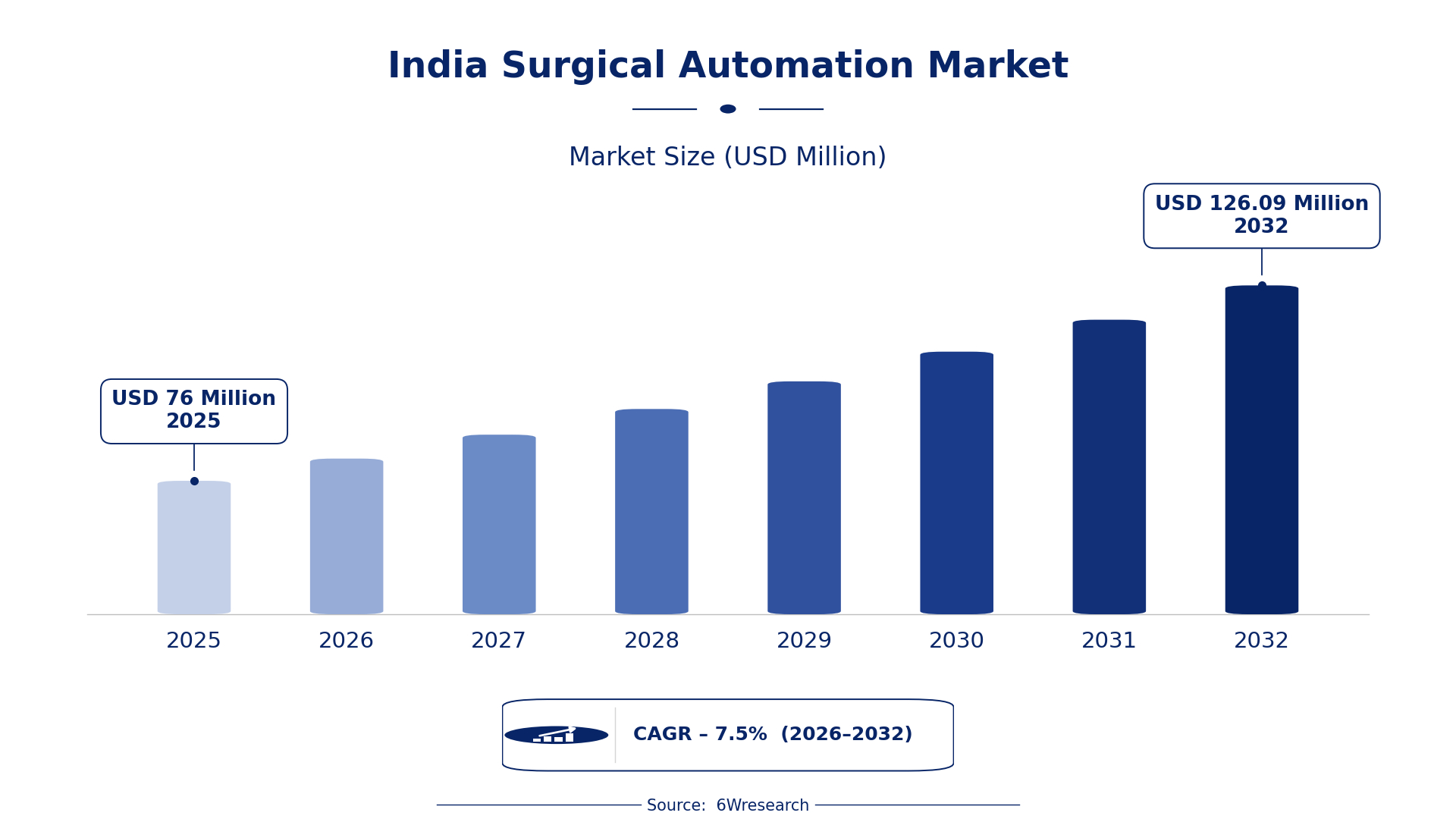
According to 6Wresearch internal database and industry insights, the India Surgical Automation Market was valued at USD 76.0 million in 2025 and is projected to reach USD 126.09 million by 2032, growing at a CAGR of approximately 7.5% during 2026–2032.
India Surgical Automation Market Highlights
| Report Metric | Details |
| Report Name | India Surgical Automation Market |
| Market Size 2025 | USD 76.0 million |
| Market Size 2032 | USD 126.09 million |
| Absolute Growth 2025–2032 | USD 50.09 million |
| CAGR 2026–2032 | 7.5% |
| Peak Annual Growth | 9.6% in 2031 |
| Forecast Period | 2026–2032 |
| Historical Data | 2022–2025 |
| Base Year | 2025 |
| Leading Automation Type, 2025 | Robotic Surgery Systems (40% share) |
| Leading Integration Level, 2025 | Full Automation (41% share) |
| Leading Surgical Specialty, 2025 | Urology (47% share) |
| Leading End User, 2025 | Multi-specialty Hospitals (52% share) |
| Fastest-Growing Automation Type | AI-Guided Procedures (10.0% CAGR) |
| Fastest-Growing Integration Level | Decision Support (10.2% CAGR) |
| Fastest-Growing Surgical Specialty | Cardiology (10.2% CAGR) |
| Fastest-Growing End User | Advanced Surgical Centers (10.3% CAGR) |
| Growing Sector | surgical procedures |
| Key End Users | multi-specialty hospitals, advanced surgical centers, healthcare providers |
India Surgical Automation Market Year-wise Growth Rate and Key Drivers (2022–2032)
This graph illustrates the annual growth rates of the market from 2022 to 2032, highlighting a steady upward trajectory and projected market expansion over the forecast period.
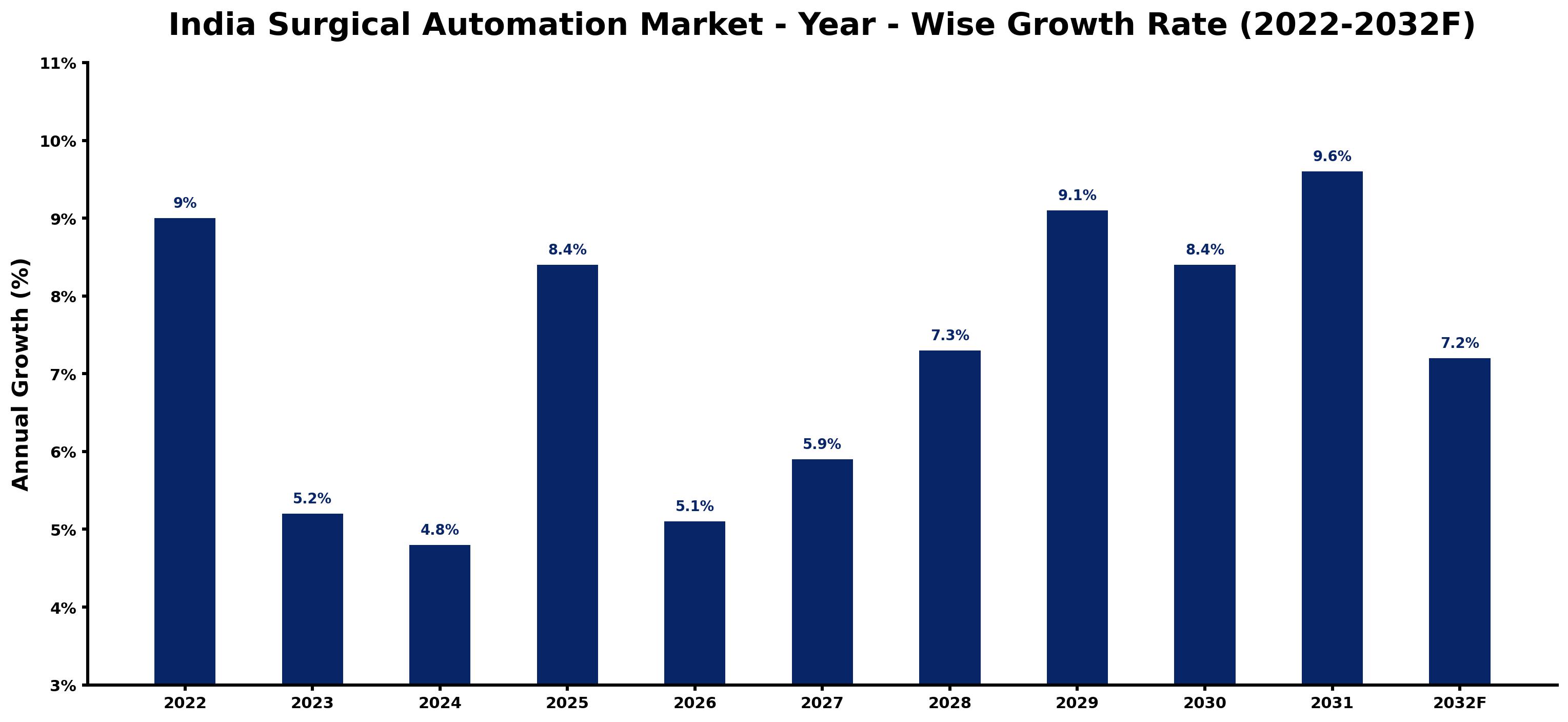
Annual growth estimates for each year appear below with the principal reason behind them, explaining the shifts that set the pace of the market.
| Year | Estimated Annual Growth (%) | Market Rationale |
| 2022 | 9.0 | The market experienced strong growth due to increased adoption of robotic systems in hospitals. |
| 2023 | 5.2 | Adoption slowed as hospitals adjusted to new technologies and training requirements. |
| 2024 | 4.8 | Continued adjustments in hospital operations led to a further slowdown in growth rates. |
| 2025 | 8.4 | Demand surged as more multi-specialty hospitals began integrating robotic surgery systems, particularly in urology. |
| 2026 | 5.1 | A slower growth rate is expected as market players face challenges in scaling operations and training staff. |
| 2027 | 5.9 | Growth is projected to pick up as hospitals expand their surgical automation capabilities, driven by the Ayushman Bharat scheme. |
| 2028 | 7.3 | Increased adoption of AI-guided procedures is expected to contribute to a rise in growth rates, especially in cardiac surgeries. |
| 2029 | 9.1 | The market is expected to see a boost as robotic systems become more widely accepted in surgical practices, supported by the Indian Medical Association. |
| 2030 | 8.4 | Growth is projected to moderate as hospitals focus on optimising existing automation technologies and integrating new ones. |
| 2031 | 9.6 | A peak in growth is expected as advanced surgical techniques gain traction in the market, particularly in oncology. |
| 2032 | 7.2 | Growth is projected to slow slightly as the market matures and competition intensifies, with a focus on quality management standards. |
Note: Market size estimations and growth projections presented in this report are based on 6Wresearch's proprietary forecasting methodology, utilizing the latest available industry data, government publications, and primary research inputs.
India Surgical Automation Market Synopsis
Surgical Automation in India refers to the use of advanced technologies such as robotics and AI to improve surgical procedures. This market is characterised by the integration of software, hardware, and surgical instruments, aimed at improving outcomes and reducing recovery times. The India Surgical Automation Market is expanding rapidly due to the increasing number of multi-specialty hospitals adopting robotic systems, with over 1,000 expected by 2025. Factors such as the National Health Mission's initiatives and the Ayushman Bharat scheme are driving this growth, indicating a strong demand for improved surgical care across the country.
Market Dynamics Impact Analysis (2026–2032)
| Factor | Type | Impact | Primary Segment Affected |
| Growing adoption of robotic surgery systems in hospitals | Driver | High | Robotic Surgery Systems |
| Increased investment in healthcare infrastructure | Driver | High | Multi-specialty Hospitals |
| Rising demand for minimally invasive surgical options | Opportunity | High | Urology |
| Expansion of advanced surgical centers in urban areas | Opportunity | Medium | Advanced Surgical Centers |
| High costs associated with robotic systems | Restraint | High | Robotic Surgery Systems |
| Limited trained professionals for advanced technologies | Restraint | Medium | AI-Guided Procedures |
| Challenges in integrating new technologies into existing systems | Challenge | High | Multi-specialty Hospitals |
| Regulatory hurdles in obtaining approvals for new devices | Challenge | Medium | Robotic Surgery Systems |
Evaluation of Drivers in India Surgical Automation Market (2026–2032)
Below mentioned are some major drivers and their influence on market dynamics.
| Drivers | Primary Segment Affected | Why It Matters (Evidence) |
| Increasing adoption of robotic surgery systems | Robotic Surgery Systems | This trend is driven by the demand for precision and minimally invasive options, with over 1,000 multi-specialty hospitals expected to adopt these systems by 2025. |
| Growth in AI-guided procedures | AI-Guided Procedures | The rise in AI-guided cardiac surgeries is leading to improved decision-making, with a growing number of trained professionals enhancing surgical outcomes. |
| Support from the National Health Mission | Semi-Automated Tools | This initiative promotes automation in healthcare facilities, aiming to improve surgical care access in rural areas, thus increasing demand for semi-automated tools. |
| Expansion of advanced surgical centers | Advanced Surgical Centers | With over 200 centers integrating robotic systems, the demand for advanced surgical technologies is increasing, leading to higher procurement of automation tools. |
| Focus on quality management standards | Full Automation | Compliance with ISO 13485 ensures that surgical automation tools meet safety and efficacy benchmarks, driving hospitals to invest in full automation solutions. |
The Surgical Automation market in India is expanding as multi-specialty hospitals increasingly adopt robotic systems, with over 1,000 expected by 2025. Demand for precision surgeries is rising, driven by the need for better outcomes, particularly in urology. The growing number of advanced surgical centers, currently over 200, is boosting the integration of robotic systems. Technological advancements in AI-guided procedures are contributing to this growth, especially in cardiac surgeries, as hospitals seek to improve decision-making and precision.
Evaluation of Restraints in India Surgical Automation Market
The key brakes on demand, and where they bite hardest, are shown below.
| Market Restraint | Primary Segment Affected | Why It Matters (Evidence) |
| High costs associated with robotic surgery systems | Robotic Surgery Systems | The initial investment for robotic systems can exceed ₹10 crores, limiting adoption among smaller hospitals. |
| Limited availability of trained professionals | AI-Guided Procedures | The shortage of trained professionals in surgical automation can delay implementation and increase operational costs, with fewer than 100 specialists available nationwide. |
| Integration challenges with existing surgical workflows | Multi-specialty Hospitals | Hospitals often face difficulties in adapting new technologies to established procedures, impacting efficiency and leading to longer surgery times. |
| Regulatory hurdles in device approvals | Robotic Surgery Systems | Stringent regulations can extend the approval process for new surgical automation technologies, delaying market entry by up to 12 months. |
| Concerns over long-term maintenance costs | Robotic Surgery Systems | Ongoing maintenance and training costs can deter hospitals from investing in robotic systems, with annual costs reaching ₹2 crores. |
India Surgical Automation Market Challenges
The India Surgical Automation Market still has to solve a few problems, and the first is high costs. Surgical automation tools require significant investment, which can delay adoption in hospitals and surgical centers, especially in rural areas where budgets are constrained. Another issue is the slow pace of technology integration; many facilities lack the necessary infrastructure to support advanced surgical systems, resulting in inefficiencies that can extend surgery times. Supply chain disruptions also pose challenges; delays in obtaining critical robotic components can lead to postponed surgeries, affecting patient care and increasing operational costs. Regulatory hurdles exist; compliance with ISO 13485 can slow down the introduction of new technologies, impacting hospitals' ability to upgrade their surgical capabilities and potentially causing a backlog in procedures.
Trends in the India Surgical Automation Market
Several trends are reshaping the India Surgical Automation Market; the most important are set out below.
- Shift towards AI-Guided Surgical Procedures: India is experiencing a shift towards AI-guided surgical procedures, particularly in cardiac surgeries. With a growing number of trained professionals, hospitals are increasingly adopting these technologies to improve surgical precision, which is reflected in a 30% increase in such procedures.
- Expansion of Advanced Surgical Centers: Advanced Surgical Centers in urban areas are rapidly integrating robotic systems into their operations. Currently, over 200 centres have adopted these technologies, reflecting a significant trend towards modernising surgical practices across India, with a projected increase of 20% in robotic surgeries.
- Increase in Robotic Surgery Systems Adoption: The adoption of robotic surgery systems is on the rise, with projections indicating that over 1,000 multi-specialty hospitals will implement these technologies by 2025. This trend is driven by the need for minimally invasive surgical options, with a 40% increase in procedures expected.
- Growth of Urology as a Leading Specialty: Urology is emerging as a leading specialty in surgical automation, with a 47% share in robotic surgeries by 2025. This growth is propelled by increasing demand for precision in procedures like prostatectomies, with a 25% increase in such surgeries.
Investment Opportunities in the India Surgical Automation Market
Several openings in the India Surgical Automation Market merit attention from investors.
- Expansion of Surgical Automation in Rural Areas: Rural healthcare facilities are increasingly adopting surgical automation technologies, supported by the National Health Mission. With over ₹500 crores allocated for healthcare infrastructure, there is a notable opportunity for suppliers to enter this market and improve surgical access.
- Investment in AI-Guided Surgical Technologies: The demand for AI-guided surgical technologies is rising, particularly in cardiac surgeries. With a growing number of trained professionals, suppliers can focus on developing these solutions for hospitals and surgical centres, aiming for a 30% increase in adoption by 2025.
- Development of Training Programs for Professionals: There is a pressing need for training programs to equip professionals with skills in surgical automation. Collaborating with medical institutions can help address this gap and create new market opportunities, with a goal of training 500 professionals by 2025.
- Focus on Minimally Invasive Surgical Solutions: The trend towards minimally invasive surgical options presents an opportunity for suppliers of robotic systems. Multi-specialty hospitals are increasingly seeking these technologies to improve patient outcomes, with a projected 25% rise in demand.
Government Initiatives in the India Surgical Automation Market
In 2021, the Ministry of Health and Family Welfare launched the Digital Health Mission, aiming to integrate technology in healthcare, including surgical automation. This initiative is designed to improve access to surgical care and operational efficiency in hospitals. Additionally, the National Medical Device Policy 2020 promotes manufacturing and innovation in surgical automation technologies, ensuring that India remains competitive in the global market. The Medical Device Rules 2017, updated in 2021, regulate the manufacturing and quality standards for surgical automation products, ensuring safety and efficacy in the market.
The National Accreditation Board for Hospitals and Healthcare Providers (NABH) sets standards for surgical automation practices, helping hospitals maintain quality. The Ayushman Bharat Digital Mission, launched in 2022, enhances healthcare delivery through digital tools, including surgical automation. This mission aims to improve access to healthcare services and streamline operations in hospitals, with a focus on integrating advanced technologies. The Department of Pharmaceuticals supports various initiatives aimed at improving the capabilities of healthcare facilities, including surgical automation solutions, with funding exceeding ₹1,000 crores.
Future Insight of the India Surgical Automation Market
Several forward-looking factors should support the India Surgical Automation Market in the coming years. The National Health Mission aims to improve surgical care access, particularly in rural regions, promoting automation in healthcare facilities. By 2025, over 1,000 multi-specialty hospitals are projected to adopt robotic systems, indicating a significant shift in surgical practices. The Ayushman Bharat scheme will further improve healthcare delivery, encouraging the use of advanced surgical technologies. Increased focus on quality management standards will ensure that surgical automation tools meet high safety and efficacy benchmarks.
Market Segmentation Analysis
The analysis below covers each segmentation, its leading category in 2025 and its fastest-growing category through 2032.
By Automation Type – Robotic Surgery Systems Dominated, AI-Guided Procedures Expected to Grow Fastest
According to Sumit Sagar, AM at 6Wresearch, Robotic Surgery Systems held a 40% share of the India Surgical Automation Market by automation type in 2025. Robotic surgery systems command the largest share of the market due to their precision and minimally invasive capabilities, which are crucial for multi-specialty hospitals. With over 1,000 hospitals projected to adopt these systems by 2025, their established presence solidifies their leading position. AI-Guided Procedures are set to record the highest CAGR in this split, 10.0% over 2026–2032. AI-guided procedures are experiencing rapid growth as they improve surgical decision-making, which leads to better patient outcomes. The increasing number of trained professionals in this area indicates a strong upward trend for these technologies. Suppliers should prioritise the development of advanced robotic systems to cater to the growing demand in surgical automation.
By Integration Level – Full Automation Dominated, Decision Support Expected to Grow Fastest
Full Automation took a 41% share of integration level in 2025, more than any other category. Full automation holds the largest market share because it provides a comprehensive approach to surgical automation, although its use is limited in India due to high costs and training requirements. Hospitals aiming to improve efficiency are likely to invest in fully automated systems whenever feasible. The quickest growth will come from Decision Support, forecast to expand at a CAGR of 10.2% between 2026 and 2032. Decision support systems are growing quickly as they assist in surgical planning without directly performing surgeries, making them more accessible to healthcare facilities. This trend is driven by the need for improved surgical outcomes at lower investment costs compared to full automation. Suppliers should focus on creating cost-effective decision support solutions to capitalise on the increasing interest in surgical automation.
By Surgical Specialty – Urology Dominated, Cardiology Expected to Grow Fastest
With a 47% revenue share in 2025, Urology was the largest surgical specialty category. Urology leads the market share due to its extensive use of automation in procedures such as prostatectomies, reflecting a strong demand for advanced surgical technologies. Established practices in urology hospitals contribute significantly to this segment's prominence in the surgical automation market. Over 2026–2032, Cardiology is expected to post the fastest growth, at a CAGR of 10.2%. Cardiology is witnessing the fastest growth as automation supports intricate cardiac surgeries, addressing the rising need for precision in this field. The growing adoption of robotic systems in cardiac procedures signals a shift towards more automated surgical practices. This indicates that suppliers should concentrate on cardiology as a vital growth area for surgical automation technologies.
By End User – Multi-specialty Hospitals Dominated, Advanced Surgical Centers Expected to Grow Fastest
Multi-specialty Hospitals accounted for a 52% market share by end user in 2025. Multi-specialty hospitals capture the largest market share as they are the primary users of surgical automation technologies, integrating these systems to enhance patient care across various specialties. Their diverse patient demographics drive the demand for advanced surgical solutions, reinforcing their leading position. Advanced Surgical Centers are projected to grow fastest, at a CAGR of 10.3% during 2026–2032. Advanced surgical centers are swiftly adopting surgical automation technologies, prioritising state-of-the-art solutions to improve surgical outcomes. This trend highlights a growing preference for specialised facilities capable of offering advanced surgical options to patients. This underscores the necessity for suppliers to customise their offerings to meet the specific needs of advanced surgical centers.
Key Attractiveness of the Report
- 10 Years of Market Numbers
- Historical Data Starting from 2022 to 2025
- Base Year 2025
- Forecast Data until 2032
- Key Performance Indicators Impacting the Market
- Major Upcoming Developments and Projects
Key Highlights of the Report:
- India Surgical Automation Market Outlook
- Market Size of India Surgical Automation Market, 2025
- Forecast of India Surgical Automation Market, 2032
- Historical Data and Forecast of India Surgical Automation Revenues & Volume for the Period 2022 - 2032F
- India Surgical Automation Market Trend Evolution
- India Surgical Automation Market Drivers and Challenges
- India Surgical Automation Price Trends
- India Surgical Automation Porter's Five Forces
- India Surgical Automation Industry Life Cycle
- Historical Data and Forecast of India Surgical Automation Market Revenues & Volume By Automation Type for the Period 2022 - 2032F
- Historical Data and Forecast of India Surgical Automation Market Revenues & Volume By Robotic Surgery Systems for the Period 2022 - 2032F
- Historical Data and Forecast of India Surgical Automation Market Revenues & Volume By Semi-Automated Tools for the Period 2022 - 2032F
- Historical Data and Forecast of India Surgical Automation Market Revenues & Volume By AI-Guided Procedures for the Period 2022 - 2032F
- Historical Data and Forecast of India Surgical Automation Market Revenues & Volume By Workflow Automation for the Period 2022 - 2032F
- Historical Data and Forecast of India Surgical Automation Market Revenues & Volume By Integration Level for the Period 2022 - 2032F
- Historical Data and Forecast of India Surgical Automation Market Revenues & Volume By Full Automation for the Period 2022 - 2032F
- Historical Data and Forecast of India Surgical Automation Market Revenues & Volume By Surgeon-Controlled for the Period 2022 - 2032F
- Historical Data and Forecast of India Surgical Automation Market Revenues & Volume By Decision Support for the Period 2022 - 2032F
- Historical Data and Forecast of India Surgical Automation Market Revenues & Volume By OR Scheduling for the Period 2022 - 2032F
- Historical Data and Forecast of India Surgical Automation Market Revenues & Volume By Surgical Specialty for the Period 2022 - 2032F
- Historical Data and Forecast of India Surgical Automation Market Revenues & Volume By Urology, Cardiology for the Period 2022 - 2032F
- Historical Data and Forecast of India Surgical Automation Market Revenues & Volume By Orthopedics for the Period 2022 - 2032F
- Historical Data and Forecast of India Surgical Automation Market Revenues & Volume By Oncology for the Period 2022 - 2032F
- Historical Data and Forecast of India Surgical Automation Market Revenues & Volume By Multi-Disciplinary for the Period 2022 - 2032F
- Historical Data and Forecast of India Surgical Automation Market Revenues & Volume By End User for the Period 2022 - 2032F
- Historical Data and Forecast of India Surgical Automation Market Revenues & Volume By Multi-specialty Hospitals for the Period 2022 - 2032F
- Historical Data and Forecast of India Surgical Automation Market Revenues & Volume By Advanced Surgical Centers for the Period 2022 - 2032F
- Historical Data and Forecast of India Surgical Automation Market Revenues & Volume By Research Hospitals for the Period 2022 - 2032F
- Historical Data and Forecast of India Surgical Automation Market Revenues & Volume By Hospital Administrators for the Period 2022 - 2032F
- India Surgical Automation Import Export Trade Statistics
- Market Opportunity Assessment By Automation Type
- Market Opportunity Assessment By Integration Level
- Market Opportunity Assessment By Surgical Specialty
- Market Opportunity Assessment By End User
- India Surgical Automation Top Companies Market Share
- India Surgical Automation Competitive Benchmarking By Technical and Operational Parameters
- India Surgical Automation Company Profiles
- India Surgical Automation Key Strategic Recommendations
Market Covered
Segments analysed in this report are listed below.
By Automation Type
- Robotic Surgery Systems
- Semi-Automated Tools
- AI-Guided Procedures
- Workflow Automation
By Integration Level
- Full Automation
- Surgeon-Controlled
- Decision Support
- OR Scheduling
By Surgical Specialty
- Urology
- Cardiology
- Orthopedics
- Oncology
- Multi-Disciplinary
By End User
- Multi-specialty Hospitals
- Advanced Surgical Centers
- Research Hospitals
- Hospital Administrators































