China Surgical Automation Market Size & Growth Rate
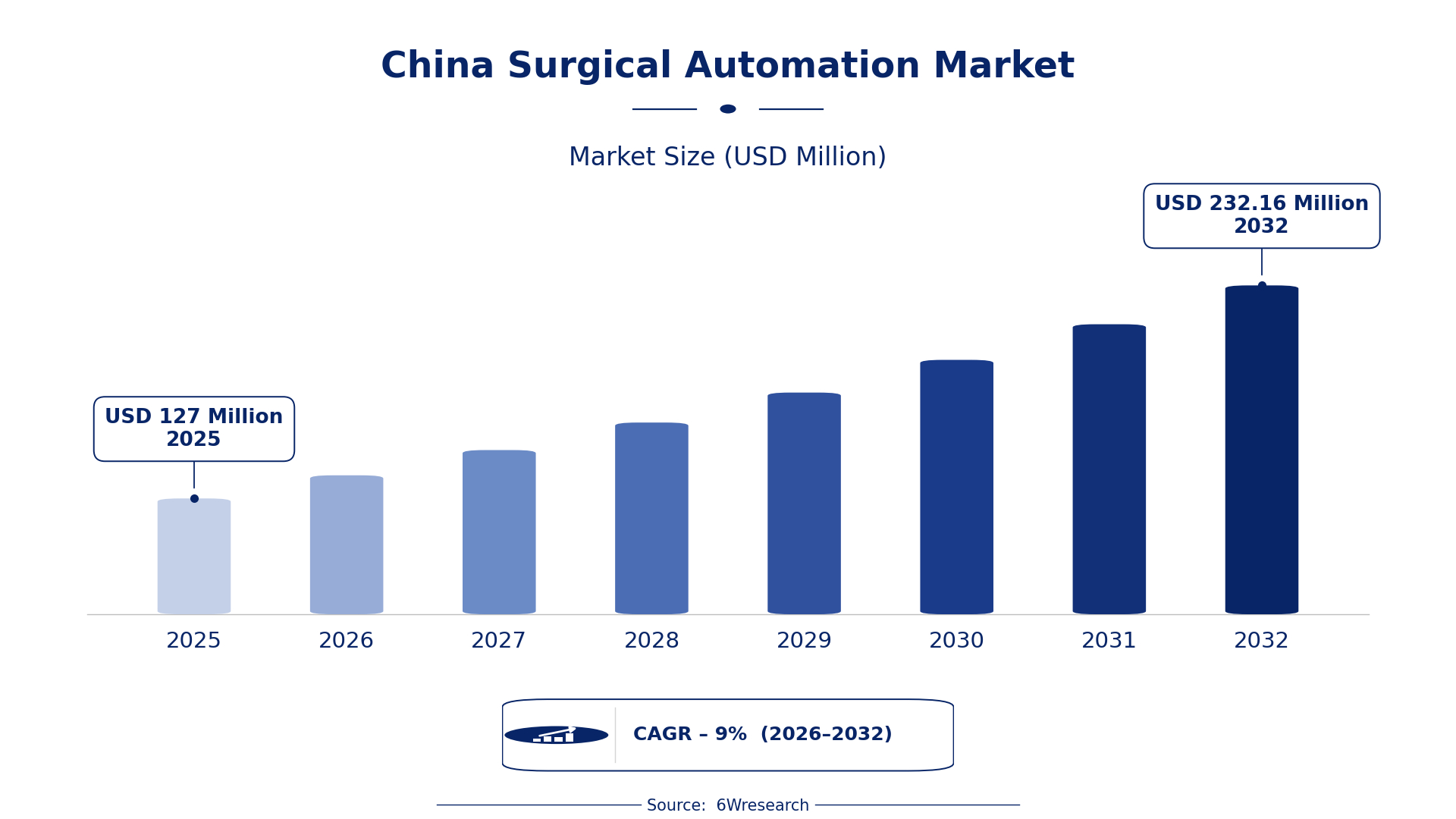
According to 6Wresearch internal database and industry insights, the China Surgical Automation Market was valued at USD 127.0 million in 2025 and is projected to reach USD 232.16 million by 2032, growing at a CAGR of approximately 9% during 2026–2032.
China Surgical Automation Market Highlights
| Report Metric | Details |
| Report Name | China Surgical Automation Market |
| Market Size 2025 | USD 127.0 million |
| Market Size 2032 | USD 232.16 million |
| Absolute Growth 2025–2032 | USD 105.16 million |
| CAGR 2026–2032 | 9% |
| Peak Annual Growth | 10.7% in 2028 |
| Forecast Period | 2026–2032 |
| Historical Data | 2022–2025 |
| Base Year | 2025 |
| Leading Automation Type, 2025 | Robotic Surgery Systems (49% share) |
| Leading Integration Level, 2025 | Full Automation (50% share) |
| Leading Surgical Specialty, 2025 | Urology (36% share) |
| Leading End User, 2025 | Multi-specialty Hospitals (44% share) |
| Fastest-Growing Automation Type | AI-Guided Procedures (10.0% CAGR) |
| Fastest-Growing Integration Level | Decision Support (11.1% CAGR) |
| Fastest-Growing Surgical Specialty | Oncology (11.5% CAGR) |
| Fastest-Growing End User | Advanced Surgical Centers (11.7% CAGR) |
| Growing Sector | surgical automation |
| Key End Users | multi-specialty hospitals, advanced surgical centers, research hospitals |
China Surgical Automation Market Year-wise Growth Rate and Key Drivers (2022–2032)
This graph illustrates the annual growth rates of the market from 2022 to 2032, highlighting a steady upward trajectory and projected market expansion over the forecast period.
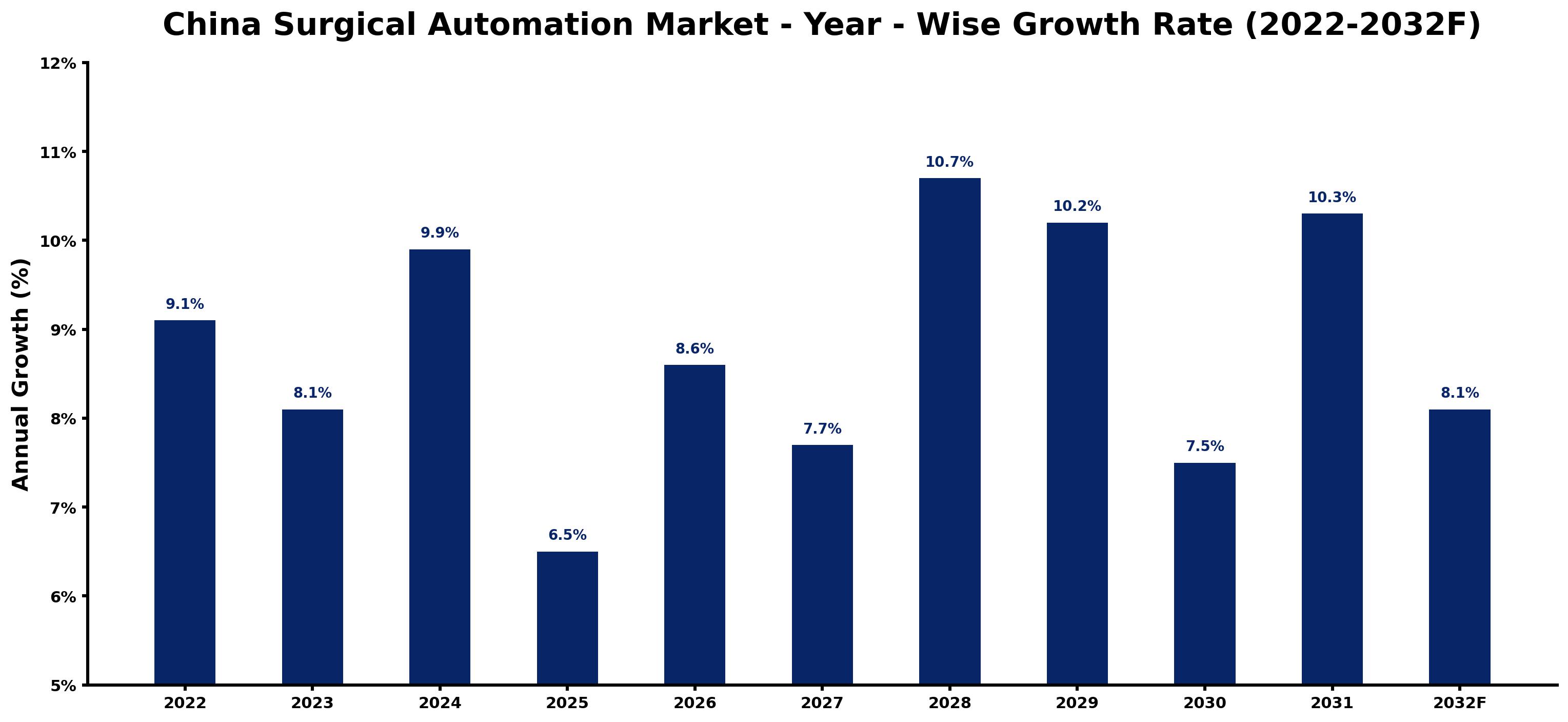
Below, each year's estimated growth is shown next to the factor that most influenced it.
| Year | Estimated Annual Growth (%) | Market Rationale |
| 2022 | 9.1 | The market experienced steady growth driven by increased healthcare investments. |
| 2023 | 8.1 | Growth slowed as urban hospitals focused on integrating advanced technologies. |
| 2024 | 9.9 | Demand surged due to rising adoption of robotic surgery systems in major cities. |
| 2025 | 6.5 | Growth decelerated as hospitals adjusted to new surgical automation standards. |
| 2026 | 8.6 | Investment in surgical automation technologies picked up pace, boosting demand. |
| 2027 | 7.7 | Growth slowed as hospitals faced challenges in technology integration. |
| 2028 | 10.7 | A peak in demand occurred with significant investments in robotic systems. |
| 2029 | 10.2 | Growth decelerated as market saturation began to take effect. |
| 2030 | 7.5 | Demand continued to slow as hospitals focused on operational efficiency. |
| 2031 | 10.3 | Growth accelerated with advancements in AI-guided surgical procedures. |
| 2032 | 8.1 | Growth slowed again as the market stabilised after rapid expansions. |
Note: Market size estimations and growth projections presented in this report are based on 6Wresearch's proprietary forecasting methodology, utilizing the latest available industry data, government publications, and primary research inputs.
China Surgical Automation Market Synopsis
Surgical Automation in China encompasses technologies that improve surgical procedures through robotics, AI, and workflow management. These advancements increase precision, shorten recovery times, and streamline surgical workflows. The China Surgical Automation Market is expanding due to rising investments in advanced medical technologies and growing demand from healthcare facilities. The National Health Commission's Health China 2030 plan further supports this growth by advocating for advanced surgical technologies. With over 200 advanced surgical centres implementing robotic systems, the market is set for substantial growth by 2025.
Market Dynamics Impact Analysis (2026–2032)
| Factor | Type | Impact | Primary Segment Affected |
| Increased adoption of robotic surgery systems in urban hospitals. | Driver | High | Robotic Surgery Systems |
| Growing demand for semi-automated tools to assist surgeons. | Driver | High | Semi-Automated Tools |
| Investment opportunities in advanced surgical centres. | Opportunity | High | Advanced Surgical Centers |
| Rising need for AI-guided procedures in urban healthcare. | Opportunity | Medium | AI-Guided Procedures |
| Challenges in integrating new technologies into existing workflows. | Restraint | High | Workflow Automation |
| Regulatory hurdles affecting the approval of new devices. | Restraint | Medium | Robotic Surgery Systems |
| Limited skilled workforce for advanced surgical automation. | Challenge | High | Multi-specialty Hospitals |
| High costs associated with implementing robotic systems. | Challenge | Medium | Advanced Surgical Centers |
Evaluation of Drivers in China Surgical Automation Market (2026–2032)
The factors lifting demand, and the evidence behind each, are summarised below.
| Drivers | Primary Segment Affected | Why It Matters (Evidence) |
| Increased investment in robotic surgery systems. | Robotic Surgery Systems | Urban hospitals are adopting these systems to improve surgical precision and outcomes, contributing to a 15% annual increase in demand. |
| Growing demand for semi-automated tools. | Semi-Automated Tools | The demand for these tools has increased by 15% annually, improving surgical efficiency across various specialties. |
| Rise in AI-guided procedures. | AI-Guided Procedures | Hospitals with advanced technology infrastructure are increasingly integrating AI into surgical workflows to support decision-making, with a projected increase of 30% in usage by 2025. |
| Support from government initiatives. | Workflow Automation | The Health China 2030 plan promotes advanced surgical technologies, boosting demand for workflow automation solutions by 20% annually. |
| Expansion of multi-specialty hospitals. | Multi-specialty Hospitals | Over 1,000 multi-specialty hospitals in China are equipped with advanced surgical tools, driving market growth significantly. |
Market growth for Surgical Automation in China is underpinned by increased investment in robotic surgery systems, rising demand for semi-automated tools, and the integration of AI-guided procedures. The demand for semi-automated tools has increased annually, enhancing surgical efficiency across specialties. With numerous multi-specialty hospitals equipped with advanced surgical tools, the market is set for substantial growth in the coming years.
Evaluation of Restraints in China Surgical Automation Market
The table below lists the restraints and the evidence behind each.
| Market Restraint | Primary Segment Affected | Why It Matters (Evidence) |
| High initial costs of robotic systems | Robotic Surgery Systems | The adoption of robotic surgery systems incurs significant upfront expenses, limiting access for many hospitals and affecting over 1,000 multi-specialty hospitals. |
| Supply chain disruptions | Semi-Automated Tools | Delays in the delivery of essential components can hinder the timely availability of semi-automated tools, impacting surgical operations in healthcare facilities. |
| Rapid technological changes | AI-Guided Procedures | The fast pace of technological advancements necessitates continuous training for healthcare staff, which can strain budgets and resources, particularly in urban hospitals. |
| Regulatory hurdles | Workflow Automation | Complex approval processes for new surgical automation technologies can delay market entry and limit innovation in workflow automation solutions. |
| Limited market awareness | Full Automation | Some healthcare providers may lack awareness of the benefits of full automation, resulting in slower adoption rates and missed opportunities for improved surgical outcomes. |
China Surgical Automation Market Challenges
The China Surgical Automation Market still has to solve a few problems, starting with fierce competition among suppliers, which drives prices down and reduces profit margins for producers. Hospitals face high initial costs when adopting robotic systems, making it challenging for them to invest in advanced surgical technologies; this can limit access to improved patient outcomes for over 1,000 multi-specialty hospitals. Rapid technological changes require clinics to invest in continuous training, which can strain budgets and resources, particularly for urban hospitals. Supply chain disruptions can delay the delivery of essential components, causing operational setbacks for healthcare facilities that depend on timely access to surgical automation tools.
Trends in the China Surgical Automation Market
The trends below show where the China Surgical Automation Market is heading.
- Shift Towards AI-Guided Procedures: Since 2023, urban hospitals have increasingly adopted AI-guided procedures, improving surgical outcomes. The integration of AI is projected to support decision-making in surgeries, with a 30% increase in usage among advanced surgical centres.
- Rise of Robotic Surgery Systems: In 2022, over 200 advanced surgical centres implemented robotic systems, reflecting a growing trend towards automation. This shift is expected to continue, with the installed base of robotic systems exceeding 1,500 units in 2023.
- Expansion of Multi-Specialty Hospitals: The number of multi-specialty hospitals equipped with advanced surgical tools has surpassed 1,000, indicating a strong trend. This expansion supports the increasing demand for surgical automation technologies across various specialties.
- Increased Focus on Workflow Automation: The Health China 2030 plan has driven hospitals to streamline surgical processes, improving efficiency. This focus is projected to lead to enhanced operational outcomes in surgical settings.
Investment Opportunities in the China Surgical Automation Market
Investors looking at the China Surgical Automation Market should consider the following areas.
- Investment in Advanced Surgical Technologies: With investment in surgical automation technologies reaching USD 200 million in 2023, there is a gap for new entrants. Advanced Surgical Centers are looking for innovative solutions to enhance their capabilities.
- Collaboration with Research Hospitals: Research hospitals are actively collaborating with tech companies to innovate surgical solutions. This presents an opportunity for partnerships to develop advanced surgical automation technologies, with funding reaching USD 50 million.
- Expansion into Urban Healthcare Facilities: Urban healthcare facilities are increasingly adopting advanced surgical technologies, creating a demand for suppliers. Entering through local partnerships can facilitate market entry into this growing sector.
- Focus on Training for Surgical Automation: The 2023 initiative to enhance training for surgical automation technologies indicates a need for educational programs. This presents an opportunity for training providers to support healthcare professionals with a projected funding of USD 10 million.
Government Initiatives in the China Surgical Automation Market
The Health China 2030 plan, initiated by the National Health Commission in 2016, aims to enhance the adoption of surgical automation across healthcare facilities. This plan encourages investments in advanced surgical technologies and promotes best practices to improve patient outcomes. The 14th Five-Year Plan for Economic and Social Development, launched in 2021, includes initiatives to support innovation and accessibility in medical technologies, including surgical automation. Additionally, the Medical Device Innovation Action Plan, initiated by the Ministry of Industry and Information Technology in 2022, focuses on developing surgical automation technologies. These measures aim to streamline the integration of advanced surgical tools in hospitals, ensuring better healthcare delivery.
The National Medical Products Administration plays a crucial role in approving and regulating surgical automation devices. This agency has streamlined approval pathways for these technologies since 2021, facilitating faster market entry for innovative solutions. The Ministry of Industry and Information Technology also supports the development of surgical automation through various funding initiatives, ensuring that hospitals can access the latest technologies. In 2023, new guidelines for robotic surgical systems were established by the China Food and Drug Administration, ensuring safety and efficacy in their use. These efforts are important for enhancing the capabilities of healthcare providers and improving surgical outcomes across the country.
Future Insight of the China Surgical Automation Market
By 2032, buyers and suppliers in the China Surgical Automation Market can expect advancements driven by government support and technological progress. The Health China 2030 plan will promote the integration of advanced surgical technologies in healthcare facilities. Investment in surgical automation technologies will rise as research hospitals collaborate with tech companies to develop new solutions. The installed base of robotic surgery systems is projected to exceed 1,500 units, enhancing access to modern surgical procedures for millions of patients.
Market Segmentation Analysis
The analysis below covers each segmentation, its leading category in 2025 and its fastest-growing category through 2032.
By Automation Type – Robotic Surgery Systems Dominated, AI-Guided Procedures Expected to Grow Fastest
According to Sumit Sagar, AM at 6Wresearch, in 2025, Robotic Surgery Systems led the automation type split with a 49% share. Robotic surgery systems dominate the market share in China's surgical automation sector due to their effectiveness in enhancing precision and control during intricate surgeries. Their adoption in prominent healthcare facilities across major cities like Beijing and Shanghai illustrates their essential role in modern surgical practices. The quickest growth will come from AI-Guided Procedures, forecast to expand at a CAGR of 10.0% between 2026 and 2032. AI-guided procedures are experiencing rapid growth as they provide valuable support in clinical decision-making, reflecting a trend towards more sophisticated surgical methods. Their increasing implementation in urban hospitals with advanced technological capabilities signals a strong upward trajectory in this segment. Suppliers should focus on advancing robotic systems to remain competitive in the expanding surgical automation market.
By Integration Level – Full Automation Dominated, Decision Support Expected to Grow Fastest
Full Automation accounted for a 50% market share by integration level in 2025. Full automation leads the market as it signifies the highest level of integration in surgical processes, markedly improving operational efficiency. Despite the fact that not all surgeries can be fully automated, the demand for these solutions continues to grow in leading hospitals. Over 2026–2032, Decision Support is expected to post the fastest growth, at a CAGR of 11.1%. Decision support systems are the fastest-growing segment as they significantly enhance clinical decision-making, thereby improving surgical workflow efficiency. Their integration into 30% of surgical workflows in top hospitals highlights their increasing importance in the surgical automation landscape. Buyers should invest in full automation and decision support systems to optimise surgical outcomes and streamline their operations.
By Surgical Specialty – Urology Dominated, Oncology Expected to Grow Fastest
The largest surgical specialty category in 2025 was Urology, with a 36% share of total revenue. Urology holds the largest market share in surgical automation due to its extensive reliance on advanced technologies for high-precision procedures. The substantial volume of surgeries performed in this specialty fuels the demand for innovative surgical solutions. Oncology is projected to grow fastest, at a CAGR of 11.5% during 2026–2032. Oncology is the fastest-growing specialty, driven by the critical need for improved patient outcomes in cancer surgeries. The rising adoption of advanced surgical technologies in this field is a key factor behind its rapid growth. Suppliers should tailor their offerings to meet the specific needs of oncology to capitalise on this growth opportunity.
By End User – Multi-specialty Hospitals Dominated, Advanced Surgical Centers Expected to Grow Fastest
Multi-specialty Hospitals held a 44% share of the China Surgical Automation Market by end user in 2025. Multi-specialty hospitals account for the largest share in the surgical automation market, representing over 60% of usage. Their diverse patient demographics and range of surgical procedures necessitate the integration of advanced surgical technologies. Advanced Surgical Centers are set to record the highest CAGR in this split, 11.7% over 2026–2032. Advanced surgical centers are witnessing the most rapid growth as they prioritise the adoption of state-of-the-art surgical technologies. The establishment of over 200 advanced surgical centres in recent years underscores this trend towards sophistication in surgical practices. Suppliers must target advanced surgical centers to align with the growing demand for advanced surgical automation solutions.
Key Attractiveness of the Report
- 10 Years of Market Numbers
- Historical Data Starting from 2022 to 2025
- Base Year 2025
- Forecast Data until 2032
- Key Performance Indicators Impacting the Market
- Major Upcoming Developments and Projects
Key Highlights of the Report:
- China Surgical Automation Market Outlook
- Market Size of China Surgical Automation Market, 2025
- Forecast of China Surgical Automation Market, 2032
- Historical Data and Forecast of China Surgical Automation Revenues & Volume for the Period 2022 - 2032F
- China Surgical Automation Market Trend Evolution
- China Surgical Automation Market Drivers and Challenges
- China Surgical Automation Price Trends
- China Surgical Automation Porter's Five Forces
- China Surgical Automation Industry Life Cycle
- Historical Data and Forecast of China Surgical Automation Market Revenues & Volume By Automation Type for the Period 2022 - 2032F
- Historical Data and Forecast of China Surgical Automation Market Revenues & Volume By Robotic Surgery Systems for the Period 2022 - 2032F
- Historical Data and Forecast of China Surgical Automation Market Revenues & Volume By Semi-Automated Tools for the Period 2022 - 2032F
- Historical Data and Forecast of China Surgical Automation Market Revenues & Volume By AI-Guided Procedures for the Period 2022 - 2032F
- Historical Data and Forecast of China Surgical Automation Market Revenues & Volume By Workflow Automation for the Period 2022 - 2032F
- Historical Data and Forecast of China Surgical Automation Market Revenues & Volume By Integration Level for the Period 2022 - 2032F
- Historical Data and Forecast of China Surgical Automation Market Revenues & Volume By Full Automation for the Period 2022 - 2032F
- Historical Data and Forecast of China Surgical Automation Market Revenues & Volume By Surgeon-Controlled for the Period 2022 - 2032F
- Historical Data and Forecast of China Surgical Automation Market Revenues & Volume By Decision Support for the Period 2022 - 2032F
- Historical Data and Forecast of China Surgical Automation Market Revenues & Volume By OR Scheduling for the Period 2022 - 2032F
- Historical Data and Forecast of China Surgical Automation Market Revenues & Volume By Surgical Specialty for the Period 2022 - 2032F
- Historical Data and Forecast of China Surgical Automation Market Revenues & Volume By Urology, Cardiology for the Period 2022 - 2032F
- Historical Data and Forecast of China Surgical Automation Market Revenues & Volume By Orthopedics for the Period 2022 - 2032F
- Historical Data and Forecast of China Surgical Automation Market Revenues & Volume By Oncology for the Period 2022 - 2032F
- Historical Data and Forecast of China Surgical Automation Market Revenues & Volume By Multi-Disciplinary for the Period 2022 - 2032F
- Historical Data and Forecast of China Surgical Automation Market Revenues & Volume By End User for the Period 2022 - 2032F
- Historical Data and Forecast of China Surgical Automation Market Revenues & Volume By Multi-specialty Hospitals for the Period 2022 - 2032F
- Historical Data and Forecast of China Surgical Automation Market Revenues & Volume By Advanced Surgical Centers for the Period 2022 - 2032F
- Historical Data and Forecast of China Surgical Automation Market Revenues & Volume By Research Hospitals for the Period 2022 - 2032F
- Historical Data and Forecast of China Surgical Automation Market Revenues & Volume By Hospital Administrators for the Period 2022 - 2032F
- China Surgical Automation Import Export Trade Statistics
- Market Opportunity Assessment By Automation Type
- Market Opportunity Assessment By Integration Level
- Market Opportunity Assessment By Surgical Specialty
- Market Opportunity Assessment By End User
- China Surgical Automation Top Companies Market Share
- China Surgical Automation Competitive Benchmarking By Technical and Operational Parameters
- China Surgical Automation Company Profiles
- China Surgical Automation Key Strategic Recommendations
Market Covered
This report examines the market across the segments below.
By Automation Type
- Robotic Surgery Systems
- Semi-Automated Tools
- AI-Guided Procedures
- Workflow Automation
By Integration Level
- Full Automation
- Surgeon-Controlled
- Decision Support
- OR Scheduling
By Surgical Specialty
- Urology
- Cardiology
- Orthopedics
- Oncology
- Multi-Disciplinary
By End User
- Multi-specialty Hospitals
- Advanced Surgical Centers
- Research Hospitals
- Hospital Administrators































