India Suspension System Market Size & Growth Rate
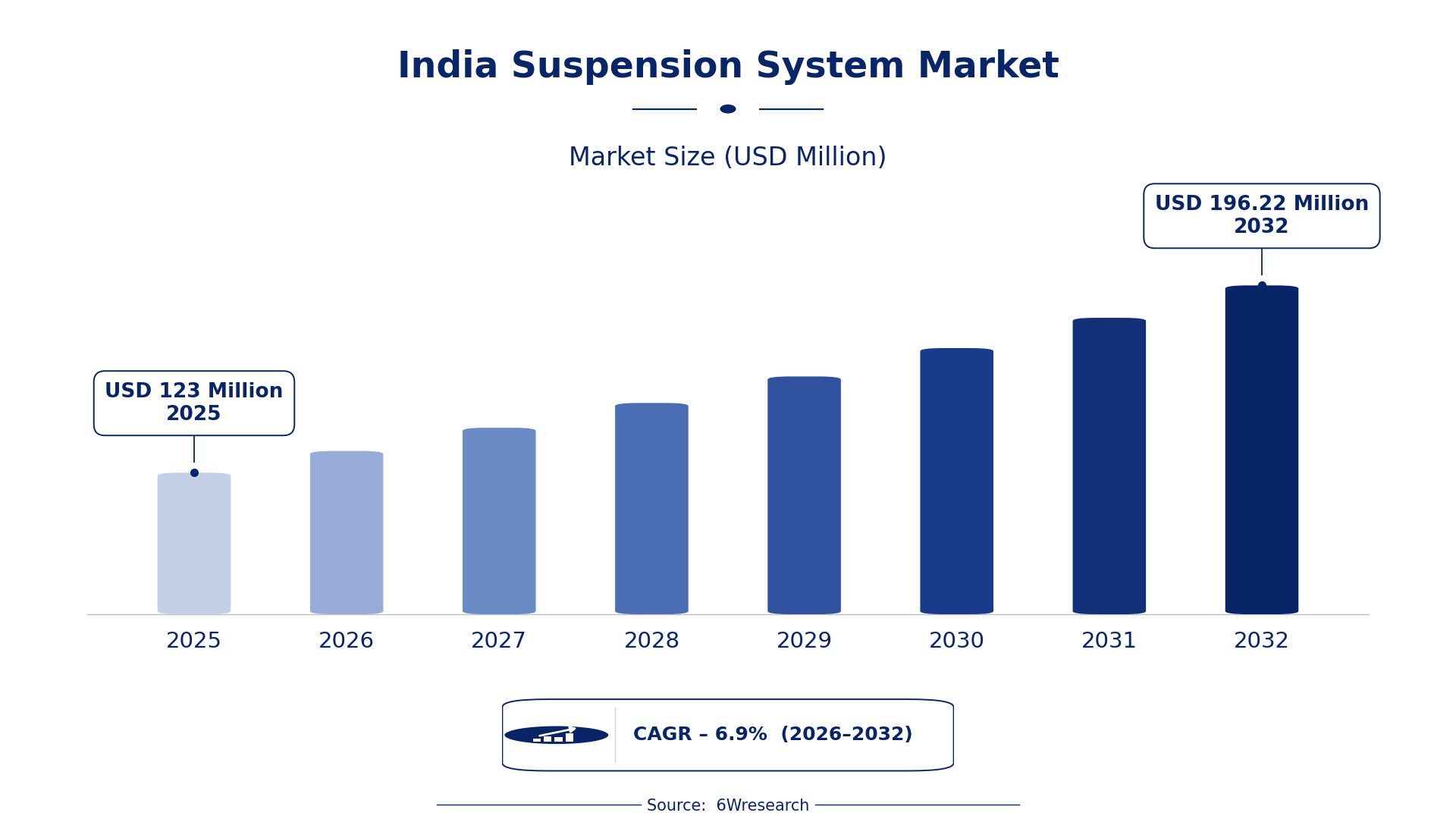
According to 6Wresearch internal database and industry insights, the India Suspension System Market was valued at USD 123.0 million in 2025 and is projected to reach USD 196.22 million by 2032, growing at a CAGR of approximately 6.9% during 2026–2032.
India Suspension System Market Highlights
| Report Metric | Details |
| Report Name | India Suspension System Market |
| Market Size 2025 | USD 123.0 million |
| Market Size 2032 | USD 196.22 million |
| Absolute Growth 2025–2032 | USD 73.22 million |
| CAGR 2026–2032 | 6.9% |
| Peak Annual Growth | 9.3% in 2027 |
| Forecast Period | 2026–2032 |
| Historical Data | 2022–2025 |
| Base Year | 2025 |
| Leading System Type, 2025 | Passive Suspension (45% share) |
| Leading Technology Used, 2025 | Conventional Shock Absorbers (52% share) |
| Leading Vehicle Segment, 2025 | Compact & Sedan Cars (53% share) |
| Leading End User, 2025 | OEMs (49% share) |
| Fastest-Growing System Type | Active Suspension (8.9% CAGR) |
| Fastest-Growing Technology Used | Electronically Controlled (9.5% CAGR) |
| Fastest-Growing Vehicle Segment | EVs & Hybrids (8.3% CAGR) |
| Fastest-Growing End User | Fleet Manufacturers (8.7% CAGR) |
| Growing Sector | automotive industry |
| Key End Users | OEMs, Fleet Manufacturers, Suspension Tech Providers |
India Suspension System Market Year-wise Growth Rate and Key Drivers (2022–2032)
This graph illustrates the annual growth rates of the market from 2022 to 2032, highlighting a steady upward trajectory and projected market expansion over the forecast period.
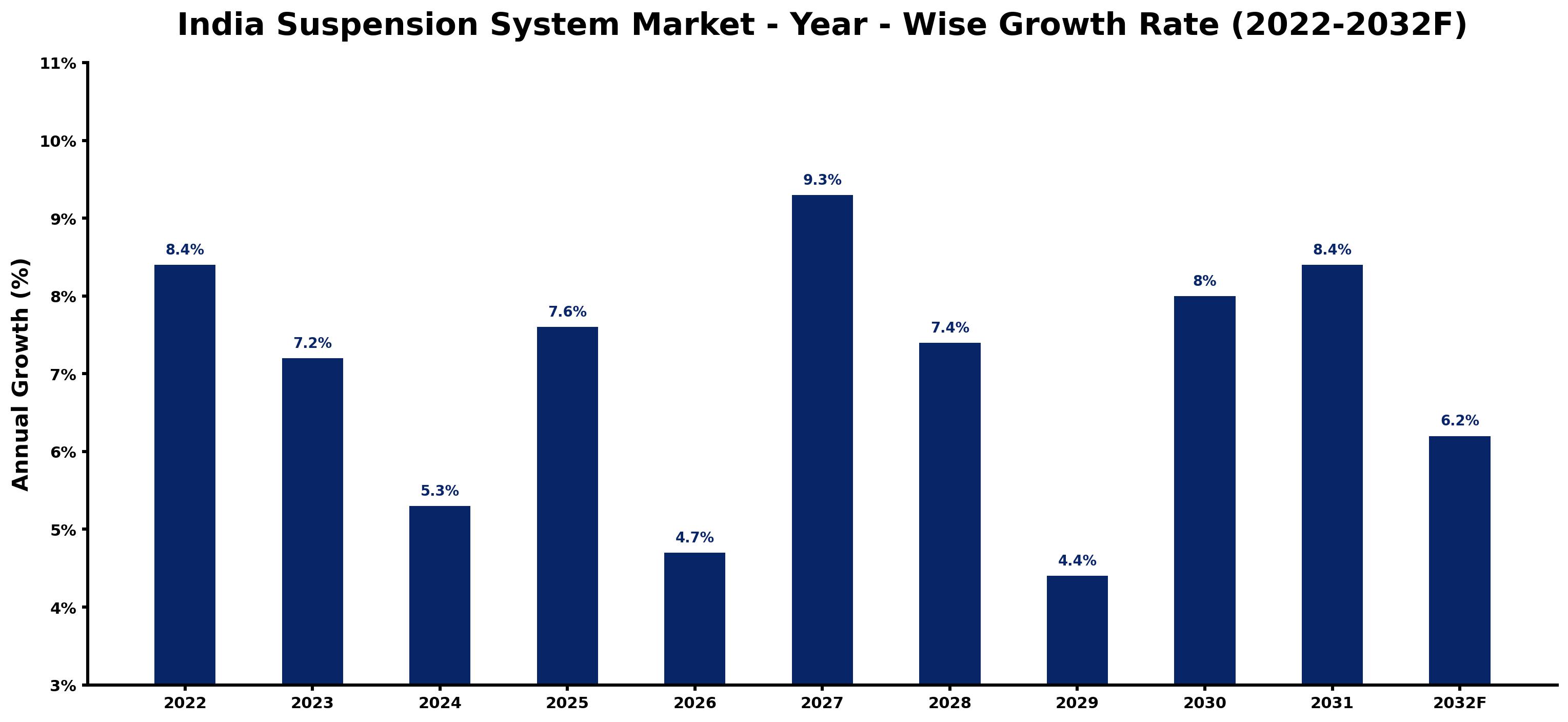
The following table presents the estimated annual growth rate for each year together with the principal factor influencing market performance.
| Year | Estimated Annual Growth (%) | Market Rationale |
| 2022 | 8.4 | The market experienced strong activity due to high vehicle production levels. |
| 2023 | 7.2 | Demand slowed slightly as manufacturers adjusted to market conditions and production capacities. |
| 2024 | 5.3 | Growth decelerated further as the market faced challenges in supply chain management. |
| 2025 | 7.6 | A rebound occurred as manufacturers increased production to meet rising consumer demand. |
| 2026 | 4.7 | Growth slowed again due to ongoing supply chain disruptions affecting component availability. |
| 2027 | 9.3 | The market peaked with heightened demand driven by new vehicle launches and investments. |
| 2028 | 7.4 | Growth moderated as manufacturers began to balance supply with demand fluctuations. |
| 2029 | 4.4 | A further slowdown was noted as the National Electric Mobility Mission Plan stabilised post-peak demand. |
| 2030 | 8.0 | Demand increased again as investments in electric vehicles began to bear fruit. |
| 2031 | 8.4 | Growth continued as OEMs expanded their offerings in response to consumer preferences. |
| 2032 | 6.2 | The market experienced a slowdown as it stabilised after several years of rapid growth. |
Note: Market size estimations and growth projections presented in this report are based on 6Wresearch's proprietary forecasting methodology, utilizing the latest available industry data, government publications, and primary research inputs.
India Suspension System Market Synopsis
The India Suspension System Market encompasses technologies used to absorb shocks in vehicles, ensuring safety and comfort. It includes components like shock absorbers and springs, essential for vehicle handling. The market is growing due to the automotive industry's projected value of $300 billion by 2026, driven by domestic users and OEMs. Increased vehicle production, particularly in states like Maharashtra and Tamil Nadu, fuels demand for efficient suspension systems. The rise of the electric vehicle market, expected to grow at a CAGR of 44% from 2020 to 2027, further enhances the need for advanced suspension technologies.
Market Dynamics Impact Analysis (2026–2032)
| Factor | Type | Impact | Primary Segment Affected |
| Increased vehicle production in India is driving demand for suspension systems. | Driver | High | OEMs |
| Growing demand for electric vehicles necessitates advanced suspension technologies. | Driver | High | EVs & Hybrids |
| Investment in automotive manufacturing infrastructure presents opportunities for suppliers. | Opportunity | High | Heavy Commercial Vehicles |
| The rise of the EV market offers a chance to innovate suspension systems for weight management. | Opportunity | High | Luxury & Premium Vehicles |
| Supply chain disruptions are impacting the availability of suspension components. | Restraint | High | Conventional Shock Absorbers |
| Quality standards set by the Bureau of Indian Standards can delay product approvals. | Restraint | Medium | Active Suspension |
| Rising costs of raw materials are affecting profit margins for manufacturers. | Challenge | High | Semi-Active Suspension |
| Technological advancements require continuous investment, posing a challenge for smaller firms. | Challenge | Medium | Air Suspension |
Evaluation of Drivers in India Suspension System Market (2026–2032)
The main growth drivers and the segments they affect most are set out below.
| Drivers | Primary Segment Affected | Why It Matters (Evidence) |
| Increased vehicle production supports demand for suspension systems. | OEMs | India produced over 4 million passenger vehicles in 2022, necessitating efficient suspension systems. |
| The growth of the electric vehicle market drives demand for advanced suspension technologies. | EVs & Hybrids | The EV market is projected to grow at a CAGR of 44% from 2020 to 2027, increasing suspension needs. |
| Investment in automotive infrastructure boosts manufacturing capabilities. | Heavy Commercial Vehicles | The Indian government allocated $1.4 billion for electric vehicle infrastructure development, boosting component demand. |
| The National Automotive Testing and R&D Infrastructure Project improves vehicle testing standards. | Luxury & Premium Vehicles | This initiative aims to improve safety and performance, influencing suspension technology development. |
| The Production-Linked Incentive (PLI) scheme encourages local production of automotive components. | Conventional Shock Absorbers | Launched in 2021, it incentivises manufacturers to enhance their capabilities and product offerings. |
The growth of the Suspension System market in India is supported by rising vehicle production, increasing electric vehicle adoption, and investments in automotive infrastructure. The automotive sector is projected to hit $300 billion by 2026, which will drive demand for suspension systems. In 2022, over 4 million passenger vehicles were produced, creating a need for efficient solutions. The rapid growth of the electric vehicle market will further heighten the demand for advanced technologies.
Evaluation of Restraints in India Suspension System Market
The key brakes on demand, and where they bite hardest, are shown below.
| Market Restraint | Primary Segment Affected | Why It Matters (Evidence) |
| Supply chain disruptions are limiting the availability of key components. | Conventional Shock Absorbers | Manufacturers are facing delays in sourcing materials, impacting production schedules. |
| Quality standards set by the Bureau of Indian Standards can extend approval timelines. | Active Suspension | Producers must ensure compliance with stringent regulations, delaying product launches. |
| Rising costs of raw materials are squeezing profit margins for manufacturers. | Semi-Active Suspension | Increased prices for essential materials are leading to higher production costs. |
| Technological advancements require continuous investment, challenging smaller firms. | Air Suspension | The need for ongoing innovation strains financial resources of less established manufacturers. |
| Market volatility affects long-term planning and investment decisions. | Active Suspension | Fluctuating demand complicates forecasting production needs. |
India Suspension System Market Challenges
The India Suspension System Market encounters regulatory challenges that prolong product approvals, potentially costing producers up to 20% in lost revenue due to extended timelines. Intense competition from low-cost imports pressures local manufacturers to lower prices, which can reduce profit margins by as much as 15%. Supply chain disruptions, especially in raw material sourcing, raise costs for distributors, leading to price increases of 10% for buyers. A shortage of skilled professionals in advanced suspension technology hampers innovation, making it challenging for producers to meet the evolving needs of the automotive sector.
Trends in the India Suspension System Market
The trends below show where the India Suspension System Market is heading.
- Shift Towards Electric Vehicle Suspension Systems: The Indian EV market is set for rapid growth, influencing the design of suspension systems. This shift is encouraging manufacturers to create advanced technologies that meet the specific demands of electric vehicles.
- Transition from Conventional to Advanced Suspension Technologies: The adoption of Electronically Controlled suspension systems is on the rise, with a projected CAGR of 9.5% from 2026 to 2032. This trend highlights the industry's commitment to improving vehicle performance and comfort.
- Growth of Fleet Manufacturers in the Suspension Market: Fleet manufacturers are increasingly seeking reliable suspension systems, with a projected CAGR of 8.7% from 2026 to 2032. This trend underscores the demand for durable and efficient components in commercial vehicles.
- Emergence of Smart Vehicle Platforms: The rise of smart vehicle platforms is shaping suspension system designs, with a growing focus on integration with advanced driver-assistance systems. This trend is influencing the future of automotive technology in India.
Investment Opportunities in the India Suspension System Market
The following opportunities in the India Suspension System Market pair current demand with a clear way in.
- Investment in Automotive Manufacturing Hubs: Maharashtra and Tamil Nadu are key states for automotive manufacturing, presenting opportunities for suppliers. With India's automotive industry projected to reach $300 billion by 2026, there is strong demand for suspension systems.
- Emerging Demand for Advanced Suspension in EVs: The growth of the electric vehicle market creates a need for innovative suspension solutions. Suppliers can target OEMs focusing on EV production, supported by the government's $1.4 billion investment in infrastructure.
- Partnerships with Local Manufacturers: Forming joint ventures with local manufacturers can facilitate entry into the Indian market. The Production-Linked Incentive (PLI) scheme supports local production, making it an attractive opportunity for new entrants.
- Development of Advanced Testing Facilities: The National Automotive Testing and R&D Infrastructure Project aims to enhance vehicle testing standards. This initiative offers opportunities for investment in testing facilities that support suspension system development.
Government Initiatives in the India Suspension System Market
The National Electric Mobility Mission Plan 2020 seeks to promote electric vehicles, impacting the development of suspension systems in EVs, with a budget of $1.4 billion. This initiative encourages manufacturers to adapt their suspension technologies to meet the needs of the expanding EV market. The Production-Linked Incentive (PLI) scheme for the automotive sector, introduced by the Ministry of Heavy Industries in 2021, incentivises local production and strengthens manufacturing capabilities, directly influencing the suspension system market.
The Bureau of Indian Standards (BIS) establishes quality benchmarks for automotive components, affecting producers and buyers by mandating compliance with these standards for market entry. The Automotive Research Association of India (ARAI) plays a crucial role in testing and certifying automotive components, including suspension systems. ARAI's initiatives ensure adherence to safety and performance standards, facilitating the introduction of new technologies into the market.
Future Insight of the India Suspension System Market
The India Suspension System Market will transform by 2032, driven by advancements in vehicle testing standards and a rapid rise in electric vehicle production. The National Automotive Testing and R&D Infrastructure Project will elevate testing capabilities, ensuring improved product quality and safety. The Production-Linked Incentive scheme will encourage local manufacturing, benefiting suppliers and promoting innovation. With the EV market projected to grow at a CAGR of 44% from 2020 to 2027, the demand for sophisticated suspension systems will increase, compelling producers to adapt their technologies.
Market Segmentation Analysis
Each segment group is reviewed below, with the leader by share and the fastest grower by CAGR.
By System Type – Passive Suspension Dominated, Active Suspension Expected to Grow Fastest
According to Sumit Sagar, AM at 6Wresearch, Passive Suspension accounted for a 45% market share by system type in 2025. Passive suspension systems hold the largest market share as they are commonly used in most vehicles, providing essential shock absorption. This technology is crucial for the substantial production of passenger vehicles in India, which exceeded 4 million in 2022. The quickest growth will come from Active Suspension, forecast to expand at a CAGR of 8.9% between 2026 and 2032. Active suspension systems are experiencing rapid growth due to their incorporation in high-end vehicles, which seek improved ride quality and handling. With the automotive industry projected to reach $300 billion by 2026, the demand for these advanced systems will continue to rise. Suppliers should focus on developing active suspension systems to capture the expanding premium vehicle market.
By Technology Used – Conventional Shock Absorbers Dominated, Electronically Controlled Expected to Grow Fastest
With a 52% revenue share in 2025, Conventional Shock Absorbers was the largest technology used category. Conventional shock absorbers dominate the market share because they are widely utilised across various vehicle types for basic suspension needs. Their reliability and cost-effectiveness make them a preferred choice among many manufacturers in India. Electronically Controlled is set to record the highest CAGR in this split, 9.5% over 2026–2032. Electronically controlled suspension systems are gaining traction, particularly in premium segments, due to their enhanced performance features. As the electric vehicle market grows, the demand for this advanced technology is set to increase significantly. Manufacturers must prioritise advancements in electronically controlled systems to remain competitive in the evolving automotive sector.
By Vehicle Segment – Compact & Sedan Cars Dominated, EVs & Hybrids Expected to Grow Fastest
Compact & Sedan Cars took a 53% share of vehicle segment in 2025, more than any other category. Compact and sedan cars represent the largest segment for suspension systems, as they are the most commonly produced vehicles in India. The focus on comfort and stability in these vehicles drives the demand for effective suspension solutions. Over 2026–2032, EVs & Hybrids are expected to post the fastest growth, at a CAGR of 8.3%. The EVs and hybrids segment is rapidly expanding, necessitating efficient suspension systems to manage the unique weight distribution of electric vehicles. With the government investing in electric vehicle infrastructure, this segment's growth is set to accelerate. Suppliers should adapt their product lines to meet the specific needs of the growing EV and hybrid market.
By End User – OEMs Dominated, Fleet Manufacturers Expected to Grow Fastest
The largest end user category in 2025 was OEMs, with a 49% share of total revenue. OEMs represent the largest market share for suspension systems, as they integrate these components into their vehicle manufacturing processes. Their pivotal role in the automotive supply chain ensures a consistent demand for reliable suspension technologies. Fleet Manufacturers are projected to grow fastest, at a CAGR of 8.7% during 2026–2032. Fleet manufacturers are increasingly requiring dependable suspension systems to maintain the performance of their commercial vehicles. As the demand for fleet services rises, this segment is expected to experience rapid growth. Suppliers should strengthen collaborations with fleet manufacturers to secure long-term contracts and enhance their market share.
Key Attractiveness of the Report
- 10 Years of Market Numbers
- Historical Data Starting from 2022 to 2025
- Base Year 2025
- Forecast Data until 2032
- Key Performance Indicators Impacting the Market
- Major Upcoming Developments and Projects
Key Highlights of the Report:
- India Suspension System Market Outlook
- Market Size of India Suspension System Market, 2025
- Forecast of India Suspension System Market, 2032
- Historical Data and Forecast of India Suspension System Revenues & Volume for the Period 2022 - 2032F
- India Suspension System Market Trend Evolution
- India Suspension System Market Drivers and Challenges
- India Suspension System Price Trends
- India Suspension System Porter's Five Forces
- India Suspension System Industry Life Cycle
- Historical Data and Forecast of India Suspension System Market Revenues & Volume By System Type for the Period 2022 - 2032F
- Historical Data and Forecast of India Suspension System Market Revenues & Volume By Passive Suspension for the Period 2022 - 2032F
- Historical Data and Forecast of India Suspension System Market Revenues & Volume By Active Suspension for the Period 2022 - 2032F
- Historical Data and Forecast of India Suspension System Market Revenues & Volume By Semi-Active Suspension for the Period 2022 - 2032F
- Historical Data and Forecast of India Suspension System Market Revenues & Volume By Air Suspension for the Period 2022 - 2032F
- Historical Data and Forecast of India Suspension System Market Revenues & Volume By Technology Used for the Period 2022 - 2032F
- Historical Data and Forecast of India Suspension System Market Revenues & Volume By Conventional Shock Absorbers for the Period 2022 - 2032F
- Historical Data and Forecast of India Suspension System Market Revenues & Volume By Adaptive Control for the Period 2022 - 2032F
- Historical Data and Forecast of India Suspension System Market Revenues & Volume By Electronically Controlled for the Period 2022 - 2032F
- Historical Data and Forecast of India Suspension System Market Revenues & Volume By Pneumatic Systems for the Period 2022 - 2032F
- Historical Data and Forecast of India Suspension System Market Revenues & Volume By Vehicle Segment for the Period 2022 - 2032F
- Historical Data and Forecast of India Suspension System Market Revenues & Volume By Compact & Sedan Cars for the Period 2022 - 2032F
- Historical Data and Forecast of India Suspension System Market Revenues & Volume By Luxury & Premium Vehicles for the Period 2022 - 2032F
- Historical Data and Forecast of India Suspension System Market Revenues & Volume By EVs & Hybrids for the Period 2022 - 2032F
- Historical Data and Forecast of India Suspension System Market Revenues & Volume By Heavy Commercial Vehicles for the Period 2022 - 2032F
- Historical Data and Forecast of India Suspension System Market Revenues & Volume By End User for the Period 2022 - 2032F
- Historical Data and Forecast of India Suspension System Market Revenues & Volume By OEMs for the Period 2022 - 2032F
- Historical Data and Forecast of India Suspension System Market Revenues & Volume By Suspension Tech Providers for the Period 2022 - 2032F
- Historical Data and Forecast of India Suspension System Market Revenues & Volume By Smart Vehicle Platforms for the Period 2022 - 2032F
- Historical Data and Forecast of India Suspension System Market Revenues & Volume By Fleet Manufacturers for the Period 2022 - 2032F
- India Suspension System Import Export Trade Statistics
- Market Opportunity Assessment By System Type
- Market Opportunity Assessment By Technology Used
- Market Opportunity Assessment By Vehicle Segment
- Market Opportunity Assessment By End User
- India Suspension System Top Companies Market Share
- India Suspension System Competitive Benchmarking By Technical and Operational Parameters
- India Suspension System Company Profiles
- India Suspension System Key Strategic Recommendations
Market Covered
This report examines the market across the segments below.
By System Type
- Passive Suspension
- Active Suspension
- Semi-Active Suspension
- Air Suspension
By Technology Used
- Conventional Shock Absorbers
- Adaptive Control
- Electronically Controlled
- Pneumatic Systems
By Vehicle Segment
- Compact & Sedan Cars
- Luxury & Premium Vehicles
- EVs & Hybrids
- Heavy Commercial Vehicles
By End User
- OEMs
- Suspension Tech Providers
- Smart Vehicle Platforms
- Fleet Manufacturers































